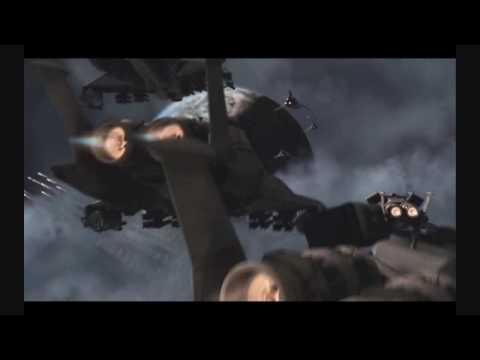
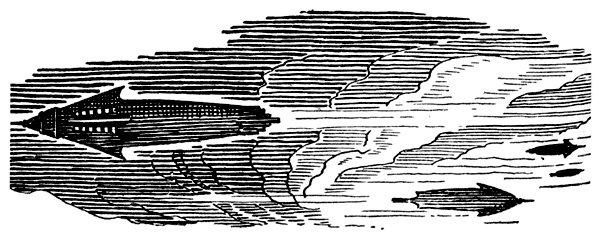
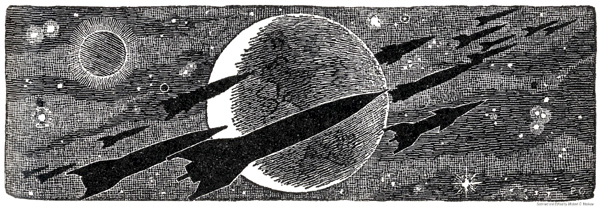
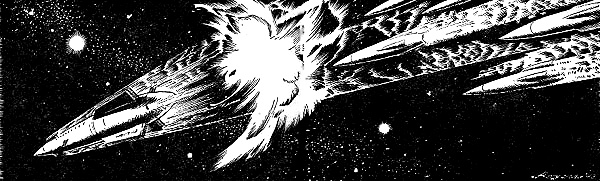
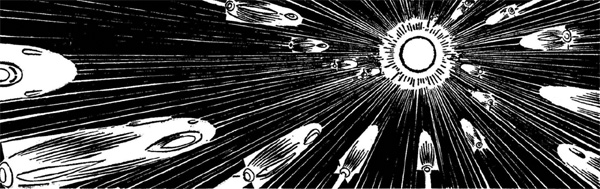
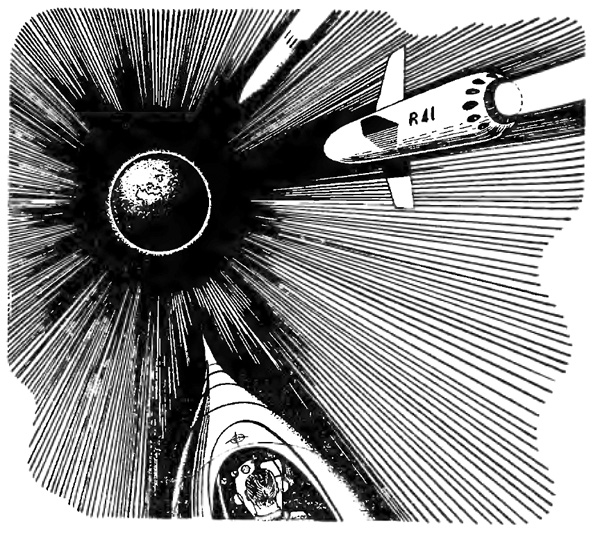
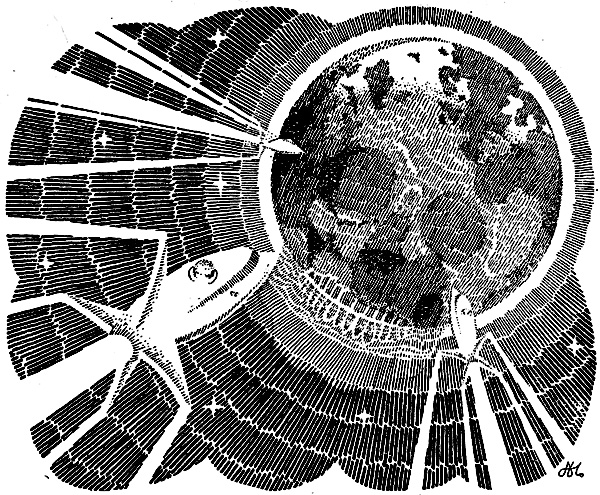
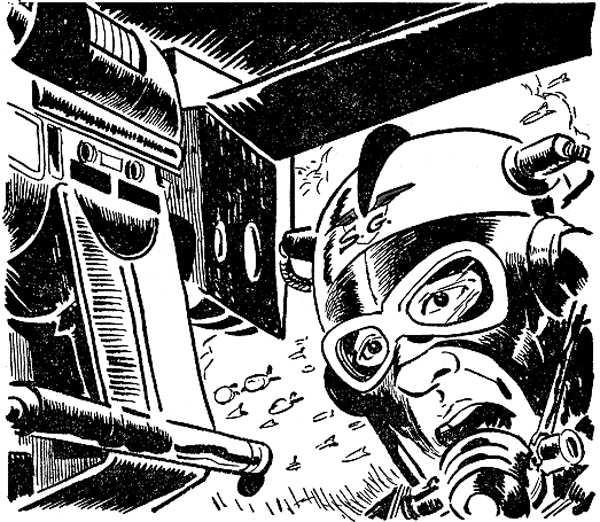
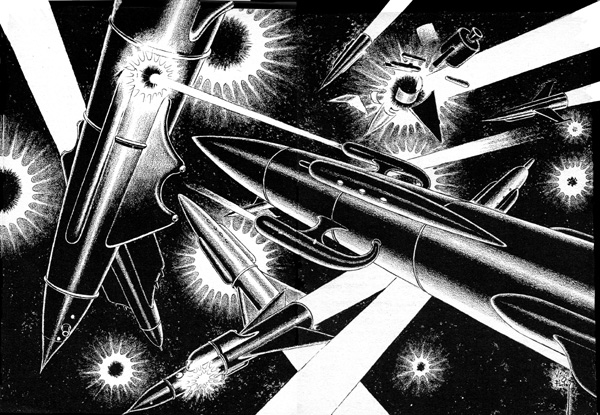
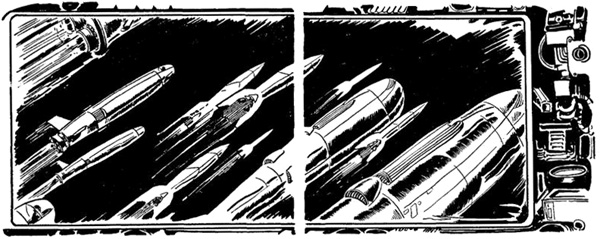
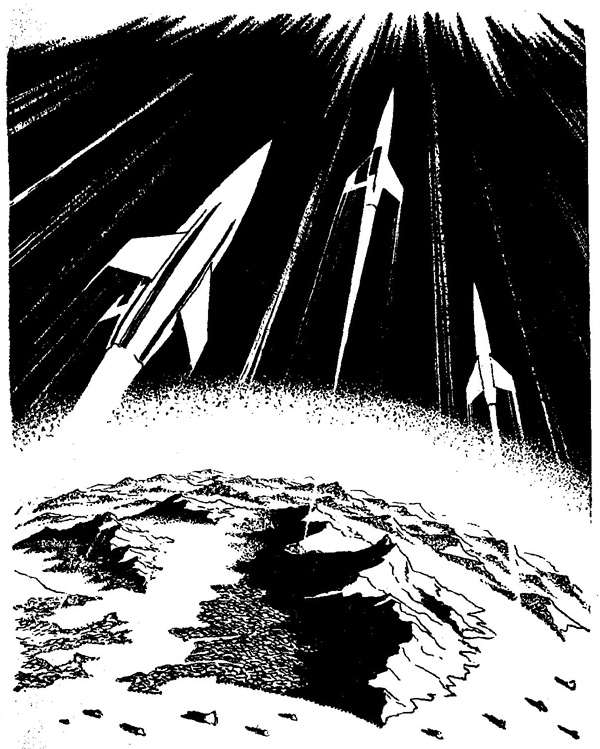
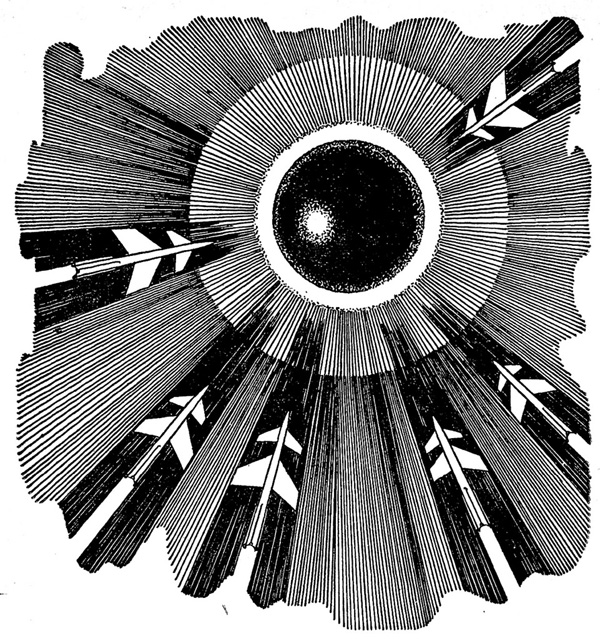
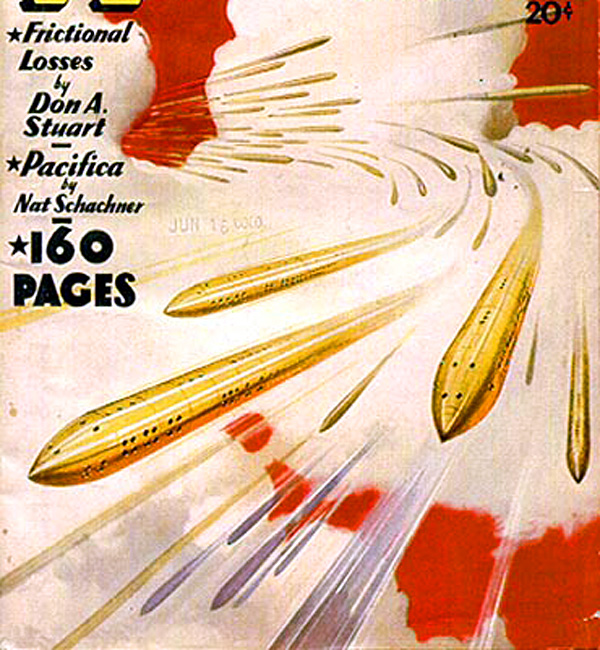
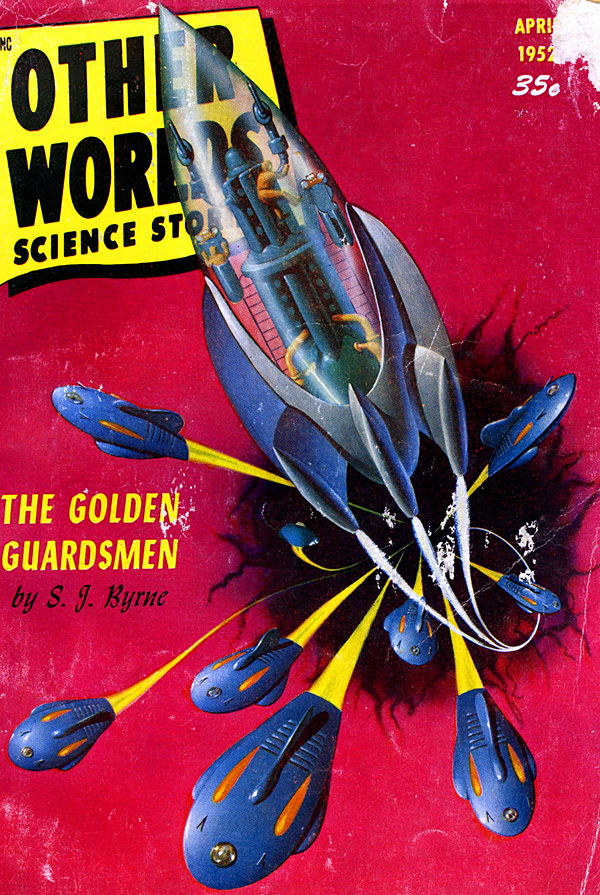
Artwork by Hubert Rogers for Gray Lensman (1939). Shown is the seven-hundred foot battle plotting tank on board the Directrix
Introduction
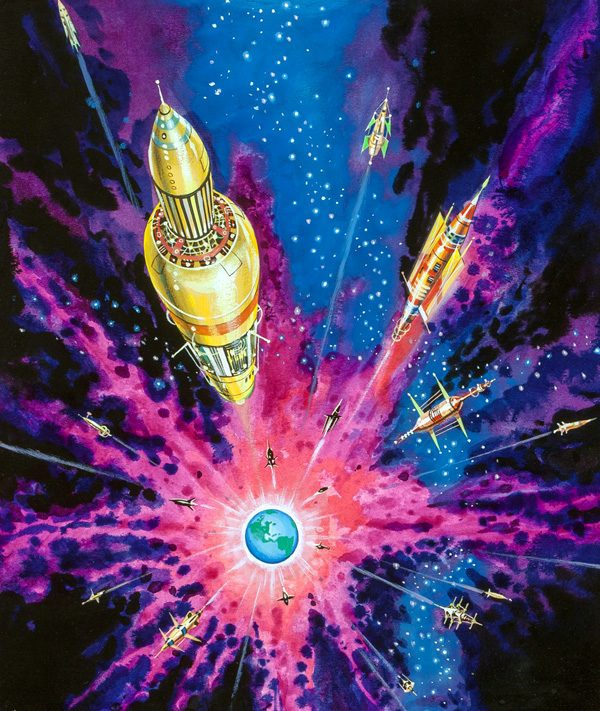
Artwork by Mel Hunter (1959)
As you probably already know, "strategy" refers to the science of successfully fighting an entire campaign or war, while "tactics" refers to the science of successfully fighting a single battle. Predictably some military strategy and tactics are general enough to apply to interplanetary combat, while others do not work at all in the space environment. Sun Tzu's The Art of War, for instance, is general enough to work splendidly. Others will fall afoul of unique features of spatial combat, like the lack of stealth, and the mathematical predictabilty of launch windows and arrival times.
There is a good list of unscientific hackneyed tropes with respect to starship combat in the TV Tropes listing Standard Starship Scuffle.
Things become even more complicated if you are an admiral or sky marshal who is responsible for all the ships in a battle, as opposed to a captain who just commands their own ship. Admirals generally control the battle from a room equipped with a Big Board, called an Operations Room or a Combat Information Center (which is NOT the bridge). If you are a lucky admiral the battle occurs near a well defended planetary base or orbital fortress. This allows you to dictate tactics to your task force without having to worry about being personally attacked by rude enemy ships. But if the battle happens out of communication range of a cozy fortress, you will have to risk your pink hide in the battle. You will be in a "flagship", a well defended and strongly armed warship carrying an operations room. This is for C2, C3, C2I, or one of the other C4ISTAR military functions. The flagship captain will take care of running the flagship, while the admiral concentrates on running the battle.
Naturally the battle will take a catastrophic turn for the worse if the admiral is killed and/or the flagship is destroyed. You should locate the operations room deep in the armored core of the spacecraft. That absurd exposed bridge on the top of the Starship Enterprise would have been shot off a long time ago. The same goes for the bridge on Space Battleship Yamato.
The phrase OODA loop refers to the decision cycle of observe, orient, decide, and act, developed by military strategist and United States Air Force Colonel John Boyd. Boyd applied the concept to the combat operations process, often at the strategic level in military operations. It is now also often applied to understand commercial operations and learning processes. The approach favors agility over raw power in dealing with human opponents in any endeavor.
Overview
The OODA loop has become an important concept in litigation, business, law enforcement, and military strategy. According to Boyd, decision-making occurs in a recurring cycle of observe-orient-decide-act. An entity (whether an individual or an organization) that can process this cycle quickly, observing and reacting to unfolding events more rapidly than an opponent can thereby "get inside" the opponent's decision cycle and gain the advantage. Frans Osinga has argued that Boyd's own views on the OODA loop are much deeper, richer, and more comprehensive than the common interpretation of the "rapid OODA loop" idea.
Boyd developed the concept to explain how to direct one's energies to defeat an adversary and survive. Boyd emphasized that "the loop" is actually a set of interacting loops that are to be kept in continuous operation during combat. He also indicated that the phase of the battle has an important bearing on the ideal allocation of one's energies.
Boyd's diagram shows that all decisions are based on observations of the evolving situation tempered with implicit filtering of the problem being addressed. The observations are the raw information on which decisions and actions are based. The observed information must be processed to orient it for decision making. In notes from his talk "Organic Design for Command and Control", Boyd said,
The second O, orientation—as the repository of our genetic heritage, cultural tradition, and previous experiences—is the most important part of the O-O-D-A loop since it shapes the way we observe, the way we decide, the way we act.
As stated by Boyd and shown in the "Orient" box, there is much filtering of the information through our culture, genetics, ability to analyze and synthesize, and previous experience. Since the OODA Loop was designed to describe a single decision maker, the situation is usually much more complex than shown, as most business and technical decisions have a team of people observing and orienting, each bringing their own cultural traditions, genetics, experience and other information. It is here that decisions often get stuck, which does not lead to winning, because:
In order to win, we should operate at a faster tempo or rhythm than our adversaries—or, better yet, get inside [the] adversary's Observation-Orientation-Decision-Action time cycle or loop ... Such activity will make us appear ambiguous (unpredictable) thereby generate confusion and disorder among our adversaries—since our adversaries will be unable to generate mental images or pictures that agree with the menacing, as well as faster transient rhythm or patterns, they are competing against.
The OODA loop, which focuses on strategic military requirements, was adapted for business and public sector operational continuity planning. Compare it to the Plan Do Check Act (PDCA) cycle or Shewhart cycle.
As one of Boyd's colleagues, Harry Hillaker, put it in "John Boyd, USAF Retired, Father of the F16":
The key is to obscure your intentions and make them unpredictable to your opponent while you simultaneously clarify his intentions. That is, operate at a faster tempo to generate rapidly changing conditions that inhibit your opponent from adapting or reacting to those changes and that suppress or destroy his awareness. Thus, a hodgepodge of confusion and disorder occur to cause him to over- or under-react to conditions or activities that appear to be uncertain, ambiguous, or incomprehensible.
The OODA Loop also serves to explain the nature of surprise and shaping operations in a way that unifies Gestalt psychology, cognitive science and game theory in a comprehensive theory of strategy. Utility theory (the basis of game theory) describes how decisions are made based on the perceived value of taking an action. The OODA Loop shows that prior to making a decision (the Decide phase), the person will first have to get information (Observe) and determine what it means to him and what he can do about it (Orient). In this way, the utility sought at the Decide phase can be altered by affecting the information the opponent receives and the cognitive model he applies when orienting upon it.
Writer Robert Greene wrote in an article called OODA and You that
... the proper mindset is to let go a little, to allow some of the chaos to become part of his mental system, and to use it to his advantage by simply creating more chaos and confusion for the opponent. He funnels the inevitable chaos of the battlefield in the direction of the enemy.
Applicability
Consider a fighter pilot being scrambled to shoot down an enemy aircraft.
Before the enemy airplane is even within visual range, the pilot will consider any available information about the likely identity of the enemy pilot—the nationality, level of training, and cultural traditions that may come into play.
When the enemy aircraft comes into radar contact, more direct information about the speed, size, and maneuverability of the enemy plane becomes available; unfolding circumstances take priority over radio chatter. A first decision is made based on the available information so far: The pilot decides to "get into the sun" above his opponent, and acts by applying control inputs to climb. Back to observation—is the attacker reacting to the change of altitude? Then comes orient: Is the enemy reacting characteristically, or perhaps acting like a noncombatant? Is his plane exhibiting better-than-expected performance?
As the dogfight begins, little time is devoted to orienting unless some new information pertaining to the actual identity or intent of the attacker comes into play. Information cascades in real time, and the pilot does not have time to process it consciously; the pilot reacts as he is trained to, and conscious thought is directed to supervising the flow of action and reaction, continuously repeating the OODA cycle. Simultaneously, the opponent is going through the same cycle.
One of John Boyd's primary insights in fighter combat was that it is vital to change speed and direction faster than the opponent. This may interfere with an opponent's OODA cycle. It is not necessarily a function of the plane's ability to maneuver, but the pilot must think and act faster than the opponent can think and act. Getting "inside" the cycle, short-circuiting the opponent's thinking processes, produces opportunities for the opponent to react inappropriately.
Another tactical-level example can be found on the basketball court, where a player takes possession of the ball and must get past an opponent who is taller or faster. A straight dribble or pass is unlikely to succeed. Instead, the player may engage in a rapid and elaborate series of body movements designed to befuddle the opponent and deny him the ability to take advantage of his superior size or speed. At a basic level of play, this may be merely a series of fakes, with the hope that the opponent will make a mistake or an opening will occur, but practice and mental focus may allow one to accelerate tempo, get inside the opponent's OODA loop, and take control of the situation, causing the opponent to move in a particular way and generating an advantage rather than merely reacting to an accident. Taking control of the situation is key. It is not enough to speed through OODA faster, which results in flailing.
The same cycle operates over a longer timescale in a competitive business landscape, and the same logic applies. Decision makers gather information (observe), form hypotheses about customer activity and the intentions of competitors (orient), make decisions, and act on them. The cycle is repeated continuously. The aggressive and conscious application of the process gives a business advantage over a competitor who is merely reacting to conditions as they occur or has poor awareness of the situation. Especially in business, in which teams of people are working the OODA Loop, it often gets stuck at the "D" (see Ullman) and no action is taken allowing the competition to gain the upper hand or resources to be wasted.
The approach favors agility over raw power in dealing with human opponents in any endeavor. Boyd put the ethos into practice with his work for the United States Air Force. He was an advocate of maneuverable fighter aircraft, in contrast to the heavy, powerful jet fighters (such as the McDonnell Douglas F-4 Phantom II) that were prevalent in the 1960s. Boyd inspired the Lightweight Fighter program (LWF) that produced the successful General Dynamics F-16 Fighting Falcon and McDonnell Douglas F/A-18 Hornet, which are still in use by the United States and several other military powers into the 21st century.
The OODA Loop is useless. Or more to the point, the way most people in the military talk about it is useless.
“We’re going to get inside the enemy’s OODA Loop.” “He got inside my loop.”
People in the military can’t shut the hell up about OODA Loops.
In the military, the OODA Loop is often used as a synonym for “decision making.” Some will even break down the acronym, into “Observe, Orient, Decide, Act,” as if that makes it a more profound statement. “You see, first the enemy has to observe us, then he has to orient himself…”
Too many people use the OODA Loop to give credibility to otherwise blindingly obvious things. “So, if we lay down a smokescreen, the enemy won’t be able to observe us, and we’ll break down his OODA Loop!” So, it’s better if the enemy can’t see us? Thanks for that insight, Napoleon.
People say things like that because everyone in the military knows about the inventor of the OODA Loop, Colonel John Boyd. He was a modern-day Clausewitz, or Jomini, or some other dude they read about in their company-grade PME, but can’t remember what the hell they said because it was all really, really boring. Boyd also invented the A-10 or something, so BRRRT!
Describing decision making by prattling on about the OODA Loop is like saying things fall because of gravity. That’s true, as far as it goes, but knowing that doesn’t mean you understand physics. Almost everyone who talks about getting inside someone’s “loop” is just using the term to mean you need to make decisions faster than the other guy. If you can make decisions faster, you’ll have a better chance of winning. No shit, Sherlock.
It might be a little unfair to criticize the OODA Loop for being obvious. Many things are obvious only after someone says them the first time. After all, people bitched about apples falling out of trees for ages until Isaac Newton explained to those idiots why that kept happening.
Just like Newton is usually known as being the apple guy even though he was really the father of physics and calculus, Boyd is known as the OODA Loop guy, even though that’s not really the most important thing he did. After all, if he hadn’t come up with OODA, there are a dozen good ways of describing the same thing. Whether it’s plan-do-check-act or collect-process-organize-do-review or assess-balance-communicate-do-and-debrief or a dozen other ways of making the very simple very complicated, someone else would have made a perfectly acceptable substitute.
Colonel Boyd wrote a series of essays and presentations that range from the fascinating Patterns of Conflict to the virtually impenetrable rumination on ideas, thermodynamics, and the Heisenberg Uncertainty Principle called Destruction and Creation. The creators of American maneuver doctrine gave a lot of credit to Boyd, but while the OODA loop is an important part of that, it is by no means the bulk of his contribution to maneuver doctrine. Beyond that, his work on energy-maneuverability theory shaped the design of every tactical aircraft flying today. Some people need to learn a little more about the background before bringing up OODA in a vacuum.
If tacticians bring the OODA Loop into a discussion, it doesn’t necessarily mean that a faux-profound statement is going to be said within the next 30 seconds, but it’s pretty likely. That mention of the OODA Loop had better be followed by immediately dropping some serious knowledge bombs about specific ways you plan to exploit it.
If those knowledge bombs could have been dropped without unnecessarily introducing the OODA Loop, please do so. And God help you if you say “get inside his Loop” unironically, just turn your laser pointer into the duty officer and consider yourself relieved.
BRAD MURRAY: As with many similar things, the advantage of defining the OODA loop is that it breaks down decision making into explicit steps that can be attacked — it simplifies or even codifies tactical thought: there are four things the enemy needs to do in order to harm you so consider ways to disrupt each.
Combat Information Center of USS Slater, left side rectangular map table with drafting machine is for strategic navigation, right circular polar plot table with parallel rulers is for tactical maneuvering.
Combat Information Center of USS Spruance.
Combat Information Center of USS Independence (CVL-22)
Combat Information Center of USS Independence (CVL-22)
Operations rooms are centered around some sort of tactical display, the aforementioned Big Board. In World War 2, you had huge tables with models of soldiers, tanks and aircraft, being moved about by military women using croupier sticks. You can see this in almost any movie about the Battle of Britain, depictions of the famous Battle of Britain Bunker. Another classic item is the grease-pencil annotated polar plot on an edge-lighted transparent plotting board. You can see that one in places ranging from old Voyage to the Bottom of the Sea episodes all the way up to Star Wars A New Hope and The Empire Strikes Back. Still later a Radar or Sonar cathode ray tube with the sweeping line became popular. Those are still used with air-traffic controllers, with aircraft annotation and everything. Then came NASA mission control and quite a few James Bond villains who were fond of video walls composed of multiple monitors displaying all kinds of different data. The Starship Enterprise had a classic Big Board display in the front. Finally, science fiction has postulated that futuristic combat spacecraft will have some species of holographic display (generally spherical) showing the location and vector of all friendly and hostile spacecraft in the battle. The display will probably have additional information, see Long Scan
"Are you aware of what a serious breach of security that would be? He'll see everything! He'll see the Big Board!"
— General "Buck" Turgidson, Dr. Strangelove
A display (whiteboard, blackboard, chart, map, 3D hologram, whatever) can serve the dual purpose of establishing that the characters are evaluating information and providing quick exposition for the audience.
It also includes "vertical plotting boards". That's the clear piece of glass or plastic that, in the real world, is written on with a grease pencil backwards on warships. In fact, transparent versions are way more common in fiction than in reality—in the real world, their use is limited by the fact that they're hard to read, but in film and television they're frequently used as a way to get the standard "actor's face behind a sea of equations" shot. Also included are dioramas, which are simply models of buildings or areas.
(ed note: The Earth empire has oppressed the interstellar colonies for too long, and the colonies have risen in a revolutionary war. The Earth fleet, lead by the conceited but stupid Comrad Admiral Kapustin is in the CIC room of the flagship, moving to intercept the rag-tag rebel fleet. Kapustin is of course using the finest cutting-edge holographic tactical display available.
But rebel admiral Skougaard finds simplicity to be a virtue. The rebels only have access to more crude instruments, but sometimes that can be an advantage.)
"Today is the day, Onyegin,” the Admiral said, expelling a cloud of aromatic smoke. “The
first space battle in history will be taking place soon, and I shall be the first officer ever to
win one. A place in the history books. Any change in their course?" “None, Comrade Admiral. You can see for yourself." He snapped orders at the Tank operator who activated the hologram field to show the
course of the approaching enemy fleet. The Admiral stamped over to stand before the
glowing display. It occupied a space of almost thirty cubic meters, taking up the entire
center of the War Room. The display was of course three dimensional and could be viewed
from any side. A group of glowing symbols sprang into view in the Tank, terminating in a
dotted white line that ran up and out of sight. “Their course so far,” Onyegin said, “and the projection into the future." A second broken
line of light, this time red, extended down from the enemy fleet to end at floor level. “Good,” the Admiral grunted. “Now where will this take them?" The small blue sphere of the Earth snapped into existence, surrounded by her captive
satellites and orbiting Moon. The line of the course passed them all by. “That is the projection as of this moment, not taking into consideration any future
changes," Onyegin said. “However there are still course alterations possible. Like this." The red line fanned out into a number of arcs, each one of them terminating at one of the
objects in space. The Admiral grunted again. “Earth, the Moon, power satellites, colonies, anything. Well that's why we are here,
Onyegin, learn that lesson. We defend Earth. Those criminals must pass us to work their
mischief, and that will not be an easy thing to do. And my old friend Skougaard is leading
them. What a pleasure! I shall personally execute the traitor when he is captured. Vodka!" The three dimensional image blurred, changed and cleared. An apparently solid image now
floated there. "Better," the Admiral condescended. He walked over and stabbed his finger into it. “I
have you Skougaard, you and your precious Dannebrog. You shall not escape. Now, let me
have a display of our converging courses." The image changed again—with the symbols of the enemy fleet at one side of the Tank,
the Earth forces on the other. First a broken line sprang across the Tank from the invaders,
then one from the defenders. Where the two lines intersected sets of numbers appeared, one
green, one yellow. The last digits flickering and changing constantly. Green represented the
distance in kilometers to the intersection from their present position, yellow the time to get
there at their present speed. The Admiral studied the figures closely. Still too far. “Show me ten and ninety." The computer made the complex calculation in microseconds and two arcs of light cut
across their future course, less than a quarter of the way to the enemy fleet. The arc closest
to the fleet was the ninety, a range at which ninety percent of their missiles could be
expected to strike the enemy—if no evasive or screening action was taken. The ten was
further out and represented ten percent of the missiles. There were hours to go before even
this impractical range would be closed. Space warfare, like ancient naval warfare, consisted
of long journeys punctuated by brief encounters. The Admiral sucked happily on his
cigarette and waited. He had always been a man of infinite patience. Skougaard's flagship, the Dannebrog, did not have an overly sophisticated War Room
like its opposite number, the Stalin. Skougaard liked it that way. All of the information he
needed was visible on the screens, and if he wanted a larger image a projection apparatus
threw a picture that could cover the entire wall. It was all solid state, with multiple parallel
circuitry, so there was very little that could go wrong. Any force strong enough to
incapacitate the circuits would undoubtedly destroy the ship as well. The Admiral always
felt that a complex hologram display, with its intricate circuitry, was just wasted effort and
unnecessary complication. Since the machines did all of the work they only needed to show
him what was happening in the simplest manner, then obey his instructions the instant they
were given. He looked at the displays of the converging fleets and rubbed his large jaw in
thought. He finally turned to Jan who waited quietly at his side. The Admiral nodded appreciatively. “Wonderful. And since time means distance in an
orbit we can space them out exactly. How close together can they be fired?" “The best we can do is one about every three meters." “Your best is incredible. That means I can fire across the line of approach of a ship or a
fleet and they will run into a solid wall of those things." “Ideally. This will simplify the range function, leaving only aim to worry about." “I have some surprises in store for my old friend, Kapustin,” the Admiral said, turning
back to the screens. “I know him very well, his tactics and his armaments—and his
stupidity. While he has no idea what I am going to hit him with. This is going to be an
interesting encounter. I think you will find it something worth watching." “I don’t imagine that I'll have much time to be a spectator. I thought I would be with the
gunners." “No. You will be more valuable here with me. If Thurgood-Smythe contacts us, or if there
is any situation involving his presence, I want you here to evaluate it instantly. He is the
only unknown factor in my calculations. Everything else has been allowed for. The
computations made, the program written." As though to drive home the point the numbers on the course screen began to flash and a
horn sounded. "Course change," the computer announced aloud at the same time. The
vibrations of the engines could be felt through the soles of their feet. “Now we will see how fast Kapustin’s computer is,” Skougaard said. “Also, how fast he
is himself. A machine can only supply information. He will have to make up his mind what
to do with it.”
(ed note: Yes, the rebels pretty much destroy the entire Earth fleet by using simpler equipment. Their weapons are glorified cannons, using mass-driver accelerators to fire iron cannon-balls. The Earth fleet has counter-measures for missiles and related weapons, but nothing to stop high velocity balls of metal.)
These displays use the Polar coordinate system. This is traditionally used with sea-going naval vessels. This means the fact that polar coordinates are two-dimensional does not matter since sea-going ships generally do not use the third dimension under normal operations (notable exceptions being a ship sinking, a ship blown out of the water, or a submarine). A spacecraft would use a spherical coordinate system.
Anyway with the wet navy, the bulls-eye center of the plot is considered to be the ship that contains the CIC room, and 0° is true north. At periodic intervals other ships are plotted with grease pencil on the display, using each ship's range and bearing as reported by your radar or sonar. The appropriate concentric circle is used for the range, the appropriate angle from 0° is used for the bearing, where these two cross is where you draw the symbol for that ship with grease pencil.
Note that if the other ship is stationary but the CIC ship is moving, the plot of the other ship will show it moving in the opposite direction. This is just the normal consequence of the CIC ship always being in the center. You want it in the center because that makes the polar plot just perfect for telling the gunnery crew which direction to fire their turrets, or where the antisubmarine station should lob a depth charge.
CIC ship is at the center of the grid, 0° is True North
Incoming enemy raider Raid 1A is at a Range of 5 miles, at a Bearing of 319°. It is located at the intersection of range and bearing inside the gold circle.
Petty Officer 3rd Class Lakysha Brown uses the dead reckoning tracer to plot the ship s course and speed in the commanding officer's tactical plot (I manually enhanced the contrast of the bug so you can see the polar grid)
DEAD RECKONING TRACER
The main drawback to the polar plot with its static grid printed on the Plexiglas is that it uses true north as zero degrees.
The radar/sonar crew get the range and bearing of all ships of interest around the CIC ship. Then they have to look at the direction the CIC ship's nose is currently pointing at, correct all the bearing readings so they are 0° oriented instead of CIC-nose oriented, then pass all the readings to the CIC room.
In the CIC room, the officer in charge of updating the sheet of Plexiglas takes the readings and draws the current locations of all the ships of interest.
Now, say that one of the ships of interest is an enemy submarine, and the CIC ship wants to lob a pattern of depth charges bracketing it. The officer of the deck draws the pattern, then uses the Plexiglas grid to determine each charge's range and bearing. But before they can pass the fire order to the depth charge gunnery crew, the bearings have to be converted from 0° orientation to CIC-nose orientation.
This is two cases of an extra step being added to the process, with the process time going up with the number of ships of interest. Time is of the essence. In addition, these are two places where mistakes in calculation can creep in. Wouldn't it be nice these steps could be avoided all together?
The steps can be avoided by just using CIC orientation at all steps. Problem is that this means the polar grid would have to be capable of rotation and movement on the Plexiglas. Which can't be done since the grid is painted on. How can we make it move?
Which brings us to the NC-2 plotter (aka a dead reckoning tracer or DRT). This was a large table with a glass top and a mobile projector below (called a "bug"). Before battle you would attach a large piece of tracing paper over the glass top. The bug would be zeroed in at the center of the table.
When you turned on the NC-2, the bug would project an image of a polar grid upward. With the lights in the room dimmed, the grid could be seen through the tracing paper. Once on, the NC-2 would move and rotate the bug (and thus the polar grid) using inputs from the ships gyro compass and underwater speed log. With this system, the CIC ship was not always at the center of the table, it moved around as the ship moved. And 0° was not true north, it was instead the direction the CIC ship's nose was pointing. Just what we wanted!
Periodically you would mark on the tracing paper the center of the polar grid's current location. So the paper would have a record of how the CIC ship moved through the area. Ships of interest you were tracking would be plotted on the current location and orientation of the polar grid, using range and bearing as reported from radar or sonar. Only the bearings would be from the ship's nose, not true north. So the radar crew could just give you the radar bearings straight, no conversion required.
And when a fire order was needed, the officer of the deck could measure the bearings directly using the bug's grid. This would automatically be oriented to the CIC ship's nose, no conversion required. The anti-sub crew thought the NC-2 was the greatest thing since sliced bread. They considered it the third-most valuable piece of equipment on the entire ship. The only items more valuable were the sonar and the depth charges.
Naturally nowadays such plotting is done on computer and displayed on a computer monitor. Electromechanical solutions like the NC-2 are not needed. Unless your computer network has been hacked by Cylons or fried by an EMP or something.
Combat Information Center of USS Yorktown, edge-lit grease pencil polar plot
Artwork by Emsh, Galaxy Magazine November 1953. The women are working on a grease pencil edge-lit polar plot.
Real world reactor control panel from USS Savannah
Fake Pentagon war room from movie Doctor Strangelove
Fake Pentagon war room from movie Doctor Strangelove
Fake NORAD from movie War Games
Fake NORAD from movie War Games
Real world NASA Mission Control
Real world control room of Massachusetts subway
Concept art from Ralph McQuarrie for original Battlestar Galactica
Video clip of Fleet Commander: an experiment in user interface design on a 20 foot screen. You know I desperately want one of these.
"I think the first matter before us," Jim said, "is to briefly discuss the strategic situation. Tactics will follow." Spock handed him a tape; Jim slipped it into the table and activated it. The four small holoprojection units around the table came alive, each one constructing a three-dimensional map of the Galaxy, burning with the bright pinpoints of stars. The map rotated until one seemed to be looking straight "down" through the Galactic disk, and the focus tightened on the Sagittarius Arm—the irregular spiral-arm structure, thirty thousand light-years long and half as wide, that the Federation, the Romulans and the Klingons all shared. From this perspective, the Sag Arm (at least to Jim) looked rather like the North American continent; though it was North America missing most of Canada, and the United States as far west as the Rockies and as far south as Oklahoma. Sol sat on the shore of that great starry lacuna, about where Oklahoma City would have been.
"Here's where we stand," Jim said. The bright "continent" swelled in the map-cube, till the whole cubic was full of the area that would have been southwestern North America, Mexico and the Californias. "Federation, Romulan and Klingon territories are all marked according to the map key." Three sets of very lumpy, irregular shapes, like a group of wrestling amoebas, flashed into color in the starfield: red for the Klingons, gold for the Romulans, blue for the Federation. There was very little regularity about their boundaries with one another, except for one abnormally smooth curvature, almost a section of an egg shape, where the blue space nested with and partly surrounded the gold. "Disputed territories are in orange." There was a lot of orange, both where blue met red and where red met gold; though rather more of the latter. "These schematics include the latest intelligence we have from both Romulans and Klingons. You can see that there are some problems in progress out there. The alliance between the Klingons and the Romulans is either running into some kind of trouble, or is not defined the way we usually define alliances. This gives us our first hint as to why we're out here, gentlebeings—unless Fleet was more open with one of you than it was with me."
Suvuk shook his head slightly; Walsh rolled his eyes at the ceiling. "I've rarely seen them so obtuse," Rihaul said. "Surely something particularly messy is coming up."
"Indeed," Jim said. "Which is why we will be needing to keep in very close touch with one another. Any piece of data, any midnight thought, may give us the clue to figuring out what's going to happen. My staff has done some research involving recent Romulan intelligence reports; I'll be passing that data on to you for your study and comment. Anything, any idea you may come up with, don't hesitate to call me. My intention is to keep this operation very free-form, at least until something happens. For something will happen."
"I wholly agree, Captain," Suvuk said. "Our mission here is as surely provocatory as it is investigatory. One does not waste a destroyer on empty space, or space one expects to stay empty. We are expected to force the Romulans' hand, as Captain Walsh would say."
Jim looked with carefully concealed surprise at Suvuk, who had flashed a quick mild glance at Walsh. Is it just me? he thought. But, no, Vulcans don't make jokes. Certainly this one wouldn't—"Yes, sir," Jim said. "With that in mind, here's our patrol pattern as I envision it; please make any suggestions you find apt."
The map's field changed again, becoming more detailed. The long curved ellipsoid boundary between the two spaces swelled to dominate the cubic; stars in the field became few. "Here we are," Jim said. "Sigma-285 and its environs. I suggest that we spread ourselves out as thinly as we can—not so far as to be out of easy communication with one another, but far enough apart to cover as much territory as possible with any given pattern."
"The ships would be a couple of hundred light-years or so apart," Walsh said.
"That's about right; the boundaries I was considering for the whole patrol area, at least to start with, would be defined by 218 Persei to the Galactic north, 780 Arietis to the south, and the 'east-west' distance along the lines from 56 Arietis to iota Andromedae; about half a Galactic degree. This way, any ship in need of assistance can have it within from a day to an hour, depending on what the situation is."
From My Enemy, My Ally by Diane Duane (1990)
Tactical Display: Holographic Sphere
Location of holographic display on a Nebular class ship in the Perry Rhodan universe. Artwork by Gregor Paulmann.
Tactical display for a combat mecha from the anime "GunBuster" (1988)
Tactical display for a combat mecha from the anime "GunBuster" (1988)
Tactical display on the bridge of the Tempest. From the webcomic Outsider by Jim Francis. More here, here, here, and here.
But as the machine slid swiftly along gleaming passages, Benton saw that the private suite of the grand admiral was no small place. Through door after door he glimpsed tremendous activities. Occasionally they whizzed through open bays of desks where scraps of conversation could be overheard, while all about were annunciators flashing weird symbols incessantly.
"Sector 4," droned a voice, "Pegasus and Altair joining action....Pegasus hit....Pegasus blows up....Cruiser Flotilla 36 moving in from lower port quarter....Altair hit —"
As that faded, the orderly cut across the back of a balcony overlooking a great hail. Far down in the pit Benton could see a huge swirling ball of vapor, glittering with pinpoints of varicolored lights cast upon it by unseen projectors. That would be the ultra-secret Battle Integrator — the marvelous moving solidograph that resolved six dimensions into four. Stern-faced officers watched it intently, snapping orders into phones, and uniformed girl messengers dashed everywhere.
Benton and Torrington were crouched over a curious device in the turret booth. It was a miniature version of the Battle Integrator, a series of transparent concentric spheres cunningly illuminated by fingers of light from a projector in its nucleus. Benton indicated a crawling pink dot.
"That's us," he said. "When we get to point A, Purcell blasts off with everything he has and from there to B we accelerate full power. By the time we get to B you should have recovered from the acceleration shock and manned the thermoscope. The target will be somewhere in the zone COTV. This curve shows its heat characteristics. The minute you pick it up, cut in the tracker and put on your alert light. Get it?"
There were five assorted admirals, two commodores, and a captain in the group.
"But who would have thought they would try to sneak in raiders that way?" growled one. They were looking at the big Battle Integrator whirling and sparkling in Action Hall, not a hundred yards from Bullard's quiet office.
"The unexpected, you know — " put in the captain. "Luckily we had scouts out."
"Yah," spat the admiral. "Boys to do a man's job. Six Vixens, and along come four maulers. All right. The Scouts disintegrated two, but now there are two left and no Vixens. What's to stop 'em from coming right on in? There's nothing heavy enough this side of Mars, and that's five days off using everything."
They stared silently at the telltale ball of mist. High up toward its pole eight dull red marks were dying out., remnants of the blasted ships. The ships were gone, but the after-radiation lingered. Inside them and several degrees down two silvery blobs were crawling slowly. A pale thread of violet light throbbed in the fog, and on it the two blobs lay like pearls on a silken thread. The violet line was their computed trajectory. Its lower terminus was the Moon, Tycho Crater, in which sat the great Defense Building.
"What the — ?" murmured a commodore. A pinkish streak of light appeared like a short-tailed comet out of the nowhere, slowed, brightened, and then condensed to a definite point of glittering light. Instantly the computers in distant rooms noted it, and with flying fingers punched its observed co-ordinates into their machines. A second later another violet thread appeared — the mysterious pink body's course. It lacked little of intersecting that of the two maulers.
"There just can't be any cruisers way up there," said a bewildered vice admiral. He was the Operational Director of the cruiser force and knew.
A loud-speaker began to blare. "The ship just appearing in Sector L-56 Plus 9 Zone is the ex-monitor Vindictive, engaged in target practice. She was propelled there as the result of a mysterious accident. Believed to be damaged and only partly manned. When last seen katatrons were still in working condition, but there are no experienced officers on board, her captain and others have abandoned her — "
From "The Bureaucrat" by Malcolm Jameson, collected in Bullard of the Space Patrol (1951)
But you're going in the wrong direction. A.T. headquarters is in King sector, about five months from Belt City."
"Five months?"
Paulsen laughed this time; a free laugh. "Oh, that's orbital distance, not the time it would take to get there. It's a Beltish system of direction. We use Earth's orbital velocity as the standard of distance for an asteroid—the way you use a clock face as the standard of position for an airplane; or a globe of Earth for the standard of reference in a spaceship.
"For instance, in an airplane—the way it's going would be twelve o'clock. If somebody comes up on it at a ninety-degree on the right, say, above it, that would be three o'clock high. Tells a guy where to look.
"But that wouldn't do you any good in a spaceship. Which way's up ? The way you're facing or the way you're going? And are you in an acceleration couch lying down, or a couch-chair like ours? But— well, you've got the 3-D Plan Position Indicator. It's f a globe. You use it like a globe of Earth for your reference."
Paulsen pointed to the global PPI. The faint glow of orange grid reference lines made it look very much like a skeletonized globe of Earth. The navigation stars that the computer selected from the multitude of stars around them shown as bright yellow dots on the outside surface of the globe. In the center of the globe was one green spark that represented their own ship. Any outside object, Stan knew, would be represented by a red spot within the globe; or if it were a planet or other sizable object, it would intrude as a large red ball. The north-south axis of the globe was in line with the ship's axis; north the direction in which they were going, south the direction from which they were pushed.
"You're in a squadron, diving on the Earthies, and you want to tell the other ships which one you're taking. You use latitude—not many of them; about twenty, forty and sixty degrees of latitude. Then north and south is like in the scope here; north is the way you're going. East and west is a reference from where you're sitting—east is the right side of the scope from here. Then farside and nearside, meaning farside of the scope or near. So if the ship you're after is—well, I don't know how to describe it except to say 'north forty farside east.' That would mean ahead of my ship at an angle of about forty degrees on the far side of my PPI scope and on an east angle from me. Get it?"
"I think so."
"But an asteroid—well, A.T. is in a position that puts it in line with a spot on Earth's orbit that's five months Earth speed further along that orbit than Belt City. So they're five months apart."
"Then you just mean that's its relative position?"
"Yep. Wouldn't take more than two weeks to reach it in this crate. But now, if you want to say where an asteroid is in the Belt, not relative to you in distance, but just where it is, you use the zodiac sign. For instance, Belt City's just entered Taurus; and A.T. is in Libra. Distance is in months; position is in zodiacal sign. Right?"
"Sure. It's easy once you think about it. Makes sense."
"Then there's the other part, the sectors. They're named like a deck of cards—ace, king, queen, jack, ten. The Belt's not evenly spaced around its orbit, you know. It sort of divides up into five sectors, with a fair amount of fairly empty space between. So you've got the sectors to contend with too. Think you can manage?"
From Phase Two by Walt and Leigh Richmond (1979)
Artwork by Hubert Rogers for Gray Lensman (1939). Shown is the seven-hundred foot battle plotting tank on board the Directrix
He jerked back to reality as he entered the gigantic teardrop which was technically the Z9M9Z, socially the Directrix, and ordinarily GFHQ. She had been designed and built specifically to be Grand Fleet Headquarters, and nothing else. She bore no offensive armament, but since she had to protect the presiding geniuses of combat she had every possible defense.
Port Admiral Haynes had learned a bitter lesson during the expedition to Helmuth's base. Long before that relatively small fleet got there he was sick to the core, realizing that fifty thousand vessels simply could not be controlled or maneuvered as a group. If that base had been capable of an offensive or even of a real defense, or if Boskone could have put their fleets into that star-cluster in time, the Patrol would have been defeated ignominiously; and Haynes, wise old tactician that he was, knew it.
Therefore, immediately after the return from that "triumphant" venture, he gave orders to design and to build, at whatever cost, a flagship capable of directing efficiently a million combat units.
The "tank" (the minutely cubed model of the galaxy which is a necessary part of every pilot room) had grown and grown as it became evident that it must be the prime agency in Grand Fleet Operations. Finally, in this last rebuilding, the tank was seven hundred feet in diameter and eighty feet thick in the middle"over seventeen million cubic feet of space in which more than two million tiny lights crawled hither and thither in helpless confusion. For, after the technicians and designers had put that tank into actual service, they had discovered that it was useless. No available mind had been able either to perceive the situation as a whole or to identify with certainty any light or group of lights needing correction; and as for linking up any particular light with its individual, blanket-proof communicator in time to issue orders in space-combat...!
Kinnison looked at the tank, then around the full circle of the million-plug board encircling it. He observed the horde of operators, each one trying frantically to do something. Next he shut his eyes, the better to perceive everything at once, and studied the problem for an hour.
"Attention, everybody!" he thought then. "Open all circuits—do nothing at all for a while." He then called Haynes.
"I think we can clean this up if you'll send over some Simplex analyzers and a crew of technicians. Helmuth had a nice set-up on multiplex controls, and Jalte had some ideas, too. If we add them to this we may have something."
And by the time Worsel arrived, they did.
"Red lights are fleets already in motion," Kinnison explained rapidly to the Velantian. "Greens are fleets still at their bases. Ambers are the planets the reds took off from—connected, you see, by Ryerson string-lights. The white star is us, the Directrix. That violet cross 'way over there is Jalte's planet, our first objective. The pink comets are our free planets, their tails showing their intrinsic velocities. Being so slow, they had to start long ago. The purple circle is the negasphere. It's on its way, too. You take that side, I'll take this. They were supposed to start from the edge of the twelfth sector. The idea was to make it a smooth, bowl-shaped sweep across the galaxy, converging upon the objective, but each of the system marshals apparently wants to run this war to suit himself. Look at that guy there, he's beating the gun by nine thousand parsecs. Watch me pin his ears back!"
He pointed his Simplex at the red light which had so offendingly sprung into being. There was a whirring click and the number 449276 flashed above a board. An operator flicked a switch.
"Grand Fleet Operations!" Kinnison's thought snapped across space. "Why are you taking off without orders?"
"Why, I... I'll give you the marshal, sir..."
"No time! Tell your marshal that one more such break will put him in irons. Land at once! GFO off.
"With around a million fleets to handle we can't spend much time on any one," he thought at Worsel. "But after we get them lined up and get our Rigellians broken in, it won't be so bad."...
...And with the passage of time came order out of chaos. The red lights formed a gigantically sweeping, curving wall; its almost imperceptible forward crawl representing an actual velocity of almost a hundred parsecs an hour. Behind that wall blazed a sea of amber, threaded throughout with the brilliant filaments which were the Ryerson lights. Ahead of it lay a sparkling, almost solid blaze of green. Closer and closer the wall crept toward the bright white star.
And in the "reducer"—the standard, ten-foot tank in the lower well—the entire spectacle was reproduced in miniature. It was plainer there, clearer and much more readily seen: but it was so crowded that details were indistinguishable.
From the anime Lensman, which has only a tenuous connection with the novels. Note the tiny human figures at the base of the sphere.click for larger image
click for larger image
From Gray Lensman, by E.E. 'Doc' Smith (1942)
Keep in mind that when Gray Lensman was written, computers were little more than electronic abacuses, there was no such thing as "computer graphics". The described tank was all analog, with physical lights for all the ships.
Westhause smiles. "Looks better on holo, doesn't it?" Clambering around like a baboon in pants, he leads me to an abbreviated astrogator's console. Flanking it are a pair of input/output consoles for the ship's main computation battery. Nudging up in front, like a calf to its mother, is the tiniest spatial display tank I've ever seen. I've see cheap children's battle games with bigger tanks.
"It's just a picket boat. She's staying out of our way. Carmon, warm the display tank."
I sneer at that toy. On the Empire Class Main Battles they have them bigger than our Ops compartment. And they have more than one. For a thrill, in null grav, you can dive in and swim among the stars. If you don't mind standing Commander's Mast and doing a few weeks' extra duty.
"Bogey Niner accelerating."
We've got nine of them now? My eyes may be open, but my brain has been sleeping.
I watch the tank instead of trying to follow the ascensions, decimations, azimuths, and relative velocities and range rates the talker chirrups. The nearest enemy vessel, which has been tagging along slightly to relative nadir, has begun hauling ass, pushing four gravities, apparently intent on coming abreast of us at the same decimation.
"They do their analyses, too," Yanevich says.
His remark becomes clear when a new green blip materializes in the tank. A parr of little green arrows part from it and course toward the point where bogey Nine would've been had she not accelerated. The friendly blip winks out again. Little red arrows were racing toward it from the repositioned enemy.
"That was a Climber from Training Group. Seems he was expected."
The two missile flights begin seeking targets. Briefly, they chase one another like puppies chasing their tails. Then their dull brains realize that that isn't their mission. They fling apart, searching again. The greenies locate the bogey, surge toward her.
"Put it in the tank," the Old Man orders.
The display tank flickers to a slight adjustment. It gives a skewed view, with the Climber at one boundary. The ship casts a thin cone of red shadow across the tank.
"Got her within twenty degrees of arc," Canzoneri says. A thin black pencil stroke lances down the heart of the red cone. "Baseline within three degrees of Rathgeber."
"Range?"
"Indeterminate." Of course. We'd have to know what kind of ship she is to guess her distance from the intensity of her neutrino output here.
The computer keeps humming. Rose and Canzoneri push hard, though they seem unsure what the Commander wants. Every sensor strains to accumulate more data on the Leviathan.
The Commander breaks his conference long enough to tell Carmon, "Erase the tank display."
Wide-eyed, Carmon does as he's told. This is a big departure from procedure. It leaves us flying blind. There's no other way to bring all the information in a single accessible picture.
"What the hell are they doing?"
Fisherman shrugs.
The Old Man tells Cannon, "Ready for a computer feed."
"Aye, sir."
Rose and Canzoneri pound out silent rhythms on their keyboards. The tank begins to build us a composite of the Leviathan, first using the data from the identification files, then modifying from the current harvest. If reinforcements give us time, the portrayal will reveal every wound, every hull scratch, every potential blind spot.
The display tank sparkles to life.
"Damn! Brown. Turn that thing all the way back up."
Clickety-clack nearly deafens us.
Floating red jewels appear where none ought to be, telling a tale none of us want to hear. We've been englobed. The trans-solar show is a distraction.
"Oh, s**t!" someone says, almost reverently.
They aren't certain of our whereabouts. The moon is well off center of their globe.
I glance at the tank. Just one red blip, moving away fast. There're no dots on the sphere's boundary, indicating known enemies beyond its scope.
From Passage At Arms by Glen Cook (1985)
artwork by Murray Tinkelman
The display was a hologram about a meter square by half a meter thick and was programmed to show the positions of Sade-138, our planet, and a few other chunks of rock in the system. There were green and red dots to show the positions of our vessels and the Taurans.
"Haven't left yet." Charlie had the display cranked down to minimum scale; the planet was a white ball the size of a large melon and Masaryk II was a green dot off to the right some eight melons away; you couldn't get both on the screen at the same time.
While we were watching a small green dot popped out of the ship's dot and drifted away from it. A ghostly number 2 drifted beside it, and a key projected on the display's lower left-hand corner identified it as 2-Pursuit Drone. Other numbers in the key identified the Masaryk II, a planetary defense fighter and fourteen planetary defense drones. Those sixteen ships were not yet far enough away from one another to have separate dots.
"Another one?" The scale of the holograph display was such that our planet was pea-sized, about five centimeters from the X that marked the position of Sade-138. There were forty-one red and green dots scattered around the field; the key identified number 41 as Tauran Cruiser (2).
I wished our spy satellites had a finer sense of discrimination. But you can only cram so much into a machine the size of a grape.
"What the hell?"
"What's that, Charlie?" I didn't take my eyes off the monitors. Waiting for something to happen.
"The ship, the (enemy) cruiser—it's gone." I looked at the holograph display. He was right; the only red lights were those that stood for the troop carriers.
"Where did it go?" I asked inanely.
"Let's play it back." He programmed the display to go back a couple of minutes and cranked out the scale to where both planet and collapsar showed on the cube. The cruiser showed up, and with it, three green dots. Our "coward," attacking the cruiser with only two drones.
But he had a little help from the laws of physics.
Instead of going into collapsar insertion, he had skimmed around the collapsar field in a slingshot orbit. He had come out going nine-tenths of the speed of light; the drones were going 0.99c, headed straight for the enemy cruiser. Our planet was about a thousand light-seconds from the collapsar, so the Tauran ship had only ten seconds to detect and stop both drones. And at that speed, it didn't matter whether you'd been hit by a nova-bomb or a spitball.
The first drone disintegrated the cruiser, and the other one, 0.01 second behind, glided on down to impact on the planet. The fighter missed the planet by a couple of hundred kilometers and hurtled on into space, decelerating with the maximum twenty-five gees. He'd be back in a couple of months.
Obviously the more efficiently the battle situation is displayed to the sky marshal, the better. In olden days you had analog methods such as people moving models of combat units on a croupier table overlaid with a map.
But now everything is digital, with computer displays full of battle data for the sky marshal. Then this is augmented with the computer calculating additional data, such as probable movement of enemy units.
Then somebody tries displaying the battle data to the sky marshal using virtual reality.
Finally people start wondering out loud why do you need a human sky marshal to decide on strategy and tactics when a computer can calculate it quicker? I mean Deep Blue beat the pants off Garry Kasparov at chess, didn't it?
Traditionally in science fiction computerized tacticians turns out to to be a mistake, because the readers become annoyed reading stories about how humans are obsolete and authors don't want to annoy their readers. Note how the movies WarGames and Colossus: The Forbin Project hammer on this theme.
THE BATTLE ANALYZER
We now know that Research had been working on the Battle Analyzer for many years, but at the time it came as a revelation to us and perhaps we were too easily swept off our feet. Norden's argument, also, was seductively convincing. What did it matter, he said, if the enemy had twice as many ships as we—if the efficiency of ours could be doubled or even trebled? For decades the limiting factor in warfare had been not mechanical but biological—it had become more and more difficult for any single mind, or group of minds, to cope with the rapidly changing complexities of battle in three-dimensional space. Norden's mathematicians had analyzed some of the classic engagements of the past, and had shown that even when we had been victorious we had often operated our units at much less than half of their theoretical efficiency.
The Battle Analyzer would change all this by replacing the operations staff with electronic calculators. The idea was not new, in theory, but until now it had been no more than a utopian dream. Many of us found it difficult to believe that it was still anything but a dream: after we had run through several very complex dummy battles, however, we were convinced.
It was decided to install the Analyzer in four of our heaviest ships, so that each of the main fleets could be equipped with one. At this stage, the trouble began—though we did not know it until later.
The Analyzer contained just short of a million vacuum tubes and needed a team of five hundred technicians to maintain and operate it. It was quite impossible to accommodate the extra staff aboard a battleship, so each of the four units had to be accompanied by a converted liner to carry the technicians not on duty. Installation was also a very slow and tedious business, but by gigantic efforts it was completed in six months.
Then, to our dismay, we were confronted by another crisis. Nearly five thousand highly skilled men had been selected to serve the Analyzers and had been given an intensive course at the Technical Training Schools. At the end of seven months, 10 per cent of them had had nervous breakdowns and only 40 per cent had qualified.
Once again, everyone started to blame everyone else. Norden, of course, said that the Research Staff could not be held responsible, and so incurred the enmity of the Personnel and Training Commands. It was finally decided that the only thing to do was to use two instead of four Analyzers and to bring the others into action as soon as men could be trained. There was little time to lose, for the enemy was still on the offensive and his morale was rising.
The first Analyzer fleet was ordered to recapture the system of Eriston. On the way, by one of the hazards of war, the liner carrying the technicians was struck by a roving mine. A warship would have survived, but the liner with its irreplaceable cargo was totally destroyed. So the operation had to be abandoned.
The other expedition was, at first, more successful. There was no doubt at all that the Analyzer fulfilled its designers' claims, and the enemy was heavily defeated in the first engagements. He withdrew, leaving us in possession of Saphran, Leucon and Hexanerax. But his Intelligence Staff must have noted the change in our tactics and the inexplicable presence of a liner in the heart of our battle-fleet. It must have noted, also, that our first fleet had been accompanied by a similar ship—and had withdrawn when it had been destroyed.
In the next engagement, the enemy used his superior numbers to launch an overwhelming attack on the Analyzer ship and its unarmed consort. The attack was made without regard to losses—both ships were, of course, very heavily protected—and it succeeded. The result was the virtual decapitation of the Fleet, since an effectual transfer to the old operational methods proved impossible. We disengaged under heavy fire, and so lost all our gains and also the systems of Lormyia, Ismarnus, Beronis, Alphanidon and Sideneus. At this stage, Grand Admiral Taxaris expressed his disapproval of Norden by committing suicide, and I assumed supreme command.
(ed note: during a space battle in the asteroid belt, the ship Captain Martin Diaz is in is destroyed. He is rescued by an enemy ship and becomes a prisoner of war. He soon realizes that there is something peculiar about the ship)
Dazed by relief and weariness, he let himself be escorted along corridors and tubes until he stood before a door marked with great black Cyrillic warnings and guarded by two soldiers. Which was almost unheard of aboard a spaceship, he thought joltingly. For a moment Diaz noticed only the suite itself. Even a fleet commander didn’t get such space and comfort. The ship had long ceased accelerating, but spin provided a reasonable weight. The suite was constructed within a rotatable shell, so that the same deck was “down” as when the jets were in operation. Diaz stood on a Persian carpet, looking past low-legged furniture to a pair of arched doorways. One revealed a bedroom, lined with microspools—ye gods, there must be ten thousand volumes! The other showed part of an office, a desk, and a great enigmatic control panel and—
The man seated beneath the Monet reproduction got up and made a slight bow. He was tall for a Unasian, with a lean mobile face whose eyes were startlingly blue. His undress uniform was neat but carelessly worn. No rank insignia were visible, for a gray hood, almost a coif, covered his head and fell over the shoulders.
“Good day, Captain Diaz,” he said, speaking English with little accent. “Permit me to introduce myself: General Leo Ilyitch Rostock, Cosmonautical Service of the People of United Asia.”
“However, I do want you to understand how much trouble we went to, to get you. When combat began, I reasoned that the ships auxiliary to a dreadnaught would be the likeliest to suffer destruction of the type which leaves a few survivors. From the pattern of action in the first day, I deduced the approximate orbits and positions of several American capital ships. Unasia tactics throughout the second day were developed with two purposes: to inflict damage, of course, but also to get the Ho so placed that we would be likely to detect any distress signals. This cost us the Genghis—a calculated risk that did not pay off—I am not omniscient. But we did hear your call. “You are quite right about the importance of this ship here. My superiors will be horrified at my action. But of necessity, they have given me carte blanche. And since the Ho itself takes no direct part in any engagement if we can avoid it, the probability of our being detected and attacked was small.” As for the immediate situation, though, he could only make an educated guess. The leisurely pace at which the engagement was developing indicated that ships of dreadnaught mass were involved. Therefore no mere squadron was out there, but an important segment of the American fleet, perhaps the task force headed by the Alaska. But if this was true, then the Ho Chi Minh must be directing a flotilla of comparable size. Which wasn’t possible! Flotillas and subfleets were bossed from dreadnaughts. A combat computer and its human staff were too big and delicate to be housed in anything less. And the Ho was not even as large as the Argonne had been. ;Yet what the hell was this but a (fleet) command ship? Rostock had hinted as much. The activity aboard was characteristic: the repeated sound of courier boats coming and going, intercom calls, technicians hurrying along the corridors, but no shooting. Nevertheless… A lull came in the battle. The fleets had passed each other, decelerating as they fired. They would take many hours to turn around and get back within combat range. A great quietness descended on the Ho. Walking down the passageways, which thrummed with rocket blast, Diaz saw how the technicians slumped at their posts. The demands on them were as hard as those on a pilot or gunner or missile chief. Evolution designed men to fight with their hands, not with computations and pushbuttons. Maybe ground combat wasn’t the worst kind at that.
The sentries admitted Diaz through the door of the warning. Rostock sat at the table again. His coifed features looked equally drained, and his smile was automatic. A samovar and two teacups stood before him.
“Be seated, Captain,” he said tonelessly. “Pardon me if I do not rise. This has been an exhausting time.”
Diaz accepted a chair and a cup. Rostock drank noisily, eyes closed and forehead puckered. There might have been an extra stimulant in his tea, for before long he appeared more human. He refilled the cups, passed out cigarettes, and leaned back on his couch with a sigh.
“You may be pleased to know,” he said, “that the third pass will be the final one. We shall refuse further combat and proceed instead to join forces with another flotilla near Pallas.”
“Because that suits your purposes better,” Diaz said.
“Well, naturally. I compute a higher likelihood of ultimate success if we followed a strategy of…no matter now.”
Diaz leaned forward. His heart slammed. “So this is a command ship,” he exclaimed “I thought so.”
The blue eyes weighed him with care. “If I give any further information,” Rostock said—softly, but the muscles tightened along his jaw—“you must accept the conditions I set forth.”
“I do,” Diaz got out.
artworkby Joe Adams
“Not that I mean to browbeat you, Captain,” said Rostock hastily. “What I offer is friendship. In the end, maybe, peace.” He sat a while longer, looking at the wall, before his glance shifted back to Diaz. Suppose you begin the discussion. Ask me what you like.”
“Uh…” Diaz floundered about, as if he’d been leaning on a door that was thrown open. “Uh…well, was I right? Is this a command ship?” “Yes. It performs every function of a flag dreadnaught, except that it seldom engages in direct combat. The tactical advantages are obvious. A smaller, lighter vessel can get about much more readily, hence be a correspondingly more effective directrix. Furthermore, if due caution is exercised, we are not likely to be detected and fired at. The massive armament of a dreadnaught is chiefly to stave off the missiles that can annihilate the command post within. Ships of this class avoid that whole problem by avoiding attack in the first place.” “But your computer! You, you must have developed a combat computer as…small and rugged as an autopilot… I thought miniaturization was our specialty.”
Rostock laughed. “And you’d still need a large human staff,” Diaz protested. “Bigger than the whole crew of this ship!
“Wouldn’t you?” he finished weakly.
Rostock shook his head. “No.” His smile faded. “Not under this new system. I am the computer.”
“What?”
“Look.” Rostock pulled off his hood. The head beneath was hairless, not shaved but depilated. A dozen silvery plates were set into it, flush with the scalp; in them were plug outlets. Rostock pointed toward the office. “The rest of me is in there,” he said. “I need only set the jacks into the appropriate points of myself, and I become…no, not part of the computer. It becomes part of me.”
He fell silent again, gazing now at the floor. Diaz hardly dared move, until his cigarette burned his fingers and he had to stub it out. The ship pulsed around them. Monet’s picture of sunlight caught in young leaves was like something seen at the far end of a tunnel. “Consider the problem,” Rostock said at last, low. “In spite of much loose talk about giant brains, computers do not think, except perhaps on an idiot level. They simply perform logical operations, symbol-shuffling, according to instructions given them. It was shown long ago that there are infinite classes of problems that no computer can solve: the classes dealt with in Gödel’s theorem, that can only be solved by the nonlogical process of creating a metalanguage. Creativity is not logical and computers do not create. “In addition, as you know, the larger a computer becomes, the more staff it requires, to perform such operations as data coding, programming, retranslation of the solutions into practical terms, and adjustment of the artificial answer to the actual problems. Yet your own brain does this sort of thing constantly…because it is creative. Moreover, the advanced computers are heavy, bulky, fragile things. They use cryogenics and all the other tricks, but that involves elaborate ancillary apparatus. Your brain weighs a kilogram or so, is quite adequately protected in the skull, and needs less than a hundred kilos of outside equipment—your body.
“I am not being mystical. There is no reason why creativity cannot someday be duplicated in an artificial structure. But I think that structure will look very much like a living organism; will, indeed, be one. Life has had a billion years to develop these techniques. “Now if the brain has so many advantages, why use a computer at all? Obviously, to do the uncreative work, for which the brain is not specifically designed. The brain visualizes a problem of, say, orbits, masses, and tactics, and formulates it as a set of matrix equations; then the computer goes swiftly through the millions of idiot counting operations needed to produce a numerical solution. What we have developed here, we Unasians, is nothing but a direct approach. We eliminate the middle man, as you Americans would say.(in other words, they have developed a math coprocessor for the human brain)
“In yonder office is a highly specialized computer. It is built from solid-state units, analogous to neurons, but in spite of being able to treat astromilitary problems, it is comparatively small, simple, and sturdy device. Why? Because it is used in connection with my brain, which directs it. The normal computer must have its operational patterns built in. Mine develops synapse pathways as needed, just as a man’s lower brain can develop skills under the direction of the cerebral cortex. And these pathways are modifiable by experience; the system is continually restructuring itself. The normal computer must have elaborate failure detection systems and arrangements for rerouting. I in the hookup here sense any trouble directly, and am no more disturbed by the temporary disability of some region than you are disturbed by the fact that most of your brain cells at any given time are resting. “The human staff becomes superfluous here. My technicians bring me the data, which need not be reduced to standardized format. I link myself to the machine and…think about it…there are no words. The answer is worked out in no more time than any other computer would require. But it comes to my consciousness not as a set of figures, but in practical terms, decisions about what to do. Furthermore, the solution is modified by my human awareness of those factors too complex to go into mathematical form—like the physical condition of men and equipment, morale, long-range questions of logistics and strategy and ultimate goals. You might say this is a computer system with common sense. Do you understand, Captain?”
(ed note: the human and alien battle fleets have been facing each other for almost a year, but the battle is showing no signs of starting. Plus, a large number of headquarter staff members have suffered psychological break-downs. The President's representative has arrived at headquarters to to find out what the hell is going on…)
The President’s representative was looking at the huge location screen. It covered one entire wall, glowing with a slowly shifting pattern of dots. The thousands of green dots on the left represented the Earth fleet, separated by a black void from the orange of the enemy. As he watched, the fluid, three-dimensional front slowly changed. The armies of dots clustered, shifted, retreated, advanced, moving with hypnotic slowness.
But the black void remained between them. General Branch had been watching that sight for almost a year. As far as he was concerned, the screen was a luxury. He couldn’t determine from it what was really happening. Only the CPC calculators could, and they didn’t need it.
“My credentials,” Ellsner said, handing Branch a sheaf of papers. The general skimmed through them, noting Ellsner’s authorization as Presidential Voice in Space. A high honor for so young a man.
“How are things on Earth?” Branch asked, just to say something. He ushered Ellsner to a chair, and sat down himself.
“Tight,” Ellsner said. “We’ve been stripping the planet bare of radioactives to keep your fleet operating. To say nothing of the tremendous cost of shipping food, oxygen, spare parts, and all the other equipment you need to keep a fleet this size in the field.”
“I know,” Branch murmured, his broad face expressionless.
“I’d like to start right in with the president’s complaints,” Ellsner said with an apologetic little laugh. “Just to get them off my chest.”
“Go right ahead,” Branch said. “Now then,” Ellsner began, consulting a pocket notebook, “you’ve had the fleet in space for eleven months and seven days. Is that right?”
“Yes.”
“During that time there have been light engagements, but no actual hostilities. You—and the enemy commander—have been content, evidently, to sniff each other like discontented dogs.”
“I wouldn’t use that analogy,” Branch said, conceiving an instant dislike for the young man. “But go on.”
“I apologize. It was an unfortunate, though inevitable, comparison. Anyhow, there has been no battle, even though you have a numerical superiority. Is that correct?”
“Yes.”
“And you know the maintenance of this fleet strains the resources of Earth. The President would like to know why battle has not been joined?”
“I’d like to hear the rest of the complaints first,” Branch said. He tightened his battered fists, but, with remarkable self-control, kept them at his sides.
“Very well. The morale factor. We keep getting reports from you on the incidence of combat fatigue—crack-up, in plain language. The figures are absurd! Thirty percent of your men seem to be under restraint. That’s way out of line, even for a tense situation.”
Branch didn’t answer.
“To cut this short,” Ellsner said, “I would like the answer to those questions. Then, I would like your assistance in negotiating a truce. This war was absurd to begin with. It was none of Earth’s choosing. It seems to the President that, in view of the static situation, the enemy commander will be amenable to the idea.”
Colonel Margraves staggered in, his face flushed. He had completed his unfinished business; adding another fourth to his half-drunk.
“What’s this I hear about a truce?” he shouted.
Ellsner stared at him for a moment, then turned back to Branch. “I suppose you will take care of this yourself. If you will contact the enemy commander, I will try to come to terms with him.”
“They aren’t interested,” Branch said.
“How do you know?”
“I’ve tried. I’ve been trying to negotiate a truce for six months now. They want complete capitulation.”
“But that’s absurd,” Ellsner said, shaking his head. “They have no bargaining point. The fleets are of approximately the same size. There have been no major engagements yet. How can they—”
“Easily,” Margraves roared, walking up to the representative and peering truculently in his face.
“General. This man is drunk.” Ellsner got to his feet. “Of course, you little idiot! Don’t you understand yet? The war is lost! Completely, irrevocably.”
Ellsner turned angrily to Branch. The general sighed and stood up.
“That’s right, Ellsner. The war is lost and every man in the fleet knows it. That’s what’s wrong with the morale. We’re just hanging here, waiting to be blasted out of existence.”
The fleets shifted and weaved. Thousands of dots floated in space, in twisted, random patterns.
Seemingly random.
The patterns interlocked, opened and closed. Dynamically, delicately balanced, each configuration was a planned move on a hundred thousand mile front. The opposing dots shifted to meet the exigencies of the new pattern.
Where was the advantage? To the unskilled eye, a chess game is a meaningless array of pieces and positions. But to the players—the game may be already won or lost.
The mechanical players who moved the thousands of dots knew who had won—and who had lost.
“Now let’s all relax,” Branch said soothingly. “Margraves, mix us a couple of drinks. I’ll explain everything.” The colonel moved to a well-stocked cabinet in a corner of the room.
“I’m waiting,” Ellsner said.
“First, a review. Do you remember when the war was declared, two years ago? Both sides subscribed to the Holmstead Pact, not to bomb home planets. A rendezvous was arranged in space, for the fleets to meet.”
“That’s ancient history,” Ellsner said.
“It has a point. Earth’s fleet blasted off, grouped and went to the rendezvous.” Branch cleared his throat.
“Do you know the CPCs? The Configuration-Probability-Calculators? They’re like chess players, enormously extended. They arrange the fleet in an optimum attack-defense pattern, based on the configuration of the opposing fleet. So the first pattern was set.”
“I don’t see the need—” Ellsner started, but Margraves, returning with the drinks, interrupted him.
“Wait, my boy. Soon there will be a blinding light.”
“When the fleets met, the CPC’s calculated the probabilities of attack. They found we’d lose approximately eighty-seven percent of our fleet, to sixty-five percent of the enemy’s. If they attacked, they’d lose seventy-nine percent, to our sixty-four. That was the situation as it stood then. By extrapolation, their optimum attack pattern—at that time—would net them a forty-five-percent loss. Ours would have given us a seventy-two-percent loss.”
“I don’t know much about the CPCs,” Ellsner confessed. “My field’s psych.” He sipped his drink, grimaced, and sipped again.
“Think of them as chess players,” Branch said. “They can estimate the loss probabilities for an attack at any given point of time, in any pattern. They can extrapolate the probable moves of both sides.
“That’s why battle wasn’t joined when we first met. No commander is going to annihilate his entire fleet like that.”
“Well then,” Ellsner said, “why haven’t you exploited your slight numerical superiority? Why haven’t you gotten an advantage over them?”
“Ah!” Margraves cried, sipping his drink. “It comes, the light!”
“Let me put it in the form of an analogy,” Branch said. “If you have two chess players of equally high skill, the game’s end is determined when one of them gains an advantage. Once the advantage is there, there’s nothing the other player can do, unless the first makes a mistake. If everything goes as it should, the game’s end is predetermined. The turning point may come a few moves after the game starts, although the game itself could drag on for hours.”
“And remember,” Margraves broke in, “to the casual eye, there may be no apparent advantage. Not a piece may have been lost.”
“That’s what’s happened here,” Branch finished sadly. “The CPC units in both fleets are of maximum efficiency. But the enemy has an edge, which they are carefully exploiting. And there’s nothing we can do about it.”
“But how did this happen?” Ellsner asked. “Who slipped up?” “The CPCs have inducted the cause of the failure,” Branch said. “The end of the war was inherent in our take-off formation.”
“What do you mean?” Ellsner said, setting down his drink.
“Just that. The configuration the fleet was in, light-years away from battle, before we had even contacted their fleet. When the two met, they had an infinitesimal advantage of position. That was enough. Enough for the CPCs, anyhow.”
“If it’s any consolation,” Margraves put in, “it was a fifty-fifty chance. It could have just as well been us with the edge.”
“I’ll have to find out more about this,” Ellsner said. “I don’t understand it all yet.”
Branch snarled: “The war’s lost. What more do you want to know?”
Ellsner shook his head. “Thou wilt not with Predestined Evil round,” Margraves quoted, “Enmesh, and then impute my Fall to Sin?”
Lieutenant Nielson sat in front of the gunfire panel, his fingers interlocked. This was necessary, because Nielson had an almost overpowering desire to push the buttons.
The pretty buttons.
Then he swore, and sat on his hands. He had promised General Branch that he would carry on, and that was important. It was three days since he had seen the general, but he was determined to carry on. Resolutely he fixed his gaze on the gunfire dials.
Delicate indicators wavered and trembled. Dials measured distance, and adjusted aperture to range. The slender indicators rose and fell as the ship maneuvered, lifting toward the red line, but never quite reaching it.
The red line marked emergency. That was when he would start firing, when the little black arrow crossed the little red line.
He had been waiting almost a year now, for that little arrow. Little arrow. Little narrow. Little arrow. Little narrow.
Stop it.
That was when he would start firing.
Lieutenant Nielson lifted his hands into view and inspected his nails. Fastidiously he cleaned a bit of dirt out of one. He interlocked his fingers again, and looked at the pretty buttons, the black arrow, the red line.
He smiled to himself. He had promised the general. Only three days ago.
So he pretended not to hear what the buttons were whispering to him.
“The thing I don’t see,” Ellsner said, “is why you can’t do something about the pattern? Retreat and regroup, for example?”
“I’ll explain that,” Margraves said. “It’ll give Ed a chance for a drink. Come over here.” He led Ellsner to an instrument panel. They had been showing Ellsner around the ship for three days, more to relieve their own tension than for any other reason. The last day had turned into a fairly prolonged drinking bout.
“Do you see this dial?” Margraves pointed to one. The instrument panel covered an area four feet wide by twenty feet long. The buttons and switches on it controlled the movements of the entire fleet. Notice the shaded area. That marks the safety limit. If we use a forbidden configuration, the indicator goes over and all hell breaks loose.”
“And what is a forbidden configuration?”
Margraves thought for a moment. “The forbidden configurations are those which would give the enemy an attack advantage. Or, to put it in another way, moves which change the attack-probability-loss picture sufficiently to warrant an attack.”
“So you can move only within strict limits?” Ellsner asked, looking at the dial.
“That’s right. Out of the infinite number of possible formations, we can use only a few, if we want to play safe. It’s like chess. Say you’d like to put a sixth row pawn in your opponent’s back row. But it would take two moves to do it. And after you move to the seventh row, your opponent has a clear avenue, leading inevitably to checkmate.
“Of course, if the enemy advances too boldly the odds are changed again, and we attack.”
“That’s our only hope,” General Branch said. “We’re praying they do something wrong. The fleet is in readiness for instant attack, if our CPC shows that the enemy has overextended himself anywhere.”
“And that’s the reason for the crack-ups,” Ellsner said. “Every man in the fleet on nerves’ edge, waiting for a chance he’s sure will never come. But having to wait anyhow. How long will this go on?”
“This moving and checking can go on for a little over two years,” Branch said. “Then they will be in the optimum formation for attack, with a twenty-eight-percent loss probability to our ninety-three. They’ll have to attack then, or the probabilities will start to shift back in our favor.”
“You poor devils,” Ellsner said softly. “Waiting for a chance that’s never going to come. Knowing you’re going to be blasted out of space sooner or later.”
“Oh, it’s jolly,” said Margraves, with an instinctive dislike for a civilian’s sympathy.
Something buzzed on the switchboard, and Branch walked over and plugged in a line. “Hello? Yes. Yes … All right, Williams. Right.” He unplugged the line.
“Colonel Williams has had to lock his men in their rooms,” Branch said. “That’s the third time this month. I’ll have to get CPC to dope out a formation so we can take him out of the front.” He walked to a side panel and started pushing buttons.
“And there it is,” Margraves said. “What do you plan to do, Mr. Presidential Representative?”
The glittering dots shifted and deployed, advanced and retreated, always keeping a barrier of black space between them. The mechanical chess players watched each move, calculating its effect into the far future. future. Back and forth across the great chess board the pieces moved.
The chess players worked dispassionately, knowing beforehand the outcome of the game. In their strictly ordered universe there was no possible fluctuation, no stupidity, no failure.
They moved. And knew. And moved.
“I’m not sure,” Ellsner said, “but I think there may be a way out of your dilemma.” The officers stopped eating and looked at him.
“Have you got some superweapons for us?” Margraves asked. “A disintegrator strapped to your chest?”
“I’m afraid not. But I think you’ve been so close to the situation that you don’t see it in its true light. A case of the forest for the trees.”
“Go on,” Branch said, munching methodically on a piece of bread.
“Consider the universe as the CPC sees it. A world of strict causality. A logical, coherent universe. In this world, every effect has a cause. Every factor can be instantly accounted for.
“That’s not a picture of the real world. There is no explanation for everything, really. The CPC is built to see a specialized universe, and to extrapolate on the basis of that.”
“So,” Margraves said, “what would you do?”
“Throw the world out of joint,” Ellsner said. “Bring in uncertainty. Add a human factor that the machines can’t calculate.”
“How can you introduce uncertainty in a chess game?” Branch asked, interested in spite of himself.
“By sneezing at a crucial moment, perhaps. How could a machine calculate that?”
“It wouldn’t have to. It would just classify it as extraneous noise, and ignore it.”
“True.” Ellsner thought for a moment. “This battle—how long will it take once the actual hostilities are begun?”
“About six minutes,” Branch told him. “Plus or minus twenty seconds.”
“That confirms an idea of mine,” Ellsner said. “The chess game analogy you use is faulty. There’s no real comparison.”
“It’s a convenient way of thinking of it,” Margraves said.
“But it’s an untrue way of thinking of it. Checkmating a king can’t be equated with destroying a fleet. Nor is the rest of the situation like chess. In chess you play by rules previously agreed upon by the players. In this game you can make up your own rules.”
“This game has inherent rules of its own,” Branch said.
“No,” Ellsner said. “Only the CPC’s have rules. How about this? Suppose you dispensed with the CPCs? Gave every commander his head, told him to attack on his own, with no pattern. What would happen?”
“It wouldn’t work,” Margraves told him. “The CPC can still total the picture, on the basis of the planning ability of the average human. More than that, they can handle the attack of a few thousand second-rate calculators—humans—with ease. It would be like shooting clay pigeons.”
“But you’ve got to try something,” Ellsner pleaded.
“Now wait a minute,” Branch said. “You can spout theory all you want. I know what the CPCs tell me, and I believe them. I’m still in command of this fleet, and I’m not going to risk the lives in my command on some harebrained scheme.”
“Harebrained schemes sometimes win wars,” Ellsner said.
“They usually lose them.”
“The war is lost already, by your own admission.”
“I can still wait for them to make a mistake.”
“Do you think it will come?”
“No.”
“Well then?”
“I’m still going to wait.”
The rest of the meal was completed in moody silence. Afterward, Ellsner went to his room.
“Well, Ed?” Margraves asked, unbuttoning his shirt.
“Well yourself,” the general said. He lay down on his bed, trying not to think. It was too much. Logistics. Predetermined battles. The coming debacle. He considered slamming his fist against the wall, but decided against it. It was sprained already. He was going to sleep.
On the borderline between slumber and sleep, he heard a click.
The door!
Branch jumped out of bed and tried the knob. Then he threw himself against it.
Locked.
“General, please strap yourself down. We are attacking.” It was Ellsner’s voice, over the intercom. “I looked over that keyboard of yours, sir, and found the magnetic doorlocks. Mighty handy in case of a mutiny, isn’t it?”
“You idiot!” Branch shouted. “You’ll kill us all! That CPC—”
“I’ve disconnected our CPC,” Ellsner said pleasantly. “I’m a pretty logical boy, and I think I know how a sneeze will bother them.”
“He’s mad,” Margraves shouted to Branch. Together they threw themselves against the metal door.
Then they were thrown to the floor.
“All gunners—fire at will!” Ellsner broadcasted to the fleet.
The ship was in motion. The attack was underway!
The dots drifted together, crossing the no man’s land of space.
They coalesced! Energy flared, and the battle was joined.
Six minutes, human time. Hours for the electronically fast chess player. He checked his pieces for an instant, deducing the pattern of attack.
There was no pattern!
Half of the opposing chess player’s pieces shot out into space, completely out of the battle. Whole flanks advanced, split, rejoined, wrenched forward, dissolved their formation, formed it again.
No pattern? There had to be a pattern. The chess player knew that everything had a pattern. It was just a question of finding it, of taking the moves already made and extrapolating to determine what the end was supposed to be.
The end was—chaos!
The dots swept in and out, shot away at right angles to the battle, checked and returned, meaninglessly.
What did it mean, the chess player asked himself with the calmness of metal. He waited for a recognizable configuration to emerge.
Watching dispassionately as his pieces were swept off the board.
“I’m letting you out of your room now,” Ellsner called, “but don’t try to stop me. I think I’ve won your battle.”
The lock released. The two officers ran down the corridor to the bridge, determined to break Ellsner into little pieces.
Inside, they slowed down.
The screen showed the great mass of Earth dots sweeping over a scattering of enemy dots.
What stopped them, however, was Nielson, laughing, his hands sweeping over switches and buttons on the great master control board.
The CPC was droning the losses. “Earth—eighteen percent. Enemy—eighty-three. Eighty-four. Eighty-six. Earth, nineteen percent.”
“Mate!” Ellsner shouted. He stood beside Nielson, a Stillson wrench clenched in his hand. “Lack of pattern. I gave their CPC something it couldn’t handle. An attack with no apparent pattern. Meaningless configurations!”
“But what are they doing?” Branch asked, gesturing at the dwindling enemy dots.
“Still relying on their chess player,” Ellsner said. “Still waiting for him to dope out the attack pattern in
this madman’s mind. Too much faith in machines, general. This man doesn’t even know he’s precipitating an attack.”
… And push three that’s for dad on the olive tree I always wanted to two two two Danbury fair with buckle shoe brown all brown buttons down and in, sin, eight red for sin—
“What’s the wrench for?” Margraves asked.
“That?” Ellsner weighed it in his hand. “That’s to turn off Nielson here, after the attack.”
… And five and love and black, all blacks, fair buttons in I remember when I was very young at all push five and there on the grass ouch—
Stone Blunts Scissors The Doctor is the gentleman with the fancy scarf. The robot Movellans are the people in the white uniforms and silver dreadlocks
from Destiny of the Daleks
(ed note: the utterly evil semi-robitic race of the Daleks and the robotic race the Movellans are having a war over mastery of the Milky Way galaxy (Mutter's Spiral). Unfortunately both are using totally logical battle computers in order to plan the strategy. Since the fleets are evenly matched and both sets of computers are using logic, the fleets are in a stalemate and not a shot has yet to be fired. For two hundred freaking years.
In an attempt to break the stalemate, the Daleks are trying to recover their creator Davros, who has been in suspended animation on a desolate planet Skaro. Surely he will have the secret to breaking the impasse.
The Doctor and his current companion Romana fall into the hands of the Movellans, and he demonstrates why the logical battle computers are locked in stalemate.)
‘Welcome back, Doctor,’ said Commander Sharrel (of the Movellans). ‘To the land of the living? It’s hardly that, is it? A
race of robots fighting a race of semi-robots. I knew
the Universe was done for the moment they invented
the washing machine.’ The Doctor leaned over to Romana and slapped
her face gently. She twisted her head to and fro and
groaned. ‘Have no fear, Doctor, she will soon recover,’ said
Commander Sharrel indifferently. ‘Tell me, when did
you first realise that we were robotic?’ ‘I suspected it when you wouldn’t let me see Lan’s
body. I was sure when the roof fell on Agella here.
One hand was sticking out of the rubble. I took a look
at it and saw it was regenerating itself. Humans don’t
mend that quickly.’ ‘That is so,’ agreed Commander Sharrel. ‘Disfunction, what humanoids call death, only occurs in us as
a result of massive circuitry disturbances. We are
infinitely superior to humanoids.’ ‘Are you now? Well, that depends on your criteria,
doesn’t it?’ ‘We function with complete logicality,’ said Sharrel
proudly. ‘Which is why you’ll never defeat the Daleks!’ said
the Doctor triumphantly. ‘Let me demonstrate.
Romana, we’re going to play a game.’ ‘We are, Doctor?’ said Romana muzzily. The Doctor moved his chair closer to hers. ‘We
are. Feeling better?’ ‘Yes, Doctor.’ ‘Good. Now you remember that old Earth game I
taught you?’ Davros unplugged himself from the computersphere
and looked at the Daleks, who were hovering at a
respectful distance. ‘At last the Daleks have met a foe
worthy of their powers. The Movellans, a race of
robots!’ The Dalek leader moved forward. ‘Dalek superiority will ultimately triumph. The Movellans will be
exterminated.’ ‘Yet according to this report, you have been
fighting them for centuries, and still you are not
victorious. Two gigantic computerised battle fleets,
manoeuvring in deep space. Thousands of galactic
battle cruisers, vying with each other for position —
for centuries — and scarcely a shot fired.’ ‘We shall not attack until we reach the moment of
maximum advantage.’ Davros laughed sardonically. ‘And neither will
they! That moment will never come, for either of you.
You have reached a logical impasse.’ ‘You will re-programme our battle computers. The
Movellans will be exterminated!’ Davros’s thin-lipped mouth twitched in the shadow
of a smile. ‘So — that is why you have returned to
Skaro, to find your creator!’ ‘Paper,’ said the Doctor, and held out an open hand. ;At the same moment Romana said, ‘Stone,’ and
held out a fist. ‘Paper wraps stone,’ said the Doctor triumphantly.
‘I win. Again! Scissors!’ ‘Stone! Stone blunts scissors!’ said Romana. ‘I win,
Doctor.’ The Doctor turned to the astonished Movellans.
‘Supposing we were two battle computers, each
trying to outmanoeuvre the other, like you and the
Daleks. Go on, you try it.’ ‘I do not see the purpose of this, Doctor.’ ‘Try it!’ Sharrel and Agella sat down to play the game. Both spoke at once. ‘Stone!’ The game was a draw. ‘Try again!’ At exactly the same time, both said, ‘Scissors.’ They tried a third time. ‘Paper!’ ‘And again!’ This time both snapped, ‘Stone!’ ‘You see,’ said the Doctor triumphantly. ‘Romana
and I have individual minds. Occasionally there’s a
draw, but mostly one or other of us wins. But you
two are robots, and your minds follow logical paths —
the same paths. So you get a draw every time. The
Daleks are as good as robots too, and the same thing
happens when you try to outguess them.’ The
Doctor laughed. ‘Two of the greatest battle fleets in
the Universe, caught in a logical stalemate. It sounds
to me as if you’ve discovered the perfect formula for
everlasting peace. Congratulations!’ Commander Sharrel slammed his fist upon a
console. ‘Our objective is not peace, Doctor. It is
victory! The total destruction of the Dalek fleet!’
Savagely he mimed the action of scissors cutting
paper. ‘Our battle computers must have some new
element programmed into them, some advantage,
however small, that will tip the balance in our
favour.’ ‘That’s what the Daleks want, too. That’s why they
came back to Skaro — to reactivate Davros.’ ‘We suspected something of the sort. When one
Dalek scout ship broke away from the main fleet, we
followed it here. It was our good fortune that we
encountered you, Doctor. Romana has told us of your
history, your skills. When we rejoin out fleet, you
will re-programme our battle computers.’ ‘Oh, I will, will I?’ said the Doctor indignantly. ‘The Dalek fleet will be wiped out. Nothing will
stand in the way of the Movellan conquest of the
galaxy.’ ‘You sound just as bad as the Daleks,’ said
Romana. ‘If not worse!’ The Doctor stood up. ‘There’s something you seem
to have overlooked. Even if I were willing to help you
change the balance of power — which I’m not,
incidentally — then Davros would be attempting to do
exactly the same thing for the Daleks. The man may
be raving mad, but he is a fully paid up genius, and
his computer skills are almost as great as mine.’ Romana smiled. ‘You’re too modest, Doctor.’ ‘I know. It’s always been one of my most
endearing features!’ The Doctor saw no one at all on his journey to the
control centre. When he entered it, the place seemed
empty of Daleks. There was only Davros, brooding alone in his
wheelchair in the centre of the room. He looked up at the sound of the Doctor’s
footsteps. ‘Come in, Doctor, come in. I’ve been
waiting for you.’ Cautiously the Doctor came forward. ‘Thank you. I
didn’t expect getting in to see you would be so easy.
There seems to be a singular lack of Daleks in these
tunnels.’ I’m afraid that thanks to your meddling the Dalek
force has sustained a number of losses. Those few
that remain are engaged in one final mission.’ ‘I see. And you’re just waiting here till the rescue
ship comes?’ ‘I do have one more small thing to do before I go,
Doctor, but it will not take long.’ Davros smiled. ‘It
seems we have both been very much in demand on
Skaro, Doctor.’ The Doctor perched himself casually on an
instrument console, close to Davros’s chair. ‘Well,it’s
always nice to be wanted.’ ‘Let us put aside our differences for a moment,
Doctor, and talk simply as fellow scientists. The
problem is a fascinating one, is it not, don’t you
agree?’ ‘It is indeed. Two vast computers so exactly
matched, that neither one can out-think the other.’ Davros nodded. ‘And as a result, two space fleets
made completely powerless. You realise how the
stalemate could be broken, of course, Doctor, how
one side or the other could secure almost certain
victory?’ ‘Of course.’ Davros seemed almost pleased. ‘I knew you would
see the solution. So simple, so obvious … but they
will never see it. Would you have told the
Movellans?’ ‘No.’ ‘I suspected as much. But I dared not take the risk.
I had to stop the Movellans from taking you.’ ‘But you didn’t stop them,’ pointed out the Doctor.
‘It was Tyssan and his escaped prisoners who set me
free. They’re going to use the Movellan ship to go
back to Earth.’ Davros smiled triumphantly. ‘I’m afraid the
Movellan ship will never take off. Soon six Daleks,
carrying more than a megaton of explosives between
them, will press against the hull. Once they are in
position I shall simply press this switch, and the
bombs will detonate.’
(ed note: after feats of derring-do, everything is brought to a satisfactory conclusion)
The Doctor and Romana made their way back to
the TARDIS and started digging away the rubble. ‘Tell me something, Doctor,’ said Romana. ‘Could
you really have solved the Movellans’ problem and
won the war for them — if you’d wanted to?’ ‘Of course I could.’ ‘How?’ ‘My dear girl, the answer is perfectly obvious.’ ‘Oh, is it?’ ‘Yes! Both sides were more or less robots, fighting
a war directed by computers, right?’ ‘Right.’ ‘So their strategies were always perfectly logical.
Each computer could predict and counter any move
made by the other side. Result, stalemate.’ ‘Yes, I know all that, Doctor,’ said Romana
patiently. ‘But how do you break that stalemate?’ ‘Oh, come on, Romana, it’s very simple. If each
side can predict the actions of the opposing computer,
and those predictions are always based on logic — then
the first side that just switches its computer off and
does something illogical …’ ‘Wins the battle!’ ‘Exactly! Make mistakes, and confuse the enemy!’ ‘Brilliant. Is that why you always win, Doctor?’ ‘Is what why I always win?’ ‘Because you make so many mistakes!’ said
Romana innocently.
In warfare, a Combat Theaters is an area or place in which important military events occur or are progressing.
What we are mainly interested in here is the classification of such theaters. This determines the design of the military assets and the strategies & tactics used, e.g., you ain't gonna be using a sea-going naval battleship in the Battle of the Bulge to crawl through the densely forested Ardennes region of Belgium in order to cross the T with the US infantry line. You use ground units and ground tactics in a ground theater, and naval units and naval tactics in a sea theater.
Ray McVay points out that the US Navy uses color names for the theaters they operate in.
Brown Water Naval Ops are conducted in rivers
Green Water Naval Ops are conducted along shores and coastlines
Blue Water Naval Ops are conducted in the high seas
Mr. McVay goes on to indicate that the latter two theaters have near-perfect analogs in space combat: Orbital Space and Deep Space. I suppose you could call them "Purple Sky" and "Black Sky".
Orbital Space
LEO: light blue MEO: yellow HEO: orange
Orbits around Terra (geocentric) are sometimes classified by altitude above Terra's surface:
Low Earth Orbit (LEO): 160 kilometers to 2,000 kilometers. At 160 km one revolution takes about 90 minutes and circular orbital speed is 8 km/s. Affected by inner Van Allen radiation belt.
Medium Earth Orbit (MEO): 2,000 kilometers to 35,786 kilometers. Also known as "intermediate circular orbit." Commonly used by satellites that are for navigation (such as Global Positioning System aka GPS), communication, and geodetic/space environment science. The most common altitude is 20,200 km which gives an orbital period of 12 hours.
Geosynchronous Orbit (GEO): exactly 35,786 kilometers from surface of Terra (42,164 km from center of Terra). One revolution takes one sidereal day, coinciding with the rotational period of Terra (on other planets the altitude depends upon that planet's particular rotational period). Circular orbital speed for Terra is about 3 km/s. It is jam-packed with communication satellites like sardines in a can. This orbit is affected by the outer Van Allen radiation belt.
High Earth Orbit (HEO): anything with an apogee higher than 35,786 kilometers. If the perigee is less than 2,000 km it is called a "highly elliptical orbit."
Lunar Orbit: Luna's orbit around Terra has a pericenter of 363,300 kilometers and a apocenter of 405,500 kilometers.
Geosynchronous Orbits (aka "Clarke orbits", named after Sir Arthur C. Clarke) are desirable orbits for communication and spy satellites because they return to the same position over the planet after a period of one sidereal day (for Terra that is about four minutes short of one ordinary day).
A Geostationary Orbit is a special kind of geosynchronous orbit that is even more desirable for such satellites. In those orbits, the satellite always stays put over one spot on Terra like it was welded atop a 35,786 kilometer pole stuck in the ground. For complicated reasons all geostationary orbits have to be over the equator of the planet. In theory you'd need only three communication satellites in geostationary orbit and separated by 120° to provide coverage over all of Terra.
All telecommunication companies want their satellites in geostationary orbit, but there are a limited number of "satellite slots" available due to radio frequency interference. Things get ugly when you have, for instance, two nations at the same longitude but at different latitudes: both want the same slot. The International Telecommunication Union does its best to fairly divide up the slots.
The collection of artificial satellites in geostationary orbit is called the Clarke Belt, again named after Sir Arthur C. Clarke.
Note that geostationary communication satellites are marvelous for talking to positions on Terra at latitude zero (equator) to latitude plus or minus 70°. For latitudes from ±70° to ±90° (north and south pole) you will need a communication satellite in a polar orbit, a highly elliptical orbit , or a statite. Russia uses highly eccentric orbits since those latitudes more or less define Russia. Russian communication satellites commonly use Molniya orbits and Tundra orbits.
About 300 kilometers above geosynchronous orbit is the "graveyard orbit" (aka "disposal orbit" and "junk orbit"). This is where geosynchronous satellites are moved at the end of their operational life, in order to free up a slot. It would take about 1,500 m/s of delta V to de-orbit an old satellite, but only 11 m/s to move it into graveyard orbit. Most satellites have nowhere near enough propellant to deorbit.
Lagrangian points are special points were a space station can sit in a sort-of orbit. Lagrange point 1, 2, and 3 are sort of worthless, since objects there are only in a semi-stable position. The ones you always hear about are L4 and L5, because they have been popularized as the ideal spots to locate giant space colonies. Especially since the plan was to construct such colonies from Lunar materials to save on boost delta V costs. The important thing to remember is that the distance between L4 — Terra, L4 — Luna, and Terra — Luna are all the same (about 384,400 kilometers). Meaning it will take just as long to travel from Terra to L4 as to travel from Terra to Luna.
Having said that, Earth-Luna L2 (EML2) is often suggested as a place to park lunar ice and other resources boosted into Lunar orbit.
If the planet the station orbits has a magnetic field, the planet probably has a radiation belt. Needless to say this is a very bad place to have your orbit located, unless you don't mind little things like a radiation dosage of 25 Severts per year. And that is for Terra, Jupiter's radiation belts are a thousand times worse. In 1973 Pioneer 11 was surprised by radiation levels around Jupiter ten times greater than NASA had predicted. This is why Pioneer did not send back photos of the moon Io since the radiation belt had fried its imaging photo polarimeter. Work on the Voyager space probe came to a screeching halt as they frantically redesigned it to cope with the radiation, but still be assembled in time for the launch window.
The Inner Belt starts at an altitude from 400 km to 1,200 km, depending on latitude, and ends at an altitude of about 6,000 km, with its most lethal area 3,500 km out. The South Atlantic Anomaly can potentially disrupt satellites in polar orbits, but usually does not pose a problem for manned spaceflights. Except for the ISS. The radiation is high-energy protons (400 MeV).
The Outer Belt ranges from 13,000 km to 60,000 km, with its most lethal area 27,000 km out. The Outer Belt is affected by solar winds, and is thus flattened to 59,500 km in the area directly between the Earth and the Sun, and extends to its maximum distance in the shadow of the Earth. The radiation is high-energy electrons (7 MeV).
A safe channel exists between the belts from 9,000 km to 11,000 km.
Hostile space forces intent on invading or investing a planet will wish to use the planet's orbital space for dropping invading troopers onto the planet, and softening up the planet (and supporting said invading troopers) with orbital bombardment. The planet will be resisting with defending fleets in orbit, orbital fortresses and planetary fortresses.
But as you can see above, orbital space over an industrialized planet is going to be crowded with civilians and commercial space stations. Some of which will be military in disguise.
Also keep in mind that orbital communication and spaceport civilian assets are a substantial part of what makes an industrialized planet valuable. Think about the drastic hit the economy of Terra would suffer if telecommunication satellites were destroyed. Invaders who want to seize a planet because it is valuable would do well to avoid damaging what makes the planet valuable.
A further consideration is that space combat generally has no "terrain" to be tactically exploited. With the major exception of orbital space combat. Hostiles on the far side of the planet are harder to observe, and the physics of orbits imposes limitations and advantages depending upon the altitude. Space combat might take place in orbital space when one or both sides think it will give them an edge.
Orbital space seems obvious, but let's define it anyway; after all, everything within a light year or so orbits the Sun in some fashion. But for our purposes, in 2015, Orbital space is anything between the upper atmosphere and Earth Departure. This includes GEO, or the geo-synchronous orbits or GPS and communication satellites, the low-fast orbits in NEO currently used for manned missions, and any and all in between. By logical extension, Every planet and moon has an orbital space easy to define by use of Sir Isaac's mighty maths (see Hill Sphere).
So, where does our Navy Space Force operate? Obviously, in orbital space, of course. This is the perfect place to operate using Patrol Rockets and smaller craft to zip to and fro. It is also where Espatiers get the most use — boarding inspections, SAR, and the classic orbital drop on a planet. But that's just the tip of the iceteroid — what about enforcement of quarantine? This could be an even bigger deal than it is today, since the enclosed system of a space station or rocket pretty much insures that if I got it, you got it.
You cannot land on a planet or moon, or leave it — including, notably, Earth — without passing through its surrounding orbital space. This gives orbital space great strategic importance.
I have used 'orbital space' a good deal on this blog without ever defining what it means. Any formal definition would be somewhat arbitrary (like 'the threshold of space') but generally a planet's orbital space is the region dominated by its gravity. Think of it as close enough that you orbit the planet rather than just taking up a nearby solar orbit. (Or orbit a moon instead of its parent planet.) (see Hill Sphere)
For orbital space to have distinctive characteristics, major orbit change maneuvers must also require a substantial effort, a delta v of at least a few hundred meters per second — enough that chemfuel burns are costly in propellant consumption, while high specific impulse burns are time consuming.
Ceres, with an escape velocity of 0.51 km/s and low orbit velocity around 0.35 km/s, is about the minimum size for strategically significant orbital space. Neatly, and not entirely by coincidence, this corresponds to the minimum size for a 'dwarf planet,' shaped (literally!) by geological forces.
Significant zones of orbital space thus surrounds the eight major planets, the Moon, Ceres itself, the four big moons of Jupiter, Titan and six other moons of Saturn, four moons of Uranus, and Triton, along with Pluto and a growing list of outer system objects. We are interested in visiting most of them, and might one day be interested in fighting over them. (This last may not really be very likely, but it is possible, and makes for good thud and blunder space stories.)
Earth and Mars have escape velocities of several km/s, on the same order as interplanetary transfer speeds. (Escape speeds from the giant planets are higher still, but in strategic terms their moon systems are like miniatures of the Solar System, and a somewhat different strategic beast.)
This means that typical encounter speeds in Earth and Mars orbital space are fairly high, even after making the burn from interplanetary transfer orbit. In low Earth orbit, encounter speeds can range from 4 km/s for circular orbits with a 30 degree difference in inclination, up to 22 km/s for a retrograde encounter just below escape velocity. Even at lunar distance a head-on encounter at escape velocity means a relative speed of 2 km/s.
Which makes orbital space a kinetic shooting gallery. A defender can pre-position kinetic target seekers as 'mines' on retrograde orbits, while an attacker coming from deep space needs hardly more than a tap to send kinetics onto a retrograde approach. Moreover, so long as they are below escape velocity, kinetic target seekers will not hurtle off into the void, but keep coming around.
What applies to kinetics also applies to ships. Ships in orbital space do not encounter each other as ships on crossing orbits in deep space do, one flash-past and off they go into the void on their separate paths, needing dozens of km/s of delta v to reverse track and re-engage. Ships orbiting a planet, so long as they are below escape velocity, will swing back around for repeated passes.
And it gets better. Orbital space (specifically, low orbit) is the domain of the Oberth effect. Imagine a target seeker in an elongated elliptical Earth orbit, so that it whips around perigee at 11 km/s, a shade under escape velocity. Let it have a small chemfuel booster good for 3 km/s of delta v. (The booster will have about twice the mass of the target seeker itself.)
Fire the booster at perigee and the target seeker is booted to 14 km/s, well above escape velocity. And its departure speed 'at infinity' will be 8.7 km/s (14 squared - 11 squared). Any target coming from deep space will have its own approach velocity, making for encounter speeds upwards of 12 km/s. A similar boot from low Mars orbit gives a departure speed of 6.2 km/s, and encounter speeds upwards of 10 km/s.
Finally, orbital space has the planet itself at the center of the maelstrom, giving spaceships a rare opportunity to crash, and providing a big exception to the rule that 'everyone sees everything.' You don't see anything through a solid planet or moon, and remote sensor probes can be burned out.
All of this ought to make orbital space militarily … intriguing. Maneuvering there is more complex than in 'flat' space. Kinetics can be deployed cheaply and effectively as a sort of mine warfare.
And it matters, because a large proportion of strategic objectives will surely be in some planet's or moon's orbital space — or on the planet, subject to attack or blockade by whoever controls its orbital space. In any setting where planets are important, a good case can be made that most combat will take place in their orbital space.
Serious space warfare games, like Attack Vector: Tactical, respond to all of this potential by avoiding orbital combat like the plague. This is for good reason. No one has yet figured out to sim convincing orbits in a board game, and not for lack of trying. This is no bar to fiction writers, who only have the problem of getting things right, or at any rate convincing.
But there is one other important consideration for orbital combat in a setting. Most of the interesting complications belong only to the near or midfuture, and become progressively less significant at higher techlevels. The planet or moon remains a physical obstacle, but its surrounding winds and currents matter less to steamships, so to speak, than to sailing ships. The shooting gallery effect matters only if kinetics approaching at 3-15 km/s are effective weapons, while orbital maneuvers are trivial for ships with torch drives.
So if you measure speeds as a fraction of c, don't have the captain fretting over approach orbits and defensive orbital mines.
Basic Assumptions:
This paper was written using the following assumptions as a baseline. 1. Physical laws:
The laws of physics as we know them still apply. This means that spacecraft move in a Newtonian (or Einsteinian, though this realm is outside the scope of the paper) manner, using reaction drives or other physically-plausible systems (such as solar sails) for propulsion. Thermodynamics dictate that all spacecraft must radiate waste heat, and lasers obey diffraction. The only exception is FTL, which will be included in some scenarios. 2. Technology:
The technological background is less constrained. If a system is physically plausible, the engineering details can be ignored, or at most subject to only minor scrutiny. The paper will examine a spectrum of technology backgrounds, but will focus on near to mid-future scenarios, where the general performance and operation of the technology can be predicted with at least a little accuracy. A common term used to describe this era is PMF, which stands for Plausible Mid-Future. This term (coined by Rick Robinson) is difficult to define, but it assumes significant improvements in technologies we have today, such as nuclear-electric drives, fading into those we don’t, such as fusion torches. 3. Environment:
This paper will attempt to examine a wide variety of environments in which space combat might occur. However, it will make no attempt to examine all of them, and the scenarios described will conform to several principles. First, this is a general theory. Any scenario that is dependent on a one-shot tactic or highly specific circumstance will likely not be included, except during the discussion of the beginnings of space warfare, or to demonstrate why it is impractical in the long run. The recommendations made are not optimal for all circumstances, nor is such a thing possible. They are instead what the author believes would be best for a realistic military based on the likely missions and constraints. Picking highly unlikely and specific sets of circumstances under which they are not optimal is best answered with a quote from the author about one such scenario, posting on the Rocketpunk Manifesto topic Space Warfare XIII: “You need a blockade, a hijacking (innocents aboard a vessel trying to break the blockade), and a high-thrust booster on the hijacked ship. Two stretch the limits of plausibility. The third is ridiculous. Claiming that this justifies humans [onboard warships, see Section 2] is like claiming that because warships sometimes run aground, we should install huge external tires on all of them to help get them off.” Second, no attempt will be made to include the effects of aliens or alien technology, because to do so would be sheer uninformed speculation. Third, the default scenario, unless otherwise noted, is deep-space combat between two fleets. Other scenarios will be addressed, but will be clearly noted as such.
Orbital mechanics obviously drive the strategy of space warfare, and in low and medium orbits will also drive tactics. To avoid turning this paper into a discussion of orbital mechanics, the author will assume that the reader has a basic knowledge of the topic.
The most basic effect of the orbital environment is that movement occurs in a totally different way than it does on Earth. Nothing is stationary, which has significant effects beyond the obvious. At the highest level, the geography of the solar system constantly changes. This will have a significant influence on the timing of events. A colonial revolt, for example, would probably wait until a relief force was at the farthest point. This fact would, of course, be known to the people who are in charge of suppressing such revolts.
One important consequence of this fact is that interception in the classical sense of going out to meet an enemy force is difficult in the extreme. Take the case of one fleet attempting to intercept another approaching from deep space. The intercepting fleet will have to reach a point in deep space ahead of the incoming fleet, and then begin to accelerate to match velocities. Once the fleets have matched velocities (and presumably fought), the intercepting fleet must still stop at the destination planet. At a first approximation, this will require delta-V of approximately four times the transit velocity of the incoming fleet. It is likely, however, that the attacking fleet will have approximately the same amount of mission delta-V in order to provide abort options.
An interesting feature of this type of interception is that the defenders have a significant advantage in the pre-battle use of kinetics. They can release salvoes of lancer-type kinetics right before they begin to decelerate, and the kinetics will hit with the combined velocity of both fleets, while any lancer-type kinetics the attackers launch will be stationary relative to them, and thus to the defenders when they make intercept. (LANCER: aim ship's vector at enemy, gently eject lancer kinetic energy weapons before ship decelerates, then decelerate ship into combat vector while lancers retain ship's destructive delta-V energy)
The suggestion above raises another question. Why not just use the kinetics, and save the fleet for when the (hopefully badly bled) enemy arrives? This leads logically to kinetic IPBMs (InterPlanetary Ballistic Missiles). IPBMs are busses, either recoverable or expendable. Either version bears more resemblance to a full-scale ship then a conventional missile, and carries a large payload of kinetic submunitions. In this scenario, recovery is feasible, but only at a penalty to throw weight and/or velocity. Depending on the timescale, it might be possible to launch multiple loads against a given opponent using a recoverable bus. The difficulty with doing so is that the salvoes with either arrive staggered, or the system will suffer throw weight penalties for later loads, although that might be balanced by said loads coming in faster.
The attacker can obviously launch kinetics shortly before beginning deceleration, which would presumably have the same effect on a waiting defender’s fleet. However, this is not as effective as the defender’s salvos would be for a variety of reasons. First, the kinetics will arrive at a predictable time, and the defender can alter his orbits slightly to ensure that the important stuff is behind the planet at the appropriate time. Spreading out the kinetics could of course defeat this, but that obviously reduces the salvo density, and makes the defender’s task significantly easier. Also, a planet’s orbital space is almost certainly far more crowded than that around a fleet transiting deep space, which could significantly complicate targeting for the attacker. The attacker would probably like as much of the orbital infrastructure intact as possible, or he wouldn’t be invading. He’d simply throw stuff at the planet from a long way away.
All of the above can be reasonably approximated using flat-space assumptions, at least on a tactical level. However, once a vessel enters a planet’s orbital space, that assumption is no longer valid. Before moving on, a definition of orbital space is required. A reasonable definition is a body’s Hill Sphere, the volume in which things will orbit the body instead of its parent. Farther, this definition should be limited to bodies of dwarf planet size and larger, as smaller bodies are likely to exert minimal influence on the paths of ships maneuvering around them.
In a body’s orbital space, any maneuver is likely to take hundreds of m/s of delta-V, which is expensive when using chemfuel or nuclear-thermal, and time-consuming when using any high exhaust velocity drive. With enough delta-V it is theoretically possible to treat orbital space as near-flat, it is unlikely that this will occur during the PMF, as it requires both very high delta-V, and high acceleration. This forces ships to maneuver not as in flat space, but as current vessels do in orbit.
Orbital space has a number of interesting characteristics beyond that. First, the ways in which a ship can maneuver are very constrained. Besides the counter-intuitive nature of orbital maneuvering in general (thrust backwards to go down and faster), the body itself serves as a significant constraint. In low orbits, there is a definite limit to the lowest (and fastest) orbit that can be used, even disregarding the possibility that someone on the planet might not be terribly fond of certain people in orbit (See Section 4 for more information). Projectiles will also tend to curve, rendering targeting more difficult, both for the attacker and the defender, and probably reducing impact velocity compared to the same weapon in flat space. This can have advantages, as well as drawbacks. It might well be harder to track incoming projectiles, particularly bursting kinetics, as mentioned in Section 8. Encounter velocities are likely to be high, ranging from 2 km/s for low orbits with 30 degrees difference in inclination to 22 km/s for posigrade-retrograde orbits meeting at just below escape velocity in low orbit. A kinetic launched from a craft in these cases is likely to only require a few hundred m/s (or less) to make intercept, while the short ranges involved make tracking the target somewhat easier, mitigating the seeker problems mentioned in Section 8. To enhance lethality, the defender can pre-position retrograde kinetic platforms, while the attacker, coming in from an interplanetary transfer, can put similar platforms in with very little trouble. Furthermore, unless the kinetic exceeds escape velocity, it will keep coming around. The biggest problem with reusing kinetics is likely to be targeting.
The same phenomena will apply to ships. Unlike deep-space warfare, where vessels go screaming by each other, then have to turn around, ships meeting in orbit will probably continue to pass by each other until one or both decide to alter their orbit. Even then, low-thrust drives might keep them in proximity for some time thereafter.
All of this gives the attacker, and the defender to some extent, significant reasons to avoid fighting in medium to low orbit. A defender would probably try to engage outside the majority of their own infrastructure, which could be as low as the equivalent of GEO. Even most of the Hill Sphere will be empty space. There are few satellites today outside of GEO (barring scientific missions, which will be relatively far less important than they are today). Activity outside of middle orbits will be confined to certain points, such as the Lagrange points and any natural satellites. These will either have to be defended separately, risking defeat in detail, or the attackers will have to be engaged at the edge of the Hill Sphere.
This casts serious doubt on any sort of “orbital forts”, relatively immobile space stations clustered in low to medium orbit. A far better choice is the equivalent of the Scandinavian coastal defense ships, mentioned briefly in Section 2, which are the equivalent of full laserstars(combat spacecraft built around a large laser weapon), but instead of a full nuclear-electric drive system use something like an NTR, which is cheaper and better suited to the operational environment. It can also be designed for short missions, on the order of days, cutting costs across the board. There are two significant problems with this concept, however.
First, depending on the relative costs of various components, one of these vessels could cost very nearly as much as a full laserstar, but with drastically reduced operational utility. For that matter, it would need the same amount of electrical power as a normal laserstar, and thus likely require the same (or an equivalent) reactor, with savings only resulting from the removal of the actual electric thrusters. This cost would be offset by the need for an alternate engine, probably leaving it a wash, although the use of a bimodal NTR design offers some possibility for small savings. The economies of scale in buying more conventional laserstars would probably make that a cheaper alternative to developing and producing a separate class of ships.
Second, the fact that the two types use different drives with different performance would be a major hindrance operationally. If there are significant numbers of both, the “coastal” laserstars would be tied to the nuclear-electric ones, sacrificing their notional performance edge. The concept only makes sense when the “coastal” laserstars make up most if not all of the fleet. This might be ideal for a less aggressive power, as well as probably being slightly cheaper for a given amount of firepower.
The only things that can function similarly to fixed defenses are kinetics deployed in retrograde orbits with kick motors ready to send them towards any attackers. These orbits might be highly elliptical, with the boosters firing at periapsis to give the maximum possible velocity. Through the use of the Oberth Effect, the boosters would impart great velocities when the projectiles reach their targets in deep space. For example, a projectile in the 32-day orbit described below, with a periapsis velocity of 10.8 km/s, given a 3 km/s delta-V at that point, would have a velocity in deep space of 8.5 km/s.
There are three problems with such a deployment, however. First, the orbital period of such an orbit that is just below escape velocity is around 32 days, which would be the approximate availability interval. Second, the projectile would only be capable of engaging targets in a limited arc, the exact width of which is dependent on the amount of delta-V available and when in its orbit the seeker is retargeted. Near apoapsis, very little delta-V is required for any inclination change, but it will still take the seeker about 16 days to reach periapsis, plus however long it takes to actually reach the target from there. Nearer periapsis, the available delta-V will only suffice for minor changes in final direction. Also, the periapsis point needs to be as low as possible to gain maximum advantage, and any delta-V used for maneuvering will reduce the final attack velocity by a much larger amount. Thirdly, when the projectiles are activated, they will be limited farther in their targeting by the need to avoid collisions with spacecraft already in low orbit. These concerns lead to either a low salvo density or long periods during which no projectiles can be brought to bear, both of which are unsatisfactory. The alternative is to deploy kinetics in a circular low orbit, which ensures constant availability and unlimited targeting within the ecliptic, but gives considerably lower velocity for a given kick motor. The problems of other spacecraft providing the enemy with ‘cover’ are somewhat reduced, because their trajectory does not have an inbound leg, and originates from a single altitude.
Another way of solving this problem is waiting until an attack is known to be inbound before the kinetics are deployed, solving the issues of targeting time and angle. While it might appear that an attacker could alter his orbit to avoid these newly-deployed kinetics, this is unlikely to be a successful tactic. Near apoapsis, alteration of direction windows is nearly free, and slight changes of time window are unlikely to be critical. This renders all attacker maneuvers until the last few days before periapsis futile, and drives up the delta-V required to dodge significantly.
For that matter, it would be possible to deploy the kinetics into a high-altitude circular orbit, and use a small engine to send them towards the planet. This means a response time of approximately 16 days from an orbit at the edge of the Earth’s sphere of influence, and the ability to hit targets across a large proportion of the sky. It also avoids the need to send kinetics screaming through low orbit on a regular basis. Multiple clusters can be positioned around Earth’s orbit, and the majority of them should be able to be combined against any given target. With proper warning, almost all of them could be maneuvered into position to attack.
As part of his classwork in orbital mechanics, the author decided to investigate this concept further, looking at how large of an arc such a projectile could threaten. The initial orbit around Earth was assumed to have a semi-major axis of 426,500 km and an eccentricity of 0.984, giving a perigee altitude of 448 km. The projectile was assumed to have 3 km/s of delta-V. For a tangential burn at perigee (the case which gives the maximum velocity in deep space), the deep-space velocity (Vinf) was 8.52 km/s, in a direction 116.5° counterclockwise from the direction of perigee as viewed from the Earth’s center. A Vinf of 8 km/s or greater is possible across a range of angles 95° to 138.5°. Vinf > 7.5 km/s runs from 86.5° to 147.5°, while the range for Vinf>7 km/s is 79° to 155°. At Vinf >6.5 km/s, the angular range runs from 76° to 161°. Accepting a Vinf lower than 6.5 km/s does not buy much more in terms of angle, due to the vagaries of orbital mechanics. This is a significantly larger arc than it might first appear to be. If we assume that the projectile begins in a circular holding orbit with a radius of 846176 km, it will be traveling at 686.3 m/s. The attack orbit has a velocity at apogee of 86.8 m/s, so insertion will require a minimum delta-V of 599.5 m/s if the attack orbit is tangential to the holding orbit. However, the worst-case attack orbit, which is retrograde to the holding orbit, will only require 733.1 m/s of delta-V. The insertion burn is made at a position with an angle of 180°. This means that to a first approximation, the same lethal arcs will be mirrored in a cone around the 0° line. In reality, there would be a slight boost for prograde attack orbits due to the delta-V saved inserting into them being used at perigee.
The author modified code written for class3, and plotted the combinations of Vinf for various combinations of true anomaly (orbital position) and burn angle. (Figures are at the end of the Section.) All of the trajectories were plotted with a semi-major axis for the attack orbit of 426,500 km, and with both burn angle and true anomaly varying between -120 and 120 degrees in one-degree steps. Any trajectories that passed below an altitude of 122 km were not plotted, as were any that failed to escape Earth’s gravity.
Figure 1 shows the effects of variations in delta-V on the final possible trajectory. All initial attack orbits had an eccentricity of 0.984. The second figure plots the reference case described above, along with two figures intended to show differences in the envelope based on minor differences in initial orbits. The first shows a prograde instead of a retrograde attack orbit (relative to the holding orbit) while the second compares orbits with perigee altitudes of 448 km (reference case) and 2160 km.
Much of the dynamics of orbital combat will be driven by the weapons involved. If the weapons are long-ranged (lasers in the tens of thousands of kilometers, and projectors with muzzle velocities of tens of kilometers per second) then almost all of orbital space is open to fire from a given ship, provided it is not blocked by the planet. In low orbits, horizon distance is likely to be minimal, possibly as low as a few hundred kilometers (counting any planetary atmosphere as part of the horizon). Given the high closing velocities possible, engagements could last a matter of seconds. These would likely be very deadly, probably killing both combatants due to the very small amount of time available to defend against incoming kinetics. If long-range lasers are available, they would also be incredibly deadly in such a knife fight, as described in Section 7. However, any craft equipped with a long-range laser is unlikely to venture into such a low orbit, both to avoid kinetic death, as well as to avoid surface defenses (described in Section 4). To a ship in geostationary Earth orbit (35,786 km / 0.125 light-seconds) the Earth will subtend an arc of about 20 degrees, and any ship in orbit will be visible for at least half the time. Assuming that the laser is capable of hitting targets at such a range, there is no need to move closer. Even if that distance is greater than the range of the weapons, there is no reason for the spacecraft to move in beyond long weapon range. Long-range kinetics are in much the same situation. Thus, short-range orbital knife-fights are only likely to develop in the early days of space warfare, when weapon ranges are short enough that the planetary horizon is not the driving factor in weapon range, or when there are multiple powers who all start in low orbit.
Note, though, that the planetary horizon is not likely to actually hide knowledge of the enemy from a vessel. Even if there are no recon drones in place to monitor the far side of the planet, the vessel should be able to see through the planet’s atmosphere to some extent, even if engagement is impossible. This fact makes popping over the horizon for a surprise attack unlikely. Orbital predictability also works against surprise. Even though it is possible for a craft to alter its orbit, it is relatively easy to predict the effects of it doing so. Nuclear-electric craft, moreover, will not be able to alter their orbits in a meaningful way during the course of a single orbit, making them doubly vulnerable. Thrusters would allow such maneuvering, but a small fuel supply imposes its own limits. Adding to this problem is the likelihood that the opponent has all-around space surveillance capability, either due to global ground stations or recon drones.
The planet itself has often been suggested as a means of allowing some form of detection uncertainty. After all, it is a warm, complex background, as opposed to the cold, simple one of deep space. Theoretically, this is true, and it is much easier to hide when against the background of a planet. There are several factors that weigh against this. First and most importantly, it is incredibly unlikely that a ship will only have one set of sensors pointed at it. Recon drones are very cheap, and would be scattered around liberally. This means that there is a good chance that either right now, or in the not-too-distant past, there was a sensor that saw the target against the background of space for long enough to get a fix on its orbit. The enemy then keeps an eye out for any attempts to adjust course. Secondly, the advantage given by the planet is outweighed by the ranges involved. A sensor system designed to detect ships at light-minute ranges will have no problem finding them against a planetary background at ranges under a light-second. Thirdly, active sensors are completely unaffected by the planet, and a number of the various passive systems are not as badly affected by the planet as IR systems are.
The only real limit to the lethality of kinetics in low orbit is the risk of serious problems from orbital debris. While the kinetic itself might well be travelling significantly faster than escape velocity, most debris from the target will not be. Assuming that both sides desire the orbital infrastructure to remain relatively intact (which may not hold true in all cases) use of large number of kinetics in low and medium orbits is unlikely. The exception is if the target is in a low enough orbit that the debris threat will clear itself quickly due to atmospheric drag, or some other form of orbital decay. Lasers would probably leave the target vessel mostly intact, making it fairly easy to deal with. In this way, low-orbit retrograde kinetics are quite similar to mines. They’re cheap, easy to deploy, and lethal, but also run the risk of serious collateral damage. Depending on the setting, they could be illegal under some treaty, or a commonly-accepted means of defending an orbit.
One interesting side-effect of the common use of low-orbit kinetics (or of any serious orbital debris problem) is the arming and armoring of space stations in those orbits. This is a serious complication for any military commander. There is in fact a legitimate reason for the station to have some firepower, but that firepower also poses a significant risk to any operations in low orbit, even after all overtly military units have been defeated. He could destroy any armed stations, but that is likely to be a serious war crime. On the other hand, desperate people sometimes do stupid things. Unless misuse of anti-debris (or anti-meteor) systems is considered abominable by virtually everyone, this situation has the potential to turn interesting very quickly.
The same orbital infrastructure that prevents indiscriminant kinetic use also has the potential to provide cover to small warcraft. This is often the last type of fighter suggested, as only a small craft would be able to hide amid the orbital clutter. This is the space-based equivalent of house-to-house fighting, messy, destructive, and unpleasant. There are two problems with this suggestion. The first is that the defender is fundamentally pinned down. A smart attacker will have his laserstars sitting nearby, waiting for the defending fighters to flee. If they do, they get picked off. If they don’t move, kinetics can be used against them. The fighter could be replaced by a concealed weapons pod with no real loss of capability. In this case, the attacker’s task is to sweep each installation to ensure that it is free of these pods. The attacker’s ‘fighter’ can be little more than a recon drone. The second problem is that the defender simply can’t win by doing this. His fighters are helpless against the attacker’s fleet, so all he can do is waste time, damage his own orbital facilities, and annoy the attacker. This is unlikely to be useful, as any attacker who wishes to mess around with the installations in low orbit is unlikely to be dissuaded by a few losses to his recon drones. Someone seeking a blockade, on the other hand, is never going to venture down into low orbit at all. While it might be pointed out a defender could choose to fight on, such fighters would have to exist before they could be used. This is improbable, and any smart defender would spend his money on weapons that have a chance of being strategically useful instead of something that is only useful to spite the attacker.
One interesting suggestion that has been put forth is that the demands of orbital defense seem to demand a separate service from the offensive forces. The practicality of this is doubtful, as the ‘offensive’ ships will also have a defensive role in high orbit, and the close-in fighting that serves as the basis for this suggestion is a dubious proposition at best. Also, the fact that ‘defensive’ ships and ‘offensive’ ships would be tactically incompatible makes this even more unlikely. On the other hand, stranger duplications of effort have been known to occur in the past.
Many of the statements above change if there are multiple players in a given orbital space. Examples of this include the situation that would be expected to prevail around Earth, any planet with multiple colonies on it, and for that matter the moon system of gas giants. In this case, there is a distinct operational environment which begins to favor craft with high accelerations and low endurance. As discussed above (and in Section 4), unlimited warfare in low orbit is likely to be devastating to both sides, which means that warfare in low orbit will likely be limited and formalized. Here at last we have a semi-plausible rationale for a space fighter. Low orbit combat is so lethal that platforms must be small, and the transit times are short enough that life support is not a major penalty. Initially, the space forces were developed from the air forces, who took their fighters into space. The fighters fight each other, and then the Espatiers board the space station that was just fought over. The fighters are manned for several reasons. First and foremost is tradition, followed by the fact that at the ranges and timescales involved, light lag cannot be discounted. The presence of men aboard is also a facet of the limited nature of warfare in this setting. However, the “fighter joust” scenario requires both sides to have semi-regular shooting wars (which would presumably extend into space from the planet) without said wars going nuclear/kinetic. Drawing from the (admittedly limited) evidence from similar situations on Earth, most wars in such a setting will instead be conducted at a proxy level.
One common mission in such a setting is going to be inspection and boarding. In deep space, such missions are impractical due to transit time and delta-V requirements. In orbital space, however, it is relatively quick and cheap to meet another spacecraft, giving a role to a sort of Coast Guard. The boarding vessel might be accompanied by one or more “gunships”, either manned or unmanned. This is discussed further in Section 11.
The dynamics discussed above regarding armed civilian space stations would also come into play here, but to an even greater extent. There is even more reason for such stations to be armed, but at the same time, the drawbacks are potentially much greater. It is entirely possible that there could be some agreement, formal or otherwise, that bans or restricts armament on non-military vessels, similar to the restrictions on arming merchant ships. If any armament is allowed, it would probably be limited to that required for defense against debris and maybe very limited point defense capabilities in case of terrorist attacks or accidents.
As an aside in the discussion of orbital mechanics, the Hohmann transfer is commonly used as an approximation of a low-delta-V interplanetary transfer by the space warfare community. However, in the real world, the Hohmann is totally impractical for interplanetary use, as planetary orbits are not coplanar. The reason for this is fairly simple. A Hohmann transfer is essentially defined by a transfer angle of 180°, or as near to this value as practical. If the initial and final orbits are in fact coplanar (as would occur if a Hohmann transfer was being used to raise or lower an orbit), this works quite well. However, if this is generalized to non-coplanar orbits, the system breaks down.
It's a basic principle of orbits that the orbital plane must go through the center of the object being orbited. For a transfer orbit, then, the departure, the destination, and the center of mass define the orbital plane. (After all, a plane is defined by three points.) However, a Hohmann involves the assumption that, when viewed from the 'top' (perpendicular to the plane of the initial orbit), all three points are in a straight line. If the initial and final orbits are coplanar, then all three points are in a straight line in 3-D space as well, and the transfer orbit can be set at any desired inclination, the most efficient obviously being coplanar to the initial and final orbits.
If the two other orbits are not coplanar, then there is a problem. From the 'top', all three points appear to be a straight line, just as they are in a coplanar case. However, unless the transfer happens to take place at exactly the ascending/descending nodes, they will not be in a line in 3-D space. The only time when three points that are not colinear in 3-D space appear to be colinear from a 2-D perspective (which is what the view is in this case) is when the viewpoint is directly on the plane defined by the points. In this case, that plane of the transfer orbit will be at 90° to the initial orbit, and very close to 90° to the destination orbit, which is obviously the worst possible case for delta-V for a given transfer. This effect persists when the transfer angle is close to 180°, and explains the gap in the center of pork-chop plots.
This is why Hohmann transfers are not used in the real world for interplanetary missions. Usually, real-world missions are designed though the the use of numerically-generated pork-chop plots, although nonimpulsive burns complicate this significantly.
*Thanks to Dr. Henry Pernicka of Missouri S&T for putting up with unusual space warfare-related questions, and providing advice on orbits matters throughout.
Figure 1: Variation in attack envelope for planetary defense projectiles.
Figure 2: Effects of minor attack trajectory changes on planetary defense envelopes.
click for larger image
The only assumption I'd argue with is "the default scenario, unless otherwise noted, is deep-space combat between two fleets." The overwhelming majority of naval battles have been near land or in a narrow body of water. You fight where there's something worth fighting over.
A few points I'd like to make. Since it's a long piece of text, I'll write them as I read them. -The geography of the Solar System is very predictable. We're already making three-body gravity assist simulations for decades ahead. -An intercept is ALWAYS going to happen if the defenders want it. An attacker necessarily runs under the restriction of having to keep deltaV for getting back home, and failing that, cannot deviate so much from their trajectory that they cannot enter orbit around the destination. So with a deltaV advantage and less restrictive maneuvering options, a defender can always force the attacker to expend so much deltaV to evade the intercept that they fail the mission anyways. Best to confront the enemy head on and save the deltaV for tactical maneuvers. -You do not have to match velocities at intercept. In fact, you want to increase it to minimize the amount of kinetics you have to drop per target. -The interplanetary velocity of kinetics launched before insertion at destination works both ways. The defenders can exploit it too. And it is a sunk cost (you've already accelerated it to the velocity and carried it all the way), so there is no natural advantage to the defenders: kinetics by both sides won't need a booster. -Kinetics can be fired months in advance, and have a large fraction, if not more, closing velocity than the attacking fleet itself. Kinetics fired as little as 1 month in advance, and with 10m/s deltaV, can deviate a whole planet-width's distance from the point the attacking fleet expects to start its insertion burn. They are unexpected! -Hill sphere is a pretty bad limit for the distinction between orbital and deep space for warfare. At 500,000 km altitude, orbital velocity is 887m/s and the orbital period is about 3 years. That's very flat space. -Nuclear thermal rockets are perfectly suited to high-thrust combat. They have excellent power-to-weight ratio, 9km/s exhaust velocity and can put out gigawatts with little need for radiators. Bets of all, we've already built gigawatt NTRs. -The orbital fort concept can be useful if you pack a giant laser, kilotons of armor slash heatsinks and a massive nuclear reactor dedicated only to producing electricity. It will outrange attacking laserstars, and can fire for much longer. Then, if for some reason you really needed to dismantle your defenses and chase after the attackers, you can eject the heatsinks, dock a rocket engine, and end up with a rather large and under-capacity warship with full tactical mobility. -The only way to pop up over the horizon is to have the two fleets orbiting at the same altitude, with a delay of 10 to 15 minutes (if in low orbit). By slowing down or speeding up, they move over the horizon, and trade laser shots. Kinetics would be very inefficient. However, it is a suicidal move for an attacker to put themselves in full view of both the defending fleet and the planetary defenses below. -Orbital warfare must develop from the outside-in, and not as a 'natural evolution' of jet fighter forces. Lasers from the ground, or anti-satellite weapons, will dominate low orbits for a long time to come. -I can't comment much about deltaV trajectories. I always assume that by the time we are fighting in deep space with dedicated warships, we'll have efficient enough engines to use impulse trajectories.
Troy Campbell
Faster intercepts are not necessarily better, as we see in Children of a Dead Earth. Whipple shields are great equalisers and you really want to increase time on target to assure a mission kill.
As Rick Robinson observes above: Ships in orbital space do not encounter each other as ships on crossing orbits in deep space do, one flash-past and off they go into the void on their separate paths, needing dozens of km/s of delta v to reverse track and re-engage. Not quite like jousting, but there are some similarities.
In deep space there generally is no terrain, no forest or hill to anchor your flank so to speak. In Ken Burnside's Attack Vector: Tactical players can use buckshot-like kinetic energy weapons to create their own terrain. In effect, the buckshot is used to herd your opponenet into vectors advantageous to you. Your weapon fire creates "terrain" by rendering certain vectors dangerous to your opponent. Your opponent will be faced with you saying "Heads - I win, Tails - You lose", as they decide if they'd rather suffer the buckshot damage or take a chance on whatever fiendish trap you have laid in the clear vector.
SECTION 5: FLEETS AND SCENARIOS
Basic Assumptions:
This paper was written using the following assumptions as a baseline. 1. Physical laws:
The laws of physics as we know them still apply. This means that spacecraft move in a Newtonian (or Einsteinian, though this realm is outside the scope of the paper) manner, using reaction drives or other physically-plausible systems (such as solar sails) for propulsion. Thermodynamics dictate that all spacecraft must radiate waste heat, and lasers obey diffraction. The only exception is FTL, which will be included in some scenarios. 2. Technology:
The technological background is less constrained. If a system is physically plausible, the engineering details can be ignored, or at most subject to only minor scrutiny. The paper will examine a spectrum of technology backgrounds, but will focus on near to mid-future scenarios, where the general performance and operation of the technology can be predicted with at least a little accuracy. A common term used to describe this era is PMF, which stands for Plausible Mid-Future. This term (coined by Rick Robinson) is difficult to define, but it assumes significant improvements in technologies we have today, such as nuclear-electric drives, fading into those we don’t, such as fusion torches. 3. Environment:
This paper will attempt to examine a wide variety of environments in which space combat might occur. However, it will make no attempt to examine all of them, and the scenarios described will conform to several principles. First, this is a general theory. Any scenario that is dependent on a one-shot tactic or highly specific circumstance will likely not be included, except during the discussion of the beginnings of space warfare, or to demonstrate why it is impractical in the long run. The recommendations made are not optimal for all circumstances, nor is such a thing possible. They are instead what the author believes would be best for a realistic military based on the likely missions and constraints. Picking highly unlikely and specific sets of circumstances under which they are not optimal is best answered with a quote from the author about one such scenario, posting on the Rocketpunk Manifesto topic Space Warfare XIII: “You need a blockade, a hijacking (innocents aboard a vessel trying to break the blockade), and a high-thrust booster on the hijacked ship. Two stretch the limits of plausibility. The third is ridiculous. Claiming that this justifies humans [onboard warships, see Section 2] is like claiming that because warships sometimes run aground, we should install huge external tires on all of them to help get them off.” Second, no attempt will be made to include the effects of aliens or alien technology, because to do so would be sheer uninformed speculation. Third, the default scenario, unless otherwise noted, is deep-space combat between two fleets. Other scenarios will be addressed, but will be clearly noted as such.
The various environments for space warfare can be classified as follows:
INTRAPLANETARY WARFARE: Intraplanetary warfare is between two or more powers on the same planet. In any setting of this kind, space warfare will be a sideshow to the rest of the war.
SATELLITE WARFARE: This is the current situation. Space war will be mostly about shooting down the other guy's satellites, and it will be done from the ground (in the broadest sense). Humans in space will almost certainly be uninvolved directly in the war. There are no spacecraft shooting at each other, unless one chooses to count co-orbital ASATs.
STATION WARFARE: Activity in space has picked up significantly. Militarily significant human concentrations are in orbit. Warfare is still mostly ground-to-orbit, but there is likely to be some orbit-to-orbit warfare as well.
CLOISTERED ORBITAL WARFARE: For whatever reason the earth-based powers aren't using surface-to-orbit weapons. Fighting is likely mostly done by short-range ‘fighters’, which leave stations, attack, and return to their bases. Delta-V requirements are minimal. This is unlikely to occur in reality, but has interesting story potential.
ORBITAL PATROL: This is a non-combat situation. It favors ‘fighters’ (more accurately small parasites/gunboats) even more than IC. Inspections and boarding actions are far more common than battles. Delta-V is low, as are weapon powers. All-out warfare will probably result in IB, though IC is possible.
INTRAORBITAL WARFARE: Intraorbital warfare covers battles between powers in orbit around the same body when at least one power isn't on the body.
SURFACE TO STATION WARFARE, TOTAL: An orbital population is fighting with a surface population. This is most likely to involve the surface power shooting at the orbital power from the surface.
SURFACE TO STATION WARFARE, LIMITED: This is similar to IIA, but it is far more likely to be space-to-space. If the surface power has limited goals, such as capturing the orbital population, kinetics alone are unlikely to work. It overlaps with IC and ID.
STATION TO STATION WARFARE: This is a battle between two space-based powers. It will likely resemble IIB, though unlimited kinetic warfare is a possibility.
INTERBODY WARFARE: This is warfare between two or more powers on different celestial bodies. This includes situations where one power is in an orbit around a separate body. There are a broad variety of factors at work here, so this list is somewhat less organized then the other two.
INTRASYSTEM: The powers are based on celestial bodies within the same planetary system, either with one on the planet and another on the moon, or with both on separate moons. Delta-V for spacecraft will likely be low, and transit times will be on the order of days. Fighters are on the edges of possibility, though the gunboats described in Section 1 are more likely. Battles in this scenario will variously resemble Types II, and IIIB.
INTERSYSTEM: The powers are in different planetary systems. Transit times will be on the order of months, and delta-V requirements will be high. There are several specific environments within this.
INTERPLANETARY TRANSFER: This applies to any ships in an interplanetary transfer orbit. High delta-Vs are required, as is long endurance. Closing velocities during battles will be high, and classical “fleet battles” are unlikely. The attacking constellation will be opposed mostly by KKVs.
OUTER ORBITS: The outer orbits are orbits that are at the edge of the Hill sphere of a body. They are likely to be mostly empty except for the Lagrange points, and can be seen as relatively flat. An attacking fleet will likely move into the outer orbits first, and probably be opposed by the defender's fleet there. For the attackers, the constellation will likely be their interplanetary vessels. The defender might have specialized vessels for this region, which will generally have lower delta-V then interplanetary vessels, but be largely the same otherwise. Encounter speeds will be low. The reason for engaging this far out is to minimize debris problems and collateral damage, which is in the interests of both sides, so long as they are relatively evenly matched.
MIDDLE ORBITS: Middle orbits are the orbits where a significant orbital curvature appears, and strategically significant objects begin to be seen, but where spacecraft are out of range of most ground-based defenses. Ships built to fight here will probably be low delta-V (nuclear-thermal class). The defender will be at a disadvantage, as the attacker can shoot into these orbits with his outer orbit warships. It is entirely possible that a typical invasion will see little combat here. There is no reason for the defender to avoid sending all combat-capable vessels to fight in the outer orbits, leaving them nothing to engage with in this band if defeated. The attacker might move into this band later to attempt to dominate low orbits with his interplanetary craft.
LOW ORBITS: These orbits are going to be the most cluttered, as well as being in range of ground-based defenses. Fighters and gunboats will most likely be the primary warcraft here, supported by either ground defenses or by interplanetary ships. Delta-Vs will be low, with high accelerations. Orbital curvature is highly significant, as is the presence of the body itself. Engagements will generally be short, though the chance of serious kinetic use is somewhat low, given the amount of stuff in low orbit. For more details on this, see Section 6.
One point that has become obvious during the construction of this taxonomy is how likely space warfare is to be asymmetrical in the broadest sense. Except for Type I warfare, just about every scenario described does not occur between equal powers. For example, take a IIC. Station A is trying to take over Station B. Station B doesn't want Station A, they just want to be left alone. They can use improvised kinetics against A's assault shuttles. A can't use kinetics because that would ruin what they are trying to attack.
Any form of interplanetary warfare must be asymmetric. It is impossible to project enough force between planets to overwhelm a defender who is within an order of magnitude economically, and the imbalance required is likely to be significantly larger, depending on the objective.
The exception to this is a variant on Type III when both sides are deploying forces to the objective. If the US and China decide to fight around Mars, but avoid conflict on Earth, a largely symmetrical war is possible. This assumes that the Martian colonies themselves are evenly matched or minor compared to the forces deployed.
It is impossible to wage symmetrical warfare with an equal opponent if the objective is anything but destruction. Total destruction of a roughly equal opponent is possible, but only at the gravest risk to yourself. If the objective is anything else, then a large advantage is required.
One point that is commonly brought up in the discussion of space warfare is the three-dimensional nature of space, and the need to think in three dimensions. While this is technically true, it is probably not as big of a factor as it is often portrayed to be. First, efficient transfers will be in the ecliptic plane, which means that most of the deployments will be made in that plane, in two dimensions. Even if one side chooses an inefficient transfer to avoid this, they would have to split up their force on the way to achieve meaningful separation between its elements, throwing away any advantage of surprise it might give them. Second, ships will be generally unable to maneuver in combat (as described above), limiting the impact of any brilliant 3-D tactics, as the opponent will have plenty of time to respond. Third, humans have been fighting in a 3-D environment for almost a century, and with a little bit of training, most people do not seem to have a problem thinking in 3-D. All but the most inexperienced officers will be familiar with the fact that space is not 2-D, and react accordingly.
by Byron Coffey (2016)
CREATE TERRAIN 1
The destroyer, Victor-9, was another matter. Neil stared at the readout, trying to absorb it into his subconscious. She was Paltus-class, built at the Novy Rodina shipyards since 2130. She looked like a bolt-action rifle, turned upside down.
She massed more than 400 tons heavier than San Jacinto. She was also slower, at 9 milligees cruise thrust to San Jacinto’s 10, and about 100 kips less cruise range. She couldn’t sustain combat accelerations as long as her American counterpart.
Her main armament was scary; she was one of the smallest warships to mount a no-kidding spinal gun. Called a “keel mount” by some navies, these weapons were heavy mass drivers that propelled a shell through a linear accelerator running the length of the ship. The longer accelerator meant the ship could boost larger masses to greater speeds than the turreted guns in San Jacinto’s main batteries.
Standing in front of Victor-9’s spinal gun could put you in a very bad way.
Beyond that, though, the destroyer’s armament was nothing impressive: two medium lasers that fired in the violet, four smaller IR lasers, and a limited missile capacity. Pretty solid point-defense. But her IR lasers doubled as the ship’s counterbattery … a potential weakness, there, to long-range laser strikes … too bad the San Jacinto’s primary laser armament was also pretty mediocre.
How would she fight? Try to hit with the spinal gun, of course. But gun shells had very limited ability to maneuver themselves; Victor-9 would have to close range to ensure a hit. The information on the spinal cannon’s muzzle velocity was noted as uncertain, as was the maneuverability of its shells. So Neil couldn’t be sure how close the vessel would have to get.
American combat doctrine relegated guns to secondary weapons, but important ones. As guns were unlikely to hit a maneuvering target, captains were taught to think of them as creating terrain on the space battlefield. Fill a section of an enemy’s sky with shells, and he won’t go there. Shoot at his nose if you want him to turn and expose his flanks; shoot to his flanks if you want to prevent him from turning in that direction. Your shells will miss, but you will be able to predict and perhaps control where your target will go.
Neil supposed a really aggressive Paltus captain could use the main gun to create terrain and try to use his lasers to deal real damage, but that was contrary to the ship’s design.
So how should San Jacinto handle her in a head-to-head fight?
First, avoid the spinal cannon shells at all costs. Neil had no idea whether the San Jacinto could survive a direct hit from one, and he didn’t want to find out.
Beyond that, it seemed the choice would be to try to remain at standoff distance, risking San Jacinto’s flanks by always turning perpendicular to the Paltus’ advance, using gun shells to herd the ship while peppering her with missiles, or to close quickly, dodging the inevitable spinal gun shots, and try to rake her at close range.
The first option risked wasting all of San Jacinto’s missiles to the Paltus’ point defenses; the second risked destruction at the spinal cannon.
Can we deceive the Paltus captain somehow? The old space warfare cliché immediately popped into his head … You can run, but you can’t hide. Pretending damage, playing dead … none of those seemed like good options. A suspicious captain would just blast away with the spinal gun.
Our advantage is speed. What about a hybrid of the two options? Point the nose toward the ship and thrust, firing the main batteries to keep her from pointing her nose toward us. When the spinal gun fires, dodge, but dodge toward her, never countering the vector pointed toward the enemy, always closing the distance.
The key was the San Jacinto’s missiles. Hold them back until about 1,000 klicks or less, then ripple-fire them. A few should get through.
The only thing he didn’t like about the plan was its complexity. Skillful handling would be required to avoid the incoming cannon fire.
Benno turned to him with an eyebrow raised.
Ortiz nodded and answered the watch stander. “OOD, weapons fire, aye.” He keyed his mic. “TAO (tactical action officer), OOD, roger on weapons fire. Do we have a classification and trajectory?”
The line to CIC answered back with Chief Rajput’s voice. “Affirm, OOD. Heat bloom and pattern confirms it as decimeter railgun fire. We’ve lost track of the rounds, so we’re guessing expanding sabot cluster shells. The sabots are cold, no IR signature, and too low a mass to have much divert capability. We figure they’re either trying to get us to light off our radar for fingerprinting or get us to adjust course. Or both.”
“Roger, TAO.” Ortiz turned to Benno. “Orders, sir?”
Benno tried to look confident, when in truth he was anything but. This was it, the culmination of the actions he had begun: the first tactical engagement with him in command. If he ever hoped to see Mio again to free her, he had to get this right, starting now.
In the last 16-plus hours of one g acceleration, they had achieved a 580 kilometers-per-second delta-v, or change in velocity. They had traveled a bit over a quarter of the 0.6 astronomical unit distance they needed to go to reach Paradiso. The Turds (Terran Navy) had done much the same, and they were now closing with each other at 4 thousandths of the speed of light, but even then, they still had a fifth of an AU between them. The cloud of small sabot rounds would not reach them for hours yet, so they were not a threat worth panicking over. But they did need to be answered with action, lest their incredible kinetic energy destroy the Puller.
An expanding cone of red light appeared on the central screen, intersecting their trajectory in just over five hours, the anticipated threat volume of the fired rounds. If he turned on their radar, the better resolution would allow them to narrow the uncertainty inherent in the projected cone. They could develop targeting solutions for eliminating the sabots, but it would provide emitter data to the enemy, enabling them to better tailor their electronic warfare response, thus increasing the Turd’s ability to jam or spoof their sensors. If they merely maneuvered to avoid the larger, more uncertain cloud, the Turds could dictate where they could go, corralling them with bracketing fire, and altering the terrain of the battlespace to the Terran’s own advantage. As the threat vectors reached out and red clouds of hit probability blossomed on the screen, a terrain began to form in the void, regions where travel was safe and areas where travel meant certain death. Benno would be damned if he allowed the Terrans to dictate the battlespace to him. “OOD, maneuver to avoid rounds but continue to close Paradiso and the enemy destroyer. Combat, Bridge, let’s add to the mix. Batteries released, mount DR1. Commence regular salvos on a single railgun mount, half of the max rate. Conserve ammo until you have a good shot at making a direct hit but push the Turds out from us and off the direct line of our approach to the planet. Spin up missiles in all cells. Prepare an initial EW solution and stand by to jam. Confirm all point-defense stations at the ready.”
“OOD, aye!”
“TAO, aye!”
Why is a Space Navy so different from a wet-navy? The medium, of course. Space is not like anywhere we've ever been and we've never had to fight up there before. It requires extreme levels of preparedness from all who dare enter, and the physics and mechanics and stuff is all wrong from a naval standpoint. "Stand" — that right there is a good example. In space, nothing "stands", everything is moving all the time, at speeds which impart the force of our most potent explosives. There is also no boarders in space. All planetary bodies are in constant motion — the planet in the next orbit will spend half the time on the other side of the Sun, making it's neighbor farther out the closer. Conjunction is based on the idea that planets move and thus cause the concept of territory to chance with the calendar. That's space for you. It's just not the same.
The rest of space (i.e., non-orbital space), deep space or interplanetary space is huge and open and that doesn't matter, because a spacecraft must travel in certain orbits to get to point A to B for a given speed and Delta V, and there are no exceptions. That being said, since everything is moving all the time at different orbital speeds around the sun, there is no way to establish trade routs or shipping lanes. The use of Hohmann trajectories does allow for convoys and such, but that's about it for interplanetary space; it's a lonely black desert out there, with spacecraft either deliberately close together or impossibly far apart.
As for Interplanetary space, the missions are similar but modified by circumstance. The world of Conjunction moves objects, oil and ore via the convoy system. I thought long and hard about the balance between the added expense of multiple spacecraft and the safety margin provided by the same, and decided that when you are flying missions measured in years, you really shouldn't put all your life support and Delta V in one basket. Therefore, rockets boosting to Saturn from Earth and vice versa, or to anywhere except maybe the moon, will travel in packs. This makes sense from an author's perspective, as well — just ask the writers on Battlestar Galactica. It's a lot more fun for our Astros and Espos to have somewhere to actually go on leave — and for work as well. The oft-mentioned inspection teams, emergency SAR, and even simple cargo transfers all give our Space Navy folks something to do for those long, long months in the Black.
Once, when man first took to the air, the waiting was short, the combat long. The biplanes and tri-planes, with turning circles half the length of Polar Star, could stay in contact till fuel ran out, with never more than five minutes between firing runs.
Then came World War II, and combat sprawling over countries and states while speeds lunged toward a thousand kilometers per hour and time between action doubled, tripled as the pilots, fighting to turn their planes around, swept miles beyond the field of battle before inertia could be bucked enough for return.
And then man broke the sound barrier. The MacDonald Phantom closing on the Mig, radar contact at sixty miles, the pilot inactive, his plane fighting for him as minutes drag, then contact, a shock of missiles, a blaze of fire, and he's fighting the rudder and ailerons, trying to make it around one hundred and eighty degrees of a turn before sliding into Chinese airspace a hundred miles away. A fistful of seconds for an armload of time.
And then into space. Forty minutes' wait while we watch those two fluorescent blue blotches converging across a quarter of the sky, our computers tracking, our nerves tensing, waiting for the five-second explosion, the reflexive punch at the missile control, and then empty sky ahead again, the enemy fading five hundred kilometers back and losing fast, your forward thrusters blazing to slow you down, to allow you to turn at a dead stop, to overcome inertia and rebuild the G-force to send you screaming back to the fray, the time between contact ten, twenty incredible minutes.
And every moment of waiting, while the heat of battle subsides around you, gives you time to think of the dangers you are in, of the dangers just survived, of the dangers you are plunging toward once again. For just a minute between battles, on less! For something to keep the mind a blank till it's needed to handle the stick! But it can't be done, and for ten minutes, twenty minutes, forty minutes, eyes riveted to the screens, you stagger beneath your load of fear. This is where battles are lost and won; this is where our battle was being fought, as the distance between us and the Tars narrowed and the minutes made their slow way by.
From COMMON DENOMINATOR by David Lewis (1972)
EXULTANT
Galactic Map 2.0
origin and radiating lines from galactic core.
Galaxy center is the purple dotted line at center right
Sol is to the left
origin and radiating lines from Sol
Torec nudged Pirius, who asked, “Sir—Commissary—can you tell us where we are?”
“Well, this is Base 528, I believe,” Nilis said. “We’re here for our first provisioning stop.” He glanced at them. “And what does that number tell you?”
Pirius was confused, but Torec said: “Sir, that it’s an old base. Arches is 2594. The older the base, the lower the number.”
“Quite so. Good. Now, come, see.” He walked past them to the other wall.
Pirius saw ships: many ships, of all shapes and sizes, crisscrossing before his vision. The nearer ships shuttled into docks, or left them. Beyond there were many more, just sparks too remote to make out any detail, a shifting crowd that sorted itself into streams that swept away. The ships were beyond counting, he thought, stunned, and this vast streaming must continue day and night, all from this one base.
But Torec was looking beyond the ships to the stars. “Pirius. The sky is dark.”
The sky was dense with stars, many of them hot and blue. But in every direction he looked, between the stars the sky was black, black as velvet. “We aren’t in the Galaxy center anymore,” he said.
“Quite right,” Nilis said. “We are actually in a spiral arm—called the Three-Kiloparsec Arm, the innermost arm of the Galaxy’s main disc.”(the Near 3 kpc arm, the Far 3 kpc was discovered four years after this book was written)
“Three-Kilo,” said Torec, wondering. “I heard of that.” “Many famous battles were fought here,” Nilis said. “But long ago. Once this base was on the front line. Now it is a resupply depot. The Front has since been pushed deeper into the heart of the Galaxy, deeper toward the Prime Radiant itself. In this part of the Galaxy there are ports, dry docks, graving yards, weapons ships: it is a belt of factory worlds that encloses the inner center, a hinterland that spans hundreds of light-years.” He sighed. “I’ve traveled here a dozen times, but the scale of it still bewilders me. But then, a war spread across a hundred thousand light-years, and spanning tens of millennia, simply cannot be grasped during a human life spanning mere decades. Perhaps it isn’t surprising that the idea of winning this war is beyond the imagination of even our most senior commanders.”
People may think they are master strategists of Terrestrial warfare, but if they think their expertise applies to spacial warfare it is yet another sad case of the Dunning-Kruger effect. A lot of things that ground-gripping generals take as elementary facts are utterly wrong in deep space.
Three-Dimensional Thinking
A basic but often overlooked feature of interplanetary combat is the fact that it is in three dimensions, not two. Think "airplane dogfighting", not "wet-navy battleship duel".
Actually it is even more extreme than airplane dogfighting, since airplanes have a strict limit of how far up or down they can go. Spacecraft have no limit. For the most part they can travel in any direction for several thousand light-years without hitting anything.
Orientation has no limit as well. In Star Trek you never see one ship approach another with one ship flying "upside down", but in reality there is no reason not to. In many SF space combat games, one can change the ship's orientation in order to allow different sets of weapon turrets to bear on the enemy.
SPOCK: Sporadic energy readings port side, aft. Could be an impulse turn.
KIRK: He won't break off now. He followed me this far, he'll be back. But, from where...?
SPOCK: He's intelligent, but not experienced. His pattern indicates two-dimensional thinking...
Kirk looks at him, smiles.
KIRK: Full stop.
SULU: Full stop, sir.
KIRK: Descent ten thousand meters. Stand by photon torpedoes.
Starship Enterprise moves downward ten thousand meters. Khan's ship sails by overhead blissfully unaware. Enterprise rises up behind Khan's ship like a striking cobra and shoots Khan's derrière off.
From STAR TREK II: THE WRATH OF KHAN
6. When attacking a StarGate, converge on it from different three-dimensional directions as much as possible, again to avoid the StarGate's combat cast.
8. Never lose sight of the immensity of the volume represented by the Stellar Display. It is almost impossible to be caught in mid-space, and if you are careful, your opponent will never discover the strength of a given force until you want him to.
10. Establishing "picket lines" or "screens" of units in space never works. It is a waste of available force and is easily countered by the Enemy. The environment is a vast three-dimensional sea — not a small, flat lake.
During an engine burn the thrust will be in the direction of the nose (and the exhaust will go in the opposite direction). But once the thrust is off, the ship can turn to any orientation. It can fly "sideways" through space if it wants. This can be important during space combat, in order to get your ship's weapons to bear on the enemy. Especially in 3D.
So all those scenes from Star Wars and the old Battlestar Galactica where a hapless space fighter cannot shake the enemy on their tail are utter bilge. All they have to do is spin on their short axis and blast the tail-gater. (For a good example watch the Babylon 5 episode "Midnight on the Firing Line")
Say your ship is traveling in direction X at a certain velocity. To increase its velocity in direction X (accelerate), it has to point its nose in that exact direction and do an engine burn. To decrease its velocity in direction X (decelerate), it has to point its nose in the exact opposite direction and do an engine burn.
If it burns in any other direction, the ship will accelerate or decelerate while simultaneously changing the direction it is traveling.
You also cannot turn on a dime. The faster the ship is moving, the wider your turns will be. Your spacecraft will NOT move like an airplane, it will act more like a heavily loaded 18-wheeler truck moving at high speed on a huge sheet of black ice.
And another thing: if you maneuver, you are NOT going to be slammed into walls by high gee forces like a NASCAR race car driver. It doesn't work that way unless you have an atmosphere and wings. The only thing you will feel is a force in the same direction that the rocket exhaust is shooting, which will be equal to magnitude to the acceleration the engine is producing. Since Rockets Are Not Boats, the force generally be in the direction the crew considers as "down", as defined by the rocket's design. It will never be "sideways" (except under silly situations, like occupying a spinning centrifugal gravity ring while the rocket is accelerating).
It doesn't matter if you are thrusting in some other direction that the rocket's direction of travel (see Rockets Are Not Arrows) nor does it matter the rocket's current velocity (relative to what?). If the rocket engine cannot provide more than 0.5 gs of acceleration, the crew is never going to feel more than 0.5 gs of acceleration. Even if the ship is moving at a large fraction of the speed of light.
But if you simply must have space fighters, they will act like this.
An airplane turns by banking off the air. The air simply redirects the momentum of the plane. For this reason, a plane can turn with its engines off. Public Domain Image, source: Christopher S. Baird.
A space ship turns by reorienting and then firing its engines in the desired direction as there is no air to bank off of. Public Domain Image, source: Christopher S. Baird.
Here on Terra, if you are driving a car and take your foot off the accelerator, the car will coast to a stop due to the friction of the road. In space, if a ship turns off its engines it will maintain its current velocity for the rest of eternity (unless is crashes into a planet or something). In the movie 2001 A Space Odyssey, you may have noticed that the spacecraft Discovery was traveling to Jupiter with nary a puff coming out of the rocket motors.
This is why it makes no sense to talk about the "range" of a rocket. Any rocket not in orbit around a planet or in the Sun's gravity well has a range of infinity. In theory it can do a burn and travel to, say, the Andromeda Galaxy, it is only that it will take millions of year to get there. Instead of a rocket's range, one should talk about a rocket's delta V capacity.
Acceleration and deceleration are symmetrical. This means if your spacecraft spends an hour accelerating to a speed of 1000 meters per second, it is going to take roughly another hour to decelerate to a stop. You cannot "put on the brakes" and suddenly stop, like you can do with a boat or an automobile. (I say "roughly" because as you accelerate your ship looses mass due to expending reaction mass, so it becomes easier to decelerate. But this is a complicating detail you can ignore for now.)
Vector Movement
Triplanetary
Spacecraft do not move and fight like army tanks on the ground. Nor do they move like ships on the ocean. Not even like aircraft in the sky. Things move weird in space and free-fall.
Though in reality it is more like things move weird on the surface of Terra and normally in space. Since there is a zillion times more area in space than there is on the surface of all the planets in the universe. A science fiction story whose name escapes me right now had a character opine that there ought to be a law forbidding the teaching of the physics of motions in a place with a gravity field.
SPACE DOCTOR
“I can’t train people in orbital medicine here on
Earth. Everybody here has a distorted notion of the
universe.” He picked up an ashtray of bright Arizona
copper that had been crafted by some skilled Navaho.
“What happens if I release this, Smitty?”
“You’ll ding a fifty-buck copper ashtray, T.K.”
“In most of the universe, it’ll just stay put if I release
it. We’re now in a warped part of the universe, Smitty.
Things don’t behave naturally. Look.” He released the
copper work of art; it clanged to the wood floor.
“Smitty, I can’t train people in orbital medicine in Albuquerque—only in GEO Base. I’ve got to train them
in the environment. I learned the hard way how to cope
with living and work conditions so different that my
Homesick Angel couldn’t adapt at all. Some of the
medical procedures I use up there can’t be used down
here; some of them wouldn’t be permitted here.”
From SPACE DOCTOR by Lee Correy (G. Harry Stine) 1981
Inertia
For starters, spacecraft are constrained by Newton's First Law, which is surprising for anybody who has grown up on a planet or other place with gravity.
Newton's First Law is all about inertia: objects in space are going to keep moving the same way unless something interferes. If the ship is moving towards Tau Ceti at ten meters per second, it will continue moving towards Tau Ceti at ten meters per second for the rest of eternity. This is the ship's vector: τ Cet @ 10 m/s. Common things that interfere with the vector include the gravity of planets, doing a thruster burn with the ship's rocket engines, and slamming into an asteroid.
We are not used to Newton's First Law because here on Terra the local gravity creates friction. Which also interferes with an object's vector. On Terra if you are driving a automobile, and you take your foot off the accelerator, the automobile gradually slows down to a halt. So us ground-grippers think this is how things act throughout the universe, which is wrong. In space when you take your foot off the accelerator the spacecraft continues at its current speed, it does not slow down and stop. Ain't no road friction in space. Or in technical terms: in space there is an absence of drag.
No "stop-onna-dime"
Newton imposes limits of acceleration. If you are driving an automobile on Earth, and you accelerate up to 150 mph, you can still stop-on-a-dime by virtue of the friction from the road and the brakes. That does not work in space. At all.
Tabletop space combat simulation wargames using vectors will savagely teach that. It happens to every first-time player. They spend ten turns constantly accelerating. Their spaceship is moving at a speed of 10. About that time they look up and say "OH NO! I'm heading right for the edge of the map!" That's when they learn the hard way that if it takes ten turns to accelerate up to speed, it will take another ten turns to slow to a halt. There ain't no brakes in space, nor is there any road friction. You cannot come to a stop in only one turn.
The new player watches in horror as their spaceship goes streaking off the edge of the map.
You also cannot turn on a dime. The faster the ship is moving, the wider your turns will be. Your spacecraft will NOT move like an airplane, it will act more like an 18-wheeler truck with tires made out of banana peels loaded with lead ingots moving at high speed on a huge sheet of black ice covered in axle grease.
Once a ship is going in a particular direction, Newton's first law will ensure that if you try to make a turn the ship will fight you every step of the way. Inertia is stubborn like that.
CANNOT TURN ON A DIME
Ken Burnside: One thing you learn in Attack Vector: Tactical is that velocities past about 30 hexes/turn
(300 km/64 seconds) actually make you EASIER to hit with ballistic
weapons, because your ability to change your vector is so
dramatically reduced. What you want for dodging missiles is a low
enough velocity that you can swing around and thrust in an
unanticipated direction and throw off the ballistic weapon's accuracy.
Here on Terra it becomes harder to shoot your opponent with a gun as the range increases. Ask any target-shooter. This is true in space as well. Except that "medium range" might be 24 times the diameter of Terra. At those ranges (one light-second and higher) lightspeed lag becomes a problem. Terrestrial target-shooters just have to cope with the inaccuracies of their rifle scopes, they don't have to worry about the fact that they are seeing where the target was one second ago. And the fact that it will take a minimum of one second more for the bullet to travel to the target.
Also on Terra it becomes harder to nail your target as the relative velocity increases. Any target-shooter will also tell you it is harder to hit a moving target. Only terrestrial target-shooters do not have to deal with relative velocities of several kilometers per second or more.
Vectors
The tried and true way of dealing with Newtonian movement is by using Euclidean Vectors. Also known as "drawing arrows on a piece of paper."
Vectors have a Direction and a Magnitude. You draw a vector as a line of a certain length, heading in a certain angle, with an arrow on one end. In a game, direction is the angle from "north" edge of the map to the ship's vector. Magnitude is the map distance that the ship travels in one game turn. What this boils down to is that vectors are drawn on the map as a line with an arrow at one end, starting in one hex and ending in another. The length of the line is the magnitude, the angle of the line (along with the arrowhead) is the direction. You don't need to know either length of magnitude in order to play the game, but it is useful to know if you ever start studying vector mathematics.
Here's the deal: a spacecraft's current motion through space is a vector. A burn of the ship's main engines is another vector. To find the result this burn has on the ship's current motion you do Vector Addition of the ship's current vector with the burn vector. The result is the ship's new vector.
Don't panic: vector addition is easy. All you do is take all the vectors and place them head to tail (the order of the vectors doesn't matter) to form a chain of arrows. Draw a new vector from the end of the chain to the head of the chain. This new vector is the "sum" of the vectors in the chain.
Congratulations: you've just learned Vector Addition.
Important note: When a spacecraft does a burn, it has to have its nose pointed in the burn direction (since the rocket engine's thrust axis is generally aimed through the ship's nose). At the end of the game turn this will be the ship's heading. This will probably not be the same angle as the ship's vector. This is not a problem because rockets are not arrows.
The fact that the ship's nose is not pointing in the same direction as the ship's vector generally does not matter, with a couple of exceptions:
If the ship's RCS takes an appreciable percentage of a game turn to rotate the ship to a new orientation, there might not be enough time to line the ship up for the next burn. It might take another turn before the burn can start.
Warships often have weapons that cannot target hostile warships omnidirectionally. Meaning if the laser cannon turret is on the ship's port side, and the enemy is on the starboard, the laser cannot cannot aim at the enemy because the body of the ship is in the way. The game terminology is "weapon firing arc".
Much like in the age of sail when ships could fire broadsides at enemy ships port and starboard. But there wasn't much they could fire at an enemy fore or aft.
Understand that unlike sailing ships, spacecraft can spin on their long axis to aim their turrets at enemies in inconvenient angles. Also weapons like seeking missiles can target omnidirectionally: fire them off in any direction and they will home in on the target.
Example
This is shown on graph paper for purposes of illustration. But in reality all you need is ordinary unlined paper, a ruler, a protractor, and a pen/pencil
Let's take a sheet of paper to be our map. The scale is 1 centimeter on the map equals 100 kilometers in deep space. Each game turn is 1,000 seconds (1 kilosecond, about 16.7 minutes). 1 centimeter of vector length represents a velocity of 100 meters per second. At the top of the page is Galactic North at 0°.
Here comes RocketCat in the Polaris. It has a trio of honest-to-Zubrin Nuclear Salt Water Rocket Engines(souped up from 20% uranium tetrabromide to 22% UTB), a starting acceleration of 10.5 g (about 100 meters per second) and a mass ratio of 3.0.
But the important data for our game is a 1 kilosecond long burn at 10.5 g creates a delta V of 100,000 meters per second = 100 km/sec = 1 centimeter of vector on the game map. The Polaris has enough reaction mass for 2,000 such burns(200,000 km/sec delta V in its tanks).
So the Polaris is cruising along at a vector at 40 degrees and 300 km/sec (3 centimeters long), the light-green vector. RocketCat decides to do a thruster burn at 160° at 100 km/sec (1 cm long), the red vector.
To add the vectors, you put the tail of the red vector on the arrow nose of the light-green vector. Draw the new vector from the tail of the light-green vector to the arrow nose of the red vector (in dark-green ink). This is the Polaris' new vector. It is at 60° and is 2.6 cm long (260 km/sec). You determine it is 2.6 cm long by using a metric ruler.
An easy way to decide upon the burn is to take a compass, separate the legs by 1 centimeter, place the needle point on the arrow point of the light-green vector, and draw a 1 cm radius circle around the arrow tip. This represents a maximum burn of 1 kilosec at 10.5 g. The tail end of the new dark-green vector has to be at the tail of the light-green vector. But the arrow point of the dark-green vector can be anywhere inside the 1 cm circle.
Here RocketCat has moved the arrow point of the dark-green vector such that it is at 60° and 3.6 cm long (360 km/sec).
Once you have decided on the dark-green vector's arrow point, you can measure to find what the burn vector has to be (the red vector). The distance between the light-green and dark-green vector arrow points is the burn's length. A line connecting the two arrow points measured with a protractor will give the burn vector's angle.
Here the burn vector is at 90° and 0.83 cm long (83 km/sec). The 83 km/sec is deducted from the amount of delta V in the Polaris' propellant tanks. Once the tanks go to zero, the ship is out of gas and cannot do any more burns.
Now in practice the procedure will be slightly different:
Start with the most recent vector
If you will not be making any burns this turn
On the arrow tip of the most recent vector, draw the next vector (using ink) that is identical to the most recent vector (because of Newton's First Law)
Done
If you WILL be making a burn
On the arrow tip of the most recent vector, draw a hypothetical future vector (using pencil) that is identical to the most recent vector
On the hypothetical future vector's arrow tip, use a compass to draw the maximum burn circle (using pencil). If there isn't enough delta V in the propellant tanks to do a maximum burn, reduce the circle radius to fit.
Decide where you want the the real future vector's arrow tip to be. It must be somewhere inside the maximum burn circle. Mark it with an X in pencil.
Using a ruler measure the distance between the hypothetical and the real future vector arrow tips. This is the burn delta V. Convert it into km/sec and deduct it from the spacecraft's propellant tanks. When the tanks go to zero, no more burns can be done.
Draw the real vector (in ink) starting at the recent vector's arrow tip and ending at the X mark. Draw the arrowhead on the X. Erase the pencil marks.
The future vector is now the most recent vector.
Done
Performing a maximum burn at the same angle as the recent vector gives the spacecraft the maximum acceleration with zero change in the vector angle. A maximum burn 180° from the recent vector angle give maximum deceleration with zero change in the vector angle.
There are two points on either side of the maximum burn circle that will give maximum angular change (turning) port or starboard, but with zero change in vector distance (ship speed). You can find the points by setting the compass to the vector length, putting the needle point on the vector start, and drawing an arc. Where the arc intersects the burn circle with determine the angle points.
In between these four points there is a trade off between distance and angular change, changing both.
When the vector's start and end point are the same point, the spacecraft has come to a halt.
Displacement
Now using vectors this way will teach you most of what you need to know about how spacecraft move. But it does have what we call a "simplifying assumption." Meaning something that makes the results slightly inaccurate but a heck of a lot easier to play.
The assumption is that the thrust burn takes zero time.
In reality this just ain't so. Rocket engines take time to produce the desired amount of thrust. Typical burns used in theoretical Mars missions are ten minutes or so, not zero. Dealing with this mathematically can require calculus, which seldom comes under the heading of light entertainment.
The technical term is "displacement." Ken Burnside talks about its effects here.
For purposes of a science fiction author trying to get a grasp on Newtonian movement, displacement can be ignored. Just be aware that it exists in case some rabid fan ambushes you.
Currently the only three games I know that deal with displacement are Voidstriker, Attack Vector: Tactical, and Squadron Strike. I'm sure if I have missed any, the game designers will loudly let me know.
From a tactical standpoint, these two problems combine to make things even worse. If your fleet and the enemy fleet accelerate towards each other, they will flash by each other at a high relative velocity. Since the two fleets have vectors in the opposite direction, the relative velocity will be about twice the velocity of one of the fleets. Problems include:
High relative velocity means most of your weapons fire at the enemy is going to miss
High relative velocity means after your first volley of weapons fire at the enemy, the next turn your fleet will probably be out of weapon range of the enemy.
Since you cannot stop-on-a-dime, the fleets will interpenetrate then go streaking away in opposite directions. It will take a long time to brake to a halt, then accelerating back at the enemy fleet for another pass-through.
This is a field ripe for some research, and experimenting by playing a fun game is less painful than trying to calculate it. Any interesting results can be mentioned in your science fiction novel, which will impress your readers to no end.
Space combat simulations with Vectors
Space combat simulation games can teach novices how spacecraft move in space and the combat implications. Because the point behind including this section in the Space War Tactics page is that combat in space will need totally new tactics. Obviously it is more painless to learn this and formulate new tactics with a fun-to-play game rather than studying dry boring old physics textbooks.
Most of these are tabletop combat simulation wargames. That is they are not computer games, they are games with printed paper maps, cardboard chips for counters, and use dice. Only about two of these are computer games.
Mayday {out of print} basically a mash-up of Triplanetary and Traveller. It uses lots of counters instead of dry-erase marker. Not recommended.
Voidstriker {free PDF download available} [Atomic Rocket Seal of Approval] The only one of three that deals with displacement. Recommended.
Attack Vector: Tactical [Atomic Rocket Seal of Approval] The only one of three that deals with displacement. In my opinion it is the most accurate simulation of Newtonian movement of them all. Recommended.
Squadron Strike [Atomic Rocket Seal of Approval] The only one of three that deals with displacement. Recommended.
Vector 3 {free PDF download available} Tries to do 3 dimensional vectors, but is difficult to play. Not recommended.
BattleFleet Mars {out of print} basically same 3D system as Vector 3. Not recommended for the vector game, but the Solar System Orrey is useful.
Full Thrust + Fleet Book 1 {free PDF download available} You need both books, Fleet Book 1 has the additional rules for vector movement.
Earthforce Sourcebook {out of print, some used copies available from bookfinder.com} Rules created by John Tuffley, they are an expansion of his Full Thrust rules.
Star Fist {out of print} basically a mash-up of Triplanetary and Ogre.
DeltaVee {free PDF download here inside Ares #9} Not recommended.
I-War and I-War 2 {available at GOG for $6US} The best computer game I've played that uses Newtonian movement. It works better if you get a joystick for your computer.
All of these games will teach vectors. Naturally they have wildly different philosophies and mechanisms to simulate weapons fire and defenses.
Hexgrids
Racetrack uses a square grid, but all the other games use a hexgrid. This is because square grids have a problem.
When it comes to determining the distance between two points, wargames and role playing games use maps ruled off into zillions of hexagons in a hex grid. You jump from hex to adjacent hex proceeding along shortest path from start to destination then multiply number of jumps by the distance between adjacent hexagon centers in kilometers, this gives the distance. This will not work if the map is ruled off into squares or triangles (the only other alternatives), since jumping diagonally is a longer distance than jumping orthogonally. In hex grids, all six neighbor hexagon centers are the same distance.
Granted it is easier to find pads of square grid paper, just go to an office supply store and ask for a quad pad. Hexgrid paper pads do exist, you just have to do some web searching. Amazon has a few. There are also websites where you can download a PDF of a hexgrid that you can print out.
Green stars are the centers of squares. Jumping orthogonally from center of square 0303 to center of square 0403 is a distance of 1.0. Alas, jumping diagonally from center of square 0303 to center of square 0402 is a distance of 1.41421... (square root of 2). This difference makes the square grid worthless for using the jump method of calculating distance.
Happily, on a hex grid, jumping from the center of hexagon 0303 to the center of any of the gray adjacent hexagons is the same distance. This makes the hex grid suitable for using the jump method of calculating distance.
RACETRACK 1
Racetrack is a paper and pencil game that simulates a car race, played by two or more players. The game is played on a squared sheet of paper, with a pencil line tracking each car's movement. The rules for moving represent a car with a certain inertia and physical limits on traction, and the resulting line is reminiscent of how real racing cars move. The game requires players to slow down before bends in the track, and requires some foresight and planning for successful play. The game is popular as an educational tool teaching vectors.
The game is also known under names such as Vector Formula, Vector Rally, Vector Race, Graph Racers, PolyRace, Paper and pencil racing, or the Graph paper race game.
The basic game
The rules are here explained in simple terms. As will follow from a later section, if the mathematical concept of vectors is known, some of the rules may be stated more briefly. The rules may also be stated in terms of the physical concepts velocity and acceleration.
Sample racetrack with first few moves by two players
Simon crashes early in the race, but wins after Shoana crashes
The track
On a squared sheet of paper ("quad pad", e.g. Letter preprinted with a 1/4" square grid, or A4 with a 5 mm square grid), a freehand loop is drawn as the outer boundary of the racetrack. A large ellipse will do for a first game, but some irregularities make the game more interesting. Another freehand loop is drawn inside the first. It can be more or less parallel with the outer loop, or the track can have wider and narrower spots (pinch spots), with usually at least two squares between the loops. A straight line is drawn anywhere across the two loops. This is the starting and finishing line. Choose a direction for the race to be run, e.g., counter clockwise.
Preparing to play
The order of players is agreed upon. Each player chooses a color or mark (such as x and o) to represent the player's car. Each player marks a starting point for his or her car - a grid intersection at or behind the starting line.
The moves
All moves will be from one grid point to another grid point. Each grid point has eight neighbouring grid points: Up, down, left, right, and the four diagonal directions. Players take turns to move their cars according to some simple rules. Each move is marked by drawing a line from the starting point of this move to a new point.
Each player's first move must be to one of the eight neighbours of their starting position. (The player can also choose to stand still.)
On each turn after that, the player can choose to move the same number of squares in the same direction as on the previous turn; the grid point reached by this move is called the principal point for this turn. (E.g., if the previous move was two squares to the left and four squares upwards, then the principal point is found by moving another two squares to the left and four more squares upwards.) However, the player also has the choice of any of the eight neighbours of this principal point.
Cars must stay within the boundaries of the racetrack; otherwise they crash.
Finding a winner
The winner is the first player to complete a lap (cross the finish line).
Additional and alternative rules
Combining the following rules in various ways, there are many variants of the game.
The track
The track need not be a closed curve; the starting and finishing lines could be different.
Before starting to play, the players may go over the track, agreeing in advance about each grid point near the boundaries as to whether that point is inside or outside the track.
Alternatively, the track may be drawn with straight lines only, with corners at grid points only. This removes the need to decide dubious points. Players may or may not be allowed to touch the walls, but not to cross them.
The moves
Instead of allowing moves to any of eight neighbours of the principal point, one may use the four neighbours rule, limiting moves to the principal point or any of its four nearest neighbours.
When drawing the track, slippery regions with oil spill may be marked, wherein the cars cannot change velocity at all, or only according to the four neighbours rule. The rule may e.g. apply to all moves beginning in the slippery region.
On the track there may be also some turbo areas marked with an arrow with a specific length and direction. When a vehicle goes through this area, the principal point is moved as indicated by the arrow.
Collisions and crashes
Usually, cars are required to stay on the track for the entire length of the move, not just the start and end. On heavily convoluted racetracks, allowing the line segment representing a move to cross the boundary twice (with start and end points inside the track), some unreasonable shortcuts may be allowed.
Several cars may be allowed to occupy the same point simultaneously. However, the most common and entertaining rule is that while the line segments are allowed to intersect, a car cannot move to or through a grid point that is occupied by another car, as they would collide.
If a player is unable to move according to these rules, the player has crashed. A crashed car may leave the game, or various systems for penalizing crashes can be devised.
A player running off the track may be allowed to continue, but is required to brake and turn around, and re-enter the track again crossing the boundary at a point behind the point where it left. At high speeds, this will take a considerable number of moves.
Another possibility is to penalize a car with "damage points" for each crash. E.g., if it runs off the track or collides, it receives 1 damage point for each square of the last movement, and comes to an immediate stand-still. A car with 5 damage points, say, cannot run anymore.
Finding a winner
At the end of the game, one may complete a round. E.g., with three players A, B and C (starting on that order), if B is the first to cross the finish line, C is allowed one more move to complete the A-B-C cycle. The winner is the player whose car is the greatest distance beyond the finish line.
If the collision rule mentioned above is used, there is still a considerable advantage in moving first. This may be partially counterbalanced by having the players choose their individual starting points in reverse order. E.g., first C chooses a start point, then B, then A. Then, A makes the first move, followed by B, then C.
Another possible rule is to let the loser move first in the next game.
Mathematics and physics
Each move may be represented by a vector. E.g., a move two squares to the right and four up may be represented by the vector (2,4).
The eight neighbour rule allows changing each coordinate of the vector by ±1. E.g., if the previous move was (2,4), the next one may be any of the following nine:
(1,5) (2,5) (3,5)
(1,4) (2,4) (3,4)
(1,3) (2,3) (3,3)
If each round represents 1 second and each square represents 1 metre, the vector representing each move is a velocity vector in metres per second. The four neighbour rule allows accelerations up to 1 metre per second squared, and the eight neighbours rule allows accelerations up to √2 metres per second squared. (If each square represents 10 metres instead, the size of the track and the maximum acceleration will be more realistic.)
The speed built up by acceleration can only be reduced at the same rate. This restriction reflects the inertia or momentum of the car. Note that in physics, speeding, braking, and turning right or left all are forms of "acceleration", represented by one vector. For a sports car, having the same maximum acceleration without loss of traction in all directions is not unrealistic; see Circle of forces. Note, however, that the circle of forces strictly applies to an individual tyre rather than an entire vehicle, that a slightly elongated ellipse would be more realistic than a circle, and that the theory of traction involving this circle or ellipse is quite simplified.
History and contemporary use
The origins of the game are unknown, but it certainly existed as early as the 1960s. The rules for the game, and a sample track game was published by Martin Gardner in January 1973 in his "Mathematical Games" column in Scientific American; and it was again described in Car and Driver magazine, in July 1973, page 65. Today, the game is used by math and physics teachers around the world when teaching vectors and kinematics. However, the game has a certain charm of its own, and may be played as a pure recreation.
Martin Gardner noted that the game was "virtually unknown" in the United States, and called it "a truly remarkable simulation of automobile racing". He mentions having learned the game from Jürg Nievergelt, "a computer scientist at the University of Illinois who picked it up on a recent trip to Switzerland". Car and Driver described it as having an "almost supernatural" resemblance to actual racing, commenting that "If you enter a turn too rapidly, you will spin. If you "brake" too early, it will take you longer to accelerate out of the turn."
Triplanetary was a science fiction rocket ship racing game that was sold commercially between 1973 and 1981. It used similar rules to Racetrack but on a hexagonal grid and with the spaceships being placed in the center of the grid cells rather than at the vertices. The game used a laminated board which could be written on with a grease pencil.
The players take turns in plotting the position of their racing car around a track.
Description
One of the players draws a track on a piece of squared paper, with a line representing the start/finish line and two dots on the start/finish line representing the cars; for example:
The players then take turns in moving their car along the track according to the following rules:
Each car is initially stationary.
The car moves the same direction and distance as it did in its previous move, or can accelerate or decelerate by one square in any direction.
For example, suppose in the previous move Blue moved three squares right and two squares up
The next move can be three squares right and two squares up again, or any of the eight positions around this
For example, this would be one possible move
At each move the starting point, end point, and line segment joining them, must stay within the bounds of the track. So, as in motor racing, a player must judge their acceleration carefully to win the race without going off the track.
Also, a car may not move onto a grid point currently occupied by the other car. This allows one car to force the other car off the ideal route.
The first player to complete a lap and reach the finish line without crashing into the sides of the track wins.
Example
The following diagram shows a finished game in which the players raced clockwise around a circuit, and Red, the second player, won by one move:
Variations
The track can be any desired shape. An entertaining shape is a figure-of-eight track, with a pre-agreed route around the circuit.
Vectors are drawn on the map as a line with an arrow at the end, starting and ending in the center of a hex. As the game progresses, the spacecraft with generate long chains of vectors snaking all over the map, each vector starting from the hex the last vector ended in. The cardboard counter representing the spacecraft is placed on the arrow of the last vector. For reasons that will become clear, I'm going to call the last vector the "previous" vector.
So in Triplanetary, a Patrol Frigate may have a vector of "three hexes to the East" as per the green arrow above. Remember that for hex distances, you do not count the hex you started in but you do count the end hex. The frigate starts in hex A and ends its vector in hex B(distance of three, marked by the little red stars). Due to Newton unless the ship moves through a gravity field, burns its rocket engine, or runs into a planet; next turn it will automatically move to hex C using the same vector. In other words if nothing alters the vector, the vector remains unaltered.
To determine the spacecraft's future position next turn (hex C) examine the previous vector (in this case, from hex A to hex B). Basically you create a new "future" vector which starts at the arrowhead of the previous vector (in hex B) and is identical in length and angle to the previous vector.
The previous vector ends in hex B(where its arrowhead is, with the ship counter on top). The previous vector's length and angle boils down to "three hexes in the eastward direction." So the future vector start in hex B and ends at its arrowhead in hex C. The ghostly square is where the ship will be next turn if it does no thruster burns (since there are no gravity fields or planets to smack into in this section of the game map).
So, let us say that the pilot of the frigate wants to change the ship's vector. In Triplanetary it is best to view this as altering the location of the arrow-head at the end of the future vector. Meanwhile the vector line acts like a rubber band with one end nailed to the start in hex B and the other attached to the arrow-head.
In Triplanetary spacecraft can generally only burn one unit of fuel per turn.
This moves the future vector's arrow-head by one hex.
Look at the diagram above. If the craft
does nothing, next turn it will wind up in hex C at the end of the
faded green arrow. By burning one unit of fuel, the craft can
change
its vector's end point to D1, D2, D3, D4, D5 or D6.
Say it burns one unit and chooses D5 as the new end point. Lay down a straight-edge, draw
the new vector from B to D5. This is the new "previous vector". Pick up the ship counter and move it to hex D5
Now that wasn't hard, was it?
If the pilot choses hex D4, the angle of the vector does not change, but the frigate accelerates by one hex per turn. If hex D1 is chosen, the angle is unchanged but the frigate decelerates by 1 hex/turn. Hexes D2 and D6 change the angle of the vector (by about 19.2°) but the speed does not change. Hexes D3 and D5 change the angle by a lesser degree (about 13.9°) but also accelerates by 1 hex/turn.
Since D5 was chosen, the frigate has accelerated from 3 hexes/turn to 4 and 13.9° clockwise from due east.
If the ship has decelerated to the point where the starting and ending hexagon is the same hex, the ship has become stationary.
Gravity isn't much harder. The six black arrows around a planet are the
"gravity
hexes". On turn two, the spacecraft moves from A to B,
passing through two of Venus' gravity hexes. (Note that one does not
count any gravity hexes at the start of the vector, i.e., if there
was a gravity hex in hex A it would be ignored)
On turn three, one would expect the ship to move to hex C. But
the gravity passed through on turn two takes its toll. The first gravity
hex moves the vector endpoint to hex D(that is, one hex in the
same direction as the first gravity arrow), and the second moves it
to hex E. Draw the new vector from B to E. Notice
that the spacecraft moves through a third gravity hex.
In the same way, on turn four one would expect the ship to move to hex
F,
but the third gravity hex changes the vector end-point to G. Draw
the new vector from E to G.
Please note that during all this the ship has burnt no fuel.
All the change in course was due to the influence of gravity.
And now for the shining gem of elegance in this movement system: orbiting
a planet.
In all other games, planetary orbits have to be taken care of by an
ad hoc rule. But in the Triplanetary system orbits occur as a natural
consequence of the existing rules.
Say the spacecraft is moving from hex A to hex B. Note
it passed through one gravity hex (in hex B, you ignore any gravity
hexes at vector start, remember?). In turn two, instead of moving to
hex C, gravity alters the vector end point to hex D. Draw
the new vector from B to
D.
If you keep this up, you will realize that the spacecraft is in a one
hex per turn orbit around Venus with no fuel or ad hoc rule required!
The dastardly Pirate corsair closes to combat range with the Patrol frigate. But what is the combat range and relative velocity?
Range is easy, count the hexes between the ships, omitting your ship's hex. Range is 1
For relative velocity, draw imaginary red vector starting at Frigate's vector start, but use the Pirate's vector (two hexes towards upper left). Then count hexes between arrow tip of red vector and arrow tip of Frigate. Relative velocity is 2
In the combat system, remember that range and relative velocity to your opponent's ship affect your ability to shoot the target.
Figuring the range between your ship and your opponent's ship easy. Like all other wargames you just count the hexes between the ships by the shortest route, not counting your hex but do count the hex your enemy is in (actually in Triplanetary you figure the distance between your ship's location and the closest approach of your opponent's vector, but you get the idea).
You'd think figuring relative velocity would be very difficult, but you'd be wrong. It is also easy.
In an unused corner of the map, pick a hexagon. Using the same hexagon in both cases, draw the arrow vector of both your ship and your opponent's ship. Then count the hexes between the two arrowheads. That is the relative velocity. Again, do not count your arrowhead hex but do count your opponent's arrowhead hex. That was not hard, was it?
When you shoot your weapons at your opponent's ship, like most wargames you roll dice. If the sum of the numbers on the dice is equal or higher than the "to-hit" number, your weapons have successfully rained death and destruction on your opponent's ship. If the dice total is lower, you miss.
However, from the dice total you have to subtract the range number and the relative relative velocity number. Which could lower the effective dice total to the point where you miss. This is how the game makes it harder to hit the target as the range and motion increase. Calculating the actual "to-hit" number is unimportant to this discussion, details can be found in Triplanetary's rulebook.
After about forty years of being out of print, Steve Jackson Games brought Triplanetary back with a recently concluded Kickstarter. It should be available around summer of 2018.
Strategy
artwork by Ed Emshwiller
Military strategies are methods of arranging and maneuvering large bodies of military forces during armed conflicts (i.e., for the entire war). Wikipedia has a nice list of military strategies here.
MILITARY STRATEGY
Military strategy is a set of ideas implemented by military organizations to pursue desired strategic goals. Derived from the Greek word strategos, the term strategy, when it appeared in use during the 18th century, was seen in its narrow sense as the "art of the general", or "'the art of arrangement" of troops. Military strategy deals with the planning and conduct of campaigns, the movement and disposition of forces, and the deception of the enemy.
The father of Western modern strategic studies, Carl von Clausewitz (1780–1831), defined military strategy as "the employment of battles to gain the end of war." B. H. Liddell Hart's definition put less emphasis on battles, defining strategy as "the art of distributing and applying military means to fulfill the ends of policy". Hence, both gave the pre-eminence to political aims over military goals.
Sun Tzu (544-496 BC) is often considered as the father of Eastern military strategy and greatly influenced Chinese, Japanese, Korean and Vietnamese historical and modern war tactics. The Art of War by Sun Tzu grew in popularity and saw practical use in Western society as well. It continues to influence many competitive endeavors in Asia, Europe, and America including culture, politics, and business, as well as modern warfare. The Eastern military strategy differs from the Western by focusing more on asymmetric warfare and deception.
Strategy differs from tactics, in that strategy refers to the employment of all of a nation's military capabilities through high level and long term planning, development and procurement to guarantee security or victory. Tactics is the military science employed to secure objectives defined as part of the military strategy; especially the methods whereby men, equipment, aircraft, ships and weapons are employed and directed against an enemy.
Principles
Many military strategists have attempted to encapsulate a successful strategy in a set of principles. Sun Tzu defined 13 principles in his The Art of War while Napoleon listed 115 maxims. American Civil War General Nathan Bedford Forrest had only one: to "[get] there first with the most men".
The concepts given as essential in the United States Army Field Manual of Military Operations (FM 3–0) are:
Objective (Direct every military operation towards a clearly defined, decisive, and attainable objective)
Offensive (Seize, retain, and exploit the initiative)
Mass (Concentrate combat power at the decisive place and time)
Economy of Force (Allocate minimum essential combat power to secondary efforts)
Maneuver (Place the enemy in a disadvantageous position through the flexible application of combat power)
Unity of Command (For every objective, ensure unity of effort under one responsible commander)
Security (Never permit the enemy to acquire an unexpected advantage)
Surprise (Strike the enemy at a time, at a place, or in a manner for which he is unprepared)
Simplicity (Prepare clear, uncomplicated plans and clear, concise orders to ensure thorough understanding)
According to Greene and Armstrong, some planners assert adhering to the fundamental principles guarantees victory, while others claim war is unpredictable and the strategist must be flexible. Others argue predictability could be increased if the protagonists were to view the situation from the other sides in a conflict. Field Marshal Count Helmuth von Moltke expressed strategy as a system of "ad hoc expedients" by which a general must take action while under pressure. These underlying principles of strategy have survived relatively unscathed as the technology of warfare has developed.
Strategy (and tactics) must constantly evolve in response to technological advances. A successful strategy from one era tends to remain in favor long after new developments in military weaponry and matériel have rendered it obsolete. World War I, and to a great extent the American Civil War, saw Napoleonic tactics of "offense at all costs" pitted against the defensive power of the trench, machine gun and barbed wire. As a reaction to her World War I experience, France entered World War II with a purely defensive doctrine, epitomized by the "impregnable" Maginot Line, but only to be completely circumvented by the German blitzkrieg in the Fall of France.
Light-years away, in his quarters, late in his local night, James Kirk sat gazing at a blank spot on the wall with his feet up on his desk, invoking the Gods of War.
They had names like Clausewitz and Imessa and Xenophon and Kalav and Churchill and Kósciuszko and Patton, and they were all full of good advice. But his problem was figuring out which parts of their advice to take. They often contradicted one another on details, due to their coming from separate time periods and in some cases separate planets. The padd in front of him was covered with notes about some of the things they agreed on, but there were too few of these for the peace of mind of a man who found himself doing his “admiral’s work” under such peculiar circumstances.
After all, an admiral normally had a fleet he could depend on—well, theoretically, anyway, Jim thought—commanded by beings with whom he had previously served. But this campaign wasn’t going to be anywhere near that simple. Jim was presently devising a battle plan that was going to be executed by people he’d fought against in the past (and often beaten, which didn’t strike him as a recipe for incipient cooperation), people who didn’t trust him, people who, even under the best circumstances, were going to want to get rid of him just as soon as possible. Some of those people might even like to see parts of his planning fail, regardless of whether they themselves took some damage from the failure. One of the War Gods had said that no battle plan, however well-laid, survives contact with the enemy. In this case, though, Jim thought, I’m going to be lucky if it survives contact with my own side. So his goal was to construct a plan that could not be damaged even by his cocombatants’ direct hostility, let alone the always unavoidable potential for sudden idiocy in a crisis.
Jim sat and looked at his padd. There, in neat order, were what he considered the Top Four Helpful Hints of the War Gods—at least, in the present circumstances—what Jim judged the most basic tactical necessities.
First, and most important: destroy the enemy’s ability to attack.
Second, as a way to bring the first goal about, destroy the enemy’s command and control structures to whatever extent possible.
Third, put the enemy into “shock.” Shock produces or facilitates unconsidered or uncoordinated actions on the enemy’s part. Such actions are usually to your advantage and almost always to the enemy’s detriment.
Fourth, destroy the enemy’s communications, his ability to predict what’s going to happen, his ability to see.
That implied four (a): destroy whatever he has by way of an early warning system.
(ed note: my USAF vet father taught me that in the United States Armed Forces the first principles of war is The ultimate military purpose of war is the destruction of the enemy's ability to fight and will to fight.)
If Wikipedia is to be trusted, apparently, US Civil War general Nathan Bedford Forrest never really said that... He did say, "git thar fust with the most men," which is close enough.
I bring this up because of Doug's comment on an earlier post that the Lanchester equations are so abstract that they merely say the obvious — if you're gonna hava a fight, it's good to have more guys. Those are the odds. Tactics are how you beat the odds. Yet one of those standard military sayings that gets bandied around is amateurs study tactics, professonals study logistics. The mark of a great general is not so much beating the odds as loading the dice.
In his next comment, however, Doug lets the cat out of the bag — confessing that the real problem with the Lanchesterian logic of deep-space combat is that it rules out cool stuff like space pirates. (Off-topic? Not in the least! This blog is fundamentally about Romance, which emphatically includes Pirates in SPAAACE!)
Logistics. The very word, like "economics," kills Romance and buries her in a shallow grave. ... Logistics and economics are both crucial to realistic worldbuilding — if you want a realistic flavor — because of the same principle: If you are a pirate, raiding galleons / starliners on their voyage each year to Cockaigne, you need to know how many galleons there are to raid.
This, however, is all in the background. The reader doesn't expect to see a table of Cockaigne's imports and exports — only to see a few of the choicest samples, when the rogueish heroes break open a chest or unseal a cargo pod. Even less do we expect to see the logistic underpinnings of warfare. We only hear about the Seabees when someone attacks them and they have to shoot back.
Yet logistics includes the time dimension — the fustest, as well as the mostest — and that is where Romance and logistics meet. Every time the cavalry pennons appear over the brow of the pass just as the fort is about to fall, it means that someone got them mounted up and on the road with the sun. That trumpet blast you hear is the triumph of logistics.
(ed note: the Terrans and the Ulantonids are at war. The Ulants fleets are attacking the Terran Inner Worlds. Along the way the Ulants by-passed a Terran agricultural world called Canaan, since it seemed to poise little or no military threat. This proved to be a major mistake.)
We trudge through the poorly lit halls of a deep subbasement. Below them lie the Pits, a mix of limestone cavern and wartime construction far beneath the old city. We have to walk down four long, dead escalators before we find one still working. The constant pounding takes its toll. A series of escalators carries us another three hundred meters into Canaan’s skin. Half a hundred production and packaging lines chug along below us. Their operators work on a dozen tiers of steel grate. The cavern is one vast, insanely huge jungle gym, or perhaps the nest of a species of technological ant. The rattle, clatter, and clang are as dense as the ringing round the anvils of hell. Maybe it was in a place like this that the dwarfs of Norse mythology hammered out their magical weapons and armor. Jury-rigged from salvaged machinery, ages obsolete, the plant is the least sophisticated one I’ve ever seen. Canaan became a fortress world by circumstance, not design. It suffered from a malady known as strategic location. It still hasn’t gotten the hang of the stronghold business.
I ask one of my questions. “Why doesn’t the other firm bring in a Main Battle Fleet? It shouldn’t be that hard to scrub Canaan and a couple of moons.” “They’re stretched too thin trying to blitz the Inner Worlds. Suppose they committed that MBF? It would have to come from inside. That would stall their offensive. If we carved it up, they’d lose the initiative. And we might cut them good. Climbers get mean when they’re cornered.” A hint of pride has crept in here. “Meaning they can’t afford to take time out to knock us off, but they can’t afford to leave us alone, either?” “Yeah. Containment. That’s the name of their game.” “The holonets say we’re hurting them.” “Damned right we are. We’re the only reason the Inner Worlds are holding out. They’re going to do something….” Back when, the other side hadn’t thought Canaan worth occupation. Big mistake. It was a tough nut now. The senior officer in the region, Admiral Tannian, had assembled scattered, defeated, ragtag units for a dramatic last stand. The Ulantonids disappointed him. So he dug in and began gnawing on their supply lines. Now they are too heavily committed elsewhere to give him the squashing he wanted. Great stuff, Fortress Canaan, High Command decided. They sent Tannian the first Climber squadron into service (Climbers are small raider starships with cloaking devices.). He saw their potential instantly. He created his own industrial base. You couldn’t question the Admiral’s energy, dedication, or tenacity. Canaan, an agricultural world sparsely settled, overnight became a feisty fortress and shipbuilding center. A loose frontier society became a tight warfare state with a solitary purpose: the construction and manning of Climbers. All Tannian demanded of the Inner Worlds was a trickle of trained personnel to cadre his locally raised legions. A bargain. High Command gladly obliged. To the sorrow of many ranking officers with ambitions or personal axes to grind. Admiral Frederick Minh-Tannian became proconsul of Canaan’s system and absolute master of humanity’s last bastion in this end of space. Down the line, on the Inner Worlds, he was considered one of the great heroes of the war.
(ed note: the protagonists are sent on a mission to do a Climber strike on the enemy installation at Rathgerber. They nuke the place but suffer heavy damage and are closely pursued by the enemy. They limp home to Canaan, only to find that it is under attack by an entire enemy Main Battle Fleet)
“This” is my earlier and correct guess. Rathgeber or the mauling of the convoy was the last straw. The gentlemen of the other firm have halted their assault on the Inner Worlds till they carve this Canaan-cancer out of their backtrail. The camera shows the negotiations at a fiery pitch. Canaan’s moon (TerVeen) is taking a pounding. Maybe staying out here would be smart. In the grand view the situation represents a glorious milestone. We’ve stopped their inward charge at last. They’ll have to commit an inordinate proportion of their power to follow through here. Tannian’s Festung Canaan will be a hard-shelled nut. Maybe hard enough to alter the momentum of the game.
Tannian has gotten his way at last.
Knowing I’m on the fringe of a desperate and historic battle isn’t comforting. I can’t get excited about sacrificing myself for the Inner Worlds. A wise man once said it’s hard to concentrate on draining the swamp when you’re up to your ass in alligators.
Tannian will be a hero’s hero. It won’t matter if he wins or dies a martyr. He’ll be immune to the darts of truth. What I write won’t touch him. No one will care. Admiral Frederick Minh-Tannian died with weapon in hand twelve days later, as TerVeen finally fell. He lived and died the role he demanded of his command. His death was his great triumph. Historians now mark it as the watershed of the war.
We who served him, for one mission or many, and survived, can neither forget nor forgive. Yet the man was a genius. He established a goal, and fulfilled it. One stubborn mongrel nipping at the enemy’s hamstrings, he broke Ulant’s inexorable stride. After that the war was won. Numbers and production were our advantages, though blunt instruments slow to hammer out the armistice.
Since the day of the trireme, warships have tended to specialize into types. Today we have such widely different classes as the heavy battleship, capable of keeping the sea in all weathers and dealing out and receiving terrible punishment; the submarine, which operates by stealth; the fast cruiser whose main function is to obtain information; aircraft carriers, transports, and so on. Whether seagoing tug or destroyer leader, each is designed for a definite purpose, and for its job is well nigh indispensible.
The fleets of tomorrow will be quite as specialized, and it may be interesting to speculate on how the conditions of space warfare will react on ship design and employment. If we imagine that the planets have all been colonized and some have set up independent governments, and that men occasionally still fight wars, how would such a war be conducted? What form would the attack take, and what defense could be made?
To simplify, let us assume that relations are at the breaking point between the Earth and Mars, that Mars is aggressive and is sure to attack, that both planets have considerable, and well-balanced fleets. Where and when would the attack fall and how could it be parried?
Since Mars is on the offensive, it can be assumed that she is sending an expeditionary force. She is bent on more than a mere raid, she intends to conquer the Earth if she can. She will therefore have transports full of troops, supply and ammunition ships, and hospital ships. These will be well guarded by warships and there will be special fighting units to beat down any opposition. The Earth cannot afford to wait for this invading armada to appear in her own skies—that would leave too many places to defend. She must intercept the fleet en route and destroy it there, or cripple it so it will have to turn back. Or, failing that, she must know when and where it will arrive so as to concentrate her defense.
Space is vast, and there are many possible routes by which the Martians can come. Which are they using, and how far along are they? These questions must be answered by the scouts. The function of scouts is to obtain information and nothing more. They possess high maneuverability, being of small mass and tremendous accelerative power. They need have little or no armament, but their crews must be handpicked physical specimens capable of enduring much greater accelerations than the run of men. Their chief equipment is thermoscopes, or delicate thermocouples, for locating ships by their intrinsic heat, and radio-sounding devices for measuring distances. And powerful radios, of course, for reporting what they have learned.
Now, although there are a number of possible routes for the Martians to follow, they all fall within a well defined area, just as there are a number of choices of routes between New York and Southampton, but lying in a fairly narrow band. Just as great fleets could not afford to go too far from those to throw an enemy off —as they would run out of fuel—neither could spaceships get too far from their most economical course. Students of rocket-ship trajectories know that the best course is a "C" shaped compound spiral connecting the two planets, and that it lies in or close to the plane of the ecliptic. Within limits, it should be possible to follow nearly parallel courses to one side or the other or above or below that "optimum" course. The locus, or rather the envelope of all such possible courses, would be a crescent shaped solid of circular or elliptical cross-section—something like a curved banana, or a pair of cow's horns set base to base. Its middle section might be as thick as sixty or eighty millions of miles across, but its ends would converge to the diameters of the planets involved.
The scouts know that the enemy is somewhere within this figure, but not how much to the right or left, or how far they have come. Once they can establish several successive points along the invader's trajectory, they can compute the rest. Therefore, the Earth sends out many fast scouts in successive waves.
These scouts spread out so as to cover the entire solid described above, but the space left between any adjacent pair must not be so great that an enemy ship could slip through without detection. If the range of the thermoscopes is five million miles, then the scouts should never be more than ten million miles apart. One or the other could then pick up the enemy vessel. They dart forward, piling up acceleration to the limit of their crews' endurance. By the time they make contact with the enemy, they are hurtling forward at such terrific velocity that their contact is much too brief for fighting. They may over-leap the enemy by millions of miles before they can check their momentum, but it will not matter—they have detected him and reported it.
A second wave of scouts repeats the process a few hours later, and a second point along the enemy's trajectory is known. With a third as a check, computers on the flagship back near Earth can then schedule the enemy's future movements, knowing that he cannot alter his course or speed much without ruinous expenditures of time and fuel. It does not matter greatly whether the Martian cruiser screen destroys some of these scouts or not. A reported scrimmage is a contact, nevertheless, and that is the scout's job.
Without the reports of the scouts, the Earth forces would be blind, not knowing within days when the enemy would strike, or from what quarter. With a knowledge of the most probable course, they can now make preparations to fight. The Earth main body, consisting of minelayers, fast torpedo boats and various battleships, takes off. They get clear of the Earth's gravity and kill their momentum along the Earth's orbit. Then they lie in space, to the sides of the enemy's line of approach, allowing the Earth to recede from them. They are motionless.
More detailed reports from the scouts inform them that the enemy is proceeding in a cruising formation somewhat like a fat, double-ended spear. The shank of it is a cylinder with the transports and other supply ships in line along its axis. The spearheads, front and rear, are cone-shaped formations of heavy fighting ships. Out ahead and on the quarters are clouds of cruiser screens to keep the scouts as far away as possible.
The Earth commander wishes to attack the Martian formation by surprise, if possible, and that is why he lies outside the horn-shaped locus of possible enemy trajectories. After the enemy has passed, the Earth forces will converge upon him from the rear by swiftly building up acceleration. In order to first throw the enemy into confusion and upset his formation (which is designed for quick deployment in any direction and at the same time to protect the non-combatant ships of the train) our admiral sends a squadron of minelayers across his path to strew great numbers of small iron mines. Having laid their mines, the mining ships hurry ahead and get clear, proceeding on to Earth.
The outline of the main battle between Terrestrial and Martian forces, after the Earth fleet has first broken through, decelerated, and is returning
Detail view
As the vanguard of the invading fleet bumps into the mines, they radio the news back to the central column, so that screens can be doubled, collision doors closed and course altered. It is while they are endeavoring to maneuver past these mines that the Earth destroyer divisions attack. They come up by groups from outside space and behind, and as they cross the bows of the formation, they let successive waves of self-accelerating rocket torpedoes go, fanwise.
With torpedoes coming at them from the beam, the ships in the formation are likely to turn themselves by means of their jet deflectors so as to head toward the torpedoes. Their screens are more effective that way, and they also offer a narrower target. But at the same time they continue to drift sideways along their old course from momentum, and therefore will strike many of the mines.
It is just at this moment of confusion that the waiting battleship squadrons overtake them and add their gunfire and torpedo salvos. This attack comes on the opposite flank from the mines. The Martians are beautifully trapped in a three-way cross fire.
The Earthmen's attack is essentially a hit-and-run affair. To overtake the enemy as shown in the diagrams, they must have built up much greater velocity than the Martians and will therefore sweep by at terrific speed, letting go their missiles at the predetermined moment. The Martians have little opportunity to hit back, and will probably sustain heavy damage. Once the defenders are up ahead, they can swing out again, kill their velocity, and prepare to repeat the maneuver.
It must be observed that in this campaign, the defenders are given an advantage—superior information. For any campaign to be decisive, one side or other always has an advantage, otherwise a stalemate will result. To reverse the situation so that the Martians could win, all that is necessary would be to deprive the Earth of its scouts. They would not know then where or when to plant their ambush. Or the Martians might be given an additional advance guard of scouts and heavy ships to entice the Earthmen to come out of their ambush. Such an advance guard would take a heavy beating, but the Earthmen would have exposed their tactics and have shot on ahead. The main body of invaders, ten million miles to the rear, could alter course slightly and avoid both the minefield and any lurking warship divisions.
Terrestrial warfare today leans heavily on the service of information. In the future, information will be paramount. Superior forces are useless if it is not known where and when to employ them. Last year the German pocket battleship Graf Spee furnished an excellent illustration of that. The Allied navies were at all times overwhelmingly more powerful and numerous, yet the Spee roamed the seas for many weeks. Her immunity was due to the fact that her enemies did not know where she was. It took many weeks of searching by great numbers of destroyers and light cruisers to find out where she was not. By the process of elimination they discovered her. Once her location was known, her destruction was inevitable.
In the incredibly vast reaches of the void where up and down is as limitless as any other direction, and where speeds are so great and distances of passing so huge that vision is ruled out, the problems of scouting are magnified a thousand-fold. The war fleets of the future, as I see it, will consist chiefly of scouts—perhaps a hundred for every heavy-duty fighter. Weapons, however powerful and wonderful, are useless ornaments if the enemy cannot be located and brought within range.
(ed note: If you found this interesting, do checkout Mr. Jameson's analysis on Tactics)
In the first six months after its attack on Pearl Harbor in December 1941, the Japanese navy swept the Pacific and Indian Oceans from Hawaii to Ceylon. It sank dozens of American, British and other Allied ships, often in one-sided victories.
The goal was to clear such a vast region of sea around Japan that no counterattack would be practical, forcing the U.S. and other Allies to accept domination of the western Pacific and Southeast Asia.
But a Japanese plan to round out its successes led instead to a decisive defeat of the Japanese navy at the Battle of Midway. Four of the six Japanese aircraft carriers that had struck at Pearl Harbor went to the bottom of the ocean, compared with just one American carrier lost. The initiative in the Pacific War shifted relentlessly toward U.S. and Allied forces.
A Sea Battle — and an Information Battle
Today, as recounted by Alan Taylor in Atlantic magazine, Midway is most remembered as the first great, full-scale clash between fleets of aircraft carriers. Indeed, it was only the second battle between carriers — the first was just a month earlier, the Battle of the Coral Sea, in which the U.S. Navy fought a Japanese task force to a draw.
The burning Japanese heavy cruiser Mikuma (National Museum of The U.S. Navy)
But even before the first airstrikes were launched, as Mark Munson reports at warontherocks.com, the Battle of Midway also demonstrated the decisive role of the information battlefield in modern warfare.
The Japanese high command had devised a complex plan intended to catch the Americans by surprise and complete the elimination of U.S. naval strength that had begun at Pearl Harbor. Instead, thanks to American codebreakers and information analysts, it was the Japanese navy that was taken by surprise and defeated.
Midway Island, some 1,500 miles west of Hawaii, was the last outpost west of Hawaii that was still in U.S. hands — and the first vital link in the chain of bases that the U.S. would need to take the war to Japan. A Japanese landing there would thus deliver a crippling blow — and perhaps pave the way for an invasion of Hawaii itself.
Battle of Midway deployment map (WikiCommons)
As part of the operation, Japan’s Admiral Yamamoto and his colleagues dispatched coordinated forces across thousands of miles of the Pacific, extending as far as Alaska. These forces were intended to leave American commanders uncertain of what objectives the Japanese would strike at. What Admiral Yamamoto did not know was that the Americans had partially broken the Japanese top secret naval code.
Seeking the Identify of “AF”
The information provided by the code breakers was tantalizing but not complete. Japanese communications revealed that an attack was intended on a place code-named “AF.” American analysts suspected that AF was Midway, but how could they be sure?
To find out, the U.S. base on Midway was secretly ordered to broadcast a message “in the clear” (uncoded) saying that it was running low on drinking water. The Japanese intercepted the message — as they were intended to — and were soon reporting that “AF” was short of water.
For the Japanese, it was a fatal mistake. They had been tricked into revealing their objective, while they remained in the dark about American moves in response. Japanese planners also mistakenly thought that the carrier USS Yorktown had been sunk in the Battle of the Coral Sea. In fact, it only had been damaged, and was already back in service.
Thus, the Japanese commanders thought that their four aircraft carriers were opposed by only two American carriers, when in fact they faced three, plus American aircraft on Midway itself. The coming battle would be more even than they realized — while their own complex plan left Japanese forces so spread out that they could not all support each other.
Fire From the Sky, Fire on the Sea
Grumman FM-1 (F4F-4) Wildcat (Air and Space Museum)
The battle itself began on June 3, 1942, when an American reconnaissance plane spotted part of the Japanese fleet. An airstrike by B-17s based on Midway had no effect. The next day, June 4, Japanese aircraft hit Midway, where they did considerable damage, but also got a tough reception from defending Grumman F4F Wildcats.
But by that time, as Taylor notes, U.S. counterstrikes had already been launched toward the Japanese fleet.
The American strikes, launched at extreme range, were not perfectly coordinated. The first waves of torpedo bombers, coming in low to launch their torpedoes, were pounded by antiaircraft fire and defending Japanese Zero fighters, and suffered heavy losses while scoring no hits. (Defective American torpedoes contributed to the failure.)
But when American dive bombers appeared a few minutes later, approaching at high altitude, the Zero fighters were caught in the wrong position, too low to engage the new attackers. In addition, the Japanese carrier flight decks were crowded with planes being armed and fueled for follow-up strikes.
Thus, the American dive bombers caught the Japanese carriers in the worst possible situation, their decks littered with bombs and gasoline hoses. Within minutes, three Japanese carriers were aflame from stem to stern. Later in the day a fourth suffered the same fate. All would sink or be scuttled by the next day.
As all this was unfolding, Japanese airstrikes pounded the USS Yorktown, which would eventually sink on June 7. By then, the Japanese task force was retreating, crippled by the loss of its carriers. The Battle of Midway was over, but the Japanese navy would never fully recover from its losses — not only the four carriers, but trained pilots and crews as well.
Modern aircraft carriers do not carry either torpedo bombers or dive bombers, which have been superseded by more capable strike aircraft. Thus, the most enduring lesson of Midway is that controlling the information battlefield is the key to victory.
The modern expression for this information battlefield is C4ISR, standing for Command, Control, Communications, Computers, Intelligence, Surveillance and Reconnaissance. While computers did not yet exist in 1942, improvements in technology have only increased the power of information as the most decisive weapon of all.
A mine detonates during exercise Open Spirit, August 31, 2017. (NATO)
A Game of Go
The primary objective of the game of Go is the control of territory. Players do this by laying stones in ways that maximize the connectedness of their own pieces, deny connectedness of enemy pieces, and in ways that mark out the most territory on the board. Open spaces next to any stone are called ‘liberties,’ and marks opportunity for connection or disconnection. Placing your stone on an enemy stone’s liberty cuts off your opponent’s options.
It is possible to capture enemy stones by taking away the last liberty of any group of connected or individual stones. Competitive stone laying where capture is the likely outcome is equated to a ‘fight.’ Novice players often focus on winning a fight with their opponent, as they spend several turns laying stones in ways that allow them to completely surround their opponent’s group. But the overall goal is not maximizing the amount of stones captured. Preoccupation with capturing stones will lead a player to lose momentum and initiative while their opponent spends those turns carving out territory, maximizing strategic control of the entire board, and ultimately winning the game.
This is the challenge the sea services face as they pursue the goals of the 2018 National Defense Strategy.1 As the United States embarks on a period of great power competition with potential adversaries, the Navy and Marine Corps are focused on achieving deterrence by denial through means of sea control and sea denial. While naval forces must be able to win a conventional conflict should one break out, the risk of escalation to a nuclear exchange puts a premium instead on convincing adversaries that conflict isn’t worth the risk. Defense planners seek this objective by constricting enemy maneuver and decision space, and by canalizing opponents toward de-escalatory off-ramps. While the risk of war is present, the goal is not to capture or kill enemy forces – it is instead to control territory to obtain a strategic victory without fighting – Sun Tzu’s acme of skill.
The littorals are home to key maritime terrain that will define this battle for control of the global commons. To date, the sea services have focused their efforts on developing mutually reinforcing operational concepts that will achieve sea control and sea denial in this space. Distributed Maritime Operations (DMO) seeks to mass effects without massing forces, mitigating the vulnerabilities of U.S. Navy ships at the outset of any potential conflict by placing them as stand-off forces outside of an enemy’s Weapons Engagement Zone (WEZ) until threats have been reduced or sea control is achieved.2 Sea control will be initially achieved by Expeditionary Advanced Base Operations (EABO), which will place Marine Corps teams as stand-in forces to persist forward inside the WEZ, where combinations of mobile sensors and shooters will deny enemy freedom of action in the maritime domain.3 With enemy A2/AD capabilities checked by stand-in forces, stand-off forces will once again enjoy freedom of maneuver in the area of operations. When applied to archipelagic defense, such as across the first island chain, these concepts are inherently about imposing high-threat chokepoints on an adversary from the littorals.
While bold and full of potential, EABO and DMO possess their own gaps. If naval forces were projecting the power of EABO and DMO on a Go board, or oban, there would be points where they would lack connectedness, and where an adversary would maintain liberties. To better explore means by which strategic chokepoints in the littorals can be controlled, the sea services must revitalize mine warfare.
Naval mine warfare (MIW) has played a significant role in every major American military conflict.4 If employed in support of sea control strategies under development by the Navy and Marine Corps, and should its full potential be leveraged by emerging technologies, MIW can serve as the lynchpin for deterring aggression in the maritime domain, and if necessary, for defeating adversaries at sea.
Where is Mine Warfare?
As sea control concepts, EABO and DMO are incredibly promising. They have generated great attention and energy from national security specialists and military thinkers, resulting in a high yield of thought pieces that have informed official military publications. This conversation has mostly focused on the integration of naval forces in support of DMO and EABO, new ways to employ existing capabilities for sea control, and what new capabilities need to be acquired or developed to provide sea denial.
But one topic that has not seen nearly enough discussion is the application of MIW in support of deterrence or denial. Most glaringly, official sea service documents are silent on the subject of MIW’s role in modern naval strategy. A Design for Maintaining Maritime Superiority2.0, which was revised explicitly to align with the 2017 National Security Strategy and 2018 NDS, does not even include the word ‘mine,’ let alone any MIW related subjects.5 The Littoral Operations in a Contested Environment concept passingly mentions the need to consider command and control operations for Navy mine warfare capabilities, and only mentions MIW twice more but in terms of mine countermeasures, not Navy MIW employment.6 All other official sea service publications are similarly glib on the topic. The only solid connection between the potential for MIW in reference to deterring China is made in a 2015 Foreign Affairs article discussing archipelagic defense, years before the release of the current NSS and NDS.7
The absence of mine warfare in these discussions should be shocking to maritime strategists given the incredible historical utility of MIW. Mines have damaged or sunk more ships over the past 125 years than all other weapon systems combined.8 The lack of consideration for MIW preceding its decisive employment in America’s wars is the repetition of an old tune. To take one example, prior to the start of the Second World War, the U.S. Navy hadn’t built a minesweeper in its history.9 By the war’s end, the U.S. had laid thousands of mines which sank hundreds of Japanese ships, critically disrupting Japanese maritime shipping.10 After years of stilted progress in the Vietnam War, the mining of Haiphong Harbor was a critical factor in compelling America’s enemies to start negotiating for an end to the war.11
September 17, 1992: RADM Raynor A. E. Taylor, commander, U.S. Naval Forces, Central Command, center, briefs ADM David E. Jeremiah, vice chairman of the Joint Chiefs of Staff, as Jeremiah studies a mine during his tour aboard the miscellaneous flagship USS LA SALLE (AGF-3). (National Archives)
Today, the pendulum has swung back in the direction of limited consideration for MIW. The U.S. Navy has only two types of mines in its inventory, the aircraft-laid Quickstrike and the Submarine-Laid Mobile Mine (SLMM). And despite a military technology renaissance that is characterized by autonomous systems, human-machine teaming, and the Internet of Things (IoT), scant energy has been directed toward pairing disruptive technologies with MIW, let alone for the purposes of sea control or sea denial. The most recent Navy-sponsored innovations in MIW, the Quickstrike-J, Quickstrike-ER, and the Hammerhead, only allow for more precise deployment of existing mine capacity.
MIW can critically reinforce control of key maritime terrain, particularly at strategic chokepoints in the littorals. This is possible by understanding the potential that MIW brings to the sea control and sea denial strategies under development by the Navy and Marine Corps, and by employing current and emerging technologies to support the new and repurposed force design.
Employing Mine Warfare in Sea Control
A critical aspect of sea control strategy is the control of key maritime terrain. This includes any area, ashore or at sea, that when controlled enables influence over the maneuver of others conducted in, on, or around that area. Imagine a small, concealed team of Marines operating from an Expeditionary Advanced Base (EAB) somewhere in the South China Sea, armed with a long-range precision fires system with a threat range of 300 nautical miles. By virtue of its location and the influence its weapon system has on maneuver around its location, this EAB force is occupying key maritime terrain and executing sea denial. By the same token, a U.S. Navy surface ship with a threat range around the Straits of Malacca would similarly provide sea control at key maritime terrain.
In the sea control envisioned by naval planners to execute the 2018 NDS, most writers have described a series of interlocking, mutually reinforcing threat envelopes presented by naval forces, comprised of teams of Marines ashore operating out of EABs, and small, distributed Navy platforms afloat.12 Used in the context of deterring China, such archipelagic defenses would provide the U.S. and its allies with significant influence over areas such as the South China Sea and East China Sea, limiting Chinese freedom of maneuver, providing a check against Chinese A2/AD, and providing entry for U.S. stand-off forces. While highly promising, the concepts are largely reliant on the deployment and persistence of naval forces in threatening forward areas, providing a vulnerability that adversaries will undoubtedly seek to exploit. In this construct, the enemy maintains liberties.
This is where mine warfare can fill the gap, and provide stand-in forces with significantly enhanced flexibility and greater ability to control the sea. Used in concert with the sea control concept described earlier, naval mines can expand and more robustly interconnect the threat envelope presented by naval stand-in forces, and fill in the gaps between forward archipelagic defenses.
An overview of stand-in and stand-off force employment, where mines could reinforce force posture at the seams of archipelagic defense. (credit: Thomas Mahken, et al/CSBA)
Imagine two EABs in the South China Sea. The sensors and shooters they employ provide some span of sea control, but those forces are targetable and the control they provide is dependent on their ability to sense and shoot. If these two EABs were connected by a series of mines, one of which also pressed itself forward of the EABs, not only is their control reinforced, but they also have a kind of picket that simultaneously provides sea control and force protection. If they were stones in the game of Go, they would have attained connectedness.
Further, mines offer more than a way to reinforce emerging force design concepts that support sea control, but might serve as a primary means by which to establish sea control and denial. Viewing this maritime strategy as deterrence in depth, stand-off forces are farthest out from our key maritime terrain until conditions are right. Stand-in forces are the next layer forward, persisting inside the WEZ and providing some level of sea control and a check against A2/AD. Finally, mines employed by stand-in forces are the most forward projected capability, providing sea denial and pressing enemy naval forces against the wall.
If this were a game of Go with the South China Sea as the board, U.S. mines could serve as the lynchpin in this series of stones that connect key maritime terrain across Singapore, the Riau Islands, the Spratly Islands, the Philippines, and through the Ryukyus toward Japan. Having occupied all of the opponent’s liberties, we gain control of the greatest amount of territory, deny the opponent options, and have the greatest leverage as the game unfolds.
Employing Mines for Sea Control in a Contested Environment
The final challenge is employing mines in strategic chokepoints in a contested environment. Adversaries will not idly stand by while U.S. naval forces deploy mines and restrict their freedom of maneuver. While existing mine deployment methods provide some capability, they are hardly ideal for an environment of competition, or where the first goal is deterrence rather than outright conflict. Thankfully, current and emerging technologies offer a plethora of means by which mines can be employed per the above framework.
Commander Timothy McGeehan and Commander Douglas Wahl (ret.) ably described potential applications of the Defense Advanced Research Project Agency’s (DARPA) Upward Falling Payload (UFP) program. DARPA developed the UFP to provide distributed, unmanned containers that could lie on the ocean floor for years at a time, providing materiel on demand in maritime theaters across the globe. McGeehan and Wahl envisioned applying the UFP to create a minefield on demand, replacing materiel with mines.13 Taking this a step further, and deliberately in line with DMO and EABO concepts, this capability could instead be deployed well before tensions escalate with potential adversaries, and should the need arise, be employed by naval stand-in forces who could use distributed command and control systems to maneuver these minefields wherever they would best support sea control and denial requirements. Further, the knowledge that such an asset could create a stranglehold in key maritime terrain would further deter aggression and escalation among adversaries.
Upward Falling Payload concept (DARPA graphic)
While promising, the UFP has its own vulnerabilities, and such mines may be detected and swept by adversaries. Another method of deploying maneuverable minefields is through a modification to the current mechanism used for deploying the Quickstrike-ER Mine. Currently, the Quickstrike-ER is dropped by an Air Force B-52 bomber, and moves onto target with an attached Joint Direct Attack Munition (JDAM) kit. While this provides a shallow-water mine that can be deployed outside of enemy anti-aircraft fire range, the Quickstrike-ER cannot be moved to another location. By combining the Quickstrike-ER package with that of the UFP, we can provide a maneuverable minefield that can be deployed on demand, that can be controlled by naval forces, and maneuvered as needed to best support sea control requirements.
Another method of deployment and employment of mines is by modifying the Expeditionary Mine Counter Measures (ExMCM) company, training and equipping it instead to execute mine warfare in key maritime terrain. The ExMCM company is trained to employ unmanned systems for the purposes of executing the MCM mission. While usually deploying its systems from rigid hull inflatable boats (RHIB), they recently validated the employment of Zodiac combat rubber raiding craft (CRRC) to conduct MCM in a clandestine environment.14 Pursuing this and similar clandestine insertion methods, a newly formed Expeditionary Mine Warfare (ExMIW) company could instead emplace and control fields of naval mines at key maritime terrain, in support of sea control and denial. Alternatively, Marines training for EABO might add this task to their mission profile.
Panama City, Fla. (May 14, 2016) — Engineman 2nd Class Jonathan Lavoie (left) and Aerographer’s Mate 1st Class Christopher Kyall (right), assigned to Mobile Diving and Salvage Unit 2 (MDSU) Unmanned Systems Platoon 204, lower a Mark 18 Mod. 2 unmanned underwater vehicle into the water during an Expeditionary Mine Countermeasure (ExMCM) certification exercise. (U.S. Navy photo by Mass Communication Specialist 2nd Class Charles Oki)
With ever increasing flexibility provided by automation and human-machine teaming, the possibilities for deployment are almost endless. While the sea services can be solution agnostic, the end state is a maneuverable naval mine that can be controlled by naval forces operating at strategic chokepoints in order to control key maritime terrain, deter adversary action, and if needed, to win the maritime fight.
Mine Warfare: A Pillar of Deterrence by Denial
The potential of mine warfare in major military conflict is a matter of historical record beyond repute. Despite this, the utility of MIW is often ignored by American military planners between periods of conflict. The direction of the NSS and the NDS to prepare for great power competition demands more from naval leaders. The development of MIW capabilities in support of deterrence by denial must begin today.
While DMO and EABO provide the essential building blocks of sea control and denial, their deterrent power can be exponentially increased through the integration of MIW. Whether deployed between EABs by ExMIW companies, activated from UFPs and maneuvered into place as the situation dictates, or fired into shallow waters with the modified Quickstrike-ER and moved as required by C2 systems, MIW is the most promising yet underdeveloped capability for today’s maritime strategists. With these and similar innovations, the sea services can deliver on the promise of sea control and deterrence by denial, and win this global game of Go.
4. Joint Chiefs of Staff, Joint Publication 3-15: Barriers, Obstacles, and Mine Warfare Operations (Washington, D.C.: Joint Force Development, 2018), IV-1.
5. United States Navy, A Design for Maintaining Maritime Superiority 2.0, (Washington, D.C.: Office of the Chief of Naval Operations, 2018), 1.
6. US Navy and US Marine Corps, Littoral Operations in a Contested Environment (Washington, D.C.: Office of the Chief of Naval Operations and Headquarters, Marine Corps: 2017), 11.
11. William Greer, “The 1972 Mining of Haiphong Harbor: A Case Study in Naval Mining and Diplomacy” (Alexandria, VA: Institute for Defense Analyses, April 1997)
If you can control ocean straits, you can control the world.
That's been the case since ancient times. We don't know that much about what caused the Trojan War or whether it even happened, but there's lots of evidence that historical Troy was a trading centre of huge importance to ancient Greek states:
That's because it can control a crucial ocean strait, the Dardanelles. At its narrowest point at Canakkale the Dardanelles are just 1.5km wide, and ocean swimmers regularly hold events crossing it.
The Bosphorus in Istanbul is even narrower. Greece's denuded soils left it dependent on grain imports from the Black Sea from quite early times, so control of these straits was an existential issue.
The origins of the (real and historical) Greco-Persian wars came with a tussle over control of the culturally Greek Ionian city-states along the Turkish coast and up to the Dardanelles. This pattern repeats through history. India's Kerala and Tamil Nadu coasts dominated east-west trade from antiquity because they dominated another sort of strait — the monsoon trade winds that could get sailing ships from the Red Sea to Southeast Asia.
The British Empire were the real experts in this business. Look at a map of the world's crucial ocean straits and it's truly astonishing how much of it was controlled by the British, from Gibraltar …
... to the Gulf of St Lawrence, giving access to the Great Lakes and the interior of North America (note the French nipping at Britain's heels with St Pierre & Miquelon) ...
... to Central America, where despite only getting control of one big island (Jamaica) the British controlled all but a handful of the small islands from the Bahamas to Trinidad that controlled access to the Caribbean and Gulf of Mexico:
The direct route on the trade winds from Africa takes you right between the British colonies of Montserrat and Dominica, where right in the middle you find Guadeloupe, controlled by — surprise, surprise — France.
The Straits of Hormuz, through which a third of the world's seaborne oil now passes, was dominated by British-aligned Gulf emirates and the Omani sultanate:
And then you have the Red Sea, where the British and French contended over control of Egypt and had colonies at Aden and Djibouti on either side of the Bab el-Mandeb:
In the 19th century they had a problem in Southeast Asia, where the Dutch in Batavia (modern-day Jakarta) controlled the straits between the islands of Indonesia and charged hefty taxes on British shipping travelling between China and India.
So Stamford Raffles starts scouting out locations for a trading post and hits on an island with about 150 inhabitants at the end of the Malaysian peninsula that the Dutch and the Sultan of Johor aren't really interested in: Singapore.
It's tempting to think that in the modern world, with the rise of aviation, telecommunications, and global finance, maritime straits don't matter all that much. I'd argue that it's close to the opposite. They matter now more than they ever did in the past.
For one thing, we're much more dependent on the constant and uninterrupted flow of goods round the world. Two-thirds of the world's crude moves by sea. Oil demand may have peaked but right now, if you stopped that flow, economies will grind to a halt quite quickly.
The same goes for food. Only about 30 or 40 countries out of 195 in the world are self-sufficient in terms of calories. Cut off the supply of grain to the other nations and you can bring them to their knees rather quickly. The same rule applies for other commodities, too, as well as for exports — which most countries are going to need if they want to pay for those imported goods.
The other thing that's changed is the growth of aircraft carriers and long-range artillery. In the Age of Sail it was quite difficult to threaten an enemy ship in the ocean because it was hard to catch up with it. The age of Gunboat Diplomacy and really being able to using warships as a maritime threat begins in the era of steamships, and accelerates with the invention of aircraft carriers that can interdict shipping within a several hundred-nautical mile radius. A single aircraft carrier is quite sufficient to block any one of the world's major ocean straits, the widest of which are less than 100 nautical miles across.
That's where Chinese foreign policy comes in. Because of the way the Pacific and Asian tectonic plates crash into each other, there's a fence-like string of volcanic islands along the edge of east Asia.
Without touching the Asian mainland, you can make it all the way from Alaska down to Australia without crossing more than 100 nautical miles of open ocean. It's not hard to see why China — which depends on seaborne imports for about three-quarters of its oil and iron ore, not to mention animal feed and foreign exchange from its export trade — is worried about that. A U.S.-supported alliance between Japan, Taiwan, the Philippines, and Indonesia — which isn't likely right now, but isn't something a military planner would want to rule out — could completely cut off China from the world's oceans.
That's one of the best ways of understanding what's happening with Xi Jinping's foreign policy.
A lot of the biggest Belt and Road infrastructure projects look like an attempt to bypass the Straits of Malacca and Singapore, from an oil pipeline through Myanmar and a railway across Malaysia to the China-Pakistan economic corridor and subsidies for trans-Asian rail.
Similarly, the tensions over the South China Sea make most sense when you consider that the disputed islands and innavigable shoals like the Spratly and Paracel Islands in effect split the sea into a series of ocean straits:
And, finally, it's worth thinking about Taiwan. While the motivation for making threatening noises about invasion is clearly nationalistic, it's worth reflecting how much Taiwan controls China's gateways to the world, and even to parts of its own territory.
Taiwan has territory on both sides of the Taiwan Strait, including heavily-fortified islands just a stone's throw from the Chinese port of Xiamen.
Southeastern China is difficult, hilly country and to this day a huge amount of cargo between Shanghai and Guangdong goes by sea.
Similarly, the straits linking the Taiwanese mainland with outlying islands of Japan and the Philippines are only about 50 nautical miles wide.
As some people have pointed out in replying to this thread, China is also one of the key backers of proposed new ocean canals across Thailand's Isthmus of Kra and Nicaragua, which could help bypass Singapore and U.S.-dominated Panama.
I'm not smart enough to offer any solutions, but I think it's important to recognize how threatening the configuration of these ocean straits appears if you're sat in Beijing. China's moves around the South China Sea and Taiwan come across as militarily offensive, but there's a very fundamental defensive aspect to them too. If we're going to seek a diplomatic solution to these tensions, we need to recognize that and accommodate it.
The freedom of the open oceans has been guaranteed for centuries by the Pax Anglica and Pax Americana, which has worked very well if you're Britain or America or one of their allies. That freedom has been hugely beneficial to the world, but it's rarely had to cope with a world where a rising power with the capability to project naval power is not exactly an ally of either Britain or America.
When Japan started doing that in the early 20th century, devastating war followed quite quickly.
The world is going to have to manage this better than it did that time around, and this Suez mishap should be a reminder of how important it will be to get that right.
It's often pointed out by historians that Vasco da Gama's 1497 voyage from Portugal to India was one of history's great anticlimaxes.
If you look at the price of Asian luxury goods in Europe, opening up this new backdoor trade route appears to have made no difference at all. Spices and fabric didn't cost any less than they did when Venetian-Ottoman traders monopolized commerce. I think there's two problems with this.
One is that nominal prices aren't a good guide to what was happening in the early 16th century, because at the same time Columbus had opened up the Atlantic and gold and silver were flooding from the Americas into Europe. So what looks like zero price change in nominal terms is actually significant deflation in real terms, when you consider the rapid devaluation of European currencies that was happening at the same time.
The other factor is that Vasco da Gama's route — crawling up the east coast of Africa before joining the monsoon route around Mombasa — wasn't a huge improvement in terms of speed compared to the traditional route. And as any shipper knows, time is money.
The real game-changer came a century later, when Dutch navigator Hendrik Brouwer made the seemingly insane decision to head due south from Africa towards Antarctica. This allowed him to catch the Roaring Forty winds that whip around the globe almost uninterrupted by land, making a much quicker passage to Southeast Asia that cut out India altogether. It's Brouwer, rather than da Gama, who really transformed east-west trade.
Second postscript:
It's no accident that the 1956 Suez Crisis, where Britain and France tried to take control of the canal and had to withdraw when the U.S. refused to offer support, is seen as the humiliating end of their empires and a key moment in the rise of U.S. hegemony. Fail to control the ocean straits, and you fail to control the world.
Last point: The one other type of global commerce that really is independent of ocean straits is the international flow of funds — but here U.S. hegemony is even greater than it is on the seas. If you or any of your trading partners want to do any business with anyone who uses dollars, your money must (metaphorically) sail through a narrow, easily-controlled strait called the U.S. District Court for the Southern District of New York.
This is the second part of our six-part series on Building the Imperial Navy (first part here), in which we extend the strategic assumptions – regarding the security environment and the resources available to meet them – we made in that part into the actual outcomes the Imperial Navy is supposed to achieve.
As is often the case, this is relatively simple. As of 7920, the Imperial Navy’s strategic goals and responsibilities, in order of priority, are defined thus:
Preservation of the assets required for civilization survival in the event of invocation of CASE SKYSHOCK BLACK (excessionary-level invasion posing existential threat) or other extreme-exigent scenario (i.e. concealed backup sites, civilization-backup ships, etc., and other gold-level secured assets).
The defense and security of the Imperial Core (including those portions of it extending into the Fringe), including population, habitats, planets, data, and Transcendent infrastructure against relativistic attack.
The defense and security of the Imperial Core (including those portions of it extending into the Fringe), including population, habitats, planets, data, and Transcendent infrastructure against non-relativistic attack.
The defense and security of stargates and extranet relays throughout the Associated Worlds volume and other associated critical corporate assets of Ring Dynamics, ICC and Bright Shadow, ICC1.
The defense and security of Imperial ecumenical colonies throughout the Associated Worlds volume.
The continued containment of perversions of any class, including but not limited to enforcement of the Containment Treaty of Ancal (i.e. containment of the Leviathan Consciousness).
The maintenance of defenses against possible invasion or other violations of the Worlds-Republic Demarcation Convention.
The protection of Imperial commerce including but not limited to the Imperial merchant fleet.
Intervention, as required, for the protection of the Imperial citizen-shareholder abroad.
Enforcement, as required, of the Accord of the Law of Free Space, the Accord on Protected Planets, the Accord on Trade, the Imperial Plexus Usage Agreement, and the Ley Accords.
When requested or otherwise appropriate, the defense and security of Imperial client-states and allies.
General patrol activities to maintain the perception of security, suppress “unacceptably damaging” brushfire wars, piracy, asymmetrism, and the interstellar slave trade.
It should be noted that with the exception of (7) and certain elements of (6) these are not targeted at specific enemies, of which the Empire has a distinct shortage requiring specific identification at this level; rather, the strategic supergoal of the Imperial Navy is the maintenance of the peaceful status quo, the Pax Imperium Stellarum if you like. Also, specifically, note that none of these goals requires the ability to conquer and occupy; they are all highly defense-focused.
1. This may seem a little high on the list to you, oh reader mine, especially since they’re specifically corporate assets. Well, think of it this way: if you lose the interstellar transportation and communications networks, which those two companies own most of, your fleet can’t find out where to go and couldn’t get there even if it could find out. This, most admirals deem, is something of a problem.
Military tactics are techniques for using weapons or military units in combination for engaging and defeating an enemy in a given battle. Wikipedia has a nice list of military tactics here.
"Wet-navy" tactics on the ocean are not interplanetary-navy tactics, but some principles still apply. Christopher Weuve has a "must read" list for anyone who wants to understand strategy and tactics as applied to science fiction.
Some Principles of Maritime Strategy by Sir Julian Corbett. Go to the appendix and read the "Green Pamphlet". As Mr. Weuve says "...which shows you how to think about using a navy. Everything you need to know about Maritime Strategy, in about 30 pages. VERY good stuff."
Edward Luttwak's The Grand Strategy of the Roman Empire. "...which shows you how to think about borders. (Stephen Donaldson's Gap series would have been a lot better had he read this book.)" This book is also very useful if you are writing a science fictional future history. Just read through it, replace "planet" for "city-state", "starship" for "naval vessel", and "stargate" for "road", and your future history writes itself.
Wayne Hughes's Fleet Tactics. "...which shows you how to think about attrition and analyzing tactics."
Frank Uhlig's How Navies Fight. "...which is a book of examples of how different navies have been used."
James George's History of Warships. "...for discussion of why naval vessels are they way they are."
TACTICS
When you boil it all down, here’s what
you need to know as an officer:
Divide
your command into three elements.
When
you contact the enemy, pin him with one
element while you use the second to try to
maneuver around a flank.
Hold the third
element in reserve to exploit any successes
the first or second elements may achieve,
or to cover their retreat in case of disaster.
It works for platoons, it works for companies,
it works for divisions. There are a
few refinements, which we’ll cover in the
rest of this course, but if you can remember
that one basic tactic, you’ll do fine.
The gallery, when the jeep emerged onto it, was empty except for casualties, a few still alive. The side of the airboat was caved in; the lifter-load of ammunition had gone up with the bomb. He moved the jeep to the right of the shaft and waited for the vehicles behind him, suffering a brief indecision.
Never divide your force in the presence of the enemy.
There had been generals who had done that and gotten away with it, but they'd had names like Foxx Travis and Robert E. Lee and Napoleon—Napoleon; that was who'd made that crack about omelets! They'd known what they were doing. He was playing this battle by ear.
[From Deep Space Entanglements: A Tactical History of the Battles of the Interregnum]
The first battle of the newly-seceded Jovian moons—now formally christened the Jovian Trade Alliance, and informally, the land of Jovia—against the remnants of the United Federation of Planets (UFP), demonstrates aptly the cultural and conceptual schism that had at that time formed between those two polities.
Maintaining warships is astronomically expensive when they’re literal boats floating on an ocean. In space—well, the sum is something more than astronomical. The first “battleships” of the UFP were actually hastily repurposed merchant vessels, built for slow inter-asteroid trafficking, affixed with mining apparatus (anything that chews up an asteroid will chew up another ship).
Even compared against this sad fleet, that of the nascent Alliance was sadder still. The major infrastructure of the Belt remained under UFP governance and control, leaving the Alliance with no real mining industry. And so the ships of the Alliance were armed with sidearms—literal hand rifles–welded to their sides. Their only advantage was delta-V capability—a capacity, as we shall see, shrewdly wielded.
The battle was pitched about one light-minute from Jupiter. The five Alliance ships, comprising almost entirely captured interplanetary freighters, were well-suited to long-distance operations between the Belt and Jupiter itself. With such knowledge of their enemy, the twelve short-range UFP vessels hung back defensively in order to first discover their opponent’s strategy.
However, the Alliance fleet did not appear to press its delta-V advantage, as had been predicted, instead holding off in a wide formation. And so a passive stalemate ensued at a range of about 1 light-millisecond (~300 km).
Finally, the UFP ships, outnumbering and outgunning their Alliance counterparts, mustered and drove headlong toward its center vessel: an unstoppable charge.
The Alliance made no move to stop it.
In fact, the targeted vessel frankly turned and ran. The outer vessels of the Alliance formation swooped sideways, to bear on the flanks of the in-falling UFP fleet.
— and passed it by.
The Alliance vessels were racing past the UFP fleet, through it, to converge on its logistical support ship, the UFP Corella. The Corella being the only long-distance freighter then repurposed by the UFP, stored the combined life support, ordnance, fuel, and other such vital materiel to the UFP war effort. It was also completely unarmed, and unguarded.
By the time the UFP fleet commander realized his error, his fleet was two light-milliseconds (~600 km) away, and increasing at 10 km/s. The Corella was destroyed before its fleet could even turn around.
In the end, the Alliance fleet returned safely home, having operated adroitly within range of Pasiphae Station, the de-facto rebellion capital. Meanwhile, without fuel or food, the UFP vessels were destroyed without having fired a shot.
Though the UFP was to ultimately win the broader conflict through sheer attrition, in early battles such as these, the UFP‘s infamous stubbornness and aggression endured heavy casualties against the Jovian pioneering innovation.
Artwork by Jack Gaughan for "First Lensman" (1950)
(ed note: The headquarters of the valiant Galactic Patrol are inside The Hill: a titanic planetary fortress. They are aware that a Black Fleet from an unknown enemy is going to arrive in the near future and attempt to blast The Hill into a giant crater. Galactic Patrol leader Virgil Samms and grand admiral Roderick Kinnison have been trying to create tactics to prevent this.)
And Kinnison, after a long moment of rebellious thought and with as much grace as he could muster, came down. Down not only to the Patrol’s familiar offices, but down into the deepest crypts beneath them. He was glum enough, and bitter, at first: but he found much to do. Grand Fleet Headquarters—his headquarters—was being organized, and the best efforts of the best minds and of the best technologists of three worlds were being devoted to the task of strengthening the already extremely strong defenses of THE HILL. And in a very short time the plates of GFHQ showed that Admiral Clayton and Lieutenant-Admiral Schweikert were doing a very nice job. All of the really heavy stuff was of Earth, the Mother Planet, and was already in place; as were the less numerous and much lighter contingents of Mars, of Venus, and of Jove. And the fleets of the outlying solar systems—cutters, scouts, and a few light cruisers—were neither maintaining fleet formation nor laying course for Sol. Instead, each individual vessel was blasting at maximum for the position in space in which it would form one unit of a formation englobing at a distance of light-years the entire Solarian System, and each of those hurtling hundreds of ships was literally combing all circumambient space with its furiously-driven detector beams. “Nice.” Kinnison turned to Samms, now beside him at the master plate. “Couldn’t have done any better myself.” “After you get it made, what are you going to do with it in case nothing happens?” Samms was still somewhat skeptical. “How long can you make a drill last?” “Until all the ensigns have long gray whiskers if I have to, but don’t worry—if we have time to get the preliminary globe made I’ll be the surprisedest man in the system.”
And Kinnison was not surprised; before full englobement was accomplished, a loud-speaker gave tongue. “Flagship Chicago to Grand Fleet Headquarters!” it blatted, sharply. “The Black Fleet has been detected. RA twelve hours, declination plus twenty degrees, distance about thirty light-years …”
Kinnison started to say something; then, by main force, shut himself up. He wanted intensely to take over, to tell the boys out there exactly what to do, but he couldn’t. He was now a Big Shot—damn the luck! He could be and must be responsible for broad policy and for general strategy, but, once those vitally important decisions had been made, the actual work would have to be done by others. He didn’t like it—but there it was. Those flashing thoughts took only an instant of time.
“… which is such extreme range that no estimate of strength or composition can be made at present. We will keep you informed.” “Acknowledge,” he ordered Randolph; who, wearing now the five silver bars of major, was his Chief Communications Officer. “No instructions.” He turned to his plate. Clayton hadn’t had to be told to pull in his light stuff; it was all pelting hell-for-leather for Sol and Tellus (Terra).
Three general plans of battle had been mapped out by Staff. Each had its advantages—and its disadvantages. Operation Acorn—long distances—would be fought at, say, twelve light-years. It would keep everything, particularly the big stuff, away from the Hill, and would make automatics useless … unless some got past, or unless the automatics were coming in on a sneak course, or unless several other things—in any one of which cases what a Godawful shellacking the Hill would take! He grinned wryly at Samms, who had been following his thought, and quoted: “A vast hemisphere of lambent violet flame, through which neither material substance nor destructive ray can pass.” “Well, that dedicatory statement, while perhaps a bit florid, was strictly true at the time—before the days of allotropic iron and of polycyclic drills. Now I’ll quote one: ‘Nothing is permanent except change’.”
“Uh-huh,” and Kinnison returned to his thinking. Operation Adack. Middle distance. Uh-uh. He didn’t like it any better now than he had before, even though some of the Big Brains of Staff thought it the ideal solution. A compromise. All of the disadvantages of both of the others, and none of the advantages of either. It still stunk, and unless the Black fleet had an utterly fantastic composition Operation Adack was out.
And Virgil Samms, quietly smoking a cigarette, smiled inwardly. Rod the Rock could scarcely be expected to be in favor of any sort of compromise.
That left Operation Affick. Close up. It had three tremendous advantages. First, the Hill’s own offensive weapons—as long as they lasted. Second, the new Rodebush-Bergenholm fields. Third, no sneak attack could be made without detection and interception. It had one tremendous disadvantage; some stuff, and probably a lot of it, would get through. Automatics, robots, guided missiles equipped with superspeed drives, with polycyclic drills, and with atomic warheads strong enough to shake the whole world. But with those new fields, shaking the world wouldn’t be enough; in order to get deep enough to reach Virgil Samms they would damn near have to destroy the world. Could anybody build a bomb that powerful? He didn’t think so. Earth technology was supreme throughout all known space; of Earth technologists the North Americans were, and always had been, tops. Grant that the Black Fleet was, basically, North American. Grant further that they had a man as good as Adlington—or that they could spy-ray Adlington’s brain and laboratories and shops—a tall order. Adlington himself was several months away from a world-wrecker, unless he could put one a hundred miles down before detonation, which simply was not feasible. He turned to Samms.
“It’ll be Affick, Virge, unless they’ve got a composition that is radically different from anything I ever saw put into space.” “So? I can’t say that I am very much surprised.” The calm statement and the equally calm reply were beautifully characteristic of the two men. Kinnison had not asked, nor had Samms offered, advice. Kinnison, after weighing the facts, made his decision. Samms, calmly certain that the decision was the best that could be made upon the data available, accepted it without question or criticism.
You’ve all read it a hundred times before. Some of you
may have written it, in a bad moment; I know! have. It
goes something like this:
Suddenly, out of the void, three dark alien craft materialize in near space, moving on a tangential course
toward the rings of Saturn. Something ahead flares silently. One instant before, Saturn’s Titan had been a thriving
mining colony, teeming with life and activity. Now, in one
blast of unthinkable energy, it is reduced to a bubbling
slag-heap, like what the Monster fell into in Son Of Frankenstein, but don’t let me get things confused.
The aliens turn and flee, vanishing into hyperspace
before they reach Uranus—a menace never before seen so
close to the Solar System, suddenly come and suddenly
gone. Within moments Earth ships move out in hot
pursuit, but the aliens’ faster-than-light drive is faster
than our faster-than-light drive and they are fading into
the void. There is time to launch only one beam; it catches
the third ship in an orange blossom of raw violence and
splits it open like a rotten melon.
Then, on the Earth ship, Mark Earthcrawler is taken
out of his cage, injected with five times his daily dose of
norepinephrine potentiator and beta-endorphins, stuffed
into a pod and launched toward the ruined alien vessel.
His mission: to bring a grisly end to any of the invading
Bugs still floating around, since they breath hyper-space …
Yes, you’ve read it before. Even the first time you read
it, at age 6, it may have struck you that there was something a little wrong with it. Maybe, reading it now, it
strikes you that there is quite a bit more than just a little
wrong with it. (But then, maybe it doesn’t, in which case
you should immediately start writing science fiction and
sell it to the movies and get rich.) Whatever else may be
said, this little vignette does conform thoroughly to a long-standing science fiction tradition. Throughout its recent
history an enormous amount of science fiction has been
concerned with warfare in various guises, and for the
most part that warfare-of-the-fixture has involved alien
beings of one sort or another. And whatever the sort, those
aliens all behaved and fought wars just exactly like human beings.
For a long time it was just fun and games anyway and
didn’t really matter that practically nobody stopped to try
to figure out just what “being an alien” might mean. The
notion of any such thing as a real alien encounter was so
far beyond any realistic consideration as to quality more
as fantasy than science fiction. But things are changing
now, for those who want to think about it. In our lifetimes
we have reached out decisively to begin the first serious
physical exploration of our immediate solar system environment. In a flare of dubious good judgment we have
fired supposedly revealing messages about ourselves off
and away to be picked up and read very much elsewhere.
We have discovered the principles of fission power, even if
we have not yet precisely harnessed it. Above all we are
expanding our knowledge of areas of physics and mathematics that suggest that there may be a considerable body
of Natural Law that we don’t know anything about at all
—a body of Natural Law which might sometime very conceivably allow us to break the fetters that we conceive as
holding us in at the present time and effectively let us Out
(and let others In as well).
With all of this going on the notion of ultimate contact
with alien creatures, with or without war, seems just a
little more imminent. Science fiction stories coming true.
We can see the pattern. But oddly enough, virtually all of
the vast body of science fiction which has dealt with such
“contact or such warfare has been 99.9% claptrap—and that
includes some of the best of science fiction as well as
some of the worst.
The problem is simple, obvious and extremely difficult
to deal with. In our foolish little opening vignette the war-like aliens act altogether too much exactly the way we
might imagine hostile human beings would act—but
whatever else those aliens may be, they are by definition
not human beings and could not conceivably act like human beings. There is not even much evidence presented,
on the face of it, that they are particularly hostile. It is
simply that what they are observed doing seems to be a
hostile act to our minds.
It is to our minds—and to theirs—that we must look for
some of the fascinating ideas that science fiction today all
too seldom explores. For openers we must convince
ourselves that whatever we imagine that future warfare
with alien creatures might be like, it is most unlikely to be
anything like that we might imagine it would be.
The Inadvertent Killer
Motives, actions and reactions between two human
beings are confusing enough to try to figure out, God
knows. If you don’t believe it, go observe a good, vigorous
divorce trial someday. Motives, actions and reactions between human and alien are impossible to figure out unless you first find out what kind of minds/bodies they
may have and what those minds/bodies may require or
make possible for them. At least in human/human reactions you can usually get a handle on something. Human
motives are based on physiology (hunger, thirst, oxygen
requirements, etc.) or on psychophysiology (sex, pleasure
drives, self-preservation, territoriality, urge for revenge,
body-mind need for endorphins, etc.) or on socio-psychology (money, greed, anger, status, desire for
power, etc.) to name just a few things that come instantly
to mind. But in human/alien encounters the handle gets
slippery because it is most extremely likely that not one of
such motives will apply, and the more bizarre the alien
the slipperier the handle gets.
For example, let’s make up an alien at random. For
kicks, and because I like the idea, let’s postulate that the
alien is a virus entity—a highly intelligent colony-being
composed of untold billions of virus particles that retains
and magnifies its intelligence in exponential proportion to
the total number and physical proximity of its particles.
That is to say, when its component particles are scattered
hither and yon individually or in little clumps, those scattered components are essentially mindless virus particles,
but when many of them are drawn close together they
become, conjointly, a powerful, sentient, intelligent organism. (This is all completely arbitrary, of course—what
else? You want it some other way, set it up some other
way.) This means, of course, that if a single virus particle,
or small cluster of particles, becomes separated from the
colony it becomes virtually nothing until it does what viruses do best: create more of themselves. And since, like
all viruses, they are obligate cellular parasites, the only
way they can create more of themselves is to invade a
suitable host composed of protoplasmic cells containing
DNA.
Now suppose a lost cluster of particles, once part of an
intelligent virus entity but now weak, stupid, helpless and
armed only with what their genetic packets are capable
of; finds such a protoplasmic host. The individual virus
particles find entry into the host’s body, spread out, tap on
cell doors until they find one kind of cell they can force
entry into most easily (like nice juicy brain cells). All they
want to do (if at this stage they can be said to want anything) is to get inside some cells of this host, safe from any
nasty antibodies that might start appearing, and pat his
DNA to see what its base pairs are. Then later, naturally,
they will make that DNA start replicating them until there
are lots, lots more of them so they can begin to acquire
sentience, maybe even enough that they can think about
making peaceful psychological contact with the host. Certainly nothing hostile about that. Nothing unreasonable,
either, he’s got a staggering surplus of protein for them to
use—
So this fragmentary, almost-mindless piece of virus entity enters the creature—now obviously a human being—
and sets his brain cells to replicating virus particles like
mad. 48 hours later the virus-entity is much larger, totally
sentient, maybe fantastically intelligent—and the human
being drops dead on the floor. This might be an absolutely appalling turn of events, from the viewpoint of the
virus-entity. There might have been nothing farther from
its collective mind or intention than to kill its host. In fact,
it might be totally outside its age-old experience that such
a thing might happen at all. It might have been sheer
blind bad luck that it had come up against one of the rare
species in the universe that happened to be mortally vulnerable to the intracellular activities of a few nice, friendly
viruses.
The human being’s companions—aboard a small
space ship, say—might regard this whole deplorable business quite differently. Perhaps these people don’t like to
have their DNA patted by viruses just on general principles, and especially by viruses they can’t identity in their
laboratories or even classify with any other viruses they
know. Whatever this one is, it wasn’t around when they
left home. The notion of sentience on the part of a virus
might never enter their minds—who ever heard of a smart
virus?—but the idea of warfare against it would arise
almost immediately. Whatever it is, this virus kills fast,
which means they have to strike back fast.
The intelligent virus-entity might well not grasp immediately that it had become the subject of warfare. However, certain things would begin happening to it to suggest that these protoplasmic creatures had intelligent
minds and a grasp of biological technology. Soon other
things would begin happening to suggest to the virus-entity that it had better find out something about how those
intelligent minds worked or it was likely to be cooked. It
could accomplish this any number of ways. Perhaps it
could try invading several host-creatures in succession,
forbearing to replicate more viruses but rather devoting
its energy to searching out the highest concentrations of
dopamine agonist activity and beta-endorphin production and then studying cells in that region to see what they
were doing biochemically—one approach to studying
psychology. Perhaps the virus-entity might discover that
certain kinds of contact with certain cells forced it to participate intellectually in the hosts’ emotions, perhaps a
function of intelligence that is totally alien and unheard-of to the virus. Perhaps it might find that by doing other
things to other cells the virus could actually control thinking patterns or behavior patterns in the host. There could
be all sorts of other possibilities, all based on the one thing
we haven’t really touched on yet, i.e. the nature of the
mind of the virus entity. And meanwhile a desperate
future war has been launched, an alien identified and a
no-holds-barred battle begun to destroy it.
Yet this could be our first contact ever with a peaceful,
intelligent alien.
Unless such a fixture war is to result in wholesale horror on either side, each side must obviously find a way to
grasp something about the mind of the other before the
war starts, not after. In the case of our virus-entity we
might (or might not) be talking about a closet war, closely confined. On the human side the horror would be held
down to 8 or 10 people on a space ship, hardly enough for
really massive horror—but then, Dracula can only bite
one girl at a time. On the virus side the horror could involve the destruction or crippling or agony of multiple
billions of individual fragments of one sentient entity,
which might be quite a bit of horror if it weren’t so hard
to sympathize with a virus particle. But in other cases
whole races and civilizations could be involved.
Minds First
artwork by Eddie Jones
Warfare as we generally comprehend it involves
motivation, means, directed action and goals to be
achieved. Without motivation of some sort you don’t ordinarily go out and hit somebody in the head. In fact, if
the somebody is big and you’re not, your strongest
motivation may well be not to hit him in the head unless
you are driven by such overwhelming considerations (rebellion against tyranny, for example) that you’re prepared to take extraordinary chances. If you do hit him in
the head, you’d better have something substantial to hit
him with or you’ll be in trouble. Without some notion of
what you’re going to do after you’ve dropped him and his
buddies are closing in, you could be in real trouble. And
unless there is something really worthwhile (to you) to be
achieved from all this, you’re just plain witless.
Notice that none of these considerations are particularly physiological; they are psychological. Hawks kill to eat,
and that is physiological. It doesn’t take much thought.
But humans do not generally commit themselves to warfare because of stomach rumblings. Warfare is mostly a
function of the mind—a reasoned or inflamed/ emotional
response to something psychologically intolerable. (It
may be a response to some other guy holding power that
you want, but you won’t go to war for it until this has
become psychologically intolerable to you.) And the way
the war will be pursued will be keyed directly to the way
the minds of the people fighting happen to work.
If this is true of human beings, why would it not be
equally true of war with alien opponents? The forces
leading aliens to war, and the ways they might pursue it,
would be keyed directly to the way their minds worked.
But to assume, as science fiction so often does, that their
minds worked in even remotely similar fashion to human
minds is either very naive or very lazy.
In the case of our virus entity, for example, We have an
alien that doesn’t have any mind at all except at certain
times and under certain special circumstances. Such a
mind could be a tough one for humans to figure out—or
to fight. In that same case one side doesn’t even know a
war is going on, at least for a period of time. Perhaps the
virus can’t even conceive What warfare is, and can only
observe, bit by bit, that the other side seems to be doing
a whole succession of very peculiar things, all of which
hurt. It takes two to make a war, you say? Since when?
Obviously in any encounter which might end up in
hostilities, which is to say any alien encounter, the first
order of business is to do something fast to figure out how
the minds of the alien creatures function. Contrary to the
advice of recent motion pictures, this may perhaps not be
best accomplished by rushing up and greeting them with
open arms. We would have absolutely no way to guess
how an alien mind might interpret such an overt act. It
might be frightened, or repelled, or horrified or infuriated. It might feel driven to take instant violent defensive measures. It might feel driven to dematerialize
completely, never to be seen again. God only knows what
it might do. Virtually any overt act on our part might
engender any one of an infinite variety of totally imponderable and unpredictable reactions, many of them not at
all nice from our viewpoint.
Probing the Unknown
A far more sane and psychologically sound approach
would be a covert search for clues to the nature of the
alien mind and its function before rushing up and greeting it with open arms. After all, much of psychology is
concerned with preserving, defending and protecting the
mental integrity of the individual, at least in the case of
humans. One might assume it to be an equal concern to
an alien race as well. In fact, one might reasonably assume (as many science fiction stories have) that the
alien’s approach to us would be extremely covert, unless
they bring with them an awful lot of foreknowledge about
us gathered from somewhere. They might, indeed, be
among us for a long old time before we had any idea they
were there—cf. Horace Gold’s celebrated speculation
about the behavior of paper clips in offices. Of course this
assumption, that aliens would come covertly, might well
be totally wrong, based as it is on the insupportable assumption that alien minds and human would work similarly at least on this one point. In fact, they might see no
point at all to a covert approach. They might even make
no distinction whatever between overt and covert.
For humans approaching them, however, a covert approach would certainly seem the least risky avenue we
could imagine, and would certainly be the most rewarding in terms of psychological probing. Here is a completely unknown, imponderable entity which appears at Time
A at Point B in space. Friendly or hostile? (Or neither?)
No guessing. Peaceful or warlike (or neither)? No guessing. Greedy as we are, we can imagine the staggering
enrichment of our culture, our civilization and our species that could be engendered by peaceful intercourse with
an alien race. Most desirable. Savage as we are, we can all
too well imagine that one wrong move from us might pull
some unknown plug and get us all wiped out. Most undesirable. (Of course both “greedy” and “savage” may be
totally incomprehensible concepts to the aliens, in which
case they are going to have quite an interesting time figuring out how our minds work.) Given these two real concerns, one desirable, one not, what kind of covert approach might help us?
I think that exploration of this problem—and it is a
huge and mind-boggling problem, when you start digging into it—is one of the things that science fiction should
be doing far more of than it has in the past. If you think
I am going to produce any neat answers, you’re wrong.
The best I can manage is a rambling and disorganized
attempt to define one tiny, insignificant comer of the
problem. The whole problem spans all time and space
and requires a firm grasp of all the known scientific disciplines just to begun to perceive the outlines and the magnitude. Like any science fiction writer, I can suggest a few
undeveloped ideas. You could add your own, and certainly pick large holes in mine. Then perhaps better ideas
might emerge.
Problem: planning some kind of covert psychological
approach to an alien in an effort to learn all we possibly
can about the workings of its mind, hopefully before we
inadvertently reveal too much about ourselves to the
alien. This might—might—enable us to retain some options that could turn out to be race-preserving. So how
could we do it?
First, we could just look at them without doing anything at all, without even moving. Simply observe them,
silently, observe what they are doing, What activities they
are involved in. Try to figure out what those activities
might mean in terms of how their minds work The seasoned hunter knows that he can learn an enormous
amount about what other species in the forest are up to
and why, just by sitting on a stump dead still and watching. If he can observe without being observed, so much
the better. But even if he is observed, he can still see and
learn if he can remain absolutely inert. I once had a cow
elk walk up and nearly put her head in my lap because
she was so damned curious about what I was and what
I was doing sitting there watching her. Then I twitched a
muscle and she immediately charged off through the
brush like a freight train. (Item: she probably didn’t know
I was sitting because she didn’t know what “sitting” was;
and she may well not have known I was watching her.
She didn’t say. But she taught me that cow elk are
curious, foolish animals with bad eyesight that don’t have
wit enough to know they may be in danger when they
approach something strange and unfamiliar.)
Second, we could let the aliens see something of
ourselves—some‘ small fragment that we select—and see
what they do. It might not matter too much what we
choose to reveal. Pick the most expendable man around
and send him off‘ on a close approach singing “A Letter
Edged In Black” and strumming on a ten‘-string banjo.
Try to pick something to reveal that would elicit from the
alien the most useful response we can imagine while not
teaching the alien any more than we can help about us.
Sanity and sensibility might not count in this little exercise. All that mattered would be what we learned.
Third, getting a bit more adventurous, we might poke
them in some small way and see what response that
elicits. Do something positive, if only to approach it. Try
to pick the most useful, least hazardous poke that we can
think of. Of course, whatever it is it may turn out to be the
equivalent of patting the alien’s DNA and bring the roof
down on us, but life is full of hazards. Try and try. If one
thing doesn’t work, try another—and another—and another.
Fourth, use information we have gained to plan further
gambits in information-gathering. Something will elicit
some revealing response, eventually. Even if nothing
elicits any response, that in itself revealing, because if
there is any single probable verity in all of this, it is that
a sentient intelligence is sooner or later going to reveal
something in its nature, mirror-like, in the actions that it
takes or doesn’t take (cf my story MIRROR, MIRROR
elsewhere in this anthology).
Oh, yes, one other point: be sure you have the chaplain
around, because any or all of the above approaches may
be mortally perilous and we may well need to have an
expert on hand praying for us.
The Time Factor
Finally, something here cries out to be said about time
and timing.
Any of the approaches we have suggested above might
or might not elicit a mind-revealing response from the
alien. If we were to win so much as a single fleeting fragment of revelation—a single tidbit of true knowledge—in
the course of an encounter, we could consider ourselves
fantastically lucky. If we won one such tidbit of true insight in the course of twenty encounters, or a hundred, we
could consider ourselves lucky. That one tidbit would be
better than none, and would be won far sooner than the
odds might indicate.
You could call it Nourse’s First Law of Alien Encounters: Aliens are not contacted in a day.
Consider: On a purely human-to-human level we in
the West have been encountering and grappling with the
Byzantine minds of countries like Mother Russia for
scores and scores of years and we still have not gotten to
first base figuring out what they are thinking about.
(Those who think we have, please read Charles Thayer’s
fascinating book Diplomat and then come back and
argue.) We know that they don’t think like we do, but
that’s about it. And these encounters were with the same
species in multitudes of meetings throughout multitudes
of years under (generally) quite favorable conditions. Yet
I read science fiction stories dealing with single encounters with totally unknown aliens which either result in
commitment to total intergalactic war then and there, or
else we’re suddenly friends forever.
I don’t believe those stories. Any single encounter with
an alien, even if it happens to be warlike, is almost certain
to be fragmentary. Innumerable encounters spread out
over centuries or eons of real time are likely to leave us
with innumerable fragments of information, many of
them totally incomprehensible and none of them internally consistent with any others. Any truly meaningful
contact with an alien, if it comes at all, will come only
after a prolonged interval of repeated encounters, joustings and counterjoustings, trials and errors—perhaps disastrous and tragic errors—and even then it will come, ultimately, only when we have succeeded in piecing together the nature of the aliens’ minds and, in the long run,
allowing them to piece together the nature of ours.
It’s a long way to go, but I suspect it’s the only way. It
requires deep knowledge of alien psychology, and vice
versa. If it then becomes clear that we must pursue future
war, knowledge of the enemy’s psychology will be the
single most vital factor in winning. If instead we can
pursue peace, commerce and interchange, that same
knowledge will be of infinitely greater value to us if only
because we will be running an infinitely smaller risk of
ceasing to exist as a species.
Right now all we need to do is somehow to survive long
enough for the first aliens to find us. Or vice versa.
Other species will have other ways of war. We might
not recognize them as warfare. We might not even know
when we have lost.
The delights of practice battle, in football, fencing or
chess, the hot musing of energy and strength when angry,
and our cool alertness of controlled fear when speeding
and dodging other cars—these are all pleasures based on
a billion years of ancestors who killed enemies or fled
from them, whose victories and escapes were helped by
that extra surge of energy and delight in both fight and
flight. There are no real losers in any living creature’s
ancestry(because the real losers have no offspring and create no ancestry).
The bloody paw-prints of ancestral winners are still in
our souls, delighting in the threat of death. Tempted into
war, battle, or revenge, we are not seeking profit or benefit, we are trying to reenact our clawed, fanged, daggered,
glittering past. All our fellow survivors of ancestral battles
must hold in check similar wild impulses to flee or fight.
In this selection all animals must be the same, even on
other planets.
(ed note: Breeding Rights Warfare)
But there is strangeness in the arena where the males
fight for the right to breed. Each species has its special
combat style of male pitted against male. Many are very
strange.
Even on other planets, the logic of evolution will probably have invented two sexes, and pitted male against male
in duels for the right to reproduce. Their styles of duel
may become their special style of warfare.
On Earth, rams charge straight at each other and meet
head to head with a ground shaking thud. Male birds
plunge into endurance displays of dancing, larks fly
straight up to a great height singing wildly without losing
breath, arousing female larks and lyric poets.
A society of civilized beings organized from an evolutionary advance of winning larks would try to repeat their
ancestors way of winning. When confronted by difficulties and giving way to anger males would sing loudly
about the threat and fly acrobatics above it.
This is not a human sort of anger. Humans when
balked and baffled first feel an urge to push, thrust, hit,
but if it is another human they usually attempt to communicate and persuade, holding in check their more
savage urges. If battled by antagonism from strangers of
strange beliefs or a different language they tend to yell,
curse, stamp, charge, swing clubs or chairs, or throw missiles.
Our ethnologists, trying to trace the kind of successes
that could have been responsible for such crude urges,
hypothesize a million or so years of wandering in family
and tribe, gathering grass seeds and berries and eggs,
finding that a threatening pack of baboons, jackals or
even single lions might turn tail and run if charged by the
whole pack of us. We find that charging, yelling, throwing
stones and striking with sticks can panic, and even kill,
wandering packs of humans who infringe on our territory
and food supply and try to steal our women.
If the band of invaders does not run, the ensuing thud
and grunt and smashed skulls results in a fine leftover of
attractive defeated women, skin clothing, tents and bags
of grain, and much later stimulates thoughts of gathering
in a male hunting band and deliberately looking for another tribe of strangers to kill, a thought that appeals to
young males when the older males of the tribe have
monopolized all the women.
Therefore when a human male hears the trumpets of
war, or even the possibility that some outside group has
done something to antagonize his group, he usually gets
a surge of primitive anticipation, an image of the splendid
energy of charging with a pack of yelling friends, lopping
violently at the heads of ferocious strange males who invaded his territory to take his women, and being admired
by new strange women who love winners.
Survival energy flows, he bristles, struts and grins,
showing his teeth, talks more loudly and feels more loyal
to his friends and more aggressive toward passing women. It is a pleasant feeling, and likely to override the chilly
voice of reason.
The political war over territory, nation against nation,
is an enlargement of male combat to an unsuitable size.
It pays off only to rulers, who conquer more taxpayers,
and to generals, who gain public applause as “defenders”
by playing the aging human male’s tribal game of
Potlatch.
Potlatch, is carried on by an exchange of pawns.
Mutual destruction of “others'” war machines, property
and surplus young males goes on until one side is left
without more property and young soldiers to sacrifice,
and the other has still a reserve left. Both nations lose, but
the one who loses the least percentage of its wealth and
living males prides itself as “the winner” and has the option to loot in reparations whatever little wealth is left the
loser. The old men win—or at least always have won in
the past.
This is specifically human, but it is the way we like it.
Other species will have other ways of war. We might
not recognize them as warfare. We might not even know
when we have lost.
(ed note: Song Warfare)
Our new settlers on a new, green, empty planet are
made uneasy by the settlement of aliens on the other side
of the planet. Human settlers who drowned are
rumored to have been killed by the aliens.
Our settlers attack and destroy an exploring party of
aliens, then, feeling guilty and fearing retaliation, the settlers claim they were attacked and beg our Space Navy to
bomb and destroy the alien settlement, which it does.
The Navy Intelligence officers find and capture a wandering survivor of the destroyed settlement and proceed to
question the young male about the war plans and defenses of the alien colony.
The prisoner acts harmless, seeming to cooperate by
trying to learn our language, but learns intonations first.
Deliberately he makes songs from human voice inflections, watching our physical responses to angry, friendly,
sad, proud, subordinate and commanding inflections. He
answers in friendly, subordinate, sad, high-pitched inflections, and presently is being responded to as a child or
girl. He listens to each individual interviewer he encounters and makes songs of mood changes from their inflections. Mimicking a few key words he sings portraits of
each individual’s innermost thoughts and moods, ranging
from defeat and despair to hope and confidence, from
love to loneliness, from successful work to courageous
stubborn attempts to go on against illness.
He is a mockingbird, invading each bird’s territory by
song—announcing he can be that bird, take his role, do
his job and do it well. He expects males defeated in song
to give up their territory and females, as any reasonable
bird would do by instinct.
“Play it again, Sam.” The human servicemen are deeply moved by Mockingbird and pleased by these artistic
renditions of their own deepest feelings. They ask him to
sing more, and they take the recordings of his “questionings” and broadcast them on the comm networks of all
Earth-settled planets.
Among the listening audiences are many personality
types similar to the servicemen whose heart-thoughts
Mockingbird has been singing. They feel their emotional
essence sublimated into song, given answers and finding
completion. They buy recordings and play them, gaining
insight and release.
The royalties go to Mockingbird. No one wants to hurt
him. He is brought back to Earth-settled planets, rich, surrounded and protected by human fans and admirers,
besieged by emotionally intemperate groupies who have
fallen sexually in love with the alien. beg him to sing
more, and he makes songs from political speeches, songs
from the inflections of sermons, songs from girls talking
to their lovers and mothers talking to their children. He
becomes The Wordless Philosopher, the Guru of Music,
respected by critics and professors, followed by creeds
and cults, starting philosophies and religions.
Politicians and military, maneuvering toward a
potlatch or a cold war with the alien planet, find they
have no public support. The public sees the alien planet
as populated with harmless, lovable, wise singers, and
does not want a war against them. Mockingbird is their
idol and friend, he can command more goods, services
and obedience than any politician.
Song has won his territory. He rules planets.
Play it again, Sam.
Believe me, his success is no fantasy. We do not defend
ourselves against invasion by music, taste, smell. It does
not strike against or arouse our male dueling instincts—there is no pleasure in such a battle for us and no defeat
in submission.
If we lost that round, we did not know we lost.
artwork by Eddie Jones
(ed note: Economic Warfare)
Meanwhile, some of our merchant traders have landed
on a neutral rocky planet near the central planetary system of the Mockingbird empire. They have demonstrated
things manufactured by Earth industry, given and taken
trade goods.
The Mockingbirds have bought some of our wonderful
sound recording equipment, some of our recordings of
great instrumental music. The second round has begun in
a different form of warfare. Their culture is under attack
and might crumble. They do not know it is a war.
Nor do our Colonel Blimps understand trade as invasion. Our military do not recognize that their own job
as top predator is to reduce our surplus population; they
think that strategy and invasion is the name of their game.
There are quick, easy ways to conquer and dominate a
new territory, ways our military do not understand.
Give the strangers tobacco, or give them free kerosene
lamps, and later when they run out of kerosene, sell them
kerosene. Send in free food, put their farms out of business. Stop sending free food after it is too late to plant, and
hire the hungry population for your factory. This strategy
is The Hook. A hooked user prays for the welfare of his
pusher.
Will you integrate the conquered population into your
nation or production chain by training them to produce a
specialty that your production might need and grow dependent on, or will you keep them as untrained workers,
the first to starve in the next wave of automation and
unemployment? Pick life or death.
Enemy trade strategists might accept your offer of free
goods, and use the surplus wealth to buy time with some
strategy of their own, trying to take the bait without the
hook.
Our military strategists do not see it. Where is the
primitive thrill, glory and blood of war, if property is
being traded instead of destroyed?!
Only top corporation executives and heads of departments of trade bent over the shipping chessboard know
the keen delight and danger of playing against a tariff
barrier until it snaps shut like a mousetrap, amputating a
hundred branch stores.
The account balance bleeds and screams, ten thousand
are thrown out of work. You pick yourself up broke and
come back for the next round, armed with a patent you
have been suppressing, long held in reserve, that will put
the entire industry out of business in all countries, including the competitors, and replace the million dollar product with something new costing ten cents.
As businesses and work skills sink and rise slowly like
overloaded life-rafts with millions hanging on, on any
planet which permits trade, we leave the gloriously destructive (but unrecognized) strategies of interstellar business and come to other kinds of alien warfare, before you
readers scream, “But this is just Earth!” and stop buying
this book.
(ed note: Scent Warfare)
Imagine a planet on which the future master race, the
creature with the creative, flexible mind, is at this
primitive point in time a small, smelly, skunk-like creature
which has learned to analyze and control its own
hormone secretions. It is being followed by a giant
carnivore, sniffling the scented footsteps.
The small genius skunk lays a trail of a substance used
in those animal brains to generate sleep.
The giant carnivore sleeps. After the many descendants
of the small genius skunk have sprayed each other into
permanent glandular arousal as father, mother, kitten,
and in heat, they have learned to cooperate. The giant
carnivores, attracted by the delightful arousals,
find that half the trees in the forest are sprayed to smell
like their own giant carnivore females in heat. They spend
their energies and have no descendants. The skunks are
safe, multiply and evolve.
Overpopulating, the skunks must develop social warfare to a fine art and become their own predators. They
play dominance submission games, and build civilizations, traveling the same paths of political gigantism,
passing through motie cycles, and developing technology
from War machines. But every war is biological and nonviolent, and the only overt machines are wagons pulled
by tamed lions and great tame birds.
The transmission of smells is the transmission of organic molecules. RNA and plasmid, self replicating DNA
are organic molecules, and in suitably nourishing environments such as the braincells of a sniffer, they can
generate moods and trigger instincts. Our exploring navy
finds a new inhabited planet.
We have found a civilized planet with no signs of destructive wars, no layers of radioactive ruins. Peaceniks!
Pacifists!
At last we have found a cooperative well-organized civilization, a submissive orderly population without any
threat of violence!
On the advice of delighted ethologists we land without
obvious weapons or threat, take no hostages, study their
languages and conform to their customs.
One of their customs is the standard costume, including a white filter worn tightly over the nose like a surgeon
operating. Our human ambassadors wear these also, for
fear of being thought immodest in exposing the nose.
Our ambassadors are ignored at first, and then, when
they have learned the language, they are approached by
a representative of the king, who demands that he be sent
the human of greatest command, power and authority
among the humans.
The ambassadors choose the one among them who
once was a strategist and gave advice that was accepted
by the Terran Empire strategic computer. He presents
himself alone at the palace of the king, and wonders at the
great place of political power in a non-violent community, while he is led into the royal presence.
The alien king, descendant of a long line of conquerers
by power of scent, has, after much thought, decided to
accept Earthmen as an equal race. He has decided to
challenge their king to a friendly duel.
Explaining that he has been impressed by Earth ship
technology, the king ostentatiously and slowly takes off
his white nose-filter mask, lays it aside and inhales deeply, taking a breath over each of the ambassador’s shoulders in a gesture which resembles a French ceremonial
kiss.
The human representative, startled by his gesture, but
trying to follow strange standards of politeness, slowly
removes his own nose filter, and inhales on either side of
the alien aristocrat’s neck. The alien aristocrat steps back,
sampling the human scents he has inhaled. Most of them
are merely the scents of clothing and plastic, but there are
the smells of oxidized foods, and a few proteins which
seem too large to be food, possibly hormones of emotion
or instinct, some in tiny peptide traces, perhaps left over
from suppressed cries of childhood.
The king smiles and releases a barrage of duplicated
hormones and peptides. The Earthman inhales a stink of
familiar scents which smell like his own armpit after a
week without showering.
He is overwhelmed by nausea, then by a barrage of
conflicting emotions. Slowly he slips to his knees, feeling
that he is in the presence of someone terrifying, huge,
fatherly, motherly, deadly, reassuring, and stunningly attractive. A hand tries to lift him to his feet and a voice
murmurs apologies in tones that send chills of delight
through his body. He clasps the legs that stand before him
and refuses to be raised, weeping with delight.
“I’m sorry. You people must be pacifists. Please stand
up,” says the incredibly attractive voice, in worried tones.
The hand pulls at his shoulder and the Earthman looks
up, weeping tears of gratitude and wonder for such undeserved kindness.
“I’m sorry,” says the godlike figure. “I didn’t know you
were unarmed.”
Herbivore Tactics
conk each other until one gives up, loser walks away
(ed note: WARNING: Spoilers for "Prey" by Paradigmblue
The League of Species High Council, Messier 18 Cluster, Carina-Sagittarius Arm, is planning to send their grand fleet to the home system of a new upstart race called the Rashan, and put them in their place. There were rumors that the Rashan species developed from predator stock. However, everybody knows that is just science fiction. All known interstellar races are descendants of herbivore prey species. It is impossible for predators to develop the cooperation required for civilization.
So the League fleet will use standard herbivore tactics which have brought victory time and time again against upstart herbivore species...
The foolish League is fortunate indeed that the secretive new species who just joined the League are concealing a useful secret. The new species called "Humans". The ones who always wear full environment suits with opaque helmets, so that nobody knows what they look like.
At the council of war, the voting member species are shocked when the Dreeden ambassador yield their speaking time to the Human delegation.)
“Thank you, Admiral.” The ambassador passed his speaking stone to a delegation directly to their right. “The Dreeden yield their time to representatives of the Terran People. May I introduce to you Ambassador Baden Woods and Admiral Patricia Davies of the Associated Republics of Terra.” Another bipedal figure accepted the Dreedle’s speaking stone. This “Terran” stood twice the height of Ambassador Dreeden. Other than the species possessing two limbs for locomotion and two arms for grasping, not much else was discernible to Nuryaw, as the entire Terran delegation seemed to be wearing full environmental suits with entirely opaque helmets. Nonetheless, there was something about their appearance that made Admiral Nuryaw uneasy, as if these Terrans tickled a half-forgotten memory.
“Honorable Species of the League, Admiral Nuryaw, we thank you for your time. You do our young species honor to have our words heard by species as wise and as powerful as yours. You have fought many wars, and won many victories.” The human ambassador took a long pause. “Unfortunately, we do not believe this strike against the Rashan will be one of them.” If the spectacle unfolding on the security council chamber floor didn’t have every delegation’s attention before, it certainly did now. Nuryaw’s hackle-spines raised along her back. “You presume too much, calfling.” While the information about the Terrans she had been able to pull up on her screen was surprisingly sparse, with remarkably little about the physiology of the creatures beneath their environmental suits, the entry about how recently they became a space-faring species told her enough. “The Bonth were fighting interstellar war while your species was using stone tools. You jeopardize your future membership in the league by presuming you have a superior military analysis of the situation.” Around the Security Council chambers, [assent] was signaled by most of the delegations. “You are correct, of course, Admiral, with the Bonth leading its fleets, the League has prospered for millennia. We do not assume to question your tactical analysis, but only to suggest that it was made with incomplete information.” Ambassador Woods replied. “We have reason to believe that the Rashan will not wage war in the manner that you expect. We believe that they are a predator species.”
Nuryaw stifled a laugh. “A predator species? A sentient, space-faring predator species? Don’t waste our time with that horror story.” Other security council members were not as successful at containing their laughter. “Simple calfing,” Nuryaw sighed, “Three thousand years this League has policed this corner of the Galaxy. Over a thousand sentient species under its protection,” she gestured over the gathered delegations with her fore-hoof. “And never has any of them encountered a sentient — or even close to sentient — predator.” “Surely you have access to the League’s database. It is the struggle against simple predators that evolves sentience! That forces species to use tools! It was our ancestral struggle as prey that was the crucible that forged every species in this League. Predators? Flesh eaters? Capable of space travel? I’m afraid you are mistaken, Terran.” Nuryaw moved once more to adjourn the session, only to hear the Terran speak once more. Her hackle-spines rose again in agitation, but Ambassador Woods didn’t seem to notice. “As implausible as it may seem, it is the truth Admiral. Our intelligence sources managed to find visual records of Rashans outside of their combat armor during one of their recent incursions into league space. Those records show that the Rashans have forward-facing eyes, and we believe teeth-analogs that indicate a carnivorous diet. They are predators, and they will wage war like them. Admiral Davies can elaborate, but their tactics will be nothing like those you have fought against before, and if you use the battle plan proposed today, your fleet will not survive.”
Despite the Terran Ambassador’s opaque helmet, Nuryaw felt his gaze on her and again repressed a feeling of unease. What was it about this creature that created that reaction? She brushed the thought aside. “Enough! This council will not be distracted by scientific impossibilities!” Nuryaw once again raised the gavel-stone to adjourn, and grunted with frustration as the symbol for [dissent] blinked insistently above Ambassador Nesh’s head. “You and your pets are trying my patience, Ambassador Nesh.” Nuryaw’s hackle-spines were now fully raised. “If it may please the security council, we would like to suggest an addendum to the battle plans. It is obvious that our Terran friends are terribly ignorant in the ways of war-making, and have let superstition guide their analysis. Surely they have misinterpreted the data. We believe that this could be a learning experience for such a young species, however. What better way for the Terrans to see that there is nothing to fear than to see the League in action?”, the Dreeden Ambassador implored. “Let the Dreeden military escort a small contingent of Terran ships to observe the battle to see for themselves that the mighty League fleet led by the Bothian vanguard will easily route the Rashan from the field.” Nuryaw waved a fore-hoof in exasperation. “If that is what it will take for the Dreeden to quit interrupting these proceedings, then so be it. I will not have their ships interfering with my line of battle, however.” “Of course not, Admiral,” Nesh bowed in the direction of the table. “We would only ask that our escorts and Terran calflings be allowed to engage any targets of opportunity, so that we may have the honor in fighting alongside a League battlefleet.” “You ask for much, but I see no reason to deny your request. How votes the council?” [Assent] appeared across the council chambers, and finally, Nuryaw was able to bring the gavel-stone down. As the delegations filtered out of the meeting hall, however, Nuryaw pondered her screen. Of course, the Terran’s claims were preposterous, but what was it about their appearance that bothered her so much, and why wasn’t she able to find any information on what they looked like under those suits?
(ed note: because Humans are indeed descendants of predators, and of all the League species only the Dreeden know)
(ed note: Later, in secret, Nesh the Dreeden ambassador consults with the human delegation. The humans are disgusted that the League did not listen to reason, and the entire League fleet will probably be destroyed by the Rashan. They have to figure out how to save the League fleet in spite of themselves)
“I can’t help wonder if it would have helped for us to take our helmets off, to show them what we were,” Patricia mused, taking a slow sip. Nesh shook his head sadly. “We’ve been over this Admiral Davies. You know the reaction that my species had when you made contact with us. Predators in space! You’re the very things that our science-fiction authors have used for imaginary villains for centuries, and that swarm-mothers frighten their hatchlings with. I’m not sure if you can ever understand the instinctual reaction that we experienced when we encountered your species. We killed the last predator that preyed on our kind thousands of years ago, but still, we felt nothing but fear when we first saw you. “If you had taken off your helmet in that council session, the only thing you would have accomplished was to start a stampede that would have killed delegates, which isn’t a good opening argument. Gods knows where our relations would be if it weren't for the Vert slavers posing a common threat. Even then, after your fleet rescued our people held captive by the Vert when the League wouldn’t lift a finger, we still had those among us who wondered if you had eaten a few Dreeden on the way back.” Nesh sighed. “No, they are not ready for the Terran's secret yet, and even if they were, it would not have swayed them from their plan.”
(ed note: in the League fleet)
“Line of Battle transit complete Admiral Nuryaw!” Nuryaw nodded to the over-enthusiastic Vice-Admiral. “Status report please.” It felt good to be away from the security council chamber and back on the bridge of her flagship, Flashing Hooves. Three million tons of warship vibrated beneath her, and it was hers to command. The battle-couch conformed to her carapace as she leaned toward her tactical screens, watching the other ships in her fleet pop into existence as light from their arrival reached the Hooves. 14 other Bothian dreadnaughts like her own made up the vanguard of the fleet, while the rest of the primary security council species contributed their own dreadnaught contingents. Less dominant species contributed battleship squadrons, while the least powerful among them made up the fleet train of tenders and supply ships. “I read the briefing packet as well,” Nuryaw said icily. “What is the disposition of Rashan forces in the system?” “We’re showing a large Rashan fleet between the orbits of the third and fourth planets. Direct line intercept takes us within 2 million miles of the gas giant.” “Make it so.” Nuryaw pointed a grasping-hoof forward, toward the waiting Rashan Fleet. The ships of the League crawled forward, moving into a wall of battle as they did. Behind the fleet, more vessels blinked into existence.
A new mass of ships blinked into existence on Nuryaw’s holo-screen. “That’s not the fleet train.” “No Admiral, it appears to be the Dreeden contingent with their human observers.” The vice-admiral squinted at a tactical screen. “Their jump spacing is surprisingly tight.” Nuryaw grunted. She had noticed how tightly packed the ships were as well, exiting jump-space in neat formation, rather than scattered over several million kilometers like the rest of the Security Council joint fleet. “It could be the Dreeden kept some of their jump technology from us when they joined the League — make a note for an investigation committee once we return.” The Dreeden-Human fleet was an odd composition. Instead of battleships and dreadnaughts, the force was comprised of many smaller ships, not fit for the League battle-line. There were two larger vessels, but they appeared to be support vessels rather than warships, with few weapons visible to Naryaw’s dreadnaught’s powerful scanners. Lighter spacecraft that appeared to Nuryaw to be only frigates and destroyers, some with Dreeden ID codes, screened the two support ships. Near the center of the formation, two cruiser-sized ships joined the massive support craft. “Hmmph,” Naryaw flicked a grasping hoof dismissively. “It is no wonder the humans thought this battle was lost. They don’t even know how to form a proper wall of battle. Vice-Admiral, it’s time to show them and the Rashan why the Bonthan battle-fleet has not been bested in millennia. Plot an intercept with the Rashan fleet and take us in.”
(ed note: in the Human fleet)
Their conversation was interrupted by the Admiral’s flag-lieutenant. “Ma’am, the League fleet has begun to accelerate well-ward(toward the planet's gravity well). Estimates show that they will cross the orbit of the gas giant in 13 hours.” “Thank you, lieutenant.” Admiral Davies manipulated her console, patching her through to the captains of her small fleet. “All ships, set condition three. Maintain current relative position. No flight ops from any ships without my direct orders.”
In the flag bridge, the red lights that had bathed the room were replaced with standard lighting as the ship stood down from condition one. “Why not launch the fighters Admiral? In every operation I’ve observed before, your carrier's launch their CAP as soon as they exit their jump.” Nesh asked. “Currently, the Rashan don’t know we use small craft. I’d like to keep it that way as long as we can.” The admiral ran a hand through her close-cropped hair. “Get some rest Ambassador. I just hope that we’ll be able to save some of them.”
(ed note: in the League fleet)
The battle-wall of the League fleet closed with the Rashan forces arrayed to face them. From Naryaw’s view-screens, a small, orange disk came into view, the outermost planet of the system. “Has there been any changes in the disposition of the Rashan fleet Vice-Admiral?” “No admiral Naryaw, they are still arrayed in a small wall of battle, facing our approach.” The vice-admiral switched the main view screen to a representation of the Rashan fleet. "We count five dreadnaughts and 18 battleships, plus a surprisingly large amount of cruiser and destroyer sized vessels.” “Re-broadcast our demand to surrender, vice-admiral. While I’m impressed such a minor species can field that many dreadnaughts, if they fight, it will be a short engagement.” Naryaw hoped they didn’t surrender. It had been too long since she had led the Flashing Hooves in battle. She also took some satisfaction in knowing that she would be showing those impertinent Dreeden and Humans how a league battle-fleet waged war.
“Admiral, we’re receiving a transmission from the Dreeden-Human joint fleet.” Naryaw turned to the communications officer. “Well, what is it?” “It’s from the human Admiral. It’s is a warning. They believe that there is a second Rashan fleet hidden in the gas giant. They advise that we adjust course to veer away from the planet, and then re-approach so that our wall of battle faces both the Rashan fleet and the planet.” Naryaw snorted angrily. “Remind the human admiral,” Naryaw chewed out each world, “That they are here as observers, not tactical advisors. If they offer any more unsolicited advice, their participation in this battle even in observer capacity will be terminated.” The gall! Naryaw realized that her hackle-spines were nearly fully extended, and made a conscious effort to retract them. It wasn’t seemly for her to seem agitated in front of the crew. “And ask what possible reason the human admiral would have to suspect there to be another Rashan force hidden in the gas giant.” Naryaw fumed as they waited for a reply. Without FTL communication, the delay was maddening. “Admiral Naryaw, the humans conveyed their apologies, and have said that they will not make further tactical suggestions.” The comm officer paused, as the remainder of the message was received. “As to why they suspect a second Rashan fleet, the human admiral has replied with “Because that is what I would do.”” “And that is why they are with the supply ships, and we are with the battlefleet.” The vice-admiral chuckled. “They are cowards,” Naryaw scoffed. “Tell them to watch the fleet carefully. We will show them what honor looks like.” “That was one of their battleships, Admiral. The first kill is ours.” “And their response?” “None yet admiral, they are holding their position and have not yet returned fire.” “Strange,” muttered Naryaw. “If they can’t match our weapons range, I would expect them to attempt to close the range as quickly as possible. Are we close enough for a visual of a Rashan ship? Put it on screen. It’s time we see what we’re dealing with.”
The main holo-screen flared to life, with an image of one of the Rashan dreadnaughts. Naryaw felt a chill go through her bones, and her hackle-spines began to extend unconsciously. She was not the only one on the Flashing Hooves’ bridge with that reaction, she noticed. The Rashan ship was shaped like a blunted wedge, with numerous forward facing weapon placements. The rear of the wedge tapered slightly until the taper reversed as it met huge engine cowlings at the anterior of the ship. Where League ships were almost always shaped like half-spheres, presenting a hedgehog-like array of defenses and weaponry to the enemy while the flat portion of the flat sphere contained their engines, the Rashan ship appeared to be designed for pursuit. Unbidden, the memory of the council meeting flashed in Naryaw’s mind: We believe they are a predator species. Naryaw shook herself, metals ratting on her carapace. She was a Bonthan! Leader of the combined fleet! She would not let herself be unnerved by this opponent, especially one that had not even drawn blood. Still, she didn’t want to look at the ship on screen any longer. “That’s enough, vice-admiral.”
(ed note: in the Human fleet)
Icons on the holographic tac-plot showed the League fleet closing with the Rashan battle-wall, which held its position. Admiral Davies sighed. “It’s as I feared. They’re letting the League fleet come to them, drawing them core-ward. Once they League fleet is fully committed, they’ll make their move.” “Isn’t there something we can do Admiral?” Admiral Davies shook her head. “I don’t think there is, Ambassador. Every attempt at warning Admiral Naryaw has been rebuffed. I’m afraid if we press the issue we’ll be ordered to jump out of the system. All we can do now is try and ensure that some of the League fleet lives through the day.”
Suddenly, the tac-plot shifted. The Rashan battle-wall dissolved in space, reforming into arrow-shaped formations that began to accelerate toward the League ships. From each Rashan battleship and dreadnought, more icons emerged, hundreds of tiny contacts on the tac-plot. “They’ve released skirmishers (large space fighters), Admiral.” Davie’s flag-lieutenant reported.
(ed note: in the League fleet)
Aboard the Flashing Hooves, Admiral Naryaw was at a loss to explain the Rashan’s behavior. Their entire wall of battle had disintegrated and reformed, and now instead of facing a traditional battle-wall, the League fleet instead was closing with five Rashan formations that were angling to the sides of the League battle wall, each formation lead by one of the Rashan’s dreadnaughts. What’s more, the Rashan’s cruisers and destroyers had formed up into these formations, and hundreds of tiny craft had emerged from the Rashan capital ships. “Vice Admiral, report!” “Yes Admiral.” The vice admiral's voice strained as he struggled to keep up with the new flood of data coming in. “It seems like the Rashan fleet is comprised of five squadrons of one dreadnaught and 3-4 battleships each, with approximately twenty cruisers and destroyers. They also have launched hundreds of what appear to be parasite craft. Each Rashsan squadron is headed spinward on a different heading.” “Could they be running?” “Unlikely, vice-admiral. The Rashan squadrons are estimated to meet the edges of our wall of battle. If they wished to run, they would have avoided us all together.’ “Noted.” Naryaw was perplexed. Space battle was fought by bringing your wall of battle to the enemy, locking horns with them to determine the stronger force. The weaker fleet then surrendered. That was the way every space battle the League had fought in its history. These Rashans, they were doing something different, and Naryaw didn’t like it. “All ships, divide fire by sectors, bring them down before they close. Vice Admiral, divide our wall of battle into five smaller units — each one will maneuver to face one of the Rashan thrusts.” Naryaw tried to exude as much calm as possible, but inside, she was nervous. She hadn’t been nervous since her first command. “Yes Admiral Naryaw. Re-forming fleet now.”
In space, the million-mile wide formation of the League fleet clumsily fractured into five square planes, each one attempting to angle their mushroom-cap shaped vessels toward the approaching Rashan. The reorganization was clumsy, ship captains reacting slowly to the unfamiliar orders. Some of the squares were larger than others, with individual League species choosing to keep their ships together rather than splitting them between multiple battle-walls. “Admiral, we’re beginning to take fire. Lasers, and particle beams.” The view-screens flashed white. “That was one of the Queel battleships. It appears that the each Rashan squadron is focus firing on one of their targets at a time. The Queel ship’s shields were overwhelmed. Naryaw clenched her grasping hooves in frustration. “Continue maneuvers; we still outgun them by a significant margin.” As if on cue, a Rashan battleship winked off the display, victim to Bonthan lasers. “Admiral, the Rashan are accelerating. Two of our five battle-lines will not reform before the Rashans reach them. Readings show that Rashan ships can accelerate nearly twice as fast as ours.” The five Rashan squadrons poured on the speed, lancing toward the League battle-walls. Re-formed League formations met three of them, raining laser fire onto the approaching ships. Two of the Rashan squadrons, however, reached the League vessels before they could turn and face them. Racing along the edge of the League formations, they picked off ship after ship as they brought their entire squadrons firepower to bear on one ship at a time, while the League ships struggled to keep their rounded half-spheres faced toward the Rashan.
Then, unthinkably, the Rashan cruisers and destroyers separated from the rest of their squadrons and penetrated the wall of battle itself.
The League wall of battle was designed to face other similarly arrayed formations; trading blows across space. Victory went to the fleet that blinked last. For thousands of years, this was how the League joined battle. For thousands of years, it’s crews and ships had been trained and designed for this kind of fighting. No one, it appeared, had informed the Rashans that this is how things were done.
As the smaller Rashan vessels raced through the heart of the League formations, the battle-walls disintegrated. Each ship struggled to keep its armored facing pointed toward the Rashan cruisers and destroyers that sliced through their ranks. What’s worse, hundreds of Rashan skirmisher craft joined the battle, weaving and corkscrewing between the League capital ships. The League fleet was caught completely unprepared. With their massive, well-armored capital ships designed for engagements against other capital sized combatants, none of them possessed significant point defense, allowing the Rashan skirmishers to make strafing runs all but unmolested. Individually, these small craft were nothing but an annoyance, but in numbers they were deadly. There were too many and too fast to keep the armored mushroom-caps of the League ships pointed toward them, and the small Rashan craft exploited this mercilessly, raking fire across the vulnerable anterior of the League ships, where their armored half-sphere shell did not protect. As a ship was damaged and fell out of formation, the Rashan fighters swarmed the disabled vessel, like so many piranhas that smelled blood. Admiral Naryaw gaped as her command fell apart around her. Sirens sounded through her ship as it rocked from explosions and particle beam impacts. Acrid smoke from fried circuitry filled the bridge as the air handlers struggled to keep up. On her holo-screen, she watched helplessly as more and more League ships winked out. Closing her eyes, she uttered words that had not been said by a Bonthan admiral in living memory. “All ships, retreat.”
(ed note: in the Human fleet)
“Why are we not meeting the League fleet along their retreat path?” He managed to squeeze out between labored breaths. “I thought I said no questions.” Admiral Davies wheezed in reply. A moment later, she relented. “That won’t be able to retreat that way. Any moment now, they will pass near the gas giant, and when they do…” “Admiral, we’re receiving a full spectrum transmission, it appears to be originating from the fourth planet. Audio and visual.” It was a testament to the communication tech’s high-g training that they were able to get the strained report out through clenched abdominal muscles. “Patch it through.” “Oh my gods.” Nesh gasped. .
An image of a Rashan replaced the tac-plot on the bridge's holo-screen. Its appearance was vaguely vulpine, but with smooth, hairless skin and four, forward facing eyes. Even with the creature's mouth closed, Nesh could see sharp, serrated teeth. Its head sat upon a long, lean bipedal body. Two powerful arms ended in three mandibles, each tipped with a thick claw. From the creature’s chest, two smaller arms emerged, each ending in six delicate manipulators. It wore a uniform of iridescent purple, with what appeared to be rank insignia or awards across the breast. Nesh quivered in his acceleration couch. It felt like its eyes were looking directly at him, and age-old instincts screamed at Nesh to do what his people had done when a predator looked at you for millions of years. You run. Nesh glanced over at Admiral Davies, who appeared unphased. “I have to say,” the Rashan spoke in galactic basic. “It is... convenient when prey comes to us. You have more fight than most, and it seems that you have many systems. We look forward to our new hunting grounds.” The broadcast cut off, and the flag-bridge was silent for a moment.
“Admiral Davies! Contacts reported rising from the atmosphere of the gas giant. It’s a second Rashan fleet.”
Carnivore Tactics
If prey escapes, outcome is a draw. If prey does not escape, it loses and becomes dinner
Naryaw could not believe her eyes. Hundreds more Rashan ships rose from the surface of the gas giant, moving to cut off their retreat to the edge of the system where they could jump to safety. The broadcast replayed in her mind, those four, forward-facing eyes that seemed to look directly at her, paralyzing her with fear. The eyes of a predator. She had dismissed the humans so easily in council, so sure of her success, but now... Her vice-admiral was reduced a blubbering wreck, eyes rolling in terror. The rest of the bridge crew were no better, all of their hackle spines fully extended in agitation and fear. From the smell, at least one of them had wet themselves. Around the Flashing Hooves, ships were dying, each one taking thousands of crew-members with them, and now their escape to the jump point was cut off. Throughout the fleet, the transmission from the Rashan had dissolved all semblance of fleet discipline. Some ships sat still in space, paralyzed by their captains fear. Others fled the battle in random directions, as Rashan ships followed them and picked them apart one by one. Naryaw felt the eyes of her bridge crew on her, waiting for her leadership, waiting for her to save them, waiting for an order. Naryaw had never felt like this, paralyzed by fear, incapable of thinking clearly. For the first time she could remember, she did not know what to do.
“Ma’am, incoming transmission from the Dreeden-Human fleet, audio only.” Her comm officer at least had managed to maintain his discipline. “It’s the human admiral again. She says that she has moved their combined fleet to these coordinates,” an icon flashed on the holo-screen, showing the location. “She urges you to rendezvous with her fleet, where she can cover our escape. She says if you don’t move to do so in the next five minutes, you’ll be trapped between the Rashan fleets.”
(ed note: and then the Rashan fleets learn the hard way that instead of a medium swarm of multi-crewed skirmisher ships, the human fleet has a huge swarm of two-crewed space fighters. All the human ships have massive point-defence suites. And the humans are predators too.)
The Starfigher Division was something of an experiement.
Four of Hatawe Ahn’s corvettes sailed through contested space on the grand arc between the leading and trailing StarGates in the border system of Almani Territories. Three Marauders, Tempest, Prospero, and Ariel, each fully loaded with a half dozen Cerberus fighters and a six Destriers, formed a triangular plane in space perpendicular to their vector. The fourth Marauder, Caliban, sailed behind the plane at the apex. Caliban was different. It carried only four Destriers for defense. Instead of mounting six high powered lasers, it only carried two in the bow, flanking the forward cabin. The lateral hardpoints were carried a pair of twin-barreled point defense railguns. The reinforced spine, which on carrier was stuffed with capacitors for the lasers, housed a single long-shaft railgun suitable for ship-to-ship combat.
They were hunting.
“Time to convoy forty minutes for outer envelope, forty-nine minutes to launch.”
Captain 6Djoser Morga acknowledged the report. From the CIC on Caliban, Djoser had could observe, after time-lag, the movements of AdStars logistical fleet. One hundred and thirty-one colliers and dromedaries moved between StarGates on a reciprocal course to Djoser’s stargosy of privateers. 6Djoser’s orders from Command were deliberately vague — capture what he could, destroy as much of the rest as possible. Prospero, at the acme point of the forward plane of battle, was carrying a platoon’s worth of Espatier Ahks in oversized network servers, ready to download into their Ammit-class automatons loaded on the Starfighter’s six Cerberus HACVs.
They were also something of an experiment.
“Thirty-two minutes to outer envelope.”
The convoy was either defended or dead in space. With literally millions of kilometers between the freighters and any safe port of call, scattering was not an option. The only point of clumping so many thousands of tons of shipping into such a small space on a predictable vector would be to place them under the umbrella of protection their escorts could offer. Depending on the value of the cargo, the defending spacecraft could be a couple of corvettes weaker than Caliban, up to a division of destroyers or even more. Djoser was by no means an optimist — at least, not beyond what one needed to go into space in the first place. He assumed at any moment, Caliban’s CIC would erupt with reports of thermal flairs indicating an opposing flotilla.
“Twenty-six minutes.”
Djoser gave orders to download Ahks to all fighters and automatons. Across space, sphont and machine interfaced, become those temporary. mongrel creatures of war. The quartet of spacecraft entered their final boosting phase, and observed no change in his prey.
“Eighteen minutes.”
It was a trap. It had to be. Something would happen when the two clumps of metal and meat collided. The Stellar Administration was as ruthless and brutal as any polity in space. They would surely have found out about 3Gleise’s negotiations with the Almani. They surely wouldn’t think to send an undefended convoy through space where the government-in-exile could reach. Something was going to happen — Djoser was convinced. But because he couldn’t know what was in store, he kept his ships steady on. Besides, he was damned if AdStar was going to frighten him away.
“Outer envelope. Nine minutes to launch.”
Djoser composed himself for battle. “Fire the main gun. On target.”
Lacking multiple ship killing guns, Djoser couldn’t very well bracket the formation ahead of them. He was half-convinced that the fools wouldn't change vector to dodge anyway.
“Four minutes to contact, eight minutes to launch.”
Djoser had four minutes to wait, and another four after to decide the course of the battle. It was always like this -always had been, for sophonts in space. Hours or days of waiting, and a handful of seconds for action. He thought a command to calculate multiple tactical maneuvers and counter attacks against a variety of responses. All at this point were equally likely. He consciously ignored them even has his augmented mind furiously collated data.
“One minute to contact, five minutes to launch.”
Djoser became still and calm. All that could be done had been, all that could be planned for was. He was serene in the last seconds, where his crew could see.
“Contact! Targets one through five eliminated. Four minutes to launch. Targets six through ten eliminated.”
“M-Com, all Flights, target kinetics, Caliban attack one, vectors and velocity to follow.” Djoser signaled his INCO to send the relevant data. Across the formation, lasers turned and fired on Caliban’s railgun slugs. No matter their monstrous speed, the coherent light easily overtook them and either vaporized the tungsten rods or pushed them out onto terminal vectors.
“Targets fifteen to twenty eliminated. Targets twenty-two, twenty-six, and twenty-seven eliminated. Launch window.”
“Launch half the Ceberus wing. Keep the remainder on the kinetics. I want eyes on the eliminated targets soonest.”
“HC-01 and -02, in range two minutes.”
There had still been no counter attack, no move to defend or evade. Djoser felt the dread he had been fighting grow ever more powerful as the possible reasons dwindled to a few, each worst than the last.
“HC-01, M-COM. IN RANGE TARGETS ONE ONE, ONE FOUR, ONE EIGHT, AND TWO SIX.”
Djoser had to swallow before he could talk. “Report.”
“HULLS DESTROYED. PASSENGER COMPARTMENTS VENTED TO SPACE. PASSENGERS IN OPEN SPACE.”
“Passengers? HC-01, is there any cargo?”
“NEGATIVE, M-COM. PASSENGERS ONLY. ATTEMPTING TO ESTABLISH HYPERBAND UPLINK”
“Time until upload is complete?”
“UPLOAD EST 01:22:31 +/- 02:00.”
“All units, begin rescue operations.” Djoser tried and failed to keep the tremor out of his voice.
“All units acknowledged,” His INCO responded. “All lasers now on hyperband recovery. Cross vectors in thirty seconds.”
And that was when the convoy’s hidden warships attacked.
Artwork by Kelly Freas for Zero Sum by Joseph P. Martino. Analog July 1971
"Did you know, Henlo, that certain eminent military tacticians have proved to my satisfaction that war in space is impossible?"
Henlo arched the fur over his eyes. "I haven't hear the theory."
"No, I didn't think you had," Miranid said in a rambling town of voice. "However, our present situation is a splendid example."
"Consider. If you picture the present Vilkan holdings (empire) as a solid sphere in space, bristling with weapons pointed outward, and our own fleet as a hollow sphere designed to contain and crush it, then you must allow that all Farla with half the Galaxy to help it could not supply us with enough strength to keep our sphere impenetrable from the inside at all points. With further problems of uncertain ship detection in hyperspace we could not prevent repeated breakthroughs from the inside."
"Once our hollow sphere is broken it is caught between two fires, and gradually decimated if it does not withdraw into a larger, and even more porous, sphere — which can again be broken. Thus, stalemate, eventual disgust, and finally an inconclusive peace at an inconclusive price."
"Now, since we are not going to be foolish enough to form such a sphere the only alternative is to attempt an attack by a knife-like method. We can spit, split, slice, or whittle."
"Spitting is out of the question. If we try to drive through, we expose ourselves to attack from all sides. The splitting process gives rise to the same objections. This leaves slicing or whittling — and since a whittle is only a small slice, or a slice a large whittle, let us discuss them simultaneously."
Miranid looked steadily at Henlo.
"I will not whittle if I can slice, but I cannot slice, and for the same reason, I cannot whittle. For this is not a clay sphere, Henlo, but a steel ball — and red-hot, to boot. With every stroke I make, I will lose a greater percentage of my available ships than the enemy will."
"His supply lines are short — I've shortened them for him. His ships can land, be repaired, refueled, and re-armed, their crews replaced by fresh men, and sent back into battle a hundred times for each new ship that can reach me from Farla. I have a limited supply of men, equipment, and food. With every stroke, I wear down my sharpness a little more."
He paused an instant, then went on, "Until, finally, I attack the sphere for one last time and my dull, worn knife slips off the surface without leaving an impression. So again, stalemate, eventual disgust, and no true peace — that is, no peace which will not leave conditions immediately ripe for another useless war."
"I would say, as a matter of fact, that this same theory makes true peace impossible so long as any wars are attempted."
(Then Miranid explains how he is going to avoid this unhappy state of affairs in the special case before them.)
Artwork by Malcolm Smith, Imagination Magazine, October 1953
Artwork by Ed Emshwiller
SPACE WAR TACTICS
Slightly dated, but surprisingly good for something written almost eighty years ago.
...There are two great factors in space warfare that will set it off sharply from anything else in human experience, and those two factors will modify fighting ship types, strategy and tactics profoundly. They are: (a) the extent of space. and (b) the tremendous speed of the vessels...
...Speeds in space are as stupendous as the spaces they traverse. Needing seven miles per second to escape the Earth and another twenty to make any reasonable progress between the planets, even the slowest vessels will have speeds of twenty-five miles per second. Warships, presumably, according to type, will have correspondingly higher speeds—perhaps as high as fifty miles per second for the faster scouts...
...When we talk of gunfire or any other means of offense, we have to hear these dizzy speeds firmly in mind. The conclusion is irresistible that scouting, tracking, range finding and relative bearings will all be observed otherwise than visually...
...Each of the combatants must compute the other's course from blind bearings and ranges and lay their guns or point their torpedo tubes by means of a differential calculator.
However, in this blind tracking there is one peculiarity of these ships that while it is in one sense a source of danger to them, is of distinct assistance. In the fleeting minutes of their contact, neither can appreciably alter course or speed! This is a point that writers of fiction frequently ignore for the sake of vivid action, but nevertheless it is an unavoidable characteristic of the ether-borne ship.
The human body can withstand only so much acceleration and the momentum these vessels carry has been built up, hour after hour, by piling increment of speed on top of what had been attained before. In space there is no resistance. Once the rockets are cut, the ship will soar on forever at what ever velocity she had at the moment of cutting. Her master may flip her end over end and reverse his acceleration, but his slowing will be as tedious and cautious as his working up to speed. Jets flung out at right angles merely add another slight component to the velocity, checking nothing.
Rocket experts have stated that an acceleration of one hundred feet per second per second can be withstood by a human being—perhaps one hundred and fifty in an emergency. The master of a vessel proceeding at forty miles per second applying such an acceleration at right angles would succeed in deflecting his flight about one hundred miles by the end of the first minute, during which he will have run twenty-four hundred—a negligible turn, if under fire. Applied as a direct brake, that hundred miles of decreased velocity would slow him by one twenty-fourth—obviously not worth the doing if the emergency is imminent.
WITH these conditions in mind, let us imagine a light cruiser of the future bowling along at forty miles per second on the trail of an enemy. The enemy is also a cruiser, one that has slipped through our screen and is approaching the earth for a fast raid on our cities. He is already decelerating for his prospective descent and is thought to be about one hundred and fifty thousand miles ahead, proceeding at about thirty-five miles per second. Our cruiser is closing on him from a little on his port quarter, and trying to pick him up with its direction finders.
So far we have not seen him. We only know from enciphered code messages received several days ago from our scouting force, now fifty millions astern of us, that he is up ahead. It would take too long here to explain how the scouts secured the information they sent us. The huge system of expanding spirals along which successive patrols searched the half billion cubic miles of dangerous space lying between us and the enemy planet is much too intricate for brief description. It is sufficient for our purposes that the scouts did detect the passage of the hostile cruiser through their web and that they kept their instruments trained on him long enough to identify his trajectory. Being neither in a position to attack advantageously nor well enough armed—for their function is the securing of information, and that only—they passed the enemy's coordinates along to us. This information is vital to us, for without it the probability of contact in the void is so remote as to he nonexistent.
The ship in which we are rushing to battle is not a large one. She is a bare hundred meters in length, but highly powered. Her multiple rocket tubes, now cold and dead, are grouped in the stern. We have no desire for more speed, having all that is manageable already, for after the few seconds of our coming brush with the enemy our velocity is such that we will far overrun him and his destination as well, it will require days of maximum deceleration for us to check our flight and be in a position to return to base.
Our ship's armament, judged by today's standards, will at first sight appear strangely inadequate. Our most destructive weapon is the mine, a simple sphere of meteoric iron about the size of a billiard ball, containing no explosive and not fused. The effectiveness of such mines depends upon the speed with which they are struck by the target ship—no explosive could add much to the damage done by a small lump if iron striking at upward of thirty miles a second. Then there will be torpedo tubes amidships. and perhaps a few guns. but it may be well to post pone a discussion of the armament until we have examined the conditions at the place of battle.
Although we know in a general way where the enemy is and where he is going, before we close with him we must determine his course and speed very accurately, for our ability to hit him at all is going to depend upon extremely nice calculations. Our speeds are such that angular errors of so much as a second of arc will be fatal, and times must be computed to within hundredths of seconds.
Figure 1
This falls within the province of fire-control, a subject seldom if ever mentioned by fiction writers. There is no blame to be attached to them for that, for the problems of fire-control are essentially those of pure mathematics, and mathematics is notoriously unthrilling to the majority of readers. Yet hitting with guns—or even arrows, though the archer solves his difficulties by intuition—requires the solution of intricate problems involving the future positions and movements of at least two bodies, and nothing more elementary than the differential calculus will do the trick. In these problems interior ballistics, for all its interesting physics, boils down to a single figure—the initial velocity of the projectile, while exterior ballistics evaporates for the most part the moment we propel our missile into a gravityless vacuum. In space we are to be concerned with the swiftly changing relationship of two rapidly moving vessels and the interchange of equally swift projectiles between them, the tracks of all of them being complicated curves and not necessarily lying in a plane.
In its simplest statement the problem of long-range gunnery is this: where will the enemy be when my salvo gets there? For we must remember that even in today's battles the time the projectile spends en-route to its target is appreciable—fully a minute on occasion, at sea, during which the warship fired upon may move as much as half a mile. Under such circumstances the gunner does not fire directly at his target, but at the place it is going to be. That requires very accurate knowledge of where the enemy is headed and how fast he is moving.
At sea that is done by observing successive bearings and ranges and plotting them as polar co-ordinates, bearing in mind that the origin is continuously shifting due to the ship's own motion. This work of tracking—the subsequent range-keeping and prediction of future ranges and bearings—is done in our times in the plotting room. This is the most vital spot in the ship, for if her weapons may be likened to fists and her motive power to legs, her optical and acoustical instruments to eyes and ears. then the plotting room is the counterpart of the brain. There all the information is received, corrected, digested, and distributed throughout the ship. Without that co-ordination and direction the ship would be as helpless as an idiot.
Well, hardly that helpless today. Our individual units, such as turret crews, can struggle on alone, after a fashion. But not so with the ship of the future. There the plotting room is everything, and when it is put out of commission, the ship is blind and paralyzed. It will, of course, be located within the center of the ship, surrounded by an armored shell of its own, and in there will also be the ship control stations.
THE BEST WAY to approach the problems our descendants will have to face is to consider a simple problem in tracking that our own warships deal with daily. It is an absurdly simple one compared to the warped spirals to be handled in space warfare, but it will serve to illustrate the principle. In Fig. 1. it is shown graphically, but in actual practice the elements of the problem are set up on a motor-driven machine which thereupon continuously and correctly delivers the solutions of problems that would take an Einstein minutes to state. As the situation outside changes, corrections are cranked into the machine, which instantly and uncomplainingly alters its calculations.
In the figure we have the tracks of two ships, ours the left-hand one. For the sake of clarity and emphasis I have made the ratio of speeds three to one, hut the same trends would be shown at the more usual ratio of, say, 20:19.
At positions 1, 2, 3 and so on, we observe the range and bearing of the target, and plot them. By noting the differences between successive readings and the second differences between those, we soon have an idea of the type of curve the rates of changes would plot into. In a short time we can also note that the rates themselves are changing at a certain rate. This is a rough sort of differentiation—by inspection—and to one familiar with such curves these trends have a definite meaning.
For example, it is apparent that the series of observed angles Beta; are steadily opening, signifying that we are drawing past the target. Any sudden alteration of the second differences, such as occurs at 8, at once indicates a change of condition on the part of the enemy. He has either turned sharply away or slowed to half speed, for the bearing suddenly opens nearly two degrees more than the predicted bearing. We learn which by consulting our ranges. It could be a combination of changed course and changed speed.
The ranges during the first seven time-intervals have been steadily decreasing, although the rate of decrease has been slowing up, indicating we are approaching the minimum range. At 8, though, the range not only fails to decrease, but the rate of change actually changes sign. We know without doubt that the enemy has turned away.
The importance of having the machine grind out predicted bearings and ranges, aside from the desirability of speed and accuracy, is that at any moment smoke, a rain squall, or intervening ships may obscure the target. In that event the gunners need never know the difference—their range and bearing indicators are ticking away like taximeters, fed figures by the controlling range-keeper. It would not have mattered if sight had been lost of the enemy at 4; the gun fire would have been just as accurate up to the time he changed course as if they had the target in plain sight.
Figure 1 (a)
As a matter of fact, the guns are not pointed at the target at all, but in advance of it, as is shown in Fig. 1 (a), both range and bearing being altered to allow for the forward movements of the target while the shells are in the air. The projectiles may be regarded as moving objects launched on a collision course with regard to the enemy vessel.
Speaking of collision courses, it is an interesting property of relative bearings that when the bearing remains constant—except in the special case of the vessels being on parallel courses at identical speeds—the vessels will eventually collide, regardless of what their actual courses and speeds are. Hence, from the time the shots of the salvo left their guns until they struck their target, the target bore a constant angle of thirteen degrees to the right of the nose of the shells. (This knowledge has some utility in estimating the penetration of armor at the destination.)
In the example above, all the movement can be regarded as taking place in a plane; the ships follow straight courses and they maintain constant speeds. Our terrestrial problems are in practice much complicated by zigzagging, slowing down and speeding up, but at that they are relatively child's play compared to what the sky-warrior of the future must contend with.
His tracks are likely to he curved in three dimensions, like pieces of wire hacked out of a spiral bedspring, and whether or not they can be plotted in a plane, they will nowhere be straight. Moreover, whatever changes of speeds occur will be in the form of steady accelerations and not in a succession of flat steps linked by brief accelerations such as we know. Computing collision courses between two continually accelerating bodies is a much trickier piece of mathematical legerdemain than finding the unknown quantities in the family of plane trapeziums shown in Fig. 1. Yet projectiles must be given the course and speed necessary to insure collision.
The gunnery officer of the future is further handicapped by rarely ever being permitted a glimpse of his target, certainly not for the purpose of taking ranges and bearings. In the beginning of the approach the distances between the ships is much too great, and by the time they have closed, their relative speed will generally forbid vision.
SINCE optical instruments are useless except for astragational purposes, his range-finders and target-bearing transmitters will have to be something else. For bearings, his most accurate instrument will probably be the thermoscope—an improved heat-detector similar to those used by astronomers in comparing the heat emission of distant stars. It will have a spherical mounting with a delicate micro-vernier. A nearby space ship is sure to radiate heat, for it is exposed constantly to full sunlight and must rid itself of the excess heat or its crew will die. Once such a source of heat is picked up and identified, it can be followed very closely as to direction, although little can be told of its distance unless something is known of its intrinsic heat radiation.
Ranges will probably be determined by sounding space with radio waves, measuring the time interval to the return of reflected waves. It is doubtful whether this means will have a high degree of accuracy much beyond ranges of one light-second on account of the movement of the two vessels while the wave is in transit both ways. At long ranges the need for troublesome corrections is sure to enter.
Such observations, used in conjunction with one another, should give fairly accurate information as to the target's trajectory and how he bears from us and how far he is away. This data will be fed into a tracking and range-keeping machine capable of handling the twisted three-dimensional curves involved, and which will at once indicate the time and distance of the closest point of approach. Both captains will at once begin planning the action. They may also attempt to adjust their courses slightly, but since the rockets evolve great heat, neither can hope to keep his action from the knowledge of the other owing to the sensitiveness of the thermoscopes.
Assuming we have, by observation and plotting, full knowledge of the enemy's path and have come almost into position to commence the engagement, we find ourselves confronted once more with the two overwhelming factors of space warfare—great distance and immense speeds—but this time in another aspect. We have come up close to our foe—in fact we are within twenty seconds of intersecting his trajectory—and our distance apart is a mere four hundred miles. It is when we get to close quarters that the tremendous problems raised by
Figure 2
Look at Fig. 2.
The elapsed time from the commencement of the engagement until the end is less than twenty seconds. Our ship is making forty miles per second, the other fellow is doing thirty-three. We will never be closer than fifty miles, even if we regard the curves as drawn as being in the same plane. If one rides over or below the other, that minimum range will be greater. What kind of projectile can cross the two or three hundred miles separating the two converging vessels in time to collide with the enemy? Shooting cannon with velocities as low as a few miles per second would be like sending a squadron of snails out from the curb to intercept an oncoming motorcycle—it would be out of sight in the distance before they were well started.
Projectiles from guns, if they were to be given velocities in the same relation to ships' speeds that prevail at present, would have to be stepped up to speeds of three to four thousand miles per second! A manifest impossibility. It would be difficult, indeed, to hurl any sort of projectile away from the ship at greater initial velocities than the ship's own speed. Such impulses, eighty times stronger than the propelling charge of today's cannon, would cause shocks of incredible violence. It follows from that that an overtaken ship is comparatively helpless—unless she is in a position to drop mines—for whatever missiles she fires have the forward inertia of the parent ship and will therefore be sluggish in their movement in any direction but ahead.
Another difficulty connected with gunfire is the slowness with which it comes into operation. This may seem to some to be a startling statement, but we are dealing here with astonishing speeds. When the firing key of a piece of modern artillery is closed, the gun promptly goes off with a bang. To us that seems to be a practically instantaneous action. Yet careful time studies show the following sequence of events: the primer fires, the powder is ignited and burns, the gases of combustion expand and start the shell moving down the tube. The elapsed time from the will to fire to the emergence of the projectile from the muzzle is about one tenth of a second. In Fig. 2 our target will have moved more than three miles while our shell is making its way to the mouth of the cannon! It looks as if guns wouldn't do.
I COME to that conclusion very reluctantly, for I am quite partial to guns as amazingly flexible and reliable weapons, hut when we consider that both powders and primers vary some what in their time of burning, there is also a variable error of serious proportions added to the above slowness. It is more likely that the rocket-torpedoes suggested by Mr. Willy Ley in a recent article on space war will be the primary weapon of the future. They have the advantage of auto-acceleration and can therefore build up speed to any desired value after having been launched.
The exact moment of their firing would have to be computed by the tracking machine, as no human brain could solve such a problem in the time allowed. But even assuming machine accuracy, great delicacy in tube-laying and micro-timing, the chances of a direct hit on the target with a single missile is virtually nil. For all their advanced instruments, it is probable that all such attacks will be made in salvos, or continuous barrages. following the time honored shotgun principle. For the sake of simplicity, only two such salvos are shown on the diagram. but probably they would be as nearly continuous as the firing mechanisms of the tubes would permit. Any reader with a flair for mathematics is invited to compute the trajectories of the torpedoes. The ones shown were fired dead abeam in order to gain distance toward the enemy as rapidly as possible...
...Spotting, as we know it, would be impossible, for the target would be invisible, Hits would have to be registered by the thermoscope, utilizing the heat generated by the impact. The gunnery officer could watch the flight of his torpedoes by their fiery wakes, and see his duds burst; that might give him an idea on which side of the enemy they passed in the event the thermoscopes registered no hits.
If there were guns—and they might be carried for stratosphere use—they could be brought into action at about 15, firing broad on the starboard quarter. The shells, ... would lose some of their forward velocity and drift along in the wake of the ship while at the same time making some distance toward the oncoming enemy. These guns would be mounted in twin turrets, one on the roof and the other on the keel, cross-connected so that they would be trained and fired together. If the ship's center of gravity lay exactly between them, their being fired would not tend to put the ship into a spin in any direction. What little torque there might be, due to inequalities in the firing charge, would be taken care of by the ship's gyro-stabilizer, an instrument also needed on board to furnish a sphere of reference so that the master could keep track of his orientation.
If upon arriving at point 16 the enemy were still full of fight and desperate measures were called for, we could lay down mines. These hard little pellets would be shot out of mine-laying tubes clustered about the main driving jets. They would be shot out at slight angles from the fore-and-aft line, and given a velocity exactly equal to the ship's speed, so that they would hang motionless where they were dropped. Being cheap and small, they could be laid so thickly that the enemy could not fail to encounter several of them. If she had survived up to this point, the end would come here.
The end, that is, of the cruiser as a fighting unit. Riddled and torn, perhaps a shapeless mass of tangled wreckage, she would go hurtling on by, forever bound to her marauding trajectory. The first duty of our cruiser would be to broadcast warnings to the System, reporting the location of its own minefield, and giving the direction taken by the shattered derelict. Sweepers would be summoned to collect the mines with powerful electromagnets, while tugs would pursue and clear the sky of the remnants of the defeated Martian.
(ed note: If you found this interesting, do checkout Mr. Jameson's analysis on Strategy)
The trajectories for rotation followed by constant thrust, all trajectories using the same thrust. Image by James Huff
The trajectories for rotation only, followed by drifting (caused by the linear component of the rotation thrust). Image by James Huff
Probability plot of end locations after a turn and burn. Rotation times are random and uniformly distributed, so the rotation angles are not uniformly distributed. Linear thrust following the turn is random and uniformly distributed. Only the trajectory end points are plotted. Image by James Huff
Ken Burnside: I call this the trumpet bell effect, and it becomes much more
noticeable when slinging ballistic weapons in 3-D play.
Provided your ballistic weapon's rate of closure is greater than the
lateral velocity of the target, you get a trumpet bell, or manifold
shape. As the projectile's velocity increases, the skinny part of
the trumpet bell elongates — but it also thins out. The volume
described by the surface of the trumpet and the centerline of the
trumpet remains constant along the time axis, provided the ability to
laterally accelerate remains constant.
In short, if you've GOT a good shot lined up, it's harder to dodge it
by "jinking". If you've got a fuzzy shot that gets refined as you
approach (which is roughly how Attack Vector: Tactical does it, because it's easier than
having people pretend to be targeting computers in 3-D vector space),
higher speeds on the shells can reach a threshold effect, where a
small error that could be corrected for at a low closing velocity
can't be corrected for at a high closing velocity.
A bit of practice renders this moot, but without that practice in the
mechanics of doing vector ballistics (let alone 3-D vector
ballistics), they can get very frustrating to use.
(somebody asks if sensor lag will prevent the trumpet bell effect)
My suspicion is that it's still going to be a trumpet bell effect.
While there's sensor lag, if they're moving at 0.92 c (about where
relativity becomes noticeable), the "trumpet bell" of the target's
possible positions is also very long and skinny.
One thing you learn in Attack Vector: Tactical is that velocities past about 30 hexes/turn
(300 km/64 seconds) actually make you EASIER to hit with ballistic
weapons, because your ability to change your vector is so
dramatically reduced. What you want for dodging missiles is a low
enough velocity that you can swing around and thrust in an
unanticipated direction and throw off the ballistic weapon's accuracy.
(ed note: An "inertial compensator" is a handwavium gadget that allows spacecraft to make drastic maneuvers without the gee forces turning the crew into thin layers of bloody chunky pulp plastered all over the walls.)
No, I think you (Rick) are in error about the missiles
— unless you have inertial compensators or other
physics escape mechanisms.
Actually, let me interrupt with what I've begun to
take as a truism. The superiority of Beams vs
Missiles is as variable as the superiority of Offense
vs Defense — each is antecendent in its turn,
depending upon the specific technology and inspiration
in use existent at the moment of comparison.
That said, I think your slingshot launch has a major
problem. It goes as follows:
Let us assume that the
missile acceleration is 2 distanceunits/timeunit while
the ship has an acceleration of 1. For simplicity,
we'll say that a missile has a duration of 3
timeunits, with the ability to be dangerous despite
point defense mechanisms of one additional timeunit.
The missile thus has a maneuvering hit range of 6 distanceunits (du),
and a stationary hit range of 9 du inherent.
Let's have your ship produce a rate of movement of 10
du/tu. This means the ship can fire at the base at a
range of 19 du, well outside the range of the bases
missiles. Thus far your concept is correct.
Unfortunately, now we've the subsequent time
intervals.
Immediately upon launch, the ship begins
a thrust to maintain maximum distance from the base —
initially we'll use 90 degrees to current vector.
Further we'll simplify this to simple vector movement
instead of true Newtonian calculations — largely
because I'm lazy (grin) — but the difference here will
be slight.
Create a grid of 20×20. Place the ship at
0,0, and the base at 0,19. The initial vector of the
ship is +1,+10 (the 90 degrees of thrust applying at
the instant of launch).
The ship's location at the
next interval is +1,+10 — a slight bit outside range
11 from the base and so still safe. The next vector
change has another interval of thrust applied, so the
ship's vector is now +2,+10. At the end of the second
turn, we're at +3,+20 — or a bit less than 4 du from
the base.
The base probably fired missiles in return
on an intercept path as soon as you began your
avoidance thrust — thus he knows the path you must be
taking. After two intervals, the intercepting
missiles had a range of 6 (2+4) du.
In other words,
your ship fell within the missile range of the base —
and they reached that range at about the same time
your missiles reached the base (actually the missiles
at your ship probably intercepted your ship before the
base-bound missiles reached their target, but we've
broken down the time interval too broadly for that.)
This is what Ken refers to as the 'trumpet bell effect'.
The only way for the ship to stay out of missile range
in your attack profile is for the ship to be faster
than the missiles. If that's the case, then beams are
more important because missiles can be dodged more
easily.
Now, I'll admit that a base can't dodge, and so in
actuality you can probably launch from even further
out and trust to simple mechanics in null/microgravity
to be sufficient. But you used that example as the
'simple' example of ship-vs-ship combat.
Given a
ship/base capable of slight maneuver, the ballistic
flight is closed. I'll also note that with the base
you can 'float' missiles to the launch point — throw
them ballistically for several time units, then have
them ignite at the optimum point for effective
engagement. But you can't do this in a ship-ship
battle — your foe will laugh and maneuver outside the
intercept envelope to which your missiles are
committed. (note that he's then committed to staying
outside that space-time envelope, but you still only
have a limited amount of missiles.)
In short, I don't believe your attack profile isn't
what you thought, but is instead very susceptible to
mutual endangerment.
Ken Burnside
The "trumpet bell effect", as I call it, puts a "maximum relative velocity" on
missile engagements
This maxima is based on the delta V of the missiles, and the delta V of the
ships.
In essence, if your initial relative velocity vis a vis your stationary target (and
to all missiles, all targets are stationary...) means that you really
cannot afford to let your ship impart much momentum at all to your
shells — otherwise, your ship is going to cruise into mutual
annihilation distance.
This means that for low-thrust, high-specific-impulse drives like Rick's, the
smart naval commander will match velocities with his target and pick
a range where his missiles have the advantage over the other guy's.
At which point, tactical maneuver doctrine is a null pointer (i.e., is pointless).
Operational maneuver doctrine is still interesting — you're trying
to find that point in the enemy's plot where he MUST commit to coming
towards something of value, and match his velocity there.
This also means that the missile's relative velocity (assuming they
focus on dV rather than thrust will be significantly slower as well.
This takes effect in Attack Vector: Tactical (AV:T); trying for the high speed pass turns you
into missile-bait, because your course and range over time is easily
predicted.
I've been pondering the MITEE driven missile Rick described earlier.
It may be possible to work it under the rules for AV:T with the new
ballistic weapons system under development. One thing that becomes
very clear is that it can engage outside of "buttoned up" distance —
which means it's a lot more practical to use anti-ship beam weaponry
to kill it farther away from the ship. In fact, with its high
emissions signature and low thrust, it should be pretty easy to hit —
it won't be jinking signficant amounts when engaged at 1000 km.
Rick Robinson
Ken Burnside: The "trumpet bell effect", as I call it, puts a "maximum relative velocity" on
missile engagements. This maxima is based on the delta V of the missiles, and the delta V of the
ships.
I think of it more as a "range" — but in vector space, not just linear
space — incorporating both distance and relative motion. Like
pornography, it is hard to describe, but I know it when I see it. :)
Ken Burnside: In essence, if your initial relative velocity vis a vis your stationary target (and
to all missiles, all targets are stationary...) means that you really
cannot afford to let your ship impart much momentum at all to your
shells — otherwise, your ship is going to cruise into mutual
annihilation distance.
There seems to be a key word or phrase missing above — something like
"if your initial relative velocity ... is high enough" or some such. That was just
what happened in Kirk's scenario: the attacker made such a running
start before launching his missile that he committed himself to
passing within missile range of the non-maneuverable target, and could
not perform an effective breakaway.
Ken Burnside: This means that for low-thrust, high-specific-impulse drives like Rick's, the
smart naval commander will match velocities with his target and pick
a range where his missiles have the advantage over the other guy's.
At which point, tactical maneuver doctrine is a null pointer (i.e., is pointless).
If your missiles are enough superior to the other guy's missiles, this
would be the case — even if he is more maneuverable, if your missile
delta V exceeds his combined ship delta V and missile delta V, he'll
never be able to get a firing position where you can't hit him.
One thing that is going on here, I think, is that "missile" is a less
clearly defined concept than "beam." That is, a beam is understood to
be more or less the ideal bullet: you point and shoot, and at AV:T
ranges — or even many times AV:T ranges, out to a few hundred thousand
km — it is effectively instantaneous.
"Missile," though, seems to cover a variety of weapons, from railgun
shells that are almost slowed-down beams, but with some ability to
veer in response to target jinking, to weapons that have prolonged
flight times and are only modestly more maneuverable than the ships
they are sent to intercept.
Missiles of the latter type are what I have in mind, used at relative
ranges such that the trumpet bell tends to balloon outward to the
point where it ultimately becomes nearly spherical.
Which is why I don't think tactics would devolve to simple velocity
matching, because my working presumption is that, during a missile's
useful flight time, the potential maneuver of ships is not much less
than that of missiles.
(Submunitions, in my scheme, are very different, and behave almost like
"slow beams." The relative velocity of missile bus and target, at the
moment of submunition release, is very much greater than the delta V
available either to the submunition or the target, so as seen by the
target the submunition have a very long, narrow trumpet bell.)
Ken Burnside:Operational maneuver doctrine is still interesting — you're trying
to find that point in the enemy's plot where he MUST commit to coming
towards something of value, and match his velocity there. This also means that the missile's relative velocity (assuming they
focus on dV rather than thrust will be significantly slower as well.
Yes. One way to look at it is that my concept of missile combat blurs
the tactical and operational levels.
Ken Burnside:
It may be possible to work it under the rules for AV:T with the new
ballistic weapons system under development. One thing that becomes
very clear is that it can engage outside of "buttoned up" distance —
which means it's a lot more practical to use anti-ship beam weaponry
to kill it farther away from the ship. In fact, with its high
emissions signature and low thrust, it should be pretty easy to hit —
it won't be jinking signficant amounts when engaged at 1000 km.
Yeah. The MITEE missile I outlined was badly hampered by the mass of
its fuel tankage (and use of bulky hydrogen fuel). I suspect that a
small fuel tank could be built much lighter — the estimate I used was
based on my model for ship hulls. For my style of combat, you'd need
a missile with about 2x the delta V given, and configure it to carry
submunis.
Alternatively, given their low mass, the MITEE units could themselves
be used as submunis — the constraint being whether they can carry
sufficient fuel for the terminal phase of flight.
After reading a recent essay at The Space Review on space reconnaissance (see “From SSA to space recon: Setting the conditions to prevail in astrodynamic combat”, The Space Review, August 31, 2010), I found myself inspired to think about the challenges of intelligence preparation of the battlespace for space warfare. As a young cadet and then Infantry officer, I was taught the mnemonic OCOKA, which apparently was changed in Army field manuals some years ago to OAKOC. OAKOC stands for Observation and Fields of Fire, Avenues of Approach, Key and Decisive Terrain, Obstacles, and Cover and Concealment. Additionally, Weather is also a consideration for assessing the battlespace. This essay will attempt to apply the “OAKOC plus Weather” methodology in the space warfare domain, particularly for combat operations in Earth orbit.
Observation and fields of fire
For the most part, outer space provides almost limitless observation ranges and vast “fields” (volumes?) of fire for weapons. Indeed, the primary appeal of space-based platforms for military communications and reconnaissance is the fact that vast areas of the Earth can be communicated with or observed from space at any particular time. It is the ultimate “high ground.” And, as the orbits get higher, the greater the area of the Earth’s surface that can be seen (but at a loss of imagery resolution or signal strength.) For observing resident space objects, the challenge is more one of effective sensor range rather than obscuring terrain or weather events. A satellite at geosynchronous altitude is more than 35,000 kilometers from an Earthbound observer or telescope. Even satellites in a typical low Earth orbit (LEO) are hundreds of kilometers above the Earth’s surface. This is why military Earth-based Space Object Surveillance and Identification (SOSI) work is performed by large telescopes and powerful radars. Satellites are also used for Space Domain Awareness (SDA), but their effective sensor ranges are ultimately limited by the available mass and power of the spacecraft.
While fields of fire usually should be quite expansive in space warfare, the actual effective range of weapons may be limited by the ability of their operators to compute adequate fire control solutions because of the previously mentioned challenges in detecting and tracking space objects at long range.
Avenues of approach
In land warfare, Avenues of Approach represent likely paths for military units to traverse in the battlespace towards objectives. One of the key concepts here is one of “mobility corridors,” pathways for units to maneuver in a favorable fashion. Roads and open hard ground are advantageous for vehicles, while wooded or rough terrain would be advantageous for dismounted infantry. In space, the equivalent of mobility corridors would be advantageous trajectories to reach objective orbits or nodes. There seems to be no direct space warfare analog of the distinction between mounted and dismounted units. However, the preferred trajectory for an orbital maneuver would largely depend upon whether or not the maneuvering spacecraft is trying to optimize its fuel efficiency, its transit time, or its particular time of arrival at the new orbit. The first two goals can be addressed as purely a matter of engineering and physics. The third goal requires insight into the scheme of maneuver for the operative operational maneuver plan.
It also can be noted that choosing the location of space launch bases is predicated on the envisioned trajectories of the missions that need to be launched from those bases. The Plesetsk Cosmodrome in Russia is generally used for launches into high inclination orbits. Conversely, the Kourou launch site in French Guiana is highly useful for launching missions into low inclination orbits.
Key and decisive terrain
One of the peculiar features of space warfare is that the “terrain” is not necessarily stationary. In terrestrial warfare, natural terrain like forests, hills, mountains, and bodies of water don’t move about. This is also true of human-made terrain like buildings, roads, and bridges. In space, the natural terrain is composed of celestial bodies and their associated gravity fields. It can be argued that orbiting space stations can be considered “buildings,” but there is no space analog currently to bridges or roads.
For contemporary military space operations, the Earth itself is the dominant terrain as all other tactically significant objects orbit around it. Yet it is not truly stationary—it rotates about its axis (in addition to moving through the solar system). Therefore, unless a satellite is a perfectly geostationary orbit, the portions of the Earth visible to a satellite change constantly.
So, is there an analog to “Key Terrain” in space? Arguably, there is. In the GEO belt, certain nodes are important because of their corresponding fields of view. Certain other orbits offer their own advantages. For example, Sun-synchronous orbits allow imaging satellites, such as WorldView or TerraSAR-X, to pass over terrestrial locations at the same time of day consistently. Looking to the broader expanse of the Earth-Moon system (cislunar space), the Lagrange Points represent critical locales where armed platforms could dominate nearby space.
Obstacles
In near-Earth space, the Earth’s gravity represents the biggest obstacle to unhindered maneuver. The laws of Kepler and Newton are merciless in this regard, and gravity has an effect on any maneuver. Human-made space objects also can represent hazards to navigation because of the potentially catastrophic consequences of accidental collisions. It should also be noted that the debris created by kinetic attacks on spacecraft will result in new obstacles or hazards. Destroyed land combat vehicles, shot-down aircraft, and sunken ships remain stationary. But in space, spacecraft destroyed by kinetic effects and their associated debris will move and shift in accordance with the momentum imparted by spacecraft’s orbit, the physics of the fatal strike, and the effects of gravity.
Cover and concealment
There is scant protective cover in space, particularly in Earth orbit. For satellites concerned with terrestrial threats, the Earth itself provides perhaps the only meaningful cover from weapons fired from Earth. In land warfare, cover often limits the actual effective range of direct fire weapons by limiting the previously mentioned fields of fire. In space, the weapons may often have longer theoretical effective ranges than actual effective ranges because obtaining an adequate firing solution is too difficult.
The Earth also provides concealment from Earth-based sensors. This is where Kepler’s laws and the Earth’s rotation again work to the detriment of spacecraft survivability. A cagey infantry unit can stay safely hiding in the woods or behind a hill for a considerable amount of time. But with the exception of geosynchronous orbits, satellites eventually have to “break cover” versus observers or sensors positioned at suitable latitudes. It is at this point the reader should note that space terrain analysis should be applied to position terrestrial counterspace forces or anticipate where an adversary might deploy them. Indeed, the process of choosing sites for ground-based SOSI sensors or ground terminals for satellite uplinks and downlinks already consider optimizing clear fields of view for observation of, or communication with, satellites in particular orbits.
For precluding observation of a satellite from space-based sensors, again the Earth is an excellent source of cover and concealment. Even when a satellite is not behind the Earth in relation to a space-based sensor, clearly detecting and identifying that satellite is challenging against the backdrop of a sunlit Earth, especially with electro-optical sensors at high altitude orbits. The Sun and Moon also can confound electro-optical sensors in many situations, precluding detection and identification. Finally, a spacecraft operating in close proximity to other objects may get “lost” in the clutter when sensors attempt to observe it.
Weather
Most laymen do not appreciate that space has its own “weather.” The dominant source of space weather for the Earth is the Sun. Solar activity can create high-energy particle fluxes that pose problems for spacecraft. The shape, behavior, and status of the Earth’s magnetic field also impacts space operations. The famed South Atlantic Anomaly (SAA) has very real effects on space operations. (Then again, one could argue that the SAA represents a form of space terrain that is rough going, an obstacle, for spacecraft lacking proper hardening.) And even conventional terrestrial weather can have effects on space operations: clouds can adversely impact the performance of laser weapons as well as electro-optical telescopes used for space object tracking. Also, strong thunderstorms can degrade the performance of space-to-ground radiofrequency communications.
Conclusion
As the Space Capstone Publication Spacepower put it, “we must be fluent in Kepler and Clausewitz, Maxwell and Sun Tzu, Goddard and Corbett and Mahan, as well as Newton and Liddell Hart.” Space warfare doctrine is in its infancy, and space warfare professionals need to do some serious thinking about the peculiar nature of their warfare domain and the unique challenges it presents. The goal of this brief essay was to inspire discussion about how some particular theory and practice from the land warfare domain might be adaptable for application in space warfare. Let the discussions continue.
(ed note: this is focused on the theaters of Low Terra Orbit and CisLunar Space, and on unmanned satellites. But the principles can be expanded to other theaters and manned combat spacecraft)
Summary
As the United States and the world discuss the possibility of conflict extending into space, it is important to have a general understanding of what is physically possible and practical. Scenes from Star Wars, books, and TV shows portray a world very different from what we are likely to see in the next 50 years, if ever, given the laws of physics. To describe how physics constrains the space-to-space engagements of a conflict that extends into space, this paper lays out five key concepts: satellites move quickly, satellites move predictably, space is big, timing is everything, and satellites maneuver slowly. It is meant to be accessible to policymakers and decisionmakers, helping to frame discussions of space conflict. It does not explore geopolitical considerations.
Introduction
Movies portray wars in space much as they do wars on Earth. Starfighters dogfight with unlimited maneuverability and range. Troop transports drop from orbit to celestial surfaces to deliver space marines. But that is not how a real war in space would look for decades, if ever. The space-to-space engagements in a modern conflict would be fought solely with un-crewed vehicles controlled by operators on the ground and heavily constrained by the limits physics imposes on movement in space.
At the beginning of the Space Age, there was the assumption that military personnel would live and work in space, just as they do in all other domains. As an extension of a human in the cockpit, the Air Force pursued a crewed spaceplane, the Dyna-Soar program.1 However, adapting techniques that work for an airplane into the vacuum of space proved beyond their capabilities. Instead, the focus shifted to basing people in space and focusing on crewed reconnaissance platforms. The Air Force pursued a Manned Orbiting Laboratory and the Soviets worked on the Almaz space station, which carried an externally mounted machine gun cannon to defend against American astronaut attacks. Unfortunately, people require a lot of support: food, water, even air, all of which must be launched from Earth. Eventually, both programs faltered. Instead, improvements in technology and data transmission—the same developments that ultimately underpin our modern connected life—made possible satellites that perform the same military functions envisioned for the earlier crewed programs. Since then, activity in space is dominated by these “un-crewed” satellites, which provide amazing capabilities and influence almost every aspect of modern military operations. These same capabilities are also attractive targets for adversaries in future warfare.
This paper aims to describe what that war would look like, with an emphasis on space-to-space engagements, due to the constraints imposed by physics, rather than a treatise on why or whether a war should be fought in space; what strategy or doctrine should be used to fight or avoid a war in space; or what threats adversaries are fielding in space. It is not even about how one might fight in space. Its focus is only to help those of us bound to Earth understand the counterintuitive forces that drive movement and maneuver in space.
To describe how physics would constrain space-to-space engagements, this paper describes five key concepts: satellites move quickly, satellites move predictably, space is big, timing is everything, and satellites maneuver slowly. Building upon these concepts are explanations of how competing spacecraft can engage each other kinetically, as well as contrast how electronic warfare, directed energy, and cyberattacks might play in a space fight. Finally, these basics are further illuminated via a discussion of how debris created by these engagements can affect later engagements.
Movement in space is counterintuitive to those accustomed to flight within Earth’s atmosphere and the chance to refuel. The focus here is on what is counterintuitive, specifically on the space-to-space fight with a limited discussion on ground-to-space capabilities. Still, even by establishing only the basic understanding, one can better understand how a war in space might occur. Space-to-space engagements would be deliberate and likely unfold slowly because space is big and spacecraft can escape their predictable paths only with great effort. Furthermore, attacks on space assets would require precision because spacecraft and even ground-based weapons can engage targets in space only after complex calculations are determined in a highly engineered domain. This is true because physics puts constraints on what happens in space. Only by mastering these constraints can other questions such as how to fight and, most importantly, when and why to fight a war in space, be explored.
How to Think about a Space War
Warfighting on Earth typically involves competitors fighting to dominate a physical location. Opposing military forces fight to control the land, sea, and air over a certain part of Earth to expand influence over people or resources. Space warfare does not follow this paradigm; satellites in orbit do not occupy or dominate a single location over time. Instead, satellites provide capabilities, such as communications, navigation, and intelligence gathering, to Earth-based militaries. Therefore, to “control space” is not necessarily to physically conquer sectors of space but rather to reduce or eliminate adversary satellite capabilities while ensuring one retains the ability to freely operate their own space capabilities.
There are several potential objectives for an attacking force in a space war:
Deceive an enemy so that they react in ways that hurt their interests
Disrupt, deny, or degrade an enemy’s ability to use a space capability, either temporarily or permanently
Destroy completely a space-based capability
Deter or defend against a counterattacking adversary, either in space or on Earth
The weapons used to achieve these goals can be either ground-based or space-based and can be reversible or irreversible. Furthermore, space weapon types range from kinetic weapons, which must physically affect a target, to standoff weapons, which can reach a target many miles away. This paper will cover most of these weapon categories, with a detailed discussion of physics constraints on space-to-space movement and maneuver. Regardless of how they are employed, the use of space weapons is not only constrained by system design but also by physics.
Satellites Move Quickly but Predictably
Space Domain Awareness
Being able to find and track satellites is fundamental to space operations. This is known as space domain awareness. Because satellites can be thousands of miles away, large, powerful ground and space-based radars and telescopes are used to monitor where a satellite is, when within view of the sensor. Each time a radar or telescope detects a satellite, the data is sent to a cataloging agency (usually a military organization or company) where it is combined with previous observations to estimate the satellite’s orbit. The orbit information is then cataloged in a central database where observers can use it to predict where the satellite will be in the future.
The catalog not only contains active satellites, but all objects that have been launched into space, including rocket bodies, inactive satellites, and debris. Checks are made for each object to make sure that the orbits are matching previous predictions.
The fact that satellites move quickly and that they move predictably are two separate and equally important concepts. However, it is easier to discuss them together. Objects move through space differently than they move through Earth’s atmosphere. Objects orbiting Earth have a strict relationship between altitude and speed. Orbital mechanics dictate that objects at lower altitudes will always move more quickly than those at higher altitudes. Any attempt to add or reduce a satellite’s speed will always lead to a change in altitude. Compare this relationship between speed and altitude to an aircraft, which often changes speed without affecting its altitude, and vice versa.
And that speed is fast. Satellites in commonly used circular orbits move at speeds between 3 km/s and 8 km/s, depending on their altitude. In contrast, an average bullet only travels about 0.75 km/s.
Satellite orbits are also constrained in the direction of movement. Unlike an aircraft, which is free to change where it is heading at any time, a satellite in orbit generally follows the same path and goes in the same direction without additional propulsive maneuvers. These paths can be circular or elliptical5 (i.e., shaped like a watermelon) but must revolve around the center of Earth. Also, because a satellite’s speed is tied to its altitude, a satellite will return to approximately the same point in its orbit at regular intervals (known as its period), regardless of the orbit’s shape and absent a maneuver to change the orbit. Satellites in circular orbits maintain a constant altitude and speed. Elliptical orbits vary in altitude, with the satellite traveling slower as it moves higher and faster as it moves lower in altitude.
This relationship between altitude, speed, and orbit shape makes satellite paths predictable. There are external factors that create an imperfect relationship (e.g., atmospheric drag for satellites at lower altitudes [below 600 km or 375 mi.] and the fact that Earth is not a perfect sphere). However, these factors can be reasonably accounted for, making it easy to track and predict the trajectory of satellites for those with access to space domain awareness data. To deviate from their prescribed orbit, satellites must use an engine to maneuver. This contrasts with airplanes, which mostly use air to change direction; the vacuum of space offers no such option.
Furthermore, the orbit of a satellite does not depend on its mass—both small satellites and large satellites move at the same speed for a given altitude. This is fundamentally different than our experience on Earth, where motion is driven by adding energy and large objects tend to move more slowly than smaller objects when using the same amount of energy. Thus, a large passenger airliner requires more energy to fly as fast as a small corporate jet.
Table 1 shows characteristics of common orbit regimes, highlighting the predictable relationship between altitude and speed. Satellites in low Earth orbit (LEO), including the International Space Station at an altitude of 400 km, are relatively close to Earth and thus move the fastest. This is akin to the distance between Washington, D.C., and New York City but, at a satellite’s speed, you would get there in less than one minute. A satellite in a geostationary Earth orbit (GEO), which includes satellite TV and communications satellites, are orbiting at an altitude of 35,786 km—almost the same distance as a complete trip around the world at the equator.
Satellites move very differently from anything we are accustomed to on Earth; however, the motion is far more predictable than most familiar vehicles. That predictability will have significant implications for how to engage satellites in space.
Table 1: Characteristics of Common Orbit Regimes
Altitude
Speed
Period
Low Earth Orbit (LEO)
160–2,000 km
7–8 km/s
1.5–2 hours
Medium Earth Orbit (MEO)
2,000–35,000 km
3–7 km/s
2–23.5 hours
Geosynchronous Earth Orbit (GEO)
35,786 km
3 km/s
24 hours
Highly Elliptical Earth Orbit (HEO)
Varies (noncircular)
1.5–10 km/s
12–24 hours
Delta-V (ΔV): A Limiting Factor
One of the biggest constraints on any warfighting vehicle, whether a satellite, an airplane, or a tank, is the amount of energy needed to move it. Fighter planes have indicators showing how much fuel is left onboard, which limits the range of the aircraft. Similarly, maneuvers in space are measured by the amount of velocity change required. The magnitude of these velocity changes, provided almost exclusively by onboard propellants, is known as Delta-V (denoted: ΔV) and is measured in meters per second. When a satellite uses ΔV it is known as a burn. A satellite is designed with a specific ΔV budget that acts as the satellite’s fuel gauge. Just as a pilot will know how far they can fly on a tank of gas by looking at the fuel gauge, a satellite operator will plan satellite maneuvers based on how much ΔV is left in the satellite’s budget. Importantly, unlike an airplane that can be refueled, once a satellite is launched, it currently does not have the ability to increase its ΔV budget. Although on-orbit servicing, or the ability to add ΔV to a satellite that has depleted its on-board propellant, has recently been demonstrated, a new satellite is still required. No effective orbital “gas station” exists to replenish a satellite’s spent ΔV.
Figure 1. Conceptualizing ΔV Budgets (also serves as the color key for Figures 3, 4, and 7 through 9).
Figure 1 illustrates the capacity of different ΔV budgets. The left end corresponds to small ΔV budgets (0 to 100 m/s), which can be compared to the capacity of shoebox-sized satellites known as CubeSats. Because of their small size, CubeSats generally cannot carry enough propellant to do more than a few maneuvers (e.g., adjusting orbit due to atmospheric drag) throughout their lifetimes, if they carry propellant at all. The right end corresponds to rockets that use large ΔV budgets to loft satellites to the vast distances required to orbit Earth. Generally (but not always), satellites have larger ΔV budgets as they grow in size.
There is a practical limit to how much propellant a satellite can carry. For very large maneuvers (above about 4,000 m/s, such as interplanetary travel or launch), satellites require the use of outside sources of ΔV. This includes the use of launch vehicles and custom modules that can attach to satellites and be jettisoned later when emptied. Some interplanetary probes will use flybys of certain planets to change their speed to reach distant objects. Whatever is used, the ΔV required for the maneuvers exceeds the satellite’s capacity and must be provided through external means. ΔV is an important concept to understand when dealing with satellites and their ability to maneuver because it means engagements in space are fuel limited.
Space Is Big
Figure 2: Orbital Planes: Each loop is a different orbital plane.
The volume of space between LEO and GEO is about 200 trillion cubic kilometers. That is 190 times bigger than the volume of Earth. Furthermore, because a satellite is moving quickly, it has a lot of inertia. Consequently, changing or repositioning a satellite in its orbit, known as a maneuver, can require significant time and energy.
Because space is very big and coupled with the tight natural relationship between a satellite’s speed, altitude, and direction, changing an orbit requires both ΔV and time. Maneuvering a satellite in space is very different from maneuvering an airplane or other Earth-bound vehicle. Because the satellite travels at high speeds, attempting to change its course through space requires expending energy to generate ΔV. This is done usually by burning chemical propellants or expelling accelerated gases through a propulsion system. If no ΔV is used, a satellite cannot be moved from its trajectory. A terrestrial comparison to a satellite in this regard is the maneuvering of a train, which is only free to move in the one direction defined by its tracks.
One common maneuver is the plane change, where the satellite’s orbit plane is tilted relative to its original orientation without changing the satellite’s altitude (Figure 2). This is comparable to moving a train to an intersecting set of tracks without changing its speed. Because satellites travel so fast and have so much momentum, it takes a lot of ΔV to perform even small plane changes, but it does not take a lot of time. See Figure 3 to see how much ΔV is needed for different plane changes. For example, in 2018, a GEO satellite was inserted into an orbital plane 17 degrees higher than intended. Reducing the angle to its intended mission orbit consumed about 40 percent of its lifetime ΔV budget. For this reason, a satellite is launched into an orbit as close to its intended orbit plane as possible. To change orbital planes, a single burn, where ΔV is applied to the satellite’s orbit, is needed to do a plane change. However, this burn must occur at the exact spot where the current orbit plane and the desired plane meet, meaning that some transit time may be required to wait for the right time to maneuver. At worst, this requires waiting the duration of half an orbital period (or a maximum of about 1 hour in LEO, about 12 hours in GEO).
Figure 3: Plane Change ΔV Budget: Assuming circular orbits, the approximate ΔV needed to change planes about Earth. A minimal time delay exists for all plane changes. The colors correspond to the ΔV budgets outlined in Figure 1.
Figure 4: Altitude ΔV and Time Budget: Starting from a 500 km circular orbit, the approximate time and ΔV needed to raise a spacecraft to a higher orbit. These times assume the use of Hohmann transfers orbits, a commonly used orbit transfer method that minimizes transfer ΔV costs. The colors correspond to the ΔV budgets outlined in Figure 1.
Satellites may also be required to change altitudes during their mission. This often occurs for satellites that operate in high altitude orbits, such as GEO, if the rocket is not powerful enough to go the entire way. Like a train that must climb a mountain, a satellite making large changes in altitude requires a significant amount of ΔV. At least two burns are required for an altitude change maneuver. The first burn puts the satellite on a new orbit that has one point at the old altitude and another point at the new altitude. The last burn moves the satellite completely onto the desired orbit. These burns are done only at certain points of the orbit where the satellite is either closest or farthest from Earth. Furthermore, unlike a plane change, which occurs within minutes, an altitude change may take hours or days to complete. Figure 4 shows the time required to reach certain altitudes. For example, moving from LEO to GEO requires over five hours to complete, at a minimum. Altitude changes are often combined with any required plane changes to minimize the ΔV required.
Figures 3 and 4 convey both the time and ΔV budgets required to maneuver (plane change and altitude, respectively) in space. For both figures, the ΔV required is denoted by the color with Figure 1 being the color key. As with airplanes, tanks, and ships, satellites have finite fuel tanks. Therefore, even for satellites with large ΔV budgets, only a limited number of maneuvers are available. Because space is big, many satellites are simply unable to reach the orbits of other satellites within their ΔV budgets. Purpose-built space weapons may require larger-than-typical ΔV budgets to enable maneuver to their intended targets.
Space is big, which means that a space-to-space engagement is not going to be both intense and long. It can only be one or the other: either a short, intense use of a lot of ΔV for big effect or a long, deliberate use of ΔV for smaller or persistent effects. Due to the distances involved, planning for a kinetic satellite attack requires accounting for both the timeand ΔV needed to execute the mission. Operators of an attack satellite may spend weeks moving a satellite into an attack position during which conditions may have changed that alter the need for or the objective of the attack. Additionally, if an attacking satellite must perform costly maneuvers to match planes with its target, it may not have the reserves needed to respond if the target performs its own maneuver to avoid the attacker.
Relative Velocity
Space is mostly empty, and this makes it difficult to have points of reference. On Earth, many objects exist to help orient both your position and speed. (For example, you can direct people to turn left at Starbucks, and you generally do not think of Starbucks as moving.) To reference movement between satellites, we use the idea of relative velocity. The relative velocity of two objects (A and B) is the velocity of object A as seen from object B.
As an analogy, imagine driving down the highway at 60 mph. If a car is in the next lane also traveling at 60 mph (in the same direction), the relative velocity is zero (that is, both cars appear stationary to each other). Say, instead, you pass a car traveling at 50 mph. Since both cars are traveling in the same direction, you are traveling 10 mph faster than that other car, and you appear to slowly pull away. If a car is traveling in the opposite direction at 60 mph, your relative velocity is the addition of your separate speeds (120 mph). In this case, the other car appears to fly by very quickly.
In the car analogy, it would be much worse if you were hit by a car driving at the same speed (or even a bit slower) but in the opposite direction, as opposed to getting hit by a car driving in the same direction, even if they are going a bit faster. If you want to intercept a satellite, you need to understand how speed is dependent on altitude, that satellites follow an elliptical trajectory, and how relative velocity works. If you want to inflict physical kinetic harm to a satellite, these are key principles to keep in mind. In short, hitting a satellite head-on will inflict more damage and generate more debris than hitting it from behind. However, any collision at orbital speeds is likely to effectively end a satellite’s life.
Timing Is Everything
Within the confines of the atmosphere, airplanes, tanks, and ships can nominally move in any direction. They can move in a straight line, make a circle, zigzag, etc. Satellites do not have that freedom. Due to the gravitational pull of Earth, satellites are always moving in either a circular or elliptical path, constantly in free-fall around the Earth. When one satellite tries to move close to another, its motion—whether circular or elliptical—becomes important. And therefore, timing is everything.
The nature of conflict often requires two competing weapons systems to get close to one another. Aircraft carriers maneuver to get close enough to enemy ships so that their aircraft can reach them. Jets maneuver to get their missiles close enough to other jets. For space, this means two satellites must be near the same physical location at the same time. Getting two satellites to the same altitude and the same plane is straightforward (though time and ΔV consuming), but that does not mean they are yet in the same spot. The phasing—current location along the orbital trajectory—of the two satellites must also be the same. Since speed and altitude are connected, getting two satellites in the same spot is not intuitive. Therefore, it requires careful planning and perfect timing.
One way to get close to another satellite is to perform a flyby. A flyby occurs when one satellite nearly matches the other satellite’s position without matching its orbit. Because the satellites are in different orbits, they will appear to speed past each other. These maneuvers are useful for inspection missions where the goal is not to destroy the target but to image it. Flybys often require minimal ΔV for an attacking satellite to perform since it can use natural intersection points of the two orbits to come close to its target. A related operation, known as an intercept, involves intentionally trying to match positions with the target, leading to the destruction of both satellites.
For two satellites in the same orbit, a common maneuver known as a phasing maneuver is required for one satellite to catch the other satellite. A phasing maneuver involves changing the satellite’s position in its orbit plane, either moving it ahead or behind of where it would normally be, similar to a train increasing or decreasing its speed to arrive at a destination sooner or later. Unlike a train, which can speed up or slow down without changing tracks, a satellite that changes speed also changes its altitude. This leads to the satellite entering into a new orbit known as a transfer orbit, an orbit used temporarily to move a satellite from an original orbit to a new orbit.
Therefore, a phasing maneuver is a two-burn sequence. The first burn will move the satellite into either a higher or lower transfer orbit. The satellite is now traveling at a different speed relative to its original spot. A higher orbit has a slower speed, which moves the satellite backward relative to its original position in the orbit. A lower orbit increases the speed of the satellite, moving the satellite forward relative to its original spot. When the satellite has reached the new location, a second burn is applied to return the satellite into its original orbit. Both burns are roughly the same magnitude in terms of ΔV. See Figure 5 for a schematic of both a backward- and forward-phasing maneuver.
Figure 5: Phasing Maneuvers: How satellites can change their position within their current orbit. This is akin to “catching up” to a satellite that is in the same orbit. Note, the direction of the satellite’s motion around Earth is the same at all points. The different directions of the arrows indicate relative velocity (see the sidebar on this topic). When a satellite raises its orbit and slows down, it appears to be moving backward relative to its initial orbit and altitude.
click for larger image
Figure 6: Rendezvous and Proximity Operations: Maneuvering a satellite to perform a rendezvous with a target.
click for larger image
Figure 6 is a schematic overview of rendezvous and proximity operations (RPO)—or how satellites maneuver to get close. A rendezvous requires two or more satellites to match their altitude, plane, and phasing. A proximity operation is when two or more satellites maneuver around each other. The final state can include, but does not require, docking or physically touching. In Figure 6, the far-left panel (panel 1) shows the attacking satellite (green orbit) at a different altitude than its target (orange orbit). The attacking satellite enters a transfer orbit (panel 2) that causes it to approach the target in a series of loops, as viewed from the target (panel 3). The looping motion is due to the changing altitude and speed of the approaching satellite as it rises to the target orbit and falls back to its starting orbit. When the satellite finally approaches its target (panel 4), it performs a final burn to complete the rendezvous.
A critical component of RPO is plane matching. Plane matching refers to maneuvering a satellite such that its orbit plane is aligned with a target. Once an attacker’s space-to-space weapon system has matched planes with a target, it has options. If the weapon is not limited by ΔV, the attacker can choose the time and location of the engagement.
Because the attacker matched planes, it now has the initiative and can dictate when an engagement occurs. By not initiating threatening maneuvers immediately, an attacker may try to seem harmless while waiting for an optimal time to attack. The target satellite could defensively maneuver to avoid the attacker, but such maneuvers use ΔV and thus decrease the target’s ability to perform future maneuvers. Furthermore, defensive maneuvers often temporarily take the satellite out of its primary mission, achieving the same result the attacker was seeking in the first place.
There are multiple ways to get close to another satellite. Satellites may come into close proximity through purposeful action (maneuvers) or through happenstance (orbits may intersect naturally). What constitutes small or close distances is a judgement call depending on the satellite operators. For example, a GEO satellite may be able to tolerate 50 km of separation between other satellites, but a crewed space station may not allow any satellite to approach within 150 km. For an attacker intentionally maneuvering a spacecraft, there are three points to consider:
1. Threats can maneuver to naturally intersecting points of orbits.
Because of the natural intersection of some orbits, two satellites
may periodically get close to each other without any plane matching involved. These opportunities can be exploited by an attacker. For example, two satellites in orbits at the same altitude but in different planes will intersect twice, as shown in Figure 2. A hostile satellite can then use small phasing maneuvers to position itself to intercept its target at one of these intersection points, similar to an army using choke points such as a mountain pass to ambush an enemy patrol. These attacks will produce high relative velocities that are useful for destructive kinetic attacks, which are explained in more detail in a later section.
A satellite may plane match to create regular attack opportunities. If the satellite is positioned with a slight altitude offset to its target, the attacking satellite will have a slight speed offset. The speed difference between the two satellites will cause the attacking satellite to make low relative velocity passes on the target, either by being slower or faster than the target. These types of passes are used by satellites on rendezvous missions, such as delivery missions to the International Space Station or inspection missions where the goal is to observe and characterize the target.
3. A seemingly “safe” approach provides opportunities for low-ΔV intercept trajectories.
The previous two methods involve maneuvering an attacking satellite to a point that is close to its target. However, a satellite intent on doing RPO may be placed in an orbit that does not come extremely close to the target object in an effort to disguise its approach as a natural, coincidental pass. Similar to point 2, a hostile satellite would match planes, but instead of attempting a close approach of, for example, 10 km, an operator may position the satellite to approach at 100 km. In spite of this larger separation, because the hostile spacecraft has already matched planes, only small ΔV maneuvers would be required to move the satellite onto an engagement trajectory. Functionally, this is like sending a bomber on a patrol route over a region. Even though it remains on a set path, only a small effort is required to divert the aircraft to a nearby area to attack.
Understanding how to position satellites allows for discussions about using them for hostile intent. The physics of space dictate that kinetic space-to-space engagements be deliberate with satellites maneuvering for days, if not weeks or months, beforehand to get into position to have meaningful operational effects. But once an orbital threat has matched planes and set up the timing through precise orbital phasing, many opportunities can arise to maneuver close enough to engage a target quickly.
Satellites Maneuver Slowly
While satellites move quickly, space is big, and that makes purposeful maneuvers seem relatively slow. The following subsections highlight this with specific examples for satellites in LEO and GEO.
Maneuvering in LEO
LEO is an interesting place to examine due to its proximity to Earth and the subsequent behavior of satellites in that orbit. LEO is also where many satellites are located, meaning it would be likely to be a key battleground in a space war. In LEO, satellites move at around 8 km/s, circling Earth approximately every 90 min. They are also spread out over many different orbital planes.
While this is the orbit in which satellites both move the fastest and have the shortest distance to travel to complete a revolution around Earth, it still takes a lot of time to do a phase change. That means if an attacker wants to “catch up” to a satellite that is at the same altitude and plane, but at a different point along the trajectory, it can be time consuming to do. There are many reasons to catch up to another satellite during a space conflict, from monitoring and surveying to inflicting harm or otherwise interfering with its function. There are also many ways to do so, including those mentioned in the above section. However, there are challenges with catching up to another satellite in an orbit. Because space is so big, catching up to a target takes careful planning and a long time to execute.
If Satellite A wants to catch up or change the phase of its orbit to match with Satellite B (which is on the other side of Earth, 180 degrees out of phase), it has multiple options to achieve this. Note, this would be a worst-case scenario as military planners are likely to target a closer satellite. As discussed in Figure 5, it can go forward or backward to maneuver. However, certain physical limitations exist. As shown in Figure 7, if the satellite in a 500 km circular orbit is to be moved forward in the orbit, no single burn can exceed about 115 m/s; otherwise, the satellite will descend too far into Earth’s atmosphere and immediately reenter. Note, a burn of this magnitude would cause a notable change in the orbit and use a substantial portion of a LEO satellite’s ΔV budget, comparable to a jet aircraft using its afterburner to increase its speed at the expense of greatly increased fuel use.
Figure 7. Bounding Cases for Phase Maneuvers in LEO: If a satellite performs a forward phasing maneuver with a first burn of 115 m/s or more of ΔV, it will reenter Earth’s atmosphere and burn up. Similarly, if the satellite performs a backward phasing maneuver with a first burn of 350 m/s or more of ΔV, it will experience high radiation in the Van Allen belts. These two facts create natural bounds for how quickly a satellite can maneuver in LEO (500 km).
There is also a limit to how high Satellite A should reasonably try to go to phase backward in its orbit. Once it reaches about 2,000 km in altitude, the Van Allen radiation belt becomes a problem. While not quite as devastating as crashing into Earth, the radiation belt is harmful to satellites and is generally avoided. Satellites in LEO are generally not designed to survive long exposures with these belts; however, satellites at higher orbits that must cross through the belt will have shielding to reduce the effects of the radiation as they transit the belts.
Phasing options less extreme than those highlighted in Figure 7 exist. Ultimately, it is a trade between how quickly the operator wants to get there and how much ΔV they are willing to use. Recall, using ΔV limits the number of total maneuvers available for the satellite. Figure 8 shows three potential phasing maneuvers (two-burn maneuvers) for Satellite A in a 500 km low Earth orbit.
Figure 8: Catching up in LEO: Each panel depicts how far Satellite A in LEO (at 500 km altitude) could travel in 4, 12, and 24 hours, respectively, and the corresponding ΔV required.
click for larger image
As shown in Figure 8, Satellite A can catch up to Satellite B by doing a backward phasing maneuver in 4 or more hours. Doing the maneuver in 4 hours requires both the highest total ΔV and Satellite A to temporarily go to a relatively higher altitude than the slower 12- and 24-hour options shown. If Satellite A instead wants to do a forward phasing maneuver, it will take a minimum of about 18 hours. In 4 hours, it could only travel 22 percent of the way there; in 12 hours it could get 67 percent of the way there.
This means a LEO fight will be complicated because of the large number of satellites that are moving very quickly and are spread over many orbital planes. However, as explained in this section, even satellites in LEO maneuver slowly. A “quick-strike” rendezvous attack in LEO would require a very large ΔV budget for the attacking satellite—and would not be quick. In addition to performing the right phasing maneuver, the attacker and the target must be in the same orbit plane. Any plane change maneuver performed by the attacker will be costly, as shown in Figure 3. Targets may be spread out over many planes, meaning that one attacker may not have the ΔV to reach multiple targets in different planes. Thus, an RPO attacker in LEO would probably launch directly into its target plane and make small maneuvers over many days to move itself closer to its target before attacking.
Maneuvering in GEO
The GEO belt has several characteristics that make it an interesting place to consider for kinetic engagements. Satellites in this orbit are “stationary” above a fixed point on Earth over the equator. That means a satellite in this orbit takes 24 hours to move around Earth. Changing locations (called slots) along this orbit means changing which point on Earth the satellite is constantly above. The allotment of slots is regulated by an international organization such that movement to other slots would be readily noticed. The circumference of this orbit is 225,000 km, or about five times Earth’s circumference, and each slot can be as narrow as 75 km in length along the orbit.
If an object is to move to a different slot, it can use either forward or backward phasing, as described in Figure 5. Figure 9 depicts different time and ΔV budget options for moving to the opposite side of the GEO belt. Note that to phase 180 degrees in an orbit, which corresponds to moving about 112,000 km, can require multiple days even for large phasing maneuvers. Most commercial satellites in GEO will use only a few meters per second of ΔV to move into another slot, making these repositioning events take up to several weeks. An attacking satellite that uses larger burns to move faster will therefore be conspicuous.
Figure 9: Catching up in GEO: Each panel depicts how far Satellite A in GEO (at 35,786 km altitude) could travel in 1, 3, and 7 days, respectively, and the corresponding ΔV required.
click for larger image
Because GEO satellites travel large distances during each orbit and the relative speed between satellites can be small, it can take a long time to position a weapon to engage a target. It can take days or weeks to get a weapon into an appropriate attack position. That means any space-to-space engagements in GEO will unfold over days, not minutes, resulting in slow and deliberate engagements. The majority of the satellites in GEO are in the same plane, providing more opportunities and targets to attack. However, an attacking satellite is unlikely to have its motion go unnoticed since many operators will be maintaining space domain awareness around their satellites.
Types of Kinetic Engagements
The previous sections outline the key concepts necessary to understand how objects move in space. What do these key principles mean in the context of a kinetic conflict in space? Just like in terrestrial warfare, one objective of an attack is the physical destruction of a target, known as a kinetic impact attack. There are two types of kinetic impact weapons for space warfare: ground-based anti-satellite (ASAT) missiles, and on-orbit weapons (kinetic kill vehicles or orbital ASAT).
Ground-based ASATs are missiles that rely on a rocket to deliver a small warhead to impact with a satellite. Because the rocket has a large ΔV capacity, the warhead itself is placed in the correct intercept trajectory and requires little propellant to reach its target—this makes them more intuitive as they behave more like traditional missiles. Unlike orbital ASATs, it does not require extensive setup time to be operational—if the target is within range, the missile can be used. Flyout times can be less than 10 minutes to LEO and less than 5 hours to GEO, leaving the target little time to detect and react to an attack. Once the missile launches, the warhead separates some distance from the target and uses onboard seekers and thrusters to refine its approach. If the missile delivers the warhead in the proper trajectory and if the target has not significantly changed its position relative to the attacker’s predictions, the warhead likely will successfully intercept the target. However, if the target maneuvers, or if the missile does not deliver the warhead on the correct path, the ASAT will have limited ΔV to move to the correct intercept path.
In contrast, an orbital ASAT is basically a satellite that purposefully destroys other satellites. This can be done either with an RPO intercept or with onboard weapons. Unlike the ground ASAT missile, which can be launched without warning and at a moment’s notice, an orbital ASAT may be launched months to years ahead of a potential conflict. Furthermore, since the ASAT itself is a satellite (or is carried by a satellite), the weapon must be placed in an orbit that has access to the target. This could be the same orbit (same altitude and orbit plane) or an orbit that crosses the target’s orbit, either of which increases the prospect of the target’s operators identifying the potential threat. The orbital ASAT must then maneuver into position to launch its attack which, as shown above, takes time and ΔV. One advantage of an orbital ASAT is that it can more readily pursue a maneuvering target than can a rapidly approaching ASAT missile.
There are several ways a kinetic ASAT can attack a satellite:
1. Head-on collision.
A head-on collision from a kinetic weapon yields the highest relative velocity (just like two cars on a freeway hitting head-on). However, a head-on collision also minimizes the time available to course correct if the target moves contrary to the weapon’s calculations. The ASAT weapon must be launched into the same orbit plane as the target but going in the opposite direction. This practically limits attacks using head-on collisions to a missile, given that maneuvering an orbital ASAT weapon into the proper trajectory would require thousands of m/s of ΔV. Head-on collisions generate lots of debris, which may pose dangers to other satellites in the orbit.
2. T-bone collision.
A collision that comes from two orbits crossing each other, which is like a car being “T-boned,” also yields high-impact velocities and offers little time to make any trajectory corrections. Unlike a head-on collision, a T-bone collision only requires that the target and the attacker are in the same location at the same time. No plane matching is required. Thus, an attacker could come from a different orbit plane with different altitudes but crosses the target’s plane at the point of impact. This attribute is particularly attractive for orbital ASAT weapons, since attacks can be masked as harmless orbit intersections up until the time of impact. However, for a T-bone collision to succeed, the attacker must accurately place the interceptor at the intersection point at the exact time the target is there, which can be difficult. The 2009 accidental collision of the Iridium 33 and Cosmos 2251 satellites is a real-life example of the damage done by two satellites that impact at an orbit crossing. Like the head-on collision, large amounts of debris are generated by a T-bone collision.
3. Tail-on collision.
A tail-on collision allows for more time for the weapon to adjust its approach orbit to better track the target. However, the impact velocities in this configuration will be lower, which leads the attacker to either apply extra ΔV to engage kinetically or deploy onboard weapons to finish the attack. The lower-impact velocities also decrease the amount of debris generated by the attack. A tail-on collision also requires the target and attacker to have matched planes. GEO is an especially good location for a tail-on collision by an attacking satellite, as all satellites in GEO are already in nearly the same plane and orbit in the same direction, making it easy to pass off an attacking satellite as a nonaggressive satellite like other satellites in the orbit.
The engagements discussed here are limited to attacks on a single satellite. Given the size of space and the distance between satellites, kinetic attacks will be constrained to focus on individual satellite targets. This is analogous to using a sniper rifle, rather than a machine gun, in a terrestrial battle. One caveat to this is the generation of debris, discussed in a later section, which would put multiple satellites at risk.
Electronic Warfare, Directed Energy, and Cyberattacks
RPO and kinetic threats require coming close to a target satellite. However, there are also ways to attack from a distance. Some counterspace threats utilize the electromagnetic spectrum to inflict either temporary (reversible) or permanent (irreversible) harm. These threats are attractive because the attacks happen from a distance, which adds a measure of deniability and lessens the burden of getting physically close. Intentional jamming can also be quite difficult to distinguish from unintentional interference, making attribution more challenging. There are two major types of electromagnetic threats, which can be delivered by satellites, or ground or airborne units:
1. Electronic warfare
includes using radio frequencies to overwhelm an opponent’s signals with random noise (jamming) and the purposeful mimicking of an opponent’s signals to send harmful commands or data (spoofing). Electronic warfare attacks are considered reversible attacks as they do not inflict permanent damage to a satellite. The principles of electronic warfare have been known since the early twentieth century and have been used extensively in ground, naval, and air battles since World War II. Jamming satellites is a natural extension of these earlier efforts
2. Directed-energy weapons
use concentrated radio frequencies (high-power microwaves) or light (lasers) to interfere with a satellite’s operations. Effects from directed-energy weapons can be either reversible or nonreversible. Lasers can be used to either temporarily blind optical sensors and cameras (dazzle) or permanently damage sensitive onboard equipment. High-power microwaves interfere with onboard electronics, with effects ranging from temporary malfunctioning to melting of critical components and other permanent damage. These are the same effects that airborne and other systems experience when attacked by directed-energy weapons.
Figure 10: Signal Intensity Dissipation: Comparison of the intensity dissipation in vacuum to that of additional atmospheric losses for three different scenarios. For a signal sent from a ground station on Earth to a satellite at medium Earth orbit (MEO), the signal strength is reduced to a trillionth of its original power due to distance alone (left panel). The signal loses an additional 90 percent of its strength through interactions with the atmosphere (middle panel). If a satellite must reach another satellite by going through the atmosphere (right panel), signal intensity is reduced by about 99 percent compared with the signal strength resulting from distance loss alone. This is due to the longer path through the atmosphere in the right panel as compared to the center panel.
To understand how these effects could play in a conflict, there are a couple of key points to understand.
1. Intensity dissipation.
As an electromagnetic signal, whether radio frequencies or light, is emitted from a source, the intensity of the signal decreases with the square of the distance from the source. The farther away, the weaker it is. An object 10 km from a source will experience only 1 percent of the intensity of an object next to the source. For satellites in orbit, where distances are often measured in hundreds or thousands of kilometers, a threat would need high-power levels to successfully engage with electronic warfare or directed-energy weapons.
Signals in a vacuum only lose strength due to distance. However, when a signal goes through the atmosphere, gases such as water vapor and oxygen absorb some of the intensity. Liquid water also degrades signal strength at many frequencies. This means that a ground-to-space or space-to-ground attack will require more power than a space-to-space attack of the same distance. If a space-based attacker’s line-of-sight to its target goes through the atmosphere, there will be additional signal losses compared with a clear (no atmosphere) attack path. Figure 10 shows these effects.
2. Precision.
Electronic warfare requires a large degree of precision to execute. In this context, precision refers to how well an attacker can match the signal of or focus on its target. For a jamming attack to be successful, the attacker must transmit a jamming signal that matches the signal of the target’s receiver, either through jamming a large block of signals in hopes of hitting the right signal (known as brute force jamming) or through specifically matching the targeted signal. Matching a signal is a combination of achieving the right frequency, polarization, and signal strength. The frequency of the signal refers to the number of times the signal oscillates through space and is correlated to the amount of data that can be carried. Polarization describes the direction the signal travels as it moves through space. Signal strength is important because a jamming signal must be at least equally strong as the targeted signal to cause interference. A jamming signal that does not match in all three areas (for example, if it matches frequency and signal strength but not polarization) will not be effective. The precision needed for electronic warfare is not unique to satellites. However, because satellites move in predictable paths, it is easier for an attacker to characterize a target’s signal and change its jamming broadcast accordingly. This is especially true for attacking spacecraft that are operating in proximity to their targets.
Spoofing attacks require even greater precision. In addition to matching a signal’s frequency, polarization, and signal strength, a spoofer must also broadcast the right type of information on the signal. As an example, suppose an attacker wishes to use spoofing techniques to transmit false troop locations to a targeted system. For the attack to work, the spoofer must know what signal to broadcast and give data that is close enough to the truth as to be believable. The attacking spoofer must thoroughly understand both the signal itself and how the signal is interpreted by the targeted system to be effective.
While electronic attacks involve interfering with a satellite’s radio frequency signals, cyberattacks target the data used and transmitted by a satellite. Just like terrestrial cyberattacks, cyberattacks on satellites involve exploiting hardware or software weaknesses in the communications link between a satellite and its ground network to either steal data or to inject malicious code into the system. A cyberattack on a satellite can result in loss of information needed to perform its mission, or even loss of control of the vehicle itself.
There are two general approaches to conducting a cyberattack against a satellite: target ground stations it communicates with or target the satellite directly. A cyberattack on a ground station is like a cyberattack on any other land-based network. However, there is a delay in the satellite receiving the bad or malicious signal, as it has to be in view of and/or communicate with the ground station to be compromised. A satellite could also be directly targeted by a ground station set up by a bad actor, as opposed to the ones it was designed to communicate with. Alternatively, a satellite can also be cyberattacked by another satellite. Exactly how close it needs to be depends on the specific capability of the attacking satellite but will likely need to be nearby and, thus, would execute an RPO maneuver to get close and then employ the attack.
Electronic warfare, directed energy, and cyberattacks greatly increase the number of shots an aggressor might take, making them more akin to a machine gun than a sniper rifle. Additionally, they have the potential to deliver effects far faster than the deliberate pace of space-to-space engagements. These factors mean they are likely to be an important aspect of space war. Even though many of these effects are reversible, they can severely degrade capabilities during a fight.
The Complication of Debris
During any kinetic conflict there may be secondary concerns to consider in engagement planning. Blowing up a bridge may prevent enemy tanks from escaping, but it will also hinder the pursuing army. Because it is so far removed from other human activities, space does not have too many secondary concerns. But it does have a big one: debris.
Space debris is created when two objects collide (whether intentional or accidental) or if a satellite explodes (due to battery failure or pressurized tank rupture, for example). Debris is especially harmful in space given the speed at which objects move, regardless of their mass. A piece of debris as small as the size of a coin, traveling at orbital speeds, could destroy a satellite.
That means what one does to another’s satellite can have dramatic—even fatal—consequences for one’s own satellites.
Figure 11: Debris Comparison of Three ASAT Tests: The density of debris is compared at different altitudes as a function of time after the ASAT intercepted (made contact with and destroyed) the target satellite. The Chinese test happened at a much higher altitude (856 km) than the other two, creating long-lasting debris.
Recently, three countries have performed successful ASAT missile tests: China (2007), the United States (2008), and India (2019). In all three cases, ASATs were launched from Earth’s surface and successfully intercepted and destroyed a satellite in LEO. Both the Indian and Chinese tests were head-on collisions though not perfectly so like a head-on car crash. Instead, the ASAT came slightly from below but still in the plane of the satellite. Figure 11 compares longevity of debris from the three tests, with the resulting debris cloud densities of the three tests plotted as a function of altitude. Red denotes areas of high debris density, while blue shows low debris densities. Black represents areas of no debris. The Indian test is similar to the U.S. test, with very short-lived debris clouds for both events due to their low intercept altitudes (less than 300 km). In contrast, in 2007, the Chinese intercept of FY-1C, a nonoperational Chinese weather satellite, occurred at an intercept altitude of 856 km and, therefore, created debris likely remaining in orbit for decades.
While the U.S. and Indian tests saw large dropoffs in debris densities after 60 days, the Chinese test had no noticeable density dropoff. Over time, satellites in these higher-density areas will have a higher probability of a catastrophic debris impact. However, even in the densest debris cloud, an individual satellite’s probability of hitting debris remains low. But a debris impact would affect the functionality of space-based capabilities during a conflict—for both a ground fight and space fight—and could be devastating.
Figure 12. Indian ASAT Debris Cloud: Time progression of the debris cloud. Starting in the top left, the images correspond to post-intercept time: 5 min., 45 min., 90 min., 1 day, 2 days, 3 days, and 6 days.
Figure 12 illustrates the evolution of the debris cloud created during the 2019 Indian test. Aerospace models predict the creation of 297,000 debris fragments greater than 1 cm in size. Regions of high debris density show up in orange and red, low debris densities are shown in blue. Although the initial impact produces a localized debris cloud, it only takes about a day for the debris cloud to form rings around the entire Earth. Even though the density of the debris ring is relatively low after one day, the region affected by the test has become greatly expanded.
Debris clouds propagate quickly, which has immediate consequences for further engagements. If an adversary threatens a satellite by being in the same plane, there are few good options for the target. Kinetically destroying the adversary satellite may create debris that then threatens the very satellite being protected. Furthermore, other spacecraft will have to fly through the debris cloud. Debate continues on how many engagements would make space unusable.
While this discussion focused on ground-to-space ASAT tests, similar outcomes could be expected for orbital kinetic engagements (space-to-space).
Additionally, any debris generated in space could have a lasting effect on the space environment, especially for orbits at higher altitudes, such as GEO.
Conclusion
Because the way things move in space is not intuitive to most of us, it is important to take the time to understand what makes the space domain unique if we are to understand the practical constraints on space-to-space engagements. Five key principles have been presented here: satellites move quickly, satellites move predictably, space is big, timing is everything, and satellites maneuver slowly.
The space-to-space portions of conflict in space would be uniquely limited. Until there are gas stations in space, maneuvering requires careful ΔV budgeting, limiting the number of maneuvers a given satellite could do. Between ΔV limitations and the likely desire to minimize detection, properly positioning an orbital weapon into an appropriate attack position will often take days or weeks.
Since space-to-space engagement timelines tend to be lengthy due to the physics of orbits, there is a strong incentive for an aggressor to consider alternative weapon systems among ground-based ASATs, electronic warfare, directed energy, and cyber. These alternatives to space-based weapons could shorten attack timelines and increase the number of targets that can be attacked in short order.
However, not everything about conflict in space would be unique. Satellites being jammed or spoofed is a natural extension of electronic warfare that has existed for decades. However, the distances involved and the predictability of satellite motion does introduce new considerations.
Most space activities are for peaceful purposes: science missions, human exploration, communication, environmental monitoring. Because of the broad range of space applications, the effects of conflict in space would affect most everyone on the planet. The possible generation of debris is the most obvious example. However, operating in a less benign environment might change how civil and commercial stakeholders operate.
While there has never been a battle in space, we can still gauge what a war in space might look like. It would not be like the movies with intense dogfights. Instead space-based threats would be un-crewed and require slow and deliberate planning to get into position. Compared with the timing and flexibility limitations of on-orbit weapons, ground-based threats afford substantially shorter engagement execution timelines and the prospect of more numerous shots. The more we can internalize these insights, the better we can understand the stakes of a geopolitical fight in space.
I originally wrote this post as a guest post for the Future War Stories blog( link), where it generated a lot of very interesting discussion in the comments. Since then, and mainly as a result of the comments, I've decided to expand on the theme of tactical manoeuvres. I'm posting this so that anyone reading either part will be able to find the other; I do encourage reading the comments on Future War Stories though, they have almost as much stuff as the post itself. The hand can't hit what the eye can't see
As both Hoban 'Wash' (Firefly) and Han Solo(Star Wars) have demonstrated on numerous occasions firepower is not the only asset that can win a fight. Quite often in movie SF the heroes of the story will be aboard a smaller spacecraft than their opponents, their only hope of survival lying in their superior abilities. While this is largely due to dramatic reasons, it does draw attention to the importance of manoeuvrability in space combat. When dealing with hard SF — no handwavium forcefields or technobabble shields — one shot kills are very probable: nukes, mass drivers, particle beams, lasers, all posses more than enough potential to negate any form of armour we know about today. And while no real spaceship will every fly with the grace of a X-wing starfighter this does mean that the ability to avoid hits may be more important than surviving them(structurally, the crew is still a concern), much like the situation in arial combat today.
For SF writers this is a boon. A battle that requires manoeuvres is intrinsically better suited to one in which humans might play a role. Randomness and intuition could be vital, and so far computers don't offer that. Even if the ship can fly and fight itself this leaves room for a human tactician, negating Burnside's Zeroth Law of Space Combat — SF fans relate more to humans than they do to silicon chips. However, it can also pose difficulties. Space is not a familiar environment, and movement in it is counterintuitive at best. It is also radically different for a spacecraft in orbit around a single planet, in a planetary system, or in deep space. And for those of us who try to avoid the dreaded 'Space is a Ocean' trope this can be very...frustrating.
So, I'll look at four basic situations; deep space with low relative velocity, deep space with high relative velocity, single planet, and planetary system. For each I'll also take a look at the changes in the situation that different tech will have. This post is not so much about manoeuvring itself, but about how different situations shape it. An in depth discussion of tactical manoeuvring down to the level of orbital physics or specific technologies would make the article far to long. In the future I'll attempt to do follow up articles that look at manoeuvring in the context of a specific spacecraft, but for now this should provide an indication of what a spaceship would be doing. For simplicity's sake I'm only going to consider one-on-one battles in detail, not constellation engagements. Fleet actions are a whole separate ball game, and will warrant a separate post.
Deep Space — low relative velocity
Just what is 'deep space'? For the purposes of a story it is that area of space which only the bigger spacecraft can reach, so interplanetary or interstellar, depending on tech levels. From a navigational perspective it could be defined as 'flat' space. That is, space in which the gravitational acceleration is insignificant. Insignificant is defined by the power of the drives your spacecraft is using, so this adjusts itself to match the setting.
Manoeuvres here are closest they will get to those found in Space Opera. The lack of a gravitational source means that movement in any direction is equally easy, and the fight becomes truly 3D.
For high tech - multi-gee acceleration and big delta-V — the fights will be 'dogfights' to some degree. This will be more marked if the craft use spinal mounted weapons, or if they have large blind spots in offensive or defensive weaponry. If kinetics are the main weapon then the fight could become quite interesting, with KE rounds restricting the possible choices for manoeuvring, a possible tactic for the adept captain to employ. Missiles will be very effective, with s straight line of flight to the target, as will beam weapons. Particle beams will benefit, as they are degraded in accuracy and rage in the presence of a planet's gravity or magnetic field. If lasers are the primary weapon then the fight will be less of a dogfight, and more of random 'drunk-walking' to throw off targeting.
For low tech - milligee acceleration and limited delta-V - visually this would be quite boring. The ships cannot perform elaborate manoeuvres to get in each other's blind spots, nor can they expect to dodge beams and kinetic weapons at short ranges(ranges dependant on velocity of the weapon). Instead orientation and sensor data is the most vital. The spaceship must bring the most weapons to bear, while at the same time keeping a small target profile, and reducing signals that might give its opponent an effective targeting solution. The ships orient themselves, enter weapons range, fire a few salvoes, and the battle is decided. In this case missiles are very effective, as they can come in at an angle to the primary attack vector, distracting sensors and absorbing point defence capacity. Kinetic rounds are also more effective, not only can the score a hit from longer range, but they can be more easily used to 'box in' an opponent than if accelerations were high. As before, 'drunk-walk' will be used to throw off targeting. Deep Space — high relative velocity
The chances are that spaceships will rarely intercept each other in deep space. It is simply to large, and too easy to see someone coming. When they do it is likely to be a head-on pass at high relative velocity for two spacecraft following the same or similar orbit in opposite directions. Note that once unrealistically powerful torch-drives become common, interception is possible, if still unlikely unless both parties wish it, or one slips up.
It turns out that for both high and low tech the manoeuvres are much the same in this situation. Any reasonably fast orbit will result in the two ships passing with Rv of tens if not hundreds of km/s. At this speed there is not time to dogfight. Even a torch ship, which will have a much higher intercept velocity, will take so long to cancel its Rv and return to the battle it would be considered as a separate engagement, rather than a second pass. For a ship with foreseeable tech it would be nearly impossible. If anything it will resemble a joust between two medieval knights on horseback. Unlike a joust, however, they might not be a winner.
The longest commonly accepted range for a laser weapon to target effectively is about one light second, or 3*10^8 meters. At a very low end relative velocity — I randomly chose 40 km/s, which means that each ship has ~half solar escape velocity, which is not unrealistic, nor is it that high for a advanced ship. At this range and closing speed the time for targeting the incoming ships and its projectiles is ~2 hours. Plenty of time to shoot down incoming projectiles, you say. But at this speed one kilogram of inert matter has an energy of 8*10^8 J. And how many of those is the opposing ship going to throw out in your path? You can make considerable sideways movement relative to direction of travel in an effort to avoid the projectiles, but the opposing ship can easily see any move you make, and at charter ranges dodging will become impossible. Pretty much any kinetic hit at this speed will be fatal, so it will be the ship with the best point defence, sensors, and emergency manoeuvring that will survive.
Durin the approach both ships fill space with inert projectiles, possible with last ditch terminal guidance. They will be hard to spot at long range, tiny, inert, and possibly cooled down so that they have no discernible thermal signature. So it will be only in the last stage of the pass that the combatants can begin to dodge the projectiles. High lateral acceleration and powerful attitude control will help to weave through the incoming fire like a skier on a slalom course. Good sensors will be needed to sport the incoming, and good PD to shoot those that can't be avoided. However, it is my personal opinion that this sort of situation would be 'two men go in, half a man comes out'. If energy wagons are primarily used, them this is even more so the case, as dodging becomes effectively impossible. Orbital Space — single planet
Most space battles in SF take place in orbit around a planet. This makes sense in both hard and soft SF 'Verse's for several reasons. Primarily it is the place where hostile spacecraft are most likely to meet. It also adds a new layer of complexity to the fight, introducing 'terrain' to the tactical considerations. The planet can hide opponents, restricts manoeuvres, sucks up delta-V, and provides something to crash into.
Aside from hiding spacecraft who are on the other side a planet can slo provide some cover for combatants. Picking up a spacecraft against the disk of a planet is significantly harder than spotting one against the backdrop of space after all. A low orbit that brushed the atmosphere prevents opponents from attacking from most of one hemisphere, a great advantage. For a craft equipped to reenter the atmosphere it also offers the possibility of manoeuvres not possible with the amount of delta-V they posses. From reading Atomic Rockets kinetic weapons seem to hold the advantage shooting from a higher orbit at a lower. A DEW is not effected so much, and so the orbit used is less of an advantage or disadvantage aside from the detection aspects. Lasers also posses the potential to be 'bounced' around the horizon by remote drones, meaning that the attacker can shoot without exposing themselves.
So the aim of any manoeuvres is pretty simple. Orientation to bring weapons to bear, and the standard 'drunk-walk' are a given. The opposing captains will try to gain the better position in an orbit underneath the enemy ship, or perhaps between the enemy ship and the sun, which might help to blind sensors. This will be complicated by the fact that change orbital inclination is very hard compared to other manoeuvres, restricting the spacecraft to a 3D layer of space, although not 2D plane shown in so many soft SF works. Forcing the ship into a lower orbit will decrease its orbital period, and vice versa. Combined with changing the orbit from circular to the elliptic and back this gives spacecraft commanders the ability to surprise their opponents by appearing around the planet at a different place or time than expected. There will also be a large amount of 'minelaying' of a kind, seeding or its will kinetic projectiles in order to herd the enemy into a bad position.
But while the aim of the manoeuvres is simple, execution is not. Trying to explain it is beyond me, so I suggest that anyone serious about grasping orbital mechanics begins by playing the Kerbal Space Program game, or browsing youtube for anything helpful. It makes a lot more sense visually than it ever will in writing. High tech - for advanced ships a planet is a much smaller piece of terrain, a hill rather than a mountain. They can more easily afford to change orbits, to drop below minimum orbit al velocity or go over the maximum, and can perform delta-V heavy manoeuvres such as change the orbital inclination. The ultimate of course is a ship that has drives powerful enough to reverse its orbit completely, surprising its opponent when it emerges around the opposite side of the planet to what was expected. With higher acceleration and delta-V the seeding of orbits becomes less effective, much easier to dodge than with a low powered spacecraft. Low tech - with low levels of acceleration, even if the spacecraft has a high delta-V, changing orbits can take days if not weeks. The position of the enemy will be highly predictable, and so kinetic weapons become very important. The advantage converted by different orbits will be much more apparent, as it is harder for anyone to turn the tables on their opponent. Most tactics would be a combination of manoeuvring into a good position, and using kinetics to force the enemy into a bad one. Low tech ships would also gain a large advantage by being able to dip into the atmosphere, as this provides essentially free deceleration, saving reaction mass. Planetary Systems
Adding more heavenly bodies to the mix vastly increases the tactical possibilities. While 'planets' per se do not do much, moons do. A gas giant with seven or eight moons is a extremely complicated system, and has travel times of only hours or days as opposed to years between planets, and that is with Hohmann orbits. High acceleration, low delta-V spacecraft could follow complicated routes, sling-shoting themselves around the moons to gain an unexpected position. For much of the time they could be out of sight of the enemy, making it a scenario reminiscent of The Hunt for Red October. The fact that moons often have lower gravity than planets also means that the manoeuvres in proximity to them can be more extreme given the same tech level. It even brings up the possibility of landing on a moon, camouflaging the spacecraft, waiting for the enemy to pass by, and then launching and taking them by surprise. The changes imposed by tech levels are the same as those for a single planet, so I won't both to go into detail. This kind of setting will be the most complicated for a SF aficionado to get right, and I would suggest finding a solar system simulator to model the setting before attempting to figure out a complicated battle. It does lend itself to far more interesting scenarios, however, and will be far more rewarding.
If you played the earliest iterations of Traveller you soon realized there wasn't a lot different between a warship and a commercial vessel, design wise. Okay sure, the warship didn't need to justify its existence and could use space for drives and weapon turrets a civilian ship would use for cargo.
But what if some naughty people, say I dunno, pirates get hold of a 600 ton merchant. They stick as many turrets as they can onto the vessel and then run up against a 400 ton Patrol cruiser (go Patrol!) The Patrol ship has but four turrets. Surely the brave Patrol men are doomed!
Nope.
The Patrol vessel has state of the art software, for targeting and to avoid being targeted. They can use their lasers to explode the corsairs' missiles. Indeed in short order the Pirates must strike their colors, jettison the turrets and surrender. Software makes the difference, and the military guards its 'ware jealously.
But military ships also need to get to the fight. If a pirate loots a fat merchant ship and jumps before the Patrol can close in that Patrol ship is a waste of credits. Patrol strategists minimize intercept times using hellacious engines and/or having enough patrols running to cover a large area experiencing traffic. Consider a Tech Level 10 planet Prudence (Size 5 or average), with good industry, lots of loot, and a small population, so no huge armies to oppose a raider.
Prudence's government has placed her defense in a small but efficient Navy. Its jump limit is 800,000 kilometers. We all know the jump limit is 100 diameters. Jumping within this limit means roll for misjumsp, roll 1d6 for direction and 1d6*1d6 for distance. Jump within ten diameters and roll 2d6 six times for a new character.
The Patrol has problems. A sphere 800,000 kilometers in radius has 8 trillion square kilometers of area. If a ship can see and hit things out to 2 light seconds, 600,000 km then you would need seven or eight task forces/space fortresses/cyborg space whales etc to cover a planet from all directions. A ship's lasers cover 1.13 trillion square kilometers figuring a circle with a radius of 600,000 km. Assume the star's jump shadow prevents jumps from one quadrant and that is still 6 trillion square kilometers or six task forces. if you go with 400,000 km (maximum acceleration of missiles in MgT 10g4) it's 10-11 task forces for such a sphere. If you go with 50,000 km (for lasers and energy weapons) then you need about 750 defense points. Yikes.
Mind you, that's if you want to control the jump boundary and be able to burn anything that jumps in. A navy that says drop dead to ships coming in from the jump boundary and concentrates on defending the world has an easy time of it. Four task forces can form a tetrahedron around a planet at a distance of 50,000 kilometers from each other and 30,000 kilometers from the surface. This lets one group engage incoming forces while supported by all the other groups and ground installations.
If you have enough forces to take an icosahedron (d20!) you're really talking coverage. Twenty task forces fifty thousand kilometers apart Eans each force is supported by the firepower of five task forces and you're still only 47,000 kilometers from the planetary surface batteries.
As for ships jumping in towards Prudence, if general approach vectors are established then those volumes will have most of the available ships on patrol and search and rescue ships assigned. Appearing outside those areas could indicate 1) your ship has had a misjump and may require aid 2) you are trying to sneak about unseen 3) your navigator is an idiot. Such ships will be hailed, forces will be placed on alert, interceptors will be launched in more volatile systems, and S&R ships rerouted.
Running an intercept pattern beyond far orbit requires more ships. Covering a quadrant completely requires about 250 ships or mines or whatever (note that mines are pretty poor at performing search and rescue, they are more for drumming up business.) You don't need to just burn everything at once (though that sort of defense overkill is in use around throne worlds and such). Figure a pirate needs at least two hours to cripple (or intimidate), board, and loot a merchant. You need enough fast ships to perform an intercept, fly within weapon range, and start blasting.
If you keep your forces around your planet then traveling 750,000 kilometers to the jump boundary will take about two hours as well or seven combat rounds. How fast can your guys loot a merchant?
Merchants for their part can expect local forces to crash the party in 7 or so combat rounds. Delaying tactics might be worthwhile. For example shipping gold or other valuable minerals in ingots weighing several hundred kilos, putting misleading labels on containers (or hiding the labels inside the crates), and turning up the gravity and locking the controls could keep unwanted visitors from making off with your whole cargo.
Most crews will not fight for freight, however, hazard pay for repelling pirates based on the value of the cargo retained does work wonders.
Missiles can move 390,000 km in two hours or so. A 6 gee ship can move 780,000 km assuming it drives at zero relative speed to the larceny. That means a 6 gee ship within 1,170,000 km is in the game. That means such a ship- can cover 4.3 trillion square kilometers. A fast reaction force could get away with two task forces on opposite side of the main world.
It's not as simple as that though. What makes up a task force? Are they a credible threat? How many incidents can the Patrol respond to at once? How fast are the pirates? How much of a fight will the merchants put up? Start your world building.
Or roll 2d6 for the number of combat rounds till the Patrol shows up. Obviously the patrol will vary the positions or their task forces, send ships put in odd directions and such hoping to catch someone being naughty. Having information on how these positions vary will be of great interest in certain quarters.
If there are few ships faking an emergency to get a Patrol ship to respond is an option. faking a distress call can result in your ship being seized, loss of master's paper and jail tie for this reason. Thus most ships working as a decoy create a real emergency. Having a pirate aboard your ship to hijack it or sabotage it's engines is one thing. Having some saboteur trash your life support system, kill crew and passengers or start a fire is far harder to deal with. This sort of mission is only done by the most skilled operators or what the pirate chiefs refer to as throw aways.
If the CT rules linking drive types to tech level are used that will determine the size of the ships used in anti-piracy and S&R. In the case of Prudence the local TL 10 shipworms can produce type H drives, limiting the size of 6 gee response ships to 200 tons. S&R ships might be larger and slower, because they need room for S&R gear and transporting evacuees. A backwater planet might have to make do with ship's boats (6 gee acceleration, power for one energy weapon, and room for a Model 2 or 3 computer if you don't want lasers).
Appearing on the wrong approach or well inside the jump limit, if that is possible, can result in being intercepted and boarded, fines, and being forced to pay for the fuel and other expenses of interceptors. Everyone is scared of epic misjumps leaving them stranded but some of the smaller ones can leave you broke or your ship impounded.
SHIP ICONS USED IN TACTICAL DIAGRAMS Assault ships carry marines
"Exo" are Japanese manga-style giant mecha suits which are impractical, but the rest make scientific sense. Exos are tiny agile high-acceleration low-delta-V ships, fighters in other words
5.6.2 Battle Plans
Decades of space operations have shown that a highly coordinated force will always perform much better. This section shows
how the tactical duties are organized during actual engagements.
These are just a sample of the battle plans available: fleet commanders will often derive additional formations when faced with
a real life situation that doesn't quite fit any existing plan. If it
proves successful, the battle plan may be added to CEGA’s tactical doctrine, greatly adding to the reputation of its designer.
Engaging the enemy fleet is the primary focus of the battle plans.
If space superiority can be achieved then followed on, operations
can be repeated until successful. On the other hand, if the enemy
fleet still operates in an area, resources must be allocated carefully. Some commanders are willing to stick it out in a difficult
situation, leading to battles where the force besieging or stalking
an objective is in turn under siege by an enemy fleet.
Fixed resources are a common objective for tactical maneuvers.
Although a space station facility is pictured in the following pages,
it could just as well be a merchant convoy that does not have the
option of changing course; in space, all motions are relative. Most
facility plans focus on taking over the target for use by CEGA's
own fleet, and thus to avoid damaging it if possible.
Squadron Deployment
Admirals frequently have to oversee the fulfillment of several objectives. By forming
groups of ships in squadrons they may achieve secondary objectives. This allows
the main fleet to focus on one primary goal.
Such squadrons invariably contain at least one Hachiman which provides their heavy
punch. For missions where the target is an exo squadron or carrier Tengu-class carriers will be attached. Four corvettes is a common number to see in a squadron.
However, one or two will almost always be away running an errand, transferring
crew or escorting a supply ship for the squadron. Area Defense Boats only appear
on an as needed basis.
The Hachiman vessels form the battle line. In an engagement the ships required to
fulfill the objective form in the rear. They will only come forward when the time is
right to engage their target. Skirmishing units, including possible exo armors, will
seek to engage the enemy line in close quarters. Their goal is to draw the fire away
from the heavier ships.
Squadrons are particularly useful against targets with little firepower. The mix of
vessels allows CEGA to conduct the operation without using an entire fleet. Peace
time operations normally use only the smallest five or six ship squadrons. With the
continuing escalation toward war large squadrons, some as many as fourteen ships
have been seen.
When a squadron is dispatched either a flag officer, rank Commodore of higher, is
placed in command. The command staff will load themselves onto a Hachiman.
From here they will direct the entire squadron. Fleets may need to dispatch squadrons for unexpected duties, such as pursuing a portion of an enemy force. In these
cases one Captain is made Acting Commodore for the duration of the assignment.
Success or failure in the operation will determine if the individual will ever see promotion to full Commodore anytime in their career.
Marine Squadron
Marine squadrons have the specific task of invading a target, most often a colony or
installation. The reasons tor this are numerous; one of these is to move ahead into
the area of operations and seize a suitable port for the rest of the fleet to use as a
base of operations, “leapfrogging" from one to another.
Admirals are careful in how they use their marine assets. Once a target has been
invaded, it mean the marine force has to stay deployed or local control will be lost.
Without its marine contingent, the Constantinople-class ship has little to contribute
to the fleet actions. Alter unloading the troops it had been ferrying, it will have to be
suit back to a friendly base to resupply, Furthermore, the vessel is too valuable to
send back alone. Combat craft escorts and at least one Hachiman destroyer will
have to be detached to protect it. Thus the deployment of a marine squadron generally means the entire squadron is out of the operation.
In this kind of operation, the line and skirmish units will engage the enemy forces
first. Their duty is to disable or destroy any heavy defensive installation present in
order to open the way to the transport ships. In general, the smaller defense guns
are left to the exo-armors and fighters of the task force so as to not run the risk of
damaging the facility beyond use.
Additional exo armors and interceptors may be involved. If needed, Tengu-class
escort carriers will be used. If the target is so heavily defended as to require a Birmingham-class vessel, then a full fleet action is more likely.
Once the preliminary bombardment is complete, the marine vessel(s) will move in
and deploy the troops. Alternatively, a sudden raid by marines may be able to get
inside the facility and disable many of the defenses. Long-term plans, for example
during a campaign of conquest or liberation, generally call for naval operatives to
be planted inside sites suitable to use as a resupply point.
Heavy Attack
As fleets must rely on their supply convoys for continued operation, it is possible for
a battle group to be crippled by their loss. In a heavy attack, the fleet is released of
the burden to defend the support ships, who are diverted to other vectors in order
to bypass the engagement entirely.
In order to protect themselves, the friendly support ships avoid the battle through
one of many possible maneuvers. During lightning strikes, the convoy takes a course
parallel to the main fleet but outside the possible range of enemy interception. In
slower moving battles, continuous thrusting can prevent the enemy from catching
up, but is more costly in reaction mass. This latter action is particularly effective
when evading exo-armors, which, although accelerating faster, have a much limited
endurance compared to the larger vessels. After the battle is decided, the support
ships may rejoin the fleet or vice versa.
Another option is to have the main fleet and support ships separate a good distance
from the target. The main fleet can then engage in an extended battle while the
support ships are still farther out. The support vessels then adjust their velocity so
that if it went unchanged they would pass by the battle at lightning strike velocities.
As they draw nearer, they can use passive sensors to decide whether to slow themselves down or continue on past.
If exo-armors are being deployed, either tactics can still be used. It will up to the
carrier, however, to rendezvous with the friendly own exo-armors, which have to
check their reserves much more closely. If really necessary, the exo-armors will land
on the main ships of the line and tether themselves to the hull. It would even be
possible to temporarily transfer the exo-armors to the line vessels for a day or two
and launch them a few minutes before the battle. These keeps the carrier maintenance actions well clear of any possible harm.
Fleet Battle Plan
The normal fleet battle line consists of drawing the ships up into three lines of vessels. While seemingly oversimplified, its real strength is that very simplicity. Each
ship knows where it is to be, and forming up is easily accomplished.
The skirmishers' first priority is the destruction of any other enemy skirmishers, such
as exo-armors and interceptors. it is known that the Jovians are heavily dependent
on their exos, and if they can be defeated, one of their their fleet's main foundations
will have been removed. With the transport assets in the rear, the enemy will be
forced to try and break directly through friendly lines. This draws them into the short
range engagements prefer by CEGA officers and to which Navy ships are well-suited.
The second stage of engagement is to bring the Ships of the Line to bear. Until the
enemy is within range, these ships should be evading to avoid lucky hits by enemy
skirmishers. At the point of commitment the line, as one, should fire all their batteries at high priority targets, will should already be tagged by this time. Tactical evaluations suggest that concentrating the first volley of fire on roughly one third the
number of friendly ships at most. (thus each enemy is fired on by three friendly
vessels). The line will quickly break open with gaps that can be exploited by the
skirmishers or by assault ships.
A third phase may occur if the battle drags on. If the two lines cross, the support
ships will scatter to the flanks. Enemy units that break through will likely scatter as
well. The battle line must thus have the discipline to achieve a victory by maintaining pressure on the bulk of the enemy line. lf the enemy carriers are destroyed, then
the exo-armors it carries can be considered destroyed as well. If the upper-hand is
gained in the skirmisher engagement, it may be possible to dispatch high thrust
units to block any enemy's attack on the friendly support vessels.
Cavalry Battle Plan
Sometimes political issues or matters of physics mean the enemy have limited maneuverability. It may also simply be the case that he has low-thrust vessels, or has
sustained battle damage. Whatever the case, it is an advantage that must be exploited for maximum success in battle.
As the fleets approach, it is desirable to attempt flanking maneuvers with high thrust
units, such as exo-armors. This will have three possible effects: one is that high
thrust units which could counter later maneuvers are now committed to a distant
action. Second, it is easy to lure the enemy into expanding his line, which is especially likely when some of the attacking line moves to support positions for the
flanking efforts. Third, the enemy may tighten its force up around the primary target, which then makes them vulnerable to wave attacks or massed firepower on
high value targets. The superior thrust advantage allows friendlies to engage only
part of the enemy force, whereas they have to spread over multiple fronts.
Our forces near the selected target flank should mass in quickly and be prepared to
come into action one at a time. Local superiority can then be acquired to destroy a
good portion of the enemy fleet.
The forces farthest from the selected flank should engage the enemy's middle. They
act as a holding force, preventing the enemy from gathering in the target area. The
forces committed there must be careful in choosing when to withdraw, to avoid
being caught in a local inferiority situation.
Once the target enemy sector is crippled, the ships will regroup into a proper battle
line, either to repeat the assault, chose another strategy or even move in for the kill,
if the enemy has been sufficiently weakened.
Facility Seizure
Seizing a facility is a complicated issue. The first phase of battle should be an attempt to gain complete space superiority. Enemy warships still operating in the area
can inflict massive damage to the boarding parties by firing on the assault vessel
before they get a chance to launch. If the enemy fleet can be destroy quickly, then
the landing ships may be deployed at minimal range.
The second phase of battle is the assault proper. Weapon placements capable of
disrupting the landing force will have to be silenced: exo-armors are particularly
useful in this roles. Marines have also shown that exo-suits can break into defense
emplacements and disable it from the inside. Dragoon Kobalt teams have a found
an effective tactic to gain access: cut open the armor with the hatchet, then fire a
grenade barrage inside. These cluster bombs will scatter around, explosions will
blow through entire walls and shrapnel will bounce around off the heavier bulkheads, hopefully hitting something soft in the process.
Skirmishers play an even bigger part in facility engagements. For one, the ranges
are forced into to being much shorter, generally where skirmisher weapons have
their full effect. The other issue is that the facility may be reserving some skirmishers
of their own for point blank defense.
Jovian exo-armors are a difficult issue to handle when attacking one of their facilities. It
is therefore necessary to give the impression that the intention is to destroy, not
capture the facility. This will force the exo-armors to engage at longer ranges. If they
await the landing force, they could unleash missile attacks within the minimal range
for defense systems and also bring their plasma lances into action on the landing
craft while they unload.
Facility Defense
Defending the area around a facility or installation is an entirely different type of
operation than being on the offensive. Enemies will often resort to wave attack
tactics, trying to disable more and more of the defensive installations each time to
gradually wear the defenders down. This will continue until the defenders can no
longer present a credible threat to the invading forces and are forced to flee. This
assumes, of course, that they could count on sufficient forces to begin with.
The most likely assault strategy is to attempt to outflank the friendly heavy battle
line with exo-armors and other agile combat craft. Friendly skirmishers will have to
counter such movements with extreme prejudice, lest an opening is created in the
defensive line. A reserve skirmisher force, if enough vehicles can be spared, is always useful to eliminate enemy units which manage to break through or begin attacking the ships of the line stationed nearby.
The ships of the line have conflicting objectives to perform. On one hand, they have
to avoid being overrun by enemy auxiliary combat craft. They must remain within
the close area of the facility, however, to prevent the opponent's line or assault
forces from bearing down on their target. In between sorties, combat engineers will
generally have the opportunity to repair and rearm the ships.
Defense of the facility itself should not be neglected. If a Constantinople-class marine assault vessel is present, the option of using her marines in a defensive fashion
is certainly available. Once dug in, these ground troops will require a massive military undertaking to dislodge if one wishes to take the installations in working order.
Even if the enemy gains control of the facility, the marines have standing orders to
switch to guerrilla tactics. In a large scale war, this can force the enemy to expand
major resources to a few facilities — resources which cannot then be used elsewhere.
Convoy Defense
One major difference between defending a convoy compared to a facility is the
number of targets. The numerous vessels each can be targeted separately. Maintaining the convoy together itself can be difficult. Defending resources have to adjust to defend different targets. Thus they prefer to position themselves on the flanks
of the likely route of attack.
As with a facility defense, the objective is to arrange the defensive vehicles so that
like intercepts like. It is possible that the enemy may send in a heavy ship to raid the
convoy, and thus most convoys need to have a heavy warship of their own. The
major problem in organizing merchants convoys is this: ships move individually according to high quickly they load and unload the cargo. Small convoy groups limits
the impact of having loaded ships wait for the rest of the convoy, but require the
most amount of warships to protect. Large convoys are the easiest to protect but
are most likely to be the target of a major enemy action.
If the defenders have been bypassed or forced through, one final defensive option
remains: that is for the convoy to scatter. In fact, the merchant crews will likely do
this almost instantly even if the breakthrough unit has little ammunition left and
present only negligible danger.
Regrouping a scattered convoy is a tiresome job. Some merchant crews will attempt
to dash their delivery through, others will mill about scanning to see if the area is
safe again, others will abort thrusting to conduct rescue operations and some may
abort the delivery all together and just try to get back home. Scattering the convoy,
however, is an excellent means of avoiding exo-armors as these light units do not
have enough fuel to intercept all the convoy's ships and still get back to their carriers. A counter-offensive launched against the enemy carriers may force his exo-armors to abandon attacking the convoy for fear of being stranded in space.
Orbital Battle Plan
Orbital gravitational mechanics forces engaging fleets to either conduct extended
battles or lightning strikes, but not both. Extended battle tactics are fought using
roughly the same tactics as normal. In the lightning strike situation, however, the
two fleets will again meet in a brief time as their orbits intersect once more. Between engagements, ships will have the opportunity to repair and exo-armors and
fighters to reload. The exo-oriented Jovian Armed Forces will likely have the upper
hand in orbital battles, unless its carriers can be taken out.
The ships of the line and a few defending skirmishers will group into a tight defensive pattern. The support vessels will be spaced behind them. Due to the nature of
orbital mechanics, engagements will occur in the forward arc of the direction of
travel. Therefore, firepower is usually concentrated there to attempt to smash through
anything hostile.
In the meantime, a detachment of high thrust skirmish units can make an attempt on
the enemies carriers by moving into a different orbit. If the enemy defends against
this by grouping the carriers with the battle fleet, the balance will be restored in the
CEGA's favor. When the fleet encounters the carriers and battle fleet, the firepower
will be concentrated on the carriers. If the enemy disperses them, then they become
vulnerable to ambush due to the curvature of the planet: by the time a unit is seen
cresting the planet's horizon, there will be insufficient time to escape an encounter
and probably destruction.
Multiple groups on both sides can be moving along multiple orbital paths. This
creates a series of confused engagements, but is more likely to catch the enemy
carries at some point. This is a more a reckless plan, but may be useful in a heavily
defended enemy area.
Wedge Attack
Sometimes the best defense is a strong offense, even if this means plowing straight
in the middle of a heavily armed enemy formation. The basic principle of the "Wedge"
battleplan is to lead the attack force with the strongest units, since they will have the
greatest chance of smashing through the enemy lines. This tactic is often used to
support an assault operation since it forces the enemy to commit to defend along
the route taken by the friendlies. Otherwise, the lead ship will penetrate straight
through into his rear area. Following in the wake ofthe wedge gives the assault ship
the clearest and most direct path to the target.
Ships of the line placed on the side of the formation serve to protect the lead ships
and the rest of the formation from flanking attempts. Skirmishers are placed behind
the lead ship for close-in protection; should enemy units attempt to engage the
lead ships at close range, these skirmishers will advance to meet them.
Enemy units which break into the center of the wedge will find themselves in a
deadly crossfire from the heavy ships placed on both sides of the formation. Furthermore, this also places them at the mercy of the lead ships’ protective skirmishers, who will then be at minimum range.
The major drawback to this plan is the heavy damage the lead vessels will inevitably
take. It is possible that a heavy concentration of firepower may break the point of
the wedge and leave behind a relatively hollow center and two separate battle lines
which might be individually attacked and perhaps even overrun. In such a case, it is
crucial that the formation regroups as soon as possible, less even more damage be
sustained.
Spear Attack
The attack formation known as the spear attack is a variation on the classic wedge.
instead of placing heavy ships on the sides, the skirmisher units are deployed there
instead. The entire battle line forms into a tightly packed formation found at the tip
of the wedge. This gives the ultimate concentration of firepower, as nearly all ships
open fire on the same target. Assault and support ships are placed at the rear as
before to take advantage of any opening in the enemy line.
From their positions to the sides, the skirmishers can intercept exo-armors or other
fighter craft moving to engage the battle line or attempting a flank attack on the
support ships. The crossfire amid the spear point will be far too strong for enemy
skirmishers to break through at that point.
The disadvantage to this formation is the heavy reliance on the spear point itself.
Even the very strength of the formation, the close proximity of the lead vessels, puts
them at risk if one of them suffers a core explosion. If the enemy has a means of
breaking it up, perhaps a minefield, the entire fleet can suddenly be in jeopardy. In
deep space battles, however, the enemy generally will not have had the time to
deploy these measures, reducing the risks inherent in using the spear attack.
As before, the assault ships will be able to move in the wake of the lead force. Since
the formation is much narrower so to is the safe zone. An assault ship strays to one
side may find itself engaged with an undamaged enemy ship of the line or under
close assault by skirmishers.
Pincer Defense
Whereas the wedge was a "V" formation with the point facing the enemy, the pincer
defense presents the opening. The appearance of vulnerability is part of the plan to
lure the enemy into the death zone.
The outer edges of the V are made of ships of the line, while the inner sections are
the skirmishers. The support ships are at the point in the V. By offering the support
ships as a target, it appears to the enemy that the battle line is broken. In fact, a few
ships in the middle may intentionally withdraw after a few exchanges of fire to add to
the illusion.
This formation is intended to take advantage of the weak side armor of the Jovian
designs. By moving into the center of the V, the enemy finds itself in a crossfire. As
the enemy attempts to engage the support ships, he enters into close combat with
the skirmisher and exo-armors.
The risk in this maneuver comes from the possibility that the enemy may adjust
course to engage only a single branch of the V. If this occurs, the section under
attack should adjust into a flat line perpendicular to the oncoming attack. Meanwhile, the other section approaches in a line of ships parallel to the attackers course.
This will form a formation looking like a "T" or an "L," depending on the position of
the reinforcements. Once the attack breaks through, the forward battle line is engaged in succession by the other wing. By the time the enemy will have reached the
target, he will have taken heavily losses — perhaps even enough to cause a retreat.
In the case of a lightning strike deployment, the enemy will not have the opportunity to adjust where he hits the V formation. This is where this formation excels at
destroying hard striking but very directional ships, such as the Jovians' Alexander-class destroyers.
Keep and Barbican
In this battle plan, the friendly forces form up into two lines, with the outer line
formed of skirmishers and some heavier vessels for added firepower. This outer line,
called the barbican, seeks to disrupt the main enemy thrust by probing it to find
weaknesses. The second line inflicts the killing blow as the enemy units come through
the first line. Casualties will be heavy in the first line, but the second will earn a
victory for the fleet.
A portion of the ships of the line occupy the center of the barbican. These seek to
inflict damage that can disable the enemy, such as firing on turrets and engines.
Their function is not necessarily to destroy, but rather to disable as many ships as
possible. Exo-armors and skirmishers on the sides of the barbican will then close in
on enemy exo-armors or on targets of opportunity.
The keep has in its center the valuable support ships that will be the target of the
enemy's thrust. The rest of the battle line rests on either side. As with the pincer
defense this ships may be able to catch the enemy ships in a crossfire. if heavily
pressed the support ships will turn off to one side. Should the enemy pursue, he will
be leaving his rear exposed to the line ships on the other side.
The risk to the friendly fleet is that the support ships may not be the enemies’ main
target. It is possible that they may concentrate fire solely on the barbican, devastating it. Alternatively, they could move off to only engage the ends of the keep formation, with similar results. in this case, it is still possible for the rest of the "keep"
formation to exchange fire with the enemy on his sides.
At a guess, though, space battles will not involve a lot of strategic manoeuvering. Both sides know where the other guy is, where the other guy wants to go, and roughly what course he has to take to get there. If one side wants to completely avoid the other and has any capability of doing so, they do, and no battle happens. Otherwise the "battle" is a pretty straightforward approach of the two forces, with both conducting small maneuvers to make sure the enemy doesn't hit them from extreme range.
At some point before firing starts, both sides launch their long-range missiles, and possibly a screen of interceptors. As the missiles and interceptors pass each other, they duke it out with energy weapons, kinetic-kill, and a few nukes and then whatever is left from each side's launch goes past toward the opposing fleet. Each fleet uses point-defense countermeasures against the enemy, tries last-minute invasions, and then takes whatever damage the missiles deal.
Repeat this for multiple volleys of missiles, until the fleets are within a few hundred thousand kilometers when they start pelting each other with energy weapons. They can fly past each other shooting, in which case likely one side or the other will be utterly destroyed, or one side can decide it is defeated and try to break off from battle as quickly as possible, preserving what it has left. This may not be feasible depending on how remaining fuel reserves compare to their velocity.
The dominant rules of space battle are:
You can't hide. The enemy probably knows where you are the moment you launch.
You can run or fight, but you will typically have to pick one of the two long before battle is joined, and then you're stuck with it.
There isn't much room for tactics and strategy. Pretty much everything is automated, and the what your computers calculate as the best possible attack strategy probably really is the best possible attack strategy. If battle is joined, and both sides have a good idea of what the capabilities of the other side's ships are, the result will be a lot more predictable than we are used to.
If the engagement moves into short range (i.e. beam weapon range), it will probably be decided in a single pass. This is because at those kinds of ranges, it is very easy to hit the enemy and very hard to avoid being hit. Both sides will keep hitting each other with deadly accuracy until one of them is no longer capable of shooting. The exception is if both sides pass each other at _extremely_ high speed, but this isn't likely to happen if the primary objective of one side is to do as much damage to the other side as possible (in which case it will decelerate, slowing relative velocity).
You may know where the other guy is from extreme range, but due to lightspeed delay, none of your weapons actually have a chance of hitting him until they get fairly close. The range of the weapons themselves isn't the determining factor at all, range of engagement is determined by the size and maneuverability of the enemy. Thus, your weapons are effective against large, stationary, or slow-moving targets at far, far longer ranges than they are against the average warship.
Anything which can't manoeuver had better be very heavily protected, or had better not let you get anywhere near it. This tends to eliminate the "happy medium" of space stations, they die if an enemy fleet gets in close. Anything that can't move, and move fast, had better have huge amounts of shielding and lots and lots of countermeasures, point-defense, and whatnot. Only fortified targets on planets, moons, or within large asteroids have a chance of surviving a close attack by an enemy space fleet. These bases will compensate for their lack of mobility with means of defense that spacecraft cannot have due to weight restrictions. They will be extremely heavily armored (probably with most of the important parts deep underground), and have large numbers of defensive batteries that can destroy spacecraft at long range simply by putting up so much fire that something is bound to be hit.
The most effective way to destroy planetary installations is not by using warships, but by using the warships to clear out enemy space forces so you can bombard the planet with asteroids or mass nuclear assault. Conventional invasion is effectively impossible, since the defenses will destroy your invasion force if they are still functional, and the only reliable way to take out the defenses is with mass bombardment. A successful planetary assault will not allow you to capture any installations intact except those that are deep underground, and to capture those you have to send in ground forces that were very expensive to transport across space. This means capture of installations isn't really a viable alternative, unless you get the enemy to surrender upon the threat of destruction.
Ian Montgomerie
Ken Burnside notes how capabilities drive tactics:
There are a few variables for space combat.
The first is drive efficiency and top thrust. If top thrust is low enough, maneuver ceases to be a tactical concern.
The second is laser ranges — if laser ranges are long, even with high thrust, maneuver ceases to be a tactical concern.
If your engines can scale down to missile drives (Rick Robinson's torch missiles), maneuver stops being a tactical concern in terms of avoiding them, because the missile will have enough delta v (with strap on tanks or expendable stages) that it can run down the target.
AV:T's torch drives, while laughable from a space opera standpoint, are wildly optimistic at best. Likewise, AV:T's lasers, while about 5 orders of magnitude beyond current technologies, are perhaps conservative.
Ken Burnside
Ken goes on to note that a more realistic set of technologies would have ship drives that were much weaker and laser weapons that had greater ranges. Unfortunately this results in very boring interplanetary combat.
For essentially the same reason, a higher-performance ship should always be able to choose the range, at least so long as fuel holds out. With higher acceleration, he can match any maneuver the other guy makes, plus some extra vector to either close the range or open it.
Some exception when you get down to time and distance scales where pivot time matters, but even then, there's a pretty limited scope to the ability to "turn inside" a faster-accelerating but pivot-sluggish opponent.
Rick Robinson
(ed note: Admiral Castro talks to Captain Fitzthomas)
"I know you're here, captain," said Castro. "Come, join me here."
Fitzthomas complied. The map was scaled to show the entire solar system out to Neptune. At that resolution, virtually the entire United States Space Guard was visible.
"What do you see here, captain?"
"I see what looks like our current force disposition...sir, am I cleared for this?"
"Relax. This is only an approximation. I had my staff whip it up based on our best estimation of what the Euros and the (Chinese) know. The only ones for sure and for certain in the right place are the five here: Saskatchewan, New Jersey, Jamaica, San Luis Potosí and Ohio. Now, what do you see?"
"I see we have frigates well distributed to keep an eye on most of the planetoids inside of the Kupier Belt, with the battleships in close to Earth."
"So you'd say the fleet disposition is currently optimized for protecting shipping lanes and monitoring potential threats to Earth."
"Yes sir."
"So is that configuration also optimal for a conflict with another space force of roughly equal numbers and ability."
"That would depend on how they're deployed, sir."
"I thought that's what you'd say." He touched a button on the tank's control panel. A speckle of red and blue dots appeared on the map.
"My best estimate of where Europe and China's fleets are. What do you notice?"
"Their frigates are pulled in closer to the inner system. And they're bunched together. They seem to be moving in formations of between two and four ships. Their battleships are spread out more, but they're all inside the orbit of Mars."
"So how would you say our friends on either side of the ocean are deployed?"
"They're optimized for battle. Formations of mutually supporting frigates, probably positioned to act as wolf packs. Battleships spread out so they're not vulnerable to a Pearl Harbor strike, but in easy cruising distance of strategic targets in the inner system."
"So who wins a shooting war if it breaks out today?"
"They do. Unless they're too busy with India and Russia."
"Very astute. I won't bother showing you their estimated disposition. Nevertheless, I find this whole situation troubling." He shut down the holotank.
On rec.arts.sf.science James Nicoll started the following interesting dialog:
Okedokee: basic set-up
Balkanized Earth, ditto solar system.
Too many Great Powers for stability.
Delta vees in the tens of km/s, peak accelerations a few gee (Higher gees tend to mean lower delta vees, though).
All sides have decent sensor nets and stealth is more or less impossible.
Weapons have outstripped defenses, but so far nobody has built a beam weapon that can reach across AU. You do need to close with the enemy to fight them.
Since it takes months to years to cross the system and since rocket flares are visible across the system, the target knows you are coming.
Am I right in thinking that this makes for an extremely lossy battlefield? Ten men go in, half a man comes out sort of thing?
James Nicoll
For certain assumptions, yes. Obviously conventional ideas of surprise and tactical manouver are compromised in the above scenario, show up at the enemies gate and he knows where and when you are coming, along with some idea of your numbers. But fear not, human ingenuity will never fail to find ways to kill other people. A number of possible strategies come to mind to get around this problem.
But first, the big assumption of your scenario: that the war is being fought between two powers on opposite sides of the Galaxy. Given that this is a highly Balkanized set-up, this seems improbable. Most countries will be mainly concerned with their immediate area, and rocket flares won't be a concern if Manhattan is invading Brooklyn (say), and only a little more when L5A invades L5B. Those with wider concerns will probably have Allies in the region.
That being said, some useful strategies for your scenario:
The Ace in the Hole: They know how many rockets you have, and where they are going and (more or less) when they will get there, but do they know what's on them? A common strategy might be to pack many tactical vehicles onto one "thruster pack" which then breaks up on arrival. This obfuscates both force numbers and composition, even good visuals won't tell what the interior ships are...
The Trojan Horse: The big trade fleet comes from across the system and, surprise! It's not a trade fleet... It could even be a supposed ally changing his colors instead of relieving you.
The Stab in the Back: You send out your forces to meet the enemy a safe distance away from the colony, and before you can get them back, the guy next door (in a secret pact with the enemy) is going for your throat.
Multiball madness: Launch a whole bunch of drones/kamikaze fighters to overwhelm enemy defenses and hope some get through. It might be useful to combine this with the thruster pack idea and have the pack break up into no-return death balls.
Routine Patrol: Useful for your would-be hegemons, the great power regularly sends an overwhelming show of force out on "anti-piracy patrol" (or whatever). You know when they will arrive, you know what their force is, you know you can't beat them unless you take 'em by surprise. What you don't know is whether they come in peace and will let you fete the Admiral to show the neighbors that everything is just copacetic with the big boys, or if they come to deliver, and implement, a declaration of war.
The Riccochet: You don't send your force to the enemy, you send it to a nearby ally, who adds his own troops, and launches a close range combined attack.
Cool Running: Accelerate to a decent speed, use a low emissions method to alter your course slightly (so that it's not obvious where the ships that disappeared are going), and be prepared to wait a while to get to your target. If you can pull off the attack on a flyby (or crash), that's ideal. Otherwise, your deceleration will give things away, but hopefully too late. (ed note: I personally consider this option problematic due to the impossibility of ships "disappearing".)
Other than that, I would suggest that invasion would probably be downplayed as a means of trans-system warfare. Instead, the focus would probably be on using proxies, supporting privateers, terrorists, and other NGAs (non-governmental armies...), building isolating alliances, trade interdiction, financial interference, lightspeed infostructure and psyops attacks... In short, much more like 21st century warfare than 19th...
Old Toby (Least Known Dog on the Net)
James Nicoll: Since it takes months to years to cross the system and since rocket flares are visible across the system, the target knows you are coming.
This raises interesting questions about what sort of conflict could arise in the first place. The last time I was working on an interplanetary war story idea, I struggled to wrap my mind around the human aspect of launching an attack which wouldn't even reach the battlefield for months.
However, in my story idea, I assumed the two sides (Earth and the Martian colony) had no military spacecraft at all at first, because no one considered an interplanetary conflict a serious possibility. In your proposed assumptions, the political situation is far more volatile. Your situation is more like the historical situation during the age of sail.
If you look at the naval conflicts of the age of sail, the most important principle is the close blockade. Ships move so slowly that if you're not already where you need to be it's too late. Perhaps a similar principle could be applied to your Solar System. All of the major military powers could have expeditionary fleets which patrol close to potential troublespots.
James Nicoll: Am I right in thinking that this makes for an extremely lossy battlefield? Ten men go in, half a man comes out sort of thing?
Not necessarily. Because you can always see where the enemy is, it may be difficult to engage a force which knows it can't win. A force which is hopelessly outgunned may choose to retreat while still out of weapons range. A lot depends on the nature of the technology and how easy it is to gauge an enemy fleet's capabilities. For example, if we assume that the cost of weapon systems is small compared to the cost of drive systems, then it's a safe bet that any warship is heavily armed. On the other hand, if the cost of weapon systems is high compared to the cost of drive systems, then there could be a lot of lightly armed "dummies" to confuse matters.
Also, consider the "close blockade" principle. The tide of warfare might be determined almost entirely by strategic maneuvers BEFORE any declaration of war. The various sides move their chess pieces around the Solar System, hoping to gain some advantageous position in case of an outbreak of hostilities. Of course, if one side achieves a sufficiently advantageous position of forces, this might prompt the start of a conflict itself!
In this case, the true "conflict" is surprisingly peaceful most of the time despite the deadliness of the weapons involved.
Isaac Kuo
Artwork by Ed Valigursky
Isaac Kuo: A force which is hopelessly outgunned may choose to retreat while still out of weapons range.
The superior force then has the option to pursue, or simply force the inferior one to run away long enough that it can't get home -- if you run out of fuel moving at 60 km/s, you're on your way to Arcturus. However, if payloads are variable (as in your game concept) and some ships have more delta-V than others, then how long do you pursue?
Isaac Kuo: For example, if we assume that the cost of weapon systems is small compared to the cost of drive systems, then it's a safe bet that any warship is heavily armed. On the other hand, if the cost of weapon systems is high compared to the cost of drive systems, then there could be a lot of lightly armed "dummies" to confuse matters.
Drive and weapon systems somewhat overlap at these performance levels. Anything moving at 30 km/s relative to its target is a weapon if it can be guided. As to how expensive guidance systems are...James? If guidance is cheap, then a side facing a stronger approaching force of warships will just load its merchant ships with guided buckshot payloads and expend them as necessary in order to to win.
Possibly the main design difference between merchant craft and war craft is that merchies are built to slow down and dock, warships to strike. I wouldn't expect most warships to be manned at all. For one thing, the delta-V is four times greater if you want to return home after a strike mission; a returnable warship is bound to be weaker for a given mass/cost. You might get a 'fleet' that amounts to a flock of cruise missiles — or IPBMs — just busses for kinetic weapon systems. At 30 km/s, every kilogram's mass of the strike group is packing 450 megajoules of kinetic energy (KE), and in the solar ecliptic, even every dirtside target can be 'on the near side' at impact (if you time the launch right).
Alternatively, perhaps you could have busses placed into retrograde 'parking' orbits matched to their potential targets — depending on how many were deployed, the delay time could be reduced to a couple of weeks. Of course these strike groups are also potentially subject to attack themselves every couple of weeks; KE cuts both ways.
Isaac Kuo: The various sides move their chess pieces around the Solar System, hoping to gain some advantageous position in case of an outbreak of hostilities.
The best defensive 'chess pieces' might be unmanned kinetic interceptors that are prepositioned along approach trajectories (although depending on orbital mechanics and delta-V, this might not work any better than launching them at need). If they can be maneuvered onto the track of an approaching fleet, they'll be able to strike hard while expending little delta-V of their own.
Maybe the long term weapons are robot solar-powered ion jets that latch onto small interplanetary objects (< 1 ton) and gradually nudge them onto potential attack trajectories. Or, shatter a small asteroid with a nuke, and attach mass-produced booster units to the spreading cloud of ammunition. If there are any asteroid mining ops, they already have lots of rocks to throw. (ed note: refer to the mention of "Spaceguard")
Jonathan Cresswell-Jones
Jonathan Cresswell-Jones: The superior force then has the option to pursue, or simply force the inferior one to run away long enough that it can't get home — if you run out of fuel moving at 60 km/s, you're on your way to Arcturus.
The obvious strategy is to run away in a safe direction. A greatly superior force coming from multiple directions could force a confrontation, but this is implies an extreme disparity in force strengths. Given such a disparity, it is plausibly obvious to both sides what the outcome of the battle would be. The inferior force could plausibly just surrender rather than pointlessly fighting to the death.
Jonathan Cresswell-Jones: Possibly the main design difference between merchant craft and war craft is that merchies are built to slow down and dock, warships to strike.
I imagine the main difference would be sensor and command systems. A merchant craft doesn't even need a crew or much of an onboard AI. Light speed delays don't matter because the only time they need a tight feedback loop is when they're within a "friendly" planetary system.
In contrast, a warship fleet needs to have sophisticated integral decision-making capabilities. This plausibly means on board crew although it could mean sophisticated AI. Light speed delay concerns dictate that the fleet needs to have its own sensor systems also. While the "sensor net" is good enough for strategic maneuvering, the fleet needs real-time information in a battle.
Also, a warship may have superior maneuvering capabilities. A merchant ship can live with just a single low thrust rocket. It never needs to make emergency maneuvers to dodge projectiles. On the other hand, it's desirable to limit the ship's hull to low thrust levels to minimize dead weight. In contrast, a warship could have a high thrust rocket, or a multi-mode rocket, or auxiliary rockets to facilitate high thrust maneuvers. It may have a beefier hull to deal with high thrust stresses. This depends on whether high thrust capability is militarily significant, of course.
Jonathan Cresswell-Jones: The best defensive 'chess pieces' might be unmanned kinetic interceptors that are prepositioned along approach trajectories.
You can simply launch them at need. In fact, if there are no enemy forces patrolling your sector, you may be able to afford to BUILD THEM at need.
But you misunderstand the idea of the "close blockade". The idea is to patrol all potential trouble spot sectors so you don't have to wait weeks or months before reacting to a situation. Your expeditionary fleets are already in place to react immediately to the outbreak of hostilities.
Isaac Kuo
Isaac Kuo: The obvious strategy is to run away in a safe direction.
Well, the point was that if the defender gets driven to fuel exhaustion, there is no safe direction; you can't slow down. Maybe another friendly force (or negotiated neutral) could match velocities and rescue you, but unless they were set up for it in advance, it'd be tricky.
Now, here's where a high-KE kamikaze fleet has a problem — if the defender sidesteps somehow, the attacker may not be able to decelerate, come back, and resume the fight.
Isaac Kuo: But you misunderstand the idea of the "close blockade". The idea is to patrol all potential trouble spot sectors so you don't have to wait weeks or months before reacting to a situation.
Isn't that a division in detail, though? Of course, a player doesn't have to place fleets in all sectors. Each player would tend to 'patrol' the regions that they had vital interests in, and would have to think hard about committing force to others.
The lack of any stealth is a curious aspect. You can't sneak up on an opponent; if you redeploy some of your warships to gain local superiority over Player X's forces at one spot, everyone sees them moving into position. Depending on how predictable combat is (i.e., a 2-to-1 superiority means the weaker side is wiped out at little cost), simply sending more warships to one area could force a weaker, neutral player to either match the upgrade by dispatching their own reinforcements; start a fight immediately at even odds; sit tight and stare you down despite the new odds that would allow you to win handily if you start a fight; or withdraw. If there are three or more players' forces in one spot, then diplomacy/treachery will be decisive. "Oh, by the way, these arriving forces aren't to attack B — I just made peace with B this morning. They're to attack you."
On the other hand, "weapons outstripping defenses" implies a non-Lanchester equation: i.e., if 100 A units engage 50 B units, maybe there are only 50 A's left alive after the (very short) battle, not the 90 A's you'd expect if the units had some staying power. No stealth for moving attacks, but surprise treachery attacks would be deadly.
If Earth's balkanized as per James' post, then there could be several major Earth-based players who have large production and military capability, but are a long way from the outer system's points of interest. Suppose one Earth player has interests in the Unobtainium Mines of Io. If they station a permanent force there, it needs to be strong enough to defeat local forces, but it's too far away from home to count as a defensive force for the player if their interests are threatened back home — it's a write-off in some ways. Too many like that, and you might get attacked by another Earth player with more strength available at hand. If you send a mobile force, then it too must be (a) strong enough to not be a tempting target for an ambush en route by a hostile player; (b) still weak enough to afford to be 'out of play' for a year or two.
It might be cheaper to pay tribute to a distant local power, rather than to keep a squadron there. This is a bit like the 19th-cen Barbary Coast, where the US Congress voted for years to pay tribute to local rulers, rather than to build and deploy a more expensive navy. If the local-power player gets too greedy, they get spanked.
Jonathan Cresswell-Jones
James Nicoll: Am I right in thinking that this makes for an extremely lossy battlefield? Ten men go in, half a man comes out sort of thing?
Well, since every unit in a battle can be shooting, it'll approximate the Lanchester square law (your losses are inversely proportional to your initial strength) - much like classical naval war. So basically I'd think that would be a good source of analogies. >(The main difference being the "see the enemy coming six months in advance" part, so no surprise attacks.)
Russell Wallace
James Nicoll: Am I right in thinking that this makes for an extremely lossy battlefield? Ten men go in, half a man comes out sort of thing?
Alternately, you don't send in your men until you have a hundred to the enemy's ten. Lots of staring across No Man's Space, feints to try and convince the enemy to misdeploy his forces, very occasional concentrated attacks against targets the enemy has left inadequately guarded.
Having an edge in strategic mobility is going to be important; the enemy can see your forces converging on a particular target, but can't quite do anything about it. Except, perhaps, counterattack somewhere else.
Having a 2:1 edge in strategic mobility is huge. You can concentrate your forces for an attack on any particular target, take or destroy it before reinforcements arrive, and still get back home (or wherever) ahead of the counterattack the enemy launched while you were away.
Both of the above assume that mobile forces contribute substantially to local defenses. If relatively immobile weapons platforms (surface or orbital) win over armed spaceships representing a much larger investment, you're back to stalemate.
Tactics: If one side has a clear advantage in both tactical mobility and weapons range, they win. On the other hand, some weapons don't allow for an absolute range advantage. And the defender will probably have the edge in tactical mobility, as he starts with full tanks and can burn it all.
Balkanized Earth may well be the battlefield of choice. If it's balkanized, even spaceborne parties to a conflict will likely find proxies there, and stealth and surprise are almost certainly still possible in the place crowded with friends, enemies, neutrals, oceans, jungles, mountains, and cities. Plus, it's likely to be the single greatest concentration of wealth in the Solar System until the time comes to dismantle it for raw materials, so un-balkanizing the Earth in one's own favor is, if possible, a winning strategy.
John Schilling
NAVAL TACTICS IN THE EXORDIUM SERIES
(ed note: here is an example of adapting tactics to a more science-fictional background. The subject is the Exordium series by Sherwood Smith and Dave Trowbridge. The curve-ball is that in the Exordium universe, starship warships can do tactical faster-than-light jumps. This means during a battle ships can maneuver FTL, which makes the lightspeed-lag problem a million times worse.
The analysis is by Christopher Weuve, who works at the US Department of Defense as a naval analyst. Analyzing naval tactics is his job.)
Naval tactics in theExordium
universe
This section
copyright 1997, Sherwood Smith and Dave Trowbridge.
Text written by Dave Trowbridge and Christopher
Weuve.
Overview
There are a number of parallels
between the strategic and tactical situation inExordium, and that during the Napoleonic Wars.
Even bringing the enemy to battle was difficult:
Fleets first had to find each other in an environment
without landmarks; they then had to choose formations
which allowed their firepower to bear; finally they had
to hold the enemy in play sufficiently long for firepower
to take effect.
John Keegan,The Price of Admiralty (1988),
p. 5-6
InExordium, engagements take
place in solar systems, usually near transponders, which
are the navigational features most quickly used. (Sighting
on stars takes more time, and is far less accurate. Most
navigation relies on transponders or beacons). Ship
positioning is very important, as a ship's fiveskip drive
only works along the axis of the ship, which is also the
direction the skipmissile tube is mounted. Battlecruisers
can generally take hits even from other battlecruisers for
long periods of time. Finally, the fiveskip makes it easy
to flee a losing engagement.
As a result of these factors, conclusive battles are rare.
In fact, except for Panarchist ships destroyed by surprise
early in the series (due to underestimating the power of
newly-upgraded Rifter weapons), the only conclusive battles
that we know of were the Battle of Arthelion, in which the
Panarchists captured a functional hyperwave at the cost of
two battlecruisers, three destroyers, and six frigates,
along with a number of corvettes, and the final battle at
the Suneater.
If you can find an opponent willing to engage, the closer
you are willing to fight, the more effective you will be,
for two reasons. First, the more willing you are to fight
at close range, the more tactical knowledge you will have.
Those who play it safe lose the tactical advantage and the
battle. Second, ships are potentially able to do more
damage up close. Nelson's dictum (from his instructions
before Trafalgar) that "no captain will err by laying his
ship alongside the enemy" is quite applicable.
Battles are fought of ranges from fractions of light
seconds up to about ten light minutes. The longer ranges
are just for targeting and observing, actual weapons fire
tends to take place at no more than a light minute or so.
Detailed examination of naval tactics
A
while ago I (Chris Weuve) became engaged in a conversation
with Chris Klug and Fred Kiesche regarding the naval
tactics used in theExordium series. (Indeed,
that conversation was really the genesis of this website.)
At some point I decided to copy Dave Trowbridge on the
discussion, so that he could correct me if I said something
really stupid. The basics of that conversation — with much
input at a later date from Dave Trowbridge — follow.
[Special thanks to all the participants — some of their
comments are incorporated below.]
At one point, Margot Ng, Captain of the Panarchic Navy
battlecruiser Grozniy, thinks about the tactical
differences between her world and that of her hero, British
Admiral Horatio Nelson, the brilliant victor of the Battle
of Trafalgar (1805). After thinking about some of the
similarities (strategic communications limited to the speed
of the fastest ship, tactical communications difficult at
best, commanders with huge amounts of discretion, etc.),
she considers some of the differences:
Still, what would [Nelson] have made of relativistic
tactics, where the order of events depends on where you
watch them from? Of being able to watch an action a day
after it happened? Or of being able to skip out of a
battle, watch your enemy's tactics again from a different
angle, free of battle-pressure, then return to the fray
with a new plan? Or using the fiveskip to attack the
same ship from three different positions
simultaneously? [Ruler of Naught, p.60;
emphasis added]
What exactly does that last sentence mean?
How can one ship attack from three different directions at
once?
The answer lies in tactical FTL travel. The
fiveskip drive used in theExordium universe,
unlike, say, the jump drives in GDW'sTraveller, Gallacci'sAlbedo or
Pournelle's CoDominium series, allow precision tactical FTL
skips on demand over relatively short distances. As a
result, ships can actually move faster than most (if not
all — skipmissiles are FTL) weapons fire, and hence can
move in closer and fire again (from a different direction)
before the first shot arrives. Here's an example (using
numbers picked for ease of explanation, not consistency
with the books):
An attacker is currently in the 12 o'clock position 3 light
minutes away from its target.
The attacker fires a ruptor from 3 light minutes.
The ruptor beam moves at lightspeed, so it will take 3
minutes to reach its target.
The attacker then skips to a new location 2 light
minutes away and at the 3 o'clock position relative to
the target. When the rupter beam fired in #1 is exactly 2
minutes away from the target, the attacker fires from the
new position.
The attacker then skips to a new location 1 light
minute away and at the 6 o'clock position relative to the
target. When the rupter beams fired in #1 and #2 are
exactly 1 minute away from the target, the attacker fires
from the new position.
In one minute from #3, three different ruptor
beams, each fired from the same ship, will converge in
from three different directions each 90 degrees apart,
striking the target at the same time.
Since the information regarding the
attackers location is also moving at lightspeed (unlike inStar Trek, which combines tactical FTL
capabilities with FTL sensors), the ship being attacked has
a very difficult time knowing the exact location of the
attacker. The target will be able to sort things out, of
course, since the nearer the attacker is when it fired, the
larger the image the target will see, but it's still
difficult to make these determinations immediately in the
heat of battle. And, of course, the attacker has jumped
since then, and is plotting the next attack...
This is a very simplistic example; in a "real" battle, both
sides would be jumping all over the place, trying to get
off shots without getting hit in return. They would
probably also be firing skipmissiles, which move at FTL
speeds, although I suppose that skipmissiles may move too
fast for such a coordinated attack to be possible, and may
be too difficult to hit with at long range. More on this
below.
Later in the same book we read the following:
"...Ng's fingers, poised over her console, tingled as
battle-readiness gripped her.
"Ruptor turrets ready, skipmissile charged," said Krajno.
"Very well. Take us in," she said.
"Ten light-minutes out and over Treymontaigne," announced
the navigator as the fiveskip engaged.
"Targets bearing 144 mark 32, plus 13 light-seconds,
frigate; 186 mark 61, plus 80 light-seconds, destroyer,
Alpha!"
Waitaminute! If the information regarding the location of
the targets is moving at the speed of light, how can
Grozniy detect the targets? The targets are 13 and
80 light-seconds away, respectively. What sensor told them
the target location immediately after they skipped in?
Any of their passive sensors — optical, infrared, etc. The
key here is that the target was stationary for a relatively
long time. During this time, it is constantly emitting
radiation, reflecting light, etc. The best way to think of
this is simply as "information" — the mechanics of exactly
what wavelength of photon the ships are using in the
sensors is irrelevant, the important point is that the
information is limited to the speed of light, whereas the
ships themselves are not.
[Note: the combination of the light speed delay and the
extreme effectiveness of passive sensors have made active
sensors such as radar useless (in space, at least) except
for highly specialized tasks, e.g., docking control.]
So, the ship is constantly emitting information which can
be detected by the appropriate sensor. The attacker skips
in 3 light minutes away, at which point the information
that every body is always emitting (in normal space,
anyway) begins racing towards the target — it will arrive
in three minutes. The attacker can see the target
now, however, because he can see the information
that the target emitted three minutes ago.
So, any time a ship skips into a location with objects
(ships, bases, highdwellings) that have been stationary for
a while, there is a window of opportunity determined by the
distance between the object and the intruder. During this
time window, the intruder can act before the stationary
object detects the intruder. If, for example, I skip in 3
light minutes from another ship, I have three minutes to
react before the other ship will detect my presence and
hence react to it. In a combat situation, that reaction may
be to close for an attack, fire ruptors (which are limited
to lightspeed), fire skipmissiles (which are faster than
light), or run like hell. Sometimes the first the
stationary ship knows about an intruder is when the
skipmissile hits it — what is often referred to in the
defense business as a "flaming datum."
For this reason, standard operating procedures dictate that
even ships that are "keeping station" run through a series
of preprogrammed pseudo-random skips — called "drunkwalks"
— designed to prevent an enemy from observing them from a
distance and then jumping in close for a quick skipmissile
attack. Drunkwalks are "pseudo-random" because, if nothing
else, you can't wander too far from your patrol area.
Now, once the battle starts, nobody stays in one
place very long — at least nobody on the winning side.
They are constantly skipping all over the place, trying to
figure out where the opponents are, getting off shots when
they can, managing both the incoming information from other
ships (which is all arriving out of order — information
from two minutes ago may arrive ahead of information from
five mintues ago, depending on the relative locations of
all the vessels involved) and the outgoing information from
their own ship. Also, since a ship can only skip in the
direction it is facing, it is tactically critical to obtain
a "vector" on an opponent. There are various decoy
mechanisms to disguise the vector of a ship, but in general
they are good only beyond visual distance.
The radiants (reactor exhausts) of a ship are its weakest
point, and at close enough range become the preferred
target. Firing directly into the radiants (a "reaming"
shot) is similar in effect to the "raking broadside" of
wooden-ship warfare (firing through the stern or bow). The
teslas do protect this area, but not as effectively as
elsewhere, which is why the radiants are generally
concentrated at a ship's rear even when not used for
supplemental thrust. (This is because a warship, in
general, is trying to point its nose — i.e., its
skipmissile tube — at the enemy.) Experiments have shown
that distributing the radiants across the entire hull
creates too many weak points.
Ships can't radio sensor data to each other, either,
because radio is limited to lightspeed, and hence doesn't
help — by the time your message has arrived, the receiving
ship has already read and analyzed the same information
from its own sensors. Note, however, that the Panarchic
Navy has had a thousand years to place extensive nets of
tacponders which collect sensor data and radio traffic, and
which will dump that info upon receiving a properly coded
request. These are significant, as even info which is out
of date for targetting purposes can provide crucial pieces
of the overall puzzle, such as ship identities, the total
number of enemy ships, drunkwalk patterns, etc..
Okay, I made a comment about managing outgoing info. How do
you manage outgoing information? While you can do
things to decrease your signature — put the ship on
low-power status to prevent the enemy from detecting the
neutrinos from your engines, powering down your weapons and
tesla shields, etc. — in most instances these actions
prevent you from doing anything but hiding. As a result,
"managing" outgoing information may be the wrong term —
"being aware of" probably works better, although you can
use your presence to herd a ship in a particular direction.
The size of the information wave that describes your
current location gets bigger the longer that you
remain in normal space. The bigger your current information
wave is, the worse it is for you, because the more likely
it is that the bad guy has picked up that wave and knows
where you are. [You can think of this as a big "Shoot Me"
sign that gets bigger and more visible with time.] Hence,
you generally want to keep moving, to minimize the amount
of current information the enemy has. The idea is to drop
inside of his information propagation wave, so that you
know where he is and can act before he can see you. At the
same time, he's trying to do the same to you.
So, what type of "information" does your ship radiate as
part of its signature? One of the most distinctive features
of a ship's signature for obtaining a vector are the fields
generated by the skipmissile launch tube when the
skipmissile is charging or charged. Since the launch tube
is largely exposed on a destroyer, it is almost impossible
to disguise the vector of one of these craft. It's a bit
easier with a battlecruiser, due to its mass. The presence
of the fields can be detected from farther away than their
orientation; if so detected, an opposing captain knows that
she doesn't have to get as close to vector the opponent,
giving her more time for targeting.
Holding the skipmissile in the precharge state is one way
of disguising this information, since the launch tube is
not radiating until the charge sequence starts. The
disadvantage here is the ten-second or so delay it takes to
fire a skipmissile from the precharge state. Ten seconds is
a long time in combat; a captain whose ship can target and
fire more quickly can skip in closer for targeting
(targeting time is limited by light-speed delay from
emergence to target vessel) and thus overcome the decoy
mechanism more easily.
The emergence pulse of a ship exaggerates the signature,
making it detectable from a much greater distance.
The "fly in the ointment" for the Rifters is that they are
using surplus Navy vessels — the plans of which are on
file in the computers of every capital ship in the Navy.
Since it is very expensive to change a large ship's
signature, most Rifter ships of frigate class and up don't
bother. [The crew of the Telvarna did, which is
why it wasn't identified over Arthelion.] In addition, the
Navy has a very effective Military Intelligence section,
which correlates information from RiftNet (the Rifter
Brotherhood's equivalent of America Online) with numerous
field agents (many of them Rifters with a grudge) in the
Brotherhood and on Rifthaven. As a result, the Navy has a
fairly good idea of the modifications made to each Rifter
ship, including the tactical algorithms that automate the
modified drunkwalks used by ships keeping station. The Navy
also keeps extensive files on the captains and crews of
these ships (tactical abilities, personality profiles, and
maintenance practices, as well as the usual crimes and
misdemeanors). As a consequence, Navy ships can somewhat
predict the tactical behavior of any particular Rifter ship
once they identify it.
Tracking information propagation is one of the reasons why
the Tenno is so important, as it not only allows huge
amounts of information to be presented in a very efficient
manner, but the computers using it also do a massive amount
of preprocessing, integrating the sensor tracks of targets
that are constantly skipping in and out, detecting
information from ships out of sequence and putting it back
together in a usable form, comparing this information to a
particular target's datafile, etc.. Without these
computers, the command staff would take the same three
weeks to plot the battle that Dave Trowbridge says it took
him to plot the Battle of Arthelion. <grin> Some of
this preprocessing involves such things as calculating when
enemy forces become aware of your presence (remember the
bit about managing outgoing information?), and plotting
reactions to it. Because of the chaotic nature of the
situation, a lot of this output is predictive (like
Cherryh's longscan — see also C.J. Cherryh's essay fromThe Company War boardgame), similar in
principle to the way the mechanical gunnery computers on a
WW2-era battleship factored in the speed of both ships,
wind, barometric pressure, latitude, range, bearing, etc.,
to allow the ship to fire shells at the predicted
location of the enemy battleship.
The FTL communications device given to the Rifters by the
Doljharians, however, allowed Rifter ships to react to
things that their ship hadn't seen yet, because they
could radio information to each other. The
Panarchic computers literally did not know how to process
this behavior, and did not have the glyphs to display it
even if the structure of the Tenno language would have let
them. This left the Panarchic ships at a crippling
disadvantage until they figured out what was going on and
updated the Tenno accordingly.
Video Clip "The Expanse - Battle at Thoth Station"
The Rocinante sneaks close to Thoth Station in the shadow of a cargo ship. Two boarding pods full of troops are launched at the station and the Rocinante has to defend them againsts a hostile stealth cruiser
Note how debris trails inside the ship hold their position, until the Rocinante accelerates. Then the trails drop to the ground click to play video
Video Clip "BSG: The Adama Maneuver"
Commander Adama uses the Battlestar Galactica's jump drive to jump into the atmosphere! click to play video
Video Clip "Babylon 5 - Battle for Independence"
Earth has been taken over by evil Vice President Clark, who assassinated the president and has instituted a reign of terror. Space habitat Babylon 5 has seceded from Earth. Clark orders the Earth Force fleet to capture the station. click to play video
Video Clip "Babylon 5 - If you value your lives"
Continuation of the above video. Babylon 5 has beat off the first attack, with heavy damage. But oh noes! The evil Clark had sent a second wave. Thankfully, just in a nick of time, Babylon 5's allies come to the rescue, the alien Minbari who are a couple of tech levels in advance of Earth tech. Led by Commander Sheridan's friend Minbari ambassador D'Lenn. click to play video
Astounding Science Fiction January 1944
artwork by Orban
Astounding Science Fiction July 1952
artwork by Orban
artwork by Alan Hunter
artwork by Louis Glanzman
artwork by Orban
artwork by Orban
From Stand By For Mars by Carey Rockwell (a Tom Corbett Space Cadet book)
artwork by Louis Glanzman
artwork by Williams
From After Doomsday by Poul Anderson artwork by Virgil Finlay
artwork by Rogers
artwork by Orban
From On the Trail of the Space Pirates by Carey Rockwell (a Tom Corbett Space Cadet book)
artwork by Louis Glanzman
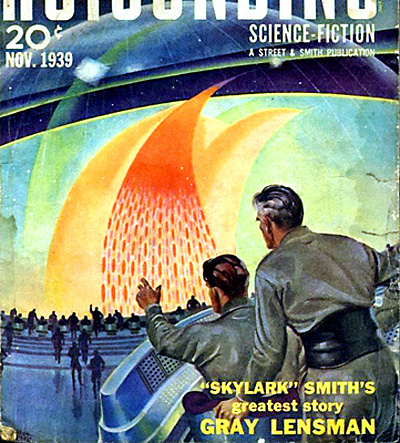
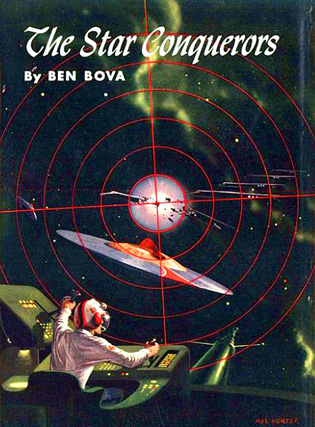
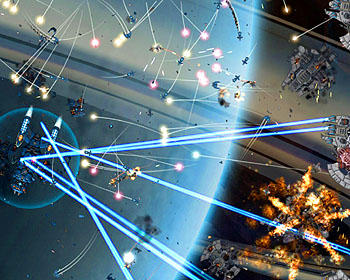
The phrase OODA loop refers to the decision cycle of observe, orient, decide, and act, developed by military strategist and United States Air Force Colonel John Boyd. Boyd applied the concept to the combat operations process, often at the strategic level in military operations. It is now also often applied to understand commercial operations and learning processes. The approach favors agility over raw power in dealing with human opponents in any endeavor.
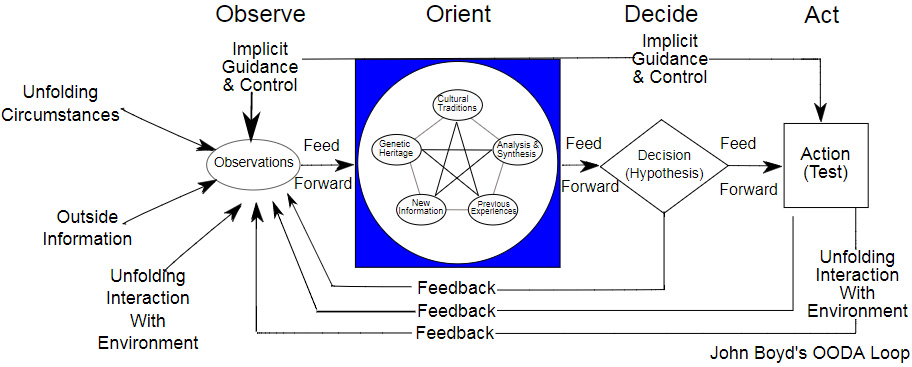

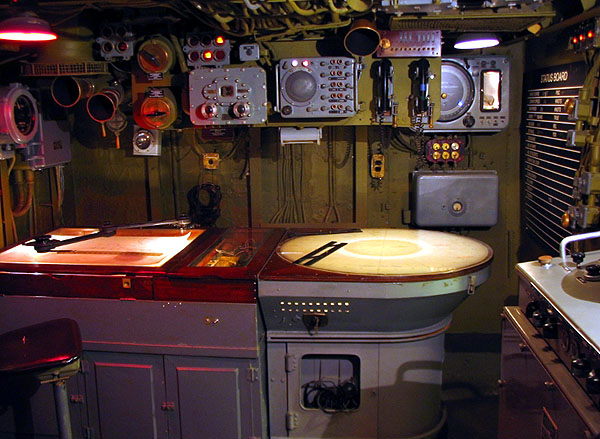
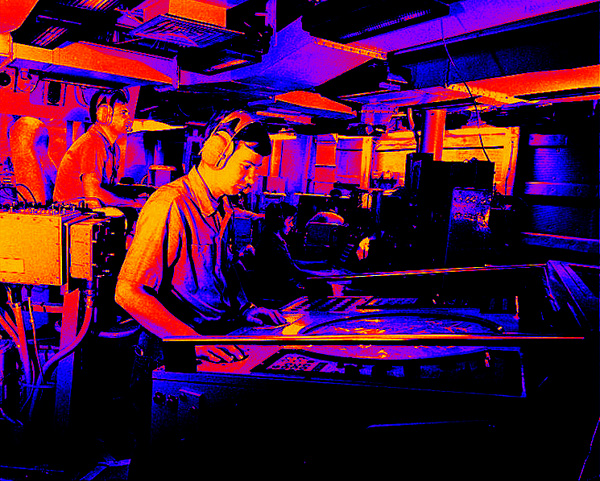
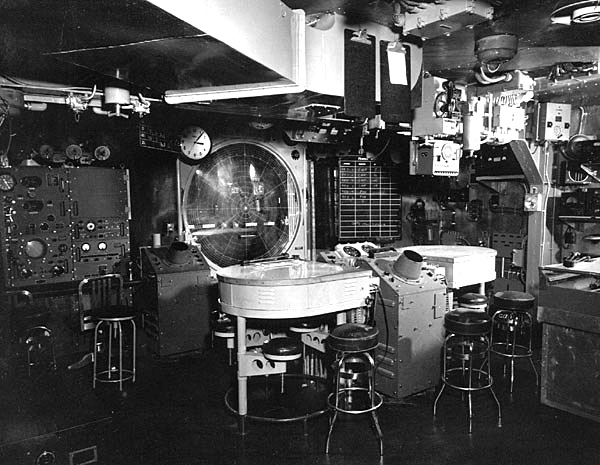
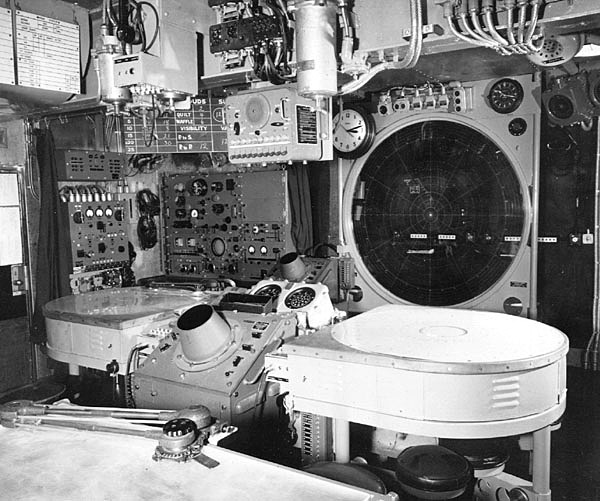

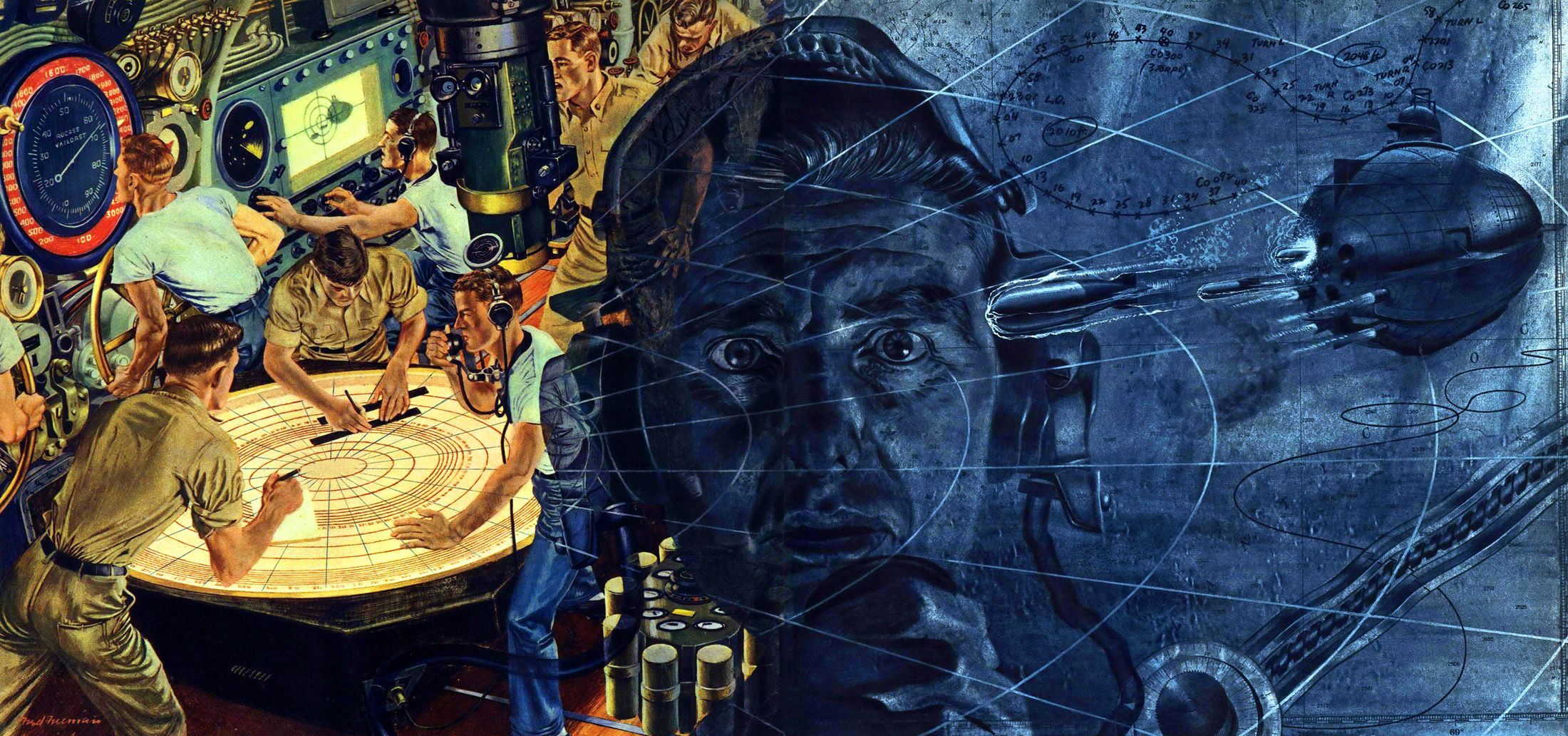


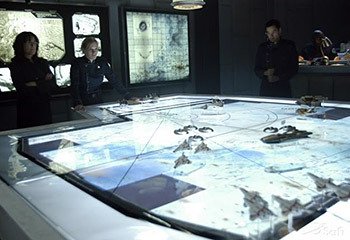

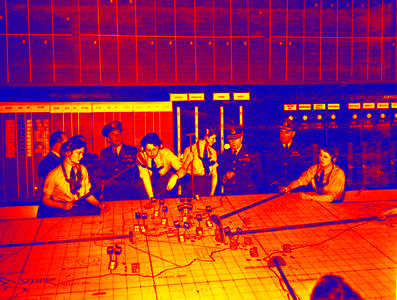
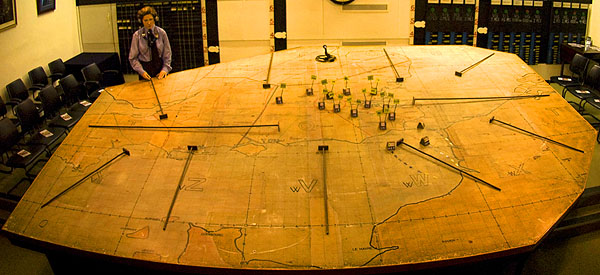
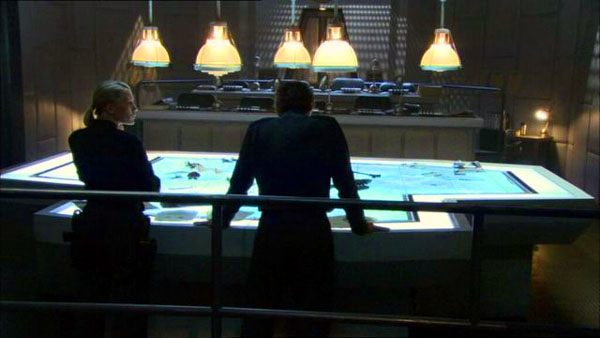

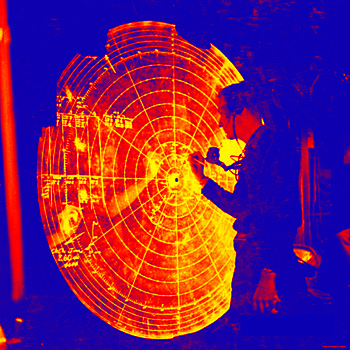
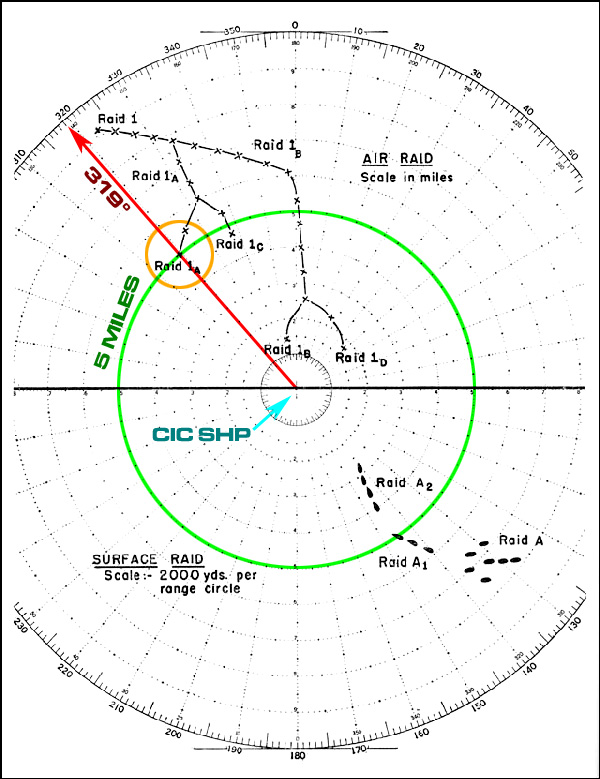
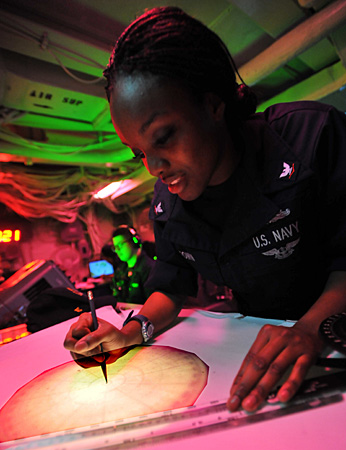
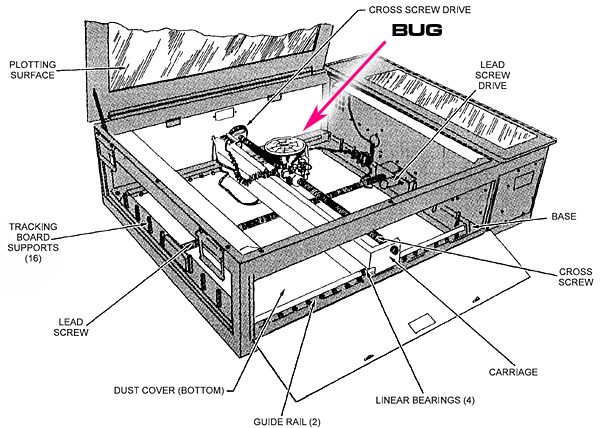
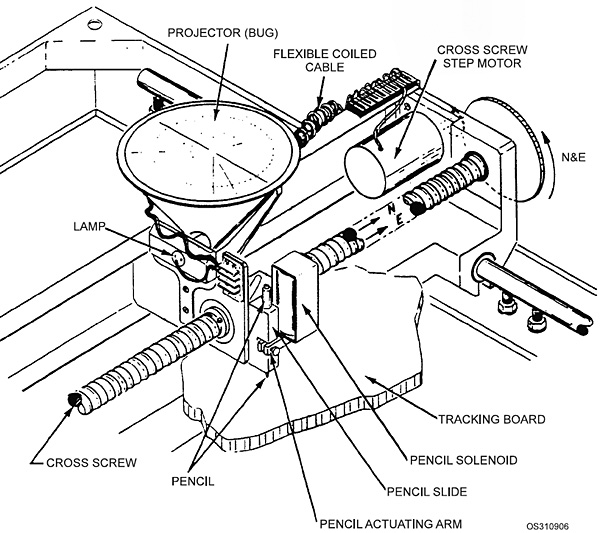
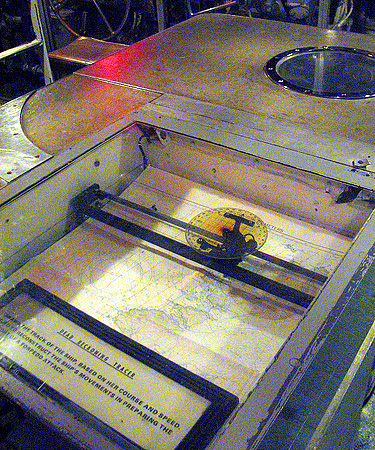
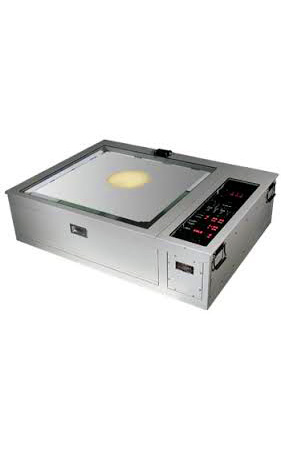
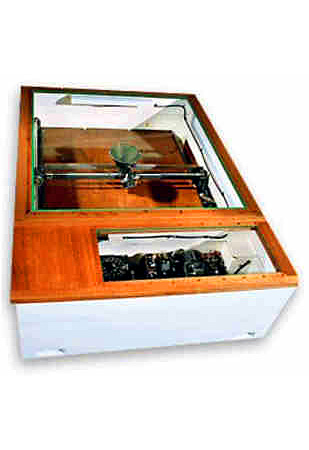

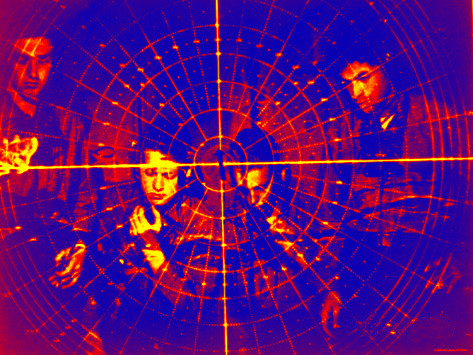
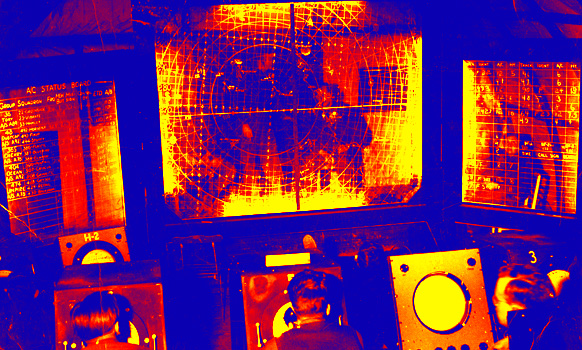
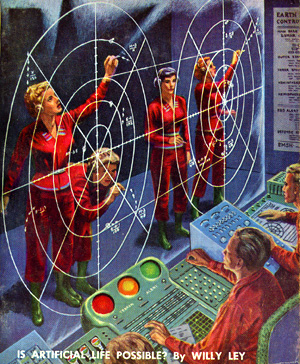
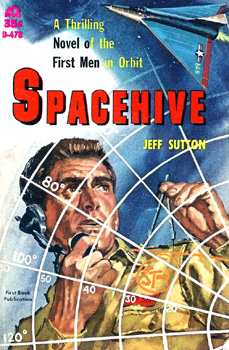


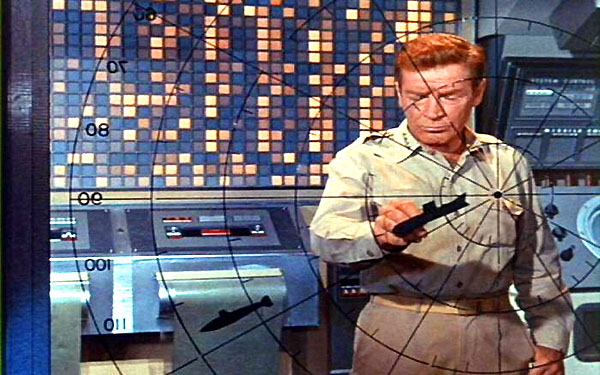
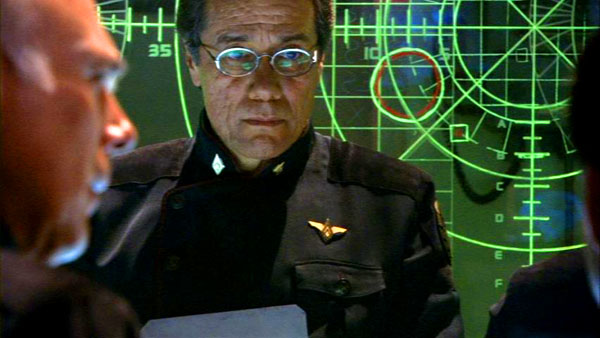
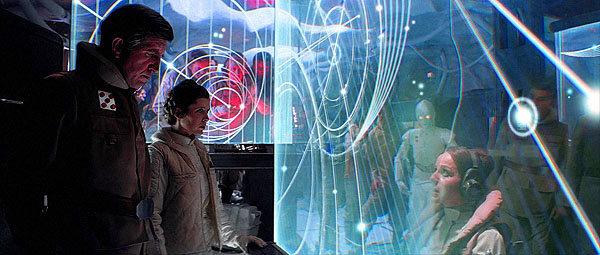
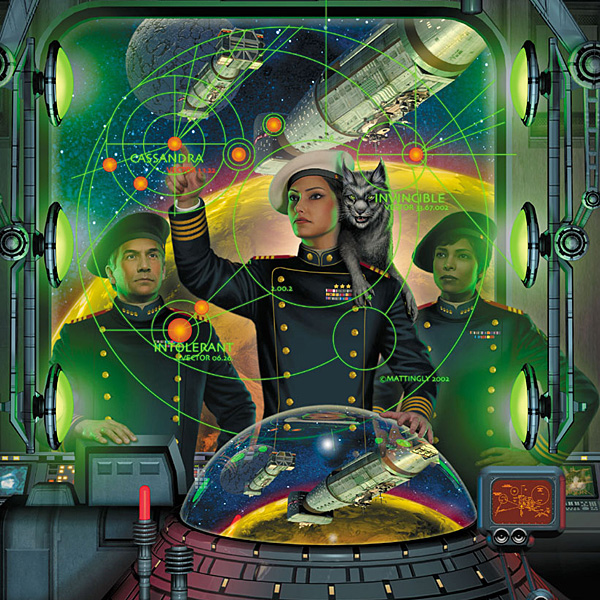
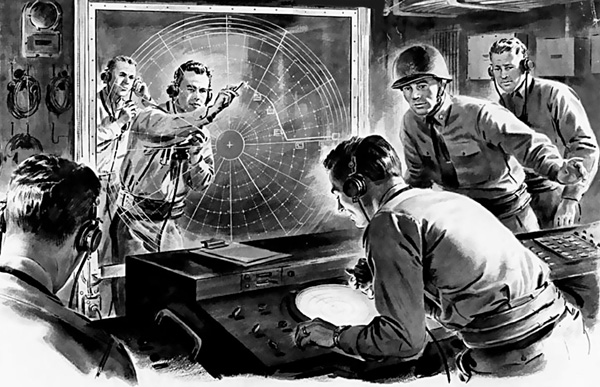
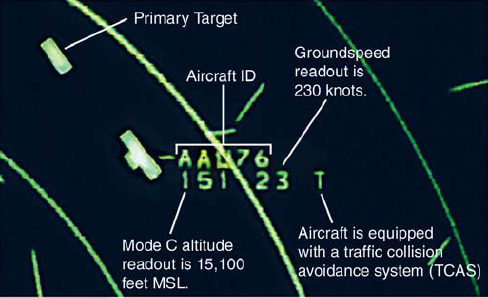

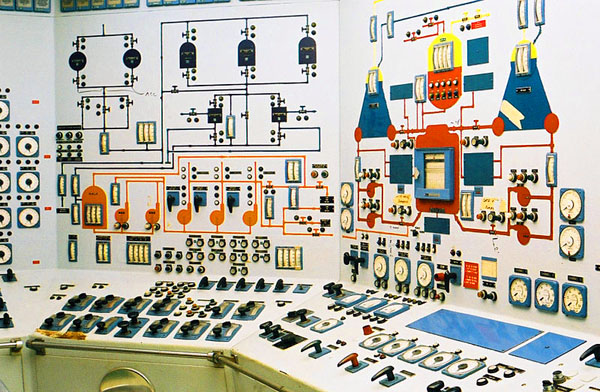
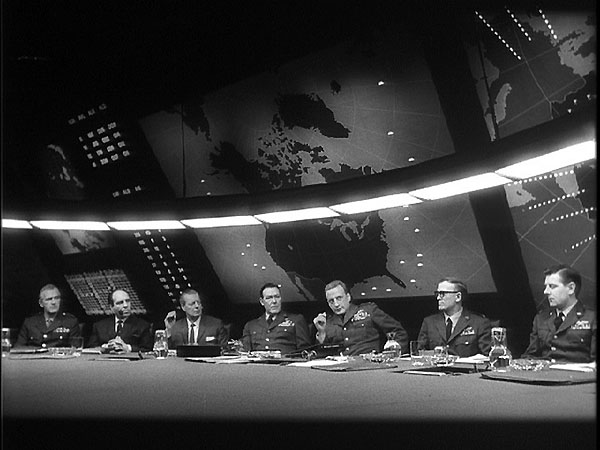
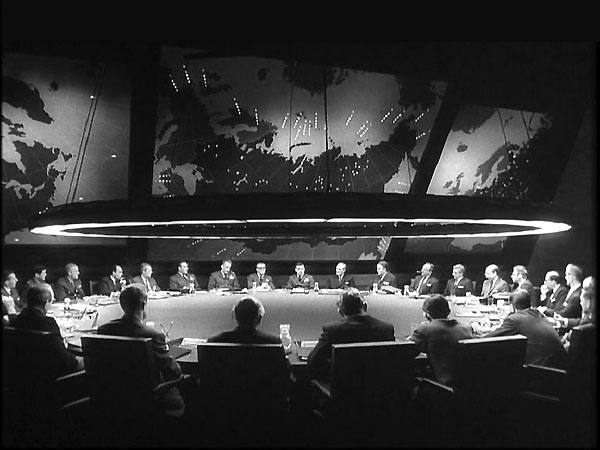
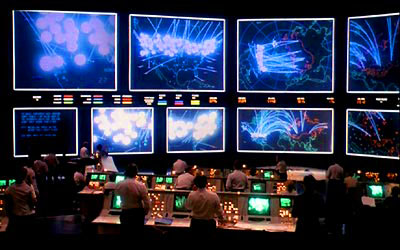
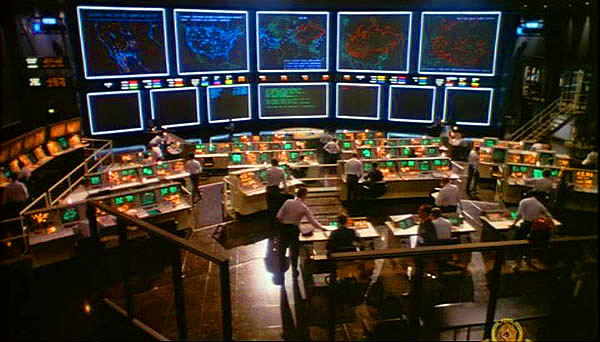
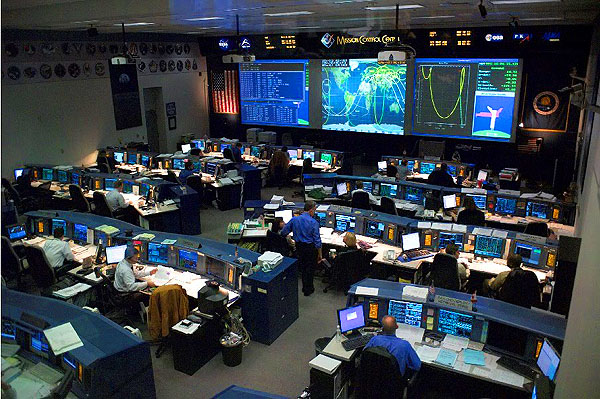
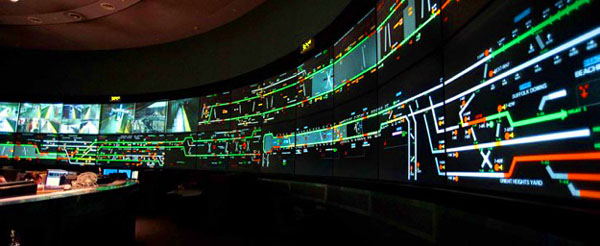
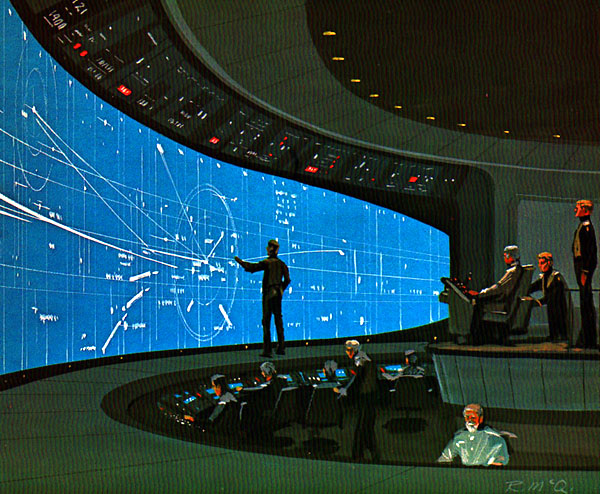

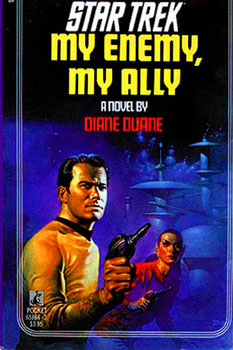

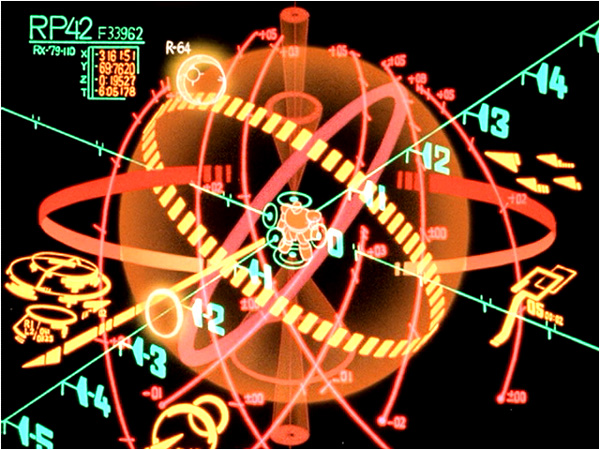
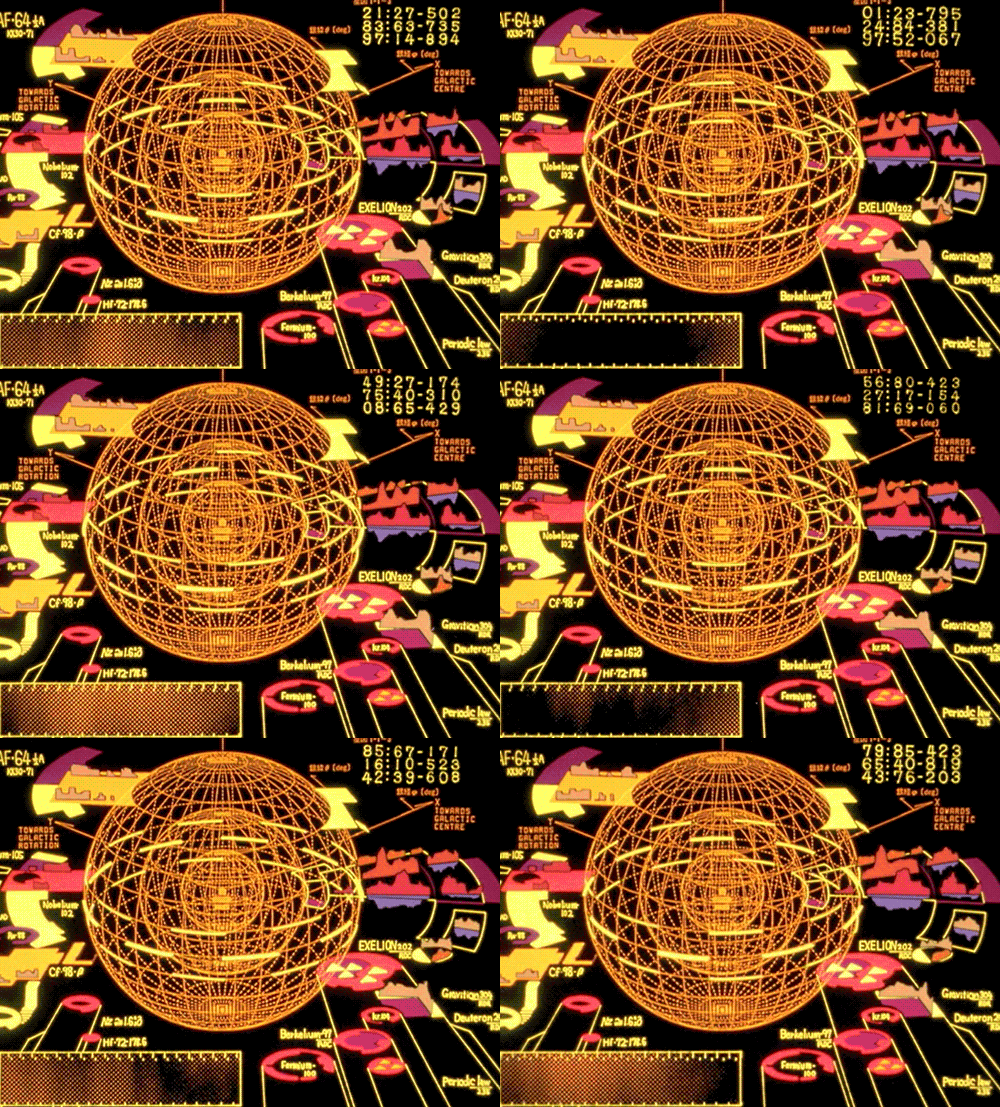
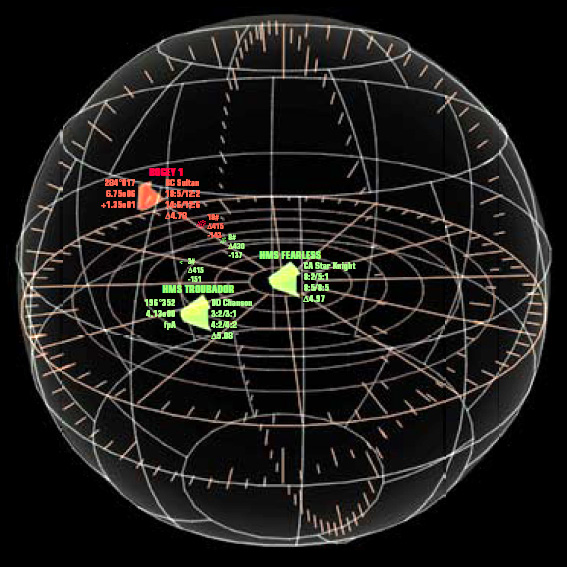
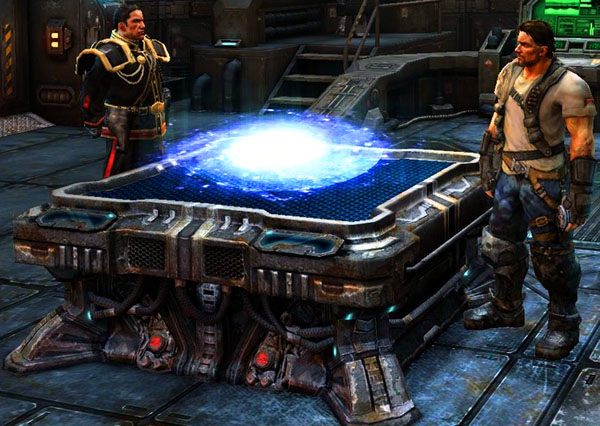
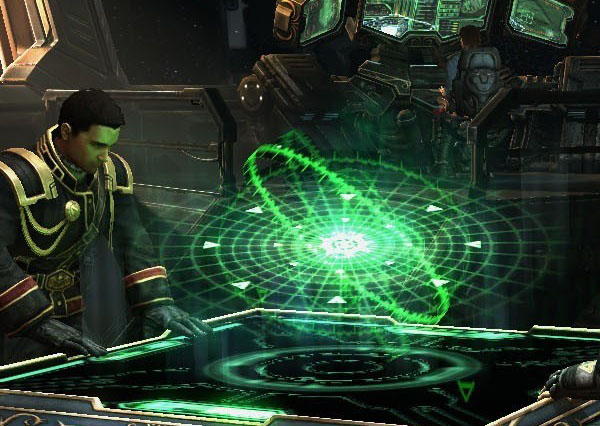
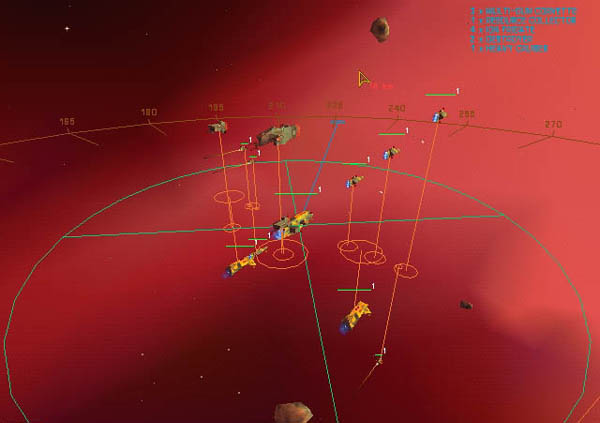
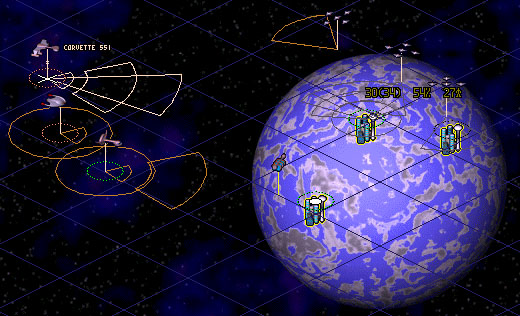
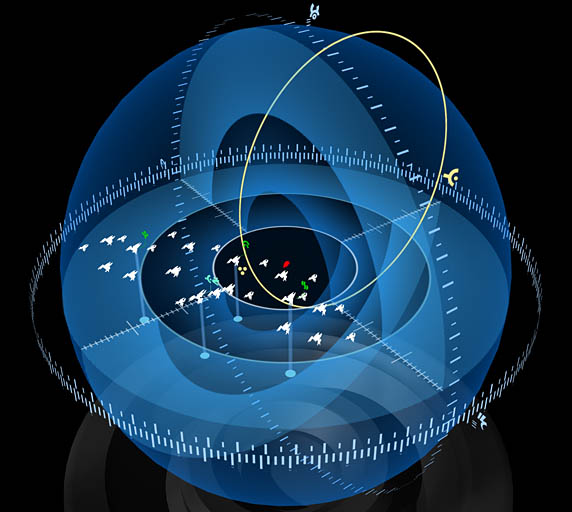
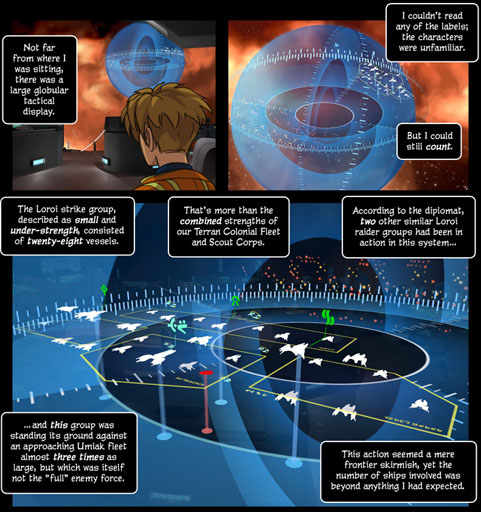
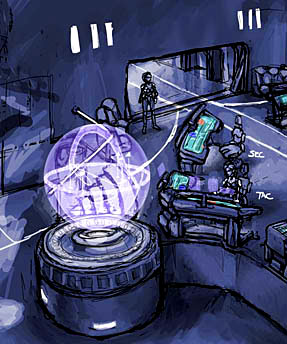

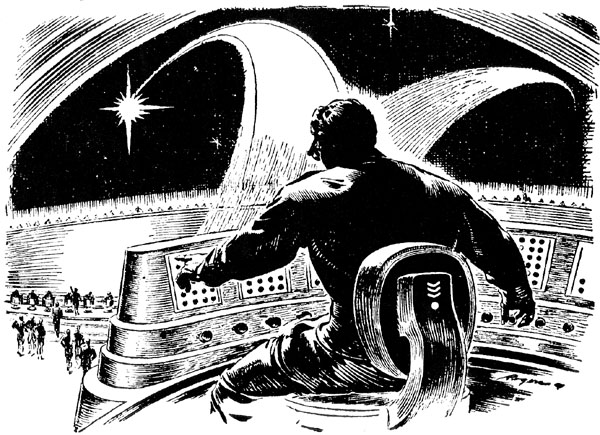
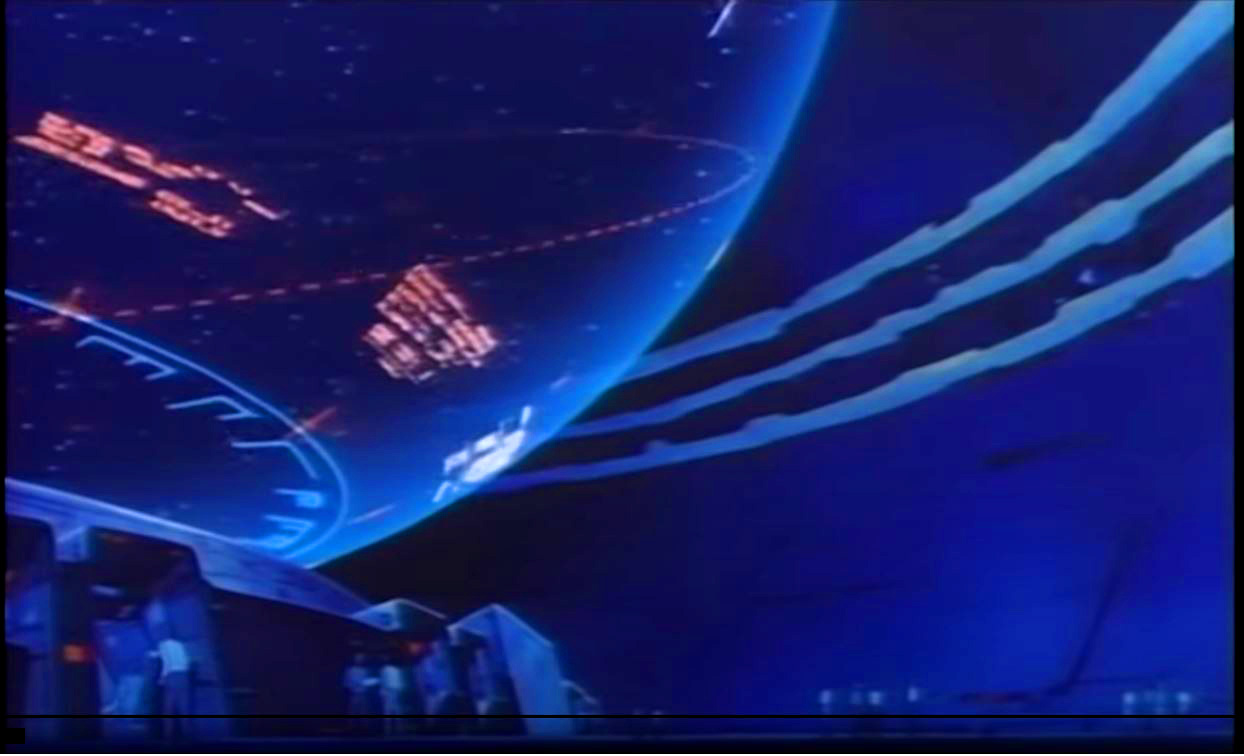
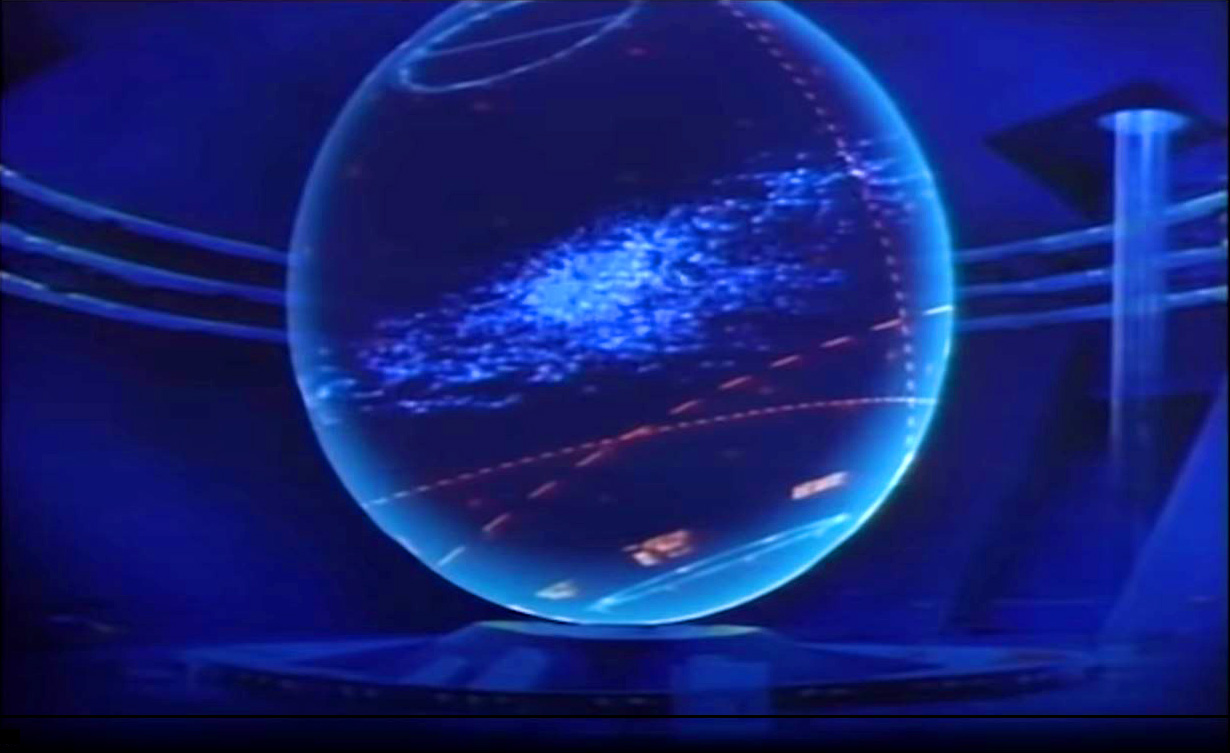

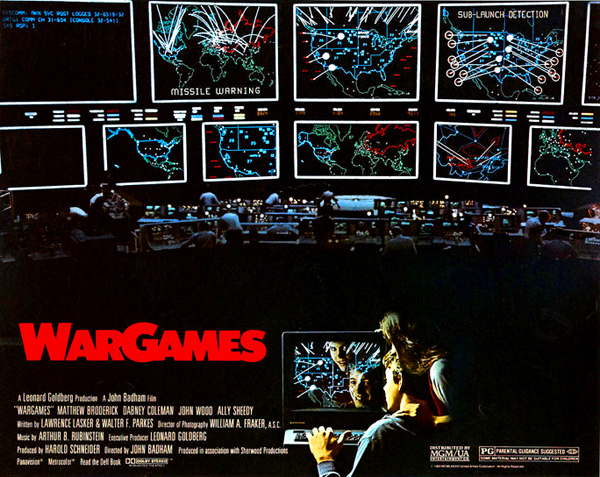
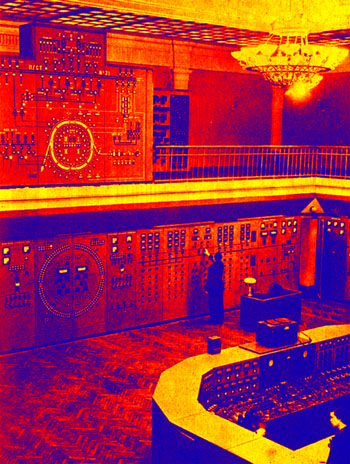

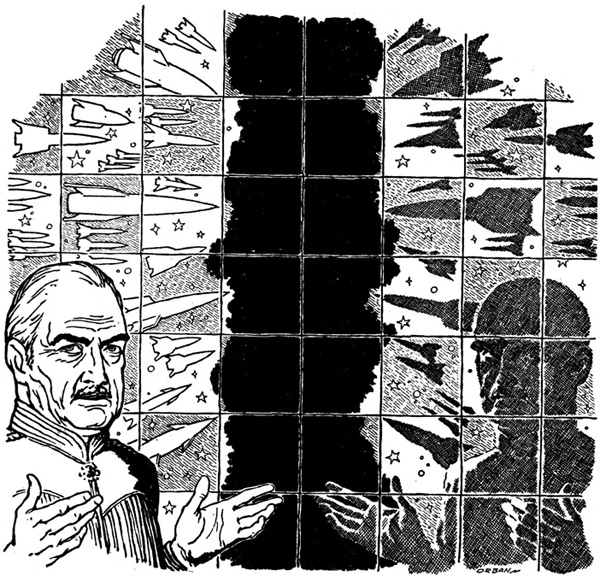
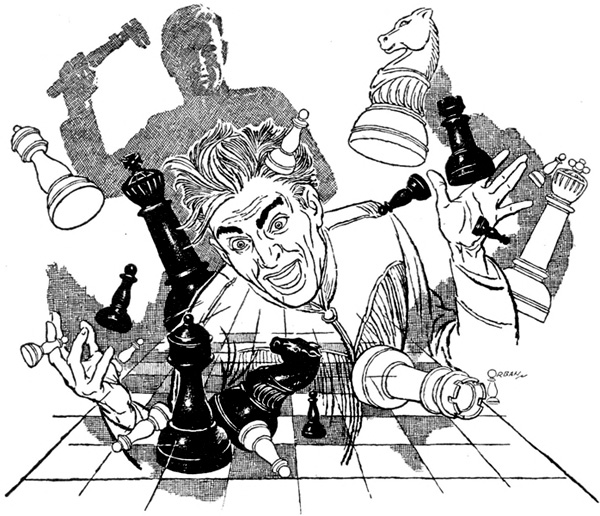

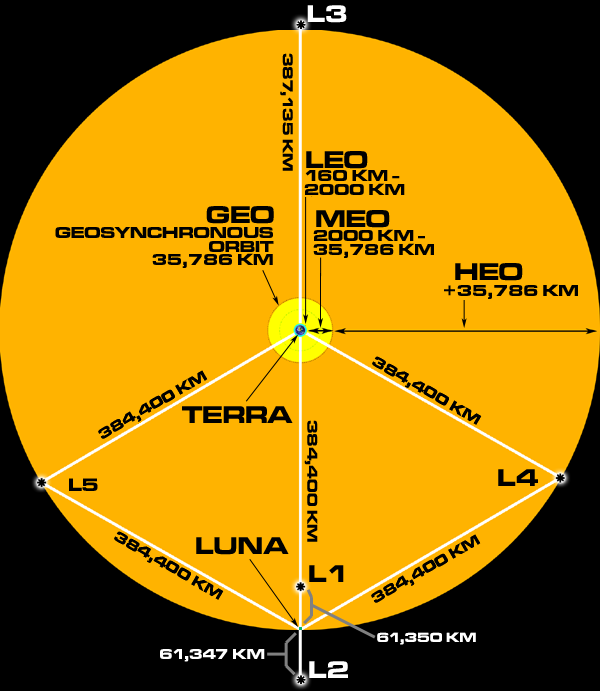
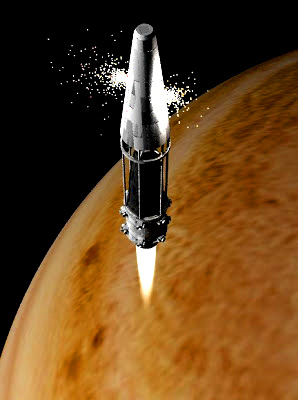
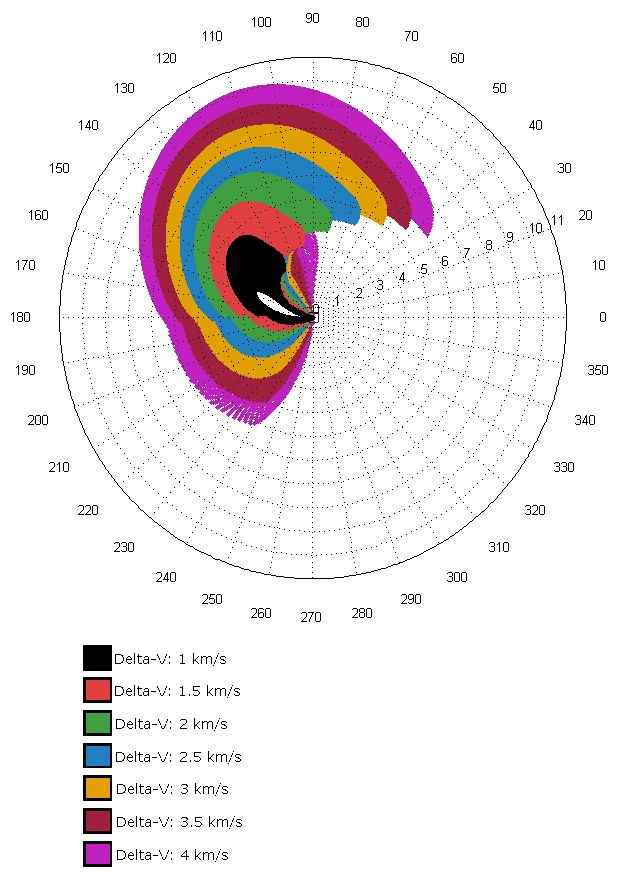


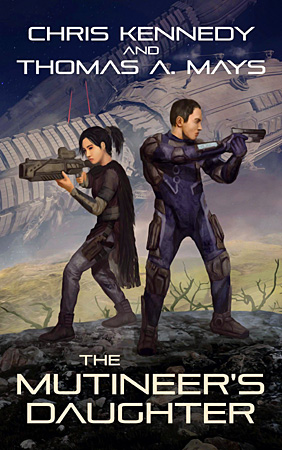
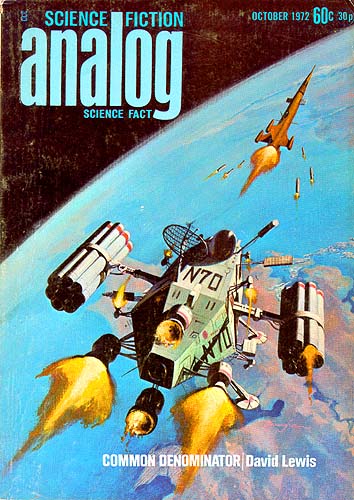
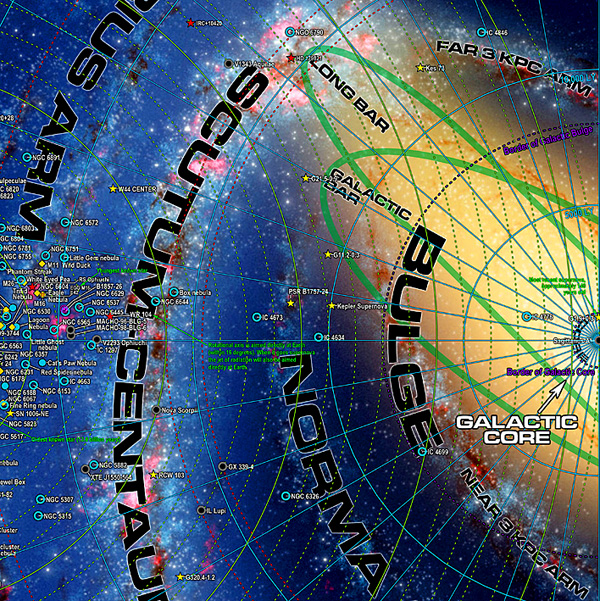

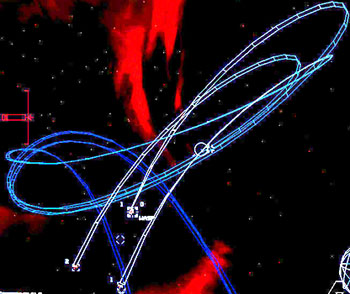
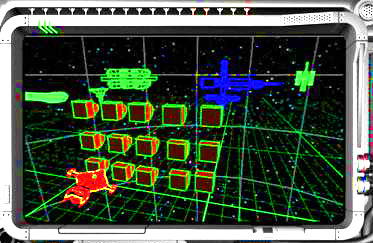

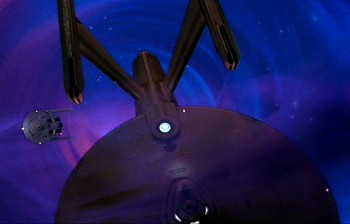





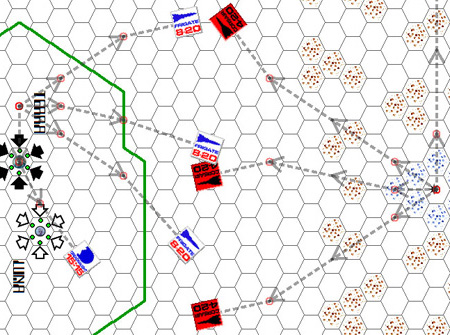

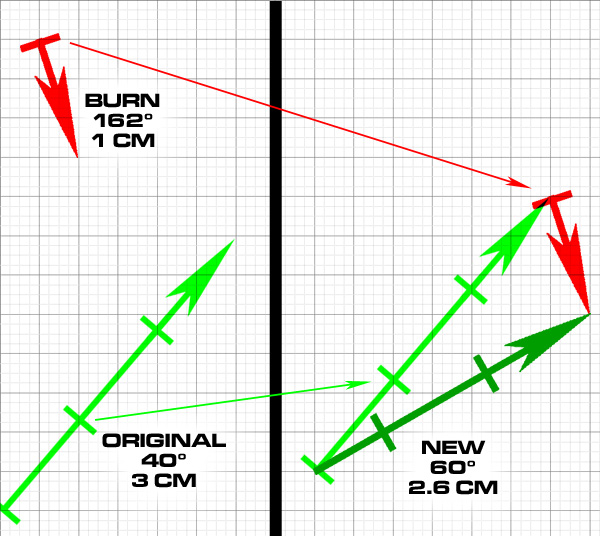
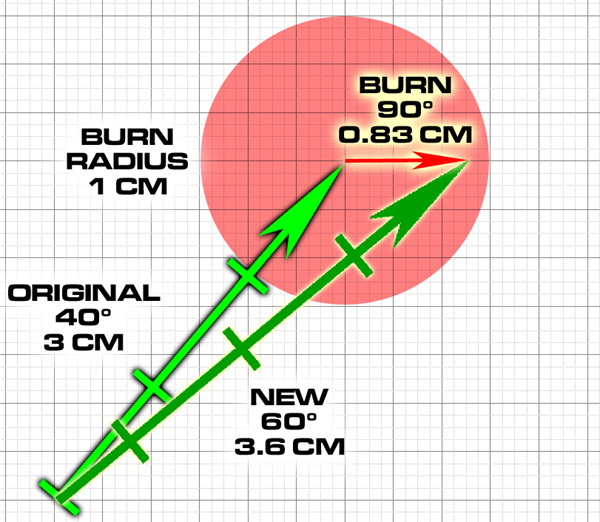

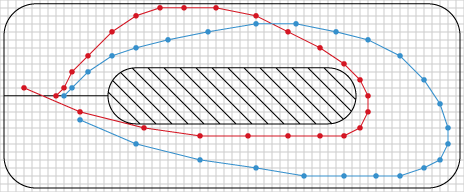

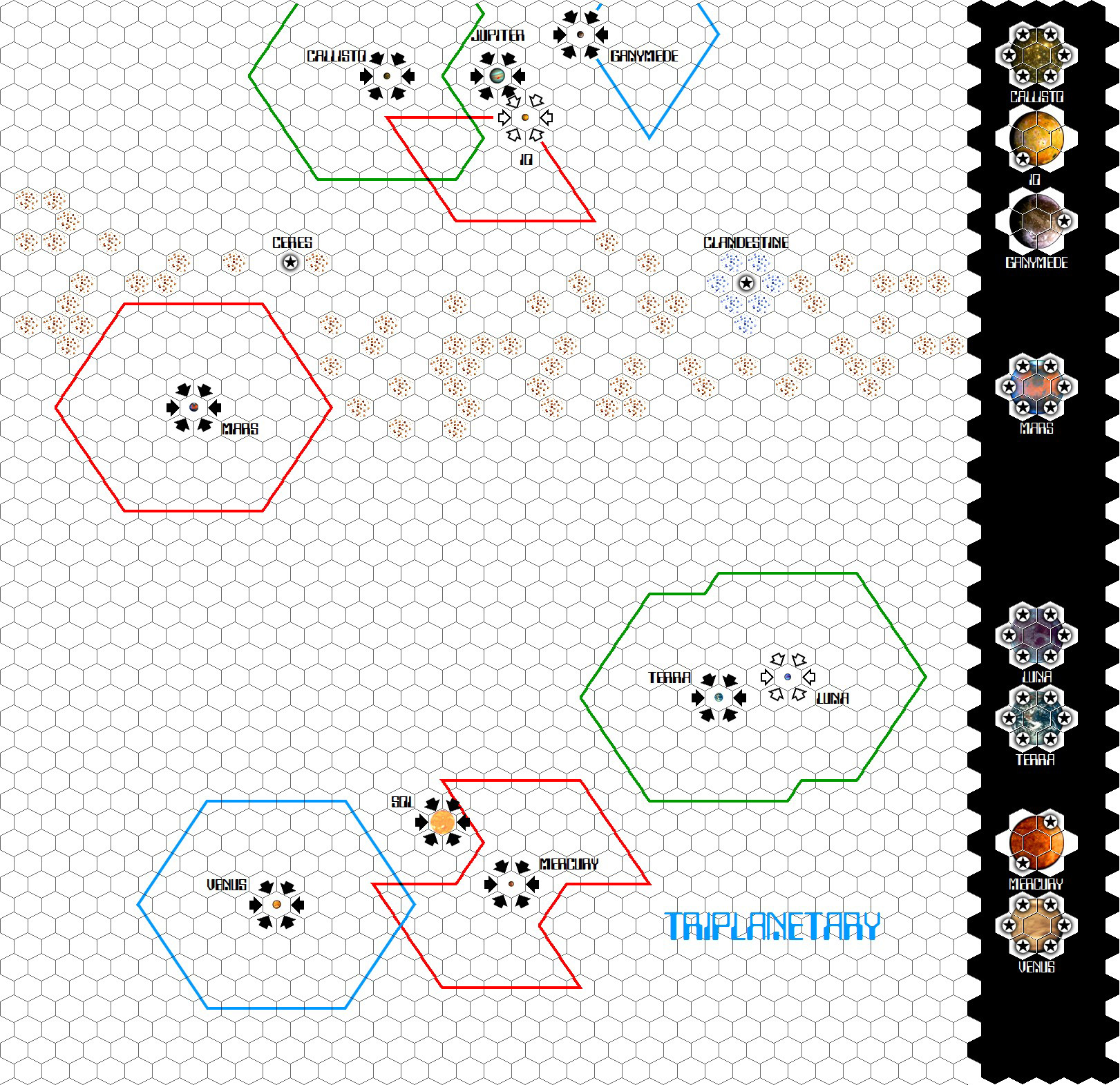
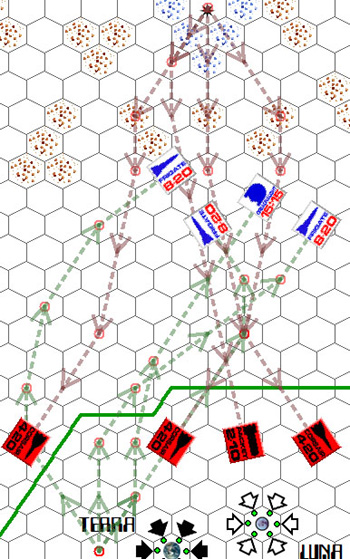

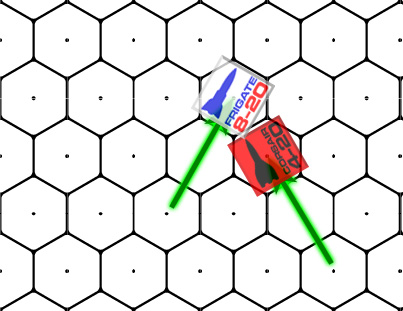
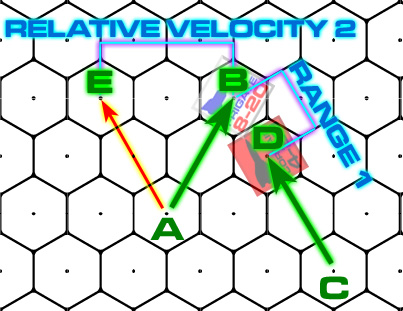
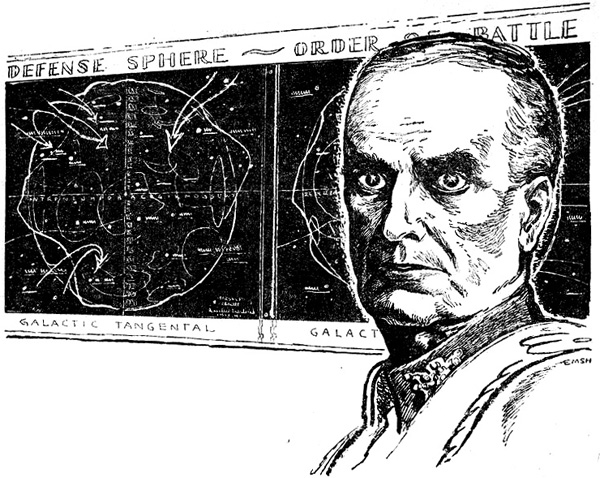







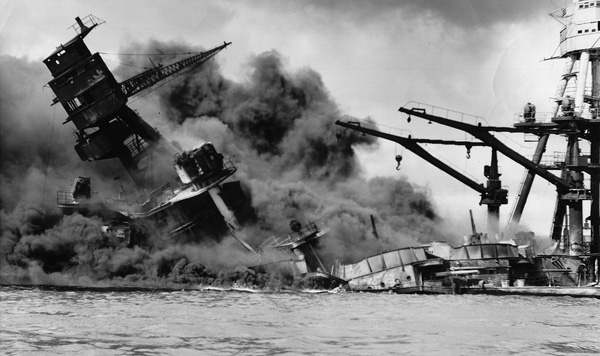
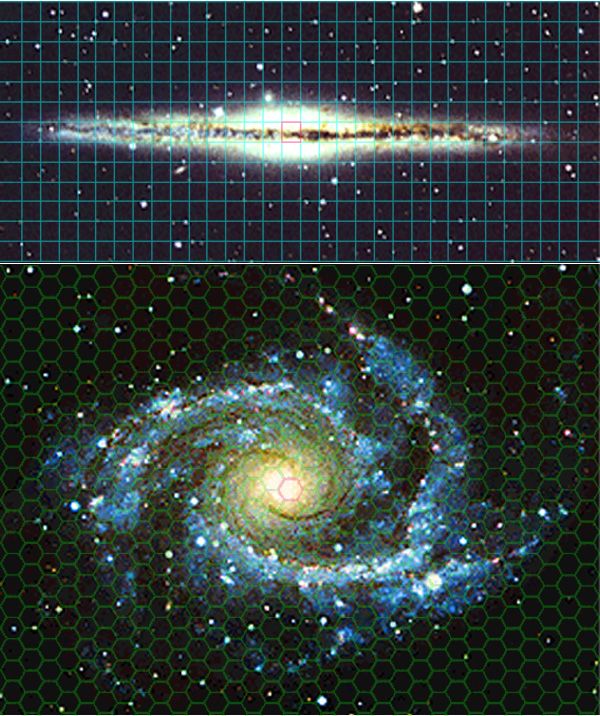

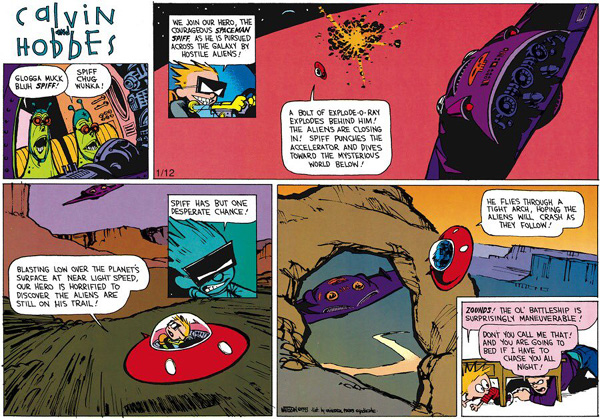
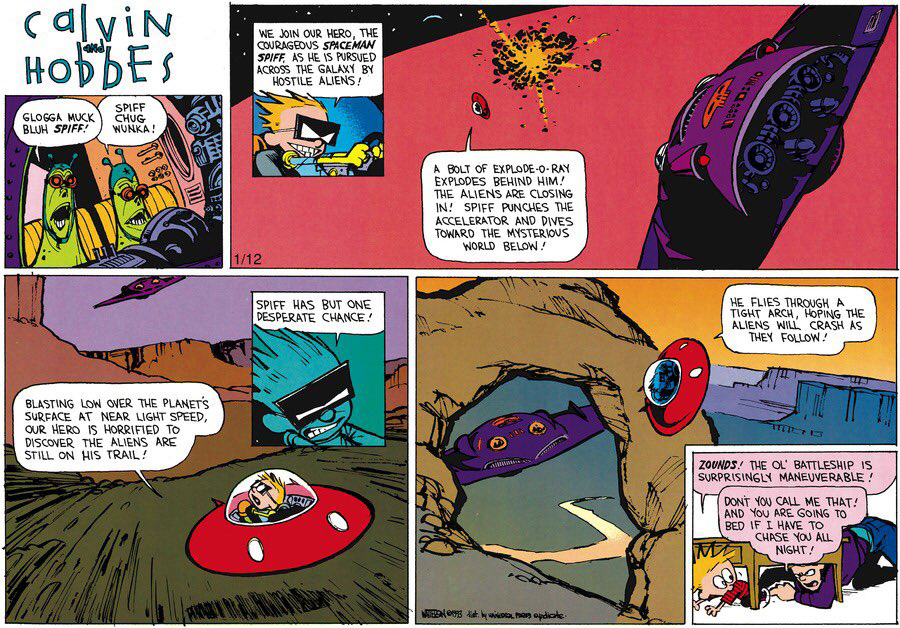
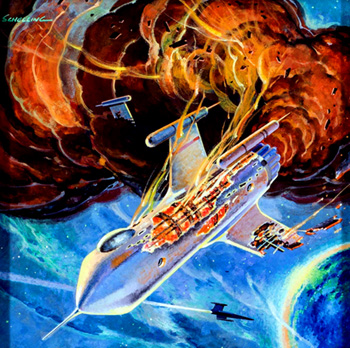
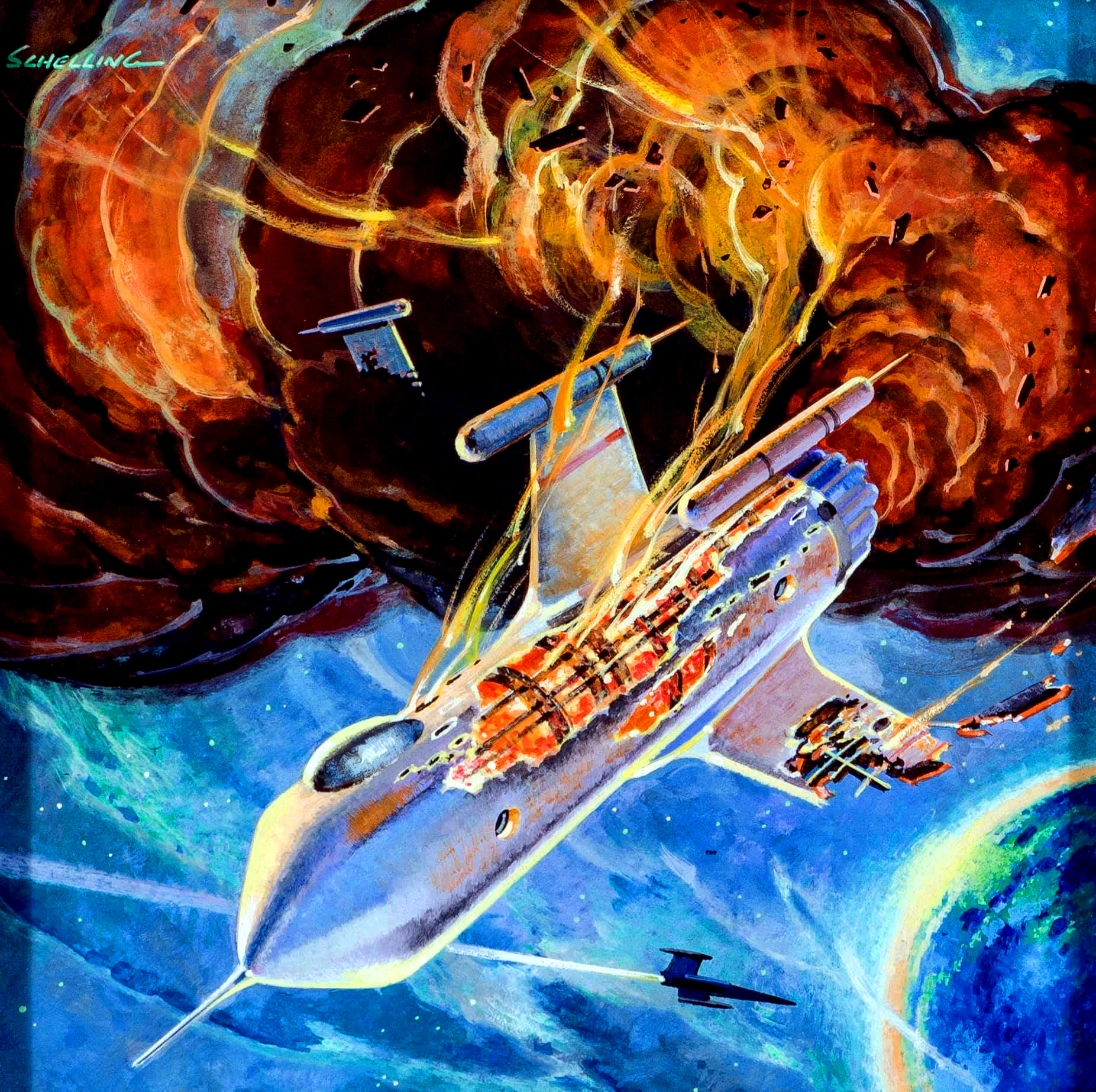
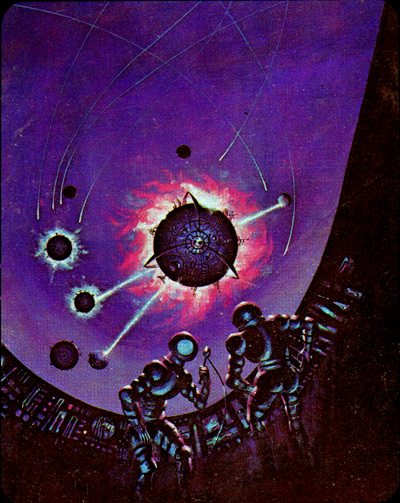
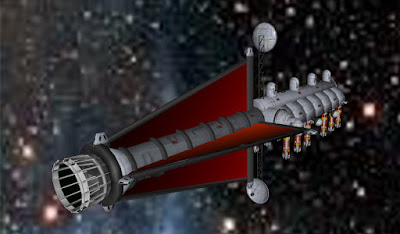
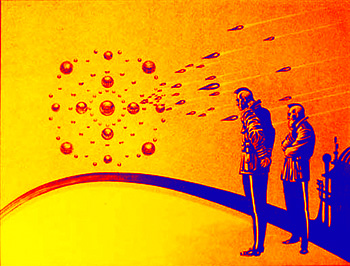
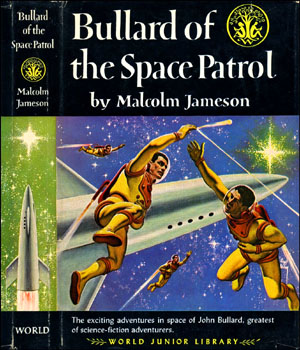
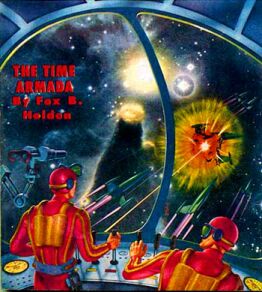


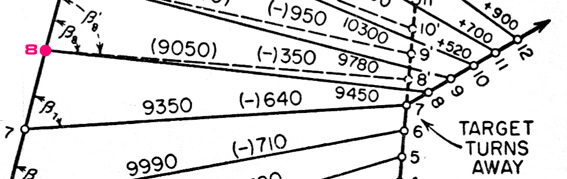
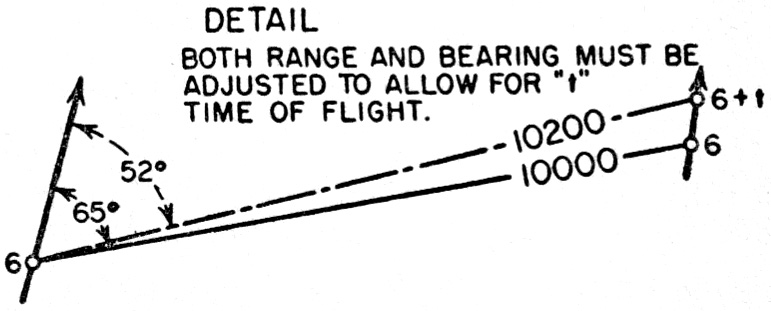

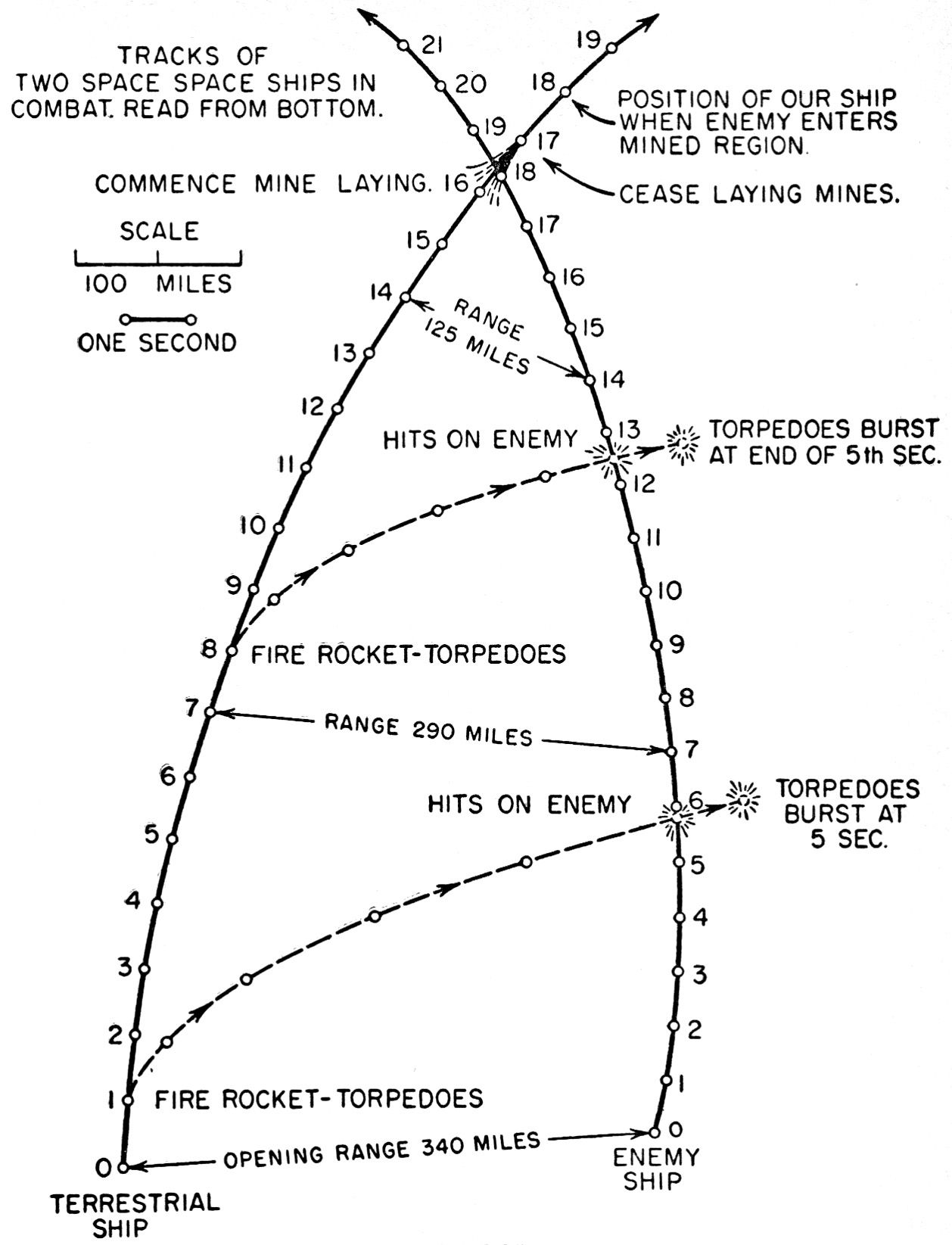


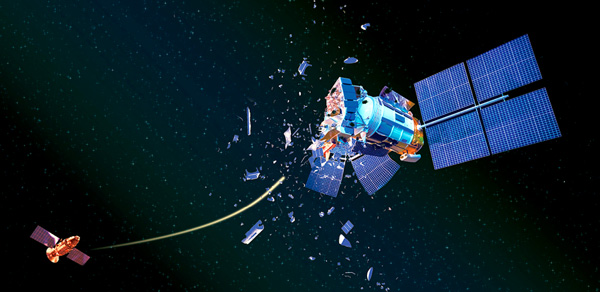
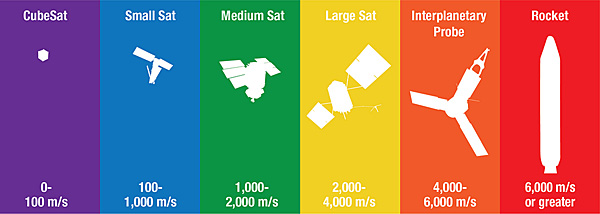

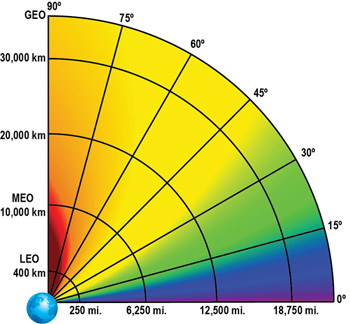
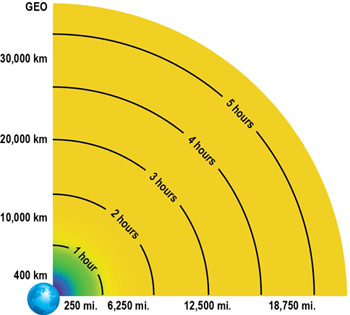
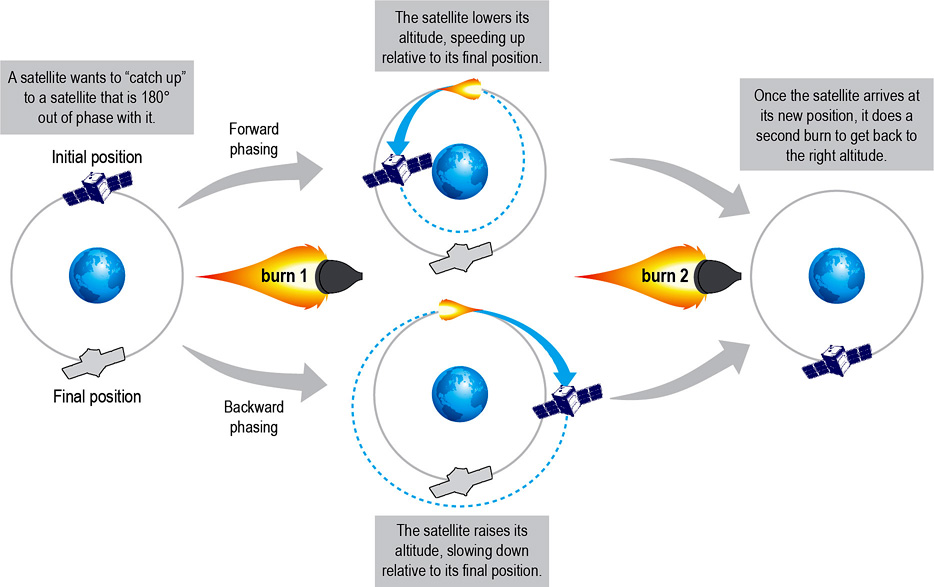
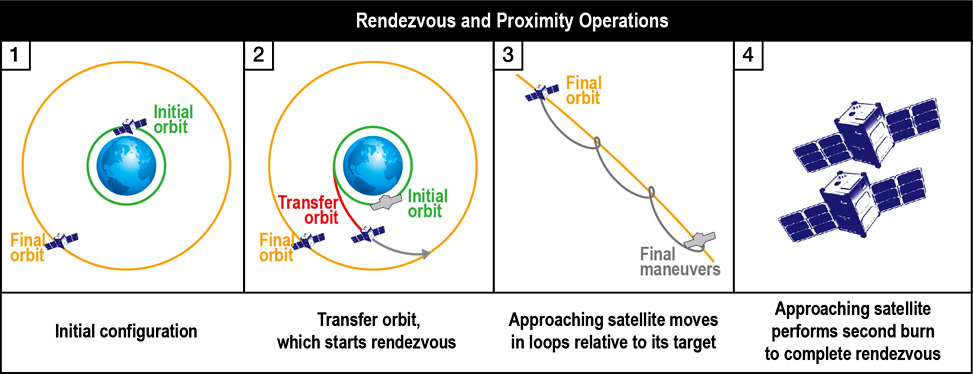
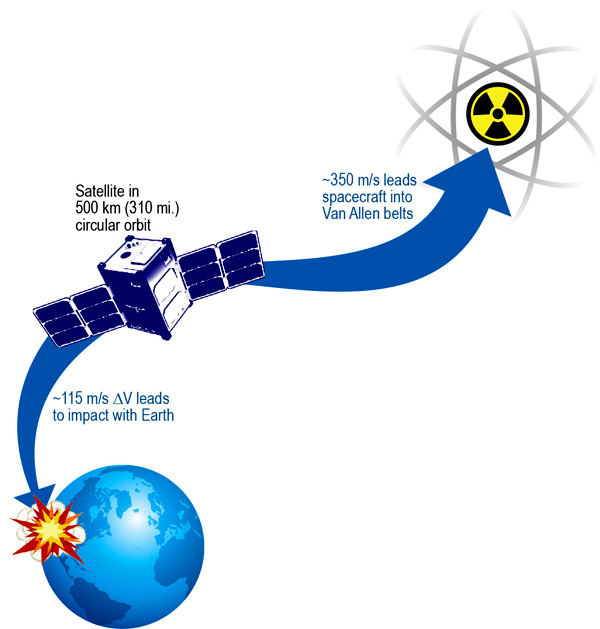

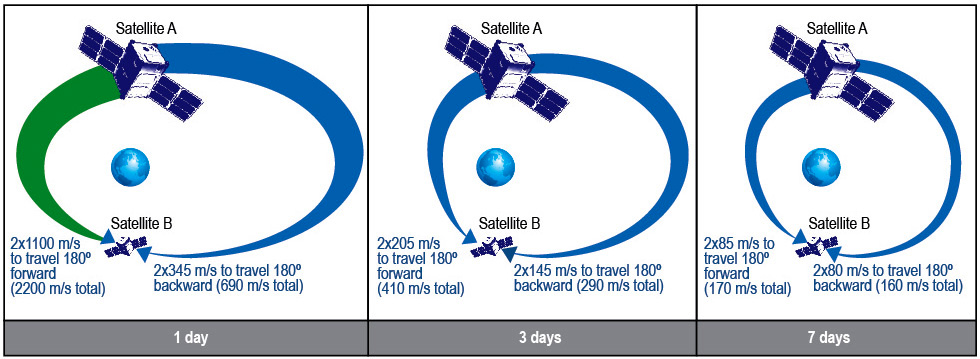
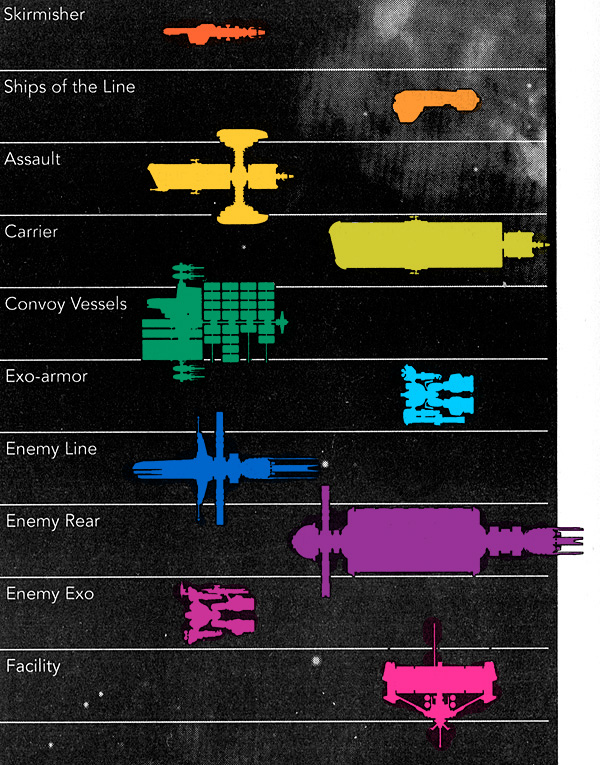
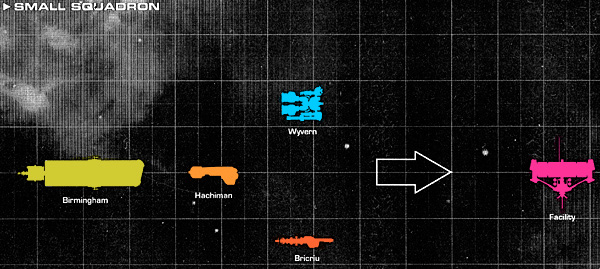
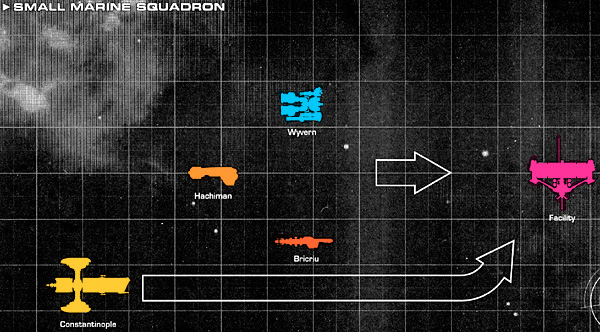
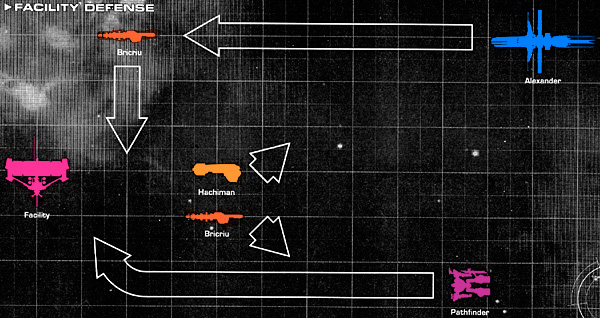
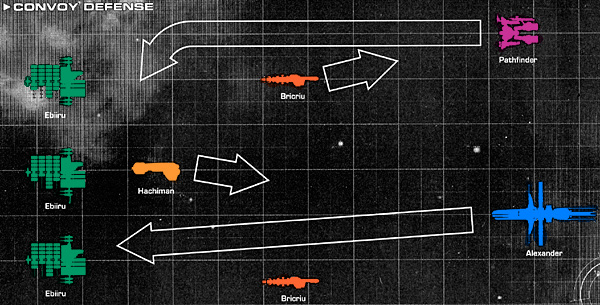
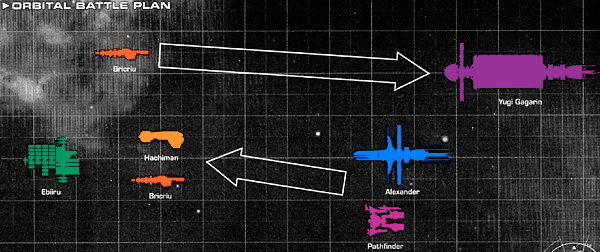
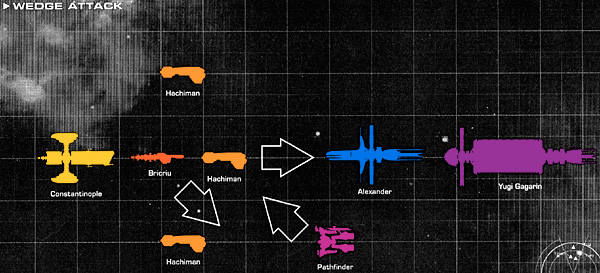
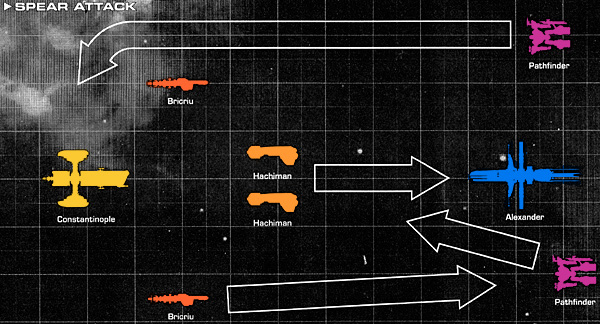
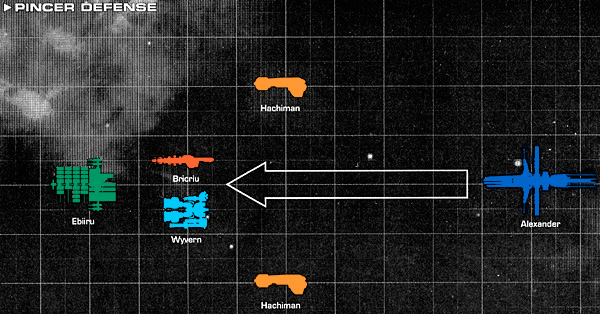
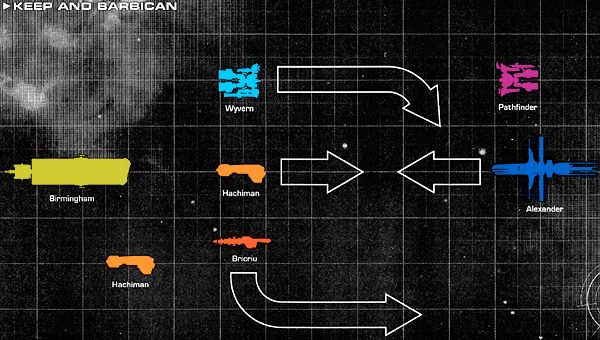
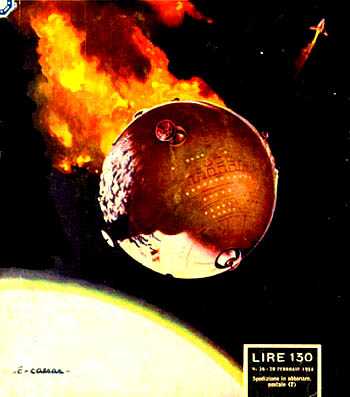
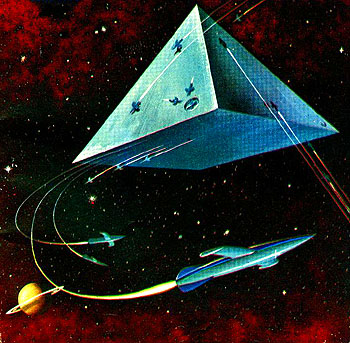

 Video Clip "The Expanse - Battle at Thoth Station"