Here is a rambling example of how I go about computing an atomic rocket. Beware that I am prone to amateurish mistakes in arithmetic so double check the math before you use the figures.
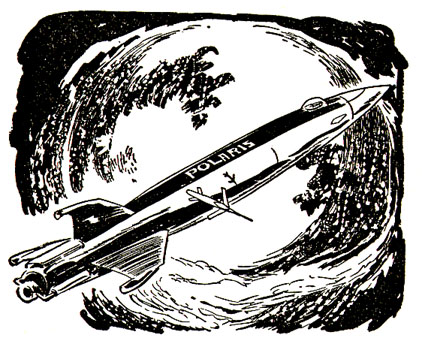
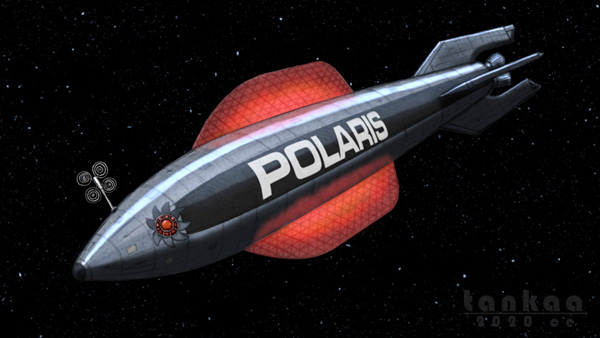
As a model we will use the classic atomic rocketship the Polaris from the Tom Corbett Space Cadet books.
Actually, the Polaris is so classic (i.e., 1952) that I fear most younger readers have never heard of it. Tom Corbett Space Cadet was an action packed science fiction series aimed at the juvenile demographic, appearing in hardback novels, comic books, Sunday newspaper comic strips, radio serials, and a TV series. Not to mention coloring books, punch-out books and View-Master reels. What is really sad is that the youngest of the younger readers have never heard of radio serials, View-Master reels, and punch-out books either. Sunday newspapers and hardback novels are on the way out, and I'm sure it is just a matter of time before comic books, coloring books and TV series follow them. But I digress.
Anyway, the Tom Corbett books were "inspired" by Robert Heinlein's classic novel SpaceCadet(if you like this website you'll probably like this novel). If you are vaguely interested in the the Tom Corbett novels they are out of copyright and are available as free ebooks(but if you are expecting deathless prose you will be sadly disappointed.).
The technical adviser was the legendary Willy Ley who did his best to keep things scientifically accurate but was often over-ruled. As near as I can figure the Polaris in the novels had some sort of closed-cycle gas core nuclear thermal rocket engine.
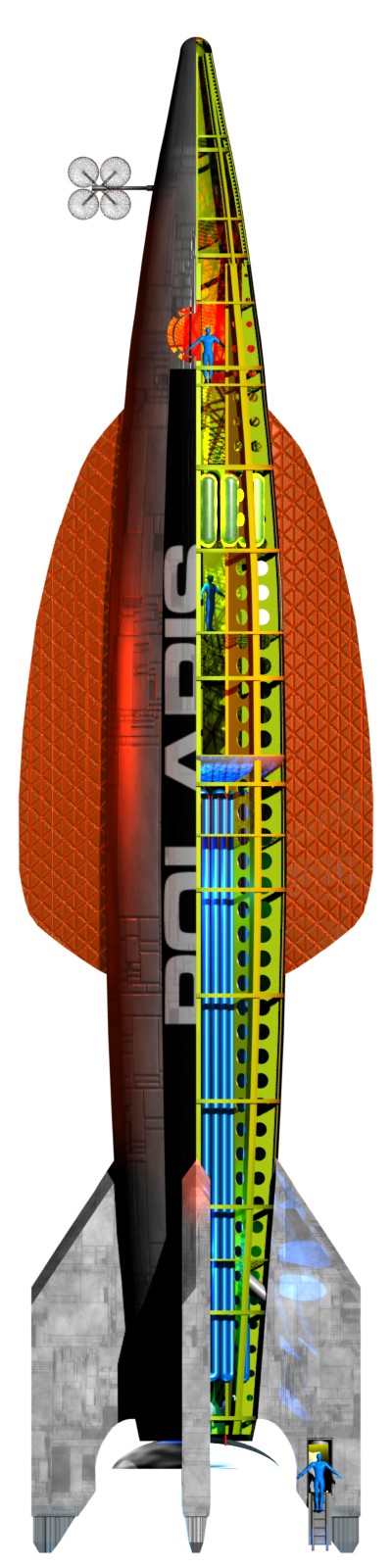
a gift artwork from Tankaa Kumawani. Thanks Tankaa! It's beautiful! click for larger image
Dimensions and Volume
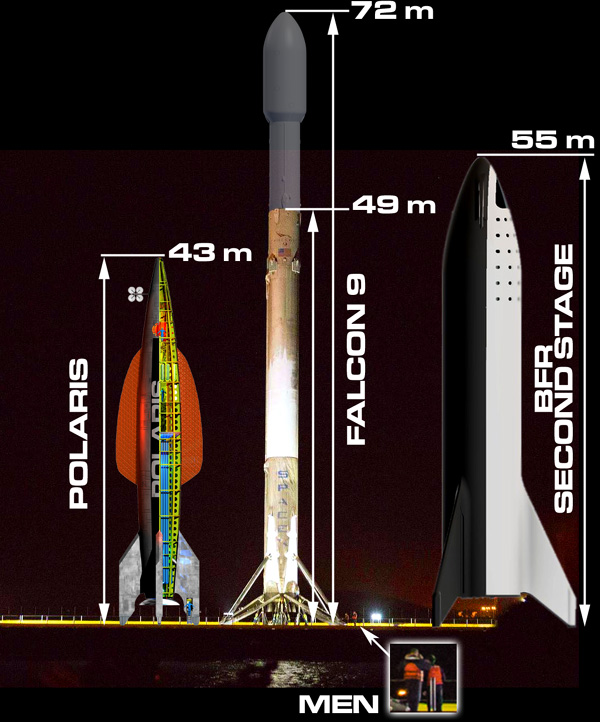
According to the novels the Polaris is 61 meters tall (200 feet) and 181 metric tons of mass (200 US tons). However, the indispensable Spaceship Handbook, scaling from images from the TV show, say it is closer to 43 meters (140 feet). That seems more reasonable to me.
I'll keep the ship's dimension, but I'm not going to try and keep the Polaris at 181 metric tons. Instead I'll see what mass is implied by the calculations.
Examining the blueprints in the Handbook, the ship has enough of a torpedo shape that trying to figure the volume using the formula for a cylinder probably won't work. The lower part, maybe, but not the top. Using the information from the blueprint about the ogive curves, I'll model the upper part as a cone 5 meters diameter at the base and 23 meters high. The lower part (i.e., to the base of the engine, not to the base of the fins) is approximated as a cylinder 5 meters in diameter and 16 meters wide.
Volume of a cone = 1/3πr2h = 1/3π2.5223 = 164 m3.
Volume of a cylinder = πr2h = π2.5216 = 340 m3.
So the total interior volume of the Polaris is 164 + 340 = 504 m3.
We better figure the surface area as well, so we can add armor. Figure the surface area of the cone, then subtract the surface area of a disc with a radius of 2.5 meters (i.e., the base, which is inside the ship). Figure the surface area of the cylinder, then subtract two discs (i.e., the top and the bottom, the top is inside, the bottom has the exhaust). Add the two together, I get a surface area of 433 m2
POLE STAR XT-14
(ed note: Mr. Roberson obviously used my Polaris example as inspiration for his torchship, and he has done it up proud! Well done, sir!)
My response, which no doubt would have been brilliant, died in my mouth as I turned my head and my eyes fell on an unexpected sight. At the center of the room, a familiar shape rose high above the crowd. It was a rocket, a torchship, and the registry numbers marked out on its nose identified it as my home for almost three years. It was Orbital Patrol Cutter 1519, my first command.
The crowd jostled around to greet me, but I only had eyes for the rocket. I’ve loved a few women in my time, but never more than I loved that ship.
A Pole Star XT-14, manufactured by Winchell-Chung Industries(thank you, Mr. Roberson!), Orbital Patrol Cutter 1519 had been one of the fastest of 22C spacecraft. With its inertial confinement fusion drive capable of maintaining accelerations of one standard gravity for weeks at a time, it could make the transit from Earth to Titan in just over twelve days in a straight-shot brachistochrone trajectory, full burn to the midpoint, and then flipping over and decelerating the rest of the way.
Forty-five meters from tip to tail, it had an interior volume of just over five hundred cubic meters, massing out fully loaded at only a few hundred metric tons. The 1519 had been lean and mean, a high-endurance Cutter-class vessel, whose primary missions were law enforcement, search and rescue, and defense operations. In the three years I’d been her skipper, we’d done all of that and more.
I stopped just short of the ship, which was standing upright on its landing jacks, its nose only a dozen or so meters from the ceiling high overhead. I reached out a hand, almost afraid to touch the hull. It couldn’t have been the same ship, I knew, not after so long a time, but it looked as though I’d just parked it and went off for a brief wander.
“What do you think?” said a voice in my left ear as a rumbling sound issued from behind me. “Have we captured the likeness? I’m something of an amateur historian,” Arluq explained, pausing only briefly to expel a quick blast of air through a blowhole on the top of her head, “and I’ve always been fascinated with the history of avionics. When I heard the news of your arrival, I dropped everything I was doing and started working on this replica right away.”
I was brought up short, remembering how short a time it had been since the news of my return had been released. “But it’s been only a couple of days since I woke up. And you built all of this”—I waved a hand up at the torchship towering over us—“so quickly? I doubt Winchell-Chung could have even gotten the registry numbers stenciled on the hull in so short a time.”
Arluq shrugged, a strange gesture for so large a creature. “I finished it yesterday, actually, but decided to wait and unveil it at this reception.” She paused and stepped over to slap one of the landing jacks with an enormous hand. “Oh, it’s fully functional, though. I could have put in a more efficient engine but, in the end, decided to go with a historically accurate inertial confinement fusion drive, powered by pellets of deuterium/helium-three ignited in the reaction chamber by inertial confinement using intense laser beams. I only had time for a short test flight, of course, but at full burn, I was able to get it up to a full standard gravity of acceleration, with no hiccups along the way.”
“Amazing.” I gestured to the silver eagle on my shoulder. “My escort here mentioned there’d be a surprise for me here, and it wasn’t kidding.”
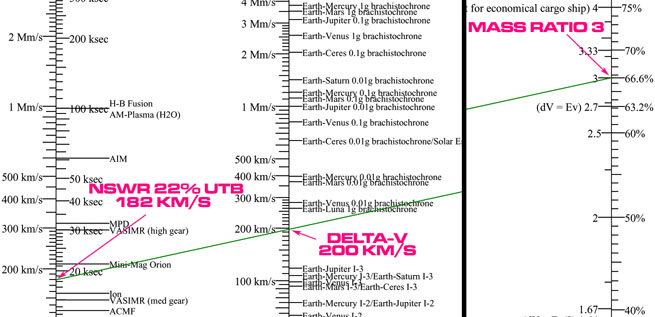
Now for the Mission. I'll cheat and examine the Mission Chart. The line for the year 2090 is attractive. The next year entry is the start of those huge deltaV Brachistochrone capable engines. Just to keep the Polaris closer to current capabilities, I'll opt for the 2090 engine performance. This means a month and a half transit time to travel to Mars, and seven and a half months to the Asteroid Belt, but that's not too unreasonable. The 2090 specifies a NSWR using a 22% uranium tetrabromide solution (i.e., mostly water). Exhaust velocity of 182,000 m/s, thrust of 13,000,000 N, and 10 metric tons per engine.
I will mandate that the Polaris will have to be capable of acceleration up to 10 g (98 m/s)(so as to reduce gravity drag), and have a mass ratio of 3 (because that is what the Mission Chart assumes.).
Mass
Propellant
How to decide on the interior tankage? Well, I decided to try and sneak up on the problem.
The Polaris has an interior volume of 504 m3. If the entire ship was totally filled with propellant, that would be the upper limit, correct? Uranium tetrabromide solution is basically salt water. Water has a density of 1000 kg/m3. So a waterlogged Polaris would mass 504 * 1000 = 504,000 kg or 504 metric tons. This will be the upper limit of the Polaris' mass, set by volume. (Always be aware that things are simplified in this example since water is one ton per m3. Thing are a tad more complicated with liquid hydrogen, at only 71 kg/m3)
I'll do the calculations for a Polaris that is 30%, 50% and 60% propellant, by volume. Then the most attractive results will be chosen.
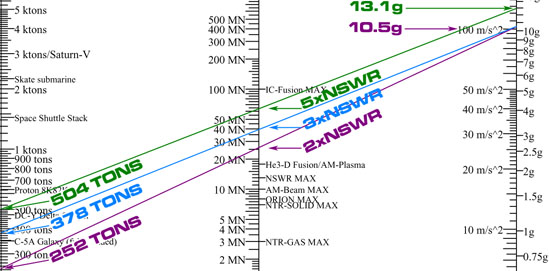
First the 50% option. 504 * 0.5 = 252 m3 propellant tankage. 252 * 1000 = 252,000 kg or 252 metric tons. Since the mass ratio is 3, the dry mass is 126 metric tons, for a total mass of 252 + 126 = 378 metric tons.
The Polaris is mandated to have an acceleration of 10 g (98.1 m/s). One NSWR has a thrust of 13,000,000 N. This would result in an acceleration of 13,000,000 / 378,000 = 34.4 m/s. Convert to gs: 34.4 / 9.81 = 3.5 g. Not good enough. Three NSWR have a thrust of 3 * 13,000,000 N = 39,000,000 N. 39,000,000 / 378,000 = 103 m/s. 103 / 9.81 = 10.5 g. That will do. 3 * 10 metric tons per engine = 30 metric tons total engine mass. This will come out of the dry mass capacity.
Structure
Now to figure the structural mass. The Polaris has a density of (M/1000) / V = (378,000 /1000) / 504 = 0.75 tons/m3.
The structural volume required to support the spacecraft is = (V4/3 * Apg0 * D) / (1000 * Thm) = (504 1.333 * 10.5 * 0.75 ) / (1000 * 2.86) = 11 m3.
Since both are the same, the actual structural volume is 11 m3.
We'll make the hull out of titanium. The density of titanium is 4,507 kg/m3(compared to 7,850 kg/m3 for steel and 1,738 kg/m3 for magnesium) so the structural mass is 11 * 4,507 = 49,580 kg = 50 metric tons.
Payload
The available payload (i.e., mass and space for everything that isn't propellant or structure) is 126 mton dry mass - 30 mton engine mass - 50 mton structural mass = 46 metric tons available payload mass. 504 m3 total volume - 254 m3 propellant volume - 11 m3 structural volume = 241 m3 available payload volume.
Specifications
So using the same techniques above, here are the 33% and 60% propellant volume spacecraft compared to the 50% option:
33%
50%
66%
Total mass
252 metric tons
378 metric tons
504 metric tons
Propellant mass
168 metric tons
252 metric tons
336 metric tons
Dry mass
84 metric tons
126 metric tons
168 metric tons
Mass ratio
3
Number of NSWR engines
2
3
5
Fully loaded acceleration
10.5 g
10.5 g
13.1 g
Structural volume
9 m3
11 m3
15 m3
Structural mass
41 metric tons
50 metric tons
68 metric tons
Available payload volume
329 m3
241 m3
153 m3
Available payload mass
23 metric tons
46 metric tons
50 metric tons
Deciding on an option
Let's look at the important part:
Percent Propellant by volume
Available Payload Volume
Available Payload Mass
33%
329 m3
23 metric tons
50%
241 m3
46 metric tons
66%
153 m3
50 metric tons
The table makes it clear that there is
a trade-off between volume and mass. If you only look at the available volume and mass, I suppose one could use calculus to make a min-max function and find the perfect balance (my knowledge of calculus is not equal to the task, alas). Of course, the other factors are important as well, the accountants will be interested in how much it costs to fill the propellant tanks with uranium tetrabromide.
For no particular reason, I'm going to go with the 50% option. This gives me 46,143 kilograms and 252 m3 of payload to play with.
The available payload volume and mass has to hold everything else. Heat radiators, air, food, water, radar gear, lifeboats, air ducting, sewage treatment, damage control replacement parts, ship's surgery, space suits, crew members, atomic torpedoes, laser cannon turrets, hammocks, periscopic sextant, toothbrushes, toilet paper, everything!. And don't forget the tail-fins.
Life Support
The air won't mass too much. The 50% propellant option has a payload volume of 241 m3. Air at one atmosphere of pressure has a density of 1.2 kg/m3, so the mass of air required to pressurize the entire payload section is 241 * 1.2 = 289 kg or 0.3 metric tons. That is just to pressurize the section, more will be required as the crew consumes oxygen.
The air, food, and water for four crew members (Tom, Roger, Astro, and Captain Strong) isn't too bad, even for a 16 month (480 day) round-trip to Ceres. Actually, we should have five crew members, using Raymond McVay's stripped down version of the Mission Control Model. The physical bodies of the crew will take up about 340 kg and 0.34 m3
Each crew member requires 10 litres of water, which is recycled. 0.25 litres will be lost each day due to inefficiencies in recycling, so each crew member will require 10 litres + (0.25 litres * 480 days) = 130 litres = 0.13 m3 of water, which will mass 0.13 metric tons. Multiply by 5 crew members and the grand total is 0.65 m3 and 0.65 metric tons.
Each crew member requires 48 litres of air per day. 48 litres * 480 days = 23,040 litres. 23,040 litres * 5 crew = 115,200 litres or 115 m3. Air is stored at 250 bar, so the actual volume is 115 / 250 = 0.46 m3. Air has a density of 1.2 kg/m3 so the mass is 115 * 1.2 = 138 kg or 0.1 metric tons.
Each crew member requires 2.3 kg of food per day (except for Astro, who can eat enough for three people). 2.3 kg * 480 days = 1,104 kg. 1,104 kg * 5 crew = 5,520 kg or 5.5 metric tons. Food has a density of roughly 0.375 kg per litre, so 5,520 / 0.375 = 14,720 litres or 15 m3. This is the bare minimum, increase to raise the crew's morale.
The grand total for consumables is 0.65 metric tons water + 0.1 metric tons air + 5.5 metric tons food = 6.25 metric tons total. 0.65 m3 water + 0.46 m3 air + 15 m3 food = 16.11 m3 total.
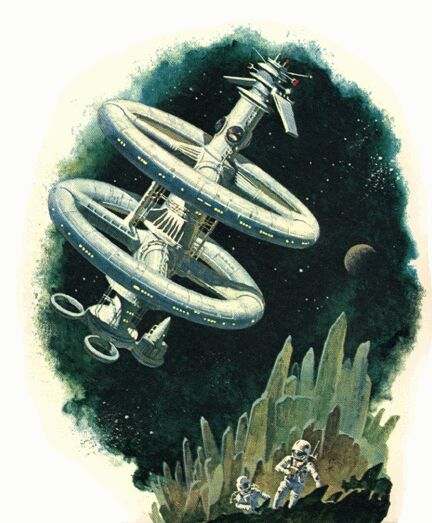
Artist unknown. Tales from the White Hart by Sir Arthur C. Clarke (1969)
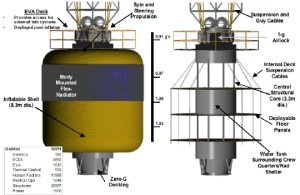
Habitat Module
TransHab module
TransHab modified for artificial gravity
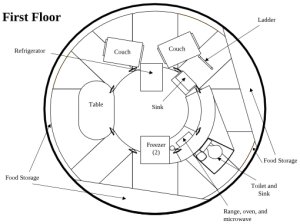
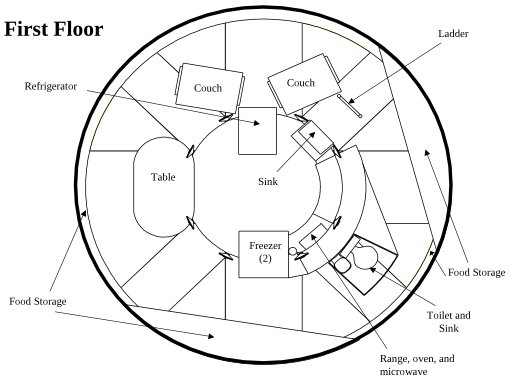
TransHab first floor
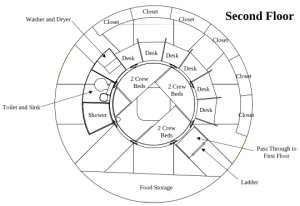
TransHab second floor
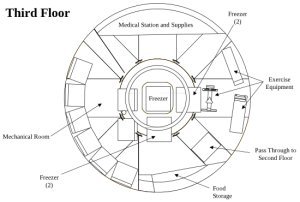
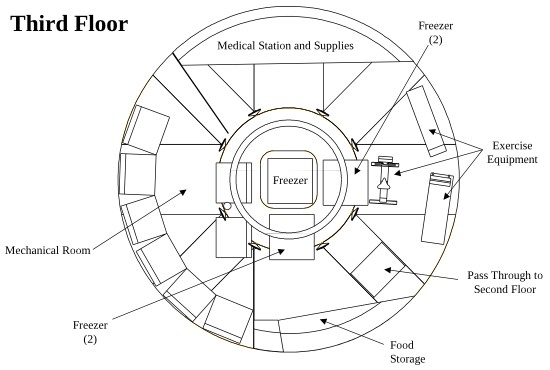
TransHab third floor
I belatedly realized that I am an idiot, overlooking a resource that I can plagiarize ... er, ah ... research. Back on the Advanced Design page was a section talking about a NASA report on TransHab which included a detailed break-down of the mass budget for a habitat module. It was for a six crew member mission with a duration of 18 months, which is close enough for government work to the Polaris' five crew member 16 month mission. I can cut and paste it into this example and see where it gets me. So ignore all the calculation in the "Life Support" section above. Refer to the original report for more details on each habitat module item.
System
Mass (kg)
Volume (m3)
Power System
Batteries
485 kg
0.44 m3
Internal power wiring
396 kg
16.40 m3
Power management
625 kg
1.05 m3
Avionics
Comm
169 kg
0.16 m3
Voice Peripherals
4 kg
0.01 m3
DMS
35 kg
0.50 m3
INS
39 kg
0.05 m3
Attitude Initialization
6 kg
0.01 m3
Displays & Controls
14 kg
0.01 m3
Video
8 kg
0.01 m3
Wiring
121 kg
0.25 m3
Enviro Control & Life Support
Atmosphere control
1133 kg
4.67 m3
Atmosphere revitalization
1021 kg
3.25 m3
Temperature and humidity
113 kg
6.32 m3
Fire detection/supression
13 kg
0.05 m3
Water recov/management
2199 kg
6.02 m3
Waste management
550 kg
11.19 m3
Thermal Control System
Internal thermal control
135 kg
0.34 m3
External thermal control
167 kg
thermal control radiators
274 kg
Crew Accommodations
storm cellar
1500 kg
galley and food
8063 kg
91.00 m3
Wardroom
194 kg
6.78 m3
waste collection system
327 kg
8.83 m3
personal hygeine
283 kg
8.83 m3
clothing
438 kg
1.91 m3
Rec and personal store
150 kg
3.00 m3
Housekeeping
215 kg
3.61 m3
Op supplies/restraints
120 kg
0.01 m3
Maintenance
1092 kg
5.91 m3
Sleep accommodations
120 kg
2.82 m3
Other
987 kg
21.81 m3
EVA Systems
Space Suits
690 kg
4.15 m3
Vehicle support EVA
291 kg
0.40 m3
EVA translation aids
123 kg
3.36 m3
EVA tools
132 kg
0.20 m3
Airlock
377 kg
8.18 m3
Medical Operations
Human research facility
289 kg
2.50 m3
Crew health care
759 kg
3.67 m3
Habitat Total
22,156 kg
227.7 m3
The paper totals up all the cubic meters under "Crew Accomodations" and uses that as a first approximation for available living space. It comes to about 168 m3. Divide by 5 crew members and you get 33.7 m3, which is about twice the spartan bare minimum of 17 m3. You will also note that each crew member has been alloted 30 kg/0.6 m3 for personal and recreational items.
Power Reactor
Reactor
System
Mass (kg)
Volume (m3)
1 MW reactor
493 kg
?? m3
0.18 m dia shadow shield
356 kg
?? m3
reactor radiator
83 kg
Reactor Total
932 kg
?? m3
I'm not sure what the power budget for the Polaris will be. With the severely limited payload allowance, I'm sure it will be impossible to fit in a massive power hog system like a Free-electron laser. Until I can figure out something better, I'll just assume it needs one megawatt. Later I might try to figure out the surface area of the Polaris' heat radiators and do some pointless calculations on the maximum power size.
On the Basic Design page, it describes a 1 megawatt reactor that has a mass of 493 kg. I have no idea what its volume is, though.
We need a shadow shield to protect the crew from the deadly radiation from the reactor. The SPAD has a typical shadow shield as about 3,500 kilograms per square meter of shield. Yikes! For first approximation the shield is a disc with a radius equal to the reactor core. Somewhere (I'll look it up, I promise!) I saw a NASA paper on an ion-drive spacecraft with a 1 MW reactor with a radius of 18 centimeters (0.18 meters). This would make the shield 356 kg. Not sure about the volume, but at those densities it cannot be much.
The heat radiators are external, so their volume does not have to be subtracted from the payload volume. At the link, the quote from Tremolo says "Our current light water reactors have about a 35% efficiency for conversion to electric power." So if the reactor is putting out 1 MW of usable power, it is putting out 1.9 MW of waste heat. Optimistically a radiator is about 0.01 kilograms per waste kilowatt dissipated. So the radiator will be about 83 kilograms.
Goodies
Remainder
System
Mass (kg)
Volume (m3)
Payload allowance
46,143 kg
252 m3
Minus
x5 Crew
340 kg
in habitat allowance
Habitat Module
22,156 kg
227.7 m3
Reactor
932 kg
?? m3
Remainder
22,715 kg
24.3 m3
Minus
x2 Space Taxis
2,896 kg
4 m3
x2 Space Taxi refuel
1,650 kg
1.65 m3
1 g/cm2 armor
4,330 kg
x6 x17 Casaba howitzer
6,900 kg 1,955 kg
2.4 m3
x5 Gyrojet pistols +90 rounds
2.8 kg
Remainder (cargo)
6,936 kg 11,881 kg
16.25 m3
After deducting the crew, habitat module, and reactor from the available payload we find that there is 22,715 kg and 24.3 m3 with which to customize the Polaris.
The Tom Corbett Space Cadet novels mention that the Polaris has a couple of "jet boats." A couple of fully fueled Project Orion 2-person space taxis will cost 2896 kg and 4 m3. Throw in one refuel for each for an additional 1650 kg and 1.65 m3.
Armor is a problem, it really eats into your payload mass allotment. One 5 g/cm2(50 kg/m2) over a ship with a surface area of 433 m2 is 21,650 kg. This would eat up almost all of our remaining payload. I'll scrimp and only use 1 g/cm2. That is only 4,330 kg, but the question arises is such a tin-foil like layer of armor even worth it? In the RocketCat universe I have the Polaris armored in muon-metal, which is very dense but very unobtainium.
Finally, we have to have some kind of weapon. But we cannot afford much. A single Trident missile is a whopping 58,500 kg, which is way over budget. Casaba howitzer charges are low mass (we conjecture, it's still classified). My best guess is each charge is about 1,150 kg and 0.4 m3. We can just about afford six of them, for a total of 6,900 kg and 2.4 m3 Just got the latest inside scoop from Scott Lowther. He estimates each Casaba Howitzer charge is only about 115 kg and 0.14 m3. So 60 of the the deadly little things will fit in 6,900 kg, but only 17 charges will fit into 0.4 m3. So that is x17 Casaba howitzer charges at 1,955 kg and 0.4 m3
And just for the heck of it, issue each of the crew members a Gyrojet rocket pistol with 18 rounds (3 magazines). Hey, if a rocket gun is good enough for Buck Rogers, it is good enough for the Polaris crew. Each pistol is 0.4 kg, and each round is 0.009 kg.
This will leave a paltry 6,939 kg 11,884 kg and 16.25 m3 for random cargo.
Now if the Polaris was going to war, it could use the random cargo allotment for 40 more Casaba Howitzer charges. That would use up the remaining 16.25 m3 of cargo volume. The ship has enough spare cargo mass allotment to add about 100 more charges, but there isn't enough volume. It ran out of volume allotment before it ran out of mass allotment. In the terminology, it bulked-out before it massed-out.
With such a limited payload, what is the Polaris useful for besides transporting five people? This probably means that the Polaris design should be scaled up a bit. The habitat and reactor mass is fixed, scaling up the ship will give more remainder payload to add goodies.
Byron Coffey did an analysis of the Polaris performing a lift-off from Terra.
I had a bit more time to play launch vehicles,
and I managed to track down some MATLAB code that will do gravity turns and
basic booster analysis. I decided to plug in your Polaris, and played with
the numbers until it went close to being in a reasonable circular orbit:
Trial 1
Initial flight path angle
27 deg
Pitchover altitude
130 m
Burn time
81.7309 s
Final speed
7.15147 km/s
Final flight path angle
6.42764 deg
Altitude
41.666 km
Downrange distance
278.328 km
Drag loss
1.30739 km/s
Gravity loss
0.160685 km/s
Apoapsis
214.15 km
Circularization Delta-V
855.4 m/s
Gravity Drag Factor
0.200
Total Delta-V
9475.0 m/s
However, this is grossly overpowered. To avoid going into a ludicrously
high orbit, I had to dial the initial angle way down, which is undesirable
because of what it does to the drag number, and the fact that you're flying
low to the ground with a NSWR. Also, there's going to be more drag after
burnout, so the delta-V here is quite low. It turns out that flying a
lower T/W gives better overall performance. It looks like T/W 3-4 on launch is
about perfect.
I suspect there's still going to be a reasonable amount of drag, but it's
not totally outrageous.
Also, lower T/W would mean you need less engine, and can have more other
stuff onboard. I'm still trying to work out a way to get the code I have
into a form people who don't have MATLAB can use.
T/W = 4:
Initial flight path angle
57 deg
Pitchover altitude
130 m
Burn time
214.544 s
Final speed
7.88897 km/s
Final flight path angle
0.728657 deg
Altitude
64.4822 km
Downrange distance
784.973 km
Drag loss
0.321213 km/s
Gravity loss
0.40909 km/s
Apoapsis
193.60 km
Circularization Delta-V
54.8 m/s
Gravity Drag Factor
0.194
Total Delta-V
8674.4 m/s
T/W = 3:
Initial flight path angle
72 deg
Pitchover altitude
130 m
Burn time
286.058 s
Final speed
7.7951 km/s
Final flight path angle
0.914701 deg
Altitude
109.762 km
Downrange distance
1008.53 km
Drag loss
0.123772 km/s
Gravity loss
0.700486 km/s
Apoapsis
163.61 km
Circularization Delta-V
76.0 m/s
Gravity Drag Factor
0.250
Total Delta-V
8695.6 m/s
I can do better than that. I played with the numbers a bit more, looking
at a ~200 km orbit, and I've included all three outputs. The code also
outputs a couple of plots, but it's going to take a little while to get all
three sets of data on the same axes and in a form that might be postable.
T/W = 10:
Initial flight path angle
27 deg
Pitchover altitude
130 m
Burn time
81.5492 s
Final speed
7.13266 km/s
Final flight path angle
6.43016 deg
Altitude
41.5207 km
Downrange distance
277.046 km
Drag loss
1.30679 km/s
Gravity loss
0.160488 km/s
Apoapsis
209.71 km
Circularization Delta-V
871.8 m/s
Gravity Drag Factor
0.201
Total Delta-V
9471.8 m/s
T/W = 4:
Initial flight path angle
57.18 deg
Pitchover altitude
130 m
Burn time
214.067 s
Final speed
7.87434 km/s
Final flight path angle
1.05931 deg
Altitude
68.8326 km
Downrange distance
781.083 km
Drag loss
0.306026 km/s
Gravity loss
0.419502 km/s
Apoapsis
208.23 km
Circularization Delta-V
73.1 m/s
Gravity Drag Factor
0.200
Total Delta-V
8673.1 m/s
T/W = 3:
Initial flight path angle
72.25 deg
Pitchover altitude
130 m
Burn time
285.422 s
Final speed
7.75005 km/s
Final flight path angle
1.55674 deg
Altitude
121.122 km
Downrange distance
998.612 km
Drag loss
0.120114 km/s
Gravity loss
0.728703 km/s
Apoapsis
206.83 km
Circularization Delta-V
133.9 m/s
Gravity Drag Factor
0.260
Total Delta-V
8733.9 m/s
I did a bit more tinkering, and managed to get the code to run each version
out to 8 minutes, which meant it was able to account for all of the drag.
I've attached the revised plots, and the results. I compensated the
gravity drag values for this, so they're only the drag values during the
burn, and the factor is only relative to the burn.
Note that these are not necessarily the most efficient trajectories to
fly. All involved using 8600 m/s for the initial boost, and then aiming
for a ~200 km orbit, with circularization delta-V being the only variable.
I'm going to play with lowering the initial delta-V (which was originally a
rectal extraction anyway) and seeing if I can find more efficient flight
paths with more of the burn made outside the atmosphere. This should
improve things some, although I expect that the T/W = 10 will still do
poorly.
T/W = 10:
Initial flight path angle
27.91 deg
Pitchover altitude
130 m
Burn time
85.6267 s
Final speed
6.93375 km/s
Final flight path angle
0.240133 deg
Altitude
200.673 km
Downrange distance
2987.26 km
Drag loss
1.28702 km/s
Gravity loss
0.167672 km/s
Apoapsis
200.90 km
Circularization Delta-V
850.4 m/s
Gravity Drag Factor
0.200
Total Delta-V
9450.4 m/s
T/W = 4:
Initial flight path angle
57.2 deg
Pitchover altitude
130 m
Burn time
214.067 s
Final speed
7.82175 km/s
Final flight path angle
1.05118 deg
Altitude
108.759 km
Downrange distance
2837.89 km
Drag loss
0.309448 km/s
Gravity loss
0.420664 km/s
Apoapsis
202.34 km
Circularization Delta-V
73.7 m/s
Gravity Drag Factor
0.200
Total Delta-V
8673.7 m/s
T/W = 3:
Initial flight path angle
72.23 deg
Pitchover altitude
130 m
Burn time
285.422 s
Final speed
7.71036 km/s
Final flight path angle
1.17619 deg
Altitude
155.236 km
Downrange distance
2470.3 km
Drag loss
0.120399 km/s
Gravity loss
0.726431 km/s
Apoapsis
201.17 km
Circularization Delta-V
128.7 m/s
Gravity Drag Factor
0.259
Total Delta-V
8728.7 m/s
I did some tests at reduced initial delta-V. I didn't plot any of them
yet, but they should provide some idea of what sort of trajectories are
possible. I should add that I was playing with the total time to get the
final altitude in the ballpark I wanted it (~150 km). Also, it should be
noted that the gravity drag figures are not reliable, as I did not
compensate them like I did those above. The drag magnitude is for the
entire period of integration, which varied depending on the initial delta-V.
DV = 8000 m/s initial
T/W = 10:
Initial flight path angle
29.05 deg
Pitchover altitude
130 m
Burn time
79.7831 s
Final speed
6.5801 km/s
Final flight path angle
2.84436 deg
Altitude
181.712 km
Downrange distance
1688.19 km
Drag loss
1.04799 km/s
Gravity loss
0.371957 km/s
Apoapsis
201.60 km
Circularization Delta-V
1231.3 m/s
Gravity Drag Factor
0.475
Total Delta-V
9231.3 m/s
DV = 8000 m/s initial
T/W = 4:
Initial flight path angle
58.9 deg
Pitchover altitude
130 m
Burn time
199.458 s
Final speed
7.20215 km/s
Final flight path angle
3.12853 deg
Altitude
148.619 km
Downrange distance
1376.37 km
Drag loss
0.228781 km/s
Gravity loss
0.56919 km/s
Apoapsis
201.76 km
Circularization Delta-V
650.0 m/s
Gravity Drag Factor
0.291
Total Delta-V
8650.0 m/s
DV = 8000 m/s initial
T/W = 3:
Initial flight path angle
72.95 deg
Pitchover altitude
130 m
Burn time
265.944 s
Final speed
7.07216 km/s
Final flight path angle
3.08721 deg
Altitude
158.703 km
Downrange distance
1078.22 km
Drag loss
0.111336 km/s
Gravity loss
0.816371 km/s
Apoapsis
201.05 km
Circularization Delta-V
767.3 m/s
Gravity Drag Factor
0.313
Total Delta-V
8767.3 m/s
At this point, delta-V for the T/W = 3 case is going up, so I dropped it
from further tests.
DV = 7500 m/s initial
T/W = 10
Initial flight path angle
30.1 deg
Pitchover altitude
130 m
Burn time
74.8988 s
Final speed
6.2009 km/s
Final flight path angle
2.39828 deg
Altitude
190.956 km
Downrange distance
1605.23 km
Drag loss
0.895938 km/s
Gravity loss
0.403182 km/s
Apoapsis
200.88 km
Circularization Delta-V
1597.7 m/s
Gravity Drag Factor
0.549
Total Delta-V
9097.7 m/s
DV = 7500 m/s initial
T/W = 4
Initial flight path angle
59.66 deg
Pitchover altitude
130 m
Burn time
187.247 s
Final speed
6.66838 km/s
Final flight path angle
3.41618 deg
Altitude
170.08 km
Downrange distance
1314.43 km
Drag loss
0.209062 km/s
Gravity loss
0.622781 km/s
Apoapsis
201.24 km
Circularization Delta-V
1158.6 m/s
Gravity Drag Factor
0.339
Total Delta-V
8658.6 m/s
T/W = 4 has started to go up, so it has also been dropped.
DV = 7000 m/s initial
T/W = 10
Initial flight path angle
31.27 deg
Pitchover altitude
130 m
Burn time
70.001 s
Final speed
5.82418 km/s
Final flight path angle
4.18311 deg
Altitude
178.836 km
Downrange distance
1175.76 km
Drag loss
0.771064 km/s
Gravity loss
0.404803 km/s
Apoapsis
200.74 km
Circularization Delta-V
1994.6 m/s
Gravity Drag Factor
0.589
Total Delta-V
8994.6 m/s
DV = 6000 m/s initial
T/W = 10
Initial flight path angle
34.1 deg
Pitchover altitude
130 m
Burn time
60.1649 s
Final speed
4.94637 km/s
Final flight path angle
3.67476 deg
Altitude
192.213 km
Downrange distance
1022.86 km
Drag loss
0.574641 km/s
Gravity loss
0.478994 km/s
Apoapsis
201.32 km
Circularization Delta-V
2854.2 m/s
Gravity Drag Factor
0.812
Total Delta-V
8854.2 m/s
At this point, the model is starting to break down slightly. I'm not
certain that burns as big as this one can be assumed to be instant, which
is the basis for the calculations. However, I will ignore this, as the
approximation should still be pretty good.
DV = 5000 m/s initial
T/W = 10
Initial flight path angle
37.9 deg
Pitchover altitude
130 m
Burn time
50.2747 s
Final speed
4.05972 km/s
Final flight path angle
8.33846 deg
Altitude
175.16 km
Downrange distance
615.022 km
Drag loss
0.424973 km/s
Gravity loss
0.51526 km/s
Apoapsis
200.65 km
Circularization Delta-V
3782.7 m/s
Gravity Drag Factor
1.045
Total Delta-V
8782.7 m/s
DV = 4000 m/s initial
T/W = 10
Initial flight path angle
43.7 deg
Pitchover altitude
130 m
Burn time
40.3299 s
Final speed
3.04832 km/s
Final flight path angle
9.61331 deg
Altitude
184.193 km
Downrange distance
475.527 km
Drag loss
0.301192 km/s
Gravity loss
0.650448 km/s
Apoapsis
200.67 km
Circularization Delta-V
4786.0 m/s
Gravity Drag Factor
1.644
Total Delta-V
8786.0 m/s
By now, T/W = 10 is going up as well. I assume that the ideal location
might be somewhere around 4500 m/s, so I ran that as a last test
DV = 4500 m/s initial
T/W = 10
Initial flight path angle
40.45 deg
Pitchover altitude
130 m
Burn time
45.3091 s
Final speed
3.56485 km/s
Final flight path angle
8.8907 deg
Altitude
180.035 km
Downrange distance
548.172 km
Drag loss
0.360414 km/s
Gravity loss
0.574759 km/s
Apoapsis
200.67 km
Circularization Delta-V
4273.0 m/s
Gravity Drag Factor
1.293
Total Delta-V
8773.0 m/s
So it turns out that the absurdly high acceleration didn't cost as much as
you might think, and is in fact very close to the other T/Ws, although the
circularization burn is larger than the initial burn. Overall, though,
you're better off with the smaller engine.
-- Byron Coffey
Poster
Poster preview, click for larger image
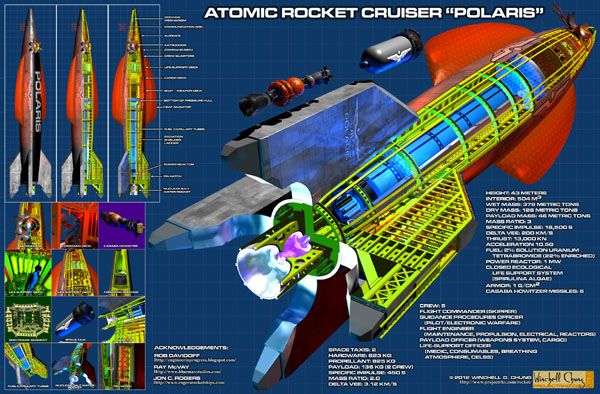
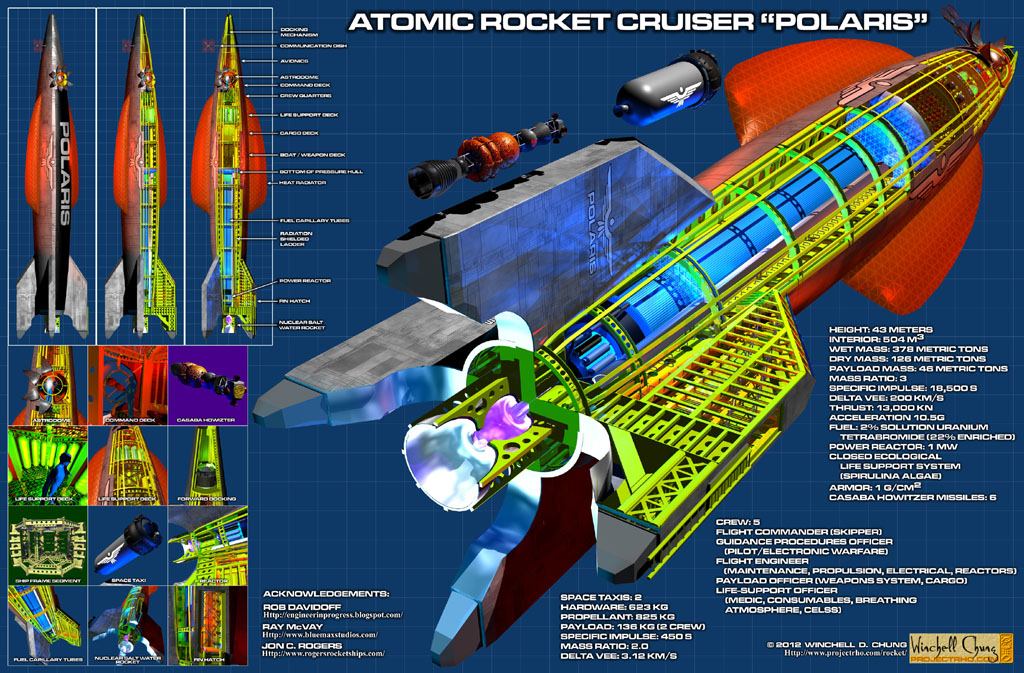
Shameless plug, I made a poster of the Polaris, you can purchase it here.
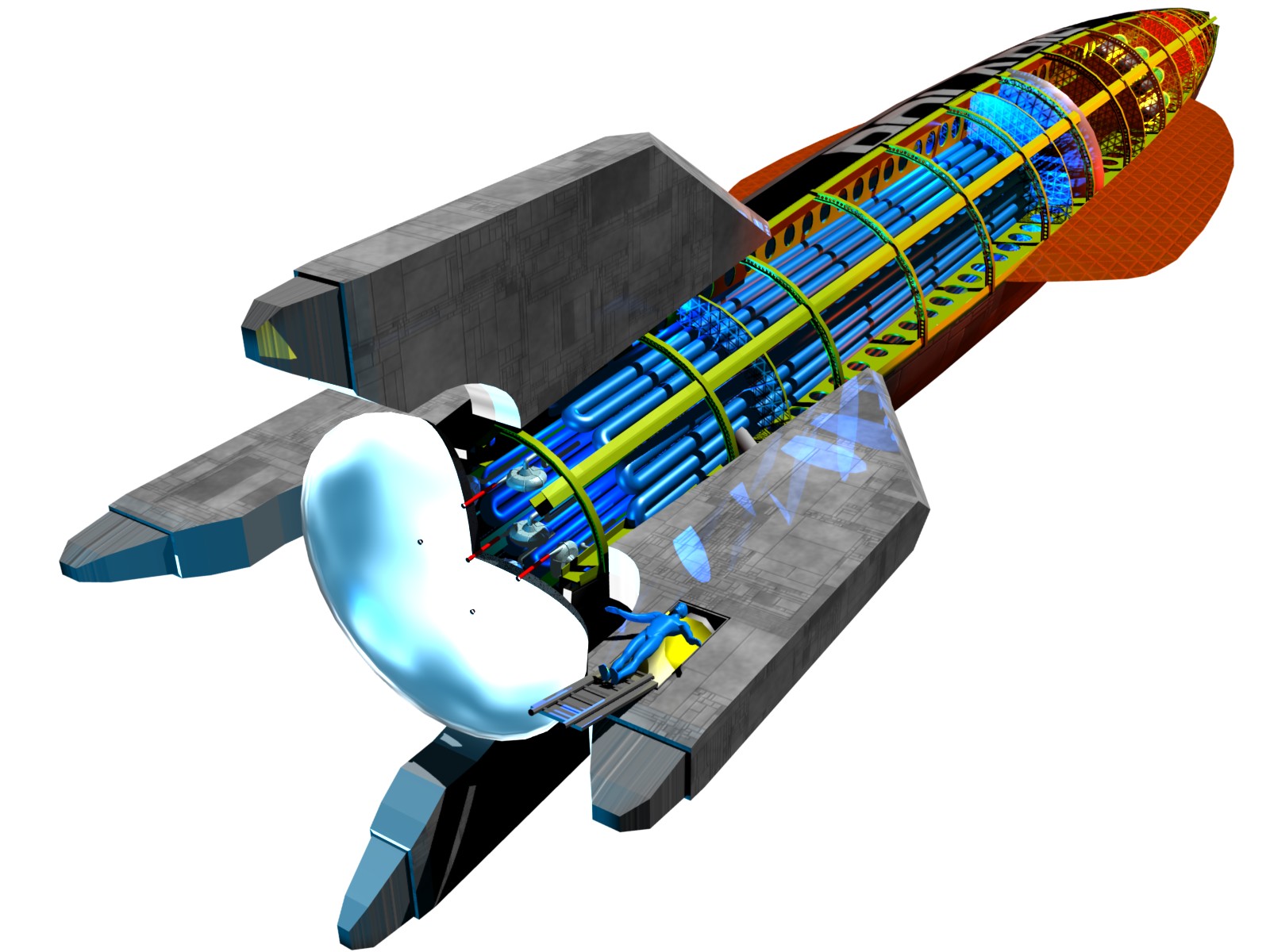
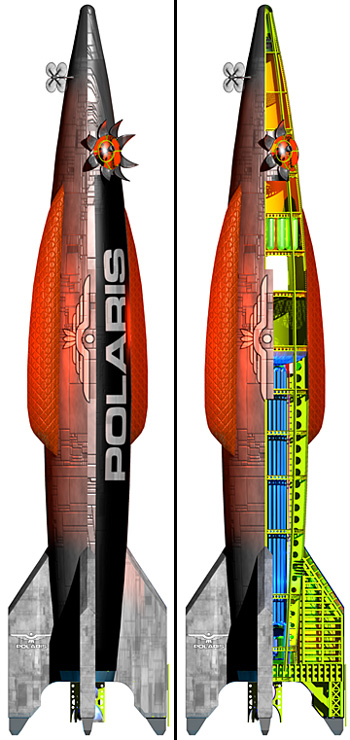
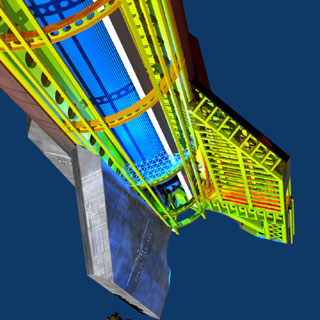
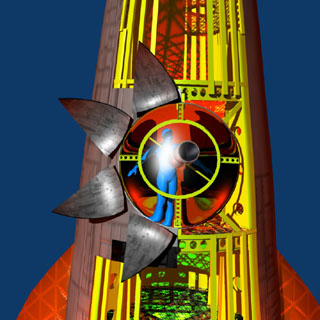
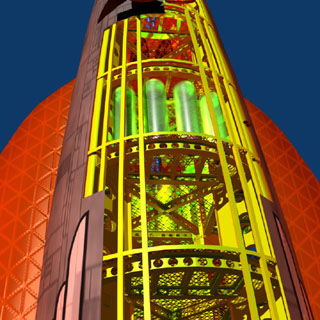
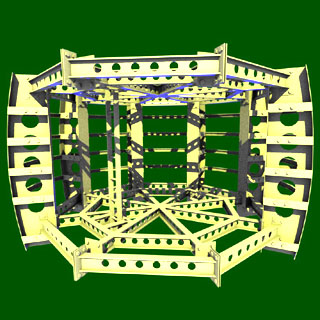
The details are more or less the ones calculated for the 43 meters tall Polaris. This is the shorter of the two Polaris versions, but as you can see it is still freaking tall. The door on the tail fin at the top of the ladder is 2 meters tall, just to give you some idea of scale. The basic outline is as drawn by master researcher and blueprint draftsman Jon Rogers. The ship's skeleton was designed by an engineer who goes by the handle JanJaap. Additional engineering expertise was supplied by Rob Davidoff. The crew is based on the budget version of the Mission Control Model proposed by Rick Robinson and developed by Ray McVay. The structural girders are painted a splendid bilious zinc chromate yellow-green. They are also full of circular lightening holes. There is an over-sized astrodome for navigation purposes. The life support deck has huge glowing green tanks filled with spirulina algae. The magazine contains six deadly missiles with Casaba howitzer warheads, ready to skewer hostile warships with swords of pure nuclear flame. The hangar bay carries two space taxis(in the Tom Corbett novels they called these "jet boats"). And the propulsion system is Zubrin's outrageous continuously-detonating Nuclear Salt-Water Rocket.
It is amazing what one can create with an open-source CGI editor application like Blender, and a lot of work. Plus a little help from your friends, and from the website you wrote.
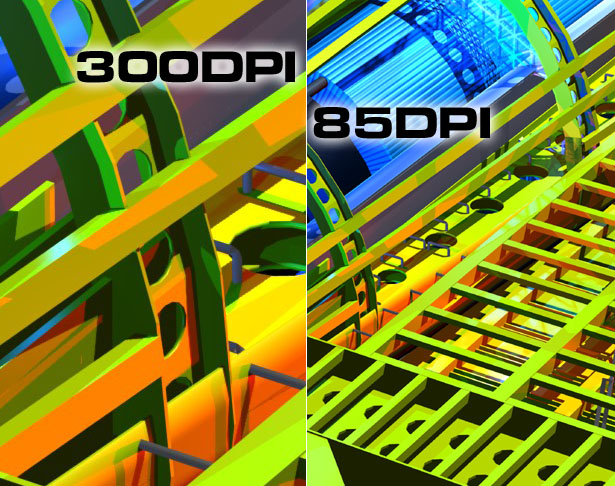
This gives you an idea of the detail. The 300DPI shows how fine the detail is, the 85DPI is about the actual size it will appear on the printed poster.
View looking down towards the tail
Astrodome with navigational telescope and protective metal shutters
View towards the algae tanks on the life support deck
Detail of the girder structure of the ship decks
This is a selection of the ship scenes in the lower left.
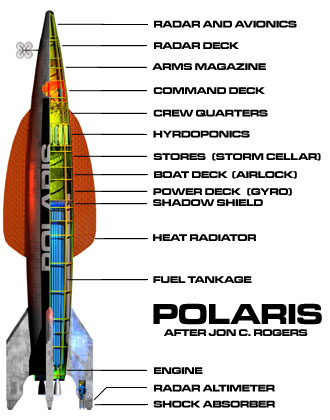


 According to the novels the Polaris is 61 meters tall (200 feet) and 181 metric tons of mass (200 US tons). However, the indispensable Spaceship Handbook, scaling from images from the TV show, say it is closer to 43 meters (140 feet). That seems more reasonable to me.