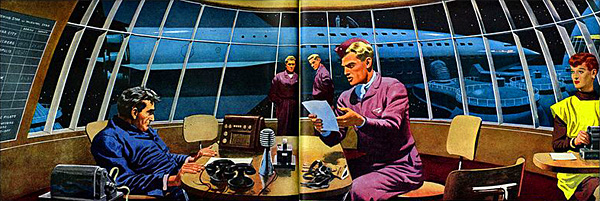
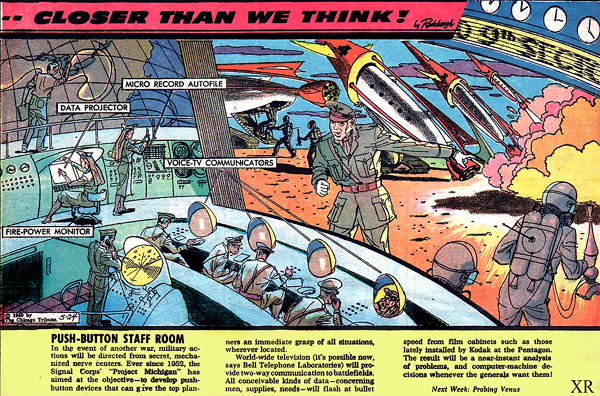
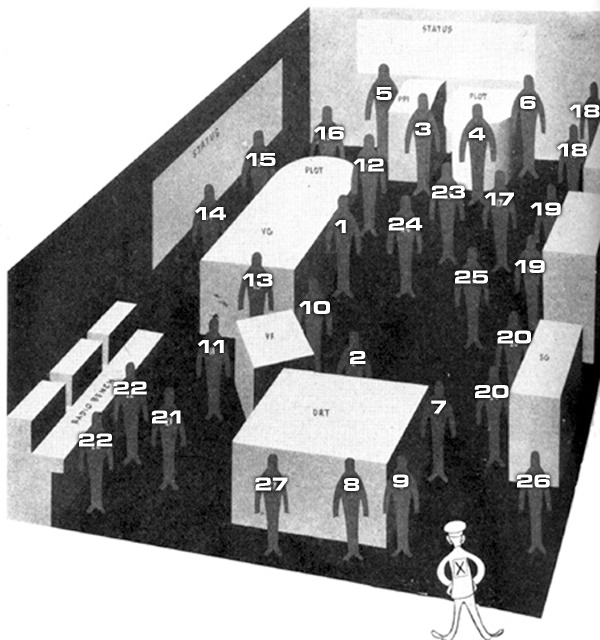
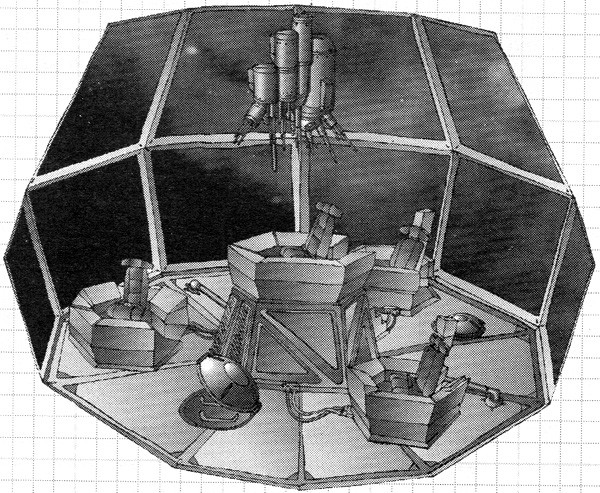
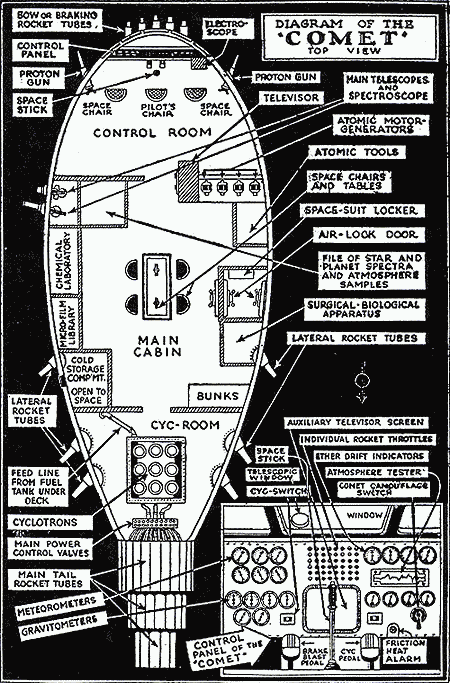
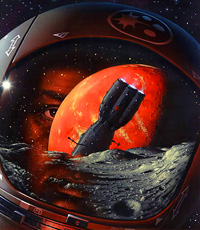
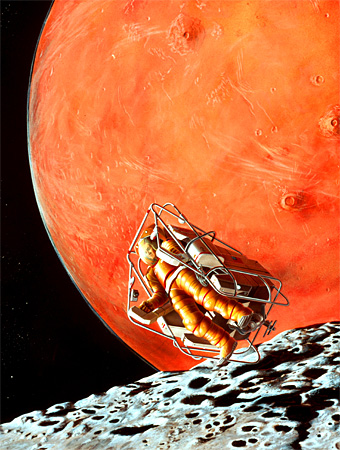
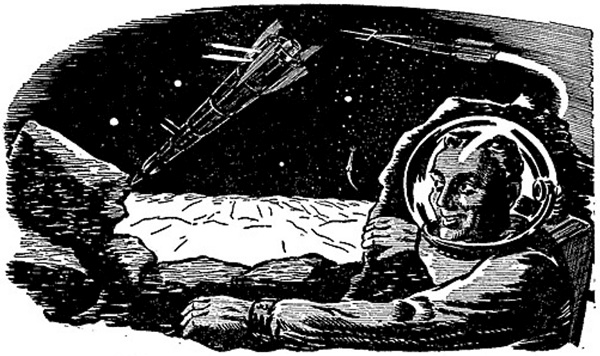
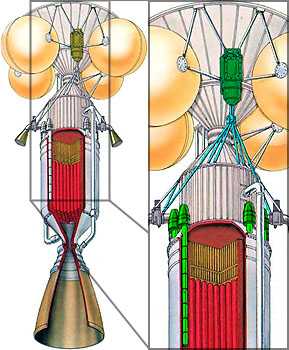
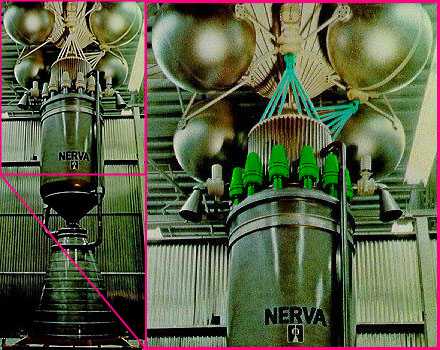
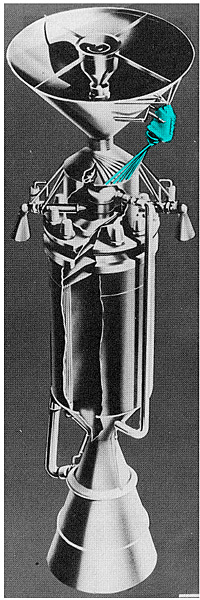
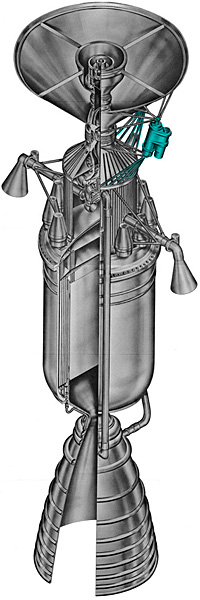
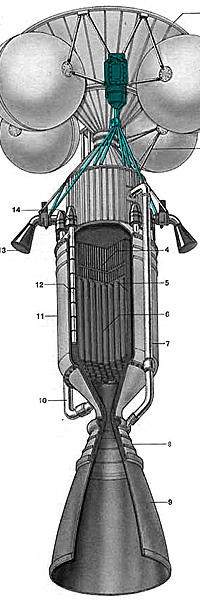
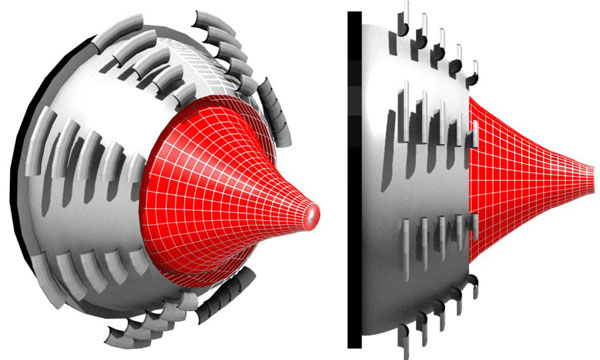
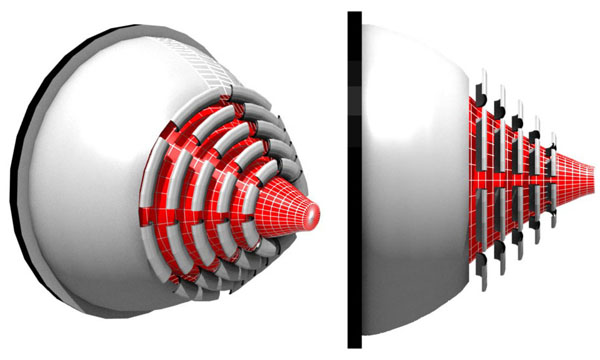
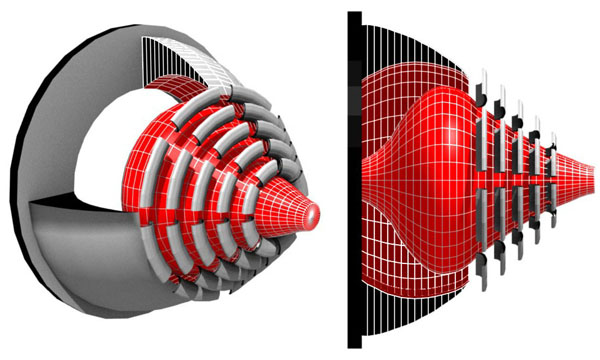
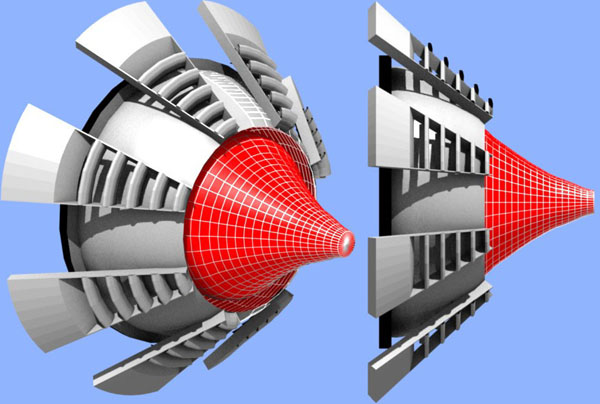
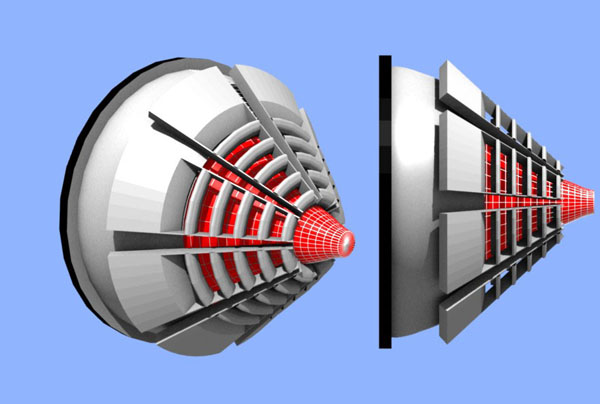
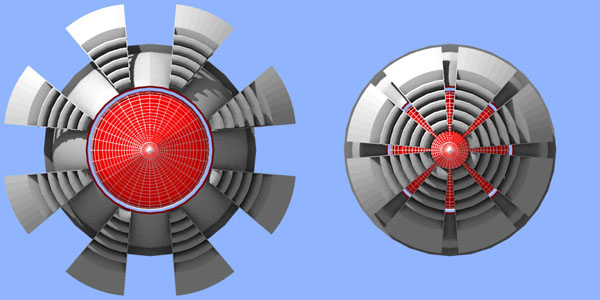
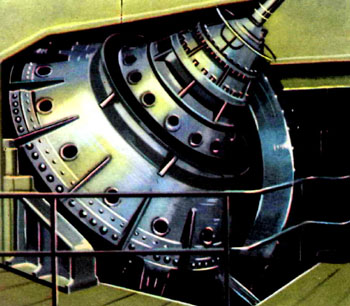
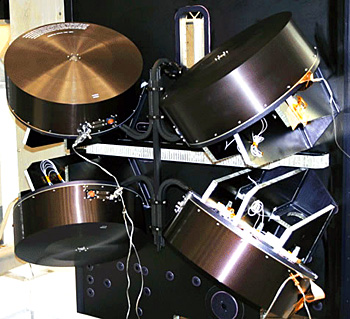
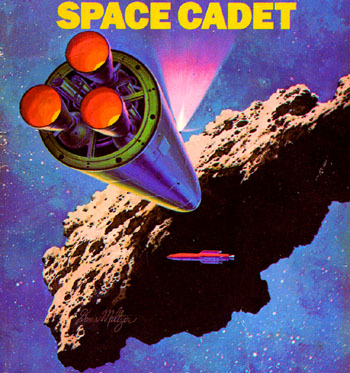
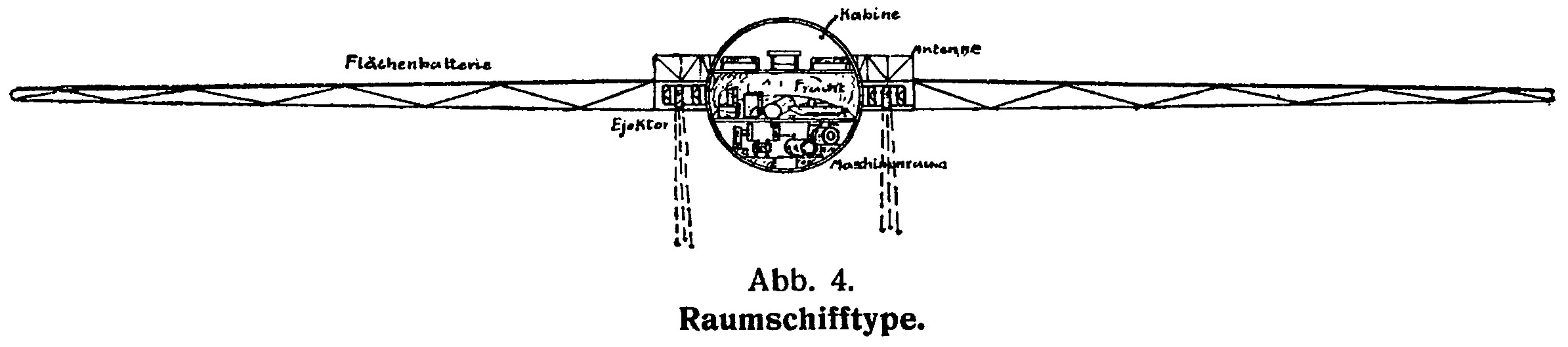
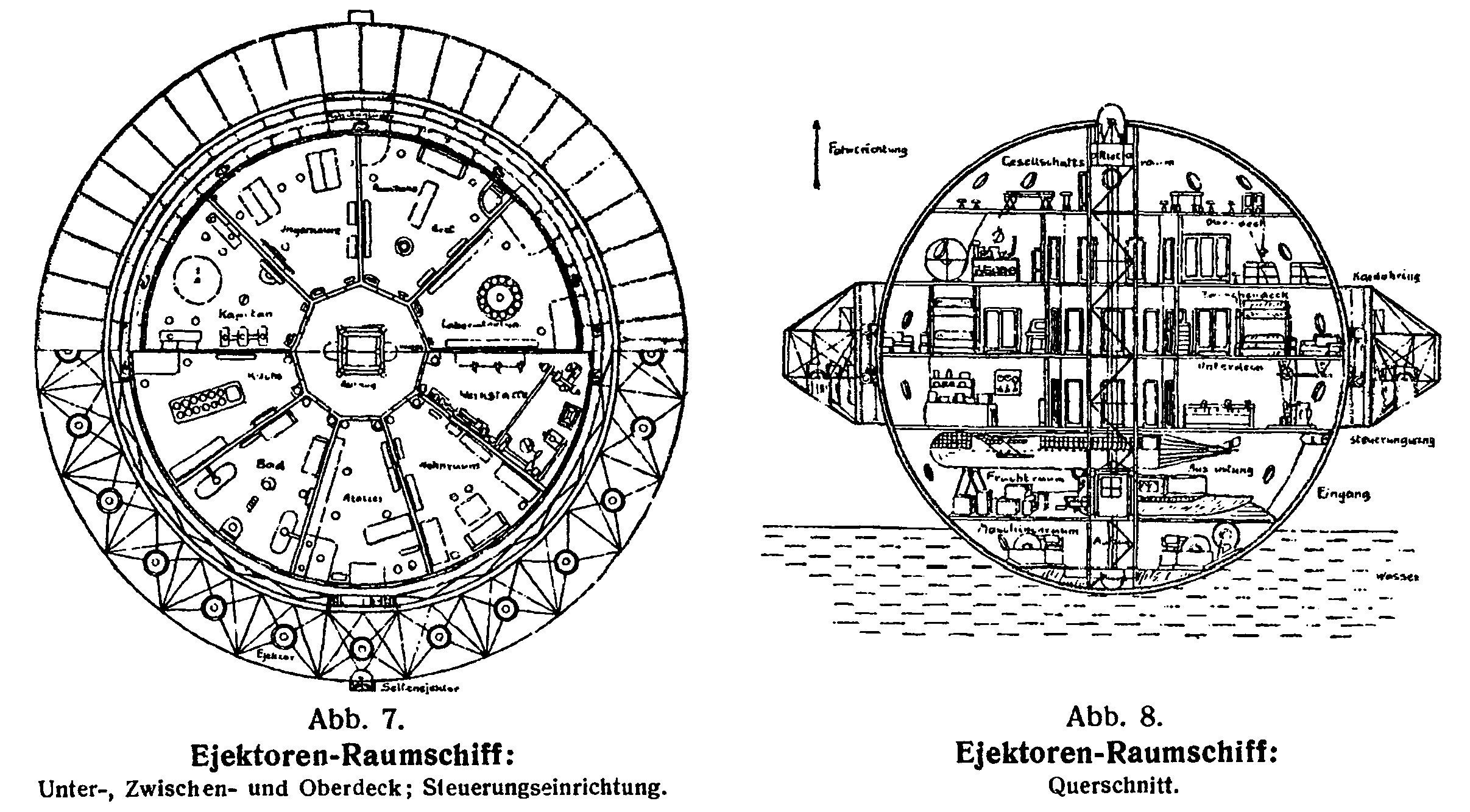
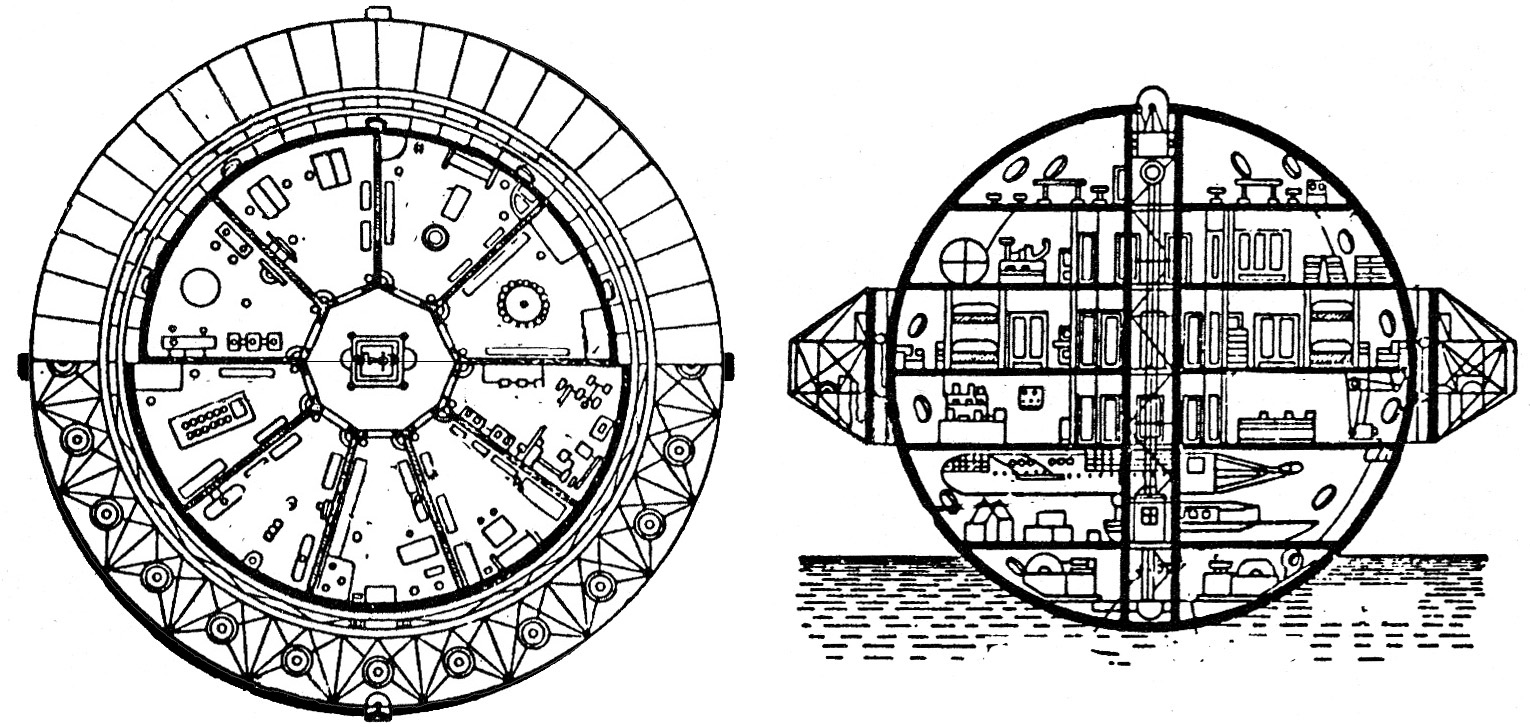
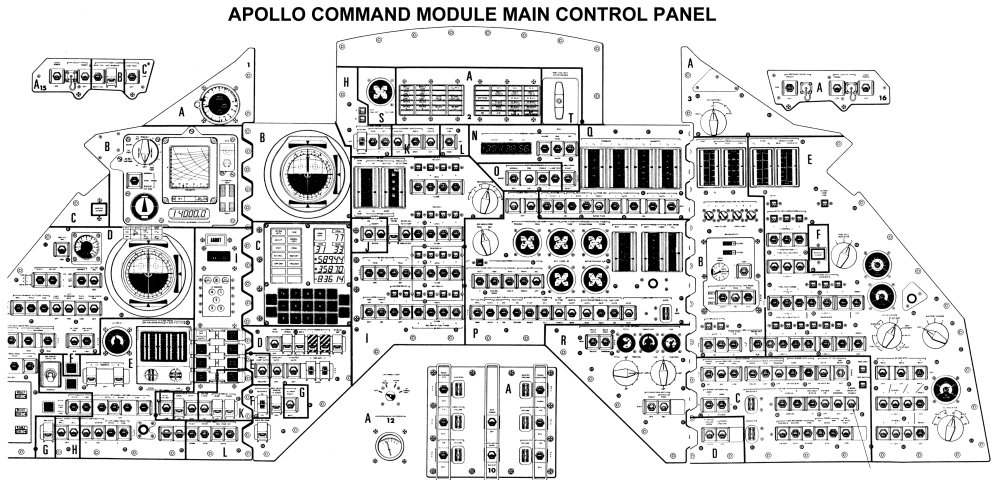
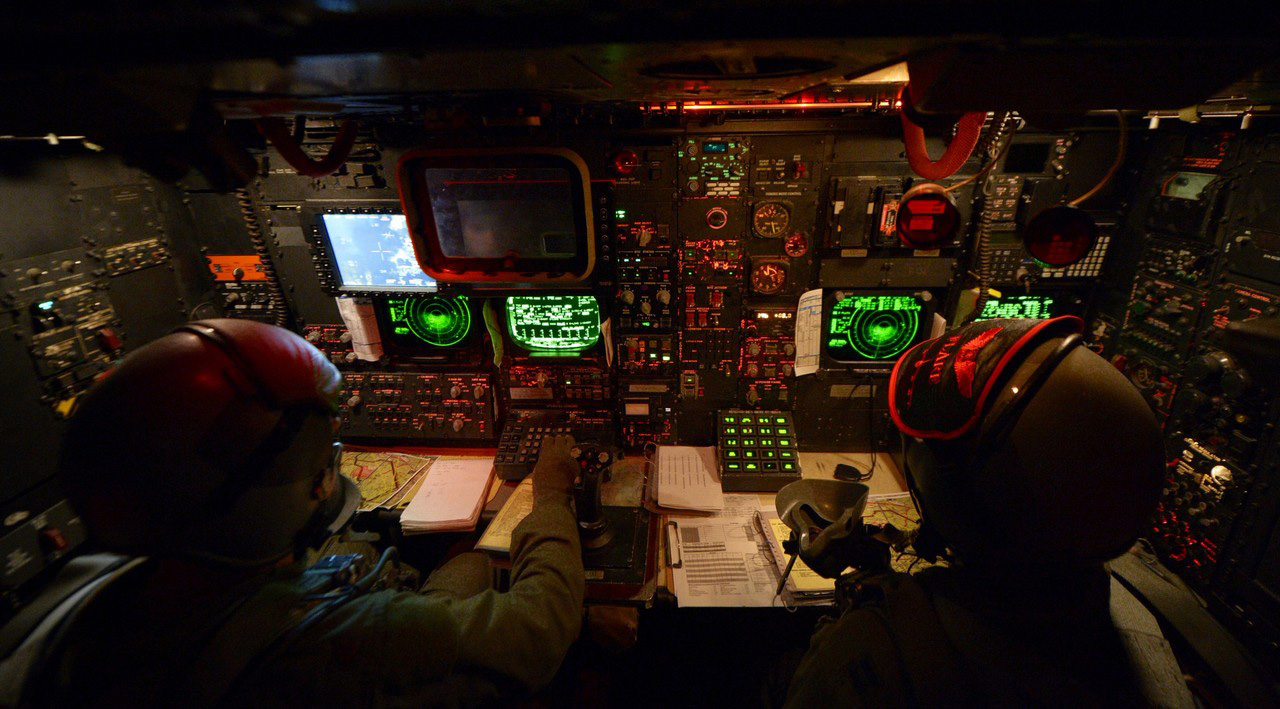
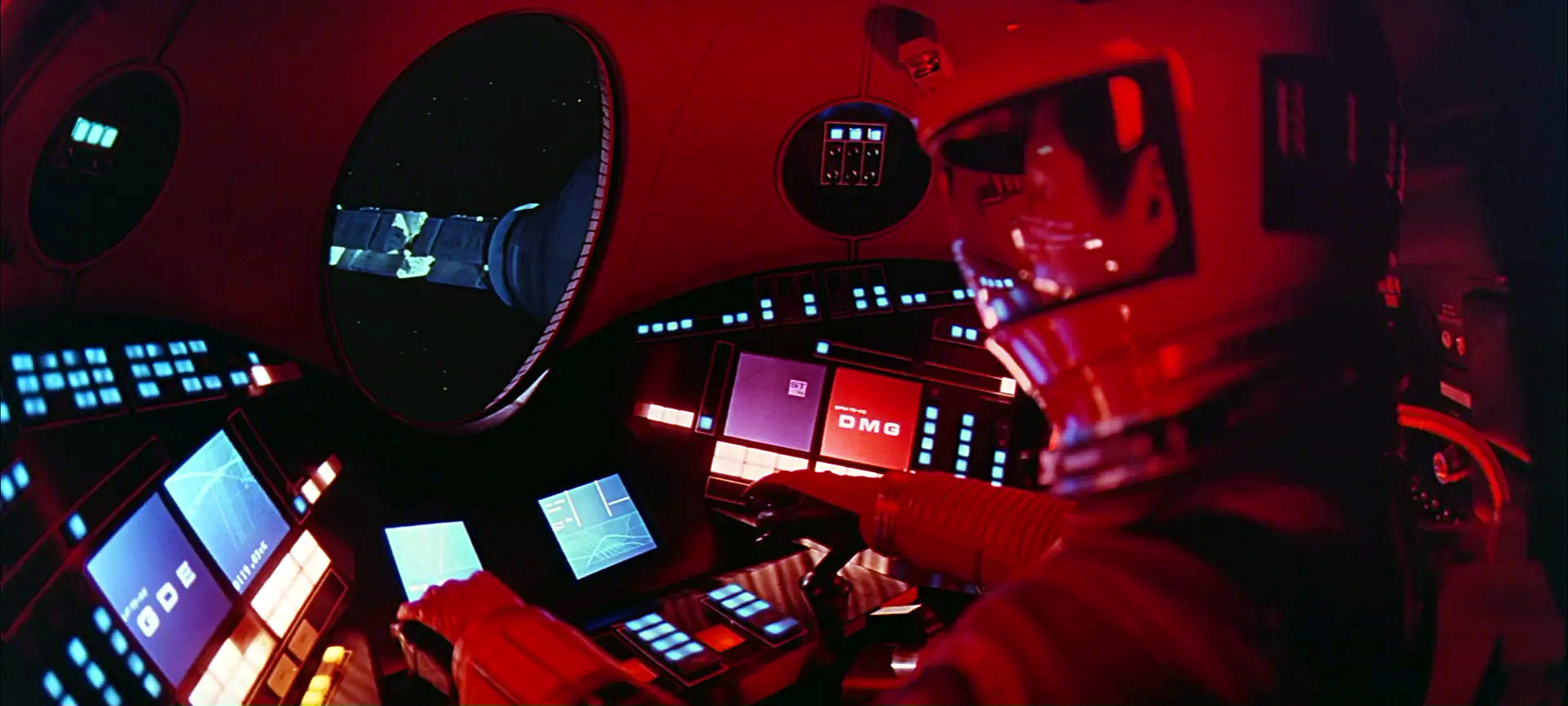
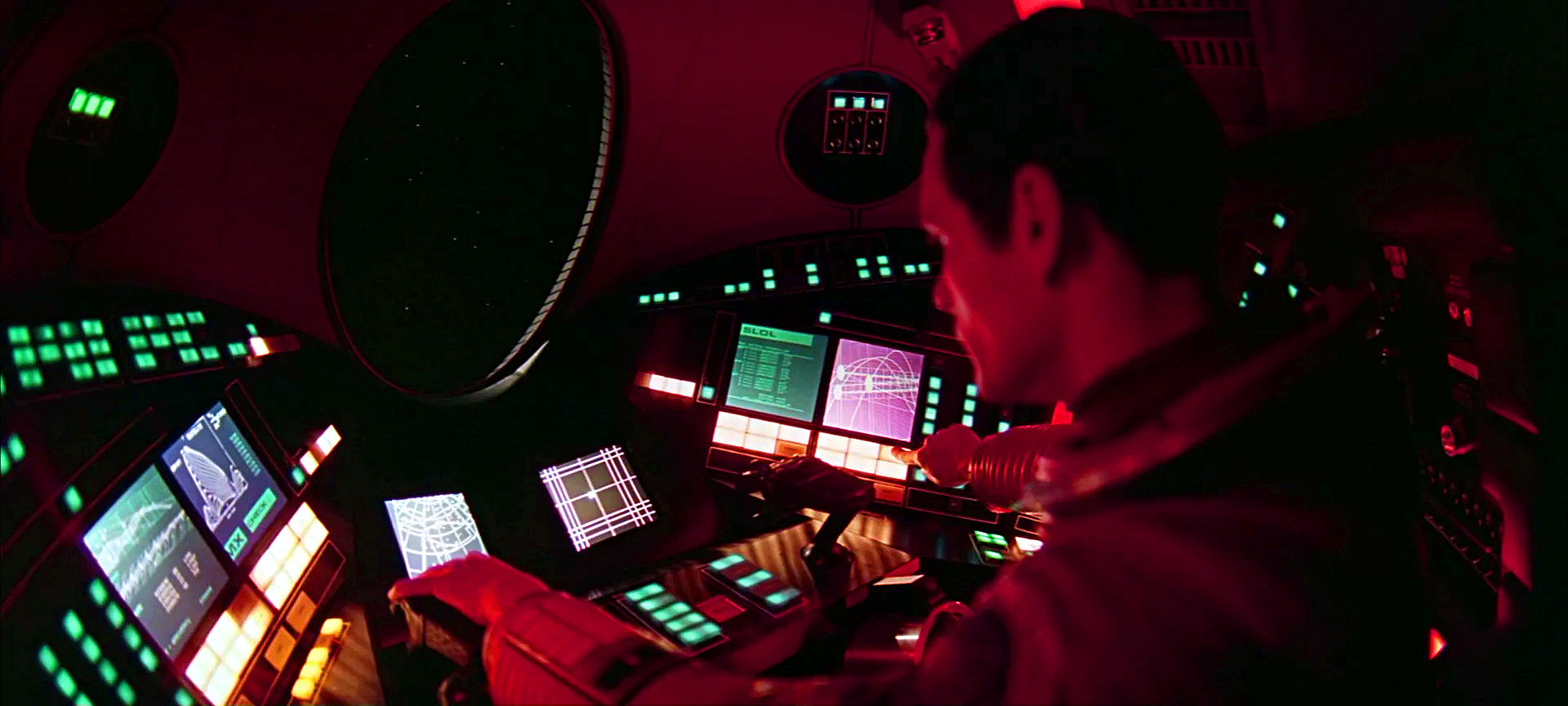
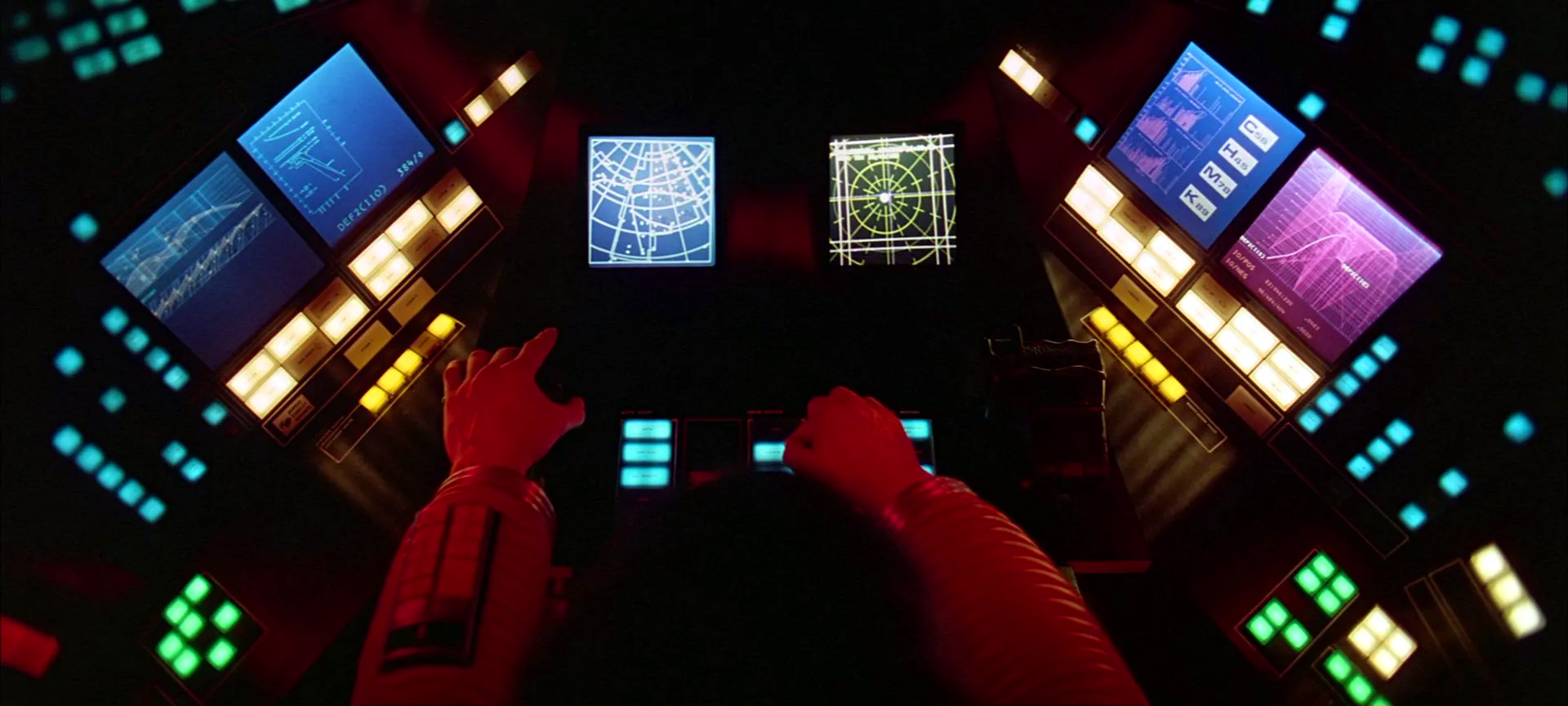
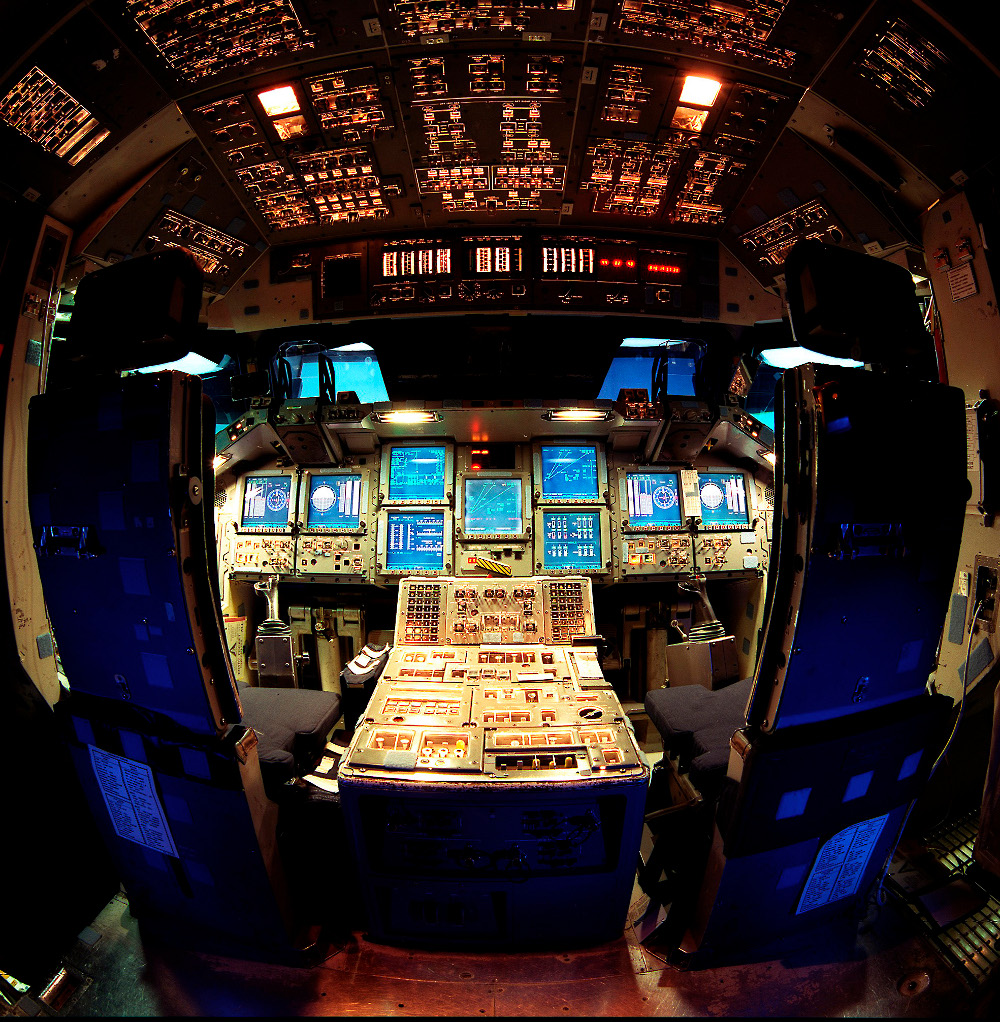
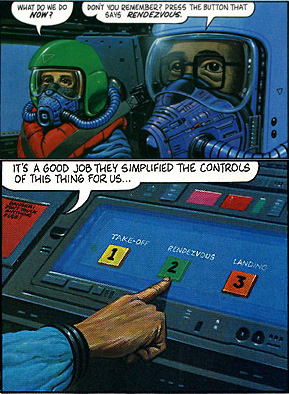
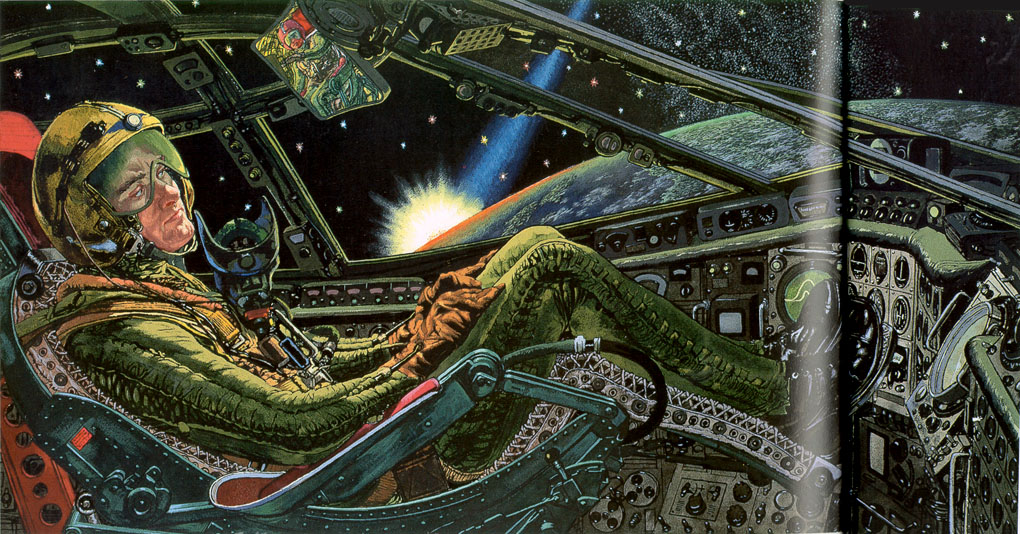
Top image artwork by Noel Sickles for Rocket to the Moon, LIFE magazine January 17, 1949. Lower left artwork by Louis S. Glanzman for On The Trail of the Space Pirates by Cary Rockwell 1953, a Tom Corbett Space Cadet book. Lower right from Space Race card game from Ed-U-Games, 1969. As you can see, artists of that era tended to "borrow" a lot.
Introduction
Artwork by Kurt Röschl, for Erich Dolezal: Raumflotte I (1952)
This is where the spacecraft's pilot flies the ship. In fiction it is often the dramatic focus. Even though without help from the astrogator, engineer, and ship's captain one will find that the pilot is helpless. Flying a spacecraft is a team effort, but Hollywood finds that to be boring.
THE SHATTERED STARS
Callahan squeezed into the crowded flight deck. Grander starships, the handsome corporate-line giants that never saw the surface of a planet, never seared their gleaming hulls with the fires of reentry, could afford spacious bridges whose crews could lounge about with elbow room to waste while their captains strode about like officers and gentlemen, impressively upright and dignified. Not the Goose. There was the captain's station to port, with its terminal and repeater screens and the vector-shift board; the pilot's chair to starboard, and the engineer's tech pit squeezed in between structural members abaft the captain. A 'fresher stall and ration dispenser for short-handed watches—the only kind aboard the Goose—completed the crowded layout, just behind the pilot's station. There was barely headroom enough to seat Moses' one meter ninety without scraping his hat on the overhead, just legroom enough for a stiff stretch under the boards, and it had been the heart of Moses Callahan's universe for eleven years.
Mitsuko had climbed down into the tech pit, all but lost from sight behind consoles and crash padding. Callahan stooped and settled himself clumsily on the lip of the pilot's recess. The view through the narrow forward portholes (the ship is a belly-lander) offered nothing save the uninspiring, heat-scored flank of an orbital barge.
The staccato sounds of a working keyboard rose from the tech pit and the panels around Callahan suddenly came to life, a swarm of green fireflies shot through with an alarming scatter of warning yellows. The familiar background noises of his ship surrounded him again, the susurrance of the ventilators, the buzzes and chimes of half a dozen telltales, the static-laced dialogues between Hybreasil port control and its traffic on the monitors.
Stan and Fred discovered that it took almost nineteen minutes just to get to Charlie Victor, Mod Four Seven. There were a lot of hatches to go through and a lot of modules to traverse. "Fred, if we don't find some faster way to move around this rabbit warren, a lot of people are going to be dead before we reach them," Stan pointed out, finally opening the hatch to Mod Four Seven. Fred was right behind him through the hatch. "I'll ask Doc to see Pratt about getting us an Eff-Mu." "What's that?" "Extra Facility Maneuvering Unit. A scooter to anybody but these acronym-happy engineers." "You want an Eff-Mu so you can get around GEO Base faster." "Right. We lost the hyperpyrexia case because we couldn't get there fast enough. It takes forever to go through all the hatches and corridors of GEO Base." "Stan, I agree on both counts," Tom replied. "You need an Eff-Mu, and all of us need to be able to get around GEO Base faster in emergencies. But do you think a standard two-man Eff-Mu will really do the job?" "Why not?" "Why don't Earth-bound paramedics use motorcycles?" "I see what you mean. We need room for the patient." "Roger. Eventually maybe not, but right now we've got to provide that, too. Is there any Eff-Mu type that'll handle the two of you plus a patient?"
(ed note: one hex module is a hexagonal prism, about 3.7 meters wall to wall (12 feet), 15.2 meters long (50 feet), and has a volume of 241 cubic meters (8,500 cubic feet)
The Pumpkin turned out to be a masterpiece of quick-and-dirty engineering. It was half a hex module outfitted with a StarPacket vernier engine as its main propulsion system and a series of electric thrusters for maneuvering. It had no direct view to the outside universe, only an array of video displays—large windows in space were a constant trouble source because the state of the art couldn't keep them from leaking, and the Pumpkin's life-support consumables were limited to twenty-four man-hours with no recycling. The unit sported a universal docking collar on the end of the hex module opposite the StarPacket vernier engine. Tom went with Fred and Stan to take delivery of their new gadget and bring it around to the med module dock. Pratt's men had latched the half hex of a docking port and pressure lock to the med module a few hours earlier in an operation that took only twenty minutes. GEO Base had been designed like an Erector set with plug-in modules; there was no time to build pretty or permanent space facilities on this job. He looked over the panel. "Attitude indicator. Four relative velocity indicators linked to eight search radars and three lidars at will. Beacon transponders. You know, this really isn't that much different from flying airplanes on instruments." And it wasn't. They returned for their P-suits, loaded another twenty-four man-hours of oxygen aboard, then checked out the Pumpkin—propellant load, battery-charge level, life-support-system consumables level, and the rest of a three-page checklist that someone had managed to put together for the Pumpkin when it was assembled at LEO Base. The controls had been highly simplified and were like those of a helicopter, with two sidearm controllers and two foot pedals to provide control in roll, pitch, yaw, and translation in six degrees of freedom. The StarPacket vernier engine offered enough thrust to get the Pumpkin moving for fast sprints, while the electric thrusters—the same kind used to propel the SPS array modules from LEO Base—permitted the gentlest of velocity changes. The Pumpkin's saved a couple of people already. Three of us have learned how to operate it: Stan, Fred, and myself. Now I understand why space pilots are people who are instrument-rated airplane pilots and also own their own boats. "Flying" the Pumpkin is like flying an airplane by instruments; you must believe what those gauges are telling you, and you can't pay any attention to the inputs from your vestibular apparatus or from kinesthetic senses. Docking and undocking the Pumpkin is like bringing the S.S. Patrick Miller alongside and gently docking to a pier; the Pumpkin has far less momentum, however, and is probably more like docking a row boat. There isn't anything difficult about it provided you aren't in a hurry. Together, they went through the power-up checklist. Total time, forty-two seconds. Less than three minutes after the call, Fred retracted the docking latches and backed the Pumpkin away from the med module on thruster power. While Fred was doing that, Tom interfaced the ship's computer with the one in GEO Base via radio link; he called up a three-dimensional display of the current GEO Base configuration and had the computer call out the location of the accident site. "Computer has fed course parameters to the guidance system," Tom reported. Fred slued the ship and coupled the autopilot. "Roger! Autopilot locked on. Stand by for thrust." Tom spoke over the radio. "Traffic, Pumpkin. Emergency. Departing med module under primary thrust for Array Subassembly Module One Zero Seven. Are we clear to boost?" Fred held his finger over the abort switch in anticipation of a possible Traffic delay. But it didn't come. "Pumpkin, Traffic. Clear to boost." The boost came with a little fishtailing. "Dammit!" Fred swore. "Doc, this autopilot doesn't warm up fast enough. We'll have to go manual follow-up." "I'll take it, Fred." Flying the Pumpkin wasn't as hard as flying a light airplane on instruments through an overcast at night. In this case, with the course already plotted by the computer, all Tom had to do was keep the marker bugs centered on the attitude-situation and relative-velocity displays. With the sidearm controller in one hand and the thruster and vernier throttles in the other, Tom didn't let the red Xs of the marker bugs deviate from the center of the display. They picked up the group of P-suited figures on video long before the computer called for retros. To keep the thruster and vernier discharges away from the P-suited workers, Tom slued the Pumpkin in yaw and applied retro thrust by vector.
From SPACE DOCTOR by Lee Correy (G. Harry Stine) 1981
MANEUVER OPERATIONS
artwork by Bob Eggleton
Captain Stone put both the boys in the power room for this maneuver and placed (his mother) Hazel as second pilot. Castor's feelings were hurt but he did not argue, as the last discussion of ship's discipline was still echoing. The pilot has his hands full in this maneuver, leaving it up to the co-pilot to guard the auto-pilot, to be ready to fire manually if need be (at maneuver-scheduled thrust-start-time), and to watch for brennschluss(at maneuver-scheduled thrust-stop-time). It is the pilot's duty to juggle his ship on her gyros and flywheel with his eyes glued to a measuring telescope, a "coelostat," to be utterly sure to the extreme limit of the accuracy of his instruments that his ship is aimed exactly right when the jet fires.
In the passage from Earth to Mars a mistake in angle of one minute of arc, one sixtieth of a degree, will amount to—at the far end—about fifteen thousand miles. Such mistakes must be paid for in reactive mass by maneuvering to correct, or, if the mistake is large enough, it will be paid for tragically and inexorably with the lives of captain and crew while the ship plunges endlessly on into the empty depths of space.
Roger Stone had a high opinion of the abilities of his twins, but, on this touchy occasion, he wanted the co-pilot backing him up to have the steadiness of age and experience. With Hazel riding the other couch he could give his whole mind to his delicate task.
To establish a frame of reference against which to aim his ship he had three stars, Spica, Deneb, and Fomolhaut, lined up in his scope, their images brought together by prisms. Mars was still out of sight beyond the bulging breast of Earth, nor would it have helped to aim for Mars; the road to Mars is a long curve, not a straight line. One of the images seemed to drift a trifle away from the others; sweating, he unclutched his gyros and nudged the ship by flywheel. The errant image crept back into position.
"Doppler?" (check on ship current velocity) he demanded.
"In the groove."
"Time?" (thrust-start time)
"About a minute. Son, keep your mind on your duck shooting and don't fret."
He wiped his hands on his shirt and did not answer. For some seconds silence obtained, then Hazel said quietly, "Unidentified radar-beacon blip on the screen, sir. Robot response and a string of numbers."
"Does it concern us?"
"Closing north and starboard. Possible collision course."
Roger Stone steeled himself not to look at his own screen; a quick glance would tell him nothing that Hazel had not reported. He kept his face glued to the eyeshade of the coelostat. "Evasive maneuver indicated?"
"Son, you're as likely to dodge into it as duck away from it. Too late to figure a ballistic."
He forced himself to watch the star images and thought about it. Hazel was right, one did not drive a spaceship by the seat of the pants. At the high speeds and tight curves at the bottom of a gravity well, close up to a planet, an uncalculated maneuver might bring on a collision. Or it might throw them into an untenable orbit, one which would never allow them to reach Mars.
But what could it be? Not a spaceship, it was unmanned. Not a meteor, it carried a beacon. Not a bomb rocket, it was too high. He noted that the (coelostat) images were steady and stole a glance, first at his own screen, which told him nothing, and then through the starboard port.
Good heavens! he could see it!
A great gleaming star against the black of space … growing—growing!
"Mind your (coelostat) scope, son," said Hazel. "Nineteen seconds."
He put his eye back to the scope; the images were steady. Hazel continued, "It seems to be drawing ahead slightly."
He had to look. As he did so something flashed up and obscured the starboard port and at once was visible in the portside port—visible but shrinking rapidly. Stone had a momentary impression of a winged torpedo shape.
"Whew!" Hazel sighed. "They went that-a-way, podnuh!" She added briskly, "All hands, brace for acceleration—five seconds!"
He had his eye on the star images, steady and perfectly matched, as the jet slammed him into his pads. The force was four gravities, much more than the boost from Luna, but they held it for only slightly more than one minute. Captain Stone kept watching the star images, ready to check her if she started to swing, but the extreme care with which he had balanced his ship in loading was rewarded; she held her attitude.
He heard Hazel shout, "Brennschluss!" just as the noise and pressure dropped off and died. He took a deep breath and said to the mike, "You all right, Edith?" (his wife)
"Yes, dear," she answered faintly. "We're all right."
"Power room?"
"Okay!" Pollux answered.
"Secure and lock." There was no need to have the power room stand by, any corrections to course and speed on this leg would be made days or weeks later, after much calculation.
"Aye aye, sir. Say, Dad, what was the chatter about a blip?"
"Pipe down," Hazel interrupted. "I've got a call coming in." She added, "Rolling Stone, Luna, to Traffic—come in, Traffic."
There was a whir and a click and a female voice chanted: "Traffic Control to Rolling Stone, Luna—routine traffic precautionary: your plan as filed will bring you moderately close to experimental rocket satellite of Harvard Radiation Laboratory. Hold to flight plan; you will fail contact by ample safe margin. End of message; repeat—" The transcription ran itself through once more and shut off.
"Now they tell us!" Hazel exploded. "Oh, those cushion warmers! Those bureaucrats! I'll bet that M-S-G has been holding in the tank for the past hour waiting for some idiot to finish discussing his missing laundry."
She went on fuming: "'Moderately close!' 'Ample safe margin!' Why, Roger, the consarned thing singed my eyebrows!"
"'A miss is as good as a mile.'"
"A mile isn't nearly enough, as you know darn well. It took ten years off my life—and at my age I can't afford that."
When the Skysprite locked in with Supra-New York, Pemberton went to the station’s stellar navigation room. He was pleased to find Shorty Weinstein, the computer, on duty. Jake trusted Shorty’s computations—a good thing when your ship, your passengers, and your own skin depend thereon. Pemberton had to be a better than average mathematician himself in order to be a pilot; his own limited talent made him appreciate the genius of those who computed the orbits. "Hot Pilot Pemberton, the Scourge of the Spaceways — Hi!" Weinstein handed him a sheet of paper. Jake looked at it, then looked amazed. "Hey, Shorty—you’ve made a mistake." "Huh? Impossible. Mabel can’t make mistakes." Weinstein gestured at the giant astrogation computer filling the far wall. "You made a mistake. You gave me an easy fix — ‘Vega, Antares, Regulus.’ You make things easy for the pilot and your guild’ll chuck you out." Weinstein looked sheepish but pleased. Pemberton fed Weinstein’s tape into the robot-pilot, then turned to Kelly. "Control ready, sir." "Blast when ready, Pilot." Kelly felt relieved when he heard himself make the irrevocable decision. Pemberton signaled the Station to cast loose. The great ship was nudged out by an expanding pneumatic ram until she swam in space a thousand feet away, secured by a single line. He then turned the ship to its blast-off direction by causing a flywheel, mounted on gimbals at the ship’s center of gravity, to spin rapidly. The ship spun slowly in the opposite direction, by grace of Newton’s Third Law of Motion. Guided by the tape, the robot-pilot tilted prisms of the pilot’s periscope (coelostat) so that Vega, Antares, and Regulus would shine as one image when the ship was headed right; Pemberton nursed the ship to that heading … fussily; a mistake of one minute of arc here meant two hundred miles at destination. When the three images made a pinpoint, he stopped the flywheels and locked in the gyros. He then checked the heading of his ship by direct observation of each of the stars, just as a salt-water skipper uses a sextant, but with incomparably more accurate instruments. This told him nothing about the correctness of the course Weinstein had ordered—he had to take that as Gospel—but it assured him that the robot and its tape were behaving as planned. Satisfied, he cast off the last line. Seven minutes to go—Pemberton flipped the switch permitting the robot-pilot to blast away when its clock told it to. He waited, hands poised over the manual controls, ready to take over if the robot failed, and felt the old, inescapable sick excitement building up inside him.
He caught a last look through the periscope. Antares seemed to have drifted. He unclutched the gyro, tilted and spun the flywheel, braking it savagely to a stop a moment later. The image was again a pinpoint. He could not have explained what he did: it was virtuosity, exact juggling, beyond textbook and classroom. Twenty seconds … across the chronometer’s face beads of light trickled the seconds away while he tensed, ready to fire by hand, or even to disconnect and refuse the trip if his judgment told him to. A too-cautious decision might cause Lloyds’ to cancel his bond; a reckless decision could cost his license or even his life—and others. But he was not thinking of underwriters and licenses, nor even of lives. In truth he was not thinking at all; he was feeling, feeling his ship, as if his nerve ends extended into every part of her. Five seconds … the safety disconnects clicked out. Four seconds … three seconds… two seconds… one—He was stabbing at the hand-fire button when the roar hit him. Kelly relaxed to the pseudo-gravity of the blast and watched. Pemberton was soberly busy, scanning dials, noting time, checking his progress by radar bounced off Supra-New York. Weinstein’s figures, robot-pilot, the ship itself, all were clicking together. Minutes later, the critical instant neared when the robot should cut the jets. Pemberton poised a finger over the hand cut-off, while splitting his attention among radarscope, accelerometer, periscope, and chronometer. One instant they were roaring along on the jets; the next split second the ship was in free orbit, plunging silently toward the Moon. So perfectly matched were human and robot that Pemberton himself did not know which had cut the power.
No co-pilot is needed in space and most pilots would rather share a toothbrush than a control room. The pilot works about an hour at blast off, about the same before contact, and loafs during free flight, save for routine checks and corrections. Pemberton prepared to spend one hundred and four hours eating, reading, writing letters, and sleeping—especially sleeping.
(ed note: Spoiled brat of a kid, son of company exec, gets to the control panel and starts a random burn, due to poor impulse control issues. Clueless father insists that his precious little snowflake could not have possibly done such a naughty thing, and in any event no harm was done. Pilot disagrees.)
"No harm, eh? How about broken arms—or necks? And wasted fuel, with more to waste before we’re back in the groove. Do you know, Mister ‘Old Spacehound,’ just how precious a little fuel will be when we try to match orbits with Space Terminal—if we haven’t got it? We may have to dump cargo to save the ship, cargo at $60,000 a ton on freight charges alone. Fingerprints will show the Commerce Commission whom to nick for it."
When they were alone again Kelly asked anxiously, "You won’t really have to jettison? You’ve got a maneuvering reserve." "Maybe we can’t even get to Terminal. How long did she blast?" Kelly scratched his head. "I was woozy myself." "We’ll open the accelerograph and take a look." Kelly brightened. "Oh, sure! If the brat didn’t waste too much, then we just swing ship and blast back the same length of time." Jake shook his head. "You forgot the changed mass-ratio." "Oh … oh, yes!" Kelly looked embarrassed. Mass-ratio under power, the ship lost the weight of fuel burned. The thrust remained constant; the mass it pushed shrank. Getting back to proper position, course, and speed became a complicated problem in the calculus of ballistics. "But you can do it, can’t you?" "I’ll have to. But I sure wish I had Weinstein here." Kelly left to see about his passengers; Jake got to work. He checked his situation by astronomical observation and by radar. Radar gave him all three factors quickly but with limited accuracy. Sights taken of Sun, Moon, and Earth gave him position, but told nothing of course and speed, at that time—nor could he afford to wait to take a second group of sights for the purpose. Dead reckoning gave him an estimated situation, by adding Weinstein’s predictions to the calculated effect of young Schacht’s meddling. This checked fairly well with the radar and visual observations, but still he had no notion of whether or not he could get back in the groove and reach his destination; it was now necessary to calculate what it would stake and whether or not the remaining fuel would be enough to brake his speed and match orbits. In space, it does no good to reach your journey’s end if you flash on past at miles per second, or even crawling along at a few hundred miles per hour. To catch an egg on a plate — don’t bump! He started doggedly to work to compute how to do it using the least fuel, but his little Marchant electronic calculator was no match for the tons of IBM computer at Supra-New York, nor was he Weinstein. Three hours later he had an answer of sorts. He called the radio room. "Get me Weinstein at Supra-New York." "Out of normal range." "I know that. This is the Pilot. Safety priority—urgent. Get a tight beam on them and nurse it." "Uh … aye aye, sir. I’ll try." Weinstein was doubtful. "Cripes, Jake, I can’t pilot you." "Dammit, you can work problems for me!" "What good is seven-place accuracy with bum data?" "Sure, sure. But you know what instruments I’ve got; you know about how well I can handle them. Get me a better answer." "I’ll try." Weinstein called back four hours later. "Jake? Here’s the dope: You planned to blast back to match your predicted speed, then made side corrections for position. Orthodox but uneconomical. Instead I had Mabel solve for it as one maneuver." "Good!" "Not so fast. It saves fuel but not enough. You can’t possibly get back in your old groove — and then match it without dumping." Pemberton let it sink in, then said, "I’ll tell Kelly." "Wait a minute, Jake. Try this. Start from scratch." "Huh?" "Treat it as a brand-new problem. Forget about the orbit on your tape. With your present course, speed, and position compute the cheapest orbit to match with Terminal’s. Pick it!, new groove." Pemberton felt foolish. "I never thought of that." "Of course not. With the ship’s little one-lung calculator it’d take you three weeks to solve it. You set to record?" (of course nowadays the computing power of tons of IBM computer at Supra-New York will fit in a cell phone) "Sure." "Here’s your data." Weinstein started calling it off. When they had checked it, Jake said, "That’ll get me there?" "Maybe. If the data you gave me is up to your limit of accuracy; if you can follow instructions as exactly as a robot, if you can blast off and make contact so precisely that you don’t need side corrections, then you might squeeze home. Maybe. Good luck, anyhow." The wavering reception muffled their goodbyes. Jake signaled Kelly. "Don’t jettison, Captain. Have your passengers strap down. Stand by to blast. Minus fourteen minutes." "Very well, Pilot."
Around the bulge of the Moon, Terminal came into sight — by radar only, for the ship was tail foremost. After each short braking blast Pemberton caught a new radar fix, then compared his approach with a curve he had plotted from Weinstein’s figures—with one eye on the time, another on the ‘scope, a third on the plot, and a fourth on his fuel gages.
Now, this gets complicated, because I'm trying to explain general rules that will apply equally to a one-crew fighter AND a battleship under command of a flag ship.
There are four basic jobs:
CAPTAIN / EVALUATOR / SHIP OWNER / OFFICER OF THE DECK WHO HAS THE CONN (CONNING OFFICER): decides spacecraft destination
ASTROGATOR / SAILING MASTER / CONNING OFFICER: decides series ship maneuvers to reach destination
PILOT / HELMSMAN / COXSWAIN: controls ship direction for a given maneuver
ENGINEER / LEE HELMSMAN: controls ship thrust burns for a given maneuver
For an autonomous one-crew ship(e.g., a self-owned tramp freighter), the crewperson is responsible for all four jobs (they wear four "hats"). They decide where to go, and do all the jobs needed to get the ship there. Example: on the planet Alfa, Han Solo has scored a cargo load of Alfan Aphrodisiac Apples, and decides to fly the Millennium Falcon to trade the apples for a load of Bravoian Bodacious Beef.
For a dependant one-crewed ship(e.g., a military one-crewed fighter or corporation-owned small freighter), the crewperson receives orders for their destination from an absent commanding officer/ship owner/job 1 person. The crewperson is responsible for getting the ship to its commanded destination by performing jobs 2, 3, and 4. Example: on the Space Battleship Yamato, Captain Juzo Okita orders hot pilot Susumu Kodai to fly his one-man Cosmo Zero fighter to sector Whiskey-Foxtrot-Tango and scout for enemy Gamillas warships.
A commander-aboard two-crewed ship is just like a dependant one-crewed ship, except the owner/commander is also in the ship. Example: in A. Bertram Chandler's novel THE FAR TRAVELER, spoiled rotten rich girl Frankie owns the starship Far Traveler. It is piloted by Captain Billinger. Basically Billinger is the chauffeur and the Far Traveler is an over-blown luxury limousine.
For an autonomous two-crew ship, generally the extra crewperson is because the thrust controls are sufficiently complicated that it is impossible for one person to do jobs 3 and 4 simultaneously. This often happens with a fission or fusion drive, since those have more controls than just an on/off switch and a throttle. Commonly the "pilot" does jobs 1, 2, and 3; while the "engineer" does job 4.
For an autonomous two-crew ship, traditionally the "pilot" does jobs 1 and 3; the "astrogator" does job 2; and the engineer does job 4. Example: in the Tom Corbett Space Cadet books: Tom Corbett is the captain/pilot; Roger Mannings is the astrogator, and Astro is the engineer.
A commander-aboard four-crewed+ ship has one crew (or watch) for each job. Example: on Star Trek TOS: Captain Kirk has job 1, Ensign Checkov has job 2, Lt. Sulu has job 3, and Lt. Scott has job 4.
In a military wet-navy vessel on an independent mission, the captain has received mission orders. The ship's conning officer has the mission orders, and is advised by the Combat Information Center (CIC). They do jobs 1 and 2. In a separate room called the "bridge" are the helmsman and the lee helmsman. The former does job 3, the latter does job 4. The two helmsmen perform whatever maneuver command are given to them by the conning officer AND NOBODY ELSE.
A military wet-navy vessel that is part of a task force, the task-force commander (on the flagship) is given commands for the task force from the fleet commander. The task-commander is advised by the flagship's fleet command room. They issue commands to the captain of every ship in the task force. The captains issue commands to their current conning officer.
For each ship's voyage, the astrogator will plot the ship's course. The course is composed of a series of "maneuvers" which is given to the pilot. It is the pilot's job to perform each maneuver in turn. If nothing else goes wrong, this will successfully bring the spacecraft to its destination. Note that there might be months separating individual maneuvers.
Each maneuver has four components:
The Axis of Acceleration(where to aim the ship's nose. Pilot must keep the ship pointed in this direction during the entire maneuver)
The Thrust Level(how frantically is the engine thrusting?)
The Maneuver Start Time(when do your start the engines thrusting?)
The Maneuver Stop Time aka "brennschluss" (when do you turn the engines off?)
The pilot's job is to perform the maneuvers given to them, using the flight controls.
The pilot has three flight controls: Rotation Control, Engine On/Off, and Throttle. The pilot has three displays: Attitude, AccelerometerorDelta-V Display, and Chronometer
The pilot keeps track of the Axis of Acceleration by observing the Attitude Display. If this wobbles off course, the pilot corrects it with the Rotation Control. This is similar to the steering wheel on an automobile.
The pilot sets the prescribed Thrust Level with the throttle. Some ships have no throttle, the only two thrust levels are On and Off. During the maneuver the pilot keeps track of the thrust with an accelerometer.
The pilot keeps track of the time with a Time Display. At the precise instant the Time Display reaches the Maneuver Start Time, the pilot turns the engines on with the Engine On/Off button. At the instant of Maneuver Stop Time, the pilot turns the engines off.
In more fancy spacecraft, they have a Delta-V Display instead of an accelerometer. At Maneuver Start Time the engines are turned on as normal. But the engines are turned off when the Delta-V Display reaches the Maneuver Delta-V value (which the astrogator supplies instead of Maneuver Stop Time).
In the months between maneuvers, the spacecraft is falling along a trajectory to its next maneuver. So the pilot has nothing to do. I'm sure the captain will have other jobs for them.
Typically a voyage has approximately three maneuvers:
Insert the spacecraft into a trajectory leading to the destination planet (or whatever)
During the voyage the astrogator monitors the ship's course. If the ship moves off track, the astrogator will calculate a mid-course corrections (Trajectory Correction Maneuver or TCM) allowing the pilot to put the ship back on course.
Upon arrival, match velocity with the destination planet and insert the spacecraft into orbit
Oh, yes, the pilot is also responsible for blast-off and landing a spacecraft on a planet. Landing is the maneuver that makes a pilot's hair turn prematurely white.
In most science fiction, it is assumed for dramatic purposes that the spacecraft is sufficiently automated so the pilot can fly the entire spacecraft like it is a huge jet fighter, all by themselves. See Han Solo at the controls of the Millennium Falcon. The pilot's room is more like an aircraft cockpit.
If the spacecraft is more like a wet navy vessel, instead of a pilot you have a "helmsman" who works in a room called the "bridge." Keep in mind that this is nothing like the "bridge" you see in Star Trek. What Trek calls a bridge is actually a Combat Information Center, the bridge is that red console in front of Captain Kirk's chair where helmsman Sulu sits. In real world wet navy vessels the bridge is commonly in a totally different part of the ship from the CIC, they are merged in Star Trek for strictly dramatic reasons.
The helmsman uses the attitude controls and the thrust controls. In some cases, the thrust controls are so complicated that they are delegated to the ship's engineer. "Sufficiently complicated" usually means there is a fission or fusion reactor involved in the thrust. The engineer changes the thrust as per commands issued by the pilot. Holms Cronch has a pilot's console and an engineer's console laid out for your edification.
On many US wet navy vessels the helmsman steers the ship by controlling the rudder (attitude controls), while the "Lee Helmsman" sets ship's speed by controlling the engine and the propeller (thrust controls). The current Conning Officer is the only person the Helmsman and Lee Helmsman listen to when it comes to direction of the ship (because a back-seat driver can cause a disaster). The officer assuming the role of Conning Officer does so by announcing "I Have The Conn".
Things get even more complicated if the spacecraft is traversing cluttered space. Somebody will have to keep watch on radar or other scanner, and warn the pilot if a meteor or wayward spacecraft is on a collision course.
SUBWAY ACCIDENTS AND SPACE PILOTS
Three terrestrial transportation mishaps recently in the news have called attention to the challenges facing human operators of highly automated systems. In Washington DC a subway train under automated control collided with another train, killing several people including the key witness, the train operator aboard the moving train. [Link may require free registration.] At about the same time, the investigation of a 'commuter' airliner crash in upstate New York concluded that the pilot failed to respond to a critical control input during a semi-automated landing approach in bad weather. And a highly automated Air France Airbus crashed in the mid-Atlantic after a cascading series of computer failures.
The first and last of these accidents are still under investigation, and unless the 'black boxes' are located and recovered from the ocean floor we may never have a full picture of what happened to the Airbus. The commuter plane crash was due to pilot error, and the training and working conditions of the crew may be implicated. But all three accidents seem to involve the human-machine interface – specifically, what happens when humans who normally are only along for the ride suddenly have to take charge.
A previous Washington subway collision investigation revealed that train operators had been specifically directed not to take the controls themselves. Whatever happened this time, we can guess at minimum that the operator had not been controlling the train during its pre-emergency run, and either did not recognize the developing emergency in time or had been told to ignore potential warning signs (such as trackside signals).
The commuter plane's control column began vibrating, a stall warning, and the pilot 'instinctively' pulled it back – putting his plane into a full stall – instead of pushing it forward to get the nose down and regain airspeed. The Airbus was at cruising altitude, the crew almost surely not handflying it, when computers went out. We can only guess that the cockpit became a desperately 'busy' place, the crew frantically trying to fly the plane on backup instruments in turbulent weather at night, while also trying to reboot the computers. In all these cases, the humans had (probably) been largely hands-off … till all hell broke loose. The resulting problems have been dubbed the automation paradox.
I have experienced a minor form of this myself, while driving on cruise control on a largely empty highway. A sharper curve comes along, or enough nearby cars appear to become 'traffic,' and I suddenly have to go off cruise to change speed. The experience is slightly jarring – and in these cases I had my hands on the wheel, alert, already involved in driving. It would be far more jarring if the car were fully automated and I wasn't driving at all until I suddenly had to take control.
The implications of all this for space operations are fairly clear. Most of the time, in space, there is no call for 'piloting' of any sort. Spacecraft on orbit stay on that orbit. Even when accelerating, especially with a milligee deep space drive, there is rarely much reason to take the controls. But rendezvous and docking are a different matter. I suspect that as space travel becomes common, a common type of accident will be low speed collisions – which can easily be catastrophic, since 'low speed' is up to tens of meters per second, comparable to highway (or subway) speeds.
One such low speed collision has already been experienced, happily without catastrophic results, when an unmanned Progress supply craft banged into the Mir space station. In that case, as it happens, a cosmonaut aboard Mir was handflying the Progress by remote, and misjudged the docking approach. But avoiding all handflying is no perfect solution. I have done enough coding to know how elusive bugs can be, and there is also such a thing as hardware failures.
So how do we deal with the automation paradox in handling spacecraft in close proximity to each others, or other situations (such as planetary landings!) where sudden emergency control inputs may be called for? It goes without saying that the humans involved need to train and practice their emergency procedures. But I am inclined to suspect that that positive handflying may be the better procedure, so that if an emergency arises the human is already in the loop, and doesn't suddenly have to shift their whole mental set to engage in emergency response.
This does not preclude automatic override, e.g., a retroburn if a docking approach goes out of parameters. This in turn can be over-overriden by the pilot, if the override system itself goes haywire. The control station will be a busy place, but with humans who were already actively engaged in the process.
The Combat Information Center is a little difficult to understand if you are not a member of a military wet navy.
These are generally only found on military or paramilitary ships.
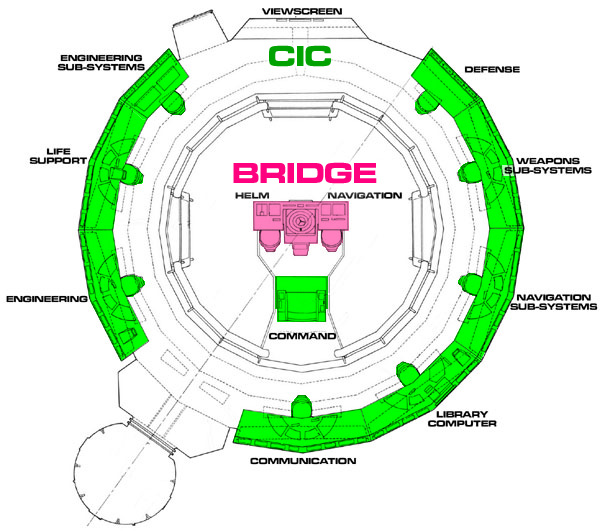
A CIC is NOT the ship's bridge, even though they are commonly arranged much the same as the fictitious "bridge" of Star Trek's Starship Enterprise (this is because real-world CICs were inspired by Matt Jeffries's design, see below). In the real world a wet navy ship's bridge only has a couple of stations. The Starship Enterprise has its bridge located in its CIC for dramatic reasons (the "bridge" is the navigation and helmsman stations, that red console Sulu and Chekov sit at).
A ship's bridge is just a two-station place (navigation and helm) mainly meant to control the movement of the ship. Usually the captain is not even present, unless some critical maneuver is underway. Back in the age of steam, the bridge did not even have any controls. They would instead give commands to the engine room where the physical controls are located. They'd either use speaking tubes for verbal commands, or use a ship's wheel and a engine order telegraph. Later the power of electricity allowed the actual controls to be located in the bridge. However, even to this day warships tend to have the physical controls for the weapons to be located deep in a protected area of the ship, not on the exposed. bridge. This allows the weapons to keep on fighting if the bridge is destroyed. Since a spacecraft does not need the visibility of an exposed bridge, it too can locate the bridge in a protected position.
A CIC is NOT the fleet command room, though it is often used for one. In reality, non-flagship vessels have their own CICs.
A CICis the center that copes with the flood of incoming information, filters out the extraneous, does analysis, and displays it to the officers. Otherwise the officers would drown in the data.
As Christopher Weuve puts it:
The primary mission of CIC is to provide the organized collection, processing, display, competent evaluation, and rapid dissemination of pertinent tactical information and intelligence to command and control stations.
Christopher Weuve
All vital "intelligence" (data) from sensors, scouts, intelligence agencies, central command, other ships, etc. pours into the CIC. The Evaluator's duty is to analyze and evaluate all combat information. They filter the information, deciding what is important and what is noise. They pass the filtered information with suggestions on tactical situations to the Captain and the Flag. The information also goes on the Big Board tactical display.
In a stunning example of science fiction innovation, the very concept of an CIC came from a science fiction novel. In his novel Gray Lensman, legendary author E. E. "Doc" Smith postulated a huge flagship called the Directrix. It contained a monster operations room centered around a seven hundred foot "tank" 3D display, capable of tracking several billion warships on a map of the galaxy.
At the Technovology website, Mark Charters mentions a letter to Astounding magazine. Editor John W. Campbell stated the acknowledgement of Captain Cal Lanning that Smith's ideas were used extensively in the design of US Navy warship's Combat Information Centers. At the TV Tropes website, they allege that the Directrix was the inspiration for Chester A. Nimitz to use a similar system for directing fleet operations during the Battle of Midway. After that, everybody started using them, which is how it became a troupe in the first place.
The entire set-up was taken specifically, directly, and consciously from the Directrix. In your story, you reached the situation the Navy was in—more communication channels than integration techniques to handle it. You proposed such an integrating technique and proved how advantageous it could be. You, sir, were 100% right. As the Japanese Navy—not the hypothetical Boskonian fleet—learned at an appalling cost.
The idea of such a centralised control room is surprisingly old; it can be found in science fiction as early as The Struggle For Empire (1900). Early versions were used in the second world war; according to Rear Admiral Cal Laning, the idea for a command information center was taken “specifically, consciously, and directly” from the spaceship Directrix in the Lensman novels of E.E. Smith, Ph.D.,[3] and influenced by the works of his friend and collaborator Robert Heinlein, a retired American naval officer.[4] After the numerous losses during the various naval battles off Guadalcanal during the war of attrition that was part and parcel of the Solomon Islands campaign and the Battle of Guadalcanal the United States Navy employed Operational analysis, determined many of their losses were due to procedure and disorganization, and implemented the Combat Information Centers building on what was initially called "radar plot" according to an essay "CIC Yesterday and Today" by the Naval Historical Center.[5] That same article points out that in 1942 radar, radar procedure, battle experiences, needs, and the CIC all grew up together as needs developed and experience was gained and training spread, all in fits and starts beginning with the earliest radar uses in the Pacific battles starting with the Coral Sea, when radar gave rise to the first tentative attempt to vector an Air CAP to approaching Japanese flights, maturing some before the Battle of Midway, where post-battle analysis of Coral Sea's results had given more confidence in the ability and to the process and the desire was bolstered by new procedures giving their measure of added confidence.
Unpublished letter from John W. Campbell to E. E. Smith, pages 1–2, Dated 11 June 1947 in the collection of Verna Smith Trestrail
Robert A. Heinlein by William H. Patterson, Jr., volume 1, chapter 24
CIC, CIC [Combat Information Center] Yesterday and Today,DEPARTMENT OF THE NAVY -- NAVAL HISTORICAL CENTER, 805 KIDDER BREESE SE, WASHINGTON NAVY YARD, WASHINGTON DC 20374-5060
“The boss likes to party. Up next is the command cave.”
“You mean the bridge?”
“Does it connect two points of land across a waterway?”
“No?”
“Then no, I didn’t mean a bridge.”
“So literal.”
The doors opened onto what would very appropriately be called a cave. The ceilings were low, even for First, who wasn’t terribly tall to begin with. The crew stations were cramped with consoles and equipment with little thought given for comfort or to stave off claustrophobia. This was no pleasure craft. It was a predator of pleasure craft.
Many of you, gentle readers, are also devotees of the Atomic Rockets web site. (As well you should be, if you are interested in matters rockety.) And, of course, you may have noted the Atomic Rockets Seal of Approval off in the right-hand column.
But today I’m going to talk about a place where I find myself, and the ‘verse, disagreeing with it. Specifically, with “It is a CIC Not a Bridge“. For convenience, I’m going to quote from it here:
That round room in the Starship Enterprise? The one they call the “Bridge?” Wrong term, that thing is a Combat Information Center (CIC). On a real wet-navy vessel, the bridge is a tiny two-station place used to control the the movement of the ship. It only had stations for the navigation and helm.
In other words, the “bridge” on the Starship Enterprise is that little console that Sulu and Chekov sit at.
The CIC is where all the data from the sensors, scoutships, intelligence agencies, central command, and other ships is gathered and evaluated. The important information is passed to the captain along with tactical suggestions. Exactly the way Uhura, Scotty, and Mr. Spock pass information and tactical suggestions to Captain Kirk.
So, here’s the thing. It’s actually slightly more complicated than that. There are three places on a wet navy vessel all of which do things that people think of as functions of “the bridge”.
There is the CIC, as described above. It’s the information-gathering and decision-making center.
Then there is the wheelhouse, which is where the ship’s movement is controlled from. This, on ships that had a bridge, was usually buried down inside the hull or beneath the superstructure – for one simple reason. You don’t want it shot off. If you lose the wheelhouse, you can’t command the ship any more, so you don’t want it somewhere vulnerable.
And then there is the bridge, which is the place you conn the ship from. It’s up high at the front of the superstructure with generous wings, etc., because its requirement is that you be able to see what the ship’s doing in order to command it.
(On a merchant ship, you probably don’t need a protected CIC, and since you don’t expect anyone to shoot your bridge off, you may have the engine-room telegraphs and wheel up there in one place. On navy vessels, on the other hand, instead of passing engine orders and steering directly, you have a bridge talker yelling “Port 40! Half ahead both!” down voice tubes to the wheelhouse.
On the other hand, the bridge is also exposed to heavy weather, so merchies that expect to encounter the rough stuff may still have a separate wheelhouse. This was actually where they first came from.)
In a historical digression, incidentally, the original bridge is an evolution of what was originally the quarter deck, the raised deck at the stern, on sailing ships. When it became more important to avoid your own smoke than see what your sails were doing, which is to say, as we moved from sail to steam, the raised area moved for’ard and became the bridge as we know it today.
As for the wheelhouse, that came from sailing ship designs in which the poop deck (the highest deck at the stern, typically forming the roof of the stern cabin) was extended forward to cover the quarter deck and the ship’s wheel, on the entirely reasonable grounds that in a storm, it’s easier to steer without being out in the full blast of wind and wave, and in battle, it’s much easier to steer if you have some protection from being shot.
So let’s bring this back around to starships.
You don’t need a bridge in the above sense. As it says further up that page, Rockets Don’t Got Windows – given space ranges and instrumentation, you are never going to be trying to conn the ship with your Mark I Eyeball, which is essentially what a bridge up high is for. Your best view is going to come from sensors, but they can be read just as easily from the CIC, buried deep in the center of the hull for maximum protection.
(Why did the Enterprise designers perch the bridge right up at the top of the saucer, with about three feet between the back of the fancy digital sensor-feed-showing viewscreen and hard vacuum, right where any Tom, Dick, or Kang could shoot at it conveniently? Were they all Romulan spies?)
Do you need a separate wheelhouse? Well, given that starships are certainly going to have fancy electronic controls rather than the hydraulic/pneumatic/etc., systems that imposed constraints on the position of wet navy wheelhouses vis-a-vis the CIC – usually buried down in the bottom of the ship where the armor is thick – I’m going to say probably not. The CIC’s already in the safest place, per above.
You are going to have a CIC, because you still need somewhere to coordinate information, make decisions. In my opinion, it will probably also be the wheelhouse (after all, as in the Enterprise example above, it’s just one console, and since the maneuvering orders are going to come from the officer on watch in the CIC anyway, why make him shout any further than he has to?).
The only question is whether it will be called the CIC. The above (combined CIC/wheelhouse) is essentially the arrangement they use on submarines today (where it is called the control room; the bridge is the place you can stand at the top of the conning tower when the boat’s on the surface).
That may be likely nomenclature for starships, too. (Noting especially that civilian starships are unlikely to have a Combat Information Center.)
On the other hand, the Imperial Navy, and their merchant tradition, call it the bridge. Why? Well, unlike our submarines, there isn’t another bridge somewhere to clash with it – and you get your best view of what’s around from it – and in the meantime, it’s a name that’s got centuries, indeed millennia, of tradition behind it as The Place From Which Ships Are Commanded. It’s a word, in a nutshell, that’s got weight.
And since you’re combining all the functions back together, as they were in the beginning, that counts plenty.
The quarter deck, on the other hand, that’s somewhere else.
Agammamon:
Big (US) Naval ships don’t have a ‘wheelhouse’ – unless you’re going waaaaaaaaaaaaay back, a couple generations or more. We have a bridge – where the ship is conned from (and where the helmsman steers and the lee-helmsman passes engine order from – or, in the case of gas-turbine ships, directly controls speed). And that is high up in a place with good visibility. The ship is still conned from here during combat though. There’s a CIC – that is, when possible, inside the hull where its protected. Some classes of ships (FFG-7, for example, where its right under and slightly behind the bridge – the missile and gunnery control room is right underneath (so one good hit will take everything out . . . )) they are not. There’s ‘after-steering’. This is the room (or rooms) where the steering gear (the hydraulic rams that move the rudder) is at. You can take control and steer from there but its normally unmanned (only during critical situations – General Quarters and close manuevering like entering/exiting port or underway replenishment). But these guys are only steering if the bridge is destroyed or the bridge control panel is otherwise inoperative. Some ships have a secondary conn – which duplicates the helm/lee helm, conn, and navigation stations of the bridge but even that is placed someplace with an exterior view and you conn and steer from there. On the Forrestal class carrier its placed up front right under the flight deck. Most ships do not have a separate secondary conn though. It is perfectly legitimate for the ‘bridge’ (the conn and helm station) to be inside CIC. There is, obviously, no particular need to it to be separate since the only reason it is on wet-navy ships is that the Conn needs to be able to visually look at what’s happening outside the ship – there’s lot’s of things that don’t show up on radar. The maneuvering room will likely in the same situation as a modern gas turbine ship – its there (like the after-steering rooms) as a backup if the remote stations are lost but it won’t normally be in control.
Alistair Young:
Thank you very much for your comment. Much of my knowledge on the subject comes from RN ships of an older generation, so I appreciate the up-to-date perspective.
courtesy of X-ray Delta One click for larger image
As previously mentioned, Matt Jeffries designed such a logical arrangement for the bridge of the Starship Enterprise that the US Navy studied it when they were designing their command centers. The main idea they favored was the captain/evaluator in the center, where they can turn to look over the shoulder of any of the work stations, plus the idea of a Big Board where currently critical information can be displayed.
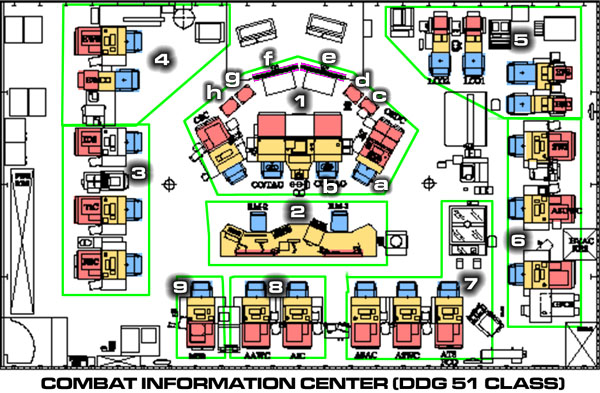
Combat Information Center from a U.S. Navy Guided Missile Destroyer DDG51 class, courtesy of Christopher Weuve.
Blue are chairs. Yellow are desks. Red are CRT/Flatscreen monitors. Magenta are rear-projection monitors ("e" and "f"). Lower case letters "a" through "h" are to allow one to match up the deck plans with the photograph. In the photo, right above "e" is the red display showing ships course, speed, and screw (propeller) revolutions. The backs of the chairs have pouches containing manuals for that control station. Note that chairs are bolted to the floor.
Aegis Display System (guilded missiles)
Computer Workstations
Comand and Control Systems
Electronic Warfare
Land Attack / Gunfire
Surface Warfare
Undersea Warfare
Air Warfare
CIWS (point defense antimissile)
Bridge of the starship Enterprise, designed by Matt Jeffries. This is a combination of a bridge (helm/navigation) and a CIC. Captain/Evaluator is in the command swivel chair in the center. All station are arranged so captain can look over the sholders of each operator and examine their displays. In the front is the big board viewscreen.
OUTSIDER COMMAND DECK
click for larger image
1. CON1: Commanding officer. Stillstorm roves more often than she sits, but no one else sits in this seat in deference to her. 2. CON2: Executive officer (Mallas Rune-Laurel). When Stillstorm is off the bridge, the officer in charge usually sits here. 3. OPS: The Operations Chief (Seinen Forest) is directly in charge of flying the ship. Often roving, sometimes sits at NAV1 or NAV3. 4. AUX1/NAV3: Auxiliary Navigation, sometimes used by OPS. 5. FIRE1: Primary fire control officer (Nedeil Cobalt). 6. FIRE2: Secondary fire control officer (Tiris Red-river). 7. TAC: Tactical Analysis. The Listel at this position (usually Beryl) coordinates the Sensors section and controls the tactical displays. 8. SEC: Security (Teidar Razorthorn). Coordinates internal security and sometimes small craft. Fireblade sometimes sits at this position. 9. INTEL: Intelligence (Parat Tempo). The Mizol at this position coordinates the intelligence and communications sections. 10. SYS: Subsystems Chief. This position coordinates engineering and damage control, assisted by the Subsystems section. 11. NAV2: Secondary Helmsman. The copilot of the ship. 12. NAV1: Helmsman. The officer piloting the ship. 13. AUX2/FIRE3: Auxiliary Fire Control. Tertiary fire control officer, in this case coordinating defensive weaponry. 14. Port Gallery: Subsystems section. 4 positions for officers who keep track of the ship's systems and their maintenance and repair. 15. Forward Gallery: Fire Control Support section. 8 positions for officers who assist with target tracking and weapons status. 16. Starboard Gallery: Sensors section. 4 positions for officers who operate the sensor suite and analyze the data. 17. & 18. Aft Offices: These offices are used for off-bridge officers including communications and intelligence. 19. & 20. Balcony Offices: The offices are available for commander's or flag officer's facilities, but are currently empty. 21. & 22. Observation Couches: These are places for the bridge security officers or observers to sit when necessary.
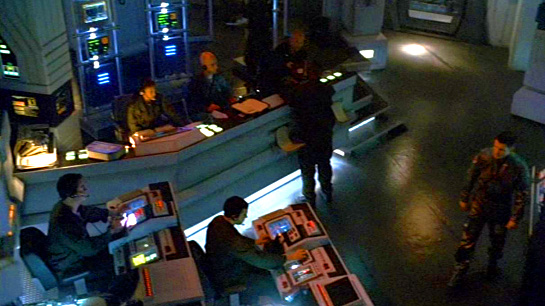
The Battlestar Galactica’s Combat Information Center, or CIC, is a medical-theater-like room that acts as the military nerve center and brain of the Galactica. It is located near the center of the ship, is heavily armored and protected by armed guards, and has a staff of between 35-50 people.
The two highest ranking officers on the ship, Commander Adama and Colonel Tigh, typically stand at the center of the auditorium around the Command Board. This position lets them hear status reports from around the room, and issue orders to the entire ship.
Various pods of workstations provide seating for the rest of the staff. These stations are grouped by function. We see Navigation crew sitting near other navigation crew, weapons officers near other combat functions, communications near the center, and engineering given a special area up top.
Phone kiosks are placed throughout the CIC, with two high profile kiosks on the Command Board. Large display boards and the central Dradis Console provide information to the entire crew of the CIC.
Organized Chaos
The CIC is dealing with a lot of information from all over the ship and trying to relate it to the lead officers who are making decisions. There is a lot of activity related to this information overload, but the design of the CIC has organized it into a reasonably effective flow.
Teams communicate with each other, then that decision flows forward to lead officers, who relate it to Admiral Adama.
Orders flow in the opposite direction.
Admiral Adama can very quickly shout out an order from the center of the CIC and have his lead officers hear it all around him. It can also act as a failsafe: other officers can also hear the same order and act as a confirmation step. From there, the officers can organize their teams to distribute more detailed orders to the entire ship.
Large screens show information that the entire CIC needs to know, while smaller screens display information for specific crew or groups.
Overall, the stadium-like construction of the CIC works well for the low tech approach that the Galactica takes after. Without introducing automation and intelligent computer networks onto the bridge, there is little that could be done to improve the workflow.
CENTRALIZED EARTH GOVERNMENT AND ADMINISTRATION BOAT BRIDGE
Designed and drawn by Ghislain Barbe
Boat-sized vessels cannot afford the volume needed for a full-sized
spherical control center. Instead, they use a reduced four-person
design. This smaller size allows a boat to still benefit from
the concept of the astronomical display.
The ship's captain is in the center. The chief gunner station, the
chief engineering station and a dual role navigation/helmsman
station form a triangle around him. Other functions, such as a
communication and astronavigation, are supervised from small
work stations located just outside the bridge itself.
The chief gunner can access all of the weapon controls from the
bridge. Normally, the bridge's gunnery station is used solely to
prioritize targets and for overall situational awareness. Actual aiming
of weapons is typicaly conducted through the local fire control
systems near the weapons themselves.
Engineering interfaces with the ship's computer to run programs,
do maintenance reviews and supervise damage control. In combat,
the chief engineer may attempt various workaround repairs
without leaving the bridge. He may also directs the damage control
parties, which are led by the watch officers.
The ship's pilot has full control of the vessel from the navigation
and helm station. Constant coordination with gunnery is important,
as the ship's maneuvers will move its firing arcs around. New
courses may be plotted onto the spherical display for review by
the captain prior to them being initiated.
Various data feeds are projected on the datascreen that form the
walls and ceiling. In combat, the system functions as a giant headup
display, including target identification, range and a symbol
showing the object's relative velocity. Each individual station has
independent displays for more detailed information.
JOVIAN CONFEDERATION BRIDGE
Designed and drawn by Ghislain Barbe
The bridge of the Corsair-class vessels is probably the largest living
space aboard the vessel. It is built around the standard Jovian
"open space" spherical layout, with crew stations far from one
another. In many ways, it would be better to refer to it as the
ship's cockpit, since it shares many characteristics with interceptor
and exo-armor cockpits.
The Corsair's bridge is covered with a bubble-like canopy, a sophisticated
projection system similar to the ones used on most
ships' bridges; it can project not only a reconstructed view from
any sensor cluster in any wavelength, but it can also overlay tactical
information such as trajectories and IFF tags.
Each crew station is equipped with an ergonomic padded seat
surrounded by readout panels that can be reprogrammed to fulfill
the functions of any of the bridge's posts. The seat features
attachment points for a sturdy padded harness for use during
combat and alert situations (a thin seat belt is used otherwise to
improve comfort). A panel in the base of the seat contains connectors
for a space suit air hose and power leads, greatly extending
the endurance of said suit.
COOPERATIVE VENUSIAN NAVAL ADMINISTRATION BRIDGE
Designed and drawn by Ghislain Barbe
The bridge of the Shan-Yu battlecruiser is a spherical chamber
which takes up the same volume as the Strategic Operations Center.
Just like the latter, the entire room can be rotated so that its
overall gravity gradient is aligned with the ship’s axis (when under
acceleration) or the outside of the hull (when the ship is under
rotation). Entry and exit are accomplished via several large hatches
that line up with the ship’s corridors; in the event of a rotation
malfunction, emergency cutting tools stored in a locker on one
wall allow the bridge crew to cut their way out of the bridge.
The Shan-Yu’s bridge has the same general layout as the bridges
of most modern military spacecraft. It has fewer stations than the
SOC, and a much more delicate-seeming framework around the
seats (the equipment is just as structurally sound as the ones used
by other nations, but is more aesthetically pleasing). The captain
sits right in the middle of the room in a gimbaled seat that can
swivel to face any direction in the room and its wall monitors.
The rest of the crew stations are scattered around, above and
below the captain's seat, and are all linked to a walkway and ladders
that ring the bridge. Each crew station is surrounded by
monitors, facing both inward and outward, that complement the
"big picture" presented on the main spherical viewscreen. When
fully active, the bridge is a riot of multimedia displays that a good
captain must be able to interpret and analyze at a glance.
COOPERATIVE VENUSIAN NAVAL ADMINISTRATION STRATEGIC OPERATION CENTER
Designed and drawn by Ghislain Barbe
The Strategic Operations Center is a room that will be present on
every Shan-Yu. It occupies a large spherical volume in the center
of one of the main hulls, exactly in the same location as the bridge
but within the opposite hull. The Operations Center‘s primaryfunction
is to coordinate fleet activities, but it can also serve as a backup
bridge if necessary. At all times, operators move between stations,
compiling intelligence and battle reports with the help of
the onboard computers to present up-to-date tactical advice to
the officers in charge. A number of heavy-duty walkways and liftlines
crisscross the room to handle foot traffic, which is much increased
in this room compared to the bridge.
The main level is placed at the ”equator” of the room. Computer
terminals and monitors line the wall, along with compact and
space-saving seating for a large number of operatives. The wall
monitors are set to show external views of the ship or other important
data. Two extra floor tiers, commonly called the “Tropic
of Cancer” and the ”Tropic of Capricorn,” are located midway
further up and down along the wall. These partial floors are accessible
via ladders or zero-gee floating, and consist primarily of
walkways around the rim and several extra workstations and monitoring
panels.
A large chair sits on a raised dais at the back of the room. It is
meant for use by the Strategic Operations Coordinator, who is
usually a flag officer. This seat, unlike the captain‘s chair on the
bridge, is designed not for maximum view but rather for easy
access to human resources; there is an endless stream of people
coming up to the dais to provide updates, explanations and advice.
The Coordinator‘s chair is surrounded by the majority of the
room’s floor space, which is fitted with clips for fold-down chairs
and a small tablekhreat board for impromptu conferences. From
this seat, a Venusian admiral can guide the movements and activities
of dozens of warships, making use of the Shan-Yu’s extensive
communications array to assign new orders and tactics.
This is the room where all the data gathered by the Huang-ti's
sensors is collated, inspected, and evaluated by the onboard specialists.
lt is located in the same position as the Cloak Room and
recreation rooms in the opposite main hull, and is fairly large for a
room aboard a spaceship of this size.
The inner room is spherical; since the corresponding space in the
other main hull is square-edged, the Analysis Room is actually a
sphere positioned within a rectangular volume. The space outside
the crew sphere is taken up by computers and data storage
equipment which is accessible via access panels in the walls. A
tiny bathroom and a snack bin are located right outside the main
door for convenience during long shifts.
The room has many chairs along the walls, but the central space
is clear of permanent furniture. The walls are covered in monitors;
threat boards and other large displays can unfold from the walls,
allowing even more data display space. In its fully "open" state,
the whole room is packed solid with display devices. Many crew,
however, prefer to use virtual reality headsets and use the central
space as a virtual environment. Up to a dozen people can work in
this room in total comfort (as far as elbow room goes, at least).
This room is not set up for ship control functions; it is a think tank,
not much else.
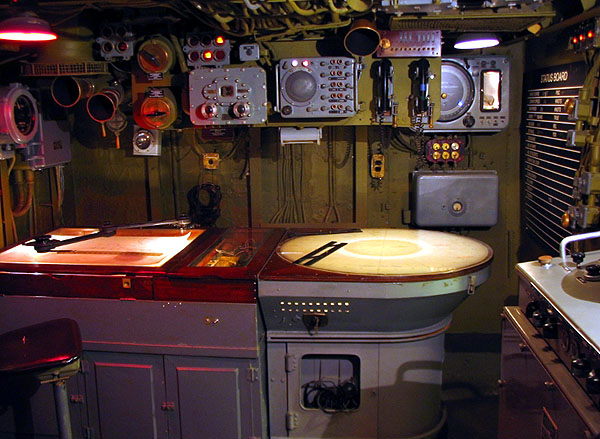
Combat Information Center of USS Slater, left side rectangular map table with drafting machine is for strategic navigation, right circular polar plot table with parallel rulers is for tactical maneuvering.
Combat Information Center of USS Spruance.
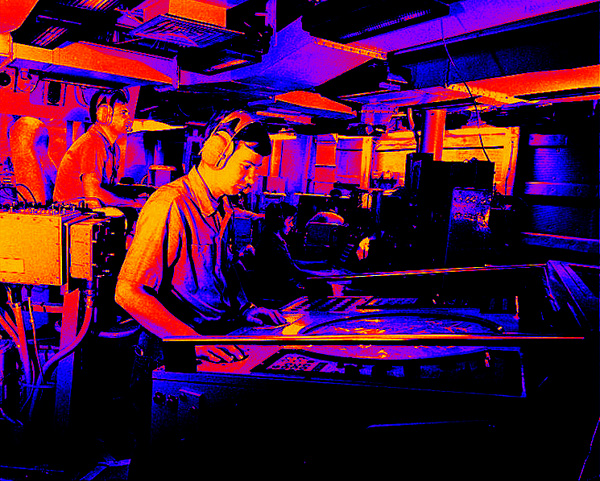
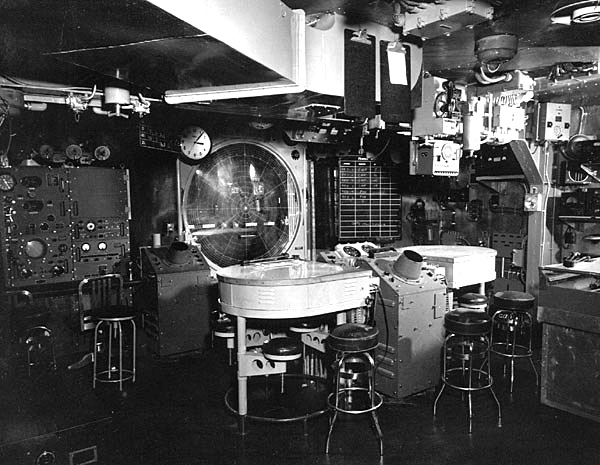
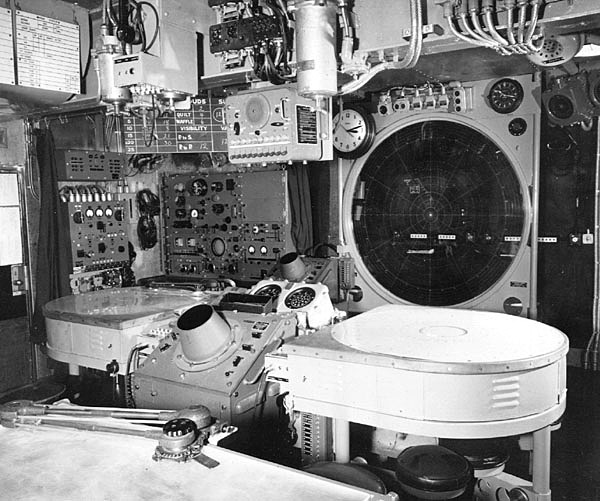
Combat Information Center of USS Independence (CVL-22)
Combat Information Center of USS Independence (CVL-22)
Controls
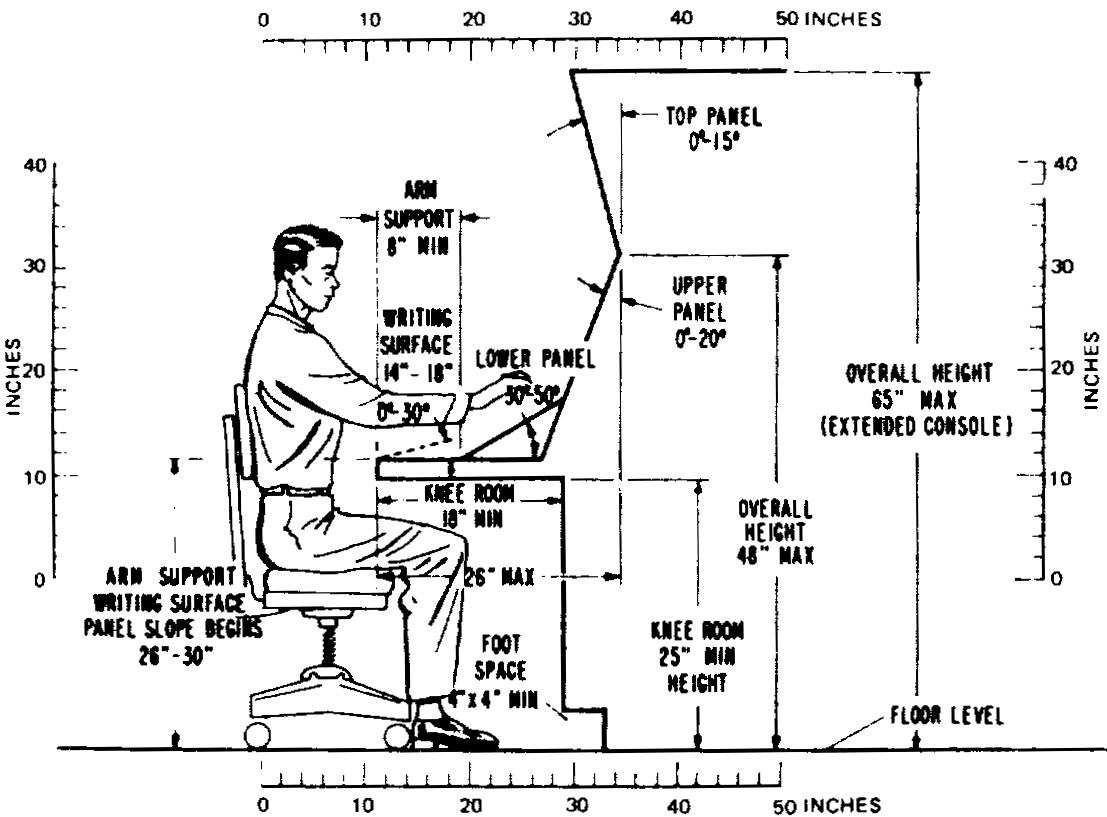
Flight Controls
RocketCat sez
Listen up, space cadets. I know all of you want to be pilots, because you think they are romantic and dashing and get all the hot dates. Tain't true, but you'll find that out soon enough.
You probably also think that pilots just jump into the acceleration couch and fly the blasted rocket by the seat of your pants, like a stupid airplane pilot or something. Also tain't true unless you are flying a putt-putt space taxi, or being a bargain-basement expendable autopilot for those expendable crewed missiles they call quote "space fighters" unquote.
What's gonna really happen is that the captain or ship owner is going to tell the astrogator that the ship has to haul ass from here to that planet over there by such-and-such a date or we'll get slapped with the late delivery and penalty clause on our cargo of zero-gee toilet paper. The 'gator will do some skull-sweat and calculate the trip. They will (eventually) hand you a set of Maneuvers. Your job is to perform each maneuver. If everybody has done their job, the ship will pull into parking orbit on time.
Each maneuver got three things: Spacecraft Attitude, Chronometer Initiation, and Delta-V Increment. Or: Where To Aim The Nose, When To Start, and How Hard To Kick The Ship's Ass.
Aiming the ship's nose sets the vector of the maneuver. You do the aiming with the Rotation joystick. The attitude display tells you where it's at. You will continue to aim the nose during the burn in case the blasted ship decides to wobble off course.
You start the burn at the precise time written on the maneuver. You'll know when by using the outrageously precise chronometer nailed right in the center of the control panel. Polite pilots give the crew a two minute warning to strap into their acceleration couches.
You start the burn with the throttle. You set it at a reasonable level, you'll work through a couple of semesters of pilot school learning what "reasonable" means for various missions. While the rockets are thrusting you'll watch the Delta-V Display. The instant the display reaches the number written in the "Delta-V Increment" box of the maneuver order you cut those rockets off! Oh, and don't forget to watch the attitude display with your other eye just in case the ship decides go all bucking bronco on you.
Mid-way through a flight you can probably count on the astrogator popping up with a mid-course correction maneuver. Try not to sigh too loudly.
The most important controls to the pilot are of course the piloting or flight path controls. These are the 3D equivalents of the steering wheel and accelerator in an automobile. To get an idea of what the bare minimum is, we will unashamedly be taking a good look at the solution in the computer game Kerbal Space Program. Since that is a game, the designers were forced to distill the controls to the very essentials (because the players will quickly get fed up and leave if they think the game is too complicated). As a matter of fact, that game is so wonderfully educational yet fun, you might be better off if you skipped this section of the website and instead started playing the Kerbal game.
The bottom line is that piloting boils down to aiming the ship's nose in the proper direction, then at the proper time performing a burn of the proper amount of delta V. This will put the ship on a trajectory to its destination. Calculating the values of all these proper parameters is the job of the astrogator. It is the captain's job to tell the astrogator the destination to be calculated for. But I digress.
The combination of burn direction, delta V, and timing is called a "maneuver."
The pilot will have to look over the parameters the astrogator passes to them and squawk if there is a problem, such as the spacecraft not having enough remaining propellant to create enough delta V. The astrogator is supposed to avoid problems like that but mistakes will happen.
The technical term for the direction the astrogator wants the ship's nose to pointing at is "Axis of Acceleration." Why the ship's nose? Because it points in the same direction as the engine's thrust axis. For most spacecraft, when they do an engine burn, the exhaust goes directly aft (out the rear of the ship) and the thrust goes forward in the direction the ship's nose is pointing. To do the maneuver properly, the thrust axis and the acceleration axis must be the same and stay the same. This is half of the pilot's job. Remember: the acceleration axis is where the astrogator wants the ship to be pointed, the thrust axis is where the ship is actually aimed at any given point in time.
During the flight while the ship is coasting, in between maneuvers, the astrogator will keep track of the spacecraft's course and timing. If the spacecraft starts to move off track, the astrogator will calculate a mid-course correction maneuver to fix things.
Since under acceleration "down" feels like it is in the direction the exhaust is going, the ship's nose will feel like it is directly overhead.
The rotation control spins the ship on one or more of its three axes, it is used to aim the ship's nose in the proper direction (i.e., controls the thrust axis).
The translation control move the ship laterally on the three axes, it is only used for docking but it is generally located next to the rotation control. Sometimes the translation control and the thrust control were combined into one, with a selector switch. You generally never need to translate while doing a burn, neither do you need to thrust while docking. Combining the controls saves mass, and every gram counts.
The thrust control turns on the rocket motor and sets the thrust level, it is used to control the delta V.
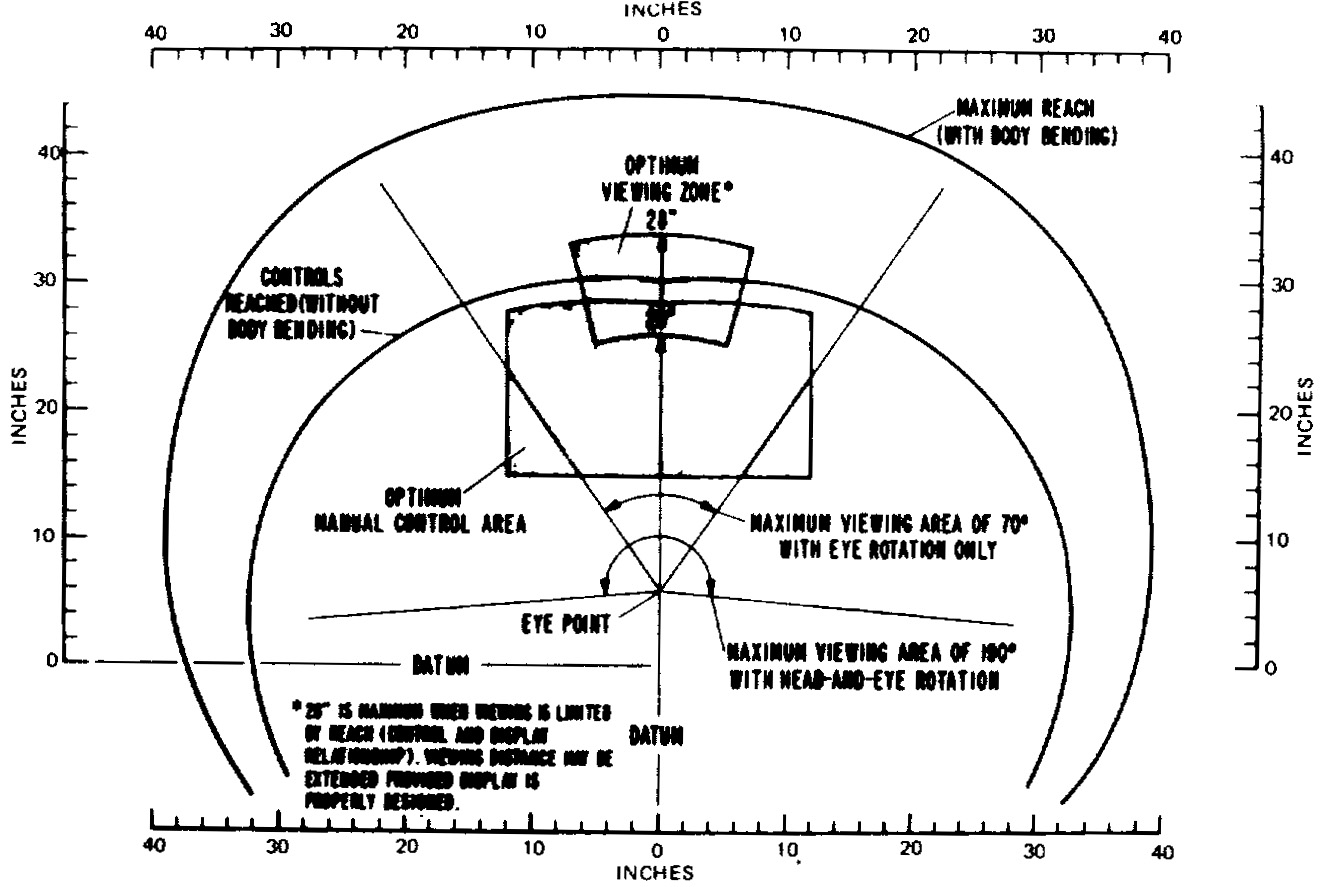
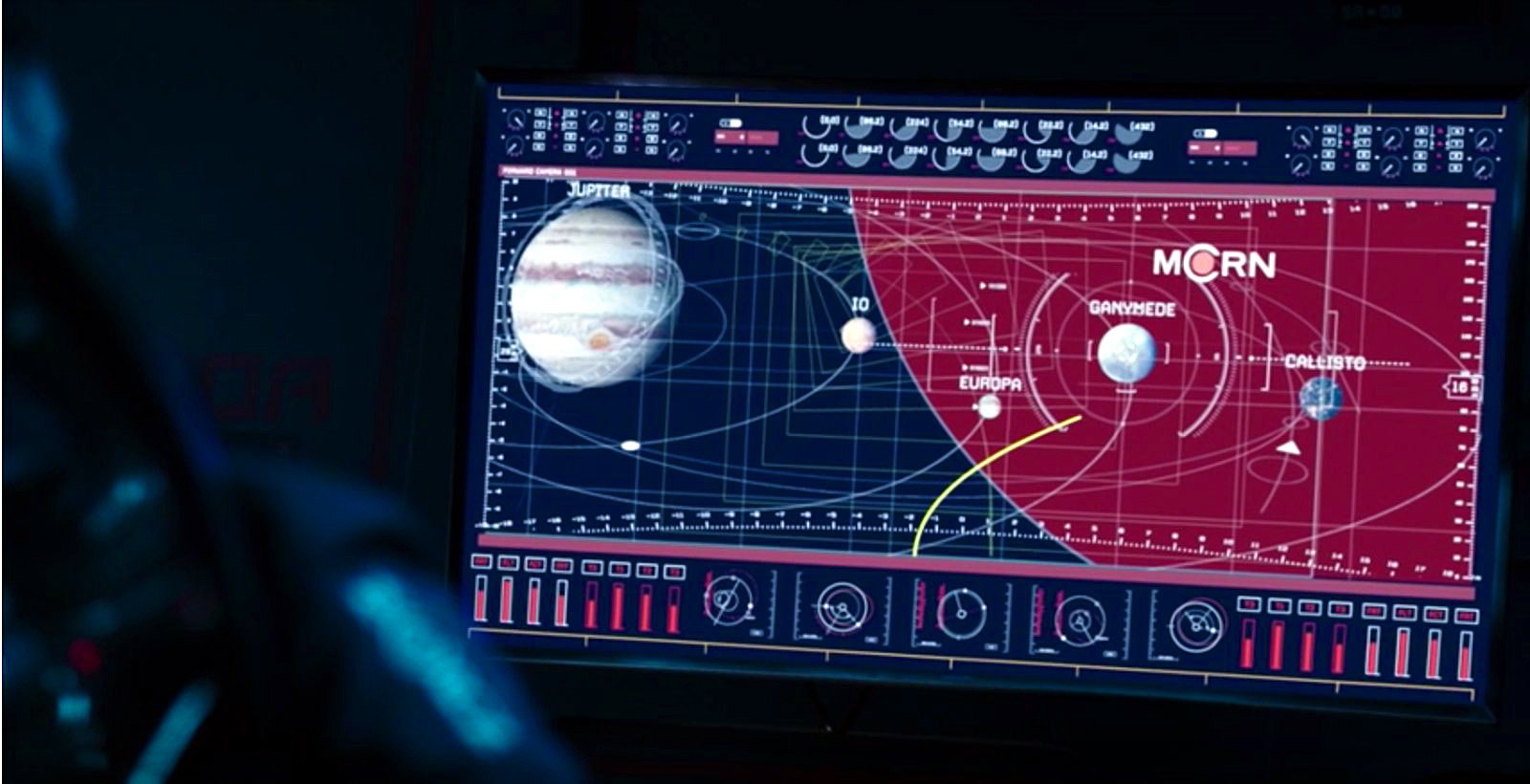
The pilot needs feedback in order to full fill all the proper parameters. Where is the ship's nose currently pointing? Is it time for the burn yet? How much delta V has been created? The pilot uses the display instruments for the necessary feedback.
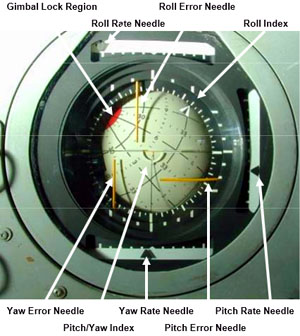
The attitude display tells where the ship's nose is currently pointing (the thrust axis). Feedback for the rotation control.
The time display tells the current time with split-second accuracy. Feedback for the thrust control.
The delta V display tells how much delta V has been generated so far by the current burn. Feedback for the thrust control.
Command Module Tanpopo (dandelion) from Rocket Girls
Rotation and Translation Controls
When a spacecraft is falling along a trajectory to its destination, there is no need for a pilot. The ship's course is determined by Newton's Laws of Motion and the effect of gravity, the pilot can go play poker with the atomjacks. It is when the ship has to have its nose pointed in the proper direction so that a scheduled engine burn gives the desired vector that the pilot earns their pay. Or when the ship needs to be docked to a space station or something.
The pilot moves the spacecraft via rotations and translations. A rotation spins the ship around its center of gravity, the ship's orientation in space changes but its position does not. A translation, on the other hand, moves the ship's position but does not affect its orientation. So if you were standing up and pivoted in place clockwise, you would be doing a rotation. But if you took a step to the right, you would be doing a translation. Aircraft can do rotations, but they generally do not do non-thrust-axis translations (with exceptions like helicopters, Harrier jump jets, and unfortunate aircraft in the process of augering in).
Rotation
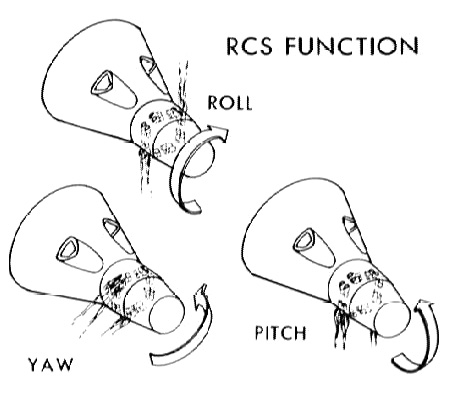
The three types of rotation are Yaw, Pitch, and Roll
And please try and remember that Rockets are not Arrows, there is no law that says the spacecraft has to be traveling in the direction its nose is pointing (i.e., the thrust axis and the ship's trajectory are independent). While the Polaris' vector is a Hohmann transfer to Mars, no law of physics will prevent Tom Corbett from using the controls to make the ship's nose point anywhere he pleases. So the Polaris is now traveling sideways through space, so what?
For a given maneuver, the pilot will use the rotation control to aim the nose in the required direction. The translation control is not needed for a burn, it generally is required only for a docking maneuver.
Both controllers will have a "trim" control. The trim will set whether each tap of the grip will move the ship's nose by a large amount (for big coarse movements) or by a small amount (for tiny high-precision movements). The trim control might be on the hand controller proper or might be on the main control panel.
The pilot might need to make rotational corrections during the burn, if the ship's nose wanders off-target due to engine irregularities, crewman Joe Idiot walking around during the burn, or something like that (which will earn Joe Idiot a free trip out the nearest airlock when the angry pilot catches up with him). Generally the spacecraft will have stabilization gyros or automatic attitude jets to keep the nose from wandering, but those can only go so far.
Control panel of the Gemini spacecraft. Note two attitude indicators on panel, and the hand rotation controller at bottom of screen. According to astronaut Virgil Grissom, the Mercury spacecraft flew the men, but the Gemini was the first true pilot's ship.
From 2001 A Space Odyssey (1968)
From 2001 A Space Odyssey (1968)
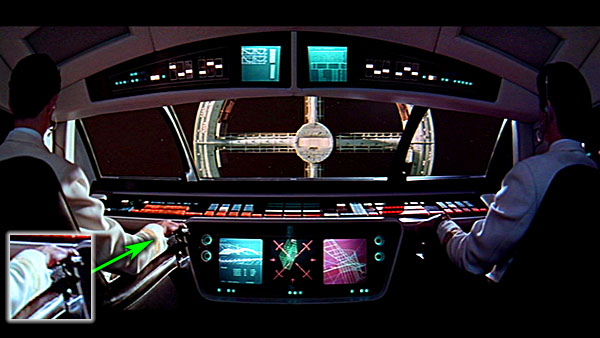
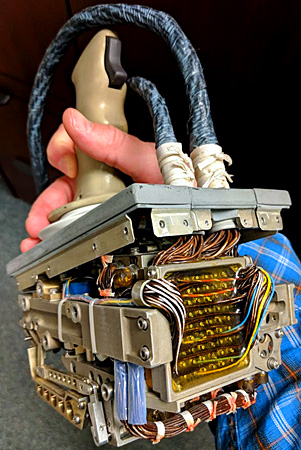
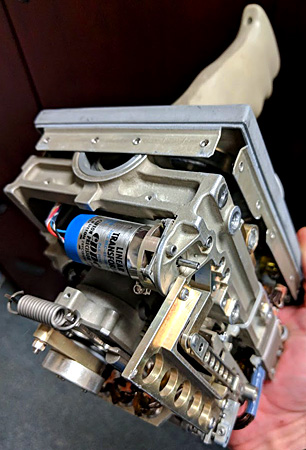
The rotation/translation control is apparently based on a DeHavilland Vampire joystick.
The bizarre throttle hand controller was invented for the movie
From 2001 A Space Odyssey (1968).
throttle hand controller at left side of photo, DeHavilland Vampire rotation/translation control on right side of photo
From 2001 A Space Odyssey (1968)
Close up of DeHavilland Vampire rotation/translation control From 2001 A Space Odyssey (1968)
DeHavilland Vampire joystick
DeHavilland Vampire joystick
DeHavilland Vampire joystick
DeHavilland Vampire joystick
DeHavilland Vampire joystick
Recreation of the bizarre throttle hand controller by Thomas Reddie (2008)
Recreation of the bizarre throttle hand controller by Thomas Reddie (2008)
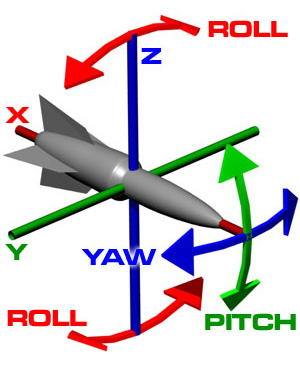
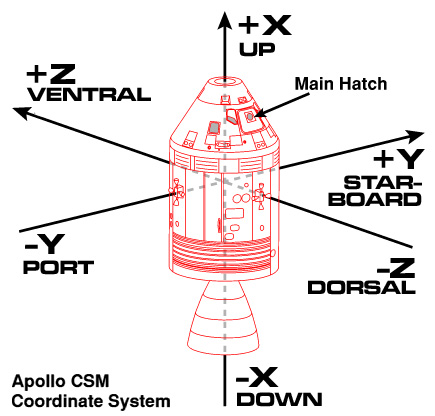
Rotation spins the ship around one of its (imaginary) axes. A "yaw" pivots the ship's nose to the left or right, spinning around the Z axis. A "pitch" pivots the ship's nose up or down, spinning around the Y axis. And a "roll" makes the ship spin like a old-style propeller prop, spinning around the X axis.
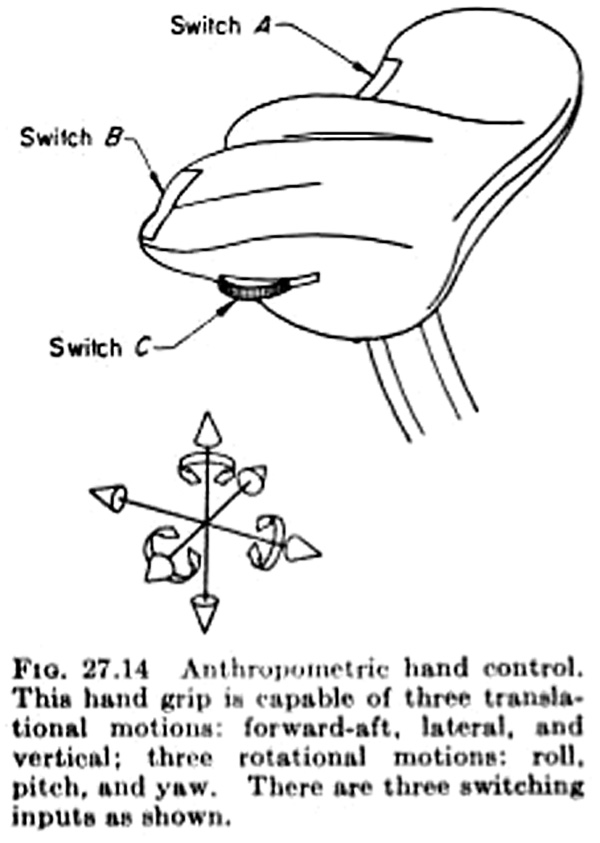
In most NASA vehicles, pushing the control grip left or right does roll, forwards and back does pitch, holding it upright and twisting left or right for yaw. In other words, imagine that there is a little model spacecraft glued on the top of the hand grip with the nose pointing forwards. Move the hand grip in such a way that the model's nose moves the way you want the spacecraft's nose to move.
According to NASA human factor design, the hand controller should be set to operate according to the viewpoint of the operator. So if you had a control for the pilot facing in the direction of the ship's nose, and a second control for an operator facing in the direction of the ship's tail, the "pitch" control for each operator will be the reverse of the other. For instance a pull back for the nose controller will pitch the nose upwards, while a pull back for the tail controller will pitch the nose down. This is because according to human factor design, the operator at the tail controller expects to pitch the tail upwards when they pull back the hand grip.
In NASA designs, pushing the control up or down translates in the Z direction, left or right translates in the Y direction, push or pull translates in the X direction. The rotation clockwise/counterclockwise by 17° is to engage/disengage the autopilot. Not shown is the "push-to-talk" button on the top of the T control.
In the game Kerbal Space Program, rotation and translation is handled by the computer keyboard. A and D are for yaw, W and S are for pitch, Q and E are for roll, H and N translate x, J and L translate y, I and K translate z, and the coarse/fine trim control is the caps-lock key.
Thrust Controls
Apollo lunar module translation/throttle control. When select lever is up the control acts as an engine throttle, when down it is a translation control. Specifically when select lever is up, push-pull and left-right still do z-axis and y-axis translation. But up-down switches from doing x-axis translation into doing 0% to 100% main engine thrust.
The arc on the left is the engine throttle display. The pointer at the bottom moves up and down under keyboard control.
Some propulsion systems only have "on" or "off", there is no fine control over the amount of thrust. The amount of delta V is set by controlling the duration of the engine burn. This can prove uncomfortable to the hapless astronauts, since the gees of acceleration will go up as the mass of the ship goes down (as propellant is expended). Acceleration is thrust divided by ship mass, as the mass goes down the rising acceleration tries to mash the crew into a pulp.
More advanced systems have variable thrust levels, they can be throttled. This gives more fine control. Or at least a way to keep the acceleration from rising and turning the astronauts into chunky salsa. The amount of thrust will have to be reduced in proportion in order to keep the acceleration constant. There may be some sort of control that will do this automatically.
The throttle may be a direct control link to the engine, or it may be a glorified engine order telegraph. In the latter case, the pilot pushes the 50% thrust button, and down in the reactor room the atomjack's control panel lights up the indicator for "GET OFF YOUR BLASTED BACKSIDE AND MAKE THE REACTOR SPIT OUT 50% THRUST!". The nuclear engineer on watch throws down the poker hand, scoops up their winnings, and then proceeds to perform all the delicate complicated procedures required to make the reactor thrust as required without exploding into a nuclear fireball. You find this set-up when the task of piloting the ship and the task of controlling a touchy reactor simultaneously is too much multi-tasking for one person to do.
Brennschluss
In the Apollo command module, the thrust was computer controlled. The flight crew would type the start time and duration of the thrust into the computer, the computer would do the rest. The computer would initiate the burn at the start time, then act as a brennschluss timer, automatically cutting off the engine. This is because the Apollo did not have touchy, tricky, nuclear engines.
In the Apollo lunar module things were a little more like flying by the seat of your pants. They did not have any moon maps with fine detail. The flight commander had to run the throttle manually, to take control in case the lunar module was trying to land on top of a bolder or something equally stupid. So the lunar module translation controller had a switch that would change it into a thrust controller. You never needed to do both functions at the same time, and combining the two controls saved payload mass.
Burn start and stop might be under autopilot control. But the pilot will still keep their hand hovering over the manual start key (or cut-off switch), as they never quite trust the auto-pilot. The co-pilot and the power officer will also have their hands hovering over their manual keys, since they never quite trust the auto-pilot nor the pilot.
There might be a brennschluss timer. When a burn is initiated, this is pre-set to count-down to burn stop time. The term is from German Brennschluß, or "End of burn". Brennen is 'to burn', schluß is 'end' or 'finish'. This was popularized in the 1950's by former German rocket engineer Willy Ley.
RocketCat sez
Gee, why would US rocket scientists use a German word for something technical? You'd think the answer is "Project Paperclip", where after World War II the US scooped up as many German scientists that they could possibly lay their hands on, so America got them instead the Soviet Union, the UK, and the smoking remains of post-war Germany.
But you'd be wrong.
German rocket scientist Willy Ley saw the hand-writing on the wall in 1934, well before the Nazis had captured all native German rocket scientists and shipped them off to the Peenemünde Army Research Center. Ley forged an authorization allowing him to go for a vacation in London and defected. He wound up in the US and wrote classic books popularizing space flight, which included German terms such as Brennschluß.
In the game Kerbal Space Program, thrust control is handled by the computer keyboard. In the game, most propulsion systems have variable thrust settings instead of just a rocket on/off setting. Shift key increases the throttle, ctrl key decreases the throttle, and X sets the throttle to zero. If the thrust is zero the engine is off, otherwise it is on. The current thrust setting is displayed on a dial on the left side of the nav ball.
FLYING SAUCER CONTROLS
Carefully locking their isolated woodland cabin, Thane turned and strode with Miribel to the shed. There was
nothing to be seen in the large space once used to hold cordwood, tools, and animal stalls. Thane pressed a knot in a post, concealing a hidden switch. A shimmering violet glow sprang forth, in the
outline of a saucer-shaped ship. It solidified in the next moment as the silvery disk Miribel had arrived in. The saucer was typical of the many thousands reported all over earth, shaped like two pie plates stuck
together. It was twenty feet wide and seven feet high, accommodating only two people. The hatchway was open
and, after they stepped in, it swung shut behind them, blending into the wall. “I still marvel at your cold welding process," Thane said staring at the blank wall. “Your doors shut so tightly
you can never see where they are." Miribel shrugged. “If the door edges weren't specially treated to bind with the frame in the wall, we wouldn’t
have the completely sealed and leak proof hull around us that we need in space," she said nonchalantly. “Super-technology," grunted Thane. He had that annoying feeling again that he was a bushman associating
with ultra-civilized beings. But he put it out of his mind and sat at the controls. “We have time so let me practice my saucer piloting,” he said. And that too was a marvel. A brass ball hung
without support within a globe of pulsing energy. He let the saucer glide out of the shed. Then, as his hand
grasped the ball and moved it upward slightly, the saucer leaped soundlessly from the ground and shot straight
up. It didn’t accelerate, as all earthly vehicles, even rockets, must, the saucer simply shot from zero speed to
supersonic speed in one instant. “No grip of gravity, no inertia, no air-drag," said Thane, still impressed after dozens of saucer rides. “No,
don't tell me how it’s done. I wouldn't understand.” Miribel reached over from her seat to stroke his hair. “Poor
backward Earthman,” she soothed in over-sweet tones. “His ego is bruised.” Her voice changed. “But I’ve told
you over and over, my Terrific Terran, that the Earth brain has the full potential of ours. You just don’t have the
lifetime of development and training we’ve had in advanced science and technology.” Thane moved the brass ball horizontally, and, obediently, the saucer moved over woodlands below at a slow
speed. Speed was controlled by how hard he squeezed the brass ball, nothing more. When the outskirts of Tanglewood came into view, Thane reached over and snapped on a separate switch for
the anti-visio unit. A violet glow shimmered around them and the saucer turned hazy in their eyes, while their
own forms looked ghostly. To anyone below, they were now completely invisible. Delicately handling the brass ball control, Thane brought the unseen saucer down to street level. The few
passing people and cars took no notice. When the saucer hung directly over a mailbox, a mechanical arm
reached out of the bottom and dropped a big envelope into the slot deftly. “Little does anyone know,” Thane grinned, “that I just mailed my article to Everyday magazine." Then, gripping the brass ball tightly, he moved it upward. In response, the saucer catapulted skyward at a
speed no airplane could ever match. Thane then switched off the anti-visio unit.
(ed note: again there are two variables being controlled: attitude and thrust. Direction the hovering brass ball is moved establishes attitude, how hard the ball is squeezed controls velocity.)
(Rob Davidoff said: Technically, what's being controlled is only one thing: velocity. Ball deflection establishes direction and the pressure establishes speed. Speed and direction combined are velocity. Attitude is precisely what this control scheme doesn't control—the actual angle of the saucer relative to the flight direction or the ground.)
The direction the ship's nose is pointing is displayed by the attitude indicator, also known as gyro horizon, artificial horizon or attitude director indicator. In Kerbal Space Program it is called the Nav Ball. This was originally developed for aircraft, and was adapted for spacecraft. An artificial horizon for a spacecraft is actually a pretty poor display for the data, but the NASA astronauts were mostly former test pilots who demanded a familiar instrument.
At the center of the display is the miniature airplane icon, indicating the postion of the ship's nose. It is painted on the glass cover since it does not move. Underneath is the sky ball, with a grid painted on. The sky sphere does rotate in place. The position of the miniature airplane on the sky ball shows what position on the celestial sphere the ship's nose is aimed at.
Primitive displays are vulnerable to the dread horror of gimbal lock, but modern ones are immune. If the ship is really primitive it might have to make do with a coelostat instead of an attitude indicator.
The attitude indicator has two modes, only one of which we are interested in.
The first mode is where the ball mirrors the celestial sphere around the ship, and is only of interest to astrogators (the ball is slaved to the inertial guidance platform). The miniature airplane will be over the part of the sky ball corresponding to the point on the celestial sphere the ship's nose is aimed at. The three scales around the ball show the rate at which the spacecraft is yawing, pitching, and rolling.
The second mode is where the pilot dials in the required ship's nose position for the next burn (on the main control panel), and the ball shows how far off the actual ship's nose is from where it should be (the ball is slaved to the gyro display coupler). When the ship's nose is on target, the miniature airplane will be over the sky ball's north pole. The three scales around the ball show how far off the nose is from being on target (the technical term is "attitude errors"). The pilot then uses the rotation controls while watching the attitude indicator, and moves the ship's nose into position. During the burn, the pilot keeps an eye on the attitude indicator, ready to correct things if the nose drifts off target.
In more sophisticated control boards, the attitude errors can be slaved to the attitude jets, so the spacecraft will automatically put and keep the ship's nose on target. Which of course gives space pilots anxiety about job security.
Video tutorial about Kerbal Space Program orbital maneuvers, by pebblegarden
From When Worlds Collide
In the game Kerbal Space Program the display is slightly different, and a lot of the work is done automatically for you. The miniature aircraft is called the "level indicator". The astrogator will use Map View with maneuver nodes to set up the maneuver. A "maneuver icon" will magically appear on the nav ball. This is the point where the ship's nose should be pointed. So the pilot's job is to keep the level indicator on the maneuver icon. A variety of other informative icons will also be automatically added to the nav ball as needed.
The sky ball does not correspond to the celestial sphere, nor is is zeroed in on the burn target. Instead it is always set so the center of the brown "ground" hemisphere is aimed at the nearest planet or moon. This makes it easier for players to enter into orbits around planets.
The prograde icon is where the ship's current vector is pointing. The retrograde icon is the exact opposite direction. Since the ship's trajectory is generally a curve, these icons will move with time. If the level indicator is over the prograde and a burn is made, the ship will maximally accelerate. If the level indicator is over the retrograd and a burn is made, the ship will maximally decelerate. If the level indicator is anywhere else and a burn is made, it will do something in between.
If the astrogator enters Map View and selects another ship as a "target", the two target icons will appear on the nav ball. The target prograde icon the point in the sky where the target appears, from the ship's point of view. The target retrograde icon is the opposite point in the sky. Placing the level indicator over the target prograde and burning will start altering the ship's trajectory towards the target. And the opposite for the target retrograde icon. And both icons will be moving, since both the ship and the target are too.
The computer, his calculations complete, watched the pilot with interest, for, accustomed as he was to traversing the depths of space, there was a never-failing thrill to his scientific mind in the delicacy and precision of the work which Breckenridge was doing -- work which could be done only by a man having had long training in the profession and possessed of almost instantaneous nervous reactions and of the highest degree of manual dexterity and control. Under his right and left hands were the double-series potentiometers actuating the variable-speed drives of the flight-angle directors in the hour and declination ranges (ed note: in the "hours" of Right Ascension and the "degrees" of Declination, which is the longitude and lattitude of celestial navigation.); before his eyes was the finely-marked micrometer screen upon which the goniometer threw its needle-point of light; powerful optical systems of prisms and lenses revealed to his sight the director-angles, down to fractional seconds of arc. It was the task of the chief pilot to hold the screened image of the cross hairs of the two directors in such position relative to the ever-moving point of light as to hold the mighty vessel, precisely upon its course, in spite of the complex system of forces acting upon it.
From Spacehounds of IPC by E.E. "Doc" Smith (1931)
Coelostat
Heinlein's short stories have rockets that use "coelostats" for an attitude display. This is the old-school clunky percursor to the artificial horizon. G. Harry Stine calls this instrument an "astrostat".
The coelostat is an astronomical instrument invented in the early 1900s by Gabriel Lippmann. The purpose was to allow long term observation or long photographic exposures of astronomical objects through a telescope, despite the fact that all the blasted things in the sky are moving due to Terra's rotation. Instead of the telescope looking directly at the sky, it instead looked at a large mirror (or prism used as a mirror). The mirror is rotated on an axis parallel to Terra's axis of rotation by a clock motor, cancelling out the effects of Terra's rotation.
Heinlein and Stine use the coleostat in a different way. They get rid of the clock motor, and have three separate coleostat mirrors feeding one telescope (the "pilot’s periscope"). The telescope has cross-hairs.
When the astrogator has plotted a given maneuver, they have the required axis of acceleration for that maneuver. Then they take three bright stars (e.g., Vega, Antares, and Regulus), one for each coleostat mirror. The idea is to angle each of the three mirrors such that when the nose of the spacecraft is properly aimed along the axis of acceleration, the view through the pilot's periscope will show all three stars dead on the center of the cross-hairs. If the nose is not pointed properly, the guide stars will be all over the screen.
There are 58 bright stars traditionally used for celestial navigation, you can find a list of them here.
This means the astrogator has to do some extra calculations to determine the correct angle for each coleostat mirror, but that's their job.
The pilot has to know their constellations with enough precision to identify the three guide stars, and will have to use a wide field spotting scope and the attitude actuators to roughly orient the ship so each guide star is visible in the proper coleostat mirror (i.e., get all three stars visible through the periscope). Then the pilot can use the pilot's periscope to fine tune the ship's position, getting all three stars at the precise cross-hair using microscopic bursts on the attitude acuators.
An artificial horizon is much easier to use, but requires a much higher level of technology to construct. It also makes the astrogator's job easier, since they do not have to pick guide stars nor calculate coleostat angles. As it turned out, NASA never used coelostats, they had artificial horizon technology by the time they had manned spacecraft. But in a science fiction novel, things might have turned out different on Planet Steampunk.
SPACE JOCKEY
artwork by Fred Ludekens
When the Skysprite locked in with Supra-New York, Pemberton went to the station’s stellar navigation room. He was pleased to find Shorty Weinstein, the computer, on duty. Jake trusted Shorty’s computations—a good thing when your ship, your passengers, and your own skin depend thereon. Pemberton had to be a better than average mathematician himself in order to be a pilot; his own limited talent made him appreciate the genius of those who computed the orbits. "Hot Pilot Pemberton, the Scourge of the Spaceways — Hi!" Weinstein handed him a sheet of paper. Jake looked at it, then looked amazed. "Hey, Shorty—you’ve made a mistake." "Huh? Impossible. Mabel can’t make mistakes." Weinstein gestured at the giant astrogation computer filling the far wall. "You made a mistake. You gave me an easy fix — ‘Vega, Antares, Regulus.’ You make things easy for the pilot and your guild’ll chuck you out." Weinstein looked sheepish but pleased. Pemberton fed Weinstein’s tape into the robot-pilot, then turned to Kelly. "Control ready, sir." "Blast when ready, Pilot." Kelly felt relieved when he heard himself make the irrevocable decision. Pemberton signaled the Station to cast loose. The great ship was nudged out by an expanding pneumatic ram until she swam in space a thousand feet away, secured by a single line. He then turned the ship to its blast-off direction by causing a flywheel, mounted on gimbals at the ship’s center of gravity, to spin rapidly. The ship spun slowly in the opposite direction, by grace of Newton’s Third Law of Motion. Guided by the tape, the robot-pilot tilted prisms of the pilot’s periscope (coelostat) so that Vega, Antares, and Regulus would shine as one image when the ship was headed right; Pemberton nursed the ship to that heading … fussily; a mistake of one minute of arc here meant two hundred miles at destination. When the three images made a pinpoint, he stopped the flywheels and locked in the gyros. He then checked the heading of his ship by direct observation of each of the stars, just as a salt-water skipper uses a sextant, but with incomparably more accurate instruments. This told him nothing about the correctness of the course Weinstein had ordered—he had to take that as Gospel—but it assured him that the robot and its tape were behaving as planned. Satisfied, he cast off the last line. Seven minutes to go—Pemberton flipped the switch permitting the robot-pilot to blast away when its clock told it to. He waited, hands poised over the manual controls, ready to take over if the robot failed, and felt the old, inescapable sick excitement building up inside him. He caught a last look through the periscope. Antares seemed to have drifted. He unclutched the gyro, tilted and spun the flywheel, braking it savagely to a stop a moment later. The image was again a pinpoint. He could not have explained what he did: it was virtuosity, exact juggling, beyond textbook and classroom. Twenty seconds … across the chronometer’s face beads of light trickled the seconds away while he tensed, ready to fire by hand, or even to disconnect and refuse the trip if his judgment told him to. A too-cautious decision might cause Lloyds’ to cancel his bond; a reckless decision could cost his license or even his life—and others. But he was not thinking of underwriters and licenses, nor even of lives. In truth he was not thinking at all; he was feeling, feeling his ship, as if his nerve ends extended into every part of her. Five seconds … the safety disconnects clicked out. Four seconds … three seconds… two seconds… one—He was stabbing at the hand-fire button when the roar hit him. Kelly relaxed to the pseudo-gravity of the blast and watched. Pemberton was soberly busy, scanning dials, noting time, checking his progress by radar bounced off Supra-New York. Weinstein’s figures, robot-pilot, the ship itself, all were clicking together. Minutes later, the critical instant neared when the robot should cut the jets. Pemberton poised a finger over the hand cut-off, while splitting his attention among radarscope, accelerometer, periscope, and chronometer. One instant they were roaring along on the jets; the next split second the ship was in free orbit, plunging silently toward the Moon. So perfectly matched were human and robot that Pemberton himself did not know which had cut the power.
Map View. Blue and yellow paths are orbits of two different ships. Colored triangles mark apoapsis and periapsis points. White triangle marks ship positions. Cluster of colored icons to the left is a maneuver node.
The green maneuver count-down clock in the lower right corner tells us to start the burn in two minutes and thirty-nine seconds. It also estimates that the burn will take 12 seconds to reach the specified delta V.
The time is displayed by the ship's chronometer. Both the astrogator and the pilot are obsessed with keeping the chronometer accurate, because mistiming a burn is a good way to doom the ship to a slow journey to oblivion.
[1] The pilot can enter Map view and see the planets, moons, and ships like an animated diagrame of the solar system (an orrey in other words). The pilot can fly by the seat of their pants by starting the burn when the ship reaches certain marked points, such as apoapsis and periapsis.
[2] The astrogator can use Map view and maneuver nodes to create a maneuver. The maneuver parameters are automatically sent to the nav ball display in front of the pilot. Next to the nav ball, a count-down timer will tell the pilot when to start the next burn (and they had better have the ship's nose pointed properly by then).
The burn start time as given by the astrogator should actually occur at the mid-point of the burn. First the pilot will figure the total burn duration needed to generate the specifed delta V. Divide burn duration by 2, and subtract this from the astrogator-supplied burn start time. In Kerbal, the burn duration is helpfully displayed next to the nav ball, 12 seconds in the case of the illustration.
Example
Astrogator Roger Mannings tells Pilot Tom Corbett that the next burn will require 5,590 m/s of delta V and has a burn start time of Thirteen hundred hours and fifty-four minutes (13:54) in order to put the Polaris on Hohmann trajectory to Mars.
Tom calculates that the Polaris currently has an acceleration of 103 m/s (a triple cluster NSWR can really crank out the thrust). 5,590 / 103 = 54.3 seconds of burn duration.
Half of that is 27.2 seconds. This means the actual burn start time should be 27.2 seconds before the time specified by Roger, or 13:54:00 - 00:00:27.2 = 13:53:32.3
“Kzinti would do that anyway,” Louis said. “Charge right in.”
Acolyte bristled. “We do not worship clocks and calendars, Tunesmith. This ship Diplomat was attacked. They will be wary.”
Louis said, “Spaceborn always worship clocks and calendars. Orbits are like that.”
Entry Monitoring System on Apollo command module control panel. Among other things, during engine burns, the accelerometer output is integrated once to calculate the velocity change (Delta-V) along the command module's X-axis. Image via Adam Shane.
Green arc marked with 83.6 m/s is delta V gauge. This shows the required delta V for the next maneuver. As the engines burn, the arc shrinks down to zero.
The delta V is displayed by a pendulous integrating gyroscopic accelerometer, or by a laser gyroscope attached to a microprocessor. On the Apollo command module, the delta V was displayed on the entry monitoring system (see illustration). The use of the EMS is an example of redundancy in the Apollo design. Delta V could be measured via the main command module guidance and nav inertial system, but this is more complex and liable to errors due to drift. The fixed EMS accelerometer provides a simple, reliable means of making this critical measurement.
In more primitive rockets they have no fancy delta V displays. Instead they do it by dead reckoning. The duration of thrust required to create the needed delta V is calculated, and a brennschluss timer is used to keep the engine thrusting for exactly the corrent amount of time.
In the game Kerbal Space Program the amount of delta V required for a maneuver is displayed as a green arc to the right of the nav ball.
Moon Hopper Console
1969 North American Rockwell lunar hopper
This is from Study of One-man Lunar Flying Vehicle. Volume 1 - Summary Final Report (though the title page misspells it as "vechicle"), a 1969 study from the space division of North American Rockwell. It is for a single-astronaut lunar hopper. But the important part is the stripped-down reduced-to-bare-minimum console and controls.
The idea is that when you design your own spacecraft control panel and controls, you can start with the items here and be sure you have the basics covered. Then you can add more items as needed (like an FTL drive control).
The rotational hand controller looks pretty standard. The thrust hand controller rotates, instead of moving it up and down like an Apollo controller. The rotation from 0% to 100% is 150°. In order to prevent a single point of failure there is another control on the console to turn off the engines. Just in case the thrust hand controller malfunctions.
The console is the interesting part. It is all the pilot needs as far as instruments and extra controls, squeezed into a 28x21 centimeter panel with a chunk taken out of the bottom for the thrust hand controller. The instruments and controls are:
Thrust to Weight Indicator
As the vehicle mass drops with fuel expenditure, the thrust to weight ratio rises. This gives an indication of how much acceleration will be produced at a given setting of the thrust hand controller. This is measured by an accelerometer, an acceleration between 1.2 and 19 feet/sec2 (given by the performance envelope of the vehicle). The acceleration is divided by one lunar gravity and the result displayed on the indicator.
Roll/Pitch/Yaw Indicator
Roll and Pitch are displayed by linear scales, while Yaw (Azimuth) is displayed by a compass dial. I suppose Roll and Pitch didn't used dials because if change either by more than 90° the rocket engines makes the vehicle crash. Roll/Pitch/Yaw is measured by three gyroscopes at 90° to each other. There is a second set of three gyros as a back-up.
Engine Status Indicators
There are four rocket motors, each with their own engine on/off lights. Each engine has a strain sensor which measures the engine's thrust. The thrust from the four engines is totaled, then divided by 4 to find the average engine thrust. If a given engine's thrust falls below or above the average by a predetermined amount, the corresponding status light is activated. I guess each light has three states: color one, color two, and dark. Or the light is lit if an engine is either below or above average, and the pilot has to figure out which.
Engine Cutoff Control
The controller is a T-shaped bar (the crossbar handle appears in the diagram below) while the control bar shaft enters into an "X" shaped hole in the console. I assume the control bar is moved towards the Engine Status Indicator light of the engine the pilot wants to cutoff. The purpose of the control is to ensure that the throttle hand controller is not a single point of failure, if the throttle controller jams the pilot can still kill the engines from the console.
Touchdown Indicators
This is a set of two lights, one for the forward two feet, the other for the rear two. Presumably they light up when the feet make contact with the ground.
Oxidizer Quantity Indicator
Displays how much nitrogen tetroxide oxidizer remains in the oxidizer tank.
Fuel Quantity Indicator
Displays how much Aerozine 50 fuel (50% hydrazine, 50% unsymmetrical dimethylhydrazine) remains in the fuel tank.
High Pressure Indicator
The oxidizer and fuel tanks are pressurized from a tank of helium. The indicator indicates a high pressure condition.
Low Pressure Indicator
The oxidizer and fuel tanks are pressurized from a tank of helium. The indicator indicates a low pressure condition.
Timer
A simple timer display with a start/stop and reset button.
Electrical Power Indicators
Status of batteries A and B. Light is on when battery is online.
Electrical Power Controls
On/Off switches for batteries A and B.
Circuit Breaker Control
On/Off switch for the circuit breaker. Presumably toggling this resets the circuit breaker.
Test Control
I'm not sure of the function of this switch, it does not seem to be mentioned in the documentation. David Hinerman suggests that it is a "lamp test" that briefly lights all indicators on the panel so the operator can be sure none are burned out. That makes perfect sense to me.
The yellow T-shaped control is the Engine Cutoff Control.
The blue unit is the Throttle Hand Controller.
Atomic Rocket Pilot Console
Pilot console from NUCLEAR SPACE PROPULSION.
Ship's wheel
This amusing example of 1960's style user interface design is from NUCLEAR SPACE PROPULSION by Holmes F. Crouch (1965). This complements the Engineer's console from the same book. This design assumes that it is for a solid-core nuclear thermal rocket. Mr. Crouch decided that controlling the rocket's trajectory while simultaneously juggling the power levels of the nuclear reactor was a little too much to ask of a single human being, so he split it into two jobs. Each subsystem has too many displays, control functions, and automatic interlocks.
According to Mr. Crouch, there are four independent subsystems involved with flying a nuclear thermal rocket:
Thrust vectoring (Engine exhaust nozzle)
Spacecraft orientation and stability (Attitude jets)
Heat generation for specific impulse (Reactor)
Propellant flow (Turbopump)
The pilot will be controlling the thrust vectoring and spacecraft orientation, the engineer will be controlling heat generation and propellant flow. So the pilot is flying the rocket, while the engineer is flying the reactor and turbopump.
The "space scanner" is an array of displays showing TV field of vision views fore, port, starboard, dorsal, and ventral; plus radar views.
Above is the collision detector. If anything is on a collision course, the light will flash, the buzzer will buzz, the linear range will display how far away it is, and the range rate will display how fast it is approaching. The way to avoid collision is to do a short thrust in any direction. For reasons explained in more detail here, the simple way to detect a collision is to have the radar watch for any object that maintains a constant bearing while having a range that decreases.
Around the space scanner are panels displaying astronomical data, navigational data (including an accelerometer, chronometer, coelostat, integrating accelerograph, brennschluss timer, and gyroscopic artificial horizon. Not to mention radar plotted trajectories of all other spacecraft and objects in the vicinity), astrophysical data (including solar storm warnings), and radio communications.
The pilot has two 3-axis joysticks, sorry, Translational Hand Controllers and Rotational Hand Controllers. The left is a rotational controller. It activates the attitude jets in order to control the spacecraft orientation (basically which way the nose is pointing and thus the direction of thrust). The right is a translational controller. It controls the thrust vectoring of the engine. This allows "translation control", which is a fancy term for moving the ship left or right without turning the nose in that direction. This also allows thrust neutralization. This means letting the engine blast but with no thrust. You need this because a nuclear thermal rocket relies upon the propellant to cool off the reactor, sometimes the reactor needs coolant when the ship does NOT need to be thrusted. Please not that for translations, an engine is limited to vectoring the thrust to no more than ten degrees or so off-axis.
Each hand controller would be fitted with step and trim buttons to throttle and vernier the maneuver commands as desired. Note that the hand controllers are analogous to the Ship's Wheel on a sea going vessel. The compass and the windows are like the other displays.
Engine order telegraph
Finally there is the Thrust Mode Selector. This is basically a glorified Engine Order Telegraph from the age of steam. The pilot uses it to tell the engineer what sort of thrust is required. It is then the engineer's job to juggle the reactor control rod and the propellant turbines to produce what is requested. When the engineer has the engine configured to the requested thrust mode, they turn on the appropriate yes/no light on the pilot's console (next to the thrust mode line) to indicate the state of nuclear readiness.
On an old-time engine order telegraph, the pilot uses the lever to set the desired engine setting. The engine crew acknowledge the order on their own telegraph. At the pilot's telegraph, the acknowledgement moves the tiny inner arrow. This should move so it matches the pilot's setting, otherwise Something Is Wrong. This includes both no acknowledgement and incorrect acknowledgement. In that case, the pilot repeats the setting on the telegraph. If things are still wrong, the situation is immediately reported to the officer of the deck (unless the officer of the deck is also the current pilot, of course).
Sometimes a situation will develop in the engine, and the engineer will have to alter the thrust mode due to the measures taken to prevent the reactor from melting down or doing something else unfortunate. The engineer will probably not bother manually changing the thrust mode yes/no lights (as you would with an order telegraph on a steam ship), instead they will hit the "discoverer" button and the big red nuclear disaster alarm on the pilot's console will start screaming.
The man-machine feedback-loop control system. From Living In Space by G. Harry Stine. Artwork by Rick Sternbach.
From manual to Atari 800 computer game Jupiter Mission 1999, artwork by Winchell Chung (1984)
(ed note: in the name of comic relief, we present this hysterically bad example of 1940's space opera design, the controls of Captain Future's space cruiser the Comet. Particularly amusing is the use of an automobile accelerator pedal to control the rocket cyclotrons. Also the electroscope used to follow enemy spacecraft by their rocket trails. Apparently in the Captain Future universe nobody ever invented radar.)
The power-plant of the Comet consists of nine cyclotrons of unusual design. The cyclotrons are the heart of any space ship. They convert powdered mineral fuel into raving energy, by atomic disintegration.
The process is started by a switch which releases a powerful flash of force from a condenser into the cycs. After that, it is self-continuous, a small fraction of the generated power being constantly "fed back" into the cycs to keep up the process of atomic disintegration.
The main flood of terrific atomic energy flows through the control valves into the various rocket-tubes of the ship, as directed by the pilot. If the energy is blasted out of the tail rocket-tubes, it hurls the ship straight forward. If directed into the bow or braking tubes, it slows down the craft. If turned into the lateral tubes along the aide of the ship, or the top tubes in the upper side or the keel tubes in the lower, it pushes the ship up or down or to one side.
THE SPACE-STICK
The Comet owes its unrivaled speed to the fact that its massive cyclotrons are of such radical design that they can produce an unprecedented output of atomic power. These cycs are one of the greatest inventive achievements of Captain Future.
The control of the Comet is essentially much like that of any space ship. The pilot sits in his chair, the main control panel In front of him. Above, easily in view, is the broad space window.
Between the pilot's knees is the space-stick and under his feet are two pedals.
The space-stick is important. It Is a device to control the flow of the atomic power into the various rocket-tubes at will, without the necessity of opening or closing the individual throttle of each tube. Such individual throttles are on the control panel for delicate maneuvering and special uses, but the space-stick is in use most of the time.
When the space-stick is in upright position, all the power of the cyclotrons is directed out of the tail-tubes, flinging the ship straight ahead. But when you pull the space-stick back toward you, it cuts some of the power into the rear keel tubes, with the result that the ship zooms upward in space. Similarly, when you push the space-stick forward, some of the power is cut into the rear top rocket-tubes, which sends the ship diving downward. The farther forward you push the stick, the more power goes into the top tubes, and the steeper is your dive. Moving the stick sideward cuts power into the right or left lateral tubes and turns your ship to right or left.
Under the pilot's right foot is the "cyc-pedal." This controls the amount of energy produced by the cyclotrons by regulating the flow of powdered mineral fuel into the cycs. When you want their full output, you push the cyc-pedal to the floor. When you want to cut the power off, you let the cyc-pedal come clear back.
Thus, when you get warning of a meteor close ahead and want to zoom up sharply, you do two things simultaneously — you pull the space-stick sharply back, so that the power flows to the tail and rear keel rocket-tubes, and you push in hard on the cyc-pedal.
The pilot has beneath his left foot the brake-blast pedal. When this is pushed inward. It instantly directs the atomic energy of the cyclotrons into the bow or brake-tubes which project from the ship's bow for a few inches. Just beneath the fore window. Pushing in on the brake-blast pedal automatically cuts out all other tubes. To make a quick stop, you simply jam both brake-blast and cyc-pedals to the floor, which pours all the power of the cycs into a blast ahead.
These standard principles of space ship control are used by Captain Future and his companions in the Comet. They are all such consummate pilots, however, that they often ignore the convenience of the space-stick and use the individual rocket-throttles, to cut a course as close as possible.
INSTRUMENTS OF SPACE NAVIGATION
The control panel of any space ship is a bewildering sight. But that of the Comet would baffle any ordinary pilot, even if he were of Rocketeer rating. All the ordinary instruments of space navigation are on the Comet's panel — the meteorometers that warn of distance and direction of nearby meteors, the gravitometers that indicate the pull of all bodies in space, the ether-drift indicators and main cyc-switch and auxiliary televisor screen and microphone. But also, the Comet has on its panel a variety of unusual instruments.
There's the atmosphere-tester, an ingenious device of Captain Future which automatically takes in and analyzes a sample of any air. and shows the percentage of all elements in it. There's the comet-camouflage switch. When turned on, it actuates a mechanism which ejects a cloud of shining ions from all rocket-tubes, concealing the Comet and making it look like a small real comet with long, glowing tail.
There's the electroscope, one of the Brain's pet instruments, and which has done sterling service in tracking criminals in space. It's a device that can detect a recent rocket-trail of a ship in space, by the faint trail of ions always left in a rocket-discharge.
From Magician of Mars in Captain Future magazine summer 1941 by Edmond Hamilton
Attitude Acutators
The rotation and translation controls have to be hooked up to some mechanism that actually turns the spacecraft. These are the Attitude Acutators. The three main Rotation types are Attitude Jets aka Reaction Control Systems (RCS), Thrust Vectoring, and Flywheels.
Translations are only done by attitude jets or thrust vectoring, never by flywheels. This is because converting rotary motion into linear motion is impossible (the Dean Drive notwithstanding).
The shape and mass balance of a spacecraft defines the ship's "moment of inertia", aka "how sluggish is it when you try to rotate the spacecraft?". This applies to any of the three rotation types.
Moment of Inertia
The shape and mass balance of a spacecraft defines the ship's "moment of inertia", aka "how sluggish is it when you try to rotate the spacecraft?"
Basically a sphere-shaped spacecraft can be rotated easier than a spacecraft shaped like a cylinder, in terms of how much energy is needed to accelerate a spacecraft's rotation on a given axis. Keep in mind that if the spacecraft's engine emits dangerous radiation, and it uses distance and/or a shadow shield to protect the crew; it more or less has to be cylinder shaped. The heavy mass of the nuclear reactor so far from the ship's center of gravity will also increase the moment of inertia.
As a general rule this only matters if you have to change the ships orientation rapidly, which is mostly in spacecraft combat situations. Combat spacecraft need rapid rotations in order to:
to Jink(aiming the axis of thrust so you can dodge)
If you are just designing a non-combat spacecraft for a Mars mission or something, you could care less about the moment of inertia.
MOMENT OF INERTIA 1
The moment of inertia, otherwise known as the angular mass or rotational inertia, of a rigid body is a quantity that determines the torque needed for a desired angular acceleration about a rotational axis; similar to how mass determines the force needed for a desired acceleration. It depends on the body's mass distribution and the axis chosen, with larger moments requiring more torque to change the body's rotation rate. It is an extensive (additive) property: for a point mass the moment of inertia is just the mass times the square of the perpendicular distance to the rotation axis. The moment of inertia of a rigid composite system is the sum of the moments of inertia of its component subsystems (all taken about the same axis). Its simplest definition is the second moment of mass with respect to distance from an axis. For bodies constrained to rotate in a plane, only their moment of inertia about an axis perpendicular to the plane, a scalar value, matters. For bodies free to rotate in three dimensions, their moments can be described by a symmetric 3 × 3 matrix, with a set of mutually perpendicular principal axes for which this matrix is diagonal and torques around the axes act independently of each other.
Introduction
When a body is free to rotate around an axis, torque must be applied to change its angular momentum. The amount of torque needed to cause any given angular acceleration (the rate of change in angular velocity) is proportional to the moment of inertia of the body. Moment of inertia may be expressed in units of kilogram meter squared (kg·m2) in SI units and pound-foot-second squared (lbf·ft·s2) in imperial or US units.
Moment of inertia plays the role in rotational kinetics that mass (inertia) plays in linear kinetics - both characterize the resistance of a body to changes in its motion. The moment of inertia depends on how mass is distributed around an axis of rotation, and will vary depending on the chosen axis. For a point-like mass, the moment of inertia about some axis is given by mr2 where r is the distance of the point from the axis, and m is the mass. For an extended rigid body, the moment of inertia is just the sum of all the small pieces of mass multiplied by the square of their distances from the axis in question. For an extended body of a regular shape and uniform density, this summation sometimes produces a simple expression that depends on the dimensions, shape and total mass of the object.
Moment of inertia also appears in momentum, kinetic energy, and in Newton's laws of motion for a rigid body as a physical parameter that combines its shape and mass. There is an interesting difference in the way moment of inertia appears in planar and spatial movement. Planar movement has a single scalar that defines the moment of inertia, while for spatial movement the same calculations yield a 3 × 3 matrix of moments of inertia, called the inertia matrix or inertia tensor.
You carefully prefaced your equations with "Just wait'll you get a load of my assumptions" — but there's one additional assumption you were making that I think you might not be aware of. You assumed that the target's acceleration (a) could be applied in ANY randomly-chosen direction with equal ease.
This implies that the target is able to point its engine in any direction instantly, or nearly instantly. I did some calculations and discovered that it's much harder for a sizable spacecraft to rotate along its pitch or yaw axis than I thought.
Consider a modestly-sized 100 meter long spacecraft with a mass of 1000 tonnes, with a great big torch engine at the back capable of producing 20 million Newtons of thrust (enough for 2g of acceleration) and small attitude thrusters pointing sideways at its nose and tail. These attitude thrusters are what the spacecraft uses to rotate. We'll assume that the spacecraft is roughly rod shaped with its mass uniformly distributed along its length, so that its center of mass is at the 50 meter mark.
Let's say this spacecraft wants to start rotating. We want to apply a VERY MODEST angular acceleration of 1 radian per second squared — that is, after firing its attitude thrusters for 1 second continuously, its angular velocity will be 1 radian per second (it'll take 3.14 seconds to face the opposite direction at this angular speed). We fire the attitude thruster on one side of the nose, and simultaneously fire the attitude thruster on the opposite side of the tail.
How hard will each those attitude thrusters have to push?
For a rod-shaped object, the Moment of Inertia. (I) is 1/12*M*L2. Here, L = 100 meters, so I is 833 * 1,000,000 kg = 833 million. Our angular acceleration is 1 rad/s2. Thus, the total amount of TORQUE we need to apply to the spacecraft is 833 million meter-Newtons. Each of the 2 attitude thrusters will have to provide half this torque, or 416 mega-meter-Newtons each. Since each thruster is situated 50 meters from the center of mass, each will have to push with a FORCE of 416/50 = 8.33 million Newtons.
In other words, each of the ATTITUDE THRUSTERS has to produce enough thrust to accelerate the ENTIRE SPACECRAFT at 0.83 g !! The thrusters themselves would have to be torch drives!
And this is JUST to produce a very modest 1 radian/sec2 angular acceleration.
If you want to be able to point your nose in any direction in only, say, half a second, you'd need at least 12 radians/sec2 of acceleration — 24 rad/s2 if you wanted to angularly accelerate through half this angle and then angularly decelerate through the other half.
Oh, and the amount of attitude thrust force required works out to being proportional to your spacecraft's length as well as its mass. A 200 meter long 1000-tonne spacecraft would require 16.6 million Newtons from each thruster for 1 rad/s2 of angular acceleration. Note that I haven't increased the spacecraft's MASS there, JUST its length. A 200 meter long 2000-tonne spacecraft would require 33 million Newtons from each thruster.
As a side note, if a 100-meter long spacecraft WERE rotating at 1 radian/sec, everything in its nose and tail section would be pinned to the outer wall by a centripetal acceleration of 5g.
And if you keep making your spacecraft longer from nose-to-engines, there'll come a point where you can actually jink more rapidly by thrusting SIDEWAYS with your attitude thrusters than you will by rotating and using your main engine. (In my example, a 100 meter long spacecraft requires 0.83 g from its nose thruster and another 0.83g from its tail thruster to get 1 rad/s2 of angular acceleration. If you point both of those thrusters in the same direction, though, you'd get 1.66 g of acceleration sideways, which is almost as much as the 2g that its main engine can provide! You'd still have to ROLL the spacecraft to position those side thrusters onto the correct side, but rolling a rod-shaped spacecraft requires much less torque than pitching or yawing.)
The dynamics of a spacecraft are governed by its distribution of
mass about its center of gravity. Heavy masses distributed at large
distances impose unwanted motions on a rocket vehicle in flight. These
unwanted motions are spinning, tumbling, wobbling, bending, twisting, and other gyrations. These are called the dynamic characteristics
of a vehicle. The dynamic characteristics are greater in the case of
nuclear rockets than for equivalent thrust chemical rockets.
To a first approximation, the Isp of a nuclear system is about twice
that of a chemical system. Therefore, for equivalent thrust systems,
the nuclear propellant weight is about one-half that of chemical
propellant weight.
(This follows simply from Wp = wdot × t = F/Isp × t for equal thrusting times.)
However, because of the low density of LH2 for
nuclear systems (4.48 lb/ft3) compared to LO2 for chemical systems
(71.15 lb/ft3), nuclear tank volume is roughly eight times that of
chemical tankage. From this, it follows that a nuclear tank is more
than twice the length and twice the diameter of equivalent chemical
tanks.
(Based on volume (π/4) D2ℓ where D is tank diameter and ℓ is tank length.)
As a consequence, the nuclear tank structure weight (devoid
of propellant) is about 1.5 times that of a chemical system.
Generally speaking, nuclear engine weight is roughly 3 to 4 times
that of equivalent-thrust chemical engine weight. For the same conditions, nuclear payload weight is approximately 2 to 3 times that
of chemical payload weight. These approximations, together with those
on the tank above, are summarized in Figure 8-7. The arrangements
are in the form of “dumbbell” schematics. This gives a better physical
insight into the dynamic differences between chemical and nuclear
systems. Although the nuclear system is larger and has greater masses
at its ends, its overall weight is less than that of its chemical counterpart. This is due to the lower propellant weight and the greater propulsion efliciency of nuclear systems. Nuclear vehicles, therefore, are
characteristically large with heavily-weighted ends. We should expect
that their dynamic characteristics will differ substantially from chemical systems.
To get some feel for the dynamic dilierences, let us reexamine
Equation 8-3. It is reasonable to assume that the θ, θ̇, and θ̈ terms
would be essentially the same for nuclear and chemical systems. The
maximum value of these terms is set by structural, component, and
pilot considerations. These considerations would not difier significantly
between nuclear and chemical spacecraft. The differences, therefore,are more closely keyed to the moment of inertia I terms. Each I term
in Equation 8-3 has three subcomponents, namely
where the subscripts are L for payload, T for tank, and E for engine.
Each I term is of the general form I = mr2, where m is the distributed mass. Using the approximate weight and dimension data in
Figure 8-7, the following comparisons are presented:
In a rough sort of way, we can say that moment of inertia of a nuclear
vehicle ranges from about 10 to 30 times that of an equivalent thrust
chemical vehicle. Hence, the restoring or corrective torques must be
greater in the nuclear case. Taking into account the relative moment
arms, the corrective thrust components in Equation 8-3 would be 4 to
12 times greater for nuclear systems.
(The general form is Fi = (Iθ)i/ri)
This implies that conventional
thrust vectoring approaches may not be fully adequate for nuclear
thrust maneuvering needs.
from NUCLEAR SPACE PROPULSION by Holmes F. Crouch (1965)
MOMENT OF INERTIA 4
Lastly, there may be a question of rotation. A more massive and longer ship would have a greater moment of angular inertia than a smaller ship, thus requiring more torque to change its rate of rotation. Again, I don't feel this will be a major concern. At the ranges involved, you again have some time to change direction. However, this does pose the problem in quick, random accelerations to throw off enemy targeting.
Going with the 10,000 metric ton ship, let's assume it has an average density equal to that of water: one tonne per cubic meter. For the shape, I am going to assume a cylinder, about 10 meters in diameter (about the same as the Saturn V), with all the mass gathered at points at the end. The reason of this is to demonstrate a possible upper number for difficulty of rotation (moment of inertia), not to actually propose this is what it would look like. Actually determining an optimal realistic shape for such a ship would take much more thought.
With this, we can determine the length of the cylinder to be 10000 / (π r2) = about 130 metres long. Now, we can estimate the moment of inertia, for which, we will assume there are two point masses of 5000 tons, each 65 meters away from the center. So moment of inertia for the turning axis (as opposed to rotating), is 2*5000 * 65^2 = about 4e10 kilogram meters squared.
Now, let's assume there are maneuvering jets on each end that would fire on opposite sides to rotate the ship. Let's further assume these have thrust about equal to that found on the space shuttle, simply because it is a realistic number that I can find: about 30 kilo-newtons. Let's determine torque, which is radius times force, so 3e4 * 65 * 2 (two thrusters) = about 4e6 newton meters. Outstanding, now we can determine angular acceleration possible.
Angular acceleration = It, where I is moment of inertia and t is torque. So, we have 4e6 / 4e10 = 1e-4 radians per second squared. This is about a meager 10th of a degree per square second. Remember this is acceleration — change in rotation rate. Once spinning, it would tend to continue spinning. This is also a lower limit: most likely, the thrusters would be more numerous than I assumed, and probably more powerful as well, and the mass probably would be more evenly distributed. But anyway, let's see if it might be good enough.
As I said when discussing linear acceleration, you would want some quick randomness to help prevent a concentrated laser beam from focusing on you, and you would want the ability to change your path within a scale of minutes to prevent long range coilgun shells from impacting. There isn't much you can do about missiles except point defense: a ship cannot hope to outmaneuver them due to limitations of the crew, if nothing else.
Some unpredictable linear acceleration should be enough to do these tasks, unless the enemy can get lined up with you, in which case, you will want to change direction to prevent him from using your own acceleration against you, and blasting you head on. So the concern is can you rotate fast enough to prevent the enemy from lining up with you. So, let's assume the enemy can change direction infinitely fast, and can thrust at 3 g's. The range will still be one light-second.
We can calculate how much of an angle he can cut into the circle per second if he attempted to circle around you. His thrust must provide the centripetal acceleration, so we can use that as our starting point. Centripetal acceleration is equal to radius times angular velocity squared, thus, sqrt(30 / 3e8) = 3e-4 radians per second.
So, its angular velocity is three times that of the acceleration of the battleship. Thus, it would take the battleship three seconds to match that rotation rate. It would also want to spin faster to make up for lost time, thus lining up on your terms again. I feel this is negligible because of two factors: if the enemy actually was orbiting like this, its position at any time would be predicable, thus vulnerable, and the battleship can probably see this coming: the enemy's tangential velocity must also be correct to do such a burn - he can not randomly change the orientation of his orbit due to his limitations on linear acceleration. This means you can see what he is doing and prepare for it with a small amount of time of him setting the terms. In this small time, he would not even move a degree on you: still easily within your armor and firing arc. (Also, weapons turrets on the battleship would surely be able to rotate at a much, much faster rate, so outrunning them is impossible anyway).
(ed note: Secret agent K-15 is being chased by enemy ship Doradus. If K-15 can survive a few hours, friendly spacecraft will come to his rescue. So to buy time, K-15 bails out of his ship in a spacesuit, and goes to ground on the tiny Martian moon of Phobos. The commander of the Doradus is most displeased.)
To the layman, knowing nothing of the finer details of astronautics, the plan would have seemed quite suicidal. The Doradus was armed with the latest in ultra-scientific weapons: moreover, the twenty kilometers which separated her from her prey represented less than a second’s flight at maximum speed. But Commander Smith knew better, and was already feeling rather unhappy. He realized, only too well, that of all the machines of transport man has ever invented, a cruiser of space is far and away the least maneuverable. It was a simple fact that K-15 could make half a dozen circuits of his little world while her commander was persuading the Doradus to make even one.
There is no need to go into technical details, but those who are still unconvinced might like to consider these elementary facts. A rocket-driven spaceship can, obviously, only accelerate along its major axis-that is, "forward." Any deviation from a straight course demands a physical turning of the ship, so that the motors can blast in another direction. Everyone knows that this is done by internal gyros or tangential steering jets, but very few people know just how long this simple maneuver takes. The average cruiser, fully fueled, has a mass of two or three thousand tons, which does not make for rapid footwork. But things are even worse than this, for it isn’t the mass, but the moment of inertia that matters here — and since a cruiser is a long, thin object, its moment of inertia is slightly colossal. The sad fact remains (though it is seldom mentioned by astronautical engineers) that it takes a good ten minutes to rotate a spaceship through 180 degrees, with gyros of any reasonable size. Control jets aren’t much quicker, and in any case their use is restricted because the rotation they produce is permanent and they are liable to leave the ship spinning like a slow-motion pinwheel, to the annoyance of all inside.
In the ordinary way, these disadvantages are not very grave. One has millions of kilometers and hundreds of hours in which to deal with such minor matters as a change in the ship’s orientation. It is definitely against the rules to move in ten-kilometer radius circles, and the commander of the Doradus felt distinctly aggrieved, K-15 wasn’t playing fair.
Re. "Hide and Seek": Actually the commander of the Doradus used a very inefficient method of circling Phobos. As I recall he would fire his "jets", travel in a straight line for some minutes while making a 180-degree turn, fire his jets again to brake to a halt, reorient, then repeat.
A much more efficient method of circumnavigating Phobos would be to align the rotation and thrust so that the Doradus was thrusting in towards Phobos while spinning at the same rate as it took to complete the circumnavigation. In other words, substitute the ship's drive for the nearly non-existent gravity needed to make an orbit. The maximum rate would be dictated by the circumference of the circle, the drive's thrust and the maximum allowable spin rate.
I was trying to calculate hard figures for the Doradus, how fast it would have to go to circumnavigate Phobos and how much acceleration would be required. If my math is correct here's what I've got:
The story mentions a spin rate of 10 minutes to flip 180 degrees, so 20 minutes for 360 degrees. Let's take that as the working spin rate and circumnavigation time. The story then mentions a 10 km radius. That would mean a circumference of 2Pi x 10, which rounds up to 62,832 meters.
If Doradus travels that distance in 1200 seconds the tangential velocity is (rounded up again) 52.36 m/s. If the formula for centripetal acceleration is A=V2/R then Doradus has to maintain a centripetal acceleration of 0.27415 m/s2 to artificially orbit Phobos at maximum speed, or about 1/36 of a G.
If Doradus attempts to maintain this for (iirc) six hours, the delta-V budget needed would be a little over 5.9 km per sec. Of course a slower speed can probably be used since that's faster than a man in a suit can move around Phobos.
by Michael Hutson (2019)
Attitude Jets
Attitude jets are tiny rocket engines mounted such that they can torque the spacecraft around to new orientations. They are often mounted in tiny clusters, with each cluster having jets for yaw, pitch, and roll. The clusters are mounted so each of its jets is paired with an opposite jet on another cluster. By "opposite" I mean a jet pointing in the opposite direction and part of a cluster located at the same distance from the ship's center of gravity but 180° around the axis of rotation.
Attitude jets are also called a Reaction Control System (RCS). It is also possible to do mild yaw and pitch by gimbaling the engine. If you have two or more engines that are off-axis, gimbaling can also do a mild roll as well.
Translations are only done by attitude jets, never by momentum wheels. As mentioned before this is because converting rotary motion into linear motion is impossible.
If you need to changes the ship's attitude rapidly, you should look into thrust vectoring.
REACTION CONTROL SYSTEM
The Mercury space capsule and Gemini re-entry module both used groupings of nozzles to provide attitude control. The thrusters were located off their center of gravity, thus providing a torque to rotate the capsule. The Gemini capsule was also capable of adjusting its re-entry course by rolling, which directed its off-center lifting force. The Mercury thrusters used a hydrogen peroxide monopropellant which turned to steam when forced through a tungsten screen, and the Gemini thrusters used hypergolic mono-methyl hydrazine fuel oxidized with nitrogen tetroxide.
The Gemini spacecraft was also equipped with a hypergolic Orbit Attitude and Maneuvering System, which made it the first manned spacecraft with translation as well as rotation capability. In-orbit attitude control was achieved by firing pairs of eight 25-pound-force (110 N) thrusters located around the circumference of its adapter module at the extreme aft end. Lateral translation control was provided by four 100-pound-force (440 N) thrusters around the circumference at the forward end of the adaptor module (close to the spacecraft's center of mass). Two forward-pointing 85-pound-force (380 N) thrusters at the same location, provided aft translation, and two 100-pound-force (440 N) thrusters located in the aft end of the adapter module provided forward thrust, which could be used to change the craft's orbit.
"Pursuit fighters," I told the Ship. "Easily fast enough to catch one of our boats, if they can do it within their limited range. It's limited because they're the only kind of craft designed for dogfight tactics.
They're just enormous multidirectional motors in a spheroid hull with one pilot in the centre and a few missile tubes scattered between the motor vents. Fast maneuvering in space means killing momentum one way as well as building it up in another, so there's murderous acceleration and deceleration every few seconds, with the motor blasting in all directions, eating up hydrogen and putting incredible stress on the pilots. Even with all the aids — liquid suspension cocoons, special suits, body reinforcement, field-shields, the lot — it takes years of training to stand it for more than a few minutes at a time.
The American call fighter pilots Globetrotters, for some old game where you had to bounce a ball all the time. I've been in a fighter simulator once — I came out black and blue, and they say the real thing's worse.
And that's our hope — that Liang can hold them off, make them maneuver so much they'll have to give up, or just outrun them. That's what he's trying to do now, but he's got to be careful. They mustn't box him in and stop him maneuvering, that'd let them swarm over him like hornets, killing the boat or crippling it till the gunships catch up —"
From RUN TO THE STARS by Michael Scott Rohan (1982)
Gold jets are rotation attitude jets
Red and violet jets are translation attitude jets
Rotation
Note how both Roll and Pitch uses the Z-attitude jets. Roll uses jets on opposite sides, while Pitch uses jets on the same side.
Rotation
Translation
Unlike rotation jets, the Translation jets are located at the center of gravity. Except for fore and aft, so they have to be in pairs balancing at the center of gravity.
The negative pitch jets are in front of the center of gravity, the positive pitch jets are behind the center of gravity
Image courtesy of NASA
Hop David has an exceedingly clever arrangement of attitude jets on his Tetrahedral spaceship concept. This takes the "jet on a long lever arm" arrangement of Babylon-5 Starfuries to the logical ultimate.
Tetrahedral Spaceship
Starfury from Babylon 5. Note attitude jet burning in upper right corner.
Attitude Jet Sound
What do the jets sound like as the pilot rotates the ship? In Larry Niven and Jerry Pournell's classic The Mote in God's Eye the space taxi's attitude jets make a sound like popcorn popping.
ENTERING SPACE
(ed note: Troy Campbell noted In ENTERING SPACE, astronaut Allen gives this description of the Shuttle RCS sounds:)
The forward primary thrusters sound like exploding cannons at thrust onset; and during their firing, jets of flame shoot out from the orbiter's nose…
…The orbiter reacts to the primaries' shove by shaking slightly and moving very noticeably. For the crew on board, a series of attitude changes using primaries resembles a World War I sea battle, with cannons and mortars firing, flashes of flame shooting in all directions, and the ship's shuddering and shaking in reaction to the salvos…
…The nose jets, merely a few yards forward of the windows, hammered the cockpit as if howitzers were firing next to us. Checklists strained at their Velcro anchors.
Video Clip "STS-125 Atlantis Hubble SM4"
Attitude jet sounds are at 3:15
Sounds like muffled cannon fire to me click to play video
Jet Protection
You may or may not need thermal protection on the hull to shield it from the thruster exhaust. Depends upon how the thrusters are angled, and how hot the exhaust is.
Or what the exhaust is. The Space Shuttle thrusters used nitrogen tetroxide as the oxidizer, and monomethyl hydrazine as the fuel. Nitrogen tetroxide is not particularly healthy for human beings, but monomethyl hydrazine is hideously toxic. Back when the Space Shuttle was still flying, whenever it approached the International Space Station it used a complex nautilus-shell shaped approach trajectory in order to ensure that the RCS thruster jets exhaust never hit the station. Otherwise unburnt monomethyl hydrazine could be deposited on the space station hull, just waiting for an astronaut on EVA scrape some off by accident and bring it back inside.
Why do they use such nasty stuff for RCS fuel? It does have some advantages. Nitrogen tetroxide and monomethyl hydrazine are hypergolic, which means the thrusters do not need a failure prone maintenance nightmare ignition system. As soon as the two chemicals hit each other they go boom, no pilot light required.
The first technique is simple. Firing a thruster off center of your spacecraft will cause it to torque. Since rotation is the goal, and rotational acceleration is not, a second thruster must be fired to decelerate it at the end. And because such a thrust would send the center of mass off center, often two thrusters on opposite sides are used to start rotating, and two different opposing thrusters are fired to stop rotating.
A capital ship fires two vernier thrusters at opposite ends and directions to rotate. The rockets are water resistojets (hence the transparent plumes) and they tap into the main NTR propellant tanks.
These are called Vernier Thrusters, and see heavy use in space travel.
There are significant disadvantages to this method, however, chiefly that additional reaction mass is needed. Not only that, such thrusters usually can’t be Nuclear Thermal Rockets (NTRs), due to radiation concerns (recall that most crew modules are placed as far away from the main engine NTRs as possible). Cold gas thrusters don’t provide near enough thrust to be useful in combat, which means combustion rockets and resistojets are in.
Combustion rockets suffer from the issue that they require propellant(s) that are almost guaranteed to be different than NTR propellants, so additional propellant tanks must be added in, which takes up space and mass. This leaves resistojets as the prime method of providing torque to your spacecraft, since they can use the same propellant as your NTR...
...This leaves thrusters as the only viable method of spinning about in combat. How fast can they spin?
Because thrusters affect acceleration rather than velocity, the answer is that it varies. For instance, the time to spin 90 degrees is not going to be twice the time it takes to spin 45 degrees. And it varies based on which axis of rotation is used.
A simple metric is the Full Turnabout Time, which is the time it takes to spin 180 degrees about the slowest axis. This is essentially the “slowest” possible turning time for the ship, and most turns will be much faster, a fraction of this time.
For medium sized capital ships with gimbaled thrusters in game, 20-30 seconds is a common value. Capital ships with vernier thrusters tend in the 10-20 second range, as do small sized capital ships. Very large capital ships can take up to a minute to do a full turnabout. Gimbaled drones and missiles tend to take 5 seconds or less for a full turnabout, with some being able to do a 180 in under a second.
Much faster turnabouts are possible by simply adding more and more vernier thrusters or gimbaled thrusters. However, this is often fast enough to deal with the rapidly changing nature of space combat. It is rare for a capital ships to ever need to flip a 180. Most of their turns are much smaller angle shifts, small dodges and broadsides.
Fault tolerant attitude jets are a good idea for such a critical system. Otherwise a jet failure could mean starting a clockwise pitch manuever, then finding to your horror that you cannot brake the pitch to a halt. Generations of future astronauts will salute your spinning spacecraft/tomb, endlessly twirling your skeletons like a demonic rock-tumbler.
The idea is to have enough back-up jets so that a single jet failure does not spell doom.
Science-fiction artists who are placing attitude jets on their designs will find this interesting. Science-fiction authors will find interesting the way the pilot's control over the spaceship's attitude decays as attitude jets malfunction, since the pilot will probably be the protagonist.
JET FAILURE MODE OPERATION
7.0 AUXILIARY CONTROL SUBSYSTEM
7.1 REQUIREMENTS
The tug auxiliary control system (ACS) is part of a stabilization system
that complements the vehicle main propulsion. Upon command it holds the
vehicle at a fixed inertial attitude or angular rate, maneuvers the vehicle to
a desired attitude, provides the force necessary for separation from, or
docking with, another vehicle, and damps disturbance torques. It may also
be required to steer the vehicle during main propulsion operation. For the
tug, the stabilization system may be commanded either manually or automatically.
In either case, the system will include both attitude and rate
feedback loops. In the conceptual phase, it is not necessary to design the
stabilization system. However, estimates of jet size, quantity, configuration,
and propellant usage are needed. Where possible, the estimates are
derived parametrically since a broad spectrum of missions are involved.
Several questions are addressed in this section, beginning with ACS jet
location on the vehicle and the number of jets to be used. Next, jet thrust
levels are derived from consideration of operational requirements. Estimates
of ACS propellant usage are obtained by examining individual mission
elements. Finally, the jet thrust level time history and the resulting propellant
usage are discussed. Simplified attitude and translation control
requirements are defined to specify thrust levels within the range of Apollo
spacecraft requirements.
Present concepts of the tug indicate that it will take roughly a cylindrical
form consisting of specialized modules that separately enclose one or
more of the major systems: propellant, oxidizer, main propulsion engines,
cargo, crew, and supporting subsystems. Since not all of the modules will
be included on every mission, it is desirable to concentrate the ACS on a
single module. The moment arm for a jet couple is thus approximately the
diameter of the cylinder. The distance between the jet station and the
vehicle c.g. is an alternative moment arm, but cannot be used to provide a
pure moment. A summary of the ACS requirements is given in Table 7-1.
Table 7-1. Auxiliary Control Subsystem Requirements and Drivers
Requirements
Jet external envelope must fit within 15-foot-diameter (4.56-m) EOS (Earth-orbit shuttle) cargo bay
ACS will provide 6-degree-of-freedom translation and rotational acceleration levels appropriate for passive or active docking and separation.
ACS will provide roll control during a single main-engine propulsive maneuver.
ACS will provide adequate rotational acceleration response about any axis for orientation maneuvers and for all disturbance damping.
ACS will provide adequate longitudinal acceleration for vernier midcourse velocity correction.
ACS will provide adequate attitude hold precision for all sensor pointing requirements.
No credible single points of failure without justification.
Ten-mission reusable life, three-year total life.
Drivers
Common propellant tankage for ACS and main propulsion.
Jets fail off only.
Independent translation and rotation capability for docking and separation.
Fail-safe condition must permit docking (tug passive).
Unlimited maximum surge demand for two jet operation.
Degraded response allowed for failure conditions.
Not sensitive to vehicle c.g. position.
Both forces and moments are required of the ACS to provide translational
and rotational vehicle control. The most convenient arrangement is
to have the jets located in clusters of four each at 90-degree intervals around
the circumference of the cylinder and oriented parallel to standard body
axes as in the case of the Apollo service module.
Four clusters of four jets each provide the capability of full control
with a single jet, or even an entire cluster, inoperable. However, there
are other combinations of two jets failed that preclude translation in one
direction.
It must be assumed at this point that the ACS will be designed such
that jets only fail off. Without this design, serious loss of propellant would
occur with a jet failure, even if control could be maintained.
7.2 JET CONFIGURATION
A preliminary description of normal and failure mode operation is
shown in Table 7-2 for a 16-jet system. Normal operation uses two to
four jets to obtain pure rotations and translations. Lateral or vertical
translation disturbs yaw or pitch control appreciably when the jet center is
greater than a diameter from the c.g. If one jet is inoperable, a logic
change to use the alternate set of roll jets is necessary to maintain full
control. Lateral or vertical translation authority is approximately onethird
of normal with one jet out. When two jets are inoperable, no lateral
or vertical translation control is left, for the worst case, and the active
docking capability is lost. A logic change is mandatory to maintain pitch
or yaw stabilization, but it requires that the jet center not be coincident
with the c.g. Other logic changes are recommended as shown. When three
jets fail, no further complications arise.
TABLE 7-2
Auxiliary Control Jet Failure Operation click for larger image
If the 16-jet system is used on the tug, there are two requirements:
The ACS must be designed so that jets cannot fail stuck on, within the
multiple failure criteria, and the ACS must be located away from the c.g.
to assure safe operation after the second jet failure.
The second requirement probably defeats the modularity and multimission
tug concepts. Cargo, under certain conditions, may be added to
either end of the vehicle. The IM (intelligence module), which should contain the jet system,
may be anywhere in the module stack above the PM (propulsion module). The IM may also be
required to operate as a free module. All three of these conditions may
include times when the c.g. and jet station coincide. Therefore, the 16-jet
complex at a single body station will not suffice.
In an attempt to avoid a shotgun approach to the analysis of other
configurations. the following method is used. First, the question of how
many jets at a single station is necessary will be attacked. The objective
is to determine minimum complexity and number of jets to reach fail
operational - fail operational - fail safe (FO-FO-FS) and fail operational,
fail safe (FO-FS). In this case, FS means the tug is stable, but may not be
capable of active docking. The rescue a vehicle, however, could approach
and dock with the FS tug and thereafter command maneuvers. It is important
at this point to realize that one step past FS means a divergent tumbling rate,
which probably precludes any rescue or salvage.
Table 7-3 shows the independent configurations necessary for rotation
and translation with a single jet station at an arbitrary distance from the
c.g. and no jets failed. All foreseen possibilities are shown for the stated
conditions. The concepts, labeled A, B, and C are combined in Table 7-4.
to show complete sets. These sets, however, suffer from weak failure
tolerances, as is indicated in the right hand four columns. For example,
combination AAA, which is identical to AAC, would be in the fail-safe condition
after a minimum of one jet failure. Thus, the next step is to selectively
add jets to increase the failure tolerance.
TABLE 7-3
ACS Choices Based on Minimum Requirements and a Single Jet Station click for larger image
TABLE 7-4
Single Jet Station ACS Combinations click for larger image
The FO-FS level of redundancy is reached under the conditions shown
in Table 7-5 and the FO-FO-FS level of redundancy in Table 7-6. A more
detailed analysis of the 20-jet pentad shown in Table 7-5 is given in Table 7-7,
where it is shown that the level of redundancy is FO-FS only under a combination
of worst case conditions. For all other cases, FO-FO-FS or better
will be obtained.
TABLE 7-5
Redundancy Requirements for Single Jet Station ACS with FO-FS Redunancy click for larger image
TABLE 7-6
Redundancy Requirements for Single Jet Station ACS with FO-FO-FS Redunancy click for larger image
TABLE 7-7
Failure Mode Analysis of a 20-Jet, Single-Station Configuration click for larger image
All of the single-jet station configurations suffer from a disadvantage.
Lateral translation, when the jets are away from the vehicle c.g., must be
accompanied by countertorquing in pitch or yaw. The result is degraded
response.
The multiple-jet-station cases are more difficult to analyze in that
literally hundreds of configurations may be postulated that use 16 to 32 jet
sets. Two generalized examples have been selected for analysis, however.
A FO-FS generalized concept is shown in Figure 7-1, in which the two jet
stations may be widely separated or they may be both on the IM. Sixteen
jets are necessary if some of the jets are canted outward to serve double
duty. Isp losses are incurred by this approach. Figure 7-2 shows a
generalized concept that uses 24 jets, with none of the jets canted.
FIGURE 7-2
Redundancy Requirements for Dual Jet Station ACS click for larger image
Multiple-jet-station configurations have two distinct advantages over
those of the single-jet station. They are independent of c.g, location and
they do not suffer from degraded lateral translation response.
The 20-jet pentad configuration shown in Table 7-5 is recommended
for the following reasons:
The minimum, worst case redundancy is FO-FS
The configuration does not use radially pointing jets, which compound the vehicle outer envelope problem.
It is relatively simple, in that few jets are required and only four clusters are needed. Only one jet station is required.
All jets may be rated at the same thrust level.
7.3 JET THRUST LEVEL
In a rate-stabilized attitude control system, the factor dominating ACS
control-moment levels is adequate authority over disturbances. If a factor
of approximately seven is maintained over all prolonged distrubance torques,
then the ACS will meet any other attitude control requirement for large
thrust. The thrust level thus obtained may also meet requirements for
sensitive control, docking, navigation sightings, etc., provided that the
vehicle mass and moments of inertia do not radically change during the
mission,
For assurance of adequate response during maneuvers, the jet thrust
level must be of sufficient magnitude. A reasonable case of the largest pitch
or yaw moment of inertia, in conjunction with the most constraining maneuver
time requirement, would set the upper thrust level requirement. Unfortunately,
neither the times nor the configuration yielding the largest moment
of inertia (including payload) are easily identified this early in tug development.
Spur-of-the-moment calculations conducted during the study produced
results ranging from 123 lb/jet (547 N/jet) to 350 lb/jet (1557 N/jet). All
the calculations assumed maneuver times based on intuition only. As will
be shown, it is desirable to keep the maximum thrust as low as possible.
The most reasonable value, therefore, appears at this time to be 200 pounds
(890 newtons).
More data exist to support the requirements for minimum jet thrust.
A minimum pulse should produce a rotational or translational velocity change
at least half an order of magnitude less than any velocity error allowance
for docking. This will be referred to later as the docking resolution requirement. Apollo easily met this requirement, with the help of a very low minimum
pulse duration (approximately 0. 013 seconds). If O2/H2 propellant is
used with tug, indications are that the minimum pulse duration is nearer
0.050 seconds. The longer the pulse, the lower the thrust level has to be
to achieve the same velocity change.
Another driver for a low minimum thrust is propellant usage. As will
be shown, propellant increases as the square of the minimum impulse bit
(thrust times minimum pulse duration) during attitude hold. Long coast
periods during which attitude hold control is used could account for a major
portion of ACS propellant if the jets are too large. From another standpoint,
the lower the thrust level progresses, the more susceptible the control
system is to the effects of disturbances. The major disturbances are
strongly influenced by vehicle configuration. Since tug is designed to be
somewhat variable in configuration, thrust should likewise be variable to
optimize propellant consumption.
The conclusion is that a variable-thrust-level ACS is necessary to
meet the varied requirements of tug, either by selection of multiple jets,
use of mutiple jet levels, or by throttling jets. The throttling approach is
recommended for the following reasons:
No jet configuration change is necessary to increase or decreasethe variable range.
Only slow response throttling is necessary; therefore, simple propellant flow rate valves may be used.
Throttling capability will pay for itself in propellant weight saved and is less complex than the other alternatives.
Several ACS operating regimes may be encountered during a tug
mission. The requirements of each regime have been established during
development of other spacecraft and are applicable to the tug. This study
employs Apollo program spacecraft criteria as a basis for these requirements,
since nearly all tug manned-mission elements have Apollo parallels.
Although it is not necessarily true that the control forces and moments
adapted for Apollo spacecraft represent the only appropriate ranges, adequate
control characteristics are assured if they are used. Because the ACS jets
are only part of the stabilization loops, the angular and translational accelerations
they produce are time-limited by velocities. Through proper sizing
of the moments and forces they produce, desirable system responses will be
generated. The objective of the approach taken is, therefore, to produce
tug control that responds the same as Apollo spacecraft.
Another reason for relying on Apollo requirements is to preclude the
design of an inefficient system. Unnecessarily large control moments cause
jets to operate in short bursts, which requires fast-acting elements in the
rest of the control loop and jet operation at low Isp. Weak control moments
optimize Isp and loop element cost but give sluggish response to commands
and are unable to damp disturbances rapidly. These points are summarized
in Figure 7-3.
Typical Apollo CSM and LM mass properties data used in the analysis
are given in Tables 7-8 and 7-9. From the data, the rotational and translational
accelerations shown in Table 7-10 were computed. These accelerations
are the end product of years of intensive study in the areas of handling
qualities, disturbance environments, and timing constraints. It may be
noted in the table that the LM control moment authority is much greater
than that of the CSM, since LM RCS must steer during main propulsion
operation. Both stages of the LM rely on a single RCS system, which
indicates that the preferred control acceleration may adequately cover a
large range.
FIGURE 7-8
Apollo CSM Mass Properties Data
FIGURE 7-9
Apollo LM Mass Properties Data
TABLE 7-10
Apollo Spacecraft RCS Acceleration Capabilities click for larger image
The throttling ratio may be calculated from a consideration of docking
resolution. Angular rate is the most constraining of the six docking accuracy
requirements listed in Table 7-10 for a small vehicle. To maintain a ±1.0
deg/sec envelope, the control system must at least be able to control within
0.4 deg/sec. Assuming a 15-foot-diameter jet couple with a minimum pulse
duration of 0.05 sec allows derivation of the maximum thrust level for
rotational rate docking resolution with Apollo requirements for any vehicle
moment of inertia. The minimum value of the thrust level results from
considering the lowest obtainable moment of inertia. This value is approximately
2940 slug-ft2 (406 kg-m-sec2 ) for the mini-tug pitch axis. With the
data used in a simple torque equation, the jet thrust level is calculated to
be 27 pounds (120 newtons). The throttling ratio from the assumed 200-pound-rated
(890-newtons) thrust is then 7.4 to 1. Further analysis has indicated
that a throttling ratio of 5 to 1 is adequate for all other tug configurations.
As a special case, the mini-tug flow-rate valves might be designed to give
a larger throttle ratio.
Thrust Vectoring is basically using the spacecraft's main engines as attitude jets. The two main techniques are gimbaling the engine, or using cascade vanes. If the spacecraft design can handle multiple engines, it can thrust vector by throttling engines down in an unbalanced fashion. For example if you throttle down the -Z engine while keeping the +Z engine steady, the spacecraft will pitch its nose in the -Z direction.
Rapidly changing the ship's attitude with a RCS is a problem unless you have unreasonably powerful attitude jets. Thrust vectoring is a solution, since the ship's main engines are generally always huge compared to an attitude jet. Of course exploration and merchant spacecraft generally do not need to rapidly change attitude, this is only needed with warships.
Gimbaled Engines
Conventional spacecraft have the engines firmly welded to the ship's thrust frame, such that the engine's axis of thrust passes precisely through the ship's center of gravity. With gimbaled engines, the rocket engine is attached to a tilting device so that the engine's axis of thrust can be pivoted off center. This allows the engine to act like a powerful attitude jet.
The old design for NASA's Reusable Nuclear Shuttle had a gimbaled NERVA nuclear engine. The engine can be pointed up to three degrees off-center in any direction. The maximum rate it can change the pivot in preparation for thrust vectoring is 0.25 degrees per second, but it takes time to get up to speed. It can only accelerate to maximum rate at 0.5 degrees per second per second.
In a 1969 US Atomic Energy Commission pamphlet on NERVA, it had this to say:
A critical structural problem arises at the junction between the engine and rocket body, however. Across this junction must be transmitted the entire engine thrust that is conveyed upwards from the nozzle through the engine exoskeleton. Ordinarily, such a joint would present no engineering difficulties. But in this case, the joint must be flexible. All big rockets have their engines mounted on gimbals that permit the "driver" to steer them.
Gimballing chemical engines is relatively easy because they are lightweight. But, in a nuclear rocket, the heavy reactor replace the empty combustion chamber of the chemical rocket. Despite the added weight, suitable flexible joints now have been designed.
Dr. Crouch is unsure about this. He notes that unlike a chemical rocket, the poor gimbal is trying to swing an entire reactor so the actuation loads will be large. Even worse: the gimbal is subject to cryogenic temperatures, nuclear radiation, and thrust loads. Simultaneously. He is of the opinion that a more optimal solution would be secondary injection, jetavators, or a movable nozzle.
Having said that, here are the gimbals designed for the NERVA project.
Control drums and actuators in green, gimbals in blue.
Control drums and actuators in green, gimbals in blue.
In the images here, the gimbals are the network of blue rods emerging from the bottom of a hydraulic piston. The wasp-waist in the center is the pivot. The green "mushroom caps" are the control-drum actuators, perched on top of the control drums protruding from the reactor.
Note that the gimbals are a nasty trouble spot. If one jams, that engine cannot be steered. The proximity to the dangerously radioactive engine makes repair difficult. This is a good place for a waldo.
THE WHEELS ON THE SPACECRAFT GO ROUND AND ROUND
A capital ship with four main engines gimbaled off to the side to provide torque.
...Alternatively, instead of a system of multiple Vernier Thrusters spread out across your hull, simply putting a gimbal on your main thruster will do the trick instead. This allows your main engine to turn, producing off center thrust on your ship, rotating it. In this way, your main engines can serve the dual purpose of getting you places as well as orienting you in combat. This is one of the cheapest forms of thrust vectoring.
A few more complex thrust vectoring designs for achieving reverse thrust.
The primary disadvantage of it is that propellant is still expended when turning, however, no additional propellant tanks are needed as your main thrusters are doing the turning. For capital ships, the amount of delta-v spent turning is negligible, though for smaller crafts like missiles, the delta-v spent can raise a few eyebrows.
A more subtle disadvantage of gimbaled thrusters is that the size of the opening that the engines need to have can balloon significantly. This can yield much larger aft sections of the ship, and increase the targetable cross section of the spacecraft heavily.
Gimbaled thrust tends to be the cheapest and simplest solution to turning in space, and many capital ships and all drones and missiles in Children of a Dead Earth use them. Some capital ships opt for resistojet Vernier Thrusters, primarily for getting a smaller targetable cross section...
A missile’s rocket nozzle is slightly gimbaled to the side, only a few degrees off center, generating tremendous torque. Screen distortion is from the camera being inside the rocket plume.
...This leaves thrusters as the only viable method of spinning about in combat. How fast can they spin?
Because thrusters affect acceleration rather than velocity, the answer is that it varies. For instance, the time to spin 90 degrees is not going to be twice the time it takes to spin 45 degrees. And it varies based on which axis of rotation is used.
A simple metric is the Full Turnabout Time, which is the time it takes to spin 180 degrees about the slowest axis. This is essentially the “slowest” possible turning time for the ship, and most turns will be much faster, a fraction of this time.
When the enemy targets parts of your ship away from your center of mass, you can dodge simply by spinning along one axis. This particular ship is spinning with a single gimbaled NTR.
For medium sized capital ships with gimbaled thrusters in game, 20-30 seconds is a common value. Capital ships with vernier thrusters tend in the 10-20 second range, as do small sized capital ships. Very large capital ships can take up to a minute to do a full turnabout. Gimbaled drones and missiles tend to take 5 seconds or less for a full turnabout, with some being able to do a 180 in under a second.
Much faster turnabouts are possible by simply adding more and more vernier thrusters or gimbaled thrusters. However, this is often fast enough to deal with the rapidly changing nature of space combat. It is rare for a capital ships to ever need to flip a 180. Most of their turns are much smaller angle shifts, small dodges and broadsides.
Cascade vanes are used to redirect the engine's thrust axis by redirecting the exhaust without gimbaling the engine. The vanes are inserted into the exhaust right where it emerges from the engine. The vanes change the direction of the exhaust gases. The new direction is controlled by which vanes are inserted and how deep they go.
Cascade vanes are used in Dr. Crouch's design for the Basic Solid Core NTR. They were intended on solving the problem of maneuvering around a space station or space craft without exposing them to the deadly radiation from the NERVA's reactor. You have to change the exhaust direction without altering the orientation of the engine (and its anti-radiation shadow shield).
The plug nozzle lends itself well to thrust vectoring, thrust throttling, and nozzle close-off. This is because of the short shroud and the configuration of the cowl lip. Unlike a conventional bell nozzle there is no fixed outer boundary. While the cowl lip defines the outer periphery of the annular throat, there isn't an outer boundary. So all you have to do is alter the cowl lip angle to adjust the throat area, which will vector the thrust (that's what Mr. Crouch meant when he was talking about varying rβ and β).
In the diagram at right, variable throat segments A, B, C, and D are sections of the cowl which are hinged (so as to allow one to alter the lip angle). This will allow Yaw and Pitch rotations.
If the pilot wanted to pitch the ship's nose up, they would decrease the mass flow through segment A while simultaneously increasing the mass flow through segment C. Segment A would have its lip angle increased which would choke off the throat along its edge, while Segment C's lip angle would be decreased to open up its throat section. The increased thrust in segment C would force the ship to pitch upwards.
It is important to alter the two segments such that the total thrust emitted remains the same (i.e., so that segment A's thrust lost is exactly balanced by segment C's gain). Otherwise some of the thrust will squirt out among the other segments and reduce the amount of yaw or pitch thrust. With this arrangement, it is also possible to do yaw and pitch simultaneously.
The moment arm of thrust vectoring via a plug nozzle is greater than that of thrust vectoring from a conventional bell nozzle. This is because the thrust on a bell nozzle acts like it is coming from the center, along the thrust axis. But with a plug nozzle, the thrust is coming from parts of the annular throat, which is at some distance from the center. This increases the leverage.
Nozzle close-off means when thrusting is over, you can shut the annular throat totally closed. This keeps meteors, solar proton storms, and hostile weapons fire out of your reactor.
Pivoting each section of cowl lips is a problem, because as you pivot inwards you are reducing the effective diameter of the circle that defines the edge of the lips. The trouble is that the lip is not made of rubber. The solution used in jet fighter design is called "turkey feathers" (see images above). It allows the engine exhaust to dialate open and close without exposing gaps in the metal petals.
Thrust vectoring allows docking within the shadow shield's cover.
With chemical rockets, retrothrust is achieved by flipping the ship until the thrust axis is opposite to the direction of motion, then thrusting. This is problematic with a nuclear rocket, since it might move another object out of the shadow of the shadow shield and into the radiation zone. For example, the other object might be the space station you were approaching for docking. Ideally you'd want to be able to perform retrothrust without changing the ship's orientation. What you want to do is redirect the primary thrust stream.
Clam Shell, Bucket Door, and Cold Stream Reverser
Jet aircraft use "thrust reversers." These are of two type: clam shell and cascade vanes. For complicated reasons clam shell reversers are unsuited for nuclear thermal rockets so Mr. Crouch focused on cascade vanes reversers. The main thing is that the actuators for cascade vanes are simpler than clam shell, and unlike clam shells a cascade vane reverser surface is segmented. There are five to ten vanes in each surface.
Note that the maximum reverse thrust is about 50% of the forwards thrust.
Each vane is a miniature partial nozzle. It takes its portion of the propellant flow and bends it backwards almost 180°. In the "cascade reverser end view" in the right diagram above, there are eight reversers, the wedge shaped surfaces labeled A, A', B, B', C, C', D, and D'. Each reverser is normally retracted out of the propellant stream, so their rear-most edge is flush with the tip of the cowl lip. When reversal is desired, one or more reversers are slid into the propellant stream. At maxmimum extension, the rear-most edge makes contact with the plug body.
Vane segmentation of the reverser surface eases the problem of center-of-pressure changes as the reverser's position is varied in the propellant stream.
Inserting all eight reversers causes retrothrust (see "Full Reverse" in below left diagram). Inserting some but not all reversers causes thrust vectoring. You'd expect that there would be a total of four reversers instead of eight (due to the four rotations Yaw+, Yaw-, Pitch+, Pitch-), but each of the four were split in two for reasons of mechanical alignment and the desirablity of shorter arc lengths of the vanes. This means the reversers are moved in pairs: to pitch upward you'd insert reverser A and A' (see "Thrust Vectoring" in below left diagram).
I am unsure if using reversers means that it is unnecessary to use the variable throat segments for yaw and pitch rotations, Mr. Crouch is a little vague on that. And the engineering of reversers that can withstand being inserted into a nuclear rocket exhaust is left as an exercise for the reader. There will be temperature issues, supersonic vibration issues, and edge erosion issues for starters. These are desgined for a solid-core NTR, where the propellant temperatures are kept down so the reactor core remains solid. This is not the case in a gas-core NTR, where the propellant temperatures are so high that the "reactor core" is actually a ball of hot vapor. The point is that a gas core rocket might have exhaust so hot that no possible material cascade vane could survive. There is a possibility that MHD magnetic fields could be utilized instead.
But the most powerful feature of cascade vanes is their ability to perform "thrust neutralization". When all the reversers are totally out of the propellant stream, there is 100% ahead thrust. When all the reversers are totally in the propellant stream, there is 50% reverse thrust. But in the process of inserting the reversers fully in the propellant stream, the thrust smoothly varies from 100% ahead, to 75% ahead, to 50% ahead, to 25% ahead, to 25% reverse, and finally to 50% reverse.
The important point is that at a specific point, the thrust is 0%! The propellant is still blasting strong as ever, it is just spraying in all directions, creating a net thrust of zero.
Why is this important? Well, ordinarily one would vary the strength of the thrust while doing maneuvers. Including stopping thrust entirely. Trouble is, nuclear thermal rocket reactors and turbopumps don't like having their strength settings changed. They lag behind your setting changes, and the changes put stress on the components.
But with the magic of thrust neutralization, you don't have to change the settings. You put it at a convenient value, then leave it alone. The cascade vanes can throttle the thrust to any value from 100% rear, to zero, to 50% fore. And do thrust vectoring as well.
Mr. Crouch also notes that while using thrust vectoring for maneuver, the rocket will have to be designed to use special auxiliary propellant tanks. The standard tanks are optimized to feed propellant while acceleration is directed towards the nose of the ship. This will not be true while manuevering, so special "positive-expulsion" tanks will be needed. These small tanks will have a piston or bladder inside, with propellant on the output tube side of the piston and some neutral pressurized gas on the othe side of the piston.
I was having difficulty visualizing the cascade reversers from the diagrams. I used a 3D modeling program called Blender to try and visualize them.
Attitude jets are marvelous for changing a spacecraft's orientation, except for one nasty little drawback: the little hogs use rocket fuel, and rocket fuel is finite. Once the RCS fuel tanks go dry, they cannot change the ship's facing.
As a side note, dry RCS tanks are the major reason forcing decommissioning of expensive geostationary communication satellites. Such satellites require periodic burns for stationkeeping due to perturbing forces. Before the RCS fuel totally runs out, the owner of the satellite is supposed to use the last dregs of fuel to put it into a graveyard orbit. Otherwise the out-of-control satellite could collide with a another very expensive communication satellite, getting you into hot water with the owning corporation/foreign nation. It could also make dangerous clouds of space debris which could really make a mess out of the Clarke Orbit.
Anyway, since every gram counts, it would be nice to have some magic gadget that could turn electricity into orientation changes. Electricity can be made by solar voltaic cells, and sunlight is effectively infinite.
We are in luck, such a thing exists. While it is more or less impossible to convert electricity into linear motion without reaction mass, converting into rotary motions is easy. All you need is a flywheel, a device to store and release angular momentum.
All three types are used for attitude control. All three are heavy flywheels. All three work by creating a torque via changing their momentum. They are usually mounted in trios at 90° to each other (x,y,z axis) sometimes with a fourth one as a spare. But the differences are:
REACTION WHEEL
This is not spinning most of the time. They are bolted solid to the spacecraft's structure.
If the pilot wanted to make the spacecraft do a yaw to change the ship's attitude, they would spin up the Z-axis reaction wheel. The ship will counter rotate around the Z-axis (centered at the ship's center of gravity) as long as the reaction wheel is spinning. As soon as the pilot stops the reaction wheel from spinning, the ship stops spinning as well. This is used in lieu of attitude jets.
This is spinning most of the time. They are bolted solid to the spacecraft's structure.
Their purpose is stabilization. Specifically gyro-stabilization. As anybody who has played with a gyroscope knows, once they are spun up they will fight you if you try to make their spin axis point somewhere else (technical term is "gyroscopic resistance force"). The idea is when the pilot has finally gotten the ship aimed where they want it, they spin up the momentum wheels and keep them spun up to ensure that the ship stays aimed. If only one wheel is spun up and, say, the ship gets an off-center whack from a meteorite, the ship will spin at a 90° angle to the way you'd expect (technical term is precession). If you have all three momentum wheels spun up the precessions fight each other, and the ship stays aimed.
Obviously you have to brake all the momentum wheels to a halt before trying to use the reaction wheels or attitude jets to aim the ship, otherwise you are driving your automobile with the emergency brake on.
In Heinlein's novels the momentum wheels are always spinning, but can be "unclutched" from the spacecraft's structure to allow reaction wheel useage.
CONTROL MOMENT GYROSCOPE (CMG)
This is kind of a hybrid of reaction wheels and momentum wheels. They are spinning all of the time like momentum wheels, so they provide gyro-stabilization. However, they are not bolted to the spacecraft's structure. Instead they are attached by a single or duo gimbal. As long as the pivots of the gimbal are clutched rigid, the control moment gyroscope acts like a momentum wheel.
When you unclutch the gimbal pivots you can use the CMG to change ship's attitude like a reaction wheel but using a totally different mechanism. Reaction wheels change attitude by altering their spin. CMG instead have motorized gimbal pivots. The motors try to rotate the CMG. Since the CMG is gyrostabilized, what happens is the CMG stay put and the ship rotates in the opposite direction.
I am not sure, but it appears that reaction wheels and momentum wheels use the same hardware, but utilized it two different ways. In some of the reports they tend to use the terms reaction wheels and momentum wheels as if they were interchangeable.
As a point of interest, the International Space Station uses control moment gyroscopes. The Hubble Space Telescope uses momentum wheels. The Kepler Space Telescope uses reaction wheels.
Since the spacecraft has far more mass that the flywheel, the ship will rotate far more slowly than the flywheel does. So if you want the ship to rotate faster than the hour hand on an analog watch the flywheel will have to spin like a x100 CD-ROM drive. It might be prudent to put an armored cage around the flywheel, in case of "explosive delamination". This will ensure that the deadly shrapnel from the delaminating flywheel will shred the armored cage instead of shredding the unlucky crewmembers who happened to be in the plane of the flywheel. Unfortunatly the mass of the armor cuts into payload mass.
All three types can become "saturated." This means the wheel is now spinning so fast that if you increase its spin it will suffer explosive delamination. This is a problem because [a] stopping the wheel will spin the ship like the wheel was a reaction wheel [b] a saturated wheel cannot be used for additional changes. The standard procedure to unsaturate is to stop the wheel while simultaneously using the reaction control jets in the opposite direction to prevent the reaction wheel effect. If a satellite is in Low Terra Orbit it can use magnetorquer instead of RCS, which has the advantage of not needing RCS fuel and the disadvantage of needing an external magnetic field.
As near as I can figure both momentum wheels and control moment gyroscopes can become saturated by having to compensate for the ship being torqued, but by different mechanisms. I am unsure if reaction wheels can become saturated.
Also note that for certain types of inertial reference platforms, one cannot rotate the ship through certain directions or you will send the platform into gimbal lock and tumble it.
Aerospace Engineer Bill Kuelbs Jr corrected an error on an earlier version of this page. I mistakenly stated that the control moment gyroscopes had to be mounted at the center of gravity of the ship. Mr. Kuelbs pointed out that due to a force known as a 'moment couple' the the translative forces are balanced out (i.e., you can mount the gyros anywhere inside the ship and they will work).
Some spacecraft designers will try to economize by specifying gyros that are too light for the spacecraft's moment of inertia(i.e., the rotational analogue to mass ). Such ships will tend to wobble under acceleration. This will also happen if a gyro's bearings start to go bad.
Since gyros heavy enough to stabilize the entire spacecraft are rather massive, a more elegant solution is to use tiny gyros to detect changes in the spacecraft's orientation and connect this to an attitude control system to automatically counteract it (generally a RCS). In the old Heinlein novels ships had gyros massive enough to keep a landed ship from tipping over, but this might not be realistic.
There was nothing to see on the screens except for the hazy globe of Earth slowly growing smaller as they rose. A hum sounded in the cabin as the gyroscopes began to turn the ship under the maneuvering of the automatic pilot. It had no effect on the movement of the ship through space, but only served to swing the ship on its axis, to bring the rockets around, pointed where they would have to be. According to Newton's law of motion, every action was balanced by an equal and opposite reaction; the eighty tons of the ship would turn once for thousands of turns of the gyroscope's few pounds. It was cheaper than trying to steer with side rockets.
From STEP TO THE STARS by Lester Del Rey (1954)
THE WHEELS ON THE SPACECRAFT GO ROUND AND ROUND
...But suppose you don’t want to spend precious propellant turning? Then you need to invest in the second technique towards turning in space: exploiting Conservation of Angular Momentum.
Given a system without little or no external medium (such as space) and assuming you don’t want to expend propellant, the only way to rotate is by using conservation of angular momentum.
A quick example. Consider a pair of identical masses loosely attached to one another, floating in space. If one of the masses begins to spin in one direction, the other mass must spin in the opposite direction at an equal speed, otherwise it would violate Newton’s Laws of Motion.
This is the basic principle of operation for a Reaction Wheel, which is a flywheel with a motor attached. A flywheel is a mass with a high Moment of Inertia, or ability to resist rotational changes, along a single axis. When you spin a reaction wheel inside your ship using the motor, your spacecraft must spin in the opposite direction. Three reaction wheels must be used to get a full range of motion (one for each axis: pitch, yaw and roll). The Kepler Spacecraft uses reaction wheels.
A simple reaction wheel.
A Momentum Wheel is a reaction wheel which is constantly spinning at a very high speed. If a momentum wheel is spinning inside a spacecraft, simply braking it can cause a huge change in rotational momentum, causing a significant torque on your ship. Six momentum wheels are needed instead of three, two for each axis in opposite directions.
Momentum Wheels are often used for spin stabilization, as the huge amount of stored rotational energy will resist external torques. The Hubble Space Telescope uses Momentum Wheels.
A Control Moment Gyroscope (CMG) is a single momentum wheel on a dual-axis gyroscope. By rotating the momentum wheel about the two gimbal axis, the angular momentum balance of the spacecraft can be altered at a whim. A single CMG can rotate a spacecraft along any axis by simply rotating the gyroscope to be in line with that axis. They are the most expensive and complex of the above systems, and are used on the ISS.
A Control Moment Gyroscope. The two axis of the gimbal allow the wheel to be oriented in any direction.
These systems promise the ability to rotate your spacecraft without expending propellant. Not only that, they require no exposed external systems, so they can’t be damaged unless the main bulkhead armor is penetrated. Sounds like a win-win, right?
Unfortunately, their effectiveness is very poor for combat operations. Modern CMGs are often used to very slowly change orientations over the course of minutes and hours. I originally had never intended to implement Vernier Thrusters or Gimbaled Thrusters in game, and was only going to use Momentum Wheels and CMGs. That rapidly fell apart when I did the math on them.
Consider the above example with the two masses on a string. Because they are identical, the spins will be equal and opposite. But if one mass has twice the moment of inertia, it will spin at half the (reverse) speed as the other. The greater the moment of inertia, the slower the spin.
If one of these masses is the spacecraft and the other is the reaction wheel, you want the spacecraft to have a lower moment of inertia. Thus, if your spacecraft has a moment of inertia 100 times that of your reaction wheel, it will spin 100 times slower than that reaction wheel.
Moment of Inertia is proportional to mass and the square of distance from the rotation axis. Roughly speaking then, very voluminous and very massive objects will have the greatest moment of inertia.
When headspinning, rotational speed can be increased by pulling ones’ legs in. This reduces the distance from the rotation axis and thus reduces the moment of inertia.
Spacecrafts by nature will have a greater volume than your reaction wheels, since they envelope these wheels. And they are guaranteed to have a greater mass than your reaction wheels, unless you are okay with an abysmal mass ratio (less than 2). Thus, you are guaranteed a moment of inertia far tinier than your spacecraft’s moment of inertia. And as I discovered, even spinning your wheels at enormous speeds yields rotations that take minutes or even hours.
In short, these techniques were not viable for combat rotations, barring some sort of future technology...
Over the past few decades, numerous space probes sent to the far-flung reaches of the Solar System have fallen silent. These failures weren’t due to communications problems, probes flying into scientifically implausible anomalies, or little green men snatching up the robotic scouts we’ve sent out into the Solar System. No, these space probes have failed simply because engineers on Earth can’t point them. If you lose attitude control, you lose the ability to point a transmitter at Earth. If you’re managing a space telescope, losing the ability to point a spacecraft turns a valuable piece of scientific equipment into a worthless, spinning pile of junk.
The reasons for these failures is difficult to pin down, but now a few people have an idea. Failures of the Kepler, Dawn, Hayabusa, and FUSE space probes were due to failures of the reaction wheels in the spacecraft. These failures, in turn, were caused by space weather. Specifically, coronal mass ejections from the Sun. How did this research come about, and what does it mean for future missions to deep space?
What Is A Reaction Wheel?
A reaction wheel is important to any space mission: it’s the main method nearly every space probe uses to orient itself. It’s how a space telescope points at a star, and it’s how a Martian lander makes sure the heat shield is pointed towards the atmosphere before reentry. But how does it do this?
A reaction wheel assembly. Inside, there’s a motor, a flywheel, and not much else.
A reaction wheel is really just a flywheel — a heavy, spinning disk — that normally rotates at a few hundred to a few thousand RPM. This flywheel stores angular momentum, and changing this rotation speed imparts a tiny bit of torque around the axis of the flywheel. Think of it as a very advanced version of the infamous introduction to physics experiment where a volunteer sits on a spinny chair, holding a spinning bicycle wheel. The bicycle wheel stores angular momentum, and by tilting the wheel the volunteer can spin in their chair. No, it’s not a perfect representation of a reaction wheel, because the flywheels in a satellite don’t tilt, but the idea is the same: controlling a flywheel means you can spin. Do it on a satellite in microgravity, and you can spin the entire spacecraft.
Of course, reaction wheels aren’t the only way a spacecraft can orient itself. Satellites flying in Low Earth Orbit (or any magnetosphere, really), can use magnetorquers, or long electromagnets, to orient themselves within a magnetic field. The cubesats from several universities, in fact, use magnetotorquers for all their attitude control requirements. But magnetotorquers don’t work outside of a magnetosphere, and in deep space, space probes will also use thrusters in conjunction with reaction wheels. Using two methods of attitude control is a necessity for any deep space mission. Not only can one method fail, but reaction wheels can become ‘oversaturated’, or have the flywheel spin at the limits of its bearings. If this happens, the flywheel would need to be de-spun, which means thrusters must provide an opposing torque to keep the spacecraft from spinning out of control.
Despite these limitations, reaction wheels really are the best way to orient a small spacecraft. They only require electricity to keep them spinning, which is abundant thanks to solar panels. Using thrusters as the sole means of orientation uses valuable fuel, and the mass of that fuel would be better spent on sensors and experiments anyway.
Failures of Reaction Wheels
Reaction wheels are found in nearly every spacecraft, and over the last few decades there have been a few notable failures. The Hubble space telescope was suffering from failures of multiple reaction wheels before a servicing mission saved the space telescope in 1997. This was vitally important, because without a full suite of reaction wheels, the Hubble could not point at anything; an impressive failure for a telescope. Before the servicing mission, the problem was solved to an extent by using two of the remaining reaction wheels and magnetotorquers. With the replacement of the reaction wheels, Hubble happily continued exploring the cosmos.
Beyond Earth orbit, there have been numerous failures of reaction wheels in space. The Dawn mission to Vesta and Ceres is still continuing, but while this space probe was in orbit of Vesta, it suffered a loss of its reaction wheels. The cause of the failure was excessive friction in the bearings, and while engineers managed to get Dawn to Ceres, it wasn’t easy. A combination of the remaining reaction wheels and ion engines did allow Dawn to travel to Ceres, but it couldn’t even do that with its main antenna pointing at Earth.
In the summer of 2005, the Hayabusa spacecraft was cruising towards an asteroid named Itokawa, when a reaction wheel controlling its X axis failed. As Hayabusa had redundant reaction wheels, the mission continued towards the asteroid until September of 2005 when it assumed a 7 km orbit around its target asteroid. Just days after achieving this orbit, a second reaction wheel failed, this time controlling the Y axis. Despite this, Hayabusa landed on Itokawa momentarily, collected a small sample, and returned to Earth, sending a recovery capsule to land in the Australian desert.
While not launched into deep space, the FUSE spacecraft — the Far Ultraviolet Spectroscopic Explorer — was launched into orbit in 1999, and designed as a telescope for the far ultraviolet portion of the spectrum. This satellite was launched into a 760 km orbit around Earth (still close enough that magnetotorquers were also used in the design). After several years, two of the four reaction wheels showed a sudden increase in friction and stopped spinning. Engineers managed to update the software to use the two remaining wheels and magnetotorquers, allowing the mission to continue for several years but in 2007, the last two wheels failed, bringing an end to the mission.
But perhaps the greatest failure of reaction wheels in space is that of the Kepler spacecraft. This spacecraft was designed to sit in deep space and look at a small speck of the cosmos for planets passing in front of stars. If there was ever a mission that required accurate pointing and redundant reaction wheels, Kepler is it. Launched in 2009, the planet-finding mission was at first expected to last until 2016. This changed in the summer of 2012, when one of the four reaction wheels failed. Less than a year later, a second reaction wheel failed, causing the cancellation of the primary mission.
While the Dawn, Hayabusa, FUSE, and Kepler missions were saved by Apollo 13-level engineering heroics, all of these missions have another thing in common. The reaction wheels were all manufactured by Ithaco Space Systems. Sounds like a great opportunity for a root cause analysis, doesn’t it?
Finding The Failures In Reaction Wheels
Simply due to their nature as space probes, we’ll probably never recover the reaction wheels from Dawn or Kepler. The reaction wheels from Hayabusa were a fine mist over the Australian desert before they weren’t anymore. So, how do we figure out how these reaction wheels failed? That’s exactly what one researcher did, and the evidence is intriguing.
The failures of these reaction wheels can be traced to one problem: friction in the bearings which allow these flywheels to spin at thousands of rotations per minute. When the motor inside the reaction wheel can’t overcome the friction of the bearings, the reaction wheel has failed. But what would cause this in deep space, millions of miles away from Earth?
As it turns out, the failures of reaction wheels, specifically on the FUSE and Kepler missions, was correlated with space weather, specifically coronal mass ejections (CMEs) from the Sun. These CMEs induce a voltage across the bearings and the bearing races in the reaction wheels, and after testing, these researchers discovered it doesn’t take much to generate a small arc from the bearing to the bearing race. This arc causes a small bit of pitting, which over time increases the friction on the reaction wheels, eventually causing it to fail.
Solving Bearing Friction Failure
While the researchers provide the experimental data showing that bearings can fail due to a voltage across a bearing and a race, it’s unlikely we’ll ever be able to prove Kepler, FUSE, or Dawn suffered a reaction wheel failure because of space weather. To recover these space probes for an inspection of the bearing races we need to wait for the development of impulse drives or space pirates on a salvage mission.
The good news is the failures of these reaction wheels may be in the past. Ithaco Space Systems has since changed from metal ball bearings to ceramic bearings in their reaction wheels, greatly reducing the chance of arcing across the bearing races. While we might never know for sure if these reaction wheels failed due to space weather, the problem, at least in these Ithaco reaction wheels, is solved.
From Freefall, one of the most scientifically accurate web comics.
As the masses held in the hands are pulled closer to the rotation axis, the rotational speed increases
From 100 Entertaining Science Experiments from Science Circus by Bob Brown (1960) from the personal library of the author
THE REVOLUTION FROM ROSINANTE
Detail from cover illustration: spacecraft Secular Plum Blossom. Artwork by Rick Sternbach
(ed note: SPB is spacecraft Secular Plum Blossom, MR is Mundito Rosinante asteroid colony)
—From the log of the Secular Plum Blossom.
8/15/39 2459: Achieved zero velocity relative to MR. as ordered. Docking maneuvers begin. Distance 1542 meters, angle between MR and SPB axes of rotation 28°40'.
8/16/39 0312: Spin jets frozen at right angles to antispin direction, where they had been used as auxiliary braking jets after main jets focusing magnet lost supercooling. 0315: Begin internal ballistic flywheels to damp rotation. 1209: Rotation stopped. Distance 1504 meters. 1330: Y-axis and Z-axis flywheels have aligned axes of rotation. X-axis flywheel will not start to match SPB's rotation to MR's. 1342: X-axis flywheel delaminated. Begin replacement of X-axis flywheel with Z-axis flywheel, since spare is wrong size. 1548: Flywheel replaced. Begin matching MR's rotation. Distance 1468 meters to MR. 1807: Rotation matches. Explosive delamination of X-axis flywheel on braking. No casualties. 1810: MR's docking crew extends braking beams. Distance 1420 meters. 1814: Braking cables secured to outfacing eyebolts. Tug line extended. 1825: MR reports tug line secure. 2350: Contact with loading dock, #2 cargo hold. 2425: Annular seal tumesced at contact point. MR docking crew reports seal is tight. 2455: Pressure equalized, #2 cargo hold airlock opens.
8/17/39 0015: Begin discharging supercargo. Chief Engineer MacInterff submits formal resignation. 0018: Capt. Furukawa to sickbay with broken nose.
From THE REVOLUTION FROM ROSINANTE by Alexis Gilliand (1980)
SPACE CADET
"Nice landing, Skipper!" called out Oscar.
"Yea bo!" agreed Tex.
"Thanks, fellows. Well, let's get the stilts down." He punched a stud on the control board. Like most rockets built for jet landings, the jeep was fitted with three stabilizing jacks which came telescoping out of the craft's sides and slanting downward. Hydraulic pressure forced them down until they touched something solid enough to hold them, whereupon the thrusting force was automatically cut off and they locked in place, propping the rocket on three sides, tripod fashion, and holding it erect.
Thurlow waited until three little green lights appeared under the stud controlling the stilts, then unclutched the jeep's stabilizing gyros. The jeep held steady, he unstrapped. "All right, men. Let's take a look. Matt and Tex, stay inside. Oscar, if you don't mind my mentioning it, since it's your home town, you should do the honors."
"Right!" Oscar unstrapped and hurried to the lock. There was no need to check the air, since Venus is man-inhabited, and all of them, as members of the Patrol, had been immunized to the virulent Venerian fungi.
Thurlow crowded close behind him. Matt unstrapped and came down to sit by Tex in the passenger rest Oscar had left. The space around the lock was too limited in the little craft to make it worthwhile to do anything but wait.
Oscar stared out into the mist. "Well, how does it feel to be home?" asked Thurlow.
"Swell! What a beautiful, beautiful day!"
Thurlow smiled at Oscar's back and said, "Let's get the ladder down and see where we are." The access door was more than fifty feet above the jeep's fins, with no convenient loading elevator.
"Okay." Oscar turned and squeezed past Thurlow. The jeep settled suddenly on the side away from the door, seemed to catch itself, then started to fall over with increasing speed. "The gyros!" yelled Thurlow. "Matt, clutch the gyros!" He tried to scramble past Oscar; they fouled each other, then the two fell sprawling backwards as the jeep toppled over.
At the pilot's yell Matt tried to comply — but he had been sprawled out, relaxing. He grabbed the sides of the rest, trying to force himself up and back to the control station, but the rest tilted backwards; he found himself "skinning the cat" out of it, and then was resting on the side of the craft, which was now horizontal.
(ed note: re 'skinning the cat', "In America, as any country boy knows, this means to hang by the hands from a branch or bar, draw the legs up through the arms and over the branch, and pull oneself up into a sitting position." -- "A Hog on Ice" by Charles Earle Funk)
A quick look around was enough to confirm Oscar's prediction; the jeep lay on her side with her fins barely touching solid ground. The nose was lower than the tail and sinking in thin, yellow mud. The mud stretched away into the mist, like a flat field, its surface carpeted with a greenish-yellow fungus except for a small space adjacent to the ship where the ship, in failing, had splashed a gap in the surface.
Matt had no time to take the scene in; the mud was almost up to the door.
"Quit talking and get busy." Oscar trotted the length of the craft, taking the end of the line with him. He made it to the bank by stepping from a tail fin.
Matt and Tex had no trouble carrying Thurlow as far as the fins, but the last few feet, from fins to bank, were awkward. They had to work close to the jet tube, still sizzling hot, and balance themselves in a trough formed by a fin and the converging side of the ship. They finally made it by letting Oscar take most of the lieutenant's weight by hauling from the bank with his one good arm,
When they had gotten Thurlow laid out on the turf Matt jumped back aboard the jeep. Oscar shouted at him. "Hey, Matt — where do you think you're going?"
"Back inside."
"Don't do it. Come back here." Matt hesitated, Oscar added, "That's an order, Matt."
Matt answered, "I'll only be a minute. We've got no weapons and no survival kits. I'll duck in and toss them out."
"Don't try it." Matt stood still a moment, balanced between Oscar's unquestioned seniority and the novelty of taking direct orders from his roommate. "Look at the door, Matt," Oscar added. "You'd be trapped."
Matt looked. The far end of the door was already in the mud and a steady stream was slopping into the ship, like molasses. As he looked the jeep rolled about a quarter turn, seeking a new stability. Matt made it to the bank in one flying leap.
From SPACE CADET by Robert Heinlein (1948)
GRENDEL
(ed note: Beowulf Shaeffer is in a flying car, while Bellamy is in a spacecraft called "Drunkard's Walk" with an unreasonably powerful engine. Bellamy is trying to kill Beowulf. Beowulf bashes his flying car into the side of Drunkard's Walk then crashes into the ground. Drunkard's Walk lands using a "gravity drag" {don't ask})
The car was on its nose in high fern grass. All the plastic windows had become flying shards, including the windshield; they littered the car. The windshield frame was crushed and bent. I hung from the crash web, unable to unfasten it with my crippled hands, unable to move even if I were free.
And I watched the Drunkard's Walk, its fusion drive off, floating down ahead of me on its gravity drag.
I didn't notice the anomaly then. I was dazed, and I saw what I expected to see: a spaceship landing. Bellamy? He didn't see it, either, but he would have if he'd looked to the side when he came down the landing ladder.
He came down the ladder with his eyes fixed on mine and Emil's sonic in his hand. He stepped out into the fern grass, walked over to the car, and peered in through the bent windshield frame. I could walk, barely. I could keep walking because he kept prodding the small of my back with the gun. We were halfway to the ship when I saw it. The anomaly. I said, "Bellamy, what's holding your ship up?" He prodded me. "Walk." "Your gyros. That's what's holding the ship up." He prodded me without answering. I walked. Any moment now he'd see ... "What the —" He'd seen it. He stared in pure amazement, and then he ran. I stuck out a foot to trip him, lost my balance, and fell on my face. Bellamy passed me without a glance. One of the landing legs wasn't down. I'd smashed it into the hull. He hadn't seen it on the indicators, so I must have smashed the sensors, too. The odd thing was that we'd both missed it, though it was the leg facing us. The Drunkard's Walk stood on two legs, wildly unbalanced, like a ballet dancer halfway through a leap. Only her gyros held her monstrous mass against gravity. Somewhere in her belly they must be spinning faster and faster ... I could hear the whine now, high-pitched, rising ... Bellamy reached the ladder and started up. He'd have to use the steering jets now, and quickly. With steering jets that size, the gyros — which served more or less the same purpose — must be small, little more than an afterthought. Bellamy had almost reached the air lock when the ship screamed like a wounded god. The gyros had taken too much punishment. That metal scream must have been the death agony of the mountings. Bellamy stopped. He looked down, and the ground was too far. He looked up, and there was no time. Then he turned and looked at me. I read his mind then, though I'm no telepath. Bey! What'll I DO? I had no answer for him. The ship screamed, and I hit the dirt. Well, I didn't hit it; I allowed myself to collapse. I was on the way down when Bellamy looked at me, and in the next instant the Drunkard's Walk spun end for end, shrieking. The nose gouged a narrow furrow in the soil, but the landing legs came down hard, dug deep, and held. Bellamy sailed high over my head, and I lost him in the sky. The ship poised, braced against her landing legs, taking spin from her dying flywheels. Then she jumped. The landing legs acted like springs, hurling her somersaulting into the air. She landed and jumped again, screaming, tumbling, like a wounded jackrabbit trying to flee the hunter. I wanted to cry. I'd done it; I was guilty; no ship should be killed like this. Somewhere in her belly the gyroscope flywheels were coming to rest in a tangle of torn metal. The ship landed and rolled. Bouncing. Rolling. I watched as she receded, and finally the Drunkard's Walk came to rest, dead, far across the blue-green veldt. I stood up and started walking. I passed Bellamy on the way. If you'd like to imagine what he looked like, go right ahead. It was nearly dark when I reached the ship. What I saw was a ship on its side, with one landing leg up. It's hard to damage hullmetal, especially at the low subsonic speeds the Drunkard's Walk was making when she did all that jumping. I found the air lock and climbed in. The lifesystem was a scrambled mess. Parts of it, the most rugged parts, were almost intact, but thin partitions between sections showed ragged, gaping holes. The flywheel must have passed here. The bouncing flywheel hadn't reached the control cone. Things lighted up when I turned on the communications board. I had to manipulate switches with the heel of my hand. I turned on everything that looked like it had something to do with communications, rolled all the volume knobs to maximum between my palms, and let it go at that, making no attempt to aim a com laser, talk into anything, or tap out code. If anything was working on that board — and something was delivering power, even if the machinery to use it was damaged — then the base would get just the impression I wanted them to have. Someone was trying to communicate with broken equipment.
From GRENDEL by Larry Niven (1968)
Magnetorquer
A magnetic torquer is sort of a high-tech flywheel. It is a cute idea, but is of limited practicality.
Advantages:
Does not require propellant like attitude jets, many perfectly good satellites have to be retired just because the attitude jet fuel tanks ran dry
Has no moving parts like flywheels, drastically reducing the number of points of failure.
Disadvantages:
Requires the presence of a strong external magnetic field. So it can only be used while orbiting a planet or moon possessing a magnetic field, and probably only while in a very low orbit at that. For instance, in Terra orbit it will probably need the spacecraft to be in LEO. In a geosynchronous orbit Terra's magnetic field will be too weak.
Unless the external magnetic field is unusually strong, the magnetorquer will produce only weak amounts of torque. This means it can only change the attitude of the spacecraft very slowly.
The magnetorquer can only generate torque perpendicular to the external magnetic field. This basically means it can only control the ship's attitude in one of the three axes.
It requires electricity, as do flywheels. Though at Terra's orbit, a small solar cell array will suffice.
MAGNETORQUER
A magnetorquer or magnetic torquer (also known as a torque rod) is a satellite system for attitude control, detumbling, and stabilization built from electromagnetic coils. The magnetorquer creates a magnetic dipole that interfaces with an ambient magnetic field, usually Earth's, so that the counter-forces produced provide useful torque.
Construction
The construction of a magnetorquer is based on the realization of a coil with a defined area and number of turns according to the required performances. However, there are different ways to obtain the coil; thus, depending on the construction strategy, it is possible to find three types of magnetorquer, apparently very different from each other but based on the same concept:
Air-core magnetorquer
This comprises the basic concept of magnetorquer, a conductive wire wrapped around a non-conductive support anchored to the satellite. This kind of magnetorquer can provide a consistent magnetic dipole with an acceptable mass and encumbrance.
Embedded coil
This is constructed creating a spiral trace inside the PCBs of solar panels which generates the effect of the coil. This solution is the one with the least impact on the satellite as it is entirely contained within the solar panels. However, due to the physical limit in the board thickness and the presence of other circuits and electronic components, it is not possible to reach a high value of the magnetic dipole.
Torquerod
This is the most efficient solution. A conductive wire is wrapped around a ferromagnetic core which is magnetized when excited by the coil, thus generating a dipole considerably higher than the other solutions. However, the disadvantage is the presence of a residual magnetic dipole that remains even when the coil is turned off because of the hysteresis in the magnetization curve of the core. It is therefore necessary to demagnetize the core with a proper demagnetizing procedure. Normally, the presence of the core (generally consisting of heavy metal) increases the mass of the system.
Typically three coils are used, although reduced configurations of two or even one magnet can suffice where full attitude control is not needed or external forces like asymmetric drag allow underactuated control. The three coil assembly usually takes the form of three perpendicular coils, because this setup equalizes the rotational symmetry of the fields which can be generated; no matter how the external field and the craft are placed with respect to each other, approximately the same torque can always be generated simply by using different amounts of current on the three different coils.
As long as current is passing through the coils and the spacecraft has not yet been stabilized in a fixed orientation with respect to the external field, the craft's spinning will continue.
Magnetorquers are lightweight, reliable, and energy-efficient. Unlike thrusters, they do not require expendable propellant either, so they could in theory work indefinitely as long as sufficient power is available to match the resistive load of the coils. In Earth orbit, sunlight is one such practically inexhaustible energy source, using solar panels.
The main disadvantage of magnetorquers is that very high magnetic flux densities are needed if large craft have to be turned very fast. This either necessitates a very high current in the coils, or much higher ambient flux densities than are available in Earth orbit. Consequently, the torques provided are very limited and only serve to accelerate or decelerate the change in a spacecraft's attitude by minute amounts. Over time active control can produce very fast spinning even here, but for accurate attitude control and stabilization the torques provided often aren't enough. To overcome this, magnetorquer are often combined with reaction wheels.
A broader disadvantage is the dependence on Earth's magnetic field strength, making this approach unsuitable for deep space missions, and also more suitable for low Earth orbits as opposed to higher ones like the geosynchronous. The dependence on the highly variable intensity of Earth's magnetic field is also problematic because then the attitude control problem becomes highly nonlinear. It is also impossible to control attitude in all three axes even if the full three coils are used, because the torque can be generated only perpendicular to the Earth's magnetic field vector.
Any spinning satellite made of a conductive material will lose rotational momentum in Earth's magnetic field due to generation of eddy currents in its body and the corresponding braking force proportional to its spin rate. Aerodynamicfriction losses can also play a part. This means that the magnetorquer will have to be continuously operated, and at a power level which is enough to counter the resistive forces present. This is not always possible within the energy constraints of the vessel.
If you want your space warships to be unreasonably maneuverable, and are willing to stray perilously close to the boarder between scientifically accurate and ludicrous space opera, there is an example to use.
First off you make your spacecraft in the form of a sphere. Ordinarily you'd take advantage of the minimally low moment of intertia possessed by a sphere to increase the effectiveness of your attitude jets and/or flywheels, allowing one to quickly point the ship's engine in the desired direction.
Let us trace the history of this, which surprisingly starts back in 1919.
In that bygone year Franz Abdon Ulinski more or less invented the concept of the ion drive. Electrical power could ionize atoms, then be used to expell the electrons and ions to create thrust. A year later he expounded upon his ideas in a journal of aeronautics in Vienna called "Der Flug" in an article titled "Das Problem der Weltraumfahrt" (The Problem of Space Travel). It was way ahead of its time and was mostly ignored.
The first design had a spherical habitat module, ion drives located around the module's equator, and a large disk shaped solar thermocouple to supply power to the ion drives. A curious detail that will be important in a minute is one of the propellants proposed for the ion drive was Bismuth.
1920
The second design was more ambitious. He theorized that atomic decay (i.e., a nuclear power plant) could be harnessed for power, so you could get rid of the unwieldy solar disk and make the habitat module larger.
1920
1920
Note that the ion drives are still located in a ring bulge around the sphere's equator.
1920
In 1928 Valentin Gluško (https://translate.google.com/ is your friend), the founder of the Soviet liquid-propellant rocket engine, more or less invented the resistojet rocket engine. While its specific impulse was abysmal compared to an ion drive, it was much less of a technological challenge to build.
His "Helioraketoplan" (planetary pilot) was very similar to Ulinski's first spacecraft, including the huge solar thermocouple disk. It used resistojets instead of ion drives, but they were still arranged around the equator of the habitat module. The Helioraketoplan was considerably smaller than Ulinskis, the habitat module was only 2.6 meters in diameter (Ulinskis is three stories tall), and the disk was only 20 meters in diameter.
I'm just spitballing it, but to my eye the disk is going to need a slot about 2.6 meters wide cut at 90 degrees to the disk's spin axis or at certain angles the resistojet exhaust is going to burn the disk.
1928
1928
The ring bulge around the sphere's equator lives on in this spacecraft from "Prisoners of Alpha Centaurians", a Buck Rogers sunday newspaper comic strip that ran from 11/1/1931 to 1/24/1932 featuring Buddy Deering and Alura.
1930
Finally we come to Perry Rhodan. For all you ugly Americans who have never heard about it, this German-language science fiction saga is about the longest-running series ever. It was created in 1961 by K. H. Scheer and Walter Ernsting.
And at least one of the two had read about Ulinski, since the mightly battleship starships of the Arkonide interstellar empire are spheres with engines in the ring bulge around the equator. Not to mention using Bismuth for fuel.
Perry Rhodan Stardust class battleship
1966
artwork by Rudolf Zengerle
click for larger image
Perry Rhodan Empire class super battleship (Crest II)
1966
artwork by Ingolf Thaler
click for larger image
detail
And as it turns out Walter Ernsting was friends with the infamous Erich von Däniken, author of the fraudulent pseudoscientific fiction Chariots of the Gods? The latter was quick to seize upon the idea of ball-shaped spaceships with girdles.
GODS FROM OUTER SPACE
The Sphere: The Ideal Shape For Space-Craft
Then we should no longer have to economise on every pound of payload, as we do today, when for
every pound that a space-craft takes on a journey to the moon, an extra 2,590 lb of fuel is needed.
Once that was the case, space-craft would soon be built in a very different shape.
Old texts and archaeological finds around the world have convinced me that the first space-craft that
reached the earth many thousands of years ago were spherical, and I am sure that the space-craft of the
future will (once again) be spherical.
I am no rocket designer, but there are a couple of reflections that we can all make and which seem
completely convincing. A sphere has no 'forward' or 'aft', no 'above' or 'below', no 'right' or 'left'. It
offers the same surface in every position and direction. So the sphere is the ideal shape for the
cosmos, which also has no 'above' or 'below', no 'forward' or 'aft'.
Let us take a walk round a space sphere that still seems like a science-fiction dream today. But let's
not skimp matters. Imagine a sphere with a diameter of 17,000 ft (5 kilometers). This monster stands on sprung,
retractable spider legs. Like an ocean liner, the interior is divided into decks of various sizes. Around
the belly of the gigantic ball—at its equator—runs a massive ring housing the twenty or more
propulsion units that can all be swivelled through 180°—a simple technical feat (if you ignore minor incidentals like the challenge of designing a 180° thrust frame). When the countdown
has reached zero, they will radiate concentrated light waves amplified a million-fold. If the cosmic
sphere is to rise from the surface of the planet or one of the launching areas stationed in orbit, the
propulsion units shoot their columns of light directly down on to the launching pad, giving the sphere
a tremendous thrust. Once the sphere has reached the extra-gravitational field and is on its course to a
fixed star, the propulsion units around its equator will only be fired now and then for course
corrections. There is no risk of the sphere moving out of its flight path in a way that might endanger
the crew because it can immediately adapt itself to any situation.
It is important to realise that in this kind of space sphere course corrections in any direction are
possible without danger. The propulsion units mounted on the steel girdle round the sphere permit
lightning avoiding action or quick turns in any direction. Billiards players will easily catch on to the
idea. If a right turn is needed, the sphere gets a light touch from a steering jet mounted on the left and
vice-versa (though I hesitate to describe any thrust capable of altering the course of a 5 kilometer diameter mass of titanium as "light touch").
(ed note: then the narrative shifts to crack-pot pseudoscience land, claiming the nebulous possibility of spherical spaceships shows that every single ancient inscription and drawing depicting something vaguely circular is actually proof positive of alien starships from outer space. Yeah, right.)
From GODS FROM OUTER SPACE by Erich von Däniken (1970)
GLOBETROTTERS
"Pursuit fighters," I told the Ship. "Easily fast enough to catch one of our boats, if they can do it within their limited range. It's limited because they're the only kind of craft designed for dogfight tactics.
They're just enormous multidirectional motors in a spheroid hull with one pilot in the centre and a few missile tubes scattered between the motor vents. Fast maneuvering in space means killing momentum one way as well as building it up in another, so there's murderous acceleration and deceleration every few seconds, with the motor blasting in all directions, eating up hydrogen and putting incredible stress on the pilots. Even with all the aids — liquid suspension cocoons, special suits, body reinforcement, field-shields, the lot — it takes years of training to stand it for more than a few minutes at a time.
The American call fighter pilots Globetrotters, for some old game where you had to bounce a ball all the time. I've been in a fighter simulator once — I came out black and blue, and they say the real thing's worse.
From RUN TO THE STARS by Michael Scott Rohan (1982)
Other Controls
What else is in the control room? A radarscope, accelerometer, gyroscope platform, periscope, and chronometer. And maybe an integrating accelerograph. This will display elapsed time, velocity, and distance in dead-reckoning for empty space. If the spacecraft is under programmed controls, the programmed values for the three items will be displayed below the actual values, so the pilot can see how results matched prediction.
Another important item is the control panel lock. When the lock engaged, all the other controls are locked in place. So the pilot can sleep in their chair and not have to worry about accidentally brushing a toggle switch. This also comes in handy if the pilot is forced to allow into the control room a bratty kid who just happens to be the son of the boss.
A control of dubious utility is the three-position control switch. It is available if one has duplicate sets of controls for pilot and co-pilot. The control switch is labeled "Pilot & Co-Pilot", "Pilot only" and "Co-Pilot only". It determines which sets of controls are live. One would expect to find this only on a training spacecraft, or if you would commonly expect a non-pilot to be occasionally riding in one of the control seats.
There may also be repeater displays. Such as a red indicator light from the power room which will change to green when the power officer unlocks the safety on the reactor damper. Or maybe the colors will be the other way around, depending upon how much you trust the reactor.
HOTAS
Now in fighter aircraft, there is a concept called HOTAS (Hands On Throttle-And-Stick). Such aircraft commonly only have one crew, who has to do everything. While the enemy is shooting at you.
Since taking your hands off the throttle or stick during a battle is inadvisable, the solution is to attach all sorts of buttons and controls to the throttle and stick. Instead of removing your hand from the joystick, now all you have to do is keep your hand on the stick and flip your thumb, or something like that.
Readers who play fighter-jet flight simulator games probably have on their gaming table a HOTAS rig.
HOTAS will probably not be required for a space pilot, except perhaps a docking capture/release toggle or a rotation trim switch. Unless they are piloting a space-fighter, then the stick will be covered in HOTAS switches.
HOTAS, an acronym of hands on throttle-and-stick, is the concept of placing buttons and switches on the throttle lever and flight control stick in an aircraft's cockpit. By adopting such an arrangement, pilots are capable of performing all vital functions as well as flying the aircraft without having to remove their hands from the controls.
HOTAS was originally applied to military aircraft, starting with the British interceptor aircraft, the English Electric Lightning, in the late 1950s. The concept quickly spread to numerous other aircraft, such as the General Dynamics F-16 Fighting Falcon, Mikoyan MiG-29, and Eurofighter Typhoon. In more modern implementations, it is often combined with several other input systems, such as direct voice input and helmet mounted display, to further reduce workload upon pilots as well as the need to divide their attention between the primary controls and other systems. Outside of the cockpit, the Ground Control Stations (GCS) used by drone operators have commonly implemented HOTAS principles as well. Outside of the aviation sector, the HOTAS concept has made a noticeable impact upon both the road vehicle and gaming industries.
Description
HOTAS is a shorthand term which refers to the typical configuration of the core controls of fighter aircraft. Having all critical switches on the stick and throttle allows the pilot to keep both "hands on throttle-and-stick". Used in combination with a head-up display (HUD), the pilot can focus their attention upon flying the aircraft, manipulating sensors, and engaging targets rather than looking for controls in the cockpit. The goal is to improve pilots' situational awareness, their ability to manipulate switch and button controls in turbulence, under stress, or during high G-force maneuvers, to improve reaction time, to minimize instances when hands must be removed from one or the other of the aircraft's controls to use another aircraft system, and reduce total time spent doing so.
HOTAS enables the pilot to manipulate all the radar's important functions without taking their hands away from the stick or throttle. It is typical for several other functions to be potentially incorporated into this control arrangement; features including a radio communications switch, chaff and flare countermeasure activation, speed brake controls, nose wheel steering, and aerial refueling disconnect may be controlled as such. The precise arrangement of each aircraft's cockpit is unique, having been designed specific to mission requirements, equipment fitout, performance capabilities, and general airframe configuration of that aircraft. For instance, the F-15E Strike Eagle throttle incorporates the ability to interact with an onboard FLIR sensor.
Numerous cockpits of modern military aircraft have seen the HOTAS concept combined or enhanced by the use of further control technologies. One such example is the use of direct voice input; the combination of Voice and HOTAS control schemes has sometimes been referred to as the "V-TAS" concept. A prominent fighter aircraft to be furnished with a V-TAS cockpit is the Eurofighter Typhoon. Other examples includes the Lockheed Martin F-35 Lightning II, the Dassault Rafale and the Saab JAS 39 Gripen.
Another common enhancement has been the combination of helmet mounted display (HMS) system. These commonly allow the pilot to control various systems using his line of sight, extending even to guiding missiles by simply looking at the target. One such HMS arrangement is the Soviet "Schlem" system, which has been used on both the Mikoyan MiG-29 and Sukhoi Su-27 fighter aircraft; another is the F-35, which dispenses with a traditional head-up display mounted on the dashboard in favour of the displaying such data via the HMS, allowing pilots to see target info regardless of the direction they are facing.
Recommended console viewing angles and dimensions
From Bioastronautics Data Book (1973) click for larger image
Displays
The three types of instrument displays are Analog, Digital, and Binary. Analog are typically circular like a clock with hands, semicircular like a multimeter or some automobile speedometers, or tape-like similar to a ruler. Digital displays numbers, such as an automobile odometer or a pocket calculator. Binary are "idiot lights" that are either on or off.
The advantage of analog is in displaying the relationship between the current reading and any "red-line" minimum or maximum. The gasoline (petrol) gauge on an automobile typically has a red area adjacent to "Empty" as a warning that you'd better fill your tank soon. Analog displays are also good at showing the rate of change. You can tell at a glance if the temperature is rising too quickly. The disadvantage of analog displays is that they can seldom be read with more than three figures of accuracy.
The advantage of digital displays is that it can be read with as many figures of accuracy as there are digits in the display. Disadvantages include having memorize what the red-line values are, and not being able to read the display if the figures change so rapidly as to be a blur.
The advantage of binary displays(idiot lights) is the simplicity of an immediate warning. Disadvantages include the necessity of a test mode (so you can tell if an indicator light has burnt out) and the lack of extra information. Airplane pilots have many worries when they hit the "lower the landing gear" button and the "landing gear down" binary display fails to light up. Is the gear still up, or is gear actually down but the light is burnt out or the sensor wiring connection loose? All you can do is make a low pass by the control tower so they can look at the status of your landing gear. An analog or digital display with the angle of gear would avoid that worry.
For illustration purposes, a cockpit layout is considered, in which conventional instruments are utilized as a means of meeting the mission, information, display, and control requirements.
Referring to Fig. 27.4, the following is a description of what the instrument panel might contain.
Orientation information would be given through an attitude indicator, showing pitch, roll, and yaw. Stabilization of the indicator would be provided by a gyro-stable platform, a horizon scanner, or some other sensor for seeking a vertical. In addition, there would be indicators showing displacement in pitch, roll, and yaw, with rate of displacement shown by a separate instrument centrally located with the displacement gauges.
Direction would be displayed by an indicator similar to a compass, but indicating direction relative to the reference system being used for azimuth. This may utilize star-tracking inputs, infrared inputs, or magnetic inputs, depending on the area of operation. In addition, there would be a radio compass and distance indicator.
Altitude would be displayed with a barometric indicator for operation within the atmosphere, a radio altimeter for greater distance, and a radar altimeter for low altitudes. The distance indicators would be used when altitude became miles instead of feet.
Velocity would be displayed on a Mach airspeed indicator for operation within the atmosphere, and a velocity indicator for space operation, probably using a Doppler input.
Clocks would be used showing Greenwich time, elapsed time, and time to retrofire.
Power indicators would display information concerning the power being used, and probably would be calibrated in thrust units.
Power-plant-condition indicators would be used in accordance with the type of power unit being employed.
Fuel quantity would also be displayed as a function of the type of fuel being used, and would show fuel remaining and rate of usage.
Accelerometers would display acceleration about all three axes: laterally, longitudinally, and vertically.
In addition to these, more or less standard types of display provisions must be made for alignment of the thrust axis, in order to ensure that the resultant trajectory will conform to the equations of space mechanics (i.e., if the engine is pointing the wrong way, the thrust will put the ship off-course). The thrust alignment display would probably be similar to the zero reader or other type of rate-director indicator.
Radar would consist of both forward- and downward-looking types, for obstacle warning, and as an assist to navigation when operating close to a body such as the earth or other planet. Periscopes would also be used for position information, when operating in close proximity with a body.
The consoles would probably contain the information relative to environment conditions and control as well as communication equipment. The environment console would contain indicators for cabin pressure, atmospheric content, temperature, noise level, and radiation level. Some type of meteor-hit indicator would also be included. Appropriate controls for maintaining and controlling the environment would be present.
It is difficult to state what actual communication equipment would be utilized, except that adequate coverage of the available frequency ranges would be necessary, with both transmitter and receiver controls available to the pilot.
The controls for operation would include a power control on the left and an attitude control on the right. These wold not be manual in the sense of direct linkages as they are in conventional vehicles, but rather would operate as reprogramming devices, in which corrections would be made through the computer (Fly-by-wire was science fiction back in 1961, but is now standard equipment). There will probably be instances where direct manual control is desired, such as rendezvous, reentry, and in some instances, landing, and for emergencies. In this event, the computer would be bypassed by establishing a manual control mode. It is important to emphasize that the command pilot will not be controlling the ship through continuous contact with the controls, as is done in present aircraft, automobiles, and other vehicles (..."present" meaning "1961"). The ship will be under the control of the automatic system, into which changes will be programmed through the computer by these controls, only when a change is required. The pilot will be operating these controls in a conventional manner, only when the ship is in the complete manual mode.
Referring back to the types of displays shown in Fig. 27.4, it is not essential that the indicators be configured as a round dial. Development in the instrumentation field has resulted in vertical-reading scales, which appear to be more readable and less subject to reading error (Fig. 27.5). Although vertical or tape-like instruments are easier to read, they still only indicate factors, rather than an integrated display. Combination has been attempted in these instruments, which has tended toward clutter.
As stated earlier, research and development programs in man-machine relationships have resulted in concepts which appear, from experimental evidence, to provide a more adequate solution to displays and controls for space vehicles. Referring to Fig. 27.6, it can be seen that the cockpits consists primarily of two basic displays.
A vertical display presents orientation and director information, which may be classified as short-term information. Since the display is integrated, information with regard to pitch, roll, and yaw is inherent in the contact analogue, or background display. Heading, altitude, and velocity, as well as position within the Vn envelope, are indicated by the "flight path."(nowadays we call this an aircraft Head-Up Display or a video game status bar)
The horizontal display presents situational information or long-term data. Such information as present position, flight path, destination, radius of action, azimuth, "how goes it," and points of interest or obstacles is included in this indicator. Periscope information can also be displayed.
(ed note: in latter years, the Integrated Display concept was used in several computer games:)
In the game I-WAR(1997), the vertical display does have a "pathway" with "velocity markers" and an attitude indicator or contact analogue. However, for game purposes, the pathway is not the future planned path of the spacecraft, it is a history of the past path of the spacecraft.
In the game Elite Dangerous (2015), there was a horizontal display, a power control, and an orientation control.
As a matter of fact, the original Elite game had a horizontal display back in 1984
Both indicators are cathode-ray tubes, which may be conventional type; thin-tube types such as the Kaiser Aiken tube; or, when developed, a solid-state or nonvacuum-type tube (yes, kiddies, they are talking about prehistoric CRT type TV and computer monitors, which were replace by new-fangled solid-state nonvacuum flat-panel displays back in 2005. Some of my younger readers have never even seen a CRT.). The use of cathode-ray tubes permits superimposing of information to create integrated displays. Transparent phosphors can be used, which permit better illumination, because the ambient light being absorbed within the tube instead of being reflected from the phosphor. Tubes using transparent phosphors are readable at levels of 5000 ft-L ambient.
Side panels are provided for quantitative information such as environmental conditions, power-plant and fuel information (i.e., how close is the gasoline gauge to "empty"?), time, and general vehicle condition. Mode selectors and condition selectors are also provided on these panels, along with controls for actuating the application systems. Communication controls and indicators are also included on the side panels.
It is important to state that the same sensors required for supplying data to the conventional displays would be utilized in this display. The exception is that the information is relayed to the displays through a central control computer (which means if an evil computer hacker has infected you ship's computer with a virus, the displays could be lying to you).
The controls for operating the vehicle consist of a power control on the left and an attitude control on the right. The use of these controls is the same as stated in the description of the conventional system. They are essentially reprogramming controls, except when in complete manual mode.
From HANDBOOK OF ASTRONAUTICAL ENGINEERING, edited by Heinz Hermann Koelle (1961)
IDIOT LIGHTS
At mid-morning, they took seats in the tiny galley and compared notes.
“Other than a poor taste in coffee and a really bad couch, I didn’t find anything that would keep us from taking the ship out for a spin,” Zoya said. “Did you?”
Natalya shook her head. She took a sip of coffee and sighed. “The coffee is pretty bad, but that’s an easy fix. The couch is still horrible.”
Zoya nodded. “What’d you think of the instrumentation?”
Natalya frowned. “I didn’t notice anything terribly off. The couch was distraction enough.”
Zoya stood and beckoned Natalya to follow. She stepped into the cockpit and waved Natalya into the couch. “What’s the fuel status?”
Natalya pulled up the engineering display on the console. “Full,” she said.
“How do you know?” Zoya asked.
“Green light on the monitor.”
“Atmosphere? How’s our gas mix?”
Natalya flipped to environmental and saw a similar interface. “Another green light.” She frowned. “No data on the actual mix.”
Zoya nodded. “Just the one green light.”
“Presumably that means we can breathe but that’s less than helpful.” “None of the instrumentation is actually calibrated,” Zoya said. “They’re all idiot lights.”
Natalya frowned and pulled up potable water. Same problem. She flipped back to engineering and scanned through the various status indicators. “Capacitor charge level. Maneuvering fuel. They’re all like this?”
Zoya lifted one shoulder in a half shrug. “Every single one that I checked. I think the only display I found with actual numbers on it was the clock.”
“We’ll need to get that reprogrammed,” Natalya said. “I wouldn’t have noticed until we got underway.”
“I probably wouldn’t have if I hadn’t run into this same problem at home.”
Natalya looked up at her. “Barge?”
“Manchester was working on a ‘less taxing’ pilot interface. It was so ‘less taxing’ that it was useless. Pop-pop (grandfather, i.e., "pop's pop") wasn’t happy with it but accepted it.”
“I’ll bet this story doesn’t end well.” “No bet. The problem was the crossover point between green-for-go and red-for-stop.” “What about yellow-for-needs-attention?” “They overlooked that part. We discovered it on potable water relatively early and close to station,” Zoya said. “The indicator stayed green as long as there was water in the tank.” Natalya winced. “That’s all well and good if you can run next door for a few thousand liters of potable water.”
Zoya nodded. “Pop-pop made Manchester reprogram the system but they had to replace all the binary sensors before the programming would take.”
Natalya sighed. “Lemme guess. The correct sensors were cheaper?”
Zoya tapped an index finger to the tip of her nose. “They tried to bill us for the repair.”
“Pop-pop wasn’t amused, I take it?”
“Gram (grandmother) runs the books. She accepted the invoice, paid it, and sent it back with a twenty-five percent service charge on all future metals deliveries to the yard.”
Natalya pondered that for a few heartbeats. “Merciful Maude, that would have bankrupted them.”
Zoya nodded. “They refunded the repair payment, tossed in a few crew amenities while they had it in the dock, and Gram dropped the service charge from their bills.”
“I bet they weren’t happy with that.”
“They weren’t but they thought they had us over a barrel because they’re the only source for the barges we needed.” Zoya sipped her coffee and grimaced. “They didn’t like it when we just did it back to them. Without our metals, they couldn’t make their ships.”
A powerful technique for stabilizing man-machine loops by putting lead
information into the display, without removing the human operator from his
role as an adaptive controller, is the use of a predictor instrument. A trace
extends from the current output or error into the future. The trace representing
future output is generated rapidly and repeatedly by use of a fast time model of
the controlled element, which has the same initial conditions and control signals
as those being applied to the actual controlled element. When used with systems
having several integrations or with very slowly responding systems, the predictor
display is of great value. It allows the operator to experiment with several
different control possibilities off-line before actually applying one to the
controlled element.
Preview Displays
Preview displays are related to predictor displays. In most control
apphcations involving human operators, some explicit information concerning
the input which will reach him in the future is available, and his control actions
are based to a great extent on this preview. A view of the road and obstacles
ahead or of the runway on which he will be landing is used by the operator in his
role as a preview controller. Displays which can incorporate information on future inputs may be presented in a manner analogous to those of predicted
future outputs for the predictor display. Models of the human controller,
developed for compensatory tracking situations and extendable to pursuit
tracking, are clearly inappropriate for the preview situations so common in
controlling vehicles with a view of the external surround.
Last week in reviewing the spinners in Blade Runner, I included mention and a passing critique of the tunnel-in-the-sky display that sits in front of the pilot. While publishing, I realized that I’d seen this a handful of other times in sci-fi, and so I decided to do more focused (read: Internet) research about it. Turns out it’s a real thing, and it’s been studied and refined a lot over the past 60 years, and there are some important details to getting one right.
Though I looked at a lot of sources for this article, I must give a shout-out to Max Mulder of TU Delft. (Hallo, TU Delft!) Mulder’s PhD thesis paper from 1999 on the subject is truly a marvel of research and analysis, and it pulls in one of my favorite nerd topics: Cybernetics. Throughout this post I rely heavily on his paper, and you could go down many worse rabbit holes than cybernetics. n.b., it is not about cyborgs. Per se. Thank you, Max.
I’m going to breeze through the history, issues, and elements from the perspective of sci-fi interfaces, and then return to the three examples in the survey. If you want to go really in depth on the topic (and encounter awesome words like “psychophysics” and “egomotion” in their natural habitat), Mulder’s paper is available online for free from researchgate.net: “Cybernetics of Tunnel-in-the-Sky Displays.”
What the heck is it?
A tunnel-in-the-sky display assists pilots, helping them know where their aircraft is in relation to an ideal flight path. It consists of a set of similar shapes projected out into 3D space, circumscribing the ideal path. The pilot monitors their aircraft’s trajectory through this tunnel, and makes course corrections as they fly to keep themselves near its center.
This example comes from Michael P. Snow, as part of his “Flight Display Integration” paper, also on researchgate.net.
Please note that throughout this post, I will spell out the lengthy phrase “tunnel-in-the-sky” because the acronym is pointlessly distracting.
Quick History
In 1973, Volkmar Wilckens was a research engineer and experimental test pilot for the German Research and Testing Institute for Aerospace (now called the German Aerospace Center). He was doing a lot of thinking about flight safety in all-weather conditions, and came up with an idea. In his paper “Improvements In Pilot/Aircraft-Integration by Advanced Contact Analog Displays,” he sort of says, “Hey, it’s hard to put all the information from all the instruments together in your head and use that to fly, especially when you’re stressed out and flying conditions are crap. What if we took that data and rolled it up into a single easy-to-use display?” Figure 6 is his comp of just such a system. It was tested thoroughly in simulators and shown to improve pilot performance by making the key information (attitude, flight-path and position) perceivable rather than readable. It also enabled the pilot greater agency, by not having them just follow rules after instrument readings, but empowering them to navigate multiple variables within parameters to stay on target.
In Wilckens’ Fig. 6, above, you can see the basics of what would wind up on sci-fi screens decades later: shapes repeated into 3D space ahead of the aircraft to give the pilot a sense of an ideal path through the air. Stay in the tunnel and keep the plane safe.
Mulder notes that the next landmark developments come from the work of Arthur Grunwald & S. J. Merhav between 1976–1978. Their research illustrates the importance of augmenting the display and of including a preview of the aircraft in the display. They called this preview the Flight Path Predictor, or FPS. I’ve also seen it called the birdie in more modern papers, which is a lot more charming. It’s that plus symbol in the Grunwald illustration, below. Later in 1984, Grunwald also showed that a heads-up-display increased precision adhering to a curved path. So, HUDs good.
n.b. This is Mulder’s representation of Grunwald’s display format.
I have also seen lots of examples of—but cannot find the research provenance for—tools for helping the pilot stay centered, such as a “ghost” reticle at the center of each frame, or alternately brackets around the FPP, called the Flight Director Box, that the pilot can align to the corners of the frames. (I’ll just reference the brackets. Gestalt be damned!) The value of the birdie combined with the brackets seems very great, so though I can’t cite their inventor, and it wasn’t in Mulder’s thesis, I’ll include them as canon.
The takeaway from the history is really that these displays have a rich and studied history. The pattern has a high confidence.
Elements of an archetypical tunnel-in-the-sky display
There are lots of nuances that have been studied for these displays. Take for example the effect that angling the frames have on pilot banking, and the perfect time offset to nudge pilot behavior closer to ideal banking. For the purposes of sci-fi interfaces, however, we can reduce the critical components of the real world pattern down to four.
Square shapes (called frames) extending into the distance that describe an ideal path through space
The frame should be about five times the width of the craft. (The birdie you see below is not proportional and I don’t think it’s standard that they are.)
The distances between frames will change with speed, but be set such that the pilot encounters a new one every three seconds.
The frames should adopt perspective as if they were in the world, being perpendicular to the flight path. They should not face the display.
The frames should tilt, or bank, on curves.
The tunnel only needs to extend so far, about 20 seconds ahead in the flight path. This makes for about 6 frames visible at a time.
An aircraft reference symbol or Flight Path Predictor Symbol (FPS, or “birdie”) that predicts where the plane will be when it meets the position of the nearest frame. It can appear off-facing in relation to the cockpit.
These are often rendered as two L shapes turned base-to-base with some space between them. (See one such symbol in the Snow example above.)
Sometimes (and more intuitively, imho) as a circle with short lines extending out the sides and the top. Like a cartoon butt of a plane. (See below.)
Contour lines connect matching corners across frames
A horizon line
This comp illustrates those critical features.
There are of course lots of other bits of information that a pilot needs. Altitude and speed, for example. If you’re feeling ambitious, and want more than those four, there are other details directly related to steering that may help a pilot.
Degree-of-vertical-deviation indicator at a side edge
Degree-of-horizontal-deviation indicator at the top edge
Center-of-frame indicator, such as a reticle, appearing in the upcoming frame
A path predictor
Some sense of objects in the environment: If the display is a heads-up display, this can be a live view. If it is a separate screen, some stylized representation what the pilot would see if the display was superimposed onto their view.
What the risk is when off path: Just fuel? Passenger comfort? This is most important if that risk is imminent (collision with another craft, mountain) but then we’re starting to get agentive and I said we wouldn’t go there, so *crumbles up paper, tosses it*.
I haven’t seen a study showing efficacy of color and shading and line scale to provide additional cues, but look closely at that comp and you’ll see…
The background has been level-adjusted to increase contrast with the heads-up display
A dark outline around the white birdie and brackets to help visually distinguish them from the green lines and the clouds
A shadow under the birdie and brackets onto the frames and contours as an additional signal of 3D position
Contour lines diminishing in size as they extend into the distance, adding an additional perspective cue and limiting the amount of contour to the 20 second extents.
Some other interface elements added.
What can you play with when designing one in sci-fi?
Everything, of course. Signaling future-ness means extending known patterns, and sci-fi doesn’t answer to usability. Extend for story, extend for spectacle, extend for overwhelmedness. You know your job better than me. But if you want to keep a foot in believability, you should understand the point of each thing as you modify it and try not to lose that.
Each frame serves as a mini-game, challenging the pilot to meet its center. Once that frame passes, that game is done and the next one is the new goal. Frames describe the near term. Having corners to the frame shape helps convey banking better. Circles would hide banking.
Contour lines, if well designed, help describe the overall path and disambiguate the stack of frames. (As does lighting and shading and careful visual design, see above.) Contour lines convey the shape of the overall path and help guide steering between frames. Kind of like how you’d need to see the whole curve before drifitng your car through one, the contour lines help the pilot plan for the near future.
The birdie and brackets are what a pilot uses to know how close to the center they are. The birdie needs a center point. The brackets need to match the corners of the frame. Without these, it’s easier to drift off center.
A horizon line provides feedback for when the plane is banked.
THIS BAD: You can kill the sense of the display by altering (or in this case, omitting) too much.
Since I mentioned that each frame acts as a mini-game, a word of caution: Just as you should be skeptical when looking to sci-fi, you should be skeptical when looking to games for their interfaces. The simulator which is most known for accuracy (Microsoft Flight Simulator) doesn’t appear to have a tunnel-in-the-sky display, and other categories of games may not be optimizing for usability as much as just plain fun, with the risk of crashing your virtual craft just being part of the risk. That’s not an acceptable outcome in real-world piloting. So, be cautious considering game interfaces as models for this, either.
So now let’s look at the three examples of sci-fi tunnel-in-the-sky displays in chronological order of release, and see how they fare.
Three examples from sci-fi
So with those ideal components in mind, let’s look back at those three examples in the survey.
Quick aside on the Blade Runner interface: The spike at the top and the bottom of the frame help in straight tunnels to serve as a horizontal degree-of-deviation indicator. It would not help as much in curved tunnels, and is missing a matching vertical degree-of-deviation indicator. Unless that’s handled automatically, like a car on a road, its absence is notable.
Starship Troopers (1986) We only get 15 frames of this interface in Starship Troopers, as Ibanez pilots the escape shuttle to the surface of Planet P. It is very jarring to see as a repeating gif, so accept this still image instead.
Some obvious things we see missing from all of them are the birdie, the box, and the contour lines. Why is this? My guess is that the computational power in the 1976 was not enough to manage those extra lines, and Ridley Scott just went with the frames. Then, once the trope had been established in a blockbuster, designers just kept repeating the trope rather than looking to see how it worked in the real world, or having the time to work through the interaction logic. So let me say:
Without the birdie and box, the pilot has far too much leeway to make mistakes. And in sci-fi contexts, where the tunnel-in-the-sky display is shown mostly during critical ship maneuvers, their absence is glaring.
Also the lack of contour lines might not seem as important, since the screens typically aren’t shown for very long, but when they twist in crazy ways they should help signal the difficulty of the task ahead of the pilot very quickly.
Note that sci-fi will almost certainly encounter problems that real-world researchers will not have needed to consider, and so there’s plenty of room for imagination and additional design. Imagine helping a pilot…
Navigating the weird spacetime around a singularity
Bouncing close to a supernova while in hyperspace
Dodging chunks of spaceship, the bodies of your fallen comrades, and rising plasma bombs as you pilot shuttlecraft to safety on the planet below
AI on the ships that can predict complex flight paths and even modify them in real time, and even assist with it all
Needing to have the tunnel be occluded by objects visible in a heads up display, such as when a pilot is maneuvering amongst an impossibly-dense asteroid field.
…to name a few off my head. These things don’t happen in the real world, so would be novel design challenges for the sci-fi interface designer.
The navigation station of the Canterbury didn't dress to impress. The great wall-sized displays Holden had imagined when he'd first volunteered for the navy did exist on capital ships but, even there, more as an artifact of design than need. Ade sat at a pair of screens only slightly larger than a hand terminal, graphs of the efficiency and output of the Canterbury's reactor and engine updating in the corners, raw logs spooling on the right as the systems reported in.
From LEVIATHAN WAKES by "James S.A. Corey" 2011. First novel of The Expanse
SHAKY VISION
A few years ago, back when the Constellation Program was still alive, NASA engineers discovered that the Ares I rocket had a crucial flaw, one that could have jeopardized the entire project. They panicked. They plotted. They steeled themselves for the hundreds of millions of dollars it was going to take to make things right.
And then they found out how to fix it for the cost of an extra value meal.
The problem facing Ares 1 wasn't a booster malfunction or a computer glitch. It was simple cause-and-effect physics. During the final stages of a launch, as the solid booster rocket burns down it makes the entire vehicle oscillate rapidly. Add that oscillation to the resonant frequency of the large tube that separates the booster and the crew cabin, and you get a crew capsule that vibrates like crazy. When humans are vibrating to that extent, it's impossible for them to read a digital display. If the astronauts can't read, they can't do their jobs. If they can't do their jobs, no more mission.
To evaluate the extent of the problem, NASA called in its Human Factors Division. They're the ones who study human perception and performance, from very basic research to very applied research. In fact, they were the ones who had done the most recent round of vibration tests: 50 years ago, for the Gemini project, back when displays were analog, steam-actuated dials and gauges instead of the computer screens of today. Cockpits, like everything else, have changed a lot since those days. It was time for some new tests.
Step one was to set up a chair so it would vibrate purely in an up-down motion (or in-out, if you're lying on your back like an astronaut would be), which is how the launch vehicle was predicted to shake. The vibrational frequency of the rocket would be 12 hertz (on average, but it would fluctuate between 10Hz and 13Hz) so they needed something that could hit that range exactly. Luckily, that technology already existed; the same mechanism that causes your chair to shake in simulation rides at amusement park made for a perfect prototype.
The engineers also knew that as Ares I gained speed the shake would increase. They calculated that toward the final stage, when astronauts would be already subjected to 4 G's of acceleration, they would be getting an additional 0.7 G's of vibration. As NASA slowly ramped up testing in the chair, they discovered that at 0.7 G's even the largest numbers on the digitized display were almost entirely illegible.
Houston, we have a major effing problem.
Plans were drawn up to reduce the vibrations. Spring and counter-firing motors. Hundreds of millions of dollars to implement. Added years of development and implementation. A nearly insurmountable setback.
And then the people in the Vibration Lab had a really, really good idea: By simply strobing the display in time with the vibration, they could kill this problem altogether. They bought a handful of circuits that only cost a few bucks, hooked them up to the screen, and set it to strobe at 12Hz. And it worked!
Well, almost.
The readability was vastly improved, but it wasn't perfect. The chair was vibrating at 12Hz and the screen was strobing at 12Hz, but they weren't perfectly in sync. The text was more visible, sure, but it looked like it was swimming around. NASA could do better. So they grabbed a few accelerometers and attached them to the chair. With the vibration and the strobing now perfectly in sync, the display became crystal clear. And the final cost was a fraction of a fraction of a fraction of what they'd anticipated. Victory.
If it sounds too simple to actually work, believe me, I felt the same way until I saw it with my own eyes during a recent visit to NASA Ames. My guides were only willing to take me up to 0.5 G's, but even at that rate the smallest column of numbers was completely illegible. As soon as they flipped on strobing? I could see it perfectly. The effect was stunning. We did our best to show the before/after by putting our camera on the sled, but the image-stabilization was just too damn good (well played, Sony. Well played). You'll have to take my word for it.
Because it was also important to know if the system worked while vibrating and feeling the real, face-melting G-forces that astronauts experience, NASA's big brains have incorporated a similar strobing/vibrating rig into the iconic G-force simulation centrifuge. They wouldn't let me anywhere near that thing without all kinds of medical evaluations. Begging, bribery, and tearful theatrics proved ineffective. Maybe someday.
NASA has a patent pending on the technology, although the problems it solves are decidedly not NASA-specific; helicopters, planes, and fast-moving boats have similar vibrational issues, so it's very possible we'll see this implemented elsewhere. I just want to sync my TV up to a shiatsu massage chair. Nobody blurs my Beyonce.
So while the the Ares I rocket has been grounded, there's no question this research will live on and be implemented in NASA's next launch vehicle. It's nice to know that the next generation of astronauts will be able to see what they're doing, and that it didn't cost the tax-payers hundreds of millions of dollars. Good deal.
In response to the verbal from the autopilot, Dieter Ulans flipped his datavisor in front of his eyes and prepared to take direct command of the massive ring of lasers and reaction engines that was Hercules. He hit the juicer button and felt the rush as the drugs began to wash into his veins. "Com'mon jockey juice!" he whispered and then began to croon: "All my thoughts of you, you, you — all that I've sought is you, you, you." The tiny green symbols on the datavisor began to zip past his eyes at an increasing speed.
His subconscious easily absorbed and processed the information even as his conscious mind took in the blue numbers and symbols on the main screen that showed the gross situation as Hercules and five other ships of the Martian battlefleet began their final approach to Vesta Main Station. "Joey Kolnichok, I know you're here and I'm going to personally fry your tender little parts." The ship thrummed as the main three o'clock engine cut in and changed vector in response to a movement of Dieter Ulan's right ring finger. It was his former classmate he sought — Josip V. Kolnichok — the one who had beaten him out his bid for a cushy transport command and who had also cast aspersions on his loyalty to the company. This had cost Ulans two points on his profit sharing plan and that was a deficit he intended to make up by turning J.V. Kolnichok and the DesJardin into a bright, glowing gas.
"80-80. Ready track. Ready main. On my mark FC to you and...mark!"
A second green line began streaming across the datavisor as Ulans took control of the main laser fire control systems. Every time he blinked, the little green symbols paused. Every time he squinted his eyelids, a bright blue bullseye magically appeared where he looked on the main screen. Just tap your foot when your buddy shows, he thought, and you'll make him a star. He began to click his teeth together. His finger tips sweated in the close-fitting control caps. Only eighteen k-k's from Vesta and still no Company. What had they done — written the station off? The entire ship reached into his heightened awareness. The awesome engines designed to hurl inert cargo on multi-million-kilometer tracks through space. The heavy mining laser converted into a terrifying main weapon now slung in the cargo grapples. The thousands of bits of information from the ship's computers and sensing radars. Where the hell were they? "Come on, you Company fish, swim out into the pan."
From the introduction to the wargame BATTLEFLEET MARS by Redmond Simonsen
Microwriter MW4 (1980) with six buttons for five fingers
Steve Mann's septambic keyer with seven buttons for five fingers
A computer keyboard is a commonly used computer input device, but it sure ain't compact. Most have a bit more than 100 keys, multipled by the use of the shift, ctrl, and alt keys into something like over 300. Smartphone designers quickly ran into this barrier as they tried to cram all those keys into a tiny screen.
If only there was a way to drastically reduce the number of keys.
A common solution that never seems to catch on is the Chorded Keyboard.
The idea is to press several keys simultaneously, as if you were playing a chord on a piano. As a crude example, if the keyboard had seven keys corresponding to bits in a byte, only seven keys with seven fingers can chord any of the 128ASCII characters.
The reason this never caught on is due to the unfortunate fact that memorizing all 128 chords is quite difficult. In practice, keyboard designers arrange the chords such that the simpler ones map to the most commonly used characters. That way if the user forgot a more complicated chord it would be something rarely used like the left curly bracket.
NIGHTRIDER
Arms enclosed in the couch, Sandra slipped her fingers into the concealed gloves and touched the key pads, one for each hand. Each pad had five keys, you talked into it by pressing with fingers and thumb in varying patterns. All five at once meant "activate" and "space." You could talk with the left hand, with the right hand, or allegedly with both at once,
holding two distinct conversations with the computers. She had
yet to meet someone who had been proved to be able to do that.
She keyed her screen to life. An arm's length in front of her part of the crystal surface darkened and featured reference codes she already knew by heart. She dug deeper into the retrieval routine. The key pad had a symbol pattern for everything, you entered a signal by pressing the appropriate pattern and separated the symbols by releasing pressure from all five keys at once. There were only thirty-one static key patterns, but every pattern above one-key pressure was internally variable. With a two finger pattern you could add two more values by releasing one finger or the other after the initial pressure, signaling the end of the symbol by releasing all keys. With a three finger pattern you could release any single or any pair of keys during the signalling of the symbol. With a four finger pattern you could release one, two, or three keys. With the single five finger pattern plus key releases, one symbol value was expanded into thirty-one. And the permutations went on. Instead of just fingering a full pattern and then releasing, you could release and then restore, release in sequence, or you could build up sequences by adding keys, or by adding and subtracting them. The possibilities went on and on. But the complexity was unnecessary. With static patterns and simple partial releases you arrived at two hundred and six separate signals—more than enough for alphabet, numerals, and a whole repertoire of shortened instruction codes.
Sandra and Shapir talked into their key pads almost as fast as talking with tongues, and never noticed the automatic skill. It was one of those things you learned over the professional years, from teenage initial career area selection to practising and practised ship pilot. It was just something that you could do, like all those other thoughtlessly miraculous accomplishments.
All over the ship — and down on Thalassa — men and women were tapping out messages on the seven buttons of their little one-hand keypads. Perhaps the earliest skill acquired by any child was the ability to touch-type all the necessary combinations without even thinking about them.
A glass cockpit is an aircraft cockpit that features electronic (digital) flight instrumentdisplays, typically large LCD screens, rather than the traditional style of analog dials and gauges. While a traditional cockpit (nicknamed as a "steam cockpit" within aviation circles) relies on numerous mechanical gauges to display information, a glass cockpit uses several displays driven by flight management systems, that can be adjusted (multi-function display) to display flight information as needed. This simplifies aircraft operation and navigation and allows pilots to focus only on the most pertinent information. They are also popular with airline companies as they usually eliminate the need for a flight engineer, saving costs. In recent years the technology has become widely available in small aircraft.
As aircraft displays have modernized, the sensors that feed them have modernized as well. Traditional gyroscopicflight instruments have been replaced by electronic Attitude and Heading Reference Systems (AHRS) and Air Data Computers (ADCs), improving reliability and reducing cost and maintenance. GPS receivers are usually integrated into glass cockpits.
A multi-function display (MFD) (part of multi-function structures) is a small screen (CRT or LCD) in by multiple soft keys (configurable buttons) that can be used to display information to the user in numerous configurable ways. MFDs originated in aviation, first in military aircraft, and later were adopted by commercial aircraft, general aviation (GA), and automotive use.
Often an MFD will be used in concert with a primary flight display, and forms a component of a glass cockpit. MFDs are part of the digital era of modern planes or helicopter. The first MFD were introduced by air forces in the late 1960s and early 1970s; an early example is the F-111D (first ordered in 1967, delivered from 1970–73). The advantage of an MFD over analog display is that an MFD does not consume much space in the cockpit, as data can be presented in multiple pages, rather than always being present at once. For example the cockpit of RAH-66 "Comanche" does not have analog dials or gauges at all. All information is displayed on the MFD pages. The possible MFD pages could differ for every plane, complementing their abilities (in combat).
Many MFDs allow the pilot to display their navigation route, moving map, weather radar, NEXRAD, GPWS, TCAS and airport information all on the same screen.
MFDs were added to the Space Shuttle (as the glass cockpit) starting in 1998 replacing the analog instruments and CRTs. The information being displayed is similar, and the glass cockpit was first flown on the STS-101 mission. Although many corporate business jets had them in years prior, the piston-powered Cirrus SR20 became the first part-23 certified aircraft to be delivered with an MFD in 1999 (and one of the first GA aircraft with a 10" flat-panel screen), followed closely by the Columbia 300 in 2000 and many others in the ensuing years.
In modern automotive technology, MFDs are used in cars to display navigation, entertainment and vehicle status information.
Screen-labeled function keys are a special case of soft key (function keys) where keys are placed near a screen, which provides labels for them. These are today most commonly found in kiosk applications, such as automated teller machines and gas pumps. Screen-label function keys generally date to the late 1960s, and kiosk applications were particularly common in the 1990s and 2000s. Most recently, these keys have found use in point of sale systems; NCR Corporation claims that their DynaKey system "has been proven to reduce training time and cashier errors". An alternative to screen-labeled function keys is buttons (virtual keys) on a touchscreen, where the label is directly pushable. The increased prevalence of touchscreens in the 2000s has led to a decrease in screen-labeled function keys. However, screen-labeled function keys are inexpensive and robust, and provide tactile feedback.
History
Early examples are found in aviation glass cockpits, such as the Mark II avionics of the F-111D in the late 1960s/early 1970s (first ordered 1967, delivered 1970–73). Hewlett-Packard developed them for use in computers/calculators in the 1970s.
Detail Note the multi-function displays with the screen-labeled function keys ("soft buttons")
COCKPIT CONTROLS
I saw your exchange with David Hinerman about the test switch and started thinking about how modern cockpits differ from Apollo-era ones.
The most obvious thing is that the "burnt-out bulb" problem is likely much less common, since using solid-state indicators (read: LEDs) is cheaper, easier, more reliable and draws a lot less power. So maybe there would still be a test mode to check them, but it would happen a lot less frequently.
Similar to bulbs vs. LEDs, what used to be mechanical may be replaced with displays ("glass cockpit"). I (think) the qualification here is strong: there is something to be said for diversity, and having both mechanical and electronic indicators may be worth the instrument panel real estate used. This of course depends on how fragile the specific mechanical instruments are and how reliable the sensor inputs for the on-display indicators can be made.
Right after the passive indicators, the next question is the reliability of inputs (beyond the major controls of yaw/pitch/roll and throttle). Mechanical buttons and switches break, throw sparks and can be bumped by accident unless protected from such (making the system more fragile). Touch-screens have precision problems and are close to impossible to use when the user can't see for some reason. They need power beyond the signal/sensor lines they use. Failure of one display can make a whole slew of actions (and data) inaccessible if there is no redundancy.
Plus, their advantage of not being easily bumped by accident may work against them: if the user wears "unexpected" gloves, they may not work at all, necessitating a stylus (which obviously will be nowhere to be found in an emergency). And then there's the question if such a display can half-fail in a way that makes it represent information wrongly; beyond dead/hot pixels but short of completely garbled. Maybe there would be a test mode that shows an easily-checked test pattern?
Looking at modern airliners (or the slightly less modern Space Shuttle cockpit), there usually are prominent displays, usually at least two (but as far as I can tell, never more than three in the main field of vision) that can be configured and interacted with by buttons on their edges("screen-labeled function keys"). I have yet to see a touch-screen interface in a potentially mission-critical capacity. Beside these screens (sometimes literally) are "classic" instruments, like altimeters, speed indicators and artificial horizons, making for both information flow redundancy and failure resilience.
Long story short: I think some of the "must-haves" of Apollo-era control panels are on the way out, but a lot of the same concerns and requirements are still there and thus things like the test-button for dead-bulb-diagnosis may go away, but will have spiritual successors.
Cougar MFD computer game peripheral from Thrustmaster. Configuration file maps the buttons to the game functions, a printed cardboard insert labels the buttons.
Whoever invented dynamic configs deserves a medal — I'd give him all of mine. Imagine the chaos we'd have without them. A kid joins the Navy on Viand, learns the ropes, and then musters out and joins a merchant company operating out of the Marches.
So what happens? The merchant vessel he's on was built by a company light-years away from the yard that fabbed the dreadnought. All the controls are different: the power switch that was under the thumb of his left hand is now under the third finger of his right. The heads-up attitude display is now flat on the board, and the blue light that signaled a problem is an amber one on the merchant. If he doesn't scuttle her first time out of the dock, you're lucky.
With a dynamic config, he keys in the layout he likes, and if he wants to further customize the panel, he moves the controls around and logs it in the computer so he can call it up any time he wants.
There are moments on the bridge, too many moments, that call for split-second thinking. You set that panel up to your liking — you live with that panel — you marry that panel — and it will always be right there when you need it. Your fingers (and feet, if you use them, but I never do) learn every inch of the board, and you can fly a ship in your sleep. A skilled crewman never looks at the controls — his eyes are on the tell tales and other displays.
If a man's skilled with the configs, too, he can handle any board in a crisis. Commo needs help setting up a line-of-sight during a battle? Fine, if he's not tied up it takes him a second to pull up commo's board at his station. That's why it's so critical that your bridge crew be skilled at several tasks.
Personally, when I configure a panel I always ignore the leg controls. I don't stop my crew from using them, because a man knows what he likes or he doesn't know anything. But I was never much of a dancer, either, and I feel like my legs just flail around under the console.
I keep the most common controls under my index fingers, but I won't overlap. If there's two things I need to do at once, they've got to lie under different fingers. I'm left handed, so I put anything I need quick under those fingers. I use my thumbs as anchors, mostly. If controls need locked, sure, I'll put in a toggle where I want it, but if the control needs a sensitive touch but still must be held down, I put it under a thumb so the rest of my hand can still swivel around to all the positions.
Another good place for anchors is the little fingers. Little fingers are good, too, to set up alternative controls. For example, on my commo board I like my left index to handle fine tuning of radio frequency, but once I've zeroed in on what I want, that spot's wasted. So when I'm ready to transmit the burst, my right pinkie holds what I call my "second set". Then the burst pad is under my left index where fine tuning normally is. Once the burst is through, I let up my pinkie and I can reset the frequency if I want to. (ed note: In other words, the "second set" button is like the shift key on a computer keyboard.)
I keep any displays I want in front of me, using heads-up holo. If the station can't handle a holo, I'll use a data-display/recorder headpiece, but I don't like to because I get tired faster.
The main displays are right in front all the time. I map telltales to the center in a contrasting color — for the important ones, I use a mixture of red and green, chosen so they clash with each other. I don't like 'em to blink, because I want to look at them and catch the info at any time. The split second between blinks might be the split second I need to make the decision. Choose your own colors; your eyes are different from mine.
I use my right third finger to move the telltale once I've spotted it, and I never use this finger for any other purpose on any board. The warning light appears, in the center as I said, then once I've noted it I punch the board and the light moves off to one side. They're all set so that if the condition lasts over a certain time, the telltale will reappear, and I'll just punch it over to the side again if I'm handling it. I want to know, but once it's in my brain I don't need to keep staring at the light all the time.
If you're not human, of course, little of this applies to you, and I apologize for wasting your time. But you'll be thankful for the dynamic configs. Can you imagine a K'kree trying to drive a human board, or a Vargr pushing a Hiver panel?
CraftyHominid : Are there even touch screens on the ISS?
Chris Hadfield : Touch screens don't work so well when you're floating weightless. Touch screens require accurate finger pointing, so your body needs to be stable — seated or standing solidly. On a spaceship you're normally neither.
BAD GLASS 1
Gas Turbine System Technician (Electrical) Fireman Matt R. Richardson, left, receives training at the helm aboard the guided-missile destroyer USS Truxtun (DDG 103). Image: U.S. Navy
After a deadly 2017 crash between a destroyer and an oil tanker
The US Navy will replace the touchscreen throttle and helm controls currently installed in its destroyers with mechanical ones starting in 2020, says USNI News. The move comes after the National Transportation Safety Board released an accident report from a 2017 collision, which cites the design of the ship’s controls as a factor in the accident.
On August 21st, 2017, the USS John S. McCain collided with the Alnic MC, a Liberian oil tanker, off the coast of Singapore. The report provides a detailed overview of the actions that led to the collision: when crew members tried to split throttle and steering control between consoles, they lost control of the ship, putting it into the path of the tanker. The crash killed 10 sailors and injured 48 aboard the McCain.
The report says that while fatigue and lack of training played a role in the accident, the design of the ship’s control console were also contributing factors. Located in the middle of the McCain’s bridge, the Ship’s Control Console (SCC) features a pair of touch-screens on both the Helm and Lee Helm stations, through which the crew could steer and propel the ship. Investigators found that the crew had placed it in “backup manual mode,” which removed computer-assisted help, because it allowed for “more direct form of communication between steering and the SSC.” That setting meant that any crew member at another station could take over steering operations, and when the crew tried to regain control of the ship from multiple stations, control “shifted from the lee helm, to aft steering, to the helm, and back to aft steering.”
The NTSB report calls out the configuration of the bridge’s systems, pointing out that the decision to transfer controls while in the strait helped lead to the accident, and that the procedures for transferring the controls from one station to another were complicated, further contributing to the confusion. Specifically, the board points to the touchscreens on the bridge, noting that mechanical throttles are generally preferred because “they provide both immediate and tactile feedback to the operator.” The report notes that had mechanical controls been present, the helmsmen would have likely been alerted that there was an issue early on, and recommends that the Navy better adhere to better design standards.
Following the incident, the Navy conducted fleet-wide surveys, and according to Rear Admiral Bill Galinis, the Program Executive Officer for Ships, personnel indicated that they would prefer mechanical controls. Speaking before a recent Navy symposium, he described the controls as falling under the “‘just because you can doesn’t mean you should’ category,” and that ship systems were simply too complicated. He also noted that they’re looking into the design of other ships to see if they can bring some system commonalities between different ship classes.
Admiral Galinis tells USNI News that plans are currently underway to switch out the systems. “We’re already in the contracting process, and it’s going to come on almost as a kit that’s relatively easy to install.” According to the Naval Sea Systems Command, all Arleigh Burke class destroyers with the Integrated Bridge and Navigation System will get physical throttles, beginning in the summer of 2020 with the USS Ramage.
Touchscreens weren’t the only issue in the collision: the report calls out that several crew members on the bridge at the time weren’t familiar with the systems that they were overseeing and were inexperienced in their roles, and that many were fatigued, with an average of 4.9 hours of sleep between the 14 crew members present. The report recommended that the Navy conduct better training for the bridge systems, update the controls and associated documentation, and ensure that Navy personnel aren’t tired when they’re on the job.
Neuroprosthetics is connecting electronic equipment to the human nervous system. The most common example is the cochlear implant, but a lot of work has been done recently on connecting artificial arms to be controlled by nerves in the stump of the arm. In Samuel R. Delany's novel Nova, starship crew have neuroprothetic sockets in their wrists and at the base of their spine to issue commands to the starship equipment they operate. In David Drake's Counting the Cost military officers activate their implanted radio transceivers by willing their left little finger to crook. The finger does not move, the nerve impulse is re-routed to the transceiver.
A Brain–computer interface (BCI) uses electronics to directly communicate with the human brain itself, instead of just some nerve endings. This allows the pilot to issue commands to the spacecraft, mecha, or whatever. Sometimes the BCI can communicate back, with sensory information. Also known as mind-machine interface (MMI), brain–machine interface (BMI), or direct neural interface (DNI).
The advantages are that the pilot can control the ship with the speed of thought instead of with slow clumsy hands, and the ship can be controlled while under such high acceleration that the g-force prevents lifting the hands to the control panel. Sometimes they are used to pilot man-amplifiers instead of spacecraft.
It can also be used to give the human operator a "math coprocessor for their brain", that is, a way that the operator can simply think of the desired equation and the computer will instantly solve it and report it back.
There are draw-backs of course. The best control comes when the operator actually has the BCI surgically implanted in their brain instead of wearing an external headset (which is kind of invasive). If the interface is sensitive, a stray thought on the part of the operator can inadvertently send a catastrophic control command to the ship (Pilot: "Gee, the ground looks pretty down there…" BCI controlled ship instantly puts the ship into a crash dive and augers into the ground). And if the BCI sends back information to the brain, certain circumstances can trigger a disorienting feedback loop. Finally there is the "Monsters from the ID" problem.
And naturally there are nasty unintended side-effects. BCI technology can be used to make artificial telepathy, brainwashing & mind control, and hideously effective interrogation techniques. All of which are implied in the technology, but probably all of them together is more than the science fiction author wants to deal with in one story. They will be forced to ignore them or invent glib explanations of why each are impossible in the story's universe.
Audio feedback can happen when you connect a microphone to an amplifier connected to a speaker. If you aim the mike at the speaker, you'll created an agonizing high-pitched feedback whine. What happens is:
Random external noise enters mike
Amplifier makes random noise into louder random noise and sends it out the speaker
Louder random noise leaves speaker and enters mike
Go to A
The noise rapidly becomes louder until you snatch the mike away from the speaker or the speaker explodes.
BCI feedback is when one is using the BCI for a mental math coprocessor input (or similar) and the math coprocessor sends the answer back. Otherwise the mechanism is much like with audio feedback. Operator thinks of some random garbage, coprocessor turns it into super-garbage and feeds it back, operator thinks about super-garbage, coprocessor turns it into super-duper-garbage and feeds it back, feedback look repeats until screaming operator yanks out the plug or goes insane from the flood of mental garbage. The solution is the mental discipline to keep a tight rein on the thoughts sent to the coprocessor.
Another danger is the "Monsters from the ID" problem. If your conscious mind can use the BCI to control the spacecraft, there is a danger that your subconscious mind can use the BCI as well. This is a problem since the subconscious is a lot more barbaric and impulsive than the conscious mind. This appears in the movie Forbidden Planet (see quote below) which is where the phrase "Monsters from the ID" originated.
It also appears in the 1963 episode of The Outer Limits titled "The Man With the Power", where the poor hen-pecked and demeaned professor has implanted in his brain a device that can manipulate objects through mind power. The US space agency wants this for astronaut to use to move asteroids and other objects. Unfortunately the man is constantly humiliated and bullied, as he swallows his frustration his angry subconscious uses the device to slay his persecutors. The man does not realize that he is the cause of the freak "accidents" that are killing everybody. Of course, neither did Dr. Morbius.
In Ben Bova's As on a Darkling Plain (1972), a mission is sent into the atmosphere of Jupiter, using a spacecraft that is also a high-pressure submarine. The pilot uses a BCI to control the vessel. Unfortunately, the pilot has mental issues and subconsciously wants to commit suicide. The problem is that, as mentioned before, the pilot's subconscious can use the BCI to control the vessel as well. When it is time to leave Jupiter, the submarine diving planes are somehow locked into the "down" position, making it impossible to leave Jupiter. There are some tense times with the crew, until the pilot realizes that his subconscious is secretly locking the diving planes. The pilot disconnects from the BCI, puts in a substitute pilot, and the ship escapes Jupiter.
In Daniel Galouye's Lords of the Psychon (1963), the alien invaders use "psychon plasma" as their machines, a weird substance that can be controlled by conscious thought. Unfortunately it can be controlled by unconscious thought as well. Psychon plasma will instantly manifest all of a person's deep seated psychoses and other horrors lurking in the depths of their subconscious, sometimes with lethal results. Actually, the psychon plasma merely creating a visual image of the observer's subconscious fears is enough to drive a person into insanity. It can only be safely handled by a person who has somehow psychologically purged their subconscious to become perfectly mentally balanced. The novel does not mention it, but I'm sure the psychon plasma is perfectly capable of lashing out at other people besides the controller, and the dangerous aspects can be amplyfied by BCI feedback (see quote below from Invaders from the Infinite).
A diagram illustrating how a new type of ultrasound is used to image a motor-planning region of the brain in non-human primates. The neural activity shown in those brain images was then decoded to correspond with movements. This process was shown to accurately predict movements even before they happened.
What is happening in your brain as you are scrolling through this page? In other words, which areas of your brain are active, which neurons are talking to which others, and what signals are they sending to your muscles?
Mapping neural activity to corresponding behaviors is a major goal for neuroscientists developing brain–machine interfaces (BMIs): devices that read and interpret brain activity and transmit instructions to a computer or machine. Though this may seem like science fiction, existing BMIs can, for example, connect a paralyzed person with a robotic arm; the device interprets the person's neural activity and intentions and moves the robotic arm correspondingly.
A major limitation for the development of BMIs is that the devices require invasive brain surgery to read out neural activity. But now, a collaboration at Caltech has developed a new type of minimally invasive BMI to read out brain activity corresponding to the planning of movement. Using functional ultrasound (fUS) technology, it can accurately map brain activity from precise regions deep within the brain at a resolution of 100 micrometers (the size of a single neuron is approximately 10 micrometers).
The new fUS technology is a major step in creating less invasive, yet still highly capable, BMIs.
"Invasive forms of brain–machine interfaces can already give movement back to those who have lost it due to neurological injury or disease," says Sumner Norman, postdoctoral fellow in the Andersen lab and co-first author on the new study. "Unfortunately, only a select few with the most severe paralysis are eligible and willing to have electrodes implanted into their brain. Functional ultrasound is an incredibly exciting new method to record detailed brain activity without damaging brain tissue. We pushed the limits of ultrasound neuroimaging and were thrilled that it could predict movement. What's most exciting is that fUS is a young technique with huge potential—this is just our first step in bringing high performance, less invasive BMI to more people."
The new study is a collaboration between the laboratories of Richard Andersen, James G. Boswell Professor of Neuroscience and Leadership Chair and director of the Tianqiao and Chrissy Chen Brain–Machine Interface Center in the Tianqiao and Chrissy Chen Institute for Neuroscience at Caltech; and of Mikhail Shapiro, professor of chemical engineering and Heritage Medical Research Institute Investigator. Shapiro is an affiliated faculty member with the Chen Institute.
A paper describing the work appears in the journal Neuron on March 22.
In general, all tools for measuring brain activity have drawbacks. Implanted electrodes (electrophysiology) can very precisely measure activity on the level of single neurons, but, of course, require the implantation of those electrodes into the brain. Non-invasive techniques like functional magnetic resonance imaging (fMRI) can image the entire brain but require bulky and expensive machinery. Electroencephalography (EEGs) does not require surgery but can only measure activity at low spatial resolution.
Ultrasound works by emitting pulses of high frequency sound and measuring how those sound vibrations echo throughout a substance, such as various tissues of the human body. Sound travels at different speeds through these tissue types and reflects at the boundaries between them. This technique is commonly used to take images of a fetus in utero, and for other diagnostic imaging.
Ultrasound can also "hear" the internal motion of organs. For example, red blood cells, like a passing ambulance, will increase in pitch as they approach the source of the ultrasound waves, and decrease as they flow away. Measuring this phenomenon allowed the researchers to record tiny changes in the brain's blood flow down to 100 micrometers (on the scale of the width of a human hair).
"When a part of the brain becomes more active, there's an increase in blood flow to the area. A key question in this work was: If we have a technique like functional ultrasound that gives us high-resolution images of the brain's blood flow dynamics in space and over time, is there enough information from that imaging to decode something useful about behavior?" Shapiro says. "The answer is yes. This technique produced detailed images of the dynamics of neural signals in our target region that could not be seen with other non-invasive techniques like fMRI. We produced a level of detail approaching electrophysiology, but with a far less invasive procedure."
The collaboration began when Shapiro invited Mickael Tanter, a pioneer in functional ultrasound and director of Physics for Medicine Paris (ESPCI Paris Sciences et Lettres University, Inserm, CNRS), to give a seminar at Caltech in 2015. Vasileios Christopoulos, a former Andersen lab postdoctoral scholar (now an assistant professor at UC Riverside), attended the talk and proposed a collaboration. Shapiro, Andersen, and Tanter then received an NIH BRAIN Initiative grant to pursue the research. The work at Caltech was led by Norman, former Shapiro lab postdoctoral fellow David Maresca (now assistant professor at Delft University of Technology), and Christopoulos. Along with Norman, Maresca and Christopoulos are co-first authors on the new study.
The technology was developed with the aid of non-human primates, who were taught to do simple tasks that involved moving their eyes or arms in certain directions when presented with certain cues. As the primates completed the tasks, the fUS measured brain activity in the posterior parietal cortex (PPC), a region of the brain involved in planning movement. The Andersen lab has studied the PPC for decades and has previously created maps of brain activity in the region using electrophysiology. To validate the accuracy of fUS, the researchers compared brain imaging activity from fUS to previously obtained detailed electrophysiology data.
Next, through the support of the T&C Chen Brain–Machine Interface Center at Caltech, the team aimed to see if the activity-dependent changes in the fUS images could be used to decode the intentions of the non-human primate, even before it initiated a movement. The ultrasound imaging data and the corresponding tasks were then processed by a machine-learning algorithm, which learned what patterns of brain activity correlated with which tasks. Once the algorithm was trained, it was presented with ultrasound data collected in real time from the non-human primates.
The algorithm predicted, within a few seconds, what behavior the non-human primate was going to carry out (eye movement or reach), direction of the movement (left or right), and when they planned to make the movement.
"The first milestone was to show that ultrasound could capture brain signals related to the thought of planning a physical movement," says Maresca, who has expertise in ultrasound imaging. "Functional ultrasound imaging manages to record these signals with 10 times more sensitivity and better resolution than functional MRI. This finding is at the core of the success of brain–machine interfacing based on functional ultrasound."
"Current high-resolution brain–machine interfaces use electrode arrays that require brain surgery, which includes opening the dura, the strong fibrous membrane between the skull and the brain, and implanting the electrodes directly into the brain. But ultrasound signals can pass through the dura and brain non-invasively. Only a small, ultrasound-transparent window needs to be implanted in the skull; this surgery is significantly less invasive than that required for implanting electrodes," says Andersen. (Obviously this is less invasive than cutting the dura and implanting electrodes, but cutting a hole in the skull is a long way away from being non-invasive)
Though this research was carried out in non-human primates, a collaboration is in the works with Dr. Charles Liu, a neurosurgeon at USC, to study the technology with human volunteers who, because of traumatic brain injuries, have had a piece of skull removed. Because ultrasound waves can pass unaffected through these "acoustic windows," it will be possible to study how well functional ultrasound can measure and decode brain activity in these individuals.
The paper is titled "Single-trial decoding of movement intentions using functional ultrasound neuroimaging." Additional co-authors are Caltech graduate student Whitney Griggs and Charlie Demene of Paris Sciences et Lettres University and INSERM Technology Research Accelerator in Biomedical Ultrasound in Paris, France. Funding was provided by a Della Martin Postdoctoral Fellowship, a Human Frontiers Science Program Cross-Disciplinary Postdoctoral Fellowship, the UCLA–Caltech Medical Science Training Program, the National Institutes of Health BRAIN Initiative, the Tianqiao and Chrissy Chen Brain–Machine Interface Center, the Boswell Foundation, and the Heritage Medical Research Institute.
Fearon praised android industriousness
at length. Watchman
fretted. No work was getting done
while they were up here—he didn’t
dare let blocks be hoisted with visitors in the construction zone. And
he had schedules to keep. To his
relief, Krug soon signaled for a descent;
the rising wind, it seemed,
was bothering Quenelle.
When they came down Watchman
led the way over to the master
control center, inviting them to
watch him take command of operations.
He slipped into the linkup
seat. As he pushed the computer’s
snub-tipped terminal node into the
input jack on his left forearm the
android saw Leon Spaulding’s lips
tighten in a scowl of—what? Contempt,
envy, patronizing scorn?
For all his skill with humans,
Watchman could not read such
dark looks with true precision.
But then, at the click of contact,
the computer impulses came flooding
across the interface into his
brain and he forgot about Spaulding.
It was like having a thousand
eyes. He saw everything going on
at the site and for many kilometers
around the site. He was in total
communion with the computer,
making use of all of its sensors,
scanners and terminals. Why go
through the tedious routine of talking
to a computer when it was possible
to design an android capable
of becoming part of one?
The data torrent brought a surge
of ecstasy.
Maintenance charts. Work-flow
syntheses. Labor coordination systems.
Refrigeration levels. Power-shunt
decisions. The tower was a
tapestry of infinite detail and he
was the master weaver. Everything
rushed through him; he approved,
rejected, altered, canceled. Was
sex something like this? (Watchman is an android, they have no sexual organs) That tingle
of aliveness in every nerve, that
sense of being extended to one’s
limits, of absorbing an avalanche
of stimuli? Watchman wished he
knew. He raised and lowered
scooprods, requisitioned next
week’s blocks, ordered filaments
for the tachyon-beam men, looked
after tomorrow’s meals, ran a constant
stability check on the structure
as completed, fed cost data
to Krug’s financial people, monitored
soil temperature in fifty-centimeter
gradations to a depth
of two kilometers, relayed scores
of telephone messages per second
and congratulated himself on the
dexterity with which he accomplished
everything. No human
could handle this, he knew, even if
there were some way for humans
to jack themselves directly into a
computer. He had a machine’s
skills and a human's versatility and
therefore, except for the fairly serious
matter of being unable to reproduce
himself, he was in many
ways superior to both other classes
and therefore—
The red arrow of an alarm cut
across his consciousness.
Construction accident. Android
blood spilling on the frozen
ground.
A twitch of his mind gave him
close focus. A scooprod had failed
on the northern face, A glass block
had fallen from the ninety-meter
level. It lay slightly skewed, one
end buried about a meter deep in
the earth, the other slightly above
ground level. A fissure ran like a
line of frost through its clear
depths. Legs stuck out from the
side closest to the tower. A few
meters away lay an injured android,
writhing desperately. Three
lift-beetles were scurrying toward
the scene of the accident; a fourth
had already arrived and had its
steel prongs under the massive
block.
Watchman unjacked himself.
He shivered in the first moment of
the pain of separation from the
data flow.
Jane made a dismissive noise with her mouth. She and Wilmarth had met each other on the old HMSS Audacious, he as a midshipman and she as a Reserve ensign on her first cruise. Though in different departments (his was engineering), they had gravitated together, partly because they were both North Americans, albeit from different dominions—Carolina in her case, Oregon in his. “Well,” she said, “I certainly hadn’t expected to see you here.”
“I did expect to see you—I’d heard who’d been assigned to be our new helmsman. No surprise, considering …” Wilmarth gave a gesture vaguely indicating Jane’s head.
What he meant went unspoken. It was one of the reasons she still outranked him, even though he was regular Royal Space Navy and she was RSNR (Royal Space Navy Reserve).
Direct neural interfacing had never lived up to the more extravagant predictions, largely because very few humans had the ability to use it without suffering a terrifying descent into psychosis. But a small percentage possessed, for reasons that still baffled cyberneticists and neurologists alike, the ability to mind-link with a computer with only a brief and relatively mild initial disorientation. Even for this minority, DNI hardly possessed the near-magical properties claimed for it by its early enthusiasts. It did, however, greatly enhance the speed and precision with which computerized controls could be used—such as a starship’s controls.
It was only by coincidence that interface talent and the attributes required of a military officer occurred in the same person. When they did, such personnel were extremely valuable … and Jane Grenville was one. The helmsman’s station was fitted for manual control, of course, but it also had an interface jack. It helped account for the fact that the piloting of the mighty Resolute was being entrusted to a reservist. Sometimes pragmatism trumped snobbery.
Jane sat in the helmsman’s chair, her head capped with a neural-induction helmet connected by cable to the interface jack of the ship’s barely subsentient brain. (A cranial implant by which the jack could be plugged directly to the brain was perfectly possible. But that Just Wasn’t Done.) She had, by now, gotten past the initial unpleasantness of direct neural interfacing, and was reflecting that it was worth it to feel the titanic ship and its sensor array as an extension of her own body and senses.
“Bernheim Drive engaged, Captain,” Jane reported, unnecessarily but as per custom. She raised the helmet into its housing in the overhead, and her immediate physical surroundings came back into sharp focus as her senses contracted to those of her body. “On course as plotted.”
The multitude of sensory information received by the Star King Ship Yale from without was fed into the computer which digested it and relayed the result via the headgear designed by Caesar Smith directly into the brain of British descended, professorial George Bronson, who was at that moment brushing his stubby moustache and puffing on a pipe that burned tobacco that had never seen the soil of Earth, while walking among the stainless steel artificial wombs that housed his experiments.
Bronson was a short, graying individual with a tendency to lecture. Inside the ship he knew the condition of each and every element, transistor and fuel cell; the air pressure in every compartment; how efficiently machinery—including even the watch on his wrist—was working, and approximately when replacements and/or repairs would have to be made. In a score of labs, experiments were being carried out by automatic equipment.
He knew the results of each experiment as soon as it occurred, without consulting one meter, dial, or other data receiving device; he also knew the age, overall temperature, abnormalities, measurements, gene history and present general health of each of the thirty embryos at that exact moment as they floated within their vats.
In addition, if anything of a hostile nature were detected, he could locate, track and fire a whole arsenal of weapons that ranged from recoilless guns shooting explosive steel slugs the size of an ear of corn to the deadly hellfire of the pure energy blasters, again without consulting any controls, instrument banks or pushing any button, switches or toggles except those that were in his mind in the form of the Caesar Smith—shortened by the normal evolution of human language to C-S—headgear.
There were no controls, no gauges, dials, lights, switches, buttons or levers; the C-S headgear had done away with that. The Star Kings now lived in a symbiotic relationship with their computers and their ships.
They sat in the deep chairs, watching the splendor of the Universe unfold on the master forward view screen. Bronson had hooked his visitor into the Yale's computer with his C-S headgear and so their talk progressed much faster than it would have if they had used their vocal cords. The headgear connected both to the computer, which in turn linked both brains together and permitted a limited form of telepathy. In addition, any desired information the computer possessed on any subject they were discussing appeared immediately in the mind of each.
The C-S headgear rested lightly on Deal, almost an extension of his own body. He seemed to hear the distant chittering of myriad tiny insects as the cells of the headgear compared stimuli from the drifting life craft. He smiled to himself as the origin of the little craft was traced through its cellular history, down to the very origin of the mineral ores.
At the same time, the infinitely complex structure contained within the headgear was examining the woman's every thought and action, comparing them against the master file of human impressions from the living, and when no analogue was found there, against the vastly more complex file of the past.
From CROWN OF INFINITY by John Faucette (1968)
BCI 5
New effort aims for fully implantable devices able to connect with up to one million neurons
A new DARPA program aims to develop an implantable neural interface able to provide unprecedented signal resolution and data-transfer bandwidth between the human brain and the digital world. The interface would serve as a translator, converting between the electrochemical language used by neurons in the brain and the ones and zeros that constitute the language of information technology. The goal is to achieve this communications link in a biocompatible device no larger than one cubic centimeter in size, roughly the volume of two nickels stacked back to back.
The program, Neural Engineering System Design (NESD), stands to dramatically enhance research capabilities in neurotechnology and provide a foundation for new therapies.
“Today’s best brain-computer interface systems are like two supercomputers trying to talk to each other using an old 300-baud modem,” said Phillip Alvelda, the NESD program manager. “Imagine what will become possible when we upgrade our tools to really open the channel between the human brain and modern electronics.”
Among the program’s potential applications are devices that could compensate for deficits in sight or hearing by feeding digital auditory or visual information into the brain at a resolution and experiential quality far higher than is possible with current technology.
Neural interfaces currently approved for human use squeeze a tremendous amount of information through just 100 channels, with each channel aggregating signals from tens of thousands of neurons at a time. The result is noisy and imprecise. In contrast, the NESD program aims to develop systems that can communicate clearly and individually with any of up to one million neurons in a given region of the brain.
Achieving the program’s ambitious goals and ensuring that the envisioned devices will have the potential to be practical outside of a research setting will require integrated breakthroughs across numerous disciplines including neuroscience, synthetic biology, low-power electronics, photonics, medical device packaging and manufacturing, systems engineering, and clinical testing. In addition to the program’s hardware challenges, NESD researchers will be required to develop advanced mathematical and neuro-computation techniques to first transcode high-definition sensory information between electronic and cortical neuron representations and then compress and represent those data with minimal loss of fidelity and functionality.
To accelerate that integrative process, the NESD program aims to recruit a diverse roster of leading industry stakeholders willing to offer state-of-the-art prototyping and manufacturing services and intellectual property to NESD researchers on a pre-competitive basis. In later phases of the program, these partners could help transition the resulting technologies into research and commercial application spaces.
DARPA anticipates investing up to $60 million in the NESD program over four years.
(ed note: this is the eponymous "Monsters from the ID" problem. The alien Krell had created a titanic thought-controlled machine capable of creating and projecting matter to any place on the surface of Altair IV)
Dr. Morbius: In times long past, this planet was the home of a mighty, noble race of beings who called themselves the Krell. Ethically and technologically they were a million years ahead of humankind, for in unlocking the mysteries of nature they had conquered even their baser selves, and when in the course of eons they had abolished sickness and insanity, crime and all injustice, they turned, still in high benevolence, upwards towards space. Then, having reached the heights, this all-but-divine race perished in a single night, and nothing was preserved above ground. Doc Ostrow: Morbius was too close to the problem. The Krell had completed their project. Big machine. No instrumentalities. True creation. Commander Adams: Come on, Doc, let's have it. Doc Ostrow: But the Krell forgot one thing. Commander Adams: Yes, what? Doc Ostrow: Monsters, John. Monsters from the Id. Commander Adams: The Id? What's that? Talk, Doc!
[Doc slumps and dies]
Commander Adams: What is the Id? Dr. Morbius:[frustrated] Id, Id, Id, Id, Id! [calming down] It's a... It's an obsolete term. I'm afraid once used to describe the elementary basis of the subconscious mind. Commander Adams: [to himself] Monsters from the Id... Dr. Morbius: Huh? Commander Adams: Monsters from the subconscious. Of course. That's what Doc meant. Morbius. The big machine, 8,000 miles of klystron relays, enough power for a whole population of creative geniuses, operated by remote control. Morbius, operated by the electromagnetic impulses of individual Krell brains. Dr. Morbius: To what purpose? Commander Adams:In return, that ultimate machine would instantaneously project solid matter to any point on the planet, In any shape or color they might imagine. For any purpose, Morbius! Creation by mere thought. Dr. Morbius: Why haven't I seen this all along?
Commander Adams:But like you, the Krell forgot one deadly danger — their own subconscious hate and lust for destruction. Dr. Morbius:The beast. The mindless primitive! Even the Krell must have evolved from that beginning. Commander Adams:And so those mindless beasts of the subconscious had access to a machine that could never be shut down. The secret devil of every soul on the planet all set free at once to loot and maim. And take revenge, Morbius, and kill!
Dr. Morbius: My poor Krell. After a million years of shining sanity, they could hardly have understood what power was destroying them. [pause] Yes, young man, all very convincing, but for one obvious fallacy. The last Krell died 2,000 centuries ago. But today, as we all know, there is still at large on this planet a living monster. Commander Adams: Your mind refuses to face the conclusion. Dr. Morbius: What do you mean?
(ed note: Dr. Morbius is unaware that it is his own Id that has created the living monster still at large, unconsiously sending it to slay any man who looks lustfully at Morbius' beautiful nubile daughter.)
(ed note: The protagonist is using the psionic power of psychometry to uncover the history of a non-human race called the Old Ones, who lived for millions of years on Terra and who created the human race to be slaves. But the Old Ones all perished in a single month, in an event called the Night of the Monsters. You guessed it, the old Monsters from the ID problem strikes again.
A few of the human slaves survived, the greatest of which was K'Tholo. "C'thulhu", get it? )
In spite of their crudity, their underground cities were the greatest achievement that has ever appeared on the earth. It is impossible for a human being to grasp the discipline that went into creating them; the task of engraving the Lord’s Prayer on a pinhead is nothing compared to it. The Old Ones had no reason to be jealous of the civilisation of human beings, for their own efforts were god-like. They deserved to become lords of the solar system. And then what happened? I already knew the answer to this question, even before I turned my attention to the ‘night of the monsters’. They advanced too quickly – even though the building of their city took them ten thousand years. They actually learned to record their knowledge in books – great stone tablets held together by indestructible metal bands: iron compressed so tight that a cubic inch weighed a ton. They explored the mechanical secrets of this world of dead matter, and learned to use its laws for their own benefit. They made the amazing discovery that matter does not need to be coerced by brute force, that once its laws are understood, it becomes compliant and obedient. And so the next step was obvious: to learn all the laws of the universe, to become super-scientists. And there came their downfall. They had overlooked one absurd point. As the conscious mind learned to project its visions of reason and order, the vast energies of the subconscious writhed in their prison, and projected visions of chaos. At first, no one understood what was happening. One day, a tremendous explosion rocked the city. The building housing the central library was completely destroyed. At first they were inclined to believe that some strange hostile agency – perhaps beings from another planet – was at work. Gradually, it dawned on them that one of their own number had done this. And everyone was gripped with a tremendous sense of shock. For they suddenly realised the consequences of their evolution into separateness. In their early days of ‘unity’, this would have been impossible. What was worse, twenty of the Old Ones had been destroyed in the explosion of the library, hurled back into non-existence. In their earlier days they had been indestructible. Now they could be killed. A deep and terrible doubt possessed them. Had it all been a mistake? The road of evolution had seemed long and straight. Suddenly, it looked like a trap. And who had destroyed the library? Every one of them opened his mind to the examination of the others. And every one was innocent. And then they began to understand. Whoever had done it was totally unaware that he had done it. Some monster from the subconscious mind had taken advantage of his sleep – for the Old Ones now slept after long periods of concentration – to strike this blow for chaos. As I watched all this, I saw the solution. They were simply trying to evolve too fast. It was like trying to train a wolf to become a sheep dog. It was not an impossible task, but it needed to be done with great deliberation. They were rushing it. All they needed to do was to slow down, perhaps even to retreat a step or two. Even K’tholo could have told them this, if they had explained the situation to him. But they were terrified; it seemed that an abyss had opened underneath them, and they shrank back. And the Night of the Monsters began. It was not an ordinary night of twelve hours or so. It went on for several weeks, and it spread to all of their cities. When K’tholo spoke later of the Night of the Monsters, he meant the blackness of their underground cities. The outrages became more frequent – the great walls defaced, whole areas destroyed. As the fear increased, so did the sense of claustrophobia; and the unconscious desire to destroy everything and start afresh increased. A few of them even understood this, and killed themselves rather than endanger all they had created. But it made no difference. And then, like a dam bursting, it happened. Monstrous forces ripped the cities apart. Sometimes they had forms – the form of nightmares – monstrous red things, hundreds of feet high, with faces like human beings, great white worms, a vortex in the shape of an octopus into which things vanished without leaving a trace. Total madness reigned. The surface of the earth was convulsed. All Mu would have been destroyed if it had not been for K’tholo, who used all his powers to set up immense counter-forces to protect the continent. During the Night of the Monsters, K’tholo remained the only sane man on the surface of the earth, observing the fall of his Masters, determined that human beings should not share in that fall. He watched the Old Ones disintegrate under the terror and slip into non-existence. He saw some of them become insane from the effort of trying to break down the barriers between the conscious mind and the forces that were destroying them. He saw the destruction of Haidan Kolas, struck by a shock wave that crumpled the ground like a sheet of paper, and then spilled its fragments into a great void. (This was the immense chasm that opened up down the western side of Mu.) He expected his own destruction from minute to minute – for he was surely a symbol of the subconscious fears of the Old Ones? And then, quite abruptly, there was silence. At first, he thought they had all been destroyed. Then he understood. They had taken the only possible course to preserve some fragment of their achievement. Just as a great fire may be prevented from spreading by destroying everything that lies in its path, so this madness had been prevented from spreading by a form of self-destruction. What the Old Ones had done was the equivalent of knocking themselves out. They did this simply by allowing an uncontrolled explosion of the psychic energy they had learned to control – an explosion within the mind. They were hurled back into unconsciousness – but not into death. The convulsions of the earth gradually ceased. The winds dropped; the sea became a great mirror reflecting the sunlight. And K’tholo looked at the broken ruins of the civilisation of Mu, and the few thousand survivors, still half insane with fear, and knew that he had won. The Old Ones would awaken one day. Meanwhile, he would keep the faith. He kept it for half a million years . . .
"Here's the dining room," Seaton said briskly. "And here's the headset you put on to order dinner or whatever is appropriate to the culinary department. You will observe that the kitchen of this house is purely ornamental—never to be used unless you want to."
"Just a minute, Dick," Dorothy's voice was tensely serious. "I have been really scared ever since you told me about the power of that Brain, and the more you tell me of it the worse scared I get. Think of the awful damage a wild, chance thought would do—and the more an ordinary mortal tries to avoid any thought the surer he is to think it, you know that. Really, I'm not ready for that yet, dear—I'd much rather not go near that headset."
"I know, sweetheart," his arm tightened around her. "But you didn't let me finish. These sets around the house control forces which are capable of nothing except duties pertaining to the part of the house in which they are. This dining-room outfit, for instance, is exactly the same as the Norlaminian one you used so much, except that it is much simpler.
"Instead of using a lot of keyboards and force-tubes, you simply think into that helmet what you want for dinner and it appears. Think that you want the table cleared and it is cleared—dishes and all simply vanish. Think of anything else you want done around this room and it's done—that's all there is to it.
"To relieve your mind I'll explain some more. Mart and I both realized that that Brain could very easily become the most terrible, the most frightfully destructive thing that the universe has ever seen. Therefore, with two exceptions, every controller on this planetoid is of a strictly limited type. Of the two master controls, which are unlimited and very highly reactive, one responds only to Crane's thoughts, the other only to mine. As soon as we get some loose time we are going to build a couple of auxiliaries, with automatic stops against stray thoughts, to break you girls in on—we know as well as you do, Red-Top, that you haven't had enough practice yet to take an unlimited control."
From SKYLARK OF VALERON by E. E. "Doc" Smith (1934)
BCI FEEDBACK 1
Eventually Clifford found himself sitting before the operator’s console in one of the cubicles adjacent to the machine room while an instructor adjusted the lightweight skull-harness around his head for the first time. For about a half-hour they went through the routine of calibrating the machine to Clifford’s brain patterns, and then the instructor keyed in a command string and sat back in his chair.
“Okay,” the instructor pronounced. “It’s live now. All yours, Brad.”
An eerie sensation instantly seemed to take possession of his mind, as if a bottomless chasm had suddenly opened up beside it to leave it perched precariously on the brink. He had once stood in the center of the parabolic dish of a large radio telescope and had never forgotten the experience of being able to shout at the top of his voice and hear only a whisper as the sound was reflected away. Now he was experiencing the same kind of feeling, but this time it was his thoughts that were being snatched away.
And then chaos came tumbling back in the opposite direction — numbers, shapes, patterns, colors — twisting, bending, whirling, merging…growing, shrinking…lines, curves…His mind plunged into the whirlpool of thought kaleidoscoping inside his head. And suddenly it was gone.
He looked around and blinked. Bob, the Navy instructor, was watching him and grinning. “It’s okay; I just switched it off,” he said. “That blow your mind?” “You knew that would happen,” Clifford said after he had collected himself again. “What was it all about?”
“Everybody gets that the first time,” Bob told him. “It was only a couple of seconds…gives you an idea of the way it works, though. See, the BIAC acts like a gigantic feedback system for mental processes, only it amplifies them round the loop. It will pick up vague ideas that are flickering around in your head, extrapolate them into precisely defined and quantitive interpretations, and throw them straight back at you. “If you’re not ready for it and you give it some junk, you get back superjunk; before you know it, the BIAC’s picked that up out of your head too, processed it the same way, and come back with super-superjunk. You get a huge positive feedback effect that builds up in no time at all. BIAC people call it a ‘garbage loop.’”
“That’s all very well,” Clifford said. “But what the hell do I do about it?”
“Learn to concentrate and to continue concentrating,” Bob told him. “It’s the stray, undisciplined thoughts that trigger it…the kinds of thing that run around in your head when you’ve got nothing in particular to focus on. Those are the things you have to learn to suppress.”
"But," Zezdon Afthen asked, "while you men of Earth work on this problem, what is there for us? We have no problems, save the problem of the fate of our world, still fifty thousand years of your time in the future. It is terrible to wait, wait, wait and think of what may be happening in that other time. Is there nothing we can do to help? I know our hopeless ignorance of your science. Stel Felso Theu can scarcely understand the thoughts you use, and I can scarcely understand his explanations! I cannot help you there, with your calculations, but is there nothing I can do?"
"There is, Ortolian, decidedly. We badly need your help, and as Stel Felso Theu cannot aid us here as much as he can by working with you, I will ask him to do so. I want your knowledge of psycho-mechanical devices to help us. Will you make a machine controlled by mental impulses? I want to see such a system and know how it is done that I may control machines by such a system."
"Gladly. It will take time, for I am not the expert worker that you are, and I must make many pieces of apparatus, but I will do what I can," exclaimed Zezdon Afthen eagerly.
So, while Arcot and his group continued their work of determining the constants of the space-energy field, the others were working on the mental control apparatus.
"These are all coordinated under the new mental relay control. Some of you will doubt this last, but think of it under this light. Will, thought, concentration—they are efforts, they require energy. Then they can exert energy! That is the key to the whole thing. "But now for the demonstration."
Arcot looked toward Morey, who stood off to one side. There was a heavy thud as Morey pushed a small button. The relay had closed. Arcot's mind was now connected with the controls.
A globe of cloudiness appeared. It increased in density, and was a solid, opalescent sphere. "There is a sphere, a foot in diameter, ten feet from me," droned Arcot. The sphere was there. "It is moving to the left." The sphere moved to the left at Arcot's thought. "It is rising." The sphere rose. "It is changing to a disc two feet across." The sphere seemed to flow, and was a disc two feet across as Arcot's toneless voice of concentration continued.
"And now I am going to give a demonstration of the theatrical possibilities of this new agent. Hardly scientific—but amusing." But it wasn't exactly amusing.
Arcot again donned the headpiece. "I think," he continued, "that a manifestation of the supernatural will be most interesting. Remember that all you see is real, and all effects are produced by artificial matter generated by the cosmic energy, as I have explained, and are controlled by my mind."
Arcot had chosen to give this demonstration with definite reason. Apparently a bit of scientific playfulness, yet he knew that nothing is so impressive, nor so lastingly remembered as a theatrical demonstration of science. The greatest scientist likes to play with his science.
But Arcot's experiment now—it was on a level of its own!
From behind the table, apparently crawling up the leg came a thing! It was a hand. A horrible, disjointed hand. It was withered and incarmined with blood, for it was severed from its wrist, and as it hunched itself along, moving by a ghastly twitching of fingers and thumb, it left a trail of red behind it. The papers to be distributed rustled as it passed, scurrying suddenly across the table, down the leg, and racing toward the light switch! By some process of writhing jerks it reached it, and suddenly the room was plunged into half-light as the lights winked out. Light filtering over the transom of the door from the hall alone illuminated the hall, but the hand glowed! It glowed, and scurried away with an awful rustling, scuttling into some unseen hole in the wall. The quiet of the hall was the quiet of tenseness.
From the wall, coming through it, came a mistiness that solidified as it flowed across. It was far to the right, a bent stooped figure, a figure half glimpsed, but fully known, for it carried in its bony, glowing hand a great, nicked scythe. Its rattling tread echoed hollowly on the floor. Stooping walk, shuffling gait, the great metal scythe scraping on the floor, half seen as the gray, luminous cloak blew open in some unfelt breeze of its ephemeral world, revealing bone; dry, gray bone. Only the scythe seemed to know Life, and it was red with that Life. Slow running, sticky lifestuff.
Death paused, and raised his awful head. The hood fell back from the cavernous eyesockets, and they flamed with a greenish radiance that made every strained face in the room assume the same deathly pallor.
"The Scythe, the Scythe of Death," grated the rusty Voice. "The Scythe is slow, too slow. I bring new things," it cackled in its cracked voice, "new things of my tools. See!" The clutching bones dropped the rattling Scythe, and the handle broke as it fell, and rotted before their eyes. "Heh, heh," the Thing cackled as it watched. "Heh—what Death touches, rots as he leaves it." The grinning, blackened skull grinned wider, in an awful, leering cavity, rotting, twisted teeth showed. But from under his flapping robe, the skeletal hands drew something—ray pistols!
"These—these are swifter!" The Thing turned, and with a single leering glance behind, flowed once more through the wall.
A gasp, a stifle, groaning gasp ran through the hall, a half sob.
But far, far away they could hear something clanking, dragging its slow way along. Spellbound they turned to the farthest corner—and looked down the long, long road that twined off in distance. A lone, luminous figure plodded slowly along it, his half human shamble bringing him rapidly nearer.
Larger and larger he loomed, clearer and clearer became the figure, and his burden. Broken, twisted steel, or metal of some sort, twisted and blackened.
"It's over—it's over—and my toys are here. I win, I always win. For I am the spawn of Mars, of War, and of Hate, the sister of War, and my toys are the things they leave behind." It gesticulated, waving the twisted stuff and now through the haze, they could see them—buildings. The framework of buildings and twisted liners, broken weapons.
It loomed nearer, the cavernous, glowing eyes under low, shaggy brows, became clear, the awful brutal hate, the lust of Death, the rotting flesh of Disease—all seemed stamped on the Horror that approached.
"Ah!" It had seen them! "Ahh!" It dropped the buildings, the broken things, and shuffled into a run, toward them! Its face changed, the lips drew back from broken, stained teeth, the curling, cruel lips, and the rotting flesh of the face wrinkled into a grin of lust and hatred. The shaggy mop of its hair seemed to writhe and twist, the long, thin fingers grasped spasmodically as it neared. The torn, broken fingernails were visible—nearer—nearer—nearer—
"Oh, God—stop it!" A voice shrieked out of the dark as someone leaped suddenly to his feet.
Simultaneously with the cry the Thing puffed into nothingness of energy from which it had sprung, and a great ball of clear, white glowing light came into being in the center of the room, flooding it with a light that dazzled the eyes, but calmed broken nerves.
"I am sorry, Arcot. I did not know, for I see I might have helped, but to me, with my ideas of horror, it was as you said, amusement," said Torlos. They were sitting now in Arcot's study at the cottage; Arcot, his father, Morey, Wade, Torlos, the three Ortolians and the Talsonian.
"I know, Torlos. You see, where I made my mistake, as I have said, was in forgetting that in doing as I did, picturing horror, like a snowball rolling, it would grow greater. The idea of horror, started, my mind pictured one, and it inspired greater horror, which in turn reacted on my all too reactive apparatus. As you said, the things changed as you watched, molding themselves constantly as my mind changed them, under its own initiative and the concentrated thoughts of all those others. It was a very foolish thing to do, for that last Thing—well, remember it was, it existed, and the idea of hate and lust it portrayed was caused by my mind, but my mind could picture what it would do, if such were its emotions, and it would do them because my mind pictured them! And nothing could resist it!" Arcot's face was white once more as he thought of the danger he had run, of the terrible consequences possible of that 'amusement.'
From INVADERS FROM THE INFINITE by John W. Campbell Jr. (1961)
Brain-Computer Interface
though in the game they are called "Bio-Mechanical Links"
artwork by by Ernest Hogan for the Starfaring RPG
Sometimes the ship-control brain-computer interface (BCI) can communicate back to the pilot with sensory information. In extreme cases the BCI can give the pilot the illusion that the entire spacecraft is their body, including feeling any damage inflicted on the ship as physical harm to their bodies.
And in ultra-extreme cases, the pilot can become a cyborg, where the ship IS actually their body. Instead of a control deck where the pilot sits, there is a box containing only the pilot's brain and connections to the spacecraft.
The brain and brawn ships from Anne McCaffrey's The Ship Who Sang were such cyborgs. The parents of severely deformed babies are given the option of having the baby engineered into becoming a "shell person". They are encased in titanium shells and given a brain-computer link. Among other things they can be plugged into a starship, making a living ship. The process is expensive so the shell people come of age with heavy debts which they must work off in order to become free agents.
McCaffrey said: "I remember reading a story about a woman searching for her son's brain, it had been used for an autopilot on an ore ship and she wanted to find it and give it surcease. And I thought what if severely disabled people were given a chance to become starships? So that's how The Ship Who Sang was born."
In Larry Niven's KnownSpace series, Eric is a ship cyborg. After a horrific space accident, the only usable parts of Eric's body are the brain and spinal cord. So that is encased in a mechanical life-support system, and a brain-computer link added. Eric can be plugged into a variety of spacecraft which become his body. As a bonus, his life support system takes up half the mass of a conventional system.
In Thorarinn Gunnarsson's Starwolves series, the starwolf ships are a computer based artificial intelligence which "wears" a starship as its body.
from Starfaring RPG by Ken St. Andre (1976) artwork by Ernest Hogan
PILOT-SHIP 1
The first sight of the controls startled me. The old Javelin hadn't been too difficult to feel, because in terms of control there weren't too many fancy gadgets. Just a pair of manipulative levers and a panel of on/off switches. Plus instrumentation. But this ship was different. Lots of input and output. Setting registers all over the place. A profusion of dials, a sensor hood that looked like a beehive, a set of spinal electrodes. Some people like to fly a ship as if they were undergoing a major operation, but not me. Some people like every imaginable datum available to them on the panel, like how fast is their heart beating, and how much ash is there in the ashtray. But I want to know what's vital and what's necessary, in that order, and nothing else. At that point I was sure that I couldn't fly the ship and never would be able to. Nor anyone else, for that matter.
'It takes some getting used to,' said delArco. 'But most of the monitor devices are on automatic circuitry. You don't have to worry about the spinal hook-up, because that all works without any conscious control. The hood's so big because of the vastly increased sensory range and sensitivity made possible by the organo-metallic synapses in the ship's nerve-net. You can achieve a much higher degree of integration with the ship than you ever could with a conventional model, and this will make the sheer complexity of the controls less frightening. It will take some getting used to, but once you're acclimatised, the directness of sensation will more than compensate for the profusion of incoming and outgoing signals. You can be the ship's mind, literally — its reason and its judgement. You'll be more a part of this ship than you ever could be on board your old Javelin. The Hooded Swan and her pilot are inseparable. They are the same super-organism. You can be a giant, Grainger — a spacefaring giant.'
The captain couldn't seem to understand that while I sat in the control cradle, hooked up and doing absolutely nothing, I was working hard. I was doing necessary work, too — just acclimatising to the sensory range and potential of the ship, just feeling the size and the shape of my new body. DelArco knew every relay in those controls, all right. He knew what every inch of wire was for. But he didn't understand how to use it.
I had to have the contacts in my neck resculptured in order to fit the spinal electrodes comfortably. It's hell to fly with an itch where you can't scratch, or with a clip that pinches even slightly. I insisted on having the hood modified as well so that it was perfectly tailored to the shape of my skull, the distance between my foveae, the depth of my face. All this took time that delArco thought was dead.
Despite all the hours I'd spent sitting at the console with everything switched on, the first time I put the hood on for real it felt completely different. The sensors were beautiful — tuned and focused exactly. Through the ship's thousand eyes I watched the tower split, and the halves roll back out of our way. I put my hands around the levers, and felt the power growing inside them, swelling up from the bowels of the ship.
For the first time, I began to get some positive sensation in my ship-body. I could feel the wind that blew across the yards. I could feel threads of force reaching out from the gathering drive to the limits of the nerve-net. I felt the Hooded Swan come alive inside me. My heartbeat fused with the rhythmic discharge inside the piledriver. The flux-field of the mass-relaxation web was cold and inert, but I could sense its enfolding presence, like a carefully clutching hand. And the background sensation — the knowledge that I was the ship, the admission of common identity — grew stronger. The dials whose information was reflected in the hood around the image of the empty sky showed the gain creeping up to the meagre potential that was all I could use in taking off from the yards.
I let my tactile senses spread via the electrode contacts until I was sure that I could feel every synapse in the vessel. I couldn't feel them as entities, but I could feel the wholeness of the system. My hands grew into great wings, my spine was the ship's long axis, my legs were the tail stabilisers, my groin the atomic cannons, my heart the relaxation web wrapped around the drive, my lungs the ship's lacunae.
I breathed deeply, still feeling the pain that had possessed my throat when the flux jammed. There were great red bruises on my neck — so Johnny told me afterwards. I felt for and with my ship. Her pain was mine, and her injuries were mine. If the Hooded Swan were ever to go down, I need not worry about spending another two lonely years on some bleak rock.
From THE HALCYON DRIFT by Brian Stableford (1972)
CYBORG SPACESHIP 1
"Eric, you there?" "Where would I go?" he mocked me. "Well," said I, "if I watched every word I spoke I'd never get anything said." All the same, I had been tactless. Eric had had a bad accident once, very bad. He wouldn't be going anywhere unless the ship went along. "Touché," said Eric.
"I'd better check your maintenance." "Okay, good. Go oil my prosthetic aids." "Prosthetic aids"—that was a hot one. I'd thought it up myself. I pushed the coffee button so it would be ready when I was through, then opened the big door in the forward wall of the cabin. Eric looked much like an electrical network, except for the gray mass at the top which was his brain. In all directions from his spinal cord and brain, connected at the walls of the intricately shaped glass-and-soft-plastic vessel which housed him, Eric's nerves reached out to master the ship. The instruments which mastered Eric—but he was sensitive about having it put that way—were banked along both sides of the closet. The blood pump pumped rhythmically, seventy beats a minute.
"Jackass! Am I still alive?" "The instruments think so. But I'd better lower your fluid temperature a fraction." I did. Ever since we'd landed I'd had a tendency to keep temperatures too high. "Everything else looks okay. Except your food tank is getting low." "Well, it'll last the trip." "Yeah. "'Scuse me. Eric, coffees ready." I went and got it. The only thing I really worry about is his "liver." It's too complicated. It could break down too easily. If it stopped making blood sugar Eric would be dead. If Eric dies I die, because Eric is the ship. If I die Eric dies, insane, because he can't sleep unless I set his prosthetic aids.
Beyond the four-foot-square access door was Eric. Eric's central nervous system, with the brain perched at the top and the spinal cord coiled in a loose spiral to fit more compactly into the transparent glass-and-sponge-plastic housing. Hundreds of wires from all over the ship led to the glass walls, where they were joined to selected nerves which spread like an electrical network from the central coil of nervous tissue and fatty protective membrane.
Space leaves no cripples; and don't call Eric a cripple, because he doesn't like it. In a way he's the ideal spaceman. His life support system weighs only half of what mine does, and takes up a twelfth as much room. But his other prosthetic aids take up most of the ship. The ramjets were hooked into the last pair of nerve trunks, the nerves which once moved his legs, and dozens of finer nerves in those trunks sensed and regulated fuel feed, ram temperature, differential acceleration, intake aperture dilation, and spark pulse. These connections were intact. I checked them four different ways without finding the slightest reason why they shouldn't be working.
"Test the others," said Eric.
It took a good two hours to check every trunk nerve connection. They were all solid. The blood pump was chugging along, and the fluid was rich enough, which killed the idea that the ram nerves might have "gone to sleep" from lack of nutrients or oxygen. Since the lab is one of his prosthetic aids, I let Eric analyze his own blood sugar, hoping that the "liver" had goofed and was producing some other form of sugar. The conclusions were appalling. There was nothing wrong with Eric—inside the cabin.
She was born a thing and as such would be condemned if she failed the encephalograph test required of all newborn babies. There was always the possibility that though the limbs were twisted, the mind was not, that though the ears would only hear dimly, the eyes see vaguely, the mind behind them was receptive and alert.
The electro-encephalogram was entirely favorable, unexpectedly so, and the news was brought to the waiting grieving parents. There was the final harsh decision, to give their child euthanasia or permit it to become an encapsulated “brain,” a guiding mechanism in any one of a number of curious professions. As such, their offspring would suffer no pain, live a comfortable existence in a metal shell for several centuries, performing unusual service to Central Worlds.
She lived and was given a name, Helva. For her first three vegetable months she waved her crabbed claws, kicked weakly with her clubbed feet and enjoyed the usual routine of the infant. She was not alone, for there were three other children in the big city’s special nursery. Soon they all were removed to the Central Laboratory School, where their delicate transformation began.
One of the babies died in the initial transferal, but of Helva’s “class,” seventeen thrived in the metal shells. Instead of kicking feet, Helva’s neural responses started her wheels; instead of grabbing with hands, she manipulated mechanical extensions. As she matured, more and more neural synapses would be adjusted to operate other mechanisms that went into the maintenance and running of a space ship. For Helva was destined to be the “brain” half of a scout ship, partnered with a man or woman, whichever she chose, as the mobile half. She would be among the elite of her kind. Her initial intelligence tests registered above normal and her adaptation index was unusually high. As long as her development within her shell lived up to expectations, and there were no side-effects from the pituitary tinkering, Helva would live a rewarding, rich, and unusual life, a far cry from what she would have faced as an ordinary, “normal” being.
However, no diagram of her brain patterns, no early I.Q. tests recorded certain essential facts about Helva that Central must eventually learn. They would have to bide their official time and see, trusting that the massive doses of shell-psychology would suffice her, too, as the necessary bulwark against her unusual confinement and the pressures of her profession. A ship run by a human brain could not run rogue or insane with the power and resources Central had to build into their scout ships. Brain ships were, of course, long past the experimental stages. Most babies survived the perfected techniques of pituitary manipulation that kept their bodies small, eliminating the necessity of transfers from smaller to larger shells. And very, very few were lost when the final connection was made to the panels of ship or industrial combine. Shell-people resembled mature dwarfs in size whatever their natal deformities were, but the well-oriented brain would not have changed places with the most perfect body in the Universe.
So, for happy years, Helva scooted around in her shell with her classmates, playing such games as Stall, Power-Seek, studying her lessons in trajectory, propulsion techniques, computation, logistics, mental hygiene, basic alien psychology, philology, space history, law, traffic codes. All the et ceteras that eventually became compounded into a reasoning, logical, informed citizen. Not so obvious to her, but one of more importance to her teachers, Helva ingested the precepts of her conditioning as easily as she absorbed her nutrient fluid. She would one day be grateful to the patient drone of the subconscious-level instruction.
Helva’s civilization was not without busy, do-good associations, exploring possible inhumanities to terrestrial as well as extraterrestrial citizens. One such group, Society for the Preservation of the Rights of Intelligent Minorities, got all incensed over shelled “children” when Helva was just turning fourteen. When they were forced to, Central Worlds shrugged its shoulders, arranged a tour of the Laboratory Schools and set the tour off to a big start by showing the members case histories complete with photographs. Very few committees ever looked past the first few photos. Most of the original objections about “shells” were overridden by the relief that these hideous (to them) bodies were mercifully concealed.
On the anniversary of her sixteenth year, Helva was unconditionally graduated and installed in her ship, the XH-834. Her permanent titanium shell was recessed behind an even more indestructible barrier in the central shaft of the scout ship. The neural, audio, visual, and sensory connections were made and sealed. Her extendibles were diverted, connected or augmented and the final, delicate-beyond-description brain taps were completed while Helva remained anesthetically unaware of the proceedings. When she woke, she was the ship. Her brain and intelligence controlled every function from navigation to loading as a scout ship of her class needed. She could take care of herself, and her ambulatory half, in any situation already recorded in the annals of Central Worlds and any situation its most fertile minds could imagine.
Her first actual flight, for she and her kind had made mock flights on dummy panels since she was eight, showed her to be a complete master of the techniques of her profession. She was ready for her great adventures and the arrival of her mobile partner. The ship always chose its own partner.
Scouts were colloquially known as “brawns” as opposed to the ship “brains.” They had to pass as rigorous a training program as the brains and only the top one percent of each contributory world’s highest scholars were admitted to Central Worlds Scout Training Program.
Hers was a curious courtship, this would be only the first of several marriages for her, for brawns retired after 75 years of service, or earlier if they were unlucky. Brains, their bodies safe from any deterioration, were indestructible. In theory, once a shell-person had paid off the massive debt of early care, surgical adaptation and maintenance charges, he or she was free to seek employment elsewhere. In practice, shell-people remained in the service until they chose to self-destruct or died in the line of duty. Helva had actually spoken to one shell-person 322 years old. She had been so awed by the contact she hadn’t presumed to ask the personal questions she had wanted to.
Valthyrra Methryn slipped smoothly out of starflight to cruise at a speed that was just sublight, paralleling the freighter lane, just far enough out to avoid being seen. She was as vast and black as space itself, three kilometers long and more than one across the short wings of her arrowhead shape. Flaring main drives were tucked protectively beneath her wings; her upper hull was a smooth, armored shell that she could turn toward enemy fire. She moved like a warship, with the smooth, graceftil control of a big ship with more than enough power for its size. She was beautiful and frightening to behold.
By design, the Methryn was a destroyer of immense size, all engines and weapons and very little crew. She could turn and accelerate like a ship a fraction her size, while the cannons in her shock bumper were more than a match for a fleet of heavy cruisers. On the underside of her tapered nose was a cannon that could turn an entire planet into dust. Velmeran entered the wide bridge from the left wing. Bridge crewmembers in white armored suits sat at their stations or hurried about their duties. Consherra glanced up at him from the helm console on that side of the raised middle bridge, and an instant later Valthyrra quickly rotated her camera pod around and focused both lenses on him before turning her attention back to the Commander's console on the upper bridge. Velmeran frowned. The three of them together, Commander, helm and ship herself, was entirely too much motherly attention, and it only seemed to him like an accusation of his inability to make a pack of students fly like veterans. Velmeran, with a final gesture of hopelessness, turned away a last time.
Mayelna turned back to her monitors, but Valthyrra made no secret of watching him go. Several of the others, Consherra in particular, watched him just as closely. Valthyrra swung her boom back around to the Commander's console.
"Is he still your choice?" Mayelna asked without looking up.
The pod itself nodded in agreement. "More than ever."
Mayelna looked up sharply. "He is a good pilot, I will grant you that. But that does not make him a good leader."
"No, the two are not related," she agreed. "But I still believe that when he learns to lose his fear of being a leader, then he will make a very good one."
Mayelna leaned back in her chair, crossing her arms defiantly. "How can you know that better than me? I am his mother..."
"And I have been a carrier for nearly twenty thousand years," Valthyrra replied firmly. "I should know who I want to command on my bridge. He will prove himself soon enough." "Do you know what this is?"
"It looks like part of a large computer," he speculated cautiously.
"This is a memory cell from a Starwolf carrier," she said. "The traits and personal memories of a ship are held in there. There are eight scattered throughout a ship, with enough duplication in the information they store and the computers they drive that even extensive damage does not affect the operation of a ship. That, for all practical purposes, holds the life of a ship. The Theralda Vardon, to be exact.
As it happened, she had almost guessed wrong. The Starwolves were there before her. The carrier appeared suddenly on scan almost directly behind them, passing swiftly over the Carthaginian before matching speed barely twice her own great length ahead of the battleship, clearly visible now on the main bridge viewscreen. Then she rotated slowly, until she was facing them, a vast black hull vaguely in the shape of an arrowhead, her short, slightly downs wept wings protecting her main drives. Her color was an unreflective black, difficult enough to see against space, even at close range. There were no windows to betray her presence with their glow, although she did have her recognition lights burning as a courtesy. That was actually encouraging.
If there was trouble, Tarrel decided that the Starwolves could not have been more obliging in stationing their immense carrier directly in front of her missile racks. She doubted that those missiles could do the great ship any harm, but they might provide enough distraction to get her own ship to the vague safety of starflight.
“Message coming in,” communications reported. “No visual.”
“I’ll take it at my station,” Tarrel said.
“I should take it,” Pesca offered in his excitement. “I am the linguist.”
“You’re also an a**hole, and neither attribute qualifies you for this,” she snapped, then addressed the communication unit at her station. “This is Captain Tarrel of the battleship Carthaginian. We wish to parlay on an urgent matter.”
“This is Trendaessa Kerridayen,” the response came, a strong female voice. “Just what seems to be the problem?”
Tarrel was surprised at that lack of concern. It made her wonder if the Starwolves found her battleship at all threatening. “Some large ship is moving through our systems, destroying every ship and station it finds. The situation is very alarming to us.”
“So?”
No sympathy there. “So, we were wondering if the Starwolves were behind this, or if we have an alien threat to deal with.”
“No. It is not Starwolves.”
Tarrel was grateful that this was not a visual link, since she could not stop herself from making faces. “I have encountered this machine on three separate occasions. My opinion is that this is an automated weapon designed to seek out and destroy all power sources it encounters in space. It is also my opinion that a single Starwolf carrier could not fight it.”
“Is that a fact? You seem to expect us to do something about it.”
“This monster is efficient and absolutely merciless,” she said. “We cannot fight it. Damn it, we can’t even see it. Our military ships might be one thing, but this beast eats commercial ships and stations, both our own and the independents, without discrimination, and we can’t protect them. System Commander Lake has empowered me to negotiate for your help, even to the point of declaring a truce between us.”
“On our terms?”
“On just about any terms.”
“My word, this thing does have you people rattled. I suspect that I would do best to call Commander Daerran to the bridge. That way, you only have to explain all of this once.”
“I can wait,” Tarrel agreed.
She muted the communication unit and leaned back in her seat, thinking that she had not started out at all well. She decided now that the Starwolf ship’s odd manner had been deliberate, intended to keep her from presenting a prepared speech in the way she might have meant, possibly flustering her enough to say things she did not intend. She would have to be more oh her guard. “I thought that Starwolves didn’t have last names,” Pesca commented. “They don’t,” she said. “That was the ship.” “The ship?” He was obviously greatly surprised. “Do you mean that their ships can talk?” “They use sentient computer systems completely integrated into their carriers,” Tarrel explained; “That way, their captains can circumvent the need to ever talk to knock-headed crew-members.”
A single button on the control panel labeled "Do Mission". From So Beautiful And So Dangerous by Angus McKie (1979)
For complicated maneuvers, one programs the controls with an autopilot. These are computerized, but in olden times they were mechanical.
More realistically, there will be no pilot. The pilot will be a computer, monitored by one of the mission control crew.
If there is no human monitoring, then things are even worse. The owner will pull up the iPilot app on their smartphone and tap the PERFORM MISSION button. Which may be accurate but would send a science fiction on a collision course with Burnside's Zeroth Law of space combat.
Or maybe not. Andre Norton wanted to write interstellar novels about all sorts of people, not just space pilots. So to avoid the requirement to add a space pilot character to all the novels, Ms. Norton invented "course tapes" (aka "travel tapes" or "voyage tapes"). Even if the protagonist was just a bird-cage cleaner, they could travel to other planets in a starship just by inserting a tape into the autopilot slot and pushing the "start" button. Sort of like a galactic self-driving car. That got the novel off to a fast start, instead of wasting a chapter on how the protagonist managed to link up with a space pilot.
Granted, a "tape" is so 1960s, but so were the novels using it that Ms. Norton wrote (at least her tapes were wires instead of strips of plastic. An audio cassette tangle could be fatal). Nowadays you'd use a microSD Card, a thumb drive, or download it from the internet. In the future you'd use memory crystals, hyperspace cloud computing, or something equally outré.
ROBOT COMMAND TAPES
artwork by Tom Hill
By the time the boys joined the Guardsman
in the control cabin, the reactors were already
humming with power. “A spaceship is like a robot,” the Guardsman
told the boys. “You have to learn how to give
it orders. Then the ship takes care of everything
by itself.” The boys stared at the bewildering array of
instruments on the pilot’s control panel. Gauges,
pressure dials and rows of meters ranged the
half-circle panel in front of the pilot’s seat.
Several banks of telescreens and oscilloscopes
flanked the instrument panel. Jim and Ken stared helplessly at the mass of
instruments. Behind them, Woody watched—
a big grin on his face.
“Standard operations are all recorded on
tapes, and these buttons,” the Guardsman
pointed, “tell you what they are.” He pressed one of the buttons. “I’ve just fed the tape for blast-off into the
robot gyroscope,” he said. “When I release the
power lever, the Galahad will blast of automatically.” “It … it’s simple, sir,” Jim said. “That is, if
there’s nothing more to it.” “There’s a great deal more, Jim, but only if
the ship doesn’t operate smoothly. If everything
is working fine, then that is all there is to it.”
“And if there’s trouble?” Ken asked. “You cross your fingers and call for the Space
Guard,” Woody broke in. “That’s about it until you learn to repair and
handle the ship manually,” the Guardsman said.
“That will take a long time and a lot of study
on your part.” “We’ll do it, sir!” Ken said.
“I know you will,” the sergeant replied. Then
tuming to Woody, he ordered, “Stand by the
radar scanner.” “Aye, aye, sir!” “Check clearance!” “Blast-off vector all clear, sir. Up and away!” “Blast-off five seconds! Four … three …
two … one … zero!” The Guardsman pulled the handle of the
power lever. A shudder ran through the ship.
Powerful blasts of flame roared from the rocketubes and heaved mightily against the ground.
The ship rose slowly at first, then faster and
faster. The roar of the jets continued for almost
a minute, then cut out. The sudden feeling of
being without weight indicated that they were
in space. Through the viewport, Jim and Ken looked
at the blackness of space and the countless pinpoints of light which were the distant stars. “Take a look at the videoscreen,” Woody
called. He had focused the rear scanners and the
screen showed the bleak landscape of the Moon
falling rapidly away" from them.
“Now for the landing operation,” the Guardsman said. “There’s a button that will feed the
landing tape into the gyrobot.” He pressed the button, then placed his hand
on a small lever beside the main power release. “First I use the nose rockets to break our
speed.” He pulled the lever and as the nose rockets
exploded, the ship stopped moving away from
the Moon. A few seconds later, the image of
the Moon began to grow larger on the videoscope. “We’re being pushed back to the Moon,” the
sergeant said. He pulled the main power release lever and
then sat back, a smile on his lips. “The gyrobot will land us safely,” he said.
“Magnetic and photo-electronic computers will
gauge our speed of landing and even select the
place for touchdown.” They waited, and within seconds the tail
rocketubes exploded with force. The ship sank
down slowly, balancing on a fiery tail. As the
fins touched the ground, the rocketubes cut out.
Sergeant Brool rose from the pilot’s seat. “Jim, take over the controls.” “What? Me?” “Not what!” the sergeant roared. “Say, ‘Aye,
aye, sir.’ ” “Aye, aye, sir,” Jim said meekly and took the
pilot’s seat. “Remember everything I did,” the Guardsman said.
Jim gulped. “Stand by radar scanner,” he
whispered. “Aye, aye, sir!” Woody called out. “Check clearance.” “Blast-off vector all clear, sir. Up and away!” “And where do you think you’re going, Jim?”
the Guardsman asked. “Why, sir, I’m blasting off.” “Not until you’ve fed in the blast-off tape!”
the Guardsman ordered sternly. “Oh, I forgot …” Jim began, and hurriedly
pressed the button. “Well, don’t forget—or you’ll find yourself
digging a hole into the Moon!”
“Aye, aye, sir!” Jim placed his hand on the
power lever. “Blast-off in five seconds! Four …
three … two … one … zero!” He released the power and once again the
Galahad leaped spaceward. They drifted in space for several minutes.
Then Sergeant Brool ordered Jim to land the
ship. The boy punched in the landing tape, released the nose rockets and then pulled back
on the main power lever. The ship landed smoothly and Jim looked up
at Sergeant Brool. “If you expect compliments, Jim Barry,” the
sergeant said, “you’ll have to find them somewhere else. Your blast-off was poor. The landing
will do for a first try.” “Aye, aye, sir.”
(ed note: the protagoniast Diskan Fentress has a somewhat substandard IQ, is big, and is clumsy (but because he is the protagonist he is an Esper). His father Renfry Fentress the first-in scout is thought to be dead. Renfry turns up one day and rescues Diskan from the manual labor gangs. Sadly Diskan is miserable on the fairy-like planet Vaanchard, where he often accidentally breaks priceless works of art like a bull in a china shop. One day Diskan has had enough, and seeks to escape the planet. He secretly enters his father's room... )
Diskan relaxed. The room was still, the sounds of merriment more muffled here than in the garden. And this chamber was less alien in its appointments than any other in the huge palace dwelling. The rich fabrics at the window were native, but their colors were not so muted here. They were warmer. And save for one lacy spiral object on the wide desk-table, there were none of the fragile native ornaments. The rack of travel disks might have been taken out of a spacer—perhaps it had been. He studied that rack, his lips shaping numbers as he counted the disks, each in its own slot. More than a hundred worlds—keys to more than a hundred worlds—all visited at some time or another by Renfry Fentress. And any one of those, fitted into the autopilot of a spacer could take a man to that world— Blue tapes first—worlds explored by Fentress, now open for colonization—ten of those, a record of which to be proud. Yellow disks—worlds that would not support human life. Green—inhabited by native races, open for trade, closed to human settlement. Red—Diskan eyed the red. There were three of those at the bottom of the case. Red meant unknown—worlds on which only one landing had been made, reported, but not yet checked out fully as useful or otherwise. Empty of intelligent life, yes, possible for human life as to climate and atmosphere, but planets that posed some kind of puzzle. What could such puzzles be, Diskan speculated, for a moment pulled from his own concerns to wonder. Any one of a hundred reasons could mark a world red—to await further exploration. Keys to worlds—suppose one could use one? Diskan's hands dropped again to his knees, but his fingers crooked a little. That thinking, which was clear until he tried to translate it into action, picked at him. A blue world—another Nyborg or Vaanchard. A green—no, he had no desire to face another alien race, and his landing on such a planet would be marked at once. Yellow, that was death, escape of a sort, but he was too young and still not desperate enough to think seriously of that final door. But those three red—
His tongue crossed his lips. For a long while he had drawn into himself, refused to initiate action that always ended in failure for him. There was a key to be used only by a very reckless man, one who had nothing to lose. Diskan Fentress could be considered as such. He could never be content on Vaanchard. All he asked or wanted was what they would not grant him—solitude and freedom from all they were and he could not be.
But could he do it? There was the tape, and outside this house, not too far away, was the port. On that landing space were berthed small, fast spacers. For once his background would be an asset. Who would believe that the stupid off-worlder would contemplate stealing a ship when he had no pilot training, when the control quarters of a small ship would be so cramped for his hulking body? It was a stupid plan, but he was stupid.
Diskan did not get to his feet. Intent even now on making no sound, no move that might betray him, on all fours like the animal he believed he was, he reached the tape rack. His big hand hovered over the three red disks. Which? Not that it mattered. His fingers closed about the middle one, transferred it to a belt pocket—but that left an easily noticeable gap. Diskan made a second shift at the rack; now that gap was at the end of the row, in the shadow. If he had any luck at all, it might not be noticed for some time. There was nothing he wanted to take with him from this house but that which was already in his belt. It was night. Once out of the garden, he could easily get to the space port. He knew the geography of this small strip of territory well enough. And, Diskan realized, if he did not attempt escape now, he never would; he could not nerve himself to another try. Such a spacer would be on two controls, one for manual and one for travel tape. Diskan scowled as he tried to remember small details. All ships took off by pattern, and he dared not ask the Control for a particular one. So, he would have to risk the other way—feed in his tape, set on auto-control, go into freeze himself—and just hope. And the steps for that—? Well, Renfry, striving hard to find a common interest between them back on Nyborg while they had been waiting for exit papers, had talked about himself and his work when he discovered Diskan uncommunicative. And Diskan had listened, well enough now, he hoped, to get him off Vaanchard.
The field was lighted in one section. A liner must have just set down within the hour, as there was activity about one sky-pointing ship. Diskan watched closely and then moved forward, walking with a sureness of purpose. He paused by a pile of shipping cartons and hoisted one to his shoulder, then set out briskly on a course that angled toward his goal. To the casual glance, he hoped, he would be a laborer—one of those selected for the handling of cargo for which machines could not be trusted.
He dared not stumble—he must keep his mind on those slim small ships in their cradles ahead. He must think of his arms, of his feet, of his unruly body, and of what he was going to do when he got inside a space lock. He would mount to the control cabin, strap in, feed the tape disk to the directive, then set the freeze needle, take the perlim tablets—
Diskan was under the shadow of a trader before he thought it safe to dump his burden and quicken his pace to a trot. The first two of the smaller ships were still too large for his purpose, but the third, a racer made more for use within this solar system, between Vaanchard and her two inhabitable neighbors, was better—though he did not know if it could be used to voyage in deep space.
However, such a ship could be set for maximum take-off, to wrench him out of the influence of the control tower. And speed was an important factor. For such a ship there would be a watch robot.
Theft was not a native vice on Vaanchard, but all ports had a floating population of which a certain portion was untrustworthy. No racer was ever left without a watch robot. But Diskan had some useful information from Nyborg, learned by watching his companions at the labor depot. Robots were the enemies of the strong-back boys. When rations were scanty or poor, the human laborers had learned ways to circumvent the mechanical watchdogs at warehouses—though it was a tricky business.
Diskan glanced at his big, calloused hands. He had never tried to dis-con a watcher before. That was a task he had believed he was too clumsy to handle, but tonight he was going to have to do it!
He studied the ship in the launching cradle carefully. The port was closed, the ladder up, and the watcher would control both of those. But a watcher was not only there to check invasion; it was also attuned to any change in the ship. Diskan swung down into the cradle, put where the port inspectors had their scan-plate. He forced himself to move slowly. There must be no mistake in the false set of the dial he wanted. Sweat beaded his cheeks and chin when he achieved that bit of manipulation.
Up out of the pit—to wait. A grating noise from above marked the opening port. The ladder fed out smoothly. This was it! Diskan tensed. The watch robot, once out of the ship, would sense him instantly, come for him. A watcher could not kill or even do bodily harm; it only captured and held its prisoner to be dealt with by human authority.
And Diskan must allow himself to be so captured to serve his purpose. There was a clatter; the robot swung down the ladder and turned quickly to rush him. A thief would have run, tried to dodge. Diskan stood very still. The first rush of the machine slackened. It might have been disconcerted by his waiting for it, wondering if he had some legitimate reason to be there. Now if he had known the code word of its conditioning, he would have had nothing in the world to fear, but he did not have that knowledge.
A capture net whirled out, flicked about him, drew Diskan toward the machine, and he went without struggling. The net, meant to handle a fighter, was loose about him. He was almost up to his captor when he sprang—not away from but toward the robot. And for the first time that Diskan could remember, his heavy bulk of body served him well. He crashed against the machine, and the force of that meeting rocked the robot off balance. It went down, dragging Diskan with it, but his arm was behind its body, and before they had rolled over, he had thrust one forefinger into the sensitive direction cell.
Pain such as he had never known, running from his finger up his arm to the shoulder—the whole world was a haze of that pain. But somehow Diskan jerked away, held so much to his purpose that he had dragged himself part way up the ladder before his consciousness really functioned clearly again. Those who had told him of this trick had always used a tool to break the cell. To do it by finger was lunacy on a level they would not have believed possible. Diskan, racked with pain, stumbled through the hatch.
Sweating and gasping, he got to his feet, slammed his good hand down on the close button, and then swayed on—up one more level. The wall lights glowed as he went, obeying the command triggered by his body heat. He had a blurred glimpse of the cradle of the pilot's seat and half fell into it. Somehow he managed to lean forward, to fumble the disk out of his pocket and into the auto-pilot, to thumb down the controls. The spacer came to life and took over. Around Diskan arose the cradle of the seat. His injured hand was engulfed in a pad that appeared out of nowhere. He felt the stab of a needle as the tremble of the atomics began to vibrate the walls.
Diskan was already half into freeze and did not hear, save as a blur of meaningless words, the demand broadcast as those in Control suddenly realized an unauthorized take-off was in progress. He was under treatment for an injured pilot as the racer made its dart, at maximum, up from Vaanchard on the guide of the red tape.
To a man in freeze, time did not exist. Measure of it began again for Diskan with a sharp, demanding clang, a noise biting at his very flesh and bones. He fought the pressure of that noise, the feeling of the necessity for responding to it. Opening his eyes wearily, he found himself facing a board of levers, switches, flashing lights. Two of those lights were an ominous red. Diskan knew nothing of piloting, but the smooth beat of the Scout ship that had taken him to Vaanchard in his father's company was lacking. There was instead a pulsation, an ebb and flow of power on a broken beat.
Another light turned red.
"Condition critical!"
Diskan's head jerked against the padded surface of the cradle. The words were mechanical and came out of the walls around him.
"Damage to the fifth part. Going on emergency for landing! Repeat: going on emergency for landing!"
Ethiopian Airlines Flight ET302 was a Boeing 737 Max airliner that crashed on 11 March in Bishoftu, Ethiopia, killing all 157 passengers and crew
The views expressed here are solely those of the author and do not represent positions of IEEE Spectrum or the IEEE. Or Atomic Rockets for that matter
I have been a pilot for 30 years, a software developer for more than 40. I have written extensively about both aviation and software engineering. Now it’s time for me to write about both together.
The Boeing 737 Max has been in the news because of two crashes, practically back to back and involving brand new airplanes. In an industry that relies more than anything on the appearance of total control, total safety, these two crashes pose as close to an existential risk as you can get. Though airliner passenger death rates have fallen over the decades, that achievement is no reason for complacency. The 737 first appeared in 1967, when I was 3 years old. Back then it was a smallish aircraft with smallish engines and relatively simple systems. Airlines (especially Southwest) loved it because of its simplicity, reliability, and flexibility. Not to mention the fact that it could be flown by a two-person cockpit crew—as opposed to the three or four of previous airliners—which made it a significant cost saver. Over the years, market and technological forces pushed the 737 into ever-larger versions with increasing electronic and mechanical complexity. This is not, by any means, unique to the 737. Airliners constitute enormous capital investments both for the industries that make them and the customers who buy them, and they all go through a similar growth process.
Most of those market and technical forces are on the side of economics, not safety. They work as allies to relentlessly drive down what the industry calls “seat-mile costs”—the cost of flying a seat from one point to another.
Much had to do with the engines themselves. The principle of Carnot efficiency dictates that the larger and hotter you can make any heat engine, the more efficient it becomes. That’s as true for jet engines as it is for chainsaw engines. It’s as simple as that. The most effective way to make an engine use less fuel per unit of power produced is to make it larger. That’s why the Lycoming O-360 engine in my Cessna has pistons the size of dinner plates. That’s why marine diesel engines stand three stories tall. And that’s why Boeing wanted to put the huge CFM International LEAP engine in its latest version of the 737. There was just one little problem: The original 737 had (by today’s standards) tiny little engines, which easily cleared the ground beneath the wings. As the 737 grew and was fitted with bigger engines, the clearance between the engines and the ground started to get a little…um, tight. By substituting a larger engine, Boeing changed the intrinsic aerodynamic nature of the 737 airliner.
Various hacks (as we would call them in the software industry) were developed. One of the most noticeable to the public was changing the shape of the engine intakes from circular to oval, the better to clear the ground. With the 737 Max, the situation became critical. The engines on the original 737 had a fan diameter (that of the intake blades on the engine) of just 100 centimeters (40 inches); those planned for the 737 Max have 176 cm. That’s a centerline difference of well over 30 cm (a foot), and you couldn’t “ovalize” the intake enough to hang the new engines beneath the wing without scraping the ground.
The solution was to extend the engine up and well in front of the wing. However, doing so also meant that the centerline of the engine’s thrust changed. Now, when the pilots applied power to the engine, the aircraft would have a significant propensity to “pitch up,” or raise its nose. The angle of attack is the angle between the wings and the airflow over the wings. Think of sticking your hand out of a car window on the highway. If your hand is level, you have a low angle of attack; if your hand is pitched up, you have a high angle of attack. When the angle of attack is great enough, the wing enters what’s called an aerodynamic stall. You can feel the same thing with your hand out the window: As you rotate your hand, your arm wants to move up like a wing more and more until you stall your hand, at which point your arm wants to flop down on the car door. This propensity to pitch up with power application thereby increased the risk that the airplane could stall when the pilots “punched it” (as my son likes to say). It’s particularly likely to happen if the airplane is flying slowly.
Worse still, because the engine nacelles were so far in front of the wing and so large, a power increase will cause them to actually produce lift, particularly at high angles of attack. So the nacelles make a bad problem worse. I’ll say it again: In the 737 Max, the engine nacelles themselves can, at high angles of attack, work as a wing and produce lift. And the lift they produce is well ahead of the wing’s center of lift, meaning the nacelles will cause the 737 Max at a high angle of attack to go to a higher angle of attack. This is aerodynamic malpractice of the worst kind.
Pitch changes with power changes are common in aircraft. Even my little Cessna pitches up a bit when power is applied. Pilots train for this problem and are used to it. Nevertheless, there are limits to what safety regulators will allow and to what pilots will put up with. Pitch changes with increasing angle of attack, however, are quite another thing. An airplane approaching an aerodynamic stall cannot, under any circumstances, have a tendency to go further into the stall. This is called “dynamic instability,” and the only airplanes that exhibit that characteristic—fighter jets—are also fitted with ejection seats. Everyone in the aviation community wants an airplane that flies as simply and as naturally as possible. That means that conditions should not change markedly, there should be no significant roll, no significant pitch change, no nothing when the pilot is adding power, lowering the flaps, or extending the landing gear. The airframe, the hardware, should get it right the first time and not need a lot of added bells and whistles to fly predictably. This has been an aviation canon from the day the Wright brothers first flew at Kitty Hawk.
Apparently the 737 Max pitched up a bit too much for comfort on power application as well as at already-high angles of attack. It violated that most ancient of aviation canons and probably violated the certification criteria of the U.S. Federal Aviation Administration. But instead of going back to the drawing board and getting the airframe hardware right (more on that below), Boeing relied on something called the “Maneuvering Characteristics Augmentation System,” or MCAS. Boeing’s solution to its hardware problem was software.
I will leave a discussion of the corporatization of the aviation lexicon for another article, but let’s just say another term might be the “Cheap way to prevent a stall when the pilots punch it,” or CWTPASWTPPI, system. Hmm. Perhaps MCAS is better, after all. MCAS is certainly much less expensive than extensively modifying the airframe to accommodate the larger engines. Such an airframe modification would have meant things like longer landing gear (which might not then fit in the fuselage when retracted), more wing dihedral (upward bend), and so forth. All of those hardware changes would be horribly expensive. What’s worse, those changes could be extensive enough to require not only that the FAA recertify the 737 but that Boeing build an entirely new aircraft. Now we’re talking real money, both for the manufacturer as well as the manufacturer’s customers. That’s because the major selling point of the 737 Max is that it is just a 737, and any pilot who has flown other 737s can fly a 737 Max without expensive training, without recertification, without another type of rating. Airlines—Southwest is a prominent example—tend to go for one “standard” airplane. They want to have one airplane that all their pilots can fly because that makes both pilots and airplanes fungible, maximizing flexibility and minimizing costs. It all comes down to money, and in this case, MCAS was the way for both Boeing and its customers to keep the money flowing in the right direction. The necessity to insist that the 737 Max was no different in flying characteristics, no different in systems, from any other 737 was the key to the 737 Max’s fleet fungibility. That’s probably also the reason why the documentation about the MCAS system was kept on the down-low. Put in a change with too much visibility, particularly a change to the aircraft’s operating handbook or to pilot training, and someone—probably a pilot—would have piped up and said, “Hey. This doesn’t look like a 737 anymore.” And then the money would flow the wrong way. As I explained, you can do your own angle-of-attack experiments just by putting your hand out a car door window and rotating it. It turns out that sophisticated aircraft have what is essentially the mechanical equivalent of a hand out the window: the angle-of-attack sensor. You may have noticed this sensor when boarding a plane. There are usually two of them, one on either side of the plane, and usually just below the pilot’s windows. Don’t confuse them with the pitot tubes (we’ll get to those later). The angle-of-attack sensors look like wind vanes, whereas the pitot tubes look like, well, tubes. Angle-of-attack sensors look like wind vanes because that’s exactly what they are. They are mechanical hands designed to rotate in response to changes in that angle of attack. The pitot tubes measure how much the air is “pressing” against the airplane, whereas the angle-of-attack sensors measure what direction that air is coming from. Because they measure air pressure, the pitot tubes are used to determine the aircraft’s speed through the air. The angle-of-attack sensors measure the aircraft’s direction relative to that air. There are two sets of angle-of-attack sensors and two sets of pitot tubes, one set on either side of the fuselage. Normal usage is to have the set on the pilot’s side feed the instruments on the pilot’s side and the set on the copilot’s side feed the instruments on the copilot’s side. That gives a state of natural redundancy in instrumentation that can be easily cross-checked by either pilot. If the copilot thinks his airspeed indicator is acting up, he can look over to the pilot’s airspeed indicator and see if it agrees. If not, both pilot and copilot engage in a bit of triage to determine which instrument is profane and which is sacred.
Long ago there was a joke that in the future planes would fly themselves, and the only thing in the cockpit would be a pilot and a dog. The pilot’s job was to make the passengers comfortable that someone was up front. The dog’s job was to bite the pilot if he tried to touch anything. On the 737, Boeing not only included the requisite redundancy in instrumentation and sensors, it also included redundant flight computers—one on the pilot’s side, the other on the copilot’s side. The flight computers do a lot of things, but their main job is to fly the plane when commanded to do so and to make sure the human pilots don’t do anything wrong when they’re flying it. The latter is called “envelope protection.” Let’s just call it what it is: the bitey dog.
Let’s review what the MCAS does: It pushes the nose of the plane down when the system thinks the plane might exceed its angle-of-attack limits; it does so to avoid an aerodynamic stall. Boeing put MCAS into the 737 Max because the larger engines and their placement make a stall more likely in a 737 Max than in previous 737 models. When MCAS senses that the angle of attack is too high, it commands the aircraft’s trim system (the system that makes the plane go up or down) to lower the nose. It also does something else: Indirectly, via something Boeing calls the “Elevator Feel Computer,” it pushes the pilot’s control columns (the things the pilots pull or push on to raise or lower the aircraft’s nose) downward. In the 737 Max, like most modern airliners and most modern cars, everything is monitored by computer, if not directly controlled by computer. In many cases, there are no actual mechanical connections (cables, push tubes, hydraulic lines) between the pilot’s controls and the things on the wings, rudder, and so forth that actually make the plane move. And, even where there are mechanical connections, it’s up to the computer to determine if the pilots are engaged in good decision making (that’s the bitey dog again). But it’s also important that the pilots get physical feedback about what is going on. In the old days, when cables connected the pilot’s controls to the flying surfaces, you had to pull up, hard, if the airplane was trimmed to descend. You had to push, hard, if the airplane was trimmed to ascend. With computer oversight there is a loss of natural sense in the controls. In the 737 Max, there is no real “natural feel.” True, the 737 does employ redundant hydraulic systems, and those systems do link the pilot’s movement of the controls to the action of the ailerons and other parts of the airplane. But those hydraulic systems are powerful, and they do not give the pilot direct feedback from the aerodynamic forces that are acting on the ailerons. There is only an artificial feel, a feeling that the computer wants the pilots to feel. And sometimes, it doesn’t feel so great. When the flight computer trims the airplane to descend, because the MCAS system thinks it’s about to stall, a set of motors and jacks push the pilot’s control columns forward. It turns out that the Elevator Feel Computer can put a lot of force into that column—indeed, so much force that a human pilot can quickly become exhausted trying to pull the column back, trying to tell the computer that this really, really should not be happening.
Indeed, not letting the pilot regain control by pulling back on the column was an explicit design decision. Because if the pilots could pull up the nose when MCAS said it should go down, why have MCAS at all?
MCAS is implemented in the flight management computer, even at times when the autopilot is turned off, when the pilots think they are flying the plane. In a fight between the flight management computer and human pilots over who is in charge, the computer will bite humans until they give up and (literally) die. Finally, there’s the need to keep the very existence of the MCAS system on the hush-hush lest someone say, “Hey, this isn’t your father’s 737,” and bank accounts start to suffer. The flight management computer is a computer. What that means is that it’s not full of aluminum bits, cables, fuel lines, or all the other accoutrements of aviation. It’s full of lines of code. And that’s where things get dangerous. Those lines of code were no doubt created by people at the direction of managers. Neither such coders nor their managers are as in touch with the particular culture and mores of the aviation world as much as the people who are down on the factory floor, riveting wings on, designing control yokes, and fitting landing gears. Those people have decades of institutional memory about what has worked in the past and what has not worked. Software people do not.
In the 737 Max, only one of the flight management computers is active at a time—either the pilot’s computer or the copilot’s computer. And the active computer takes inputs only from the sensors on its own side of the aircraft. When the two computers disagree, the solution for the humans in the cockpit is to look across the control panel to see what the other instruments are saying and then sort it out. In the Boeing system, the flight management computer does not “look across” at the other instruments. It believes only the instruments on its side. It doesn’t go old-school. It’s modern. It’s software. This means that if a particular angle-of-attack sensor goes haywire—which happens all the time in a machine that alternates from one extreme environment to another, vibrating and shaking all the way—the flight management computer just believes it.
It gets even worse. There are several other instruments that can be used to determine things like angle of attack, either directly or indirectly, such as the pitot tubes, the artificial horizons, etc. All of these things would be cross-checked by a human pilot to quickly diagnose a faulty angle-of-attack sensor. In a pinch, a human pilot could just look out the windshield to confirm visually and directly that, no, the aircraft is not pitched up dangerously. That’s the ultimate check and should go directly to the pilot’s ultimate sovereignty. Unfortunately, the current implementation of MCAS denies that sovereignty. It denies the pilots the ability to respond to what’s before their own eyes. Like someone with narcissistic personality disorder, MCAS gaslights the pilots. And it turns out badly for everyone. “Raise the nose, HAL.” “I’m sorry, Dave, I’m afraid I can’t do that.” In the MCAS system, the flight management computer is blind to any other evidence that it is wrong, including what the pilot sees with his own eyes and what he does when he desperately tries to pull back on the robotic control columns that are biting him, and his passengers, to death.
In the old days, the FAA had armies of aviation engineers in its employ. Those FAA employees worked side by side with the airplane manufacturers to determine that an airplane was safe and could be certified as airworthy. As airplanes became more complex and the gulf between what the FAA could pay and what an aircraft manufacturer could pay grew larger, more and more of those engineers migrated from the public to the private sector. Soon the FAA had no in-house ability to determine if a particular airplane’s design and manufacture were safe. So the FAA said to the airplane manufacturers, “Why don’t you just have your people tell us if your designs are safe?” The airplane manufacturers said, “Sounds good to us.” The FAA said, “And say hi to Joe, we miss him.” Thus was born the concept of the “Designated Engineering Representative,” or DER. DERs are people in the employ of the airplane manufacturers, the engine manufacturers, and the software developers who certify to the FAA that it’s all good. Now this is not quite as sinister a conflict of interest as it sounds. It is in nobody’s interest that airplanes crash. The industry absolutely relies on the public trust, and every crash is an existential threat to the industry. No manufacturer is going to employ DERs that just pencil-whip the paperwork. On the other hand, though, after a long day and after the assurance of some software folks, they might just take their word that things will be okay.
It is astounding that no one who wrote the MCAS software for the 737 Max seems even to have raised the possibility of using multiple inputs, including the opposite angle-of-attack sensor, in the computer’s determination of an impending stall. As a lifetime member of the software development fraternity, I don’t know what toxic combination of inexperience, hubris, or lack of cultural understanding led to this mistake. But I do know that it’s indicative of a much deeper problem. The people who wrote the code for the original MCAS system were obviously terribly far out of their league and did not know it. How can they implement a software fix, much less give us any comfort that the rest of the flight management software is reliable? So Boeing produced a dynamically unstable airframe, the 737 Max. That is big strike No. 1. Boeing then tried to mask the 737’s dynamic instability with a software system. Big strike No. 2. Finally, the software relied on systems known for their propensity to fail (angle-of-attack indicators) and did not appear to include even rudimentary provisions to cross-check the outputs of the angle-of-attack sensor against other sensors, or even the other angle-of-attack sensor. Big strike No. 3. None of the above should have passed muster. None of the above should have passed the “OK” pencil of the most junior engineering staff, much less a DER. That’s not a big strike. That’s a political, social, economic, and technical sin.
It just so happens that, during the timeframe between the first 737 Max crash and the most recent 737 crash, I’d had the occasion to upgrade and install a brand-new digital autopilot in my own aircraft. I own a 1979 Cessna 172, the most common aircraft in history, at least by production numbers. Its original certification also predates that of the 737’s by about a decade (1955 versus 1967). My new autopilot consists of several very modern components, including redundant flight computers (dual Garmin G5s) and a sophisticated communication “bus” (a Controller Area Network bus) that lets all the various components talk to one another, irrespective of where they are located in my plane. A CAN bus derives from automotive “drive by wire” technology but is otherwise very similar in purpose and form to the various ARINC buses that connect the components in the 737 Max. My autopilot also includes electric pitch trim. That means it can make the same types of configuration changes to my 172 that the flight computers and MCAS system make to the 737 Max. During the installation, after the first 737 Max crash, I remember remarking to a friend that it was not lost on me that I was potentially adding a hazard similar to the one that brought down the Lion Air crash. Finally, my new autopilot also implements “envelope protection,” the envelope being the graph of the performance limitations of an aircraft. If my Cessna is not being flown by the autopilot, the system nonetheless constantly monitors the airplane to make sure that I am not about to stall it, roll it inverted, or a whole host of other things. Yes, it has its own “bitey dog” mode. As you can see, the similarities between my US $20,000 autopilot and the multimillion-dollar autopilot in every 737 are direct, tangible, and relevant. What, then, are the differences?
For starters, the installation of my autopilot required paperwork in the form of a “Supplemental Type Certificate,” or STC. It means that the autopilot manufacturer and the FAA both agreed that my 1979 Cessna 172 with its (Garmin) autopilot was so significantly different from what the airplane was when it rolled off the assembly line that it was no longer the same Cessna 172. It was a different aircraft altogether.
In addition to now carrying a new (supplemental) aircraft-type certificate (and certification), my 172 required a very large amount of new paperwork to be carried in the plane, in the form of revisions and addenda to the aircraft operating manual. As you can guess, most of those addenda revolved around the autopilot system. Of particular note in that documentation, which must be studied and understood by anyone who flies the plane, are various explanations of the autopilot system, including its command of the trim control system and its envelope protections. There are instructions on how to detect when the system malfunctions and how to disable the system, immediately. Disabling the system means pulling the autopilot circuit breaker; instructions on how to do that are strewn throughout the documentation, repeatedly. Every pilot who flies my plane becomes intimately aware that it is not the same as any other 172. This is a big difference between what pilots who want to fly my plane are told and what pilots stepping into a 737 Max are (or were) told.
Another difference is between the autopilots in my system and that in the 737 Max. All of the CAN bus–interconnected components constantly do the kind of instrument cross-check that human pilots do and that, apparently, the MCAS system in the 737 Max does not. For example, the autopilot itself has a self-contained attitude platform that checks the attitude information coming from the G5 flight computers. If there is a disagreement, the system simply goes off-line and alerts the pilot that she is now flying manually. It doesn’t point the airplane’s nose at the ground, thinking it’s about to stall.
Perhaps the biggest difference is in the amount of physical force it takes for the pilot to override the computers in the two planes. In my 172, there are still cables linking the controls to the flying surfaces. The computer has to press on the same things that I have to press on—and its strength is nowhere near as great as mine. So even if, say, the computer thought that my plane was about to stall when it wasn’t, I can easily overcome the computer. In my Cessna, humans still win a battle of the wills every time. That used to be a design philosophy of every Boeing aircraft, as well, and one they used against their archrival Airbus, which had a different philosophy. But it seems that with the 737 Max, Boeing has changed philosophies about human/machine interaction as quietly as they’ve changed their aircraft operating manuals.
The 737 Max saga teaches us not only about the limits of technology and the risks of complexity, it teaches us about our real priorities. Today, safety doesn’t come first—money comes first, and safety’s only utility in that regard is in helping to keep the money coming. The problem is getting worse because our devices are increasingly dominated by something that’s all too easy to manipulate: software.
Hardware defects, whether they are engines placed in the wrong place on a plane or O-rings that turn brittle when cold, are notoriously hard to fix. And by hard, I mean expensive. Software defects, on the other hand, are easy and cheap to fix. All you need to do is post an update and push out a patch. What’s more, we’ve trained consumers to consider this normal, whether it’s an update to my desktop operating systems or the patches that get posted automatically to my Tesla while I sleep. Back in the 1990s, I wrote an article comparing the relative complexity of the Pentium processors of that era, expressed as the number of transistors on the chip, to the complexity of the Windows operating system, expressed as the number of lines of code. I found that the complexity of the Pentium processors and the contemporaneous Windows operating system was roughly equal. That was the time when early Pentiums were affected by what was known as the FDIV bug. It affected only a tiny fraction of Pentium users. Windows was also affected by similar defects, also affecting only fractions of its users. But the effects on the companies were quite different. Where Windows addressed its small defects with periodic software updates, in 1994 Intel recalled the (slightly) defective processors. It cost the company $475 million—more than $800 million in today’s money.
I believe the relative ease—not to mention the lack of tangible cost—of software updates has created a cultural laziness within the software engineering community. Moreover, because more and more of the hardware that we create is monitored and controlled by software, that cultural laziness is now creeping into hardware engineering—like building airliners. Less thought is now given to getting a design correct and simple up front because it’s so easy to fix what you didn’t get right later. Every time a software update gets pushed to my Tesla, to the Garmin flight computers in my Cessna, to my Nest thermostat, and to the TVs in my house, I’m reminded that none of those things were complete when they left the factory—because their builders realized they didn’t have to be complete. The job could be done at any time in the future with a software update. Boeing is in the process of rolling out a set of software updates to the 737 Max flight control system, including MCAS. I don’t know, but I suspect that those updates will center on two things:
Having the software “cross-check” system indicators, just as a human pilot would. Meaning, if one angle-of-attack indicator says the plane’s about to stall, but the other one says it’s not so, at least hold off judgment about pushing the nose down into the dirt and maybe let a pilot or two know you’re getting conflicting signals.
Backing off on the “shoot first, ask questions later” design philosophy—meaning, looking at multiple inputs.
For the life of me, I do not know why those two basic aviation design considerations, bedrocks of a mind-set that has served the industry so well until now, were not part of the original MCAS design. And, when they were not, I do not know or understand what part of the DER process failed to catch the fundamental design defect. But I suspect that it all has to do with the same thing that brought us from Boeing’s initial desire to put larger engines on the 737 and to avoid having to internalize the cost of those larger engines—in other words, to do what every child is taught is impossible: get a free lunch.
The emphasis on simplicity comes from the work of Charles Perrow, a sociologist at Yale University whose 1984 book, Normal Accidents: Living With High-Risk Technologies, tells it all in the very title. Perrow argues that system failure is a normal outcome in any system that is very complex and whose components are “tightly bound”—meaning that the behavior of one component immediately controls the behavior of another. Though such failures may seem to stem from one or another faulty part or practice, they must be seen as inherent in the system itself. They are “normal” failures. Nowhere is this problem more acutely felt than in systems designed to augment or improve safety. Every increment, every increase in complexity, ultimately leads to decreasing rates of return and, finally, to negative returns. Trying to patch and then repatch such a system in an attempt to make it safer can end up making it less safe. This is the root of the old engineering axiom “Keep it simple, stupid” (KISS) and its aviation-specific counterpart: “Simplify, then add lightness.” The original FAA Eisenhower-era certification requirement was a testament to simplicity: Planes should not exhibit significant pitch changes with changes in engine power. That requirement was written when there was a direct connection between the controls in the pilot’s hands and the flying surfaces on the airplane. Because of that, the requirement—when written—rightly imposed a discipline of simplicity on the design of the airframe itself. Now software stands between man and machine, and no one seems to know exactly what is going on. Things have become too complex to understand.
I cannot get the parallels between the 737 Max and the space shuttle Challenger out of my head. The Challenger accident, another textbook case study in normal failure, came about not because people didn’t follow the rules but because they did. In the Challenger case, the rules said that they had to have prelaunch conferences to ascertain flight readiness. It didn’t say that a significant input to those conferences couldn’t be the political considerations of delaying a launch. The inputs were weighed, the process was followed, and a majority consensus was to launch. And seven people died. In the 737 Max case, the rules were also followed. The rules said you couldn’t have a large pitch-up on power change and that an employee of the manufacturer, a DER, could sign off on whatever you came up with to prevent a pitch change on power change. The rules didn’t say that the DER couldn’t take the business considerations into the decision-making process. And 346 people are dead.
It is likely that MCAS, originally added in the spirit of increasing safety, has now killed more people than it could have ever saved. It doesn’t need to be “fixed” with more complexity, more software. It needs to be removed altogether.
In pre-computer days, instead of an electronic autopilot they "cut a cam". A cam operates in a similar fashion to the paper roll on a mechanical player piano. When I was little they were all the rage in motorized toys, to program various movement patterns. But those have gone the way of eight track tapes and slide rules.
Currently the only place one is likely to encounter a cam in on the camshaft in the engine of your automobile. Each cam is a "program" that controls the state of the intake and exhaust valves, synchronizing them to the position of the pistons.
JOE THE ROBOT PILOT
Two-dimensional cam
Three-dimensional cam
Cargraves yelled, "Hang on to your hats, boys! Here we go! He turned full control over to Joe the Robot pilot. That mindless, mechanical-and-electronic worthy figuratively shook his non-existent head and decided he did not like the course. The image of the moon swung "down" and toward the bow, in terms of the ordinary directions in the ship, until the rocket was headed in a direction nearly forty degrees further east than was the image of the moon.
Having turned the ship to head for the point where the moon would be when the Galileo met it, rather than headed for where it now was, Joe turned his attention to the jet. The cadmium plates were withdrawn a little farther; the rocket really bit in and began to dig.
Ross found that there was indeed a whole family on his chest. Breathing was hard work and his eyes seemed foggy.
If Joe had had feelings he need have felt no pride in what he had just done, for his decisions had all been made for him before the ship left the ground. Morrie had selected, with Cargraves' approval, one of several three-dimensional cams and had installed it in Joe's innards. The cam "told" Joe what sort of a course to follow to the moon, what course to head first, how fast to gun the rocket and how long to keep it up. Joe could not see the moon — Joe had never heard of the moon — but his electronic senses could perceive how the ship was headed in relation to the steady, unswerving spin of the gyros and then head the ship in the direction called for by the cam in his tummy.
The cam itself had been designed by a remote cousin of Joe's, the great "ENIAC" computer at the University of Pennsylvania. By means of the small astrogation computer in the ship either Morrie or Cargraves could work out any necessary problem and control the Galileo by hand, but Joe, with the aid of his cousin, could do the same thing better, faster, more accurately and with unsleeping care — provided the human pilot knew what to ask of him and how to ask it.
Joe had not been invented by Cargraves; thousands of scientists, engineers, and mathematicians had contributed to his existence. His grandfathers had guided the Nazi V-2 rockets in the horror-haunted last days of World War II. His fathers had been developed for the deadly, ocean-spanning guided missiles of the UN world police force. His brothers and sisters were found in every rocket ship, private and commercial, passenger-carrying or unmanned, that cleft the skies of earth.
Trans-Atlantic hop or trip to the moon, it was all one to Joe. He did what his cam told him to do. He did not care, he did not even know.
The Zeroid Alien toy (Ideal Toys 1970). Inserting a specific cam would program the robot to move in a specific pattern. The program bumps would press on control levers inside the robot. I actually owned this toy when I was little.
Supercar toy (Remco 1963). Again each cam programmed a different movement pattern.
Supercar toy (Remco 1963). Annular tabs composed the program, each ring of tabs controlled a different function. I owned this one as well.
Logs
From the manga Planetes, vol 01 (2001). Artwork by Makoto Yukimura.
Last but not least is the pilot's logbook in the corner. Or log tape. Or floppy disk. Or CD-ROM. Or DVD. Or holographic crystal. Or whatever.
Think about Captain Kirk on the bridge of the Starship Enterprise, starting a recording with "Captain's Log, Stardate [fill in random number here]".
Aboard the flagship, a young Hindu gunnery officer set vernier dials with infinite accuracy and gently pressed a pedal with his foot. There was the faintest of shocks as the dirigible torpedoes left their cradles and hurled themselves at the enemy. The young Indian sat waiting tensely as the chronometer ticked off the seconds. This, he thought, was probably the last salvo he would fire. Somehow he felt none of the elation he had expected; indeed, he was surprised to discover a kind of impersonal sympathy for his doomed opponents, whose lives were now ebbing with every passing second.
Far away a sphere of violet fire blossomed above the mountains, among the darting specks that were the enemy ships. The gunner leaned forward tensely and counted. One—two—three—four—five times came that peculiar explosion. Then the sky cleared. The struggling specks were gone.
In his log, the gunner noted briefly: ’0124 hrs. Salvo No. 12 fired. Five torps exploded among enemy ships which were totally destroyed. One torp failed to detonate.’
He signed the entry with a flourish and laid down his pen. For a while he sat staring at the log’s familiar brown cover, with the cigarette-burns at the edges and the inevitable stained rings where cups and glasses had been carelessly set down. Idly he thumbed through the leaves, noting once again the handwriting of his many predecessors. And as he had done so often before, he turned to a familiar page where a man who had once been his friend had begun to sign his name but had never lived to complete it.
With a sigh, he closed the book and locked it away. The war was over.
Artwork by Kurt Röschl, for Erich Dolezal: Raumflotte I (1952)
Artwork by Ed Emshwiller for Original Science Fiction Stories September 1957. Mike White points out that as a model for the boy Mr. Emshwiller used a young neighbor named Bill Griffith, who now draws the cartoon Zippy The Pinhead. Bill's father was the model for the general on the view screen.
An Artist's Conception of the Way Rockets Will Be Guided in Their Flights through Space by Pilots Strapped in a Sealed Compartment — Popular Mechanics, May 1932
Artwork by Fred Freeman
click for larger image
The Mars Monopoly by Jerry Sohl, 1956 (American edition). Artwork by Ed Valigursky.
The Mars Monopoly by Jerry Sohl, 1956 (Italian edition).


Captain Stone put both the boys in the power room for this maneuver and placed (his mother) Hazel as second pilot. Castor's feelings were hurt but he did not argue, as the last discussion of ship's discipline was still echoing. The pilot has his hands full in this maneuver, leaving it up to the co-pilot to guard the auto-pilot, to be ready to fire manually if need be (at maneuver-scheduled thrust-start-time), and to watch for brennschluss (at maneuver-scheduled thrust-stop-time). It is the pilot's duty to juggle his ship on her gyros and flywheel with his eyes glued to a measuring telescope, a "coelostat," to be utterly sure to the extreme limit of the accuracy of his instruments that his ship is aimed exactly right when the jet fires.