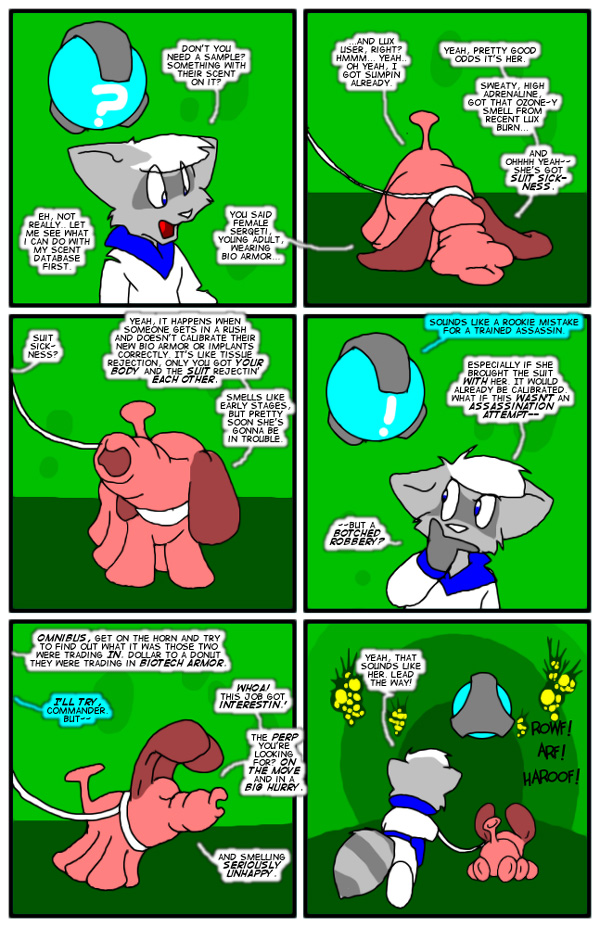
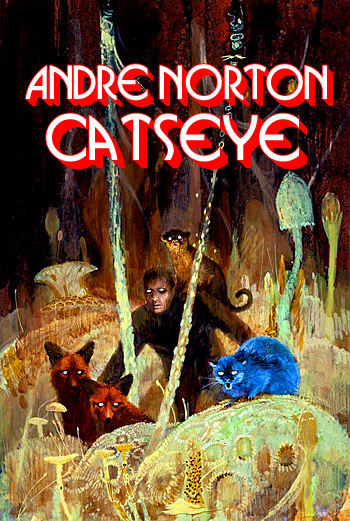
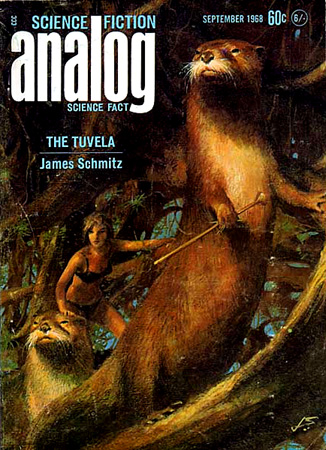
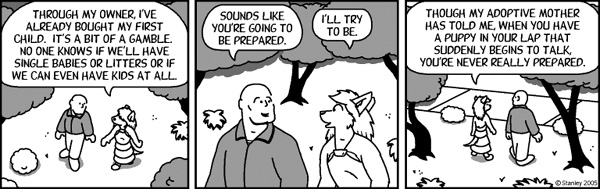
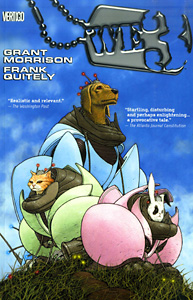
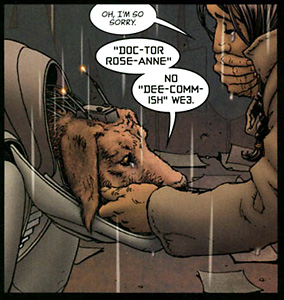
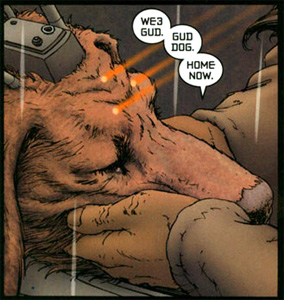
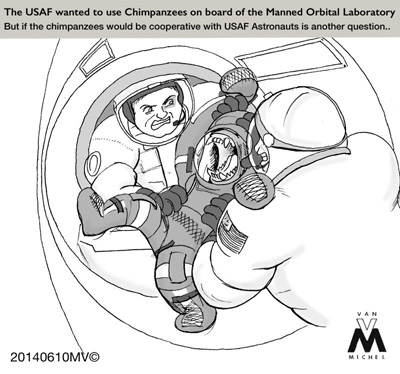
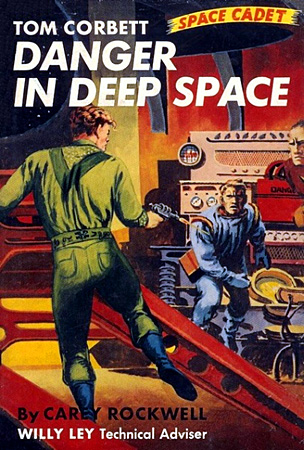
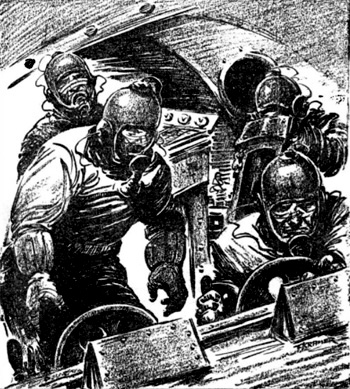
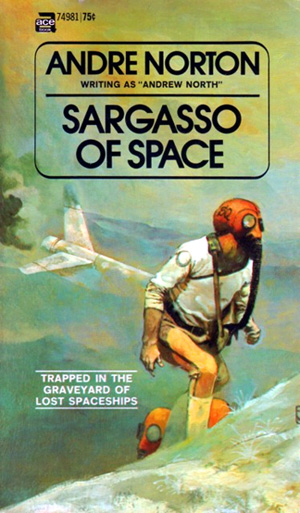
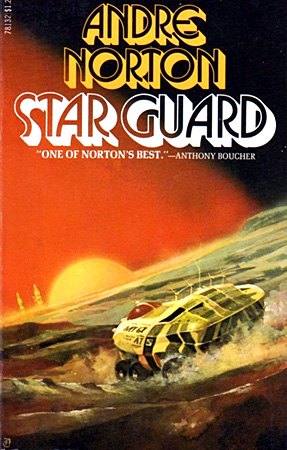
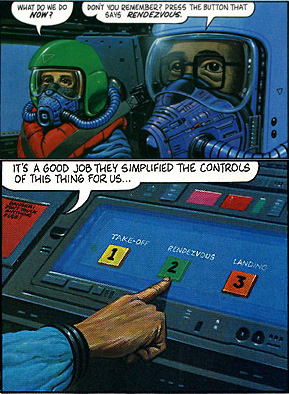
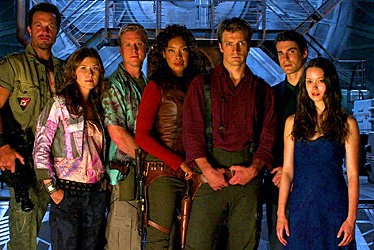
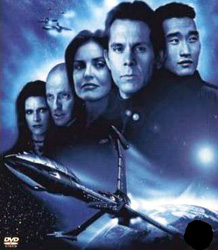
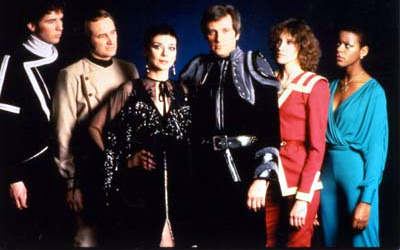
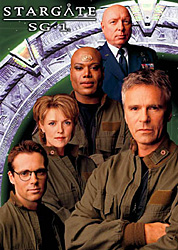
To the humor impared, this is a joke
artist unknown
Introduction
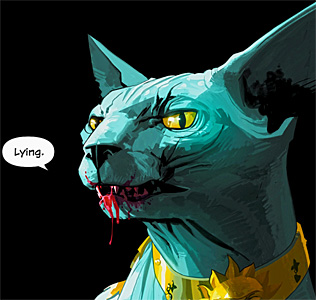
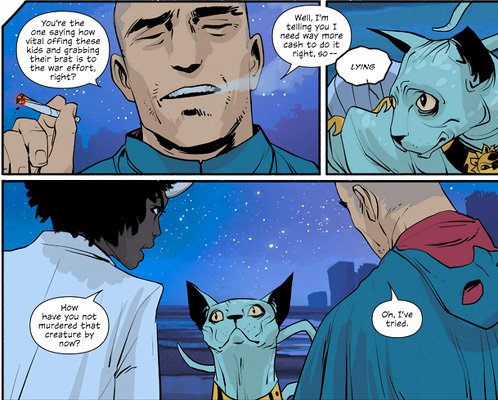
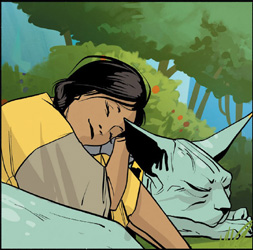
RocketCat sez
Alright, space cadets! This is the way it is. If your ship is bigger than a space taxi you gotta have more than one crewperson. There are lots of critical jobs (or "hats") on a spacecraft, the more hats a given crewperson wears the lower will be their job performance. They hafta sleep sometime.
What kinda jobs are we lookin' at here? Well:
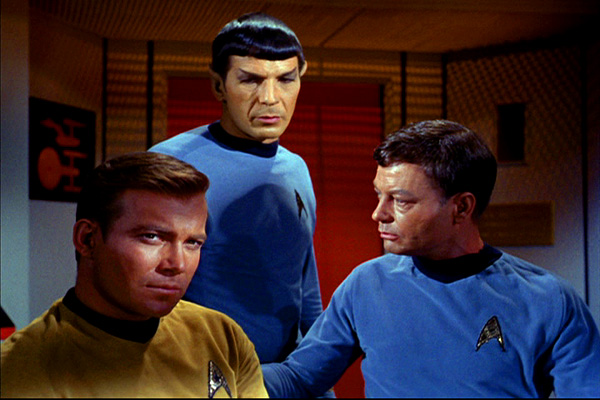
Captain
They are the absolute ruler of the spacecraft, their word is law.
But don't get the wrong idea, captains often have a boss as well. If the skipper of a Cosmi-Hauler Incorporated cargo ship fails to deliver the cargo on time the corporation will fire the captain's sorry behind.
The captain's job is things outside of the ship, mostly where the ship is going and whatsit gonna do when it gets there. Such as "fly to Deimos and load a cargo of water-ice" or "fly to Mars and drop bombs on those accurséd Arean Independence Revolutionaries."
First Officer
The captain's right-hand person. The first officer's job is things inside the ship, mostly crackin' the whip to make sure the crew does their jobs.
But the first officer also has to draft the "watchbill", make sure the blasted ship is adequately stocked with life support and other supplies so you don't all suffocate or starve to death, keep an eyeball on those lazy engineers to make sure they are keeping up with maintenance and repairs, ensure that the vacuum moonshine 'still on Z deck (that you officially don't know about) is making just enough space booze to stave off boredom but not enough to endanger the ship, and otherwise keep up the beatings until the morale improves.
The captain tells the astrogator where the ship has to go, the astrogator's job is to figure out how. Once en route, the astrogator keeps a sharp eye to make sure the blasted ship stays on course, giving the pilot mid-course corrections if need be.
When the destination is ordered, the astrogator will draw a pork-chop plot for the cap'n. From that the cap'n can chose the trip with the best possible combination of launch date, arrival date, and delta V cost. Or discover there ain't no acceptable trip so it's time for a captain-astrogator conference.
Once the trip is chosen, the astrogator breaks it down into "maneuvers" and feeds them to the pilot. During the trip the astrogator watches the ship's position and vector like a hawk, since starving to death after you've eaten all your crewmates is such a nasty way to die. If the ship drifts out of the groove, the astrogator will calculate a special maneuver called a "mid-course correction" to get the blasted ship back on track, and feeds it to the pilot.
The astrogator will be occasionally feeding to the pilot a maneuver to be done. Maneuvers have three parts: [1] direction to point the ship's nose, [2] how much delta V to burn, and [3] exact time to do it.
The pilot uses attitude controls and the attitude display to point the ship's nose (and make darn sure it stays pointed the right way), plus thrust controls, chronometer, and delta V display to start the burn at the right time and keep it burning long enough for the required delta V.
If the thrust controls are too darn complicated then the pilot job will be split into two jobs: helmsman handles the attitude controls and lee helmsman handles the thrust controls.
In between maneuvers the pilots play a lot of solitaire and surf Facebook.
The engineer's main job is to look after the engine, duh. The lee helmsman is almost always an engineer, unless the first officer is really stupid. Engineers inspect all the ship systems, do maintenance, repairs, and otherwise keep the blasted ship from falling to pieces.
If the ship is a warship, the chief engineer is also the chief damage control officer. Different skill set is required. Fixing a clogged toilet is quite different from fixing a laser cannon crater in the hull.
Ya gotta have a doc, expecially if it is 2.7 years before you can get the sick person to a hospital. The doc might be only a hospital corpsmen, but that is light years better than nothing.
(ed note: the good ship Space Angel is unexpectedly on a desperate mission. At their last encounter with hostile forces, they got away but the ship took damage. They are going to set down on an unknown unexplored planet to do repairs. )
“Where shall we land, Gertie?” Ham asked. “That
peninsula on the southeast coast of the northern continent looks like a good spot.” “There’s a tropical storm heading that way. Let’s
try that big island just south of the equator. Instrument readings show no signs of advanced, technological
civilization down there, but let’s not take chances.
If there is such a culture, an island is the last place it
will be. We need a few days without disturbance to
carry out repairs, and we can’t afford a fight with anybody who can match our firepower.” Finn descended to his navigation room and returned a few minutes later. “I’ve located a good-sized
clearing in the uplands, well away from the ocean.” “That’ll do,” the skipper said. “We’ll set down
there, and work on repairs. Nobody leaves the landing area without permission. All right, everybody,
back to your cabins and prepare to land. When we’re
down, I’ll call off work parties. We’ve got some crucial repairs to make and I don’t want to waste any
time.” They filed out. Kelly, for one, was disappointed
that they wouldn’t be doing any exploring. He suspected that he wasn’t alone.
(ed note: Kelly is the newly-hired Ship's Boy. He is barely a teenager. Lafayette is the former ship's boy, just a little older than Kelly. Lafayette is not handling the strain of the mission well.)
Kelly and Nancy stood at the top of the ramp.
Achmed, and Bert were working the first shift
repairing the Angel’s hull. The AC (atmosphere craft) would be tended
to later, and without it, the skipper had ruled out any
exploring. “What a waste!” Kelly observed bitterly. “A whole
new world, untouched by humans, and we can’t so
much as set foot on it. Doesn’t it make you mad?” He
was hoping to elicit some kind of personal revelation
from Nancy. Since the day she had revealed something of her childhood, she had withdrawn once more
into her untouchable shell when she was alone with
him. “I’ve seen lots of new worlds, Kelly, some of them
never explored before. You get used to it. And the
skipper’s right. It just looks like an Earth jungle. It
could be something completely diflerent. That stuff
that looks like grass could be carnivorous, for instance. Flowers could spray poison gas in your face.
Animals could dig camouflaged pits for you to step in.
I’ve seen such things on colonized worlds. This place
is an unknown quantity.”
“What’s the joke?” came a voice behind them.
Lafayette stepped out onto the gangway platform. He
was looking surly this morning. The last few weeks,
even Kelly had noticed that the long voyage and the
strain of uncertainty were telling on Lafayette. “Kelly made an observation concerning the Vivers,” Nancy answered blandly. “A lot of good those two lobsters have done us so
far,” Lafayette commented. “Teddy’s (ship's pet) been as much
help, and even Homer at least breaks up the monotony.” “I’m going back to the comm room,” Nancy announced, obviously not wishing to be around Lafayette in this mood. He didn’t seem to notice when she
left. “Hey, Kelly, what do you say we go have a look
around? This ship’s about to drive me into a permanent Whoopee Drive dream.” “I don’t know,” said Kelly, doubtfully. “The skipper said—” “Who cares what she said! She’s not human, anyway. What’s she going to do, kick us off the ship?
Chances are, we’ll never get back from this crazy trip
whatever we do.” “Well, suit yourself, but I’m staying here,” said
Kelly, although he really wanted to go. “Stay here, then!” Lafayette yelled. He stalked down
the ramp and onto the ground, not even pausing to
make a speech appropriate to being the first human to
set foot on a new world. He crossed the clearing and
disappeared into the jungle.
Kelly waited for him to
return, and after an hour had passed, he began to
grow alarmed. When he could wait no longer, he
headed for the bridge, where the skipper was going
over some drawings with Ham, Torwald, and
Michelle. She looked up as he entered, frowned when
she caught his worried expression. “What’s the matter?” she asked. “Lafayette’s left the ship,” he said. “What?” She jumped out of her chair, ran to Kelly
and grabbed him by the shoulders. “When?” “A little over an hour ago. He—” “Over an hour ago?” Her wrath mounted by the
second. “Why did you wait so long to tell me, you
landsman?” The deadly insult warned Kelly that he
was in deep trouble. With trepidation, he explained
what had happened.
“Why didn’t you stop him?” “It was his neck, wasn’t it? He knew your orders.” “You should’ve stopped him.” “How, Skipper?” “You could’ve punched him out,” said Torwald.
“You’ve done that before.” “We’re wasting time,” said the skipper. “Torwald,
fetch the gear you’ll need for a ground expedition.
Send the Vivers out first to scout for his trail. Send
Homer, too. He can see and sense things we can’t.
Take everybody who isn’t needed to repair the AC.
When that’s fixed, it’ll be a lot easier looking.
Michelle, I hate to send you along, but he’s liable to
need immediate medical care when he’s found. If he’s
found. Get going. You stay here,” she said, pointing
at Kelly. When the others had gone, she thrust her
face within an inch of Kelly’s. She had to stretch to do
it. He had been growing. “Listen, you. When you serve in a ship, you think
of the ship first, last, and always. Your temper and
feelings don’t count. That boy has been at the breaking point for weeks, and it was your job to look out
for him, whatever differences you two have had in
the past. You’ve let a shipmate down, you’ve forced
the rest of the crew to endanger their lives, and you’ve
endangered the ship. Those are three unforgivable
sins. Now, against my better judgment, I’m going to
give you a chance to redeem yourself. You’re going
out with that party. If Lafayette doesn’t come back
with them, I don’t want to see you back, either.” She
turned and strode through the hatch, leaving Kelly
pale and shaken, alone on the bridge.
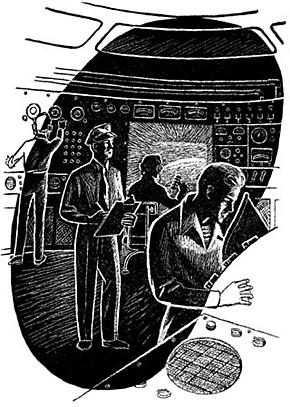
Where your ship goes, you
go. If the pilot swings the vessel into an asteroid belt and
butts it up against some rook,
that's where they'll find you later. There are simulators that'll
start someone off, but the only
way to learn to fly is to punch
the board.
But how to learn safely,
that's the life-and-death question. Sure there's a way. He's called the copilot. More
about that later.
Right now I think I'll let you in on a little secret. I've
got the best pilots of any ship in the Marches. For that
matter, I've got the best damned bridge crew of any
ship in the Marches. It's not too hard to spot real
ability it you know how.
When I've got an opening, I put out the word at places where I know spacers hang out, then I wait for
somebody to show up. If he's worked on a sub, he
never gets aboard (subsidized ships have the safety net of government money. So they tend to slack off). That's the first trick. (Forgive an
old man a few preiudices — but I'm set in my ways.)
The next thing is to bring the candidate onto the
bridge, set him down in the chair, and ask him to demonstrate what he knows against a simulation. Then
keep your eyes open. The computer will score him,
sure, and you can doublecheck that number later, but
watch him right now and you'll know whether you want
him or not.
Does he reconfigure the board? If he doesn't, show
him the hatch. That's my secret. A man who knows
his business chooses his tools carefully. They've got
these wading birds on Kinorb. You walk in among a
flock of them, and you might never get loose. Walk
left, the flock walks left. Walk right, the flock walks
right. Speed up, and they all hurry along beside you.
Stop, and the whole flock waits.
That's not what I want in a crewman. I want somebody who makes up his own mind and does what he
thinks best, in the way that be thinks best. If a man
doesn't have the confidence to reconfigure a board on
your ship so that he can do it his way, he's not the
best you can get.
As an added test (once he's passed this one), pick
another config at random and set the panel up that
way. Run the simulation again, and see how much his
performance drops off. An experienced hand won’t
suffer more than, say, 25%, and that should decrease
over the course of the test. "Judge a workman by his
tools," they say, and that's the first hurdle, but I say a
good man can use whatever he's got to his best
advantage.
One of the earliest uses of the term "astronaut"
Buck Rogers Sunday comic strip (1936)
artwork by Rick Yager
If your spacecraft have particularly weak propulsion systems, the ugly spectre of Every gram counts appears when you select your crew. Particularly with the crewperson's waistline. Put simply: the fatter you are, the more grams you mass, therefore the more propellant will have to be expended to propel your obese derrière through space.
The astromilitary will probably have a maximum weight limit on rocketmen. An enlisted person who puts on a kilo or two will have the sergeant wondering out loud how they can stand to carry around all that penalty-weight. If the enlisted person continues to gain, they will suddenly find themselves put on a diet and assigned all sorts of weight-losing exercise.
One hopes that there will not be a chronic problem with anorexia nervosa in the astromilitary.
So rocketeers would tend to be short and wiry. In Sir Arthur C. Clarke's classic THE OTHER SIDE OF THE SKY, space station construction crews got a pay bonus if they kept their weight below 68 kilograms (150 pounds).
Potential crew members will also have to be able to withstand the rigors of space travel. Things like:
Enduring multiple gs of acceleration with no injury
No claustrophobia from the cramped living conditions. And no agoraphobia if you have to do a space walk
The ability to endure long periods of boredom without psychologically cracking
Being in good health so as to minimize the risk of medical emergencies when the ship is months away from the nearest hospital
The ability to handle handle unexpected drops in atmospheric oxygen level
Bonus points if the crewmember is a space-adapted cyborg which does not need incidentals like a breathable atmosphere or comfortable temperatures.
Allen Steele puts forth the interesting possibility that for a prolonged commercial mission, psychological problems can be avoided by ensuring that the entire crew is part of a single group marriage. Sounds extreme but in his science fiction novels he makes a good case for it.
Note that the restrictions on body mass and claustrophobia would also be a good argument for rocketeers being:
Oriental
Female OR
Both
As it turns out, on the average, females mass less, eat less, and are more immune to boredom that males. As are people of the oriental persuasion, especially Japanese.
This turned up in a 1995 novel and anime television series called Rocket Girls. Maybe not so surprisingly, Japanese media in general is noted for its high standards of scientific accuracy. In this case the anime series had JAXA (the Japanese Aerospace eXploration Agency) and real-life Japanese astronaut Naoko Yamazaki as technical advisors.
The fictitious Solomon Space Association is developing the low-mass suits since their anemic one-lung LS-5 rocket can barely lift itself off the launch pad, let alone any payload. In a further desperate attempt to save on mass, they are reduce to using 16 year old girls as astronauts (which is a predictable development for a Japanese anime). They only weigh 38 kilograms, instead of the sixty-odd kilograms of the adult male astronauts. They take up less room in the control cabin as well.
AN ALL-FEMALE MISSION TO MARS
But why would anyone think a woman would be the first to space, anyway? Medical studies, for one thing. Some studies in the 1950s and ’60s suggested female bodies had stronger hearts and could better withstand vibrations and radiation exposure. Moreover, psychological studies suggested that women coped better than men in isolation and when deprived of sensory inputs.
Some of these investigations were limited in their design and sample sizes. But there was another, more compelling reason that women might outshine men as potential astronauts: basic economics. Thanks to their size, women are, on average, cheaper to launch and fly than men...
...Last year I took part in a NASA-funded research project called HI-SEAS (Hawaii Space Exploration Analog and Simulation). It required that I and five other crewmembers live as astronauts on the surface of Mars...
...Week in and week out, the three female crew members expended less than half the calories of the three male crew members. Less than half! We were all exercising roughly the same amount—at least 45 minutes a day for five consecutive days a week—but our metabolic furnaces were calibrated in radically different ways.
During one week, the most metabolically active male burned an average of 3,450 calories per day, while the least metabolically active female expended 1,475 calories per day. It was rare for a woman on crew to burn 2,000 calories in a day and common for male crew members to exceed 3,000.
The data certainly fit with my other observations. At mealtime, the women took smaller portions than the men, who often went back for seconds. One crew member complained how hard it was to maintain his weight, despite all the calories he was taking in.
The calorie requirements of an astronaut matter significantly when planning a mission. The more food a person needs to maintain her weight on a long space journey, the more food should launch with her. The more food launched, the heavier the payload. The heavier the payload, the more fuel required to blast it into orbit and beyond. The more fuel required, the heavier the rocket becomes, which it in turn requires more fuel to launch.
Every pound counts on the way to space. NASA was keenly aware of this, and that’s why in the early 1960s it nearly considered a female astronaut corps...
...In the early 2000s, Alan Drysdale, a systems analyst in advanced life support and a contractor with NASA, was thinking about the problem of astronaut bodies. He turned to a NASA document on physiological metrics called STD-3000, Man-Systems Integration Standards (now revised to STD-3001), which details needs and effluents for a range of body types. The STD-3000 gave the stats for women whose size was in the fifth percentile to men sized in the 95th percentile, a range from about 4-foot-11 and 90 pounds to 6-foot-3 and 215 pounds. He crunched the numbers.
Drysdale found that a fifth-percentile woman would use less than half the resources of a 95th-percentile man...
...Drysdale, who no longer works with NASA, is emphatic that the space agency wastes money and doesn’t consider cost-saving approaches like a Mars crew of smaller astronauts. He says his calculations suggest all things being equal, such a crew would launch for half the payload cost. “Small women haven’t been demonstrated to be appreciably dumber than big women or big men, so there’s no reason to choose larger people for a flight crew when it’s brain power you want,” says Drysdale. “The logical thing to do is to fly small women.”
Then the ship's braking program hit us and I stopped shaking. Eight gees, I would say, or maybe ten. When a female pilot handles a ship there is nothing comfortable about it; you're going to have bruises every place you're strapped. Yes, yes, I know they make better pilots than men do; their reactions are faster and they can tolerate more gee. They can get in faster, get out faster, and thereby improve everybody's chances, yours as well as theirs. But that still doesn't make it fun to be slammed against your spine at ten times your proper weight.
But I must admit that Captain Deladrier knows her trade. There was no fiddling around once the Rodger Young stopped braking.
From STARSHIP TROOPERS by Robert Heinlein (1959)
HOW A NUCLEAR SUBMARINE OFFICER LEARNED TO LIVE IN TIGHT QUARTERS
Author Steve Weiner in 2011, on the USS Connecticut, a nuclear submarine. Weiner was the ship’s navigator. Submarine and crew, with a team of scientists, were deployed in the Arctic Ocean, studying the Arctic environment and testing high frequency sonar and acoustic communications for under-ice operations. Courtesy of Steve Weiner
I’m no stranger to forced isolation. For the better part of my 20s, I served as a nuclear submarine officer running secret missions for the United States Navy. I deployed across the vast Pacific Ocean with a hundred other sailors on the USS Connecticut, a Seawolf-class ship engineered in the bygone Cold War era to be one of the fastest, quietest, and deepest-diving submersibles ever constructed. The advanced reactor was loaded with decades of enriched uranium fuel that made steam for propulsion and electrical power so we could disappear under the waves indefinitely without returning to port. My longest stint was for two months, when I traveled under the polar ice cap to the North Pole with a team of scientists studying the Arctic environment and testing high frequency sonar and acoustic communications for under-ice operations. During deployments, critical-life events occur without you: holidays with loved ones, the birth of a child, or in my case, the New York Giants 2011-2012 playoff run to beat Tom Brady’s Patriots in the Super Bowl for the second time. On the bright side, being cut off from the outside world was a great first job for an introvert.
Shuttered in a house on foreign soil where I don’t speak the language, I have found myself snapping back into submarine deployment mode. Each day I dutifully monitor online dashboards of data and report the status of the spread at the breakfast table to no one in particular. I stay in touch with friends and family all over the world who tell me they’re going stir crazy and their homes are getting claustrophobic. But if there is one thing my experience as a submarine officer taught me, it’s that you get comfortable being uncomfortable.
My training began with psychological testing, although it may not be what you think. Evaluating mental readiness for underwater isolation isn’t conducted in a laboratory by clipboard-toting, spectacled scientists. The process to select officers was created by Admiral Hyman Rickover—the engineering visionary and noted madman who put the first nuclear reactor in a submarine—to assess both technical acumen and composure under stress. For three decades as the director of the Navy’s nuclear propulsion program, Rickover tediously interviewed every officer, and the recruiting folklore is a true HR nightmare: locking candidates in closets for hours, asking obtuse questions such as “Do something to make me mad,” and sawing down chair legs to literally keep one off balance.
Rickover retired from the Navy as its longest-serving officer and his successors carried on the tradition of screening each officer candidate, but with a slightly more dignified approach. Rickover’s ghost, though, seemed to preside over my interview process when I applied to be a submariner as a junior at the U.S. Naval Academy in Annapolis, Maryland. I was warned by other midshipmen that I would fail on the spot if I initiated a handshake. So, dressed in my formal navy blue uniform and doing my best to avoid tripping into accidental human contact, I rigidly marched into the Admiral’s office, staring straight ahead while barking my resume. When I took a seat on the unaltered and perfectly level chair in front of his desk, the Admiral asked me bluntly why I took so many philosophy classes and if I thought I could handle the technical rigors of nuclear power school. My response was a rote quip from John Paul Jones’ “Qualifications of a Naval Officer.” “Admiral, an officer should be a gentleman of liberal education, refined manners, punctilious courtesy, and the nicest sense of personal honor.” My future boss looked at me, shook his head like he thought I’d be a handful, and told me I got the job.
Nuclear power training is an academic kick in the face every day for over a year. The curriculum is highly technical and the pedagogy resembles a cyborg assembly-line without even a hint of the Socratic method. Our grades were conspicuously posted on the classroom wall and a line was drawn between those who passed and those who failed. I was below the line enough to earn the distinguished dishonor of 25 additional study hours each week, which meant I was at school at 5 a.m. and every weekend. This is how the Nuclear Navy builds the appropriate level of knowledge and right temperament to deal with shipboard reactor operations.
I finally sat down for a formal psychological evaluation a few months before my first deployment. I was ushered into a room no bigger than a broom closet and instructed to click through a computer-based questionnaire with multiple-choice questions about my emotions. I never did learn the results, so I assume my responses didn’t raise too many red flags.
During my first year onboard, I spent all my waking hours either supervising reactor operations or learning the intricacies of every inch of the 350-foot tube and the science behind how it all worked. The electrolysis machine that split water molecules to generate oxygen was almost always out of commission, so instead we burned chlorate candles that produced breathable air. Seawater was distilled each day for drinking and shower water. Our satellite communications link had less bandwidth than my dial-up modem in the 1990s and we were permitted to send text-only emails to friends and family at certain times and in certain locations so as not to risk being detected. I took tests every month to demonstrate proficiency in nuclear engineering, navigation, and the battle capabilities of the ship. When I earned my submarine warfare qualification, the Captain pinned the gold dolphins insignia on my uniform and gave me the proverbial keys to the $4 billion warship. At that point, I was responsible for coordinating missions and navigating the ship as the Officer of the Deck.
Modern submarines are hydrodynamically shaped to have the most efficient laminar flow underwater, so that’s where we operated 99 percent of the time. The rare exception to being submerged is when we’d go in and out of port. The most unfortunate times were long transits tossing about in heavy swells, which made for a particularly nauseated cruise. To this day, conjuring the memory of some such sails causes a reflux flashback. A submariner’s true comfort zone is beneath the waves so as soon as we broke ties with the pier we navigated toward water that was deep enough for us to dive.
It’s unnatural to stuff humans, torpedoes, and a nuclear reactor into a steel boat that’s intentionally meant to sink. This engineering marvel ranks among the most complex, and before we’d proceed below and subject the ship and its inhabitants to extreme sea pressures, the officers would visually inspect thousands of valves to verify the proper lineup of systems that would propel us to the surface if we started flooding uncontrollably and sinking—a no-mistakes procedure called rigging for dive. Once we’d slip beneath the waves, the entire crew would walk around to check for leaks before we’d settle into a rotation of standing watch, practicing our casualty drills, engineering training, eating, showering (sometimes), and sleeping (rarely). The full cycle was 18 hours, which meant the timing of our circadian cycles were constantly changing. Regardless of the amount of government-issued Folger’s coffee I’d pour down my throat, I’d pass out upon immediate contact with my rack (the colloquialism for a submarine bunk in which your modicum of privacy was symbolized by a cloth curtain).
As an officer, I lived luxuriously with only two other grown men in a stateroom no bigger than a walk-in closet. Most of the crew slept stacked like lumber in an 18-person bunk room and they all took turns in the rack. This alternative lifestyle is known as hot-racking, because of the sensation you get when you crawl into bedding that’s been recently occupied. The bunk rooms are sanctuaries where silence is observed with monastic intensity. Slamming the door or setting an alarm clock was a cardinal sin so wakeups were conducted by a junior sailor who gently coaxed you awake when it was time to stand watch. Lieutenant Weiner, it’s time to wake up. You’ve got the midnight watch, sir. Words that haunt my dreams.
I maintained some semblance of sanity and physical fitness by sneaking a workout on a rowing erg in the engine room or a stationary bike squeezed between electronics cabinets. The rhythmic beating of footsteps on a treadmill was a noise offender—the sound could be detected on sonar from miles away—so we shut it off unless we were in friendly waters where we weren’t concerned with counter-detection.
Like a heavily watered-down version of a Buddhist monk taking solitary retreat in a cave, my extended submarine confinements opened something up in my psyche and I gave myself permission to let go of my anxieties. Transiting underneath a vast ocean in a vessel with a few inches of steel preventing us from drowning helps put things into perspective. Now that I’m out of the Navy, I have more appreciation for the freedoms of personal choice, a fresh piece of fruit, and 24 hours in a day. My only regrets are not keeping a journal or having the wherewithal to discover the practice of meditation under the sea.
One of the stranger specialized skills a spacecraft crew member might have is using ones foot like a hand. Could come in handy in free fall.
THE SPACE BEYOND
Putney went back to the lock, opened the inner chamber, closed the door behind him, and cautiously opened the outer door. A breath of their own air swept out, to be replaced in a moment by a dry, but invigoratingly cool breeze of this other atmosphere. As he glanced out he saw that the two men in the plane had already opened their door, and were coming out. They were walking along unconcernedly head down along the wing of the ship, which was equipped with a rail of some sort, evidently for this purpose. Their feet were bare, and equipped with a broad calloused palm, a strong, long and supple great toe, and the four lesser toes were all well developed and highly flexible.
To Putney's amazement one of the men let go with one foot, reached into his pocket with a contortionist motion that seemed easy and perfectly simple, and took out a heavy clip. In the meantime his hands had been busy unwinding a thin, strong line from his waist. The clip was fixed to one end of the line with the aid of one hand and one foot, while the other foot was engaged in holding him up, and the other hand adjusted the leather belt to which the other end of the line was fastened. Then with a single motion the man restored his foot to the rail, leapt, and landed lightly and safely on the threshold of the Prometheus' lock. He straightened up, and smiled engagingly...
..."Come," Putney beckoned Thaen on, and through the locked door to the interior of the ship. As the inner door opened Thaen entered the power room and stopped in amazement. He was staring with both mobile eyes at the ten-foot Flame, a perfect sphere on which sparkled little winking lights. He listened to the soft sigh of the swirling, iridescent iron atoms. MacLaurin was looking at him interestedly.
"A queer body. His toes are long."
"Uses them for fingers. I envy him. He can untie knots with them or run four-dimensional controls all at the same time."
Ships fly themselves in hyperdrive. All a pilot need do is watch for green radial lines in the mass sensor. But he has to do that frequently, because the mass sensor is a psionic device; it must be watched by a mind, not another machine.
As the narrow green line that marked Sol grew longer, I became abnormally conscious of the debris around Sol system. I spent the last twelve hours of the flight at the controls, chain-smoking with my feet. I should add that I do that normally, when I want both hands free; but now I did it to annoy Ausfaller. I'd seen the way his eyes bugged the first time he saw me take a drag from a cigarette between my toes. Flatlanders are less than limber...
...Ausfaller grinned. He took the top and bottom buttons between his fingers and tugged hard. They came off. The material between them ripped open as if a thread had been strung between them.
Holding the buttons as if to keep an invisible thread taut, he moved them on either side of a crudely done plastic touch-sculpture. The sculpture fell apart.
"Sinclair molecule chain. It will cut through any normal matter, if you pull hard enough. You must be very careful, it will cut your fingers so easily that you will hardly notice they are gone. Notice that the buttons are large, to give an easy grip." He laid the buttons carefully on a table and set a heavy weight between them...
...I couldn't see Carlos. Forward and Angel had tied us to opposite sides of the central pillar, beneath the Grabber...
...I began trying to kick off my shoes. They were soft ship-slippers, ankle-high, and they resisted.
I locked the left foot free just as one of the tugs flared with ruby light...
...I peeled the other slipper off with my toes...
...I reached up with my toes, groping for the first and fourth buttons on my falling jumper.
The weaponry in my wonderful suit hadn't helped me against Julian's strength and speed. But flatlanders are less than limber, and so are Jinxians. Forward had tied my hands and left it at that.
I wrapped two sets of toes around the buttons and tugged. My legs were bent pretzel-fashion. I had no leverage. But the first button tore loose, and then the thread. Another invisible weapon to battle Forward's portable bottomless hole.
The thread pulled the fourth button loose. I brought my feet down to where they belonged, keeping the thread taut, and pushed backward. I felt the Sinclair molecule chain sinking into the pillar.
The Grabber was still swinging.
When the thread was through the pillar I could bring it up in back of me and try to cut my bonds. More likely I'd cut my wrists and bleed to death; but I had to try. I wondered if I could do anything before Forward launched the black hole.
A cold breeze caressed my feet.
I looked down. Thick fog boiled out around the pillar.
Some very cold gas must be spraying through the hair-fine crack.
I kept pushing. More fog formed. The cold was numbing. I felt the jerk as the magic thread cut through. Now the wrists—
Liquid helium?
Forward had moored us to the main superconducting power cable.
That was probably a mistake. I pulled my feet forward, carefully, steadily, feeling the thread bite through on the return cut.
The Grabber had stopped swinging. Now it moved on its arm like a blind, questing worm, as Forward made fine adjustments. Angel was beginning to show the strain of holding himself upside down.
My feet jerked slightly. I was through. My feet were terribly cold, almost without sensation. I let the buttons go, left them floating up toward the dome, and kicked back hard with my heels.
Something shifted. I kicked again.
Thunder and lightning flared around my feet.
I jerked my knees up to my chin. The lightning crackled and flashed white light into the billowing fog. Angel and Forward turned in astonishment. I laughed at them, letting them see it. Yes, gentlemen, I did it on purpose...
The Mouse walked beside Hell3, his boot heel clicking, his bare foot silent (as in another city on another world, Leo had walked). This was his latest travel acquisition. Those who worked under free-fall in the ships that went between planets developed the agility of at least one set of toes, sometimes both, till it rivaled world-lubbers' hands, and ever after kept that foot free. The commercial interstellar freighters had artificial gravity, which discouraged such development.
When Charlie had dug his scooter out of the floating junkyard moored to his home they soon saw why he had refused to lend it. It seemed probable that no one else could possibly pilot it. Not only was it of vintage type, repaired with parts from many other sorts, but also the controls were arranged for a man with four hands. Charlie had been in free fall so long that he used his feet almost as readily for grasping and handling as does an ape; his space suit had had the feet thereof modified so that he could grasp things between the big toe and the second, as with Japanese stockings.
A person who has a "disability" on Terra might actually have an asset in the space environment. For example, somebody with non-fuctional inner ears have problems keeping their balance in a gravity field. But in free fall they are immune to drop sickness.
Actress Angel Giuffria was born missing the left arm below the elbow. She wears an arm from Advanced Arm Dynamics with a hand from Bebionic. It is controlled by myoelectric muscle signals. IMDB, Twitter, Instagram
In 1961, a college student named David Myers traveled from Washington, DC, to the US Naval School of Aviation Medicine in Florida to take part in a new experiment. “I had a very limited understanding of what I was getting myself into,” Myers told me recently over email. “So I was extremely curious and mildly excited that first day.”
Myers was one of 11 men specifically recruited by Dr. Ashton Graybiel to help test the feasibility of human spaceflight, at a time when nobody knew whether the human body could withstand a trip beyond our atmosphere. For nearly a decade, the US Navy put 11 eleven men through countless tests. Four of the men spent 12 straight days inside a 20-foot room that rotated constantly. In another experiment, they were sent out to notoriously rough seas off the coast of Nova Scotia. On the boat, the men played cards while the researchers were so overcome with seasickness that they had to cancel the test and go home. Others were sent up in the so-called “Vomit Comet,” an aircraft designed to simulate zero gravity. That’s the test Myers is still most fond of. “This free floating was a fascinating experience,” he says. “No other tests came close as my favorites.” But Myers and the other men would never go to space. In fact, they would never be allowed. They were recruited for these tests for the exact reason they would never pass the NASA astronaut qualification exams: All 11 men were deaf.
Now known as the Gallaudet Eleven, Myers and his colleagues were recruited from Gallaudet College (now Gallaudet University), a school for d/Deaf students. (“Big D” Deaf refers to Deaf culture and community, while “small d” deaf refers to people who don’t identify with that community.) Ten out of the 11 men had become deaf because of spinal meningitis, an infection of the fluid in the spinal cord. The infection ultimately damaged each man’s inner ear, including their vestibular system, which also happens to be the system that is mainly responsible for motion sickness. This made the men perfect test subjects for a space program that was trying to understand what might happen to people in places where the inner ear can’t sense up and down. “Through their endurance and dedication, the work of the Gallaudet Eleven made substantial contributions to the understanding of motion sickness and adaptation to spaceflight,” wrote Hannah Hotovy of the NASA History Division. Harry Larson, another one of the Gallaudet Eleven, put it this way: “We were different in a way they needed.”
It’s no secret that it’s incredibly difficult to become an astronaut. NASA’s selection process is notoriously rigorous—strict enough that it was the most plausible kind of place to set the movie Gattaca, where only the perfectly genetically engineered get to board rockets bound for space. Writer Tom Wolfe documented the space program’s strenuous astronaut training program in his book The Right Stuff.
The assumption has long been that this training is a necessity—traveling to space is a mentally and physically grueling endeavor. We need the strongest, smartest, most adaptable among us to go. But strength comes in many forms, as do smarts. And if you want to find people who are the very best at adapting to worlds not suited for them, you’ll have the best luck looking at people with disabilities, who navigate such a world every single day. Which has led disability advocates to raise the question: What actually is the right stuff?
"Crip bodies were built for space travel. Crip minds already push the outer limits,” Alice Wong, founder of the Disability Visibility Project, tweeted last year. “We already master usage of breathing apparatuses and can handle challenging situations.” Wong went on to coedit an issue of the literary magazine Deaf Poets Society called “Crips in Space” with writer and performer Sam de Leve.
Take, for example, people who use ostomy bags. Right now, pooping in space is actually an important technical challenge. During takeoff, landing, and spacewalks, astronauts wear diapers. While in the space station, they use a toilet that requires a fair amount of precision and training to use. Astronauts have told all kinds of stories about rogue poop, or situations in which the toilet has backed up or generally gone awry. In 2008, NASA spent $19 million on a Russian toilet for the International Space Station. None of this would be an issue for an astronaut with an ostomy bag. “I could plug into the wall and just empty the container that’s been collecting,” says Mallory K. Nelson, a disability design specialist who uses an ileostomy bag—a pouch that connects to her intestine and collects waste. “I’ve moved the output location of poop, which creates a lot more flexibility in the kind of systems I can have. I could attach it to a space suit.”
Or consider movement in space. You’ve certainly seen videos of astronauts zipping around the space station using their arms and legs to push off surfaces and direct their motion. This is a type of movement that people who use wheelchairs and other mobility aids are already familiar with. In fact, the various devices and ways of moving the body in space are likely more familiar to people with disabilities than to able-bodied people. “We move our bodies in so many different ways, and the disabled community has an exuberant amount of options,” says Nelson, who is an amputee and who has used crutches, a wheelchair, a scooter, and a prosthetic to get around. Nelson even coined a term for this recently: transmobility, the idea that there are lots of ways to get around besides putting one foot in front of the other.
Nelson also points out that most astronauts have no prior experience relying on technology for their movement and lives, whereas people with disabilities do so every day. In a space suit, for a space walk, an astronaut has to be trained in how to move their body in unison with a piece of technology. They have to get used to the idea that, if that technology should fail, they could be in grave danger. This, again, is an experience people like Nelson live with every day. “I’m always moving my body in motion with another object. That’s all we do,” Nelson says.
Or take blind astronauts. In a piece for Scientific American, Sheri Wells-Jensen lays out the case for designing spaceships for blind space travelers:
“After all, in a serious accident, the first thing to go might be the lights! This generally means that the first thing a sighted astronaut must do for security is ensure visual access to the environment. He hunts for a flashlight, and if emergency lighting comes on, his eyes take a moment to adjust. Meanwhile, the blind astronaut is already heading toward the source of the problem. In the fire aboard the Russian Mir space station, in 1997, the crew struggled as smoke obscured their view. The blind astronaut, while still affected by the lack of good air, would not be bothered by either dim lighting or occluding smoke. She would accurately direct the fire extinguisher at the source of heat and noise.”
In the Mir fire that Wells-Jensen mentions, one of the problems that arose was the sighted astronauts’ inability to locate the fire extinguisher through the smoke. Had the ship been laid out with a blind participant in mind, there would have been a nonvisual signal already built in to such a critical piece of equipment.
Or consider d/Deaf astronauts once again. The Gallaudet Eleven were tapped for their immunity to motion sickness—John Glenn even reportedly said he was envious of their ability to withstand the tests without getting sick—but there are other reasons why bringing a d/Deaf astronaut along could be useful. “Studies have shown that using sign languages confers cognitive advantages in one's visual working memory, enhancing how we see, remember, and manipulate objects in our mind,” says Joseph Murray, a professor at Gallaudet University and the scholar behind the term Deaf Gain, the idea that deafness should not be considered a loss of something but, rather, a gain of a whole host of other things. “The challenge Deaf Gain offers for NASA and all workplaces is to rethink their automatic assumptions about deaf people's capabilities,” Murray says. “If there is a mission need for people with advanced spatial processing skills who do not get motion sick, then there are quite a few deaf people ready and willing to serve.”
And it’s not just on a trip to space that people with disabilities might have an advantage. Take a situation in which astronauts are going somewhere to settle: Able bodies might no longer behave the way we expect. “Humans have an environmental niche on Earth, like all other creatures do, and we exploit it in different ways,” says Ashley Shew, a professor at Virginia Tech. Mars, or even a space station, is nothing like that niche. “The conditions in which our bodies have grown up are so drastically different that our existence in space will be much more like being a disabled person on Earth than like being an abled person on Earth.” Who better to send than those who are used to navigating environments not built for them—those who experience that every day on Earth? “Disabled people will fare better in space because disabled people have learned to negotiate hostile situations in ways that able bodied people are completely unaware of,” Shew says. Wong agrees. “The way we communicate, function, and exist with our diverse bodyminds sets us up as ideal space explorers and ambassadors of Earth, ready to make first contact with sentient beings,” she told me.
Whether this will actually happen is hard to say. NASA didn’t respond to my request for comment on their astronaut selection policy (like all government agencies, NASA personnel are currently not working due to the government shutdown). Nor did Mars One or SpaceX. Online, Mars One has a whole page of qualifications for candidates for their proposed Mars mission, stating, “In general, normal medical and physiological health standards will be used” and disqualifying anybody without “normal range of motion and functionality in all joints,” anybody with less than 20/20 vision, and anybody who is deemed not “healthy.” NASA’s FAQ section says that “for maximum crew safety, each crewmember must be free of medical conditions that would either impair the person's ability to participate in, or be aggravated by, space flight, as determined by NASA physicians.”
Changing these requirements won’t be easy. Spacecraft are designed with certain assumptions about what kinds of bodies will be sitting in the seats and operating the controls. The opportunity to change those parameters is small and must be seized while ships are being designed, not down the road. Plus, many people with disabilities who might want to go to space can’t get access to the pipeline that delivers so many astronauts: “Astronauts come via the military and that’s a closed door for disabled individuals,” Myers says. “Those kinds of obstacles need to be removed for those individuals who are otherwise qualified.” And NASA itself has had no reason to rethink their stance, because no one has really pushed them to. Yet, that is.
But all that could change. In 2017, Johanna Lucht became the first Deaf engineer to work at NASA. Eddie Ndopu, a South African activist and humanitarian, has said he wants to be the first disabled person in space. He plans to book a flight on a commercial trip into space and deliver an address to the UN while he’s up there. (MTV is slated to film the entire thing.) Julia Velasquez, a Deaf woman from California, has gone through many of the steps traditionally taken by astronauts—she’s interned at NASA, recently received her pilot’s license, and even lived in a simulated Mars colony in Hawaii.
When I asked Myers if he ever wished he could have been an astronaut, he said, “Yes, absolutely. At one point I told Dr. Graybiel, ‘If you ever develop an experiment involving a flight into space, I want to be first in line.’” Myers likely won’t wind up in space in his lifetime. But he might live to see a disabled person make the journey, opening up space to a whole new set of uniquely qualified astronauts.
Steena of the spaceways—that sounds just like a corny title for one of the Stellar-Vedo spreads. I ought to know, I’ve tried my hand at writing enough of them. Only this Steena was no glamour babe. She was as colorless as a Lunar plant—even the hair netted down to her skull had a sort of grayish cast and I never saw her but once draped in anything but a shapeless and baggy gray space-all. All the boys who had profited by her queer store of knowledge and her photographic memory tried at one time or another to balance the scales. But she wouldn’t take so much as a cup of Canal water at their expense, let alone the credits they tried to push on her. For I was there, right in the Rigel
Royal, when it all began on the
night that Cliff Moran blew in,
looking lower than an antman’s
belly and twice as nasty. He’d had
a spell of luck foul enough to twist
a man into a slug-snake and we all
knew that there was an attachment
out for his ship. Cliff had fought
his way up from the back courts
of Venaport. Lose his ship and he’d
slip back there—to rot. He was at
the snarling stage that night when
he picked out a table for himself
and set out to drink away his
troubles. However, just as the first bottle
arrived, so did a visitor. Steena
came out of her corner, Bat (the cat) curled
around her shoulders stole-wise, his
favorite mode of travel. She crossed
over and dropped down without
invitation at Cliff’s side. That shook
him out of his sulks. Because Steena
never chose company when she
could be alone. If one of the man-stones
on Ganymede had come
stumping in, it wouldn’t have made
more of us look out of the corners
of our eyes. She stretched out one long-fingered
hand and set aside the bottle he
had ordered and said only one thing,
“It’s about time for the Empress of
Mars to appear again.”
Cliff scowled and bit his lip. He
was tough, tough as jet lining—you
have to be granite inside and
out to struggle up from Venaport
to a ship command. But we could
guess what was running through
his mind at that moment. The Empress
of Mars was just about the
biggest prize a spacer could aim
for. But in the fifty years she had
been following her queer derelict
orbit through space many men had
tried to bring her in—and none
had succeeded. A pleasure-ship carrying untold
wealth, she had been mysteriously
abandoned in space by passengers
and crew, none of whom had ever
been seen or heard of again. At intervals
thereafter she had been
sighted, even boarded. Those who
ventured into her either vanished or
returned swiftly without any believable
explanation of what they
had seen—wanting only to get away
from her as quickly as possible.
But the man who could bring her in—or
even strip her clean in space—that
man would win the jackpot. “All right!” Cliff slammed his
fist down on the table. “I’ll try even
that!”
It was the first time she had decided to cash in on her own tip and she was there—that was all. Maybe that point weighed with Cliff, maybe he just didn’t care. Anyway the three were together when they sighted the Empress riding, her dead-lights gleaming, a ghost ship in night space. She must have been an eerie sight because her other lights were on too, in addition to the red warnings at her nose. She seemed alive, a Flying Dutchman of space. Cliff worked his ship skillfully alongside and had no trouble in snapping magnetic lines to her lock. Some minutes later the three of them passed into her. There was still air in her cabins and corridors. Air that bore a faint corrupt taint which set Bat to sniffing greedily and could be picked up even by the less sensitive human nostrils. Cliff headed straight for the control cabin but Steena and Bat went prowling. Closed doors were a challenge to both of them and Steena opened each as she passed, taking a quick look at what lay within. The fifth door opened on a room which no woman could leave without further investigation.
I don’t know who had been housed there when the Empress left port on her last lengthy cruise. Anyone really curious can check back on the old photo-reg cards. But there was a lavish display of silks trailing out of two travel kits on the floor, a dressing table crowded with crystal and jeweled containers, along with other lures for the female which drew Steena in. She was standing in front of the dressing table when she glanced into the mirror—glanced into it and froze. Over her right shoulder she could see the spider-silk cover on the bed. Right in the middle of that sheer, gossamer expanse was a sparkling heap of gems, the dumped contents of some jewel case. Bat had jumped to the foot of the bed and flattened out as cats will, watching those gems, watching them and—something else! Steena put out her hand blindly and caught up the nearest bottle. As she unstoppered it she watched the mirrored bed. A gemmed bracelet rose from the pile, rose in the air and tinkled its siren song. It was as if an idle hand played…. Bat spat almost noiselessly. But he did not retreat. Bat had not yet decided his course. She put down the bottle. Then she did something which perhaps few of the men she had listened to through the years could have done. She moved without hurry or sign of disturbance on a tour about the room. And, although she approached the bed she did not touch the jewels. She could not force herself to that. It took her five minutes to play out her innocence and unconcern. Then it was Bat who decided the issue.
He leaped from the bed and escorted something to the door, remaining a careful distance behind. Then he mewed loudly twice. Steena followed him and opened the door wider. Bat went straight on down the corridor, as intent as a hound on the warmest of scents. Steena strolled behind him, holding her pace to the unhurried gait of an explorer. What sped before them both was invisible to her but Bat was never baffled by it. They must have gone into the control cabin almost on the heels of the unseen—if the unseen had heels, which there was good reason to doubt—for Bat crouched just within the doorway and refused to move on. Steena looked down the length of the instrument panels and officers’ station-seats to where Cliff Moran worked. On the heavy carpet her boots made no sound and he did not glance up but sat humming through set teeth as he tested the tardy and reluctant responses to buttons which had not been pushed in years. To human eyes they were alone in the cabin. But Bat still followed a moving something with his gaze. And it was something which he had at last made up his mind to distrust and dislike. For now he took a step or two forward and spat—his loathing made plain by every raised hair along his spine. And in that same moment Steena saw a flicker—a flicker of vague outline against Cliff’s hunched shoulders as if the invisible one had crossed the space between them. But why had it been revealed against Cliff and not against the back of one of the seats or against the panels, the walls of the corridor or the cover of the bed where it had reclined and played with its loot? What could Bat see?
The storehouse memory that had served Steena so well through the years clicked open a half-forgotten door. With one swift motion she tore loose her spaceall and flung the baggy garment across the back of the nearest seat. Bat was snarling now, emitting the throaty rising cry that was his hunting song. But he was edging back, back toward Steena’s feet, shrinking from something he could not fight but which he faced defiantly. If he could draw it after him, past that dangling spaceall…. He had to—it was their only chance. “What the….” Cliff had come out of his seat and was staring at them. What he saw must have been weird enough. Steena, bare-armed and shouldered, her usually stiffly-netted hair falling wildly down her back, Steena watching empty space with narrowed eyes and set mouth, calculating a single wild chance. Bat, crouched on his belly, retreating from thin air step by step and wailing like a demon.
“Toss me your blaster.” Steena gave the order calmly—as if they still sat at their table in the Rigel Royal. And as quietly Cliff obeyed. She caught the small weapon out of the air with a steady hand—caught and leveled it. “Stay just where you are!” she warned. “Back, Bat, bring it back!” With a last throat-splitting screech of rage and hate, Bat twisted to safety between her boots. She pressed with thumb and forefinger, firing at the spacealls. The material turned to powdery flakes of ash—except for certain bits which still flapped from the scorched seat—as if something had protected them from the force of the blast. Bat sprang straight up in the air with a scream that tore their ears. “What…?” began Cliff again. Steena made a warning motion with her left hand. “Wait!” She was still tense, still watching Bat. The cat dashed madly around the cabin twice, running crazily with white-ringed eyes and flecks of foam on his muzzle. Then he stopped abruptly in the doorway, stopped and looked back over his shoulder for a long silent moment. He sniffed delicately. Steena and Cliff could smell it too now, a thick oily stench which was not the usual odor left by an exploding blaster-shell. Bat came back, treading daintily across the carpet, almost on the tips of his paws. He raised his head as he passed Steena and then he went confidently beyond to sniff, to sniff and spit twice at the unburned strips of the spaceall. Having thus paid his respects to the late enemy he sat down calmly and set to washing his fur with deliberation. Steena sighed once and dropped into the navigator’s seat.
“Maybe now you’ll tell me what in the hell’s happened?” Cliff exploded as he took the blaster out of her hand. “Gray,” she said dazedly, “it must have been gray—or I couldn’t have seen it like that. I’m colorblind, you see. I can see only shades of gray—my whole world is gray. Like Bat’s—his world is gray too—all gray. But he’s been compensated for he can see above and below our range of color vibrations and—apparently—so can I!” Her voice quavered and she raised her chin with a new air Cliff had never seen before—a sort of proud acceptance. She pushed back her wandering hair, but she made no move to imprison it under the heavy net again. “That is why I saw the thing when it crossed between us. Against your spaceall it was another shade of gray—an outline. So I put out mine and waited for it to show against that—it was our only chance, Cliff. “It was curious at first, I think, and it knew we couldn’t see it—which is why it waited to attack. But when Bat’s actions gave it away it moved. So I waited to see that flicker against the spaceall and then I let him have it. It’s really very simple….” Cliff laughed a bit shakily. “But what was this gray thing? I don’t get it.” “I think it was what made the Empress a derelict. Something out of space, maybe, or from another world somewhere.” She waved her hands. “It’s invisible because it’s a color beyond our range of sight. It must have stayed in here all these years. And it kills—it must—when its curiosity is satisfied.” Swiftly she described the scene in the cabin and the strange behavior of the gem pile which had betrayed the creature to her.
Cliff did not return his blaster to its holder. “Any more of them on board, d’you think?” He didn’t look pleased at the prospect. Steena turned to Bat. He was paying particular attention to the space between two front toes in the process of a complete bath. “I don’t think so. But Bat will tell us if there are. He can see them clearly, I believe.”
Presently we emerged into a wide metal tunnel, one of the station's main passageways, I guessed. Cables and pipes ran along the walls, and at intervals we passed through great double doors with red EMERGENCY notices painted on them. I didn't think this was at all reassuring. We met only two people on our journey. They flashed by us with an effortless ease that filled me with envy, and made me determined to be just as skillful before I left the station. "I'm taking you to Commander Doyle," the pilot explained to me. "He's in charge of training here and will be keeping an eye on you." "What sort of man is he?" I asked anxiously. "Don't you worry—you'll find out soon enough. Here we are." We drifted to a halt in front of a circular door carrying the notice: "Cdr. R. Doyle, i/c Training. Knock and Enter." The pilot knocked and entered, still towing me behind him like a sack of potatoes. I heard him say: "Captain Jones reporting, Mr. Doyle—with passenger." Then he shoved me in front of him and I saw the man he had been addressing.
He was sitting at a perfectly ordinary office desk, which was rather surprising in this place where nothing else seemed normal. And he looked like a prize fighter. I think he was the most powerfully built man I'd ever seen. Two huge arms covered most of the desk in front of him, and I wondered where he found clothes to fit, for his shoulders must have been over four feet across. Altogether, as you'll probably have gathered, Commander Doyle wasn't a very handsome man. But he was certainly a striking one, and my biggest surprise was still to come. "So you're young Malcolm, eh?" he said, in a pleasant, quiet voice that wasn't half as fearsome as his appearance. "We've heard a great deal about you. O.K., Captain Jones—I'll take charge of him now." The pilot saluted and glided away. For the next ten minutes Commander Doyle questioned me closely, building up a picture of my life and interests. I told him I'd been born in New Zealand and had lived for a few years in China, South Africa, Brazil and Switzerland, as my father—who is a journalist—moved from one job to another. We'd gone to Missouri because Mom was fed up with mountains and wanted a change. As families go these days, we hadn't traveled a great deal, and I'd never visited half the places all our neighbors seemed to know. Perhaps that was one reason why I wanted to go out into space. When he had finished writing all this down, and adding many notes that I'd have given a good deal to read, Commander Doyle laid aside the old-fashioned fountain pen he was using and stared at me for a minute as if I was some peculiar animal. He drummed thoughtfully on the desk with his huge fingers, which looked as if they could tear their way through the material without much trouble. I was feeling a bit scared, and to make matters worse I'd drifted away from the floor and was floating helplessly in mid-air again. There was no way I could move anywhere unless I made myself ridiculous by trying to swim, which might or might not work. Then the commander gave a chuckle, and his face crinkled up into a vast grin.
"I think this may be quite amusing," he said. While I was still wondering if I dared to ask why, he continued, after glancing at some charts on the wall behind him. "Afternoon classes have just stopped. I'll take you to meet the boys." Then he grabbed a long metal tube that must have been slung underneath the desk, and launched himself out of his chair with a single jerk of his huge left arm. He moved so quickly that it took me completely by surprise. A moment later I just managed to stifle a gasp of amazement. For as he moved clear of the desk, I saw that Commander Doyle had no legs.
When you go to a new school or move into a strange district, there's always a confusing period so full of new experiences that you can never recall it clearly. My first day on the Space Station was like that. So much had never happened to me before in such a short time. It was not merely that I was meeting a lot of new people. I had to learn how to live all over again. At first I felt as helpless as a baby. I couldn't judge the effort needed to make any movement. Although weight had vanished, momentum remained. It required force to start something moving, and more force to stop it again. That was where the broomsticks came in. Commander Doyle had invented them, and the name, of course, came from the old idea that once upon a time witches used to ride on broomsticks. We certainly rode around the station on ours. They consisted of one hollow tube sliding inside another. The two were connected by a powerful spring, one tube ending in a hook, the other in a wide rubber pad. That was all there was to it. If you wanted to move, you put the pad against the nearest wall and shoved. The recoil launched you into space, and when you arrived at your destination you let the spring absorb your velocity and so bring you to rest. Trying to stop yourself with your bare hands was liable to result in sprained wrists. It wasn't quite as easy as it sounds, though, for if you weren't careful you could bounce right back the way you'd come.
It was a long time before I discovered what had happened to the commander. The scar he'd picked up in an ordinary motor crash when he was a young man, but the more serious accident was a different story, having occurred when he was on the first expedition to Mercury. He'd been quite an athlete, it seemed, so the loss of his legs must have been an even bigger blow to him than to most men. It was obvious why he had come to the station; it was the only place where he wouldn't be a cripple. Indeed, thanks to his powerfully developed arms, he was probably the most agile man in the station. He had lived here for the last ten years and would never return to earth, where he would be helpless again. He wouldn't even go over to any of the other space stations where they had gravity, and no one was ever tactless or foolish enough to suggest such a trip to him.
(ed note: Hocksmith is trying to build the first orbital solar power station. According to ISHA regulations he has to set up a hospital at GEO base to deal with health and injury needs of the construction crew. Hocksmith enlists the help of his old friend Dr. Tom Noels. After some preliminary work, Dr. Tom takes a trip up to LEO base to get some first-hand info about medical issues in free fall. While he is there, one of the construction crew has a severe accident.)
Four people were jammed into First-Aid when he arrived, and the place was filled with a pink mist. All four people wore pressure suits, but three were without helmets. The exception was a short, stocky person whose utterly relaxed position, afloat in the compartment, spelled "unconscious" to Tom. "Get that off!" Tom snapped to a young woman who was holding the man by his pressure helmet. "What happened here?' Then he saw that the right leg of the man's pressure suit terminated at the lower end of the calf, just above the ankle. So that was the source of the pink mist. "Fred was working on the power-control junction and must have had a suit radio failure," the young woman remarked. There was no panic in her voice. "Some yo-yo was trying to mate the attach points of another submodule, and he didn't see Fred's leg in the way. When I saw it and yelled, Fred didn't hear me. His radio must have been out." The man's foot was sheared through just above the ankle, and it had not been a clean severance. Somebody had acted fast out there, and the conipartmentation of the pressure suit had saved the man. A rough tourniquet of electrical cable had been wound around his leg, the only thing that had prevented the pressure in his suit from pumping all his blood out into vacuum. Nonetheless, he had lost a lot of blood. Moving in a hurry in weightlessness was difficult and bordered on the impossible because Tom wasn't used to it. Several times he pushed off too robustly and ended up banging hard against bulkheads or cabinets. The equipment he removed from cabinets wouldn't behave itself. Fitzsimmons was in shock, and it was important that Tom get oxygen and stimulants into the man immediately, but the hose on the oxygen mask wound itself all over the place. Finally, with Lucky Hertzog's help, he managed to get the oxygen mask securely in place. There was no way that an IV was going to work, Tom discovered. Without gravity, it wouldn't drip. He thought of injection, then discovered he couldn't get the air bubbles out of the syringe in the usual manner. He ended up swinging it at the end of his arm and squirting most of the injection into the compartment before he felt it had been deaerated enough to prevent an embolism. Getting the IV working was strictly a lash-up, and he didn't have time to be neat. He had to start lactate of Ringer going right away, followed by whole blood—if there was any—followed by closing or cauterizing the severed blood vessels that, in spite of the tourniquet, were still seeping. He called in one of the men from the passageway and instructed him on how to inject the IV solution gently and slowly into Fitzsimmons' arm. No whole blood was available in the First-Aid Center. Tom cursed himself for not specifying that there be some. It was, therefore, vitally important that he tie off the blood vessels as quickly as possible. When Torn couldn't find any sutures in the cabinets, he yelled for the remaining man waiting in the passageway. "You, get up to my quarters and bring back my flight kit. I don't know the compartment number—ask a steward. And hurry!" After ten minutes passed and the man had not returned, Tom was in a bind. He had to stop the bleeding. "I've got to cauterize! Is there a welding torch around here?" "Nobody in his right mind would do oxyacetylene welding here," Lucky told him. "If I don't, this man's going to die from blood loss!" "How about an arc welder?" "Get it in here!" Tom didn't know how he was going to cauterize the stump of a leg with an electric arc welder, but he would try to figure something out. Unfortunately, there wasn't an arc welder within three hex modules of First-Aid. Tom didn't panic, but he was slowly coming to the conclusion that his worst fears would be realized. He was going to lose this man because he hadn't been able to assess the medical requirements of a space facility accurately. Lucky Hertzog released Fitzsimmons' head and moved toward the compartment door, maneuvering easily in zero-g. "Where are you going?" Tom asked. "You've got to seal that stump, right?" "Right, but—" "I'm going over to the beam builder three modules away. I'll bring back enough activated epoxy to cover that whole stump." And she was gone. But the man returned with Tom's bag before Lucky did. Tom kept packaged sutures and needles in his kit, along with the necessary surgical tools. He always tried to go prepared to handle emergencies, a habit born from his life in the Southwest, where towns and doctors were far apart. Tom was in the process of tying off arteries when Lucky Hertzog floated in, both hands full of a lump of curing epoxy. "How long before that cures?" "About fifteen minutes, Doc. It's got maybe ten minutes' working life left." "Okay, I can get these arteries tied off by then. Stand by." But doing so wasn't as easy as he had thought. Blood spurted everywhere. It was almost impossible to keep the working area clear of blood, which formed drops and globules, its surface tension making it creep along the exterior of every object it touched. But he managed to get the main arteries tied, then formed a base to the stump with the glob of epoxy. The procedure worked. The blood flow stopped, and Tom was able to remove the tourniquet. It hadn't been sterile, and it hadn't been neat, but Fitzsimmons was still alive. Then his heart stopped in shock from general loss of blood. "CPR!" Tom snapped. He quickly discovered CPR wouldn't work in weightlessness. When he punched down on Fitzsimmons' chest, he and Fitzsimmons flew apart. Lucky quickly jammed Fitzsimmons' body into a locker along one side of the compartment and jammed herself in with him. With her back against one side of the locker and his against the other, she began CPR. "Spell me," she gasped to Tom after about five minutes, during which time he had been trying to get the leads of the defibrillator untangled. One of her men moved in and took over, leaving Tom to his struggle. But between Lucky Hertzog and her two workers, they managed to get Fitzsimmons' heart going again without the need for Tom to defibrillate—a risky business in the metal-walled compartment. Charlie Day stuck his head into the First-Aid-Center.
“Will he make it, Doc?” Tom shook his head. “Not unless I can get him back
to Jornada fast.” “I’ll hold the departure of the Salkeld. It’s ready to
undock in ten minutes.” The LEO Base boss disappeared. Tom vented a sigh of relief. “Good. If I can get him
on that StarPacket, he has a good chance.” “Your first time in zero-g, isn’t it?” Lucky Hertzog
asked. “Yes, and I’m afraid I botched a lot of things.” She shook her red curls, obviously having adjusted to
the disorientation brought on by rapid head movements
that plagued newcomers. “Not as bad as some others
I’ve seen. You’re clumsy, and you’re still gripping
gravel. But you’ll adapt. What the hell, I can’t complain. Fred would be dead it you hadn’t been here.” “Maybe,” Tom admitted, “but I’ve got to do better
than this at GEO Base. We won’t be able to hop a StarPacket and head for help out there.” “You’re going to be the doctor at GEO Base?” “If I don’t accidentally kill myself in this screwy environment first.” “We’ll teach you, Doc.” There was one helpful characteristic of weightlessness, Tom decided. It was possible to move the seriously injured Fitzsimmons easily without putting him
under any additional stress. The two men who were
bumped from their seats on the Salkeld didn’t complain. As the stews were strapping Fitzsimmons next to
Tom, the doctor turned to Charlie Day. “Get on the
horn to Jornada. I want Dr. Vanderhoff and a paramedic team standing by at the edge of the runway
when this bird stops rolling. And a medevac helicopter
waiting to lift us all to Beaumont General in El Paso
and a trauma team standing by there. This man isn’t
out of danger yet!” “I haven’t exactly been sitting on my can, Doc,”
Charlie Day told him. “They’re already waiting. By the
way, they found the foot.” He took something out of a
plastic sack—the severed right foot of Fred Fitzsimmons was still in the boot of the pressure suit. Tom
took a quick look, then closed the sack and handed it to
a stew. The foot had been completely dehydrated from
its exposure to vacuum. “Stick this somewhere. Fitzsimmons may not want it, but I do. I’ll need it to train my
medical staff, if Fitzsimmons will let me use it for that,
if he lives.” The next ten hours were a confused blur to Tom. The
return flight and landing of the Salkeld, the transfer of
Fitzsimmons to El Paso, the hours of surgery that miraculously saved the stump of the leg without necessitating a full amputation to the hip despite the fact that
Tom had had to work without asepsis at LEO Base,
and the moments when the injured man faltered, then
recovered—Tom didn’t remember exact details and was
rather surprised when he woke up the next day,
checked the record, and discovered he had forgotten almost everything he had dictated into the hospital reoord
the night before. He went to see his patient. Fitzsimmons was conscious, though heavily sedated,
and was being maintained by two IVs as a plethora of
instruments measured his vital signs. “You the doctor
who saved me at LEO Base?” he asked haltingly. Tom nodded. “With the help of Lucky Hertzog, who
knew a lot more about how to work in weightlessness.” “Lucky's a good gal. Knows her stuff. Good person
to work for, Fitzsirmnons remarked. He managed to
glance down at his right leg, then sighed. “Looks like I
won t be going back up there to work for her again.
Dammit; that was a good job.” Don't worry about it now,” Tom told him. “You’ve
lost a lot of blood, and you ve got to rest. Eden Corporation will take care of things.” "Who's going to hire a man with one foot?” "You'll have a prosthesis. A year from now, nobody'll know. Besides, this is a big project. Eden Corporation has work for you here on Earth.” Fred Fitzsunmons shook his head slowly from side to
side on the pillow. “Doc, I quit my work here and took
that job with Eden Corporation as an electronic instrument installer because I wanted to go into space. I’ve
wanted to go into space ever since I was a kid. I saw
Eden Corporation recruiting interviewers turn down experts who’d lost a finger or were handicapped. I know I
won’t get back into space again—and just because of
some damned radio failure that I should have spotted!” “Look, things will work out.” Tom made a mental
note to prescribe some neotriptyline antidepressant. Discouragement and feelings of inadequacy usually accompanied the loss of any part of the body, and Tom
wanted to head off the problem with Fitzsimmons. The
man would live, but he faced a major hurdle if his attitude didn’t change. “I’ve got to report the accident to
Owen Hocksmith himself, so I’ll do what I can.” Fitzsimmons looked up at “Thanks, Doc.” Tom had heard that phrase many times in his career.
In most cases, it was an automatic response from a patient. But there was something in the tone of Fitzsimmons’ voice that made Tom realize the man really
meant it. For the first time in many years, Doctor Tom Noels
felt good. On the same day, he received a videophone call from
El Paso. It was Fred Fitzsimmons. “You’re looking good, Fred,” Tom told him. “Feeling good, too. They’re discharging me today.
I’ll be on crutches until they fit me with the prosthesis
and teach me how to use it,” the spaceman replied. But
the grin on his pudgy face quickly disappeared. “Doc, I
don’t want to sit on my ass the rest of my life, living off
the disability payments. And I’m having one hell of a
time convincing people to hire me.” "Well, why don’t you talk to some of the rehab people and get them to retrain you for a new trade, using
your instrument tech background as a foundation?” “That’s not what I am,” Fitzsimmons replied frankly.
“I knew enough about it so that Eden hired me, but my
background’s in electronic medical instrumentation, especially the gear associated with intensive care and
trauma. Uh, look, Doc, I want to get back into space in
the worst way. In fact, worse than ever now, because
down here I’m a guy without a foot and considered to
be handicapped. But in weightlessness, that condition
doesn’t make a damned bit of difierence.” Tom sighed and shook his head sadly. “Damn, Fred,
I wish I had an opening for an instrumentation man,
but I don’t.” “Can you use a paramedic?" Tom nodded. “I do need one more.” “I’m your man,” Fitzsimmons stated bluntly. “Look,
Doc, to qualify to wire up patients in trauma, I had to
go through paramedic training in Los Angeles. And believe me, Doc, a paramedic doesn’t have to have both
feet on the ground in weightlessness!” “Fred, grab the next corporation courier and haul up
here to Albuquerque.” Tom was happy that he’d completed the search for his paramedics, but he was elated
that he would have one who had been in orbit and understood the environment. Tom was an unusual doctor; he didn’t play golf. He
had never had time—and he didn’t have time that day,
either. He had assembled his staff in Albuquerque and
was running short of time in which to train them in
what little he knew about orbital medicine. He was
really counting a great deal on Fred Fitzsimmons, who
had already had four weeks of work in LEO Base with
Lucky Hertzog. Fred was the only member of the team
who had had any experience living in zero-g.
From SPACE DOCTOR by Lee Correy (G. Harry Stine) 1981
MANNIE'S ARMS
artwork by James Warhola
But most Loonies never tried to leave The Rock—too risky for any bloke who’d been in Luna more than weeks. Computermen sent up to install Mike were on short-term bonus contracts—get job done fast before irreversible physiologlcal change marooned them four hundred thousand kilometers from home.
But despite two training tours I was not gung-ho computerman; higher maths are beyond me. Not really electronics engineer, nor physicist. May not have been best micromachinist in Luna and certainly wasn’t cybernetics psychologist.
But I knew more about all these than a specialist knows—I’m general specialist. Could relieve a cook and keep orders coming or field-repair your suit and get you back to airlock still breathing. Machines like me and I have something specialists don’t have: my left arm. You see, from elbow down I don’t have one. So I have a dozen left arms, each specialized, plus one that feels and looks like flesh. With proper left arm (number-three) and stereo loupe spectacles I could make untramicrominiature repairs that would save unhooking something and sending it Earthside to factory—for number-three has micromanipulators as fine as those used by neurosurgeons.
I wondered about his life expectancy. Tourists often remark on how polite everybody is in Luna—with unstated comment that ex-prison shouldn’t be so civilized. Having been Earthside and seen what they put up with, I know what they mean. But useless to tell them we are what we are because bad actors don’t live long—in Luna.
But had no intention of fighting no matter how new-chum this lad behaved; I simply thought about how his face would look if I brushed number-seven arm across his mouth.
And computerman-of-the-watch comes banging and ringing at door. I took my time answering and carried number-five arm in right hand with short wing bare; this makes some people sick and upsets almost everybody.
She asked how I felt. Told her I was right, just hungry. “Sister, did you see some prosthetic arms in our luggage?”
She had and I felt better with number-six in place. Had selected it and number-two and social arm as enough for trip. Number-two was presumably still in Complex; I hoped somebody was taking care of it. But number-six is most all-around useful arm; with it and social one I’d be okay.
But this time we were searched—and a recorder removed from my pouch.
I surrendered it without much fuss; was Japanese job supplied by Stu—to be surrendered. Number-six arm has recess intended for a power pack but near enough size of my mini-recorder. Didn’t need power that day—and most people, even hardened police officers, dislike to touch a prosthetic.
On the topic of crew size, Matt Picio said that a modern wet-navy warship averages 15-20 crew members per kiloton of displacement.
However, a more accurate measurement takes into account "core crew", the minimum number of watch-standers to steer and fight the vessel. Core crew is about 80, and represents the minimum number of crew for a long-duration warship. Additional crew is fairly linear, at 1 crew per 100 tons of vessel. Automation will eventually halve these figures.
Ken Burnside says that for routine operations of a warship, you need a minimum of 10 people. Combat is, of course, far from routine. There are many complicated factors involved. For a back of the envelope calculation, figure roughly 10 to 16 crewmen per kiloton, though the lower end figure presupposes that most of the tonnage consists of armor and other things that do not require babysitting. If it sucks current, has moving parts, or works with a pressure or temperature differential, it needs babysitting.
For estimating the crew size of a long-duration military vessel, Sean Schauer has created a nice Excel spreadsheet(instructions are on last page). You'll have to decide how many shifts or "watches" there will be in a 24 hour period, generally from three to six. The spreadsheet was designed for a real-life wet navy vessel, so you may have to adapt it a bit. If you use this spreadsheet please give Mr. Knight credit for it.
Civilian ships average 10 to 25 crew members, depending on size (container ships and supertankers). Liners have about 0.8 to 1.2 crew for every passenger.
Adjust these figures to match your vision of spacecraft crews.
LIFE IN THE LONELY VOID
In Children of a Dead Earth, most capital ships run between 40 to 80 crew, and are based heavily on modern nuclear submarine crews.
These numbers are based on a tally of all the jobs needed, which scales based not by mass of the ship, but on the number of subsystems, type of subsystems, and several other factors. Thus, an enormous 10+ kiloton methane tanker can run on a tiny crew, while a small, 1 kiloton fast attack craft may require a much larger crew.
With such small crews, they would have to be highly trained to take over multiple jobs in case of injury or death of other crew members. Similar to modern nuclear submarines, crew members live 18 hour days, 6 hours on watch, and 12 hours off watch. Meals between each watch, with the enlisted men and women hot bunking to save on the precious space.
Crew complement of a very large capital ship massing about 10 kt
Figure on crew members being from 68 to 113 kilograms each (150-250 pounds).
Keeping in mind that everybody knows the Polaris only needed Tom Corbett, Roger Manning, and Astro for crew. Tom was the captain/pilot, Roger was the astrogator/communications/radar man, and Astro was the propulsion system engineer. And on the StarDuster, you only had Scott McCloud (the Space Angel) as captain/pilot, the lovely Crystal as communications/radar/nav, and Taurus as the engineer/gunner.
And don't forget the crew in FORBIDDEN PLANET. As in many wet naval vessels, a lot of the enlisted men are going to be boys around 18 years old.
Once you have established the size of the crew, you can start allocating space for their quarters and supplies for food & life support.
THE SANDS OF MARS
Artwork by Robert Schulz
The maiden flight of a new spaceship is always an occasion and the Ares was the first of her line, the first, indeed, of all spaceships ever to be built primarily for passengers and not for freight.
When she was fully commissioned, she would carry a crew of thirty and a hundred and fifty passengers in somewhat spartan comfort. On her first voyage, however, the proportions were almost reversed and at the moment her crew of six was waiting for the single passenger to come aboard.
“This,” said Captain Norden, working round the cabin from left to right, “is my engineer, Lieutenant Hilton. This is Dr. Mackay, our navigator — only a Ph.D., not a real doctor, like Dr. Scott here. Lieutenant Bradley is Electronics Officer, and Jimmy Spencer, who met you at the airlock, is our supernumerary and hopes to be Captain when he grows up.”
Gibson looked round the little group with some surprise. There were so few of them — five men and a boy!
His face must have revealed his thoughts, for Captain Norden laughed and continued.
“Not many of us, are there? But you must remember that this ship is almost automatic — and besides, nothing ever happens in space. When we start the regular passenger run, there’ll be a crew of thirty. On this trip, we’re making up the weight in cargo, so we’re really travelling as a fast freighter.”
Gibson looked carefully at the men who would be his only companions for the next three months. His first reaction (he always distrusted first reactions, but was at pains to note them) was one of astonishment that they seemed so ordinary — when one made allowance for such superficial matters as their odd attitudes and temporary baldness. There was no way of guessing that they belonged to a profession more romantic than any that the world had known since the last cowboys traded in their broncos for helicopters.
Captain Norden, thought Gibson a little ruefully, was not fitting at all well into the expected pattern. The skipper of a space-liner, according to the best — or at least the most popular — literary tradition, should be a grizzled, keen-eyed veteran who had spent half his life in the ether and could navigate across the Solar System by the seat of his pants, thanks to his uncanny knowledge of the spaceways. He must also be a martinet; when he gave orders, his officers must jump to attention (not an easy thing under zero gravity), salute smartly, and depart at the double.
Instead, the captain of the Ares was certainly less than forty, and might have been taken for a successful business executive. As for being a martinet — so far Gibson had detected no signs of discipline whatsoever. This impression, he realised later, was not strictly accurate. The only discipline aboard the Ares was entirely self-imposed; that was the only form possible among the type of men who composed her crew.
“We keep normal Earth-time — Greenwich Meridian aboard the ship and everything shuts down at ‘night.’ There are no watches, as there used to be in the old days; the instruments can take over when we’re sleeping, so we aren’t on continuous duty. That’s one reason why we can manage with such a small crew.
“I’ll get Jimmy to take you to your room. He’s our odd-job man for this trip, working his passage and learning something about spaceflight. Most of us start that way, signing up for the lunar run during college vacations. Jimmy’s quite a bright lad — he’s already got his Bachelor’s degree.”
By now Gibson was beginning to take it quite for granted that the cabin-boy would be a college graduate.
And its crew no longer consisted of Norden, Hilton, Mackay, Bradley, and Scott — but of John, Fred, Angus, Owen, and Bob.
He had grown to know them all, though Hilton and Bradley had a curious reserve that he had been unable to penetrate. Each man was a definite and sharply contrasted character; almost the only thing they had in common was intelligence. Gibson doubted if any of them had an I.Q. of less than 120, and he sometimes wriggled with embarrassment as he remembered the crews he had imagined for some of his fictional spaceships. He recalled Master Pilot Graham, from “Five Moons Too Many” — still one of his favourite characters. Graham had been tough (had he not once survived half a minute in vacuum before being able to get to his spacesuit?) and he regularly disposed of a bottle of whisky a day. He was a distinct contrast to Dr. Angus Mackay, Ph.D. (Astron.), F.R.A.S., who was now sitting quietly in a corner reading a much annotated copy of “The Canterbury Tales” and taking an occasional squirt from a bulbful of milk.
The mistake that Gibson had made, along with so many other writers back in the ‘50’s and ‘60’s, was the assumption that there would be no fundamental difference between ships of space and ships of the sea — or between the men who manned them. There were parallels, it was true, but they were far outnumbered by the contrasts. The reason was purely technical, and should have been foreseen, but the popular writers of the mid-century had taken the lazy course and had tried to use the traditions of Herman Melville and Frank Dana in a medium for which they were grotesquely unfitted.
A ship of space was much more like a stratosphere liner than anything that had ever moved on the face of the ocean, and the technical training of its crew was at much higher level even than that required in aviation. A man like Norden had spent five years at college, three years in space, and another two back at college on advanced astronautical theory before qualifying for his present position.
The problem with having one crew member for each ship function is when do they sleep? Obviously you need at least two crewmembers for each post that has to be constantly manned, or hope that the mission doesn't last longer than a day. Caffeine only goes so far.
So what you do is divide a day into a number of "watches", and for each post that must be constantly manned there will be a number of crew members sufficient to fill all the watches. "Standing a watch" means being on duty at a specific station during a particular portion of the day. Crewmembers who are currently on watch are called "watchstanders." Under normal conditions, a crew member standing watch is relieved of all other duties. Please note that "General Quarters" (battle stations) is NOT a normal condition.
At the end of their watch, a crew member will wait until they are "relieved" by the crew member in the next watch. The first crew member will tell the second that "all is well". What that actually means is "everything is OK, if anything goes wrong it's your problem now."
The crew will be divided into "duty sections" and each duty section is assigned to one or more watches. A ship will have three, four, or six duty sections, with each duty section assigned to a number of watches to ensure full coverage. That is, if a ship has six watches in a day, and there are three duty sections, each duty section will be assigned to 6 / 3 = 2 watches. There are more details here.
Generally a 24 hour "day" will be divided into six 4-hour watches. However, depending on the ship, the number of watches in a day can be anything from three to six. Sometimes the watch that occurs during dinner time is split into two "dog watches." This allows the people assigned to that watch to eat their evening meal. Dog watches also ensure that there is an odd number of watches in a day, which ensures that a duty section is not stuck with the same watches every day.
On the Starship Enterprise, there are six watches: Alpha, Beta, Gamma, Delta, Epsilon and Zeta. They have no dog watches because dinner is available from a replicator at any hour (as fast as you can say "Tea, Earl Grey, Hot"). And since there is no day and night in space, there is no way that a duty section can even tell if it is standing the same watch every day.
Some posts do not need to be manned round the clock, so there will be fewer crew assigned than the number of watches in a day.
The watch system works nicely with the "hot bunk" system. This is where several crew members in different duty sections share one bunk in a desperate attempt by spacecraft designers to reduce crew quarter mass.(Barry Messina explained to me that watch standing and hot bunking are totally independent of each other)
The first officer on a small ship is responsible for creating the "watchbill" for all crew members. This is a document specifying the watch rotation for the crew, it tells the crew who has to be where and when. On a larger ship, the department heads will be responsible for creating the watchbill for their department. There will be a different watchbill depending upon whether the ship is in space or on a planet.
As usual, when you ask me a question, the correct answer is: it depends.
US Navy practice is to design a Watch, Quarter and Station Bill during the
ship design process. Imagine a poster board three feet long and two feet
high. Each person has an individual horizontal line. The columns, from left
to right, begin with the billet sequence number (something the personnel
accounting folks use to keep track of requirements before any actual names
are assigned), then the name of the person, then the general quarters
station. The next set of columns will be assignments for other 'stations',
like various steaming conditions (Condition 2, 3, 4, 5) then various other
events (underway replenishment, flight quarters, cleaning stations) and
places (berthing assignment, import duty section, underway duty section) and
on and on. The WQ&S bill as originally planned covers where every body is
supposed to be for every type of watch station and evolution the ship is
intended to accomplish. It is normally based on the notion that everyone has
a place to be for general quarters, the ship will operate with 3 equal
sections for normal at-sea ops, and 4 or 5 (depending) sections when in
port. The WQS Bill also has listings for abandon ship stations: which
lifeboat are you supposed to be in? This should be updated every single time
the ship gets underway.
Of course, once the ship gets turned over to the Commanding Officer, changes start. If the
ship does not have enough qualified bodies to man 3 underway sections, then
you'll slide to 2 sections (known as port and starboard watches). Some parts
of the ship could be standing port and starboard watches while other parts
of the ship, with more qualified bodies, might be in a 4-section rotation.
Depending on how the Commanding Officer (CO), Executive Officer(XO) and department heads decide to run things, the
entire WQS Bill might be centrally managed by the Senior Watch Officer
(typically the most senior department head). An alternative is to have the
departments each run their own watch bills, with the Senior Watch Officer
(and the department heads) providing a watch bill for the CO that lists the
key bridge, CIC, and engineering watches. Over time, the WQS bill becomes
fractured, with some parts being updated by some groups, and the rest being
ignored. A newly reported person will be assigned an empty bunk, but the WQS
Bill may or may not be updated.
Note: in the day of data bases and computerization and networked admin
aboard ship, it may be possible now to actually maintain the entire WQS Bill
up to date all the time. That would be great, and I'd love to see it. It's a
great management tool when it is up to date, and a monster to have to update
across all departments and all possible watches, quarters, and stations.
Just keeping track of who is assigned where in a five-section inport
rotation can keep 5 chiefs busy. A number of these watch teams have to
accomplish team training, particularly for damage control and fire-fighting.
As an example, if one of those teams has 14 bodies, and the number of bodies
assigned to the team that went to the team training as part of the team
drops below 10, then the team gets decertified and all 14 have to go through
another team training session. Many of these team training sessions are held
off the ship, so the training management folks on the ship have to get a
quota, make sure all 14 bodies are available and actually show up for the
team training, blah blah blah.
Now we get to the question of how to organize the watch sections. One of the
key considerations for this is the issue of when the galley is operating,
which is the subject of negotiation between the XO and Supply Officer. The
watch schedule has to provide enough time for the on-coming watch section to
eat and get up on watch and for the off-going section to get out of their
watch spaces and over to the mess decks to eat. Therefore, even if each
department is running their own watch bills, and various timing schemes for
watches are in effect, some mechanism needs to exist to ensure everyone has
a chance to get something to eat. No matter what, for some part of the
24-hour day the galley (or galleys, on larger ships) and the places where
people eat have to be shut down for cleaning. These spaces are also used to
host training sessions and various meetings.
In my experience, one frequent method to deal with the watches in Combat
Information Center (CIC: part of the Operations Department) is to have all the
Operations Specialists in a port and starboard rotation. That means half of
the folks are on watch, and the rest of the group is off watch. One reason
this can work is that normally there are more bodies available than actual
watch positions: more bodies than seats. Since the Operations Specialists
have lots of other admin and training and cleaning things to do in CIC, the
folks 'on watch' actually are being rotated around by the Chief: some folks
are in chairs, with headphones on, staring at scopes, talking on inter
phones or radios, and so forth. Other folks may be preparing charts,
reviewing message traffic, preparing for exercises, cleaning, training, or
any number of other odds and ends. While the OS types used to try and
convince people that they really had it rough being on watch 12 hours at a
time, in fact that's not remotely what they were doing. Most of the
sit-down, be-on-watch activities have human performance limits: the
individual performance starts to degrade after 45 minutes. The wise Chief
will therefore rotate people around between the various positions and the
other admin duties. Because there are an excess of bodies, sending some of
the 'on-watch' folks down to eat does not impair the watch team performance.
After eating, those folk return to CIC and slide into chairs so others can
go eat. If a special evolution, such as flight quarters or underway
replenishment, is called away then the extra bodies from the watch section
fill in. This can be a problem when we recognize that there are job training
requirements for the individual positions on the special evolutions, and
merely sending the two bodies closest to the hatch when the evolution is
announced is actually the wrong way to do it. However, it's also my
experience that the Ops guys get away with this crap all the time unless
somebody senior is paying attention. The real reason the Ops types like port
and starboard is the 12 hours off watch when they can sleep, play cards, and
otherwise not be under the eye of some supervisor. The Ops and CIC
leadership tends to be in CIC, and guys hanging out in berthing have a
pretty good chance of remaining unmolested.
The situation is usually different in engineering, where having enough
qualified folks to get into a 3-section rotation is not guaranteed. Or, some
individual watch stations may be in a 3-man rotation, while others are in
port and starboard.
I'm used to seeing the surface ships use a dog watch, which is doing the
short watches around the time of the evening meal. My most recent time
underway was in July this year, and the crew was running dog watches. The
bridge and engineering people in a 3-section watch will use this short
rotation, while the CIC people running port and starboard will ignore the
whole thing. The start and stop times of the short watches will vary, mostly
driven by how the supply department leadership makes their arguments to the
XO and command master chief. Remember that the supply department has to
provide 4 meals per day, not 3.
The bottom line is that there's no one way to run watches, and even within
one hull, different parts of the organization may be on different watch
and/or shift schedules. Another factor can be how close you are to a major
inspection, and the amount of time required (as recommended by the
department heads, and approved by the XO and CO) to run drills. Some
training evolutions can be hazardous to the fancy electronics, so the smart
combat systems officers will try to manage the schedule so that all the
expensive electronics can be shut down while the engineers are messing with
the electrical distribution system. If the ship conducts and all-hands
evolution like general quarters, you have to have a plan for how goes on
watch once the General Quarters (GQ) is over, and depending on how long you spent at GQ, it may
have an impact on when the supply department can have lunch ready, and you
still have to get guys fed before they go on watch, and still stay open till
the folks that have been on watch get off watch and come in to eat. It's
complicated.
The watch stations to be manned vary by unit employment (operating
independently or as part of a group), threat level, weather, manpower and
the qualification levels of all the various bodies, and on and on. Engineers
might be in port and starboard, while all the department heads are totally
off the watch bill. I've also seen times when there are only two qualified
Tactical Action Officers (the XO and the Combat Systems Officer) because the
CO disqualified the Ops officer and told the Chief Engineer to stand
Engineering Officer of the Watch watches because the CO didn't trust the
rest of the engineering department junior officers. This was NOT a happy
ship.
It is a mistake to confuse the watch rotation with hot bunking. Hot bunking
means you have more bodies than bunks. Period. This will have to get
managed, normally within each department, but it may not have watch rotation
as a solution: the folks without bunks tend to be junior and unqualified and
not particularly useful.
My personal preference for CIC is a 3-section rotation of 6-hour watches.
This is intended to thin out the excess bodies in CIC: if you are on watch,
then that's what you are doing. When you get off watch, you grab something
to eat and report back to your space for training, cleaning, maintenance,
and are the 'ready duty' pool to fill in for underway replenishment and/or
flight quarters duties. If the section leader says you are done, then you
can take off. At most, you work 4 1/2 hours, then eat and you are off for 6
hours. This may not be such a good idea for bridge watches: you don't get to
sit down, and the watches can be massively boring as you stare out the
windows watching the waves go up and down. It just depends on where the ship
is and what it's doing. It's up to the senior petty officers and chiefs to
monitor how people are doing, and have the discretion to allow somebody to
slide out and catch some extra rack time. The further along in a deployment
you get, the more bodies get qualified, and the flexibility to manage people
increases.
Barry Messina
PASSAGE AT ARMS
It's not as bad as I expected. Piniaz is the sort of watch officer who stays out of the way. He makes his presence felt only when he joins Chief Nicastro by making sure Westhause's preprogrammed jumps are putting the ship into the right places in the search pattern. The astrogator can't be on the job all the time, though he does sleep less than anyone else.
Yanevich's shipboard title is a misnomer this patrol (First Watch Officer). The Commander himself has taken the first watch. Yanevich really has the second. Piniaz has the third. In Line ships the Astrogation Officer normally stands the third watch. In Climbers that usually falls to the Ship's Services Officer. The Commander is kept free.
The Old Man thinks our Ensign too green. In the quiet passages, though, he brings Bradley in for a watch. He hands it to me at times, too. Sometimes Diekereide takes a turn "just in case." The Commander has even dragged Varese in on rare occasion. One of an officer's unwritten duties is to learn everything possible. It may save your ship someday.
Watch schedules don't mean much aboard a Climber, except to officers, who assume four-hour chunks of responsibility. The men come and go. In Ops Chiefs Nicastro and Canzoneri just make sure that the critical stations are manned. In Weapons Chiefs Bath and Holtsnider do the same.
In Engineering, where they stand six on and six off and most of the stations must be continuously manned, life is more structured.
From PASSAGE AT ARMS by Glen Cook (1985)
YESTERDAY'S CHILDREN
A chime sounds, a bell-like tone. (First officer) Korie's gaze strays automatically to the clock —abruptly he checks himself. (It isn't my relief that's coming.) The thought echoes rudely in his mind.
The bridge of the starcruiser is a bowl-shaped room. The wide door at the rear of it slides open to admit four low-voiced crewmen. They cut off their talk, move quickly into the room, and separate.
Two rows of gray-blue consoles circle the bridge, the outer row surrounding the room on a wide raised ledge, the other just inside and below. Despite the spaciousness of the room's original measurements, the additional consoles and equipment that have since been added force a cramped feeling within.
Brushing past their shipmates, two of the men move around to the front of the ledge, called the horseshoe. They tap two others and step into their places at the controls. The other relief crewmen step down into the circle of consoles in the center, a lowered area called the pit. They too tap two men. Dropping easily into the quickly vacated couches, the new men settle into the routine with a familiarity bred of experience.
The men going off watch exit just as quickly, and once more the bridge is still. The crew are sullen figures in the darkened room, sometimes silhouetted against the glare of a screen.
One man —a small man on the left side of the horseshoe —is not still at his post. He glances around the bridge nervously, looks to the Command and Control Seat just above the rear of the pit.
Working up his courage, the man steps forward. "Sir?"
Korie peers into the darkness. "Yes?"
"Uh, sir. . . my relief —he hasn't shown up yet."
"Who's your relief, Harris?"
"Wolfe, sir."
"Wolfe?" Korie frowns. He rubs absentmindedly at his nose.
Harris nods. "Yes, sir."
Korie sighs to himself, a sound of quiet exasperation, directed as much at Harris as at the absent Wolfe. "Well.. . stay at your post until he gets here."
"Yes, sir." Resignedly, Harris turns back to his waiting board.
At the same time, the door at the rear of the bridge slides open with a whoosh. Red-faced and panting heavily, a short, straw-colored crewman rushes in, still buttoning the flap of his tunic.
Korie swivels to face him. "Wolfe?" he demands. He touches the chair arm, throwing a splash of light at the man.
Wolfe hesitates, caught in the sudden glare. "Yes, sir. .. ? Uh, I'm sorry I'm late coming on watch, sir."
"You're sorry. . . ?"
"Yes, sir."
"Oh." The first officer pauses. "Well, then I guess that makes everything all right."
Wolfe smiles nervously, but the sweat is beaded on his fore head. He starts to move to his post.
"Did you hear that, Harris?" Korie calls abruptly. "Wolfe said he was sorry...."
Again Wolfe hesitates. He looks nervously from one to the other.
"Harris?" Korie calls again. "Did you hear that?"
"Uh, yes, sir." The answer is mumbled; the man is hidden in shadow.
"And that makes everything all right, doesn't it, Harris?" Korie's eyes remain fixed on Wolfe.
"Uh, yes, sir," Harris answers. "I guess it does —if you say so —"
The first officer smiles thinly. "I guess it does then." His voice goes suddenly hard. "In fact, Mr. Harris, Mr. Wolfe is so sorry that he says he's going to take over your next five watches for you. In addition to his own. Isn't that good of him?"
"Sir!"
"Shut up, Wolfe!"
"Uh, sir —" insists Harris. "You don't have to do that—"
"You're right, Harris. I don't have to —Wolfe does."
"Sir!" Wolfe protests again.
"I don't want to hear it."
"But, sir, I —"
"Wolfe. . .!" says Korie warningly. "You are now ten minutes late in getting to your post. Are you trying for twenty?" He cuts off the spotlight, darkening the bridge back to Condition Red, and swivels forward.
Wolfe stares at the first officer's back for a moment, then mutters a nearly inaudible, "Yes, sir. . .!" He steps across the horse shoe and ritually taps Harris's shoulder.
Poole relieves Bowman Poole checks instruments Start Bowman's 6 hr off-duty
2000
Bowman dinner, Poole lunch
2200
Poole study period
2300
The day-by-day running of the ship had been planned with great care, and — theoretically at least — Bowman and Poole knew what they would be doing at every moment of the twenty-four hours. They operated on a twelve-hours-on, twelve-hours-off basis, taking charge alternately, and never being both asleep at the same time. The officer on duty remained on the Control Deck, while his deputy saw to the general housekeeping, inspected the ship, coped with the odd jobs that constantly arose, or relaxed in his cubicle.
Bowman’s day began at 0600, ship’s time — the Universal Ephemeris Time of the astronomers.
His first official act of the day would be to advance the Master Hibernation Timer twelve hours. If this operation was missed twice in a row, Hal would assume that both he and Poole had been incapacitated, and would take the necessary emergency action.
Bowman would attend to his toilet, and do his isometric exercises, before settling down to breakfast and the morning’s radio-fax edition of the World Times.
At 0700 he would officially relieve Poole on the Control Deck, bringing him a squeeze-tube of coffee from the kitchen. If — as was usually the case — there was nothing to report and no action to be taken, he would settle down to check all the instrument readings, and would run through a series of tests designed to spot possible malfunctions. By 1000 this would be finished, and he would start on a study period.
So for two hours, from 1000 to 1200, Bowman would engage in a dialogue with an electronic tutor, checking his general knowledge or absorbing material specific to this mission. He would prowl endlessly over ship’s plans, circuit diagrams, and voyage profiles, or would try to assimilate all that was known about Jupiter, Saturn, and their far-ranging families of moons.
At midday, he would retire to the galley and leave the ship to Hal while he prepared his lunch. Even here, he was still fully in touch with events, for the tiny lounge-cum-dining room contained a duplicate of the Situation Display Panel, and Hal could call him at a moment’s notice. Poole would join him for this meal, before retiring for his six-hour sleep period, and usually they would watch one of the regular TV programs beamed to them from Earth.
After lunch, from 1300 to 1600 Bowman would make a slow and careful tour of the ship — or such part of it as was accessible. Discovery measured almost four hundred feet from end to end, but the little universe occupied by her crew lay entirely inside the forty-foot sphere of the pressure hull.
By 1600, he would have finished his inspection, and would make a detailed verbal report to Mission Control, talking until the acknowledgment started to come in. Then he would switch off his own transmitter, listen to what Earth had to say, and send back his reply to any queries. At 1800 hours, Poole would awaken, and he would hand over command.
He would then have six off-duty hours, to use as he pleased. Sometimes he would continue his studies, or listen to music, or look at movies. Much of the time he would wander at will through the ship’s inexhaustible electronic library.
The last hours of Bowman’s day were devoted to general cleaning up and odd jobs, followed by dinner at 2000 — again with Poole. Then there would be an hour during which he would make or receive any personal call from Earth.
Just before he signed off Bowman would make his final report, and check that Hal had transmitted all the instrumentation tapes for the day’s run. Then, if he felt like it, he would spend a couple of hours either reading or looking at a movie; and at midnight he would go to sleep — usually without any help from electronarcosis. Poole’s program was a mirror image of his own, and the two schedules dovetailed together without friction.
From 2001 A SPACE ODYSSEY by Arthur C. Clarke (1968)
ALERT STATUS WATCH
Nor did she greatly enjoy standing
four-eight-four-eight watches, but she didn’t see
much choice in that matter, either. There just
weren’t enough command and ops personnel
available to keep the ship running on alert status
any other way. Four hours of general supervision
where needed in the ship, eight hours on bridge
duty, then four hours of dealing with whatever
low-priority matters and office work had cropped
up during the day. Then—in theory—eight hours to
eat at least one decent meal, wash, and grab some
kind of sleep before starting it all over again. Not
that she had gotten eight hours of downtime since
they had started the approach to Earth.
Something always came up. Last night, for
example, she had spent half the time she was
supposed to be sleeping sweating out the closest
approach of CORE 219.
I settled down to check the logs and make a list of tasks. My brain slid back into a familiar script, running through the overnight logs and checking the maintenance schedule for the next twenty-four stans (hours). It was one of my “fast-flip” days—the name I’d given to the six-on-six-off-six-on portions of the watch cycle. At the end of a fast-flip, I would get either a break of either twelve or twenty-four stans. I’d just slept through most of a twelve, and I had eighteen to go before the twenty-four. I made a note on my tablet to change the number two water intake filter on this watch and clean the number three scrubber’s field plates during the evening’s leg.
Watch standing is like riding a merry-go-round. The repetition of the activities day after day and the way the other crew members fall into their own patterns provides a structure that becomes one long blur. You regularly see the people who are in your watch section, but the full complement of the crew is only really apparent to the mess deck worker. It’s here that we all gather for meals on a cycle that isn’t always set by the rotation of watches but on a convention that goes much deeper.
DAMN, but it stuck in Don Lawson’s craw—largely because Chuck Zakarian was right. After all, Zakarian
was slated for the big Mars surface mission to be launched
from Earth next year. He never said it to Don’s face, but Don
knew that Zakarian and the rest of NASA viewed him and
Sasim as Mikeys—the derisive term for those, like Apollo
11’s command-module pilot Mike Collins, who got to go almost all the way to the target.
Yes, goddamned Zakarian would be remembered along
with Armstrong, whom every educated person in the world
could still name even today, seventy years after his historic
small step. But who the hell remembered Collins, the guy
who’d stayed in orbit around the Moon while Neil and Buzz
had made history on the lunar surface?
Don realized the point couldn’t have been driven home
more directly than by the view he was now looking at. He
was floating in the control room of the Asaph Hall, the ship
that had brought him and Sasim Remtulla to Martian space
from Earth. If he looked left, Don saw Mars, giant, red,
beckoning. And if he looked right, he saw—
They called it the Spud. The Spud, for Christ’s sake!
Looking right, he saw Deimos, the outer of Mars’ two
tiny moons, a misshapen hunk of dark, dark rock. How Don
wanted to go to Mars, to stand on its sandy surface, to see
up close its great valleys and volcanoes! But no. As Don’s
Cockney granddad used to say whenever they passed a
fancy house or an expensive car, “Not for the likes of us.”
Mars was for Chuck Zakarian and company. The A-team.
Don and Sasim were the B-team, the also-rans. Oh, sure,
they had now arrived at the vicinity of Mars long before anyone else. And Don supposed there would be some cachet in
being the first person since Apollo 17 left the Moon in 1972
to set foot on another world—even if that world was just a
15-kilometer-long hunk of rock.
Unmanned or manned space exploration? Image courtesy of NASA
Science fiction authors would do well to follow Burnside's Zeroth Law of space combat: Science fiction fans relate more to human beings than to silicon chips. Aerospace combat fans want to read about hot-shot Top Gun fighter pilots, not The Adventures of Droney, the unmanned combat aerial vehicle.
The trouble is that scientific realism is on the side of Droney.
RICK ROBINSON:Fighters substantially outperforming big ships can be justified, though. Big ships (presumably) need crew habitability for extended voyages, fuel for same, usually an FTL gizmo, and crew including maintenance types, etc. All of which are mass penalties. A fighter is pretty much just drive engine, enough delta v for its mission profile, minimal habitability for a minimal crew, and ordnance carried.
ME (being a spoil sport): The question then becomes why doesn't the designers replace the minimal habitability crew space with some electronics and turn the fighter into a missile bus.
RICK ROBINSON: What a rude question. {grin}
(ed note: but then Rick checkmated me by invoking Burnside's Zeroth Law)
Since science fiction authors are trying to make a living, they favor the Zeroth Law. Given the sorry state of the audience it is possible for writers to simply ignore the problem, most of the audience won't even notice. But if the writers want some kind of fig-leaf, there are a few tricks that can be used.
Yes, there are exceptions to Burnside's Zeroth Law in science fiction, but they are few, far in between,
and the result of exceptionally skilled authors. These are the "exceptions that Test the rule" (the
original aphorism is from the Latin, and the word "probat" in this context should be translated as "test", not "prove"). Examples include "Longshot" by Vernor Vinge, "Sun Up" by A. A. Jackson and Howard Waldrop and the Bolo stories by Keith Laumer et al.
Automated Space Exploration, Not
In the real world of space exploration, there is an furious on-going debate about unmanned exploration vs. manned exploration. Space probes vs. space men.
The manned camp points out that robot probes are so pared to the bone that often they have the wrong set of sensors to spot the important stuff. Humans are far more versatile, and can spot things that are unexpected. Plus men in space are really really kewel.
The unmanned camp points out that you get several orders of magnitude of bang-for-your-buck when you use robot probes. The mass cost for the life support system to keep the astronauts alive and healthy is hideously expensive. You can send thousands of space probes for the cost of a single manned mission.
But I point out the pragmatic fact No Buck Rogers = No Bucks. If NASA eliminates all its astronauts, it will quickly find its budget cut to the bone, or even find itself closed down. The great unwashed masses are not going to have their tax money going to fund silly satellites sending back boring scientific data. They want to see spacemen!
Stephen Hawking put it this way: "Robotic missions are much cheaper and may provide more scientific information, but they don't catch the public imagination in the same way, and they don't spread the human race into space, which I'm arguing should be our long-term strategy. If the human race is to continue for another million years, we will have to boldly go where no one has gone before."
Which is plenty of ammo for a science fiction author to use to silence their critics. Stephen Hawking sez so!
Automated Crew, Not
Rick Robinson notes that nobody navigates a boat by shooting the sun with a sextant anymore, instead you turn on your GPS unit. Most of the labor will be automated and computerized.
In a discussion I witnessed, Henry Cobb described a combat spacecraft with a Magic Fusion Torch (i.e., an exceedingly powerful unobtainium propulsion system). Eric Henry asked why not replace the human pilot with a computer. Henry Cobb correctly noted: "By the Zeroth Law, the Magical Fusion Torch only works when there is somebody on board to maintain the enchantment."
Eric Henry then wisely observed: "Ah. The Schrödinger Drive."
The above exchange may seem humorous, but I have seen the same concept actually used in science fiction.
Basically, the scifi author postulates that human beings have some magical mystical handwaving power that is impossible to give to computers. This prevents the existence of crew-less computer-controlled combat spacecraft with all the humans sitting at home watching the action on TV. Thus enforcing the Zeroth Law. Traditionally the handwaving power is described as being "psionic", since traditionally computers have no ESP.
Examples:
In Larry Niven's The Borderland of Sol, he postulates a technobabble gizmo called a "mass sensor" which is a "psionic" device. It warns of gravity fields which will destroy starships using Niven's FTL drive. The psionic device can only be watched by a living being, a computer cannot use it for some silly hand-waving reason or other. Niven invented it because he wanted to write about human starship pilots, not write about starships that flew themselves under computer control. Burnside's Zeroth Law strikes again.
In the 1984 Atari 800 computer game QUEST OF THE SPACE BEAGLE, the FTL drive requires a human pilot. As the ship enters FTL, the jump must be balanced or the ship goes off course. The only way to to detect an imbalance is by noticing alterations in the flow of time. And computers cannot notice such alterations since their only sense of time is measured by ticks of their system clock. But humans can. (side note: in my long and misspent youth, I did the illustrations for that game's manual.)
In the DUNE novels, Guild Steersmen are humans mutated by massive consumption of the spice melange. Starships move FTL by folding space but the limited computers allowed are not powerful enough to calculate a safe path (Butlerian Jihad, y'know). The Guild Steersmen have an ability to see into the future and thus plot a safe journey.
In Fred Saberhagen's Beserker story Wings Out of Shadow, human starship fighter pilots engage in combat with the dreaded Berserker robot battleships. The human consciousness cannot hope to react as fast as Beserker sentient computers. But by the magic of handwaving, Saberhagen has decreed that the human subconsciousness is a match for a Berserker. Justified by the Zeroth law.
In Grimspace by Ann Aguirre, FTL starships can only travel long distances in hyperspace (called "Grimspace") by using "beacons." These are navigational beacons placed all over the entire known Grimspace by some long dead forerunners. Lamentably these beacons cannot be used by machines, they can only be detected by human beings who were born with the Jumper gene. These "Jumpers" are in short supply, especially since they generally have to retire after a ten-year career or go permanently insane. Which means the supply of operational FTL starships is in exactly the same short supply.
In the depressing universe of the Warhammer 40,0000 game, FTL starships attempt to fly through that chaotic dimension called Warpspace. Early starships didn't last long since another name for Warpspace is Hell, hideous demons and all. Devils apart, it is almost impossible to navigate in Warpspace due to the raging tides and currents of raw psychic energy. To tame this, the Emperor of Man created the Astronomican. This is a beacon powered by 10,000 specially-selected psykers and directed by the Emperor of Man. On board a starship, special psionic mutants called Navigators can perceive the beacon and use it like a cosmic GPS to guide starships through the fury of Warpspace.
Of course I personally would be thrilled to have some sort of hand-waved FTL drive that has the side effect of forcing the use of slide rules. I keep trying to come up with one, but so far none my inventions has been free of unwanted side effects. It's hard to think of something that will kill a computer but not the crew.
Late breaking news: Karl Gallagher figured out a plausible reason for forcing slide rule use, which can be found in his Torchship series.
THREE-SIGMA DEVIATION
Part
of my training was taken over by Ursila Peri. A strong-willed young woman, she
was different from Omar Astrabadi in ways other than physical. She drilled into
me the procedures and techniques of deep space intra-orbital commercial
piloting. This is mostly procedural, doing the right things at the right time to keep the various
military forces in space from getting antsy. Sometimes it involved rather complex
trajectories that needed a lot of computer power. It helps to have computers to take over
the details of making a ship go where you want, but software can get screwed-up
even when
it's debugged. In spite of their large array of gates far exceeding the number
of neuronal connections in the human brain and their speeds many orders of
magnitude faster than the human nervous system, the human pilot still had the
upper hand. Computers might have been able to do it all, but nobody in his right mind wanted to
trust human life in space exclusively to computers.
Besides, a
computer doesn't have the human concept of "fun."
The fun of space travel
was more than just getting from A to B successfully. Any computer could do that.
"Fun" being an alogical emotion, it was strictly a human activity. It was
hanging things
out a little bit, daring the universe, and taking a risk. Omer tended to ignore
the computers and take great, big, juicy risks of the sort that scared hell out of me. On the other
hand, Ursila used computers as tools. She monitored them and let them do things she
could have done just as well. I fell somewhere in between Ursila and
Omer. I used computers, but I never trusted
them. As far as I was
concerned, there's always the possibility of the so-called "three-sigma
deviation," the occurrence that falls outside the 3-sigma limit of probability
computers were designed to handle. It kept sports from becoming cut-and-dried
exhibitions of physical prowess. There's always the guy who isn't where he's supposed to be when
he's supposed to be there, and there's always someone who fumbles the ball. This
same principle kept I human space pilots from becoming obsolete.
It also kept cyborgs from taking over because, being highly specialized, their use rate had to be kept high. Cyborgs, being partly human, needed rest, too. They couldn't perform 24 hours a day, 365 days a year like a machine. They were, to put it bluntly, technologically possible but economically unprofitable.
The mass pointer is a big transparent sphere with a number of blue lines radiating from the center. The direction of the line is the direction of a star; its length shows the star’s mass. We wouldn’t need pilots if the mass pointer could be hooked into an autopilot, but it can’t. Dependable as it is, accurate as it is, the mass pointer is a psionic device. It needs a mind to work it. I’d been using mass pointers for so long that those lines were like real stars.
From AT THE CORE by Larry Niven (1966)
HUMANS HAVE POWERS THAT COMPUTERS LACK 2
Unfortunately, as a Hyperspace-driven vessel accelerates into the fourth-dimension, temporal perturbations occur that "wobble" the vessel off-course. These perturbations must be compensated for if the ship is to arrive at its chosen destination. A computer (such as Space Beagle's Beagle) is unable to adjust the temporal imbalance because time is an aspect of organic awareness and must therefore
be adjusted by an organic awareness; in other words, you!
From the manual for QUEST OF THE SPACE BEAGLE by Scott Lamb (1984)
HUMANS HAVE POWERS THAT COMPUTERS LACK 3
artist unknown
(ed note: no human pilot can think faster than a computer. So Fred Saberhagen is handwaving, and postulating a super power that only the human brain possesses and which computers will never have)
In Malori's first and only combat mission the berserker came to him in the image of a priest of the sect into which Malori had been born on the planet Yaty. In a dreamlike vision that was the analogue of a very real combat he saw the robed figure standing tall in a deformed pulpit, eyes flaming with malevolence, lowering arms winglike with the robes they stretched. With their lowering, the lights of the universe were dimming outside the windows of stained glass and Malori was being damned.
Even with his heart pounding under damnation's terror Malori retained sufficient consciousness to remember the real nature of himself and of his adversary and that he was not powerless against him. His dream-feet walked him tunelessly toward the pulpit and its demon-priest while all around him the stained glass windows burst, showering him with fragments of sick fear. He walked a crooked path, avoiding the places in the smooth floor where, with quick gestures, the priest created snarling, snapping stone mouths full of teeth. Malori seemed to have unlimited time to decide where to put his feet. Weapon, he thought, a surgeon instructing some invisible aide. Here—in my right hand.
From those who had survived similar battles he had heard how the inhuman enemy appeared to each in different form, how each human must live the combat through in terms of a unique nightmare. To some a berserker came as a ravening beast, to others as devil or god or man. To still others it was some essence of terror that could never be faced or even seen. The combat was a nightmare experienced while the subconscious ruled, while the waking mind was suppressed by careful electrical pressures on the brain. Eyes and ears were padded shut so that the conscious mind might be more easily suppressed, the mouth plugged to save the tongue from being bitten, the nude body held immobile by the defensive fields that kept it whole against the thousands of gravities that came with each movement of the one-man ship while in combat mode. It was a nightmare from which mere terror could never wake one; waking,came only when the fight was over, came only with death or victory or disengagement.
Into Malori's dream-hand there now came a meat cleaver keen as a razor, massive as a guillotine-blade. So huge it was that had it been what it seemed it would have been far too cumbersome to even lift. His uncle's butcher shop on Yaty was gone, with all other human works of that planet. But the cleaver came back to him now, magnified, perfected to suit his need.
He gripped it hard in both hands and advanced. As he drew near the pulpit towered higher. The carved dragon on its front, which should have been an angel, came alive, blasting him with rosy fire. With a shield that came from nowhere, he parried the splashing flames.
Outside the remnants of the stained glass windows the lights of the universe were almost dead now. Standing at the base of the pulpit, Malori drew back his cleaver as if to strike overhand at the priest who towered above his reach. Then, without any forethought at all, he switched his aim at the top of his backswing and laid the blow crashing against the pulpit's stem.
It shook, but resisted stoutly. Damnation came.
Before the devils reached him, though, the energy was draining from the dream. In less than a second of real time it was no more than a fading visual image, a few seconds after that a dying memory. Malori, coming back to consciousness with eyes and ears still sealed, floated in a soothing limbo. Before post-combat fatigue and sensory deprivation could combine to send him into psychosis, attachments on his scalp began to feed his brain with bursts of pins-and-needles noise. It was the safest signal to administer to a brain that might be on the verge of any of a dozen different kinds of madness. The noises made a whitish roaring scattering of light and sound that seemed to fill his head and at the same time somehow outlined for him the positions of his limbs.
His first fully conscious thought: he had just fought a berserker and survived. He had won—or had at least achieved a stand-off—or he would not be here. It was no mean achievement.
Berserkers were like no other foe that Earth-descended human beings had ever faced. They had cunning and intelligence and yet were not alive. Relics of some interstellar war over long ages since, automated machines, warships for the most part, they carried as their basic programming the command to destroy all life wherever it could be found. Yaty was only the latest of many Earth-colonized planets to suffer a berserker attack, and it was among the luckiest; nearly all its people had been successfully evacuated. Malori and others now fought in deep space to protect the Hope, one of the enormous evacuation ships. The Hope was a sphere several kilometers in diameter, large enough to contain a good proportion of the planet's population stored tier on tier in defense-field stasis. A trickle-relaxation of the fields allowed them to breathe and live with slowed metabolism.
The voyage to a safe sector of the galaxy was going to take several months because most of it, in terms of time spent, was going to be occupied in traversing an outlying arm of the great Taynarus nebula. Here gas and dust were much too thick to let a ship duck out of normal space and travel faster than light. Here even the speeds attainable in normal space were greatly restricted. At thousands of kilometers per second, manned ship or berserker machine could alike be smashed flat against a wisp of gas far more tenuous than human breath.
Taynarus was a wilderness of uncharted plumes and tendrils of dispersed matter, laced through by corridors of relatively empty space. Much of the wilderness was completely shaded by interstellar dust from the light of all the suns outside. Through dark shoals and swamps and tides of nebula the Hope and her escort Judith fled, and a berserker pack pursued. Some berserkers were even larger than the Hope, but those that had taken up this chase were much smaller. In regions of space so thick with matter, a race went to the small as well as to the swift; as the impact cross-section of a ship increased, its maximum practical speed went inexorably down.
The Hope, ill-adapted for this chase (in the rush to evacuate, there had been no better choice available) could not expect to outrun the smaller and more maneuverable enemy. Hence the escort carrier Judith, trying always to keep herself between Hope and the pursuing pack. Judith mothered the little fighting ships, spawning them out whenever the enemy came too near, welcoming survivors back when the threat had once again been beaten off. There had been fifteen of the one-man ships when the chase began. Now there were nine.
The noise injections from Malori's life support equipment slowed down, then stopped. His conscious mind once more sat steady on its throne. The gradual relaxation of his defense fields he knew to be a certain sign that he would soon rejoin the world of waking men.
As soon as his fighter, Number Four, had docked itself inside the Judith Malori hastened to disconnect himself from the tiny ship's systems. He pulled on a loose coverall and let himself out of the cramped space. A thin man with knobby joints and an awkward step, he hurried along a catwalk through the echoing hangar-like chamber, noting that three or four fighters besides his had already returned and were resting in their cradles. The artificial gravity was quite steady, but Malori stumbled and almost fell in his haste to get down the short ladder to the operations deck.
Petrovich, commander of the Judith, a bulky, iron-faced man of middle height, was on the deck apparently waiting for him.
"Did—did I make my kill?" Malori stuttered eagerly as he came hurrying up.
The forms of military address were little observed aboard the Judith, as a rule, and Malori was really a civilian anyway. That he had been allowed to take out a fighter at all was a mark of the commander's desperation.
Scowling, Petrovich answered bluntly. "Malori, you're a disaster in one of these ships. Haven't the mind for it at all."
The world turned a little gray in front of Malori. He hadn't understood until this moment just how important to him certain dreams of glory were. He could find only weak and awkward words. "But … I thought I did all right." He tried to recall his combat-nightmare. Something about a church.
"Two people had to divert their ships from their original combat objectives to rescue you. I've already seen their gun-camera tapes. You had Number Four just sparring around with that berserker as if you had no intention of doing it any damage at all." Petrovich looked at him more closely, shrugged, and softened his voice somewhat. "I'm not trying to chew you out, you weren't even aware of what was happening, of course. I'm just stating facts. Thank probability the Hope is twenty AU deep in a formaldehyde cloud up ahead. If she'd been in an exposed position just now they would have got her."
"But—" Malori tried to begin an argument but the commander simply walked away. More fighters were coming in. Locks sighed and cradles clanged, and Petrovich had plenty of more important things to do than stand here arguing with him. Malori stood there alone for a few moments, feeling deflated and defeated and diminished. Involuntarily he cast a yearning glance back at Number Four. It was a short, windowless cylinder, not much more than a man's height in diameter, resting in its metal cradle while technicians worked about it. The stubby main laser nozzle, still hot from firing, was sending up a wisp of smoke now that it was back in atmosphere. There was his two-handed cleaver.
No man could direct a ship or a weapon with anything like the competence of a good machine. The creeping slowness of human nerve impulses and of conscious thought disqualified humans from maintaining direct control of their ships in any space fight against berserkers. But the human subconscious was not so limited. Certain of its processes could not be correlated with any specific synaptic activity within the brain, and some theorists held that these processes took place outside of time. Most physicists stood aghast at this view—but for space combat it made a useful working hypothesis. In combat, the berserker computers were coupled with sophisticated randoming devices, to provide the flair, the unpredictability that gained an advantage over an opponent who simply and consistently chose the maneuver statistically most likely to bring success. Men also used computers to drive their ships, but had now gained an edge over the best randomizers by relying once more on their own brains, parts of which were evidently freed of hurry and dwelt outside of time, where even speeding light must be as motionless as carved ice. There were drawbacks. Some people (including Malori, it now appeared) were simply not suitable for the job, their subconscious minds seemingly uninterested in such temporal matters as life or death. And even in suitable minds the subconscious was subject to great stress. Connection to external computers loaded the mind in some way not yet understood. One after another, human pilots returning from combat were removed from their ships in states of catatonia or hysterical excitement. Sanity might be restored, but the man or woman was worthless thereafter as a combat-computer's teammate. The system was so new that the importance of these drawbacks was just coming to light aboard the Judith now. The trained operators of the fighting ships had been used up, and so had their replacements. Thus it was that Ian Malori, historian, and others were sent out, untrained, to fight. But using their minds had bought a little extra time.
Like any other living system, a spaceship crew can be analyzed with Living Systems Theory, to discover sources of interesting plot complications.
In other SF, one will find Captains, Pilots, Owners-Aboard, Astrogators, Doctors/Medics, Engineers (propulsion engineers are sometimes called "Jetmen"), sensor officers/radarmen, Cargo-masters (also in charge with negotiating trades), communications-techs, turret-gunners, life-support techs, marines (space-ines?, Espatiers?), cooks (could be a rotating job), and pursers. Maybe a science officer if you have one of those unvirile exploration ships.
Of course if this is a tramp freighter, one person might have to do several jobs at once (wear several "hats"). Often the Captain, the Pilot, and the Astrogator are the same person. Or if things are really tight on the tramp, some of the jobs might be omitted (e.g., don't carry a doctor and hope nobody gets sick/injured and similar insanely dangerous decisions).
If the spaceship is large enough to have auxiliary craft (launch, pinnace, cutter, ship's boat, surface-to-orbit shuttle, etc.), it is common for each craft to have permanently assigned crews. At a minimum such crews commonly have a pilot/coxswain/helmsman, engineer/lee helmsman, and bowhook/sensor-lookout/communication tech. Larger ones may have a chief petty officer as commander. Bowhook and Sternhook are EVA specialists to make the boat fast to a spacedock or the berth inside the mothership.
For purposes of comparison, here is a list of the crew complement of a World War II LST ship. Interesting jobs you will note are Shipfitter, Motor Machinist and Fireman. The LST has seven officers and 104 enlisted men.
Living in a machine with over 100 sailors requires a person to be flexible socially and sometimes physically. I spent two decades on United States Navy submarines performing sonar duties among eccentric personalities in incredibly stressful situations. When sailors report to their first submarine, they are joining a work culture unlike any other. Surrounded by crew members busily moving about tight spaces and narrow walkways, announcements over the circuit boxes, roving watchstanders, equipment humming to 400hz fans, it can be anxiety-inducing to any sailor. That is why every new crewmember starts as a NUB. But, if they work hard and learn the systems, they will earn their dolphins and become a member of another entirely unique subculture within the grander social hierarchy that exists within the confines of the submerged tube they call home for months on end. Here’s is what is expected of a new crew member and a bit about the various 'unique' groups of people aboard the submarine, one of which the NUB will find themselves an integral part of once they get minted a submariner.
The NUB
A new crewmember is a Non-Useful Body, or NUB. He or she uses our limited supply of space, water, food, and oxygen. They are not welcome, but BUPERS (Bureau of Personnel) keeps sending them. The NUB is easily identifiable as he will be the only crewman wearing a command ball cap with the ship's name and no Dolphins symbol on the front. They have their qualification card in their rear pocket at all times and had better have a small notebook in their hand for studying. They do not have movie privileges unless they are a "Hot Runner." Hot Runner refers to a torpedo self-starting despite the fact it hasn’t been launched yet. Very dangerous, but Submariners like that kind of initiative in the NUB. Everyone, officer or enlisted, is a NUB when they report to their first submarine. They are treated with contempt. In the case of the officer, it’s respectful contempt, sir. The NUB is expected to qualify in submarines within 12 months. This can be extended a few months if there are outside circumstances that delay qualification opportunities. Qualification on a U.S. submarine is a formal process completed in phases. The first phase introduces all the major systems around the boat. This orientation phase is purposefully designed to ease the NUB through the culture shock of living inside a machine the Navy sends to submerge in the ocean for weeks on end. This introduces the NUB to their fellow crewman, one watch station at a time. This first impression will affect how difficult their qualification path is because the crew decides if you are to become a submariner or not. They must earn their confidence. They must prove that they can perform emergency actions without direction and with confidence during a 'casualty,' when something goes wrong. Phase two of submarine qualification is the most difficult. It requires detailed knowledge of every system on the boat, from the nuclear powerplant, to ventilation, to electrical and hydraulic systems, to simple atmosphere scrubbing and gravity drains. The Non-Useful Body must memorize every system, be able to draw it from memory on command, and know the initial actions they must perform if a causality occurs to that system. Even if it’s not their assigned equipment, they must know how to prevent a failure from cascading into a major casualty that could be catastrophic for the boat. Phase three of submarine qualification is the most physically demanding. This is the walkthrough phase. The NUB will walk through every level of every compartment one at a time with a qualified crewman. During this tour, they may be dressed in full protective gear like a Fire Fighting Equipment (FFE) asbestos bodysuit and wearing breathing protection. This physical discomfort compounded with an oral interview answering detailed system-specific operational questions simulates a small, but important amount of stress compared to what they would endure during a real casualty situation. Phase four is ‘The Board.’ This is the end phase of the submarine qualification and is more difficult to schedule than it is to pass. The NUB must find at least three submarine qualified crewmen who have three to five hours of off-watch time at the same time to be part of an oral interview board. There must be at least one submarine qualified officer, one senior enlisted man, and one system expert on the Board. It is customary for the qualifying crewman to bring a small snack to the Board. Usually, there is a bowl of Jolly Rancher hard candies, but I have seen a cook make a full dessert platter with pastries and a cake. The Board members can’t ask hard questions when they are enjoying some sugary treats! If a Board interview is failed, a crew member can reschedule a second board when they are ready. He or she is only restricted by the time constraints of the qualification schedule. If they fail a second board they may be removed from submarine service, but this is very rare. Good submariners can be built if given enough time by the crew to help them. I have seen both enlisted and officers wash out of the submarine qualification program and in each of those cases it was for the better. It very possibly saved their lives and ensured the safety of our ship. The final phase is a one-on-one interview with the Executive Officer and the Commanding Officer. Every submarine qualified sailor is awarded their dolphins with the full confidence and trust of the submarine Captain. By this time, the crewman has earned the respect of their shipmates and demonstrated that they know the basics to keep the submarine in fighting shape, no matter the circumstances. After achieving the approval of the crew and getting one's dolphins, they get categorized into one of two groups—Nukes and Coners.
The Nuke
Crewmen who work in the engine room are called Nukes. They are made up of high school graduates who loved Star Trek so much they decided to role-play their science fiction fantasy in real life. Incredibly smart and able to digest volumes of information in a short time, these mystical figures often whisper of powerband constraints and millirems amongst themselves. They use math so much in their daily routine they ran out of numbers and added some Latin letters to their measurement logs. They are best avoided at mealtime and are given their own table in the crew’s mess next to the Chief Petty Officers. Nukes come in three varieties:
The Reactor Operator is likely the stereotypical 90-pound geek who maintains a World of Warcraft account despite being underway for 10 months of the year. He’s wiry, lanky, and a little jittery from energy drinks. Despite his excitement, he is the smoothest Reactor Operator in the nuclear program and can catch a power spike like he’s dimming the bedroom lights next to his waifu body pillow.
The Nuclear Electrician is the most chameleon-like and may be difficult to spot in a crew photo. He often has average height and build allowing him to blend in with the ‘Coners’ if left unchallenged. He gives himself away by always having a Sudoku puzzle book tucked inside his poopy suit and a faint odor of ozone follows him around.
The Nuclear Mechanic is the protector and enforcer of the engine room. These sailors are often very large compared to their fellow Nukes. They have oil-stained fingers and faded blue poopy suits that have seen more underway time than was intended. They eat at the Nuke table in the crew’s mess with gusto, filling their frames with enough carbs to make it through the next six hours in the hot engine room.
Life in the engine room is routine at sea. No matter what the mission or our deployment location they serve one purpose: Push the Cone (in Atomic Rocket terms, the engine room is the Propulsion Bus, and the Cone is the Payload Section).
The Coner
Coners live in the Cone. That’s any space forward of the engine room. They make up the rest of the crew. A grab bag of cultures and backgrounds, from small-town USA to big city living, the Cone represents a microcosm of the United States’ young men and women. This mix of people come together at the needs of the Navy and perform well despite their differences.
The Radioman is the most elusive of the Coners. He spends his time locked in his ‘Radio Shack’ both off watch and on. This limited access space offers a small amount of privacy not seen anywhere else outside the Captain's stateroom. From this room, messages are dispatched around the boat. Radiomen are the gatekeepers of all message traffic from the most sensitive top-secret orders to routine personal messages. No matter what is happening or planned, the Radiomen know about it first.
The Quartermaster, or “QM,” could be mistaken for a militant artist with his bandolier of colored pencils and erasers. He is the ‘Keeper of the Chart.’ Hunched over a plotting table for six hours at a time, he is constantly calculating and verifying the ship’s position. Off watch, they are preparing charts for the next day or next mission. A modern, Neo-QM has turned in his colored pencils for a tablet pc and paper charts for their digital replacement, but their fixation for geolocating and browsing rules of the aquatic road remains a constant.
Sonarmen, sometimes referred to as “shower techs” or “sonar girls,” are the most eccentric of the crew zoo. In a world where every evolution from flushing the toilet to firing up the kettle has a written procedure, the sonarman works in the most liberal and creative of environments. Sonar is a talent-based skill that varies from sailor to sailor and some of the best are also some of the most unstable personalities to be awarded a secret clearance. They are most likely encountered in or near the shower as they have an affinity for bathing underway.
Missile Technicians, “MTs," are the stewards of ‘Sherwood Forest.’ Rising between levels in the missile compartment, 24 large orange trunks fill the nuclear ballistic submarine like an apocalyptic orchard. MTs rove around the ballistic missile tubes checking temperatures and pressures, ensuring their precious reentry vehicles and the nuclear warheads nested inside them are very comfortable.
Auxillarymen, or an “A-Ganger,” is a hostile creature and the natural predator of the sonarman. A combination of ‘Nuke Waste,’ a sailor who failed nuclear power school, and a backyard diesel mechanic, the A-Ganger is the gruffest, foul-mouthed sailor onboard any United States Navy vessel. They are responsible for scrubbing the atmosphere clean, managing the waste tanks, and keeping the sweet Fairbanks Morse diesel engine running smoothly. They appear to be a less evolved Nuclear Mechanic whose smell is as rank as their language.
The Torpedoman can always be found in the torpedo room. Both on watch and off watch, the torpedo room is the crew’s social center on an attack submarine. A master of small arms and heavy explosives, the Torpedoman is the weapons master of the crew. They are always cleaning rifles and polishing the torpedo tubes to a new level of brass brightness. They are often found in pairs due to their reader-worker routines, checklist and grease pencil in hand. If you find yourself in the torpedo room, look for the most heavily armed person there and that is your Torpedoman.
The Cooks, or Mess Specialists, are the most liked persons of the submarine crew. They dish out 1,000 calories of happiness every six hours, every day and keep the crew fueled. While every crewman has their watch team and circle of friends, everyone knows the cooks. Clad in very distinctive white chefs outfits and paper hats, they manage to serve up chow with a smile and light banter to keep morale up. Anyone who has spent time at sea respects the cook.
Yeomen are crewmen with a very specific skill. They can type. Commonly found in the ‘Yeomen Shack’ hunched over a keyboard like Schroeder on the piano or in the torpedo room yammering about how they don’t have to stand watch because they work so much. The Yeoman is the Executive Officer’s right hand and has a chest full of Navy Achievement Medals to prove it. He or she processes the paperwork bureaucracy that keeps the Navy afloat and flowing in the right direction.
Doc, the submarine’s Corpsman, also known as the “Pecker Checker,” keeps everyone healthy or at least can identify when someone is not. From dispensing the Navy’s universal cure, Motrin, to the ‘morale check’ (a slap on the crotch), the Doc makes sure everyone has absorbed enough radiation for evolutionary mutation and is ready to stand watch.
This is the American Submarine crew. On their own, they may be goofy and socially awkward, but as a crew, this band of misfits becomes the best warfighters I have ever had the honor of serving with. Life on board a submarine is rewarding because it is a demonstration of what a diverse group of people can achieve under incredibly difficult conditions.
(ed note: Ismael Wang is a new crewmember on the commercial cargo-hauling starship Lois. Specialist Three Sandra Belterson is explaining the crew situation. Crewmembers are called "spacers" or "ratings", as opposed to "officers")
(Sandra said) “So there’s no problem then. Stay and enjoy your life aboard. But let me ask you something. Have you ever wondered why there aren’t any old spacers?” (Ismael said) “What do you mean? We have some old spacers aboard the Lois.”
“Really? Who? And if you look in my direction, buddy, you’re going to be plucking that plate out of your rectal region.”
“Well, Francis is fifty,” I said while I tried to think of anybody older.
“How long do you think he’ll live, Ish?
“One thirty, one forty, maybe,”
“So fifty makes him old? He’s still in the first half of his life.”
She had me on that one and she knew it. “Okay, I guess you’re right. But what’s your point?”
“You consider him an old spacer because you don’t have anybody to compare him to. The only people older are the captain and (First Officer) Mr. Maxwell. Francis is actually still a pretty young man.”
I thought back to mom’s colleagues at the university and realized she was right. Many of them had been over a hundred and still teaching full-time.
“There are older people working in the Deep Dark but you don’t find them on ships like the Lois. They run their own mom-and-pop ships. You won’t run across them in a spacer bar and you won’t find them at the Union Hall.”
“Why is that?”
“Think about it. If you worked for yourself and have your family around you, why would you go to a spacer bar and get into that whole scene? Why would you look for a new berth?”
“Oh.”
“Oh, indeed. Ish, most people work commercial like this for maybe ten, twenty stanyers (standard years), then they get out. Crew is, ultimately, a dead end job. It’s fun for a while as you found out in Dunsany Roads, but it gets old fast. Eventually you get tired of chasing and want to start building. Brill’s coming up on her ten stanyer mark. I’ve only been doing this for five and I’m already thinking about getting out and settling down myself. I’m not officer material. I just don’t have any interest in that.”
“Yeah, what about officers? There are a lot of older people doing that.” “Officers are different. It’s the difference between labor and management. We’re labor. They’re management. They make a lot more money and have a lot more opportunities. They work very hard for both, but if you’re an officer, you can always get your master’s ticket and get your own ship and run it the way you want to.”
(ed note: Same as above. This is the crew on a commercial cargo-hauling starship. Crewmembers are called "spacers" or "ratings", as opposed to "officers")
“Now what’s with the table?”
“Well, that just struck me odd, Captain. I’ve never been on a ship where officers dined with ratings.”
“They had two tables on the Hector?”
She shrugged and nodded. “Yes, Skipper, they did.” “Small ships have different rules, Ms. Thomas. Organizationally, these ships are a mess. We’re desperately top heavy. They’re just big enough to need a specific officer corps and not big enough to warrant sufficient ratings. That’s why Mr. Wyatt is acting like a commissary man and I’ve (the captain) been cooking meals.”
“I can see that, Captain.”
“We, as officers, need to acknowledge the value and contribution of the ratings. None of us gets home alive if we don’t all pull together. That larger table is part of it. It represents something significant–as your reaction to it underscores.”
She looked down at her hands but nodded. “I can see that, too, Captain.”
Generally the Captain's job has to do with things external to the spacecraft (where the ship is going, what it does when it gets there, etc.) while the First Officer's job has to do with things internal to the ship (ensuring that the crew can and will do their jobs, keeping the ship supplied and in good repair, etc.) The first officer on a small ship is responsible for creating the "watchbill" for all crew members. On a larger ship, the department heads will be responsible for creating the watchbill for their department.
The Officer of the deck or "conning officer" is the direct representative of the captain, having responsibility for the ship. Various officers hold this job at different watches as assigned by the watchbill. In space the OOD is stationed in the bridge, while docked they are stationed on the quarterdeck.
After the first officer the Second Mate is the third in the chain of command. They are usually the astrogator or the ship's medical officer.
The captain barely paused before giving her answer. Floyd had often admired Tanya Orlova's decisiveness, and had once told her so. In a rare flash of humour, she had replied: 'Woody, a commander can be wrong, but never uncertain.'
From 2010: ODYSSEY TWO by Arthur C. Clarke (1982)
HAND THEIR SHIP OVER TO THE EXEC
artwork by Michael Whelan
(ed note: The planet sovereign Marduk has been taken over by subversion. A fleet composed of warships from various governments friendly to Marduk have assembled to free the planet. But first they have to neutralize the enemy base on the uninhabited planet Abaddon.
In the novel, starships travel faster than light by entering hyperspace. Once a jump is made, the ship has to stay in hyperspace for however many weeks it takes to reach the destination. Nobody can leave or enter the ship. Upon arrival the ship reappears in normal space. )
"Sixteen ships," Bentrik corrected. "No, fifteen and one Gilgamesher we're using for a troopship. I think that's enough. You'll remain here on Gimli, in any case, admiral; as soon as the other ships come in, you'll follow to Marduk with them. I am now holding a meeting aboard the Tanith flagship Nemesis. I want your four ship-commanders aboard immediately. I am not including you because you're remaining here to bring up the late comers and as soon as this meeting is over we are spacing out."
Actually, they spaced out sooner; the meeting lasted the whole three hundred and fifty hours to Abaddon (about 15 days). A ship's captain, if he has a good exec, as all of them had, needs only sit at his command-desk and look important while the ship is going into and emerging from a long jump; the rest of the time he can study ancient history or whatever his shipboard hobby is (remember, the Captain's job has to do with things external to the spacecraft while the First Officer' job has to do with thing internal. So it is the job of all the captains to decide that their ship's destination is Abaddon, and the job of all the execs to see that the ships get there). Rather than waste three hundred and fifty hours of precious time, each captain turned his ship over to his exec and remained aboard the Nemesis; even on so spacious a craft the officers' country north of the engine rooms was crowded like a tourist hotel in mid-season (remember, once they enter hyperspace, it becomes impossible to leave or enter any of the starships).
So, as soon as they spaced out, there was a party. After that, they settled down to planning the Battle of Abaddon.
(First Officer)Korie knocks gently on the captain's door. After a minute, be knocks again. A pause, then a muffled voice asks, "Who is it?"
"Korie, sir."
"Just a minute." Another pause, then the door slides open.
Inside, Brandt is just buttoning the top button of his tunic. His iron-gray hair is mussed; he brushes a hand stiffly through it. "Yes, what is it?" He sits down on one of his precious wooden chairs. He does not offer his first officer a seat.
The captain's cabin has a stale smell. Somewhat uneasily, Korie begins, "Sir, I was wondering what we were going to do about Wolfe."
"Wolfe?" A slight frown accompanies this echo.
"The crewman who was negligent on the bridge."
"Oh, yes. Him. Mmm…" Brandt's voice trails off; he focuses thoughtfully on the dark mahogany surface of the table. Idly, he brushes at a speck of dirt. "What would you suggest, Mr. Korie?"
Korie hesitates. (All right, if you won't say it, I will.) "Bust him." After an almost imperceptible beat, he adds, "Sir."
Still not looking at him, Brandt shakes his head, "Uh uh. I don't see it."
"Sir—"
"It's not necessary, Mr. Korie." He glances up. "Just confine him to quarters for a week and dock his pay for the time off duty."
"Sir!" Korie is outraged. "Negligence is an offense requiring court-martial. And—it would demonstrate to the crew that we mean business."
"I'm familiar with the regulations," Brandt sighs. He wipes at his nose. "But in this case, we might find it very difficult to prove."
Korie allows himself the luxury of an oath—a single sharp syllable.
The captain raises a shaggy eyebrow. "Mr. Korie!" he says in mock horror. "Such language from an officer and gentleman?"
Korie ignores the jibe. "It's pretty obvious, sir, that Wolfe was negligent in not showing Rogers the complete setup on the G-control board."
"Can you prove it?"
"Of course—"
"If I were Wolfe's counsel," the captain puts in, "I'd plead that it was Wolfe's every intention to complete Rogers' training at a more opportune time in the immediate future."
"That's an awfully thin thread to hang a case on."
"Strong enough," Brandt counters. "After all, he doesn't have to prove it. But we—as prosecutors—would have to disprove it.
"Besides, Mr. Korie—and you'd better learn this now if you ever hope to have a ship of your own—convening a court is a headache. And the resultant upheaval in morale is an even bigger one." He cuts off the other's objection with a brief gesture and adds thoughtfully, once more staring into the table top, "So, rather than reach for a possibly untenable position, this gives us instead an opportunity to show that we are both just and merciful. The man saves face and we save ourselves one competent crewman."
"Competent?" Korie snorts.
"Relatively speaking," Brandt concedes. "I'm sure I don't have to tell you how bad the replacement situation is. We're at war. Everything has to be stretched a little, even regulations."
"Yes, but—"
"Ah, there's always the 'yes, but—' Isn't there, Mr. Korie?" A hint of a smile starts to flicker across the captain's face, but it dies before it has a chance to be realized. "Give him a chance, give him a chance. If he's smart enough to take it, we all benefit. And if not—if he turns out to be as big a wobblehead as you seem to feel… well, then we'll only be giving him enough rope to hang himself."
"Then, if we do have to court-martial him," says Korie, "we'll have two incidents instead of one…"
Pilots and helmsmen direct the spacecraft from the control deck. Pilots might be rated according to the deltaV levels, ship classes, and trajectories that they are qualified to handle. Master Pilots are rated for any and all. The captain give the astrogator the destination. The astrogator plots the course, tells the pilot where to go, and notifies the pilot of navigational hazards.
Pilots direct the spacecraft by controlling the ship's attitude and thrust. If the thrust control is sufficiently complicated, the pilot gives thrust commands to the on-duty engineer, and the engineer controls the thrust. "Sufficiently complicated" usually means there is a fission or fusion reactor involved in the thrust.
A Maritime or Harbor pilot is a pilot rated to maneuvers ships through dangerous or congested areas, such as crowded orbits around heavily trafficked planets and docking with an over-full orbital spaceport.
The bulk of the engineer's time is taken up by maintenance. Every single piece of equipment and installation has its own maintenance schedule, and it must be inspected, cleaned, serviced, or replaced as per schedule. Sometimes non-engineer crewmembers are assigned some maintenance tasks. A basic preventative maintenance task is simple cleaning. Not only does dirt cause malfunctions, but it also lowers morale.
"Captain Suvuk," Scotty said, sounding very distressed, "wi' all due respects, that's extraordinarily dangerous for two ships of the same model, let alone ones with different engine specs-- "
"-- which we now have," Suvuk said. "Granted, Mr. Scott, but we cannot leave Bloodwing behind, either. Do you wish to speak to your Captain?"
"Not now," Scotty said, "but I will later... Implementing, sir. Scott out."
Suvuk looked at [Captain Kirk] with calm approval. "Sir, have you ever noticed that while we run our ships, our engineers own them?..."
From MY ENEMY, MY ALLY by Diane Duane (1990)
Damage Control
The other critical task of the engineers is damage control, although all crew members have some basic DC training. The focus is on fire-suppression, controlling decompression, and keeping the ship operational. The idea is to stabilize the damage as quick as possible until time allows more permanent repairs.
Belowdecks during a damage control operation the chain of command may shift. The Damage Control Officer (DCO, often but not always the chief engineer) has the authority to yank personnel from whatever department is needed in order to keep the ship operational. The DC officer creates damage control parties, each of which is responsible for a particular section of the spacecraft. The parties get their orders from Damage Control Central (DDC) which is a watch center generally in the hardest-to-damage section of the ship. The parties give progress reports to the DCO so the ship's status can be tracked. The parties utilize the damage control lockers in their assigned section. The crewperson in charge of each party generally is well trained in shipbuilding, firefighting, and team management.
Doctors/Medics
Doctors/Medics see to the health of the crew, and treat wounds/diseases. Their duty station is Sickbay. If there is one, in the real world many smaller military naval vessels have to use a table in the mess hall as a bed for emergency surgery.
Chances are the ship will have a hospital corpsman or medic instead of a full doctor. Unless the ship is the Starship Enterprise.
NOT DOCTORS: CORPSMEN AND MEDICS
(ed note: Pay attention to Ms. Linsky, she used to be a real-live military nurse)
I do, however, want to call his attention to a presumption he (Winchell Chung) has made, which I don't know is justified. Notably, that ships will carry doctors.
Why do I not know if this assumption is justified? Well, for a couple of reasons. First of all, because the vast majority of American warships do not have doctors aboard... they have Hospital Corpsman such as I once was. During WWII, hospital corpsmen aboard ships would even perform emergency appendectomies, usually on the mess deck (as Mr. Chung notes) using bent spoons as retractors. Talk about meatball surgery!
Hospital Corpsmen and their Army brothers, "Medics," receive initial training at "A School," an 18-week course. (You can also strike into the rate, as I did, but that's another discussion altogether). They receive ongoing OJT and "C Schools" throughout their career, as they go up in experience and rank. By the time a Corpsman / Medic has served a twenty year career, they may be qualified to receive the civilian designation of "Physician's Assistant," to practice medicine in the civilian field, under the supervision of a doctor.
Which brings me to my next point: advanced-practice nurses. With a master's degree, a nurse may become a nurse practitioner, a nurse midwife, a nurse anesthetist, and so forth. Again, these practitioners are nominally supervised by a physician (either an M.D. or a D.O.), but such supervision may be hundreds of kilometers away, here on Earth today.
So why would a ship prefer one of those options? A corpsman, as mentioned, receives an 18-week course, and is paid as an enlisted person. Nurses (the military only accepts baccalaureate prepared nurses; associates degree nurses are simply well-educated Corpsmen / Medics) are officers, and Doctors are officers who start service as O2 or O3 paygrades.
Plus, in space, it takes a long time to get anywhere. During that time, a corpsman who starts the voyage as an E4 may have hundreds of hours of available time to study advanced subjects, to work in simulation, and to advance in competence and paygrade. In essence, you're training your medical people during the time you're paying them to be there, anyway. And although you're paying them to be there, you're really hoping their skills won't be needed, so why not spend the time they might be reading romances on training, instead?
Additionally, there's the time to create the medical professional. I've mentioned a couple of times that Hospital Corpsman A School is 18 weeks long. Nursing school for a BSN is six semesters in most programs, followed by a year of practice as an RN, which then opens up MSN programs that can lead to advanced practice nursing in another four semesters or so. (The Doctor of Nursing Practice (DNP) degree is beginning to become popular, but I honestly know very little about it, or about the differences in scope of practice between DNP and MSN advanced practice nurses).
Physician's Assistant programs are likewise master's degree programs, but again, outside my scope of attention, so I don't know a lot about them. It seems to me that PAs have a very similar scope of practice to Nurse Practitioners, but I haven't really looked into it.
Both M.D. and D.O. (in the United States, at any rate) are three-year post-baccalaureate programs, which then also require internship and residency.
In short, a corpsman requires an initial investment in five or six months of training, while a PA or NP requires five or six years, and an MD or DO up to ten years before they're fully qualified to practice.
Consider also the state of expert systems aboard your ship. IBM has recently demonstrated Watson in an oncology role, with substantially higher correct diagnoses of cancer than human oncologists.
I suspect that future starships will mostly be crewed with people trained to render immediate, on-site first aid, to stabilize the victim, and get them into an auto-doc. The machine will then analyze the situation, display their analysis and reasoning to the Corpsman, ask for review / approval, and take whatever action is required once that approval is given.
There may be doctors aboard Capital ships or bases, but onboard a forward deployed cruiser? Corpsmen.
From Navy veteran and nurse JENNIFER LINSKY (2016)
BEDSIDE MANNER
He nodded, too weak to be greatly surprised. “I’ve
been sick, too, I guess. What day is it?” (the nurse said) “The ninth.” It shocked him. He’d been sure that weeks had
passed, but it had been only two days. “Am I all over it
now?” She smiled again, and there was the total assurance
of mercy itself in her voice. “Of course, you’re going to
be all right, Bob. You just rest until the doctor comes
back.” He’d been to visit one of his friends in a hospital often enough to know how to read what nurses said. Her
words meant that he was still sick and she didn’t know
what would happen. If he’d really been well, she would
have laughed at him. And if he’d been going to get
worse, she’d have been twice as sweet about it. “Where’s the other Lemonn?” “Shh.” She shook her head and reached for the thermometer, This time he let her insert it under his tongue. So Roger Lemonn had died. The plague really could
kill!
Doctors are never risked on any hazardous non-medical task or possibly dangerous environment. A first-in scout mission on a newly discovered planet could be in deep doo-doo if the doctor takes a stroll and is suddenly eaten by the Giant Trap-Door Spideroid(link trigger warning: spiders). There are a lot of medical emergencies that are minor with a doctors care, but fatal if the doctor is dead.
Starfleet Order 104
In Star Trek they have a bizarre bit called "Starfleet Order 104: Section C" along with Starfleet Medical Protocols Regulation 121 (Section A). Basically the chief medical officer on a Federation starship has "the power to relieve an officer or crewman of his or her duties (including one of superior rank) if, in the CMO's professional judgment, the individual is medically unfit, compromised by an alien intelligence, or otherwise exhibits behavior that indicates seriously impaired judgment." Naturally the medical officer will have to defend their decision at a subsequent board of inquiry. Presumably the medical officer is also an expert psychologist.
The only reason for this is to give some dramatic license to the Star Trek scripwriters. There isn't a real world navy on the planet which gives the ship's medic such power. In ST:TOS, Dr. McCoy uses this as a threat to keep Commodore Matt Decker from sending the crew on a suicide attack in The Doomsday Machine. And Mr. Spock rubs Dr. McCoy's nose in it during The Tholian Web.
PSYCH BUREAU OVERRULING THE ADMIRALITY
I've been looking for a better home. And have concluded that said place doesn't exist, though I should be admired for my persistence. Like the men looking for the eido.
Eido. I thought the word came from eidolon when first I heard it. Ghost. Specter. Spook. Someone you don't see, slipping around behind you, watching over your shoulder. But no, it comes from eidetic, as in eidetic memory.
Crews have a game with which they begin each patrol. An intellectual recreation caused by, I suspect, a grave error in Psych Bureau thinking. In extended hard times the eido might become a more abused scapegoat than the creature I call the gritch.
The eido is a human Mission Recorder, a crewman with a hypnotically augmented memory. He's supposed to see, hear, and remember everything, including the emotional impact of events. He's always one of the first-timers, supposedly because that maximizes objectivity.
This is a facet of Climber (space submarine) life they don't mention on the networks. A puzzling facet. When first I heard of the eido, I thought him a pointless redundancy. Then I began to wonder. He's a tool of Psych Bureau, not Climber Command. The Mission Recorder works for Command. The distinction is critical. Psych looks out for the men. The differences between Bureau and Command often become a wide, fiery chasm. Psych is the only power in the universe able to overrule the Admiral, it seems. Command's task is to turn the war around. Psych is supposed to put the right people in the right places so the job gets done efficiently. More importantly, Psych is supposed to minimize the damage done people's minds.
Sensor officers are the spacecraft's eyes, they are sometimes called the Lookout. Their duty station is the sensor deck.
Quartermasters are in charge of ship's stores, and are generally stuck with all the odd jobs that don't fit in any other jurisdiction (e.g., laundry).
Life support techs maintain the breathing mix and temperature of the habitat module, and tend to any CELSS algae reactors or hydroponic farms.
Communication techs are the ship's ears and mouth. Their duty station is the comm deck. They direct incoming messages to the proper departments and send outgoing messages in the proper format to the proper channels. Communication noise must be monitored and auxiliary channels used if required. All messages must be logged. Distress signals are sent to the watch officer, but never responded to without authorization. Responding binds the ship to render assistance, a decision reserved for the captain. John Reiher points out that given the reality of the spartan limitation on a ship's delta-V, there is probably little they could do to render assistance besides helpful advice over the radio. If they tried to match postion and vector they'd use up all their delta-V, so now there are two ships in distress. The best they can do is notify the Orbit Guard. The communication tech must also maintain the ship's transponder, which broadcasts the ship's ID. The tech may also be responsible for encrypted communications, using the proper keys to encrypt and decrypt, and destroying the code book if the ship is captured by a hostile power.
The Cargo Master is in charge of the cargo: finding people with cargo who are willing to pay the the ship to transport, purchasing cargo for trade and speculation, selling ship-owned cargo at the destination, ensuring the safety of the cargo, and ensuring it is properly stowed in the cargo holds. Currently a "Loading master" is the officer in charge of loading petroleum products into a supertanker. However, in a rocketpunk future, the name is more suited for the officer in charge of ensuring the cargo mass is evenly distributed such that the center of gravity is on the spacecraft's thrust axis. Otherwise the ship will tumble and everybody will die.
If the ship is privately owned, the owner might be along for the trip as the "owner-aboard". If the owner is not aboard, they will sometimes appoint a "ship's husband". This is a crewmember who represents the owner, and who manages its expenses and receipts.
The purser is the officer responsible for handling money and accounting.
Boatswain is the seniormost rate of the deck department and is responsible for the components of a ship's hull.
Master-at-arms is responsible for law enforcement, regulating duties, security and force protection.
Chief Cook directs and participates in the preparation and serving of meals; determines timing and sequence of operations required to meet serving times; inspects galley and equipment for cleanliness; and oversees proper storage and preparation of food. Without the cook the crew will be stuck living off of pre-packaged food ration packs. Their duty station is the mess deck.
The concept of a spacecraft version of a passenger liner or an ocean cruise ship is a little science-fictional for the near future. But if your science fiction universe has such, you will definitly need Stewards to take care of the paying passengers. After all, said passengers are the revenue stream for such spacecraft. In a larger ship there may be a Cruise Director, whose main job is being the public face of the company but is also in charge of hospitality, entertainment and social events.
When dealing with frontier planets (perhaps with human or alien indigenous inhabitants) an expedition may employ the services of an indentured Engagé, a free, licensed Voyageurs and/or an independent merchant Coureurs des bois.
An officer that started their career as an unlicensed merchant seaman instead of in a maritime college/academy is called a Hawsepiper or Mustang. They tend to be far more experienced than fresh-out-of-college officers, but of course are looked down upon. "Hawsepiper" comes from an unkind analogy to entering a ship by climbing up the anchor chain and sneeking in through the hawse pipe instead of being conducted aboard the ship with honor by the main gangplank.
SHIP STEWARDS
Topper pushed his plug hat down a little. It helped him keep a pokerface. He studied the cards before him. Luch waited for Tulip’s steward to do the math. Elf was not as patient. Furry Freddy from the Inside Strait already had folded and left in disgust to go walkies.
“Fold or meet the wager good sirrah,” Elf snapped.
“I thought elves were good at waiting,” Topper muttered.
“For something worthwhile, perhaps!” Elf spat. Topper tsked and finally with much flourishing removed his top hat and added it to the pile of clothing. Elf sighed and began removing her left ear. After a moment Luch removed his mask. Rubbing his scalp vigorously, he added his leather mask to the pile.
“Both ears sweetheart,” Luch said.
The Deck Department and the Steward Departments are two vital sections of a merchant ship. Both do not concern themselves with minor matters such as fuel and courses but dealing with the commodities that actually generate money.
Not generating money can kill a ship faster than not generating power in some situations. Of course one department has to deal volatiles and other dangers. The other is the Deck Department.
Stewards must deal with passengers, anyone of which could be a pirate saboteur, indie hijacker, nut case or just plain obnoxious. A good steward is better than an anti-hijacking program. Having a program deny you access is just not the same as a steward toting a shotgun denying you access. (If you doubt this then you never aimed a shotgun at a person or had one aimed at you. I turned around and had one pointed in a guy's general direction by accident in my reckless youth when he surprised me. The irate neighbor got very polite and reasonable with no transition.)
Most of the time the passengers are just passengers and the worst problem that comes up is jump sickness (and guess what, if you have an understaffed free trader, Mr. Steward becomes Dr. Steward.) Besides cooking the meals for passengers and crews stewards can provide a variety of services: hairstyling, tailor, makeovers, personal trainer, sparring partner among many others. Scouts with their jack of all trade skills make excellent stewards.
Long ago the question was raised, "Shall we provide such services seamlessly, blending into the background? Shall we be ghosts in the sleep cycle and keep the down low?" The stewards on the big liners indeed do just that. They are another all purpose fixture. The big companies insist on standardization, making passengers feel they provide a second home or at least familiar surroundings. Some lines even coax or demand their stewards undergo plastic surgery to better fit a template the line deems the most commonly accepted.
Free trader stewards call b******t on all that for one reason: tips! They believe the way to tip success is personality! Make them remember you! They invent an in your face persona and run with it, often winning cosplay awards inadvertently. So Topper goes for a steampunk vibe. Elf is an elf (what'd you expect? A hedge troll?). Luch is a luchador. Furry Freddy ... let's not talk about Furry Freddy. Suffice to say, he has his fans. That's enough.
Passengers on free traders: tramp freighters have no call to demand the comforts and privileges of the big liners (even the low berths have pillows and silk sheets). But they can have a fine show. So the families fortunate to travel together might want to buy passage on the ship with the lovely Elf (who babysits as events allow). The more refined passengers might find Topper to their liking. Luch appeals to those with a sense of humor and eager to have a trained martial artist look out for them (note he also makes the best creme brulee around). Furry Freddy ... has his own clientele.
Stewards often assume their roles completely. They are on call 24/7 during passages after all. It's easier mentally not to shift gears. It's also a lot of fun. Crews overlook this eccentricity, at least if the Steward is a good one. Ask Sandoval what Luch's real name is or hair color and you'd probably get a blank stare. It's not discussed to the point of being a superstition. If Luch lost his leather mask no one on the crew would look at him. As long as they keep the persona sacred good fortune will be theirs.
Okay, I'm writing the stories, but they at least figure they'll avoid outright disaster.
The antithesis of this is the poser. A poser or a faux steward does not develop a persona. They have a whole wardrobe of different clothes and accessories which they will pick and choose from to maximize their appeal for the cultures they are dealing with. The persona school regard them as con artists, and tip whores. To them they are not putting on an act, they are living the life. Being entertaining tip magnets is just a benefit. Besides, how can you play so many roles adequately, maintain them and practice your many other skills?
Besides entertaining the passengers a good steward will combat boredom and space fatigue in their crews before it even comes up. It's hard to be bored when the crazy Elf woman goes running around the ship shooting arrows at those tetra-crabs you picked up and calls them baby goblins, or Topper figures out a way to shovel coal into the ship's power plant, or Luch wears the Camazotz mask to to the formal dinner, or furry Freddy ... never mind. You get the idea.
One of the most unforgivable insults is to poach another steward's persona. They have an unofficial record of stewards and their costumes. New stewards are advised to research it before choosing their own style. Poaching will quickly result in other stewards imposing all manner of sanctions on the poacher. They vary with circumstances but siffice to say, you better not try to borrow a cup of sugar from any of them. Violence is not unheard of if the poacher runs into the wrong person. Some stewards have a strong reaction to even similar roles. When Elf heard about Fae she demanded sanctions. The other stewards were undecided so a duel was called. In a masterful show of immersion they had a magical duel with Elf declared the winner when Fae's entire crew came down with food poisoning to various degrees. Most people considered it a coincidence but no one else (not even Luch) has screwed with Elf since.
Of course if your steward is playing a wizard or magical type and has psionics, well that's the hat trick.
A spaceport (ground or orbital) will have a Harbormaster and each docking complex will have a Dockmaster. Another term for Harbormaster is "Shahbandar" who main job is dealing with traders and collecting import tariffs. A more obsolete term for Harbormaster is Wharfinger.
Dockworkers are sometimes called Khalasi. A second-class orbital spaceport that does not have the ability to dock large cargo ships will sometimes use small cargo transport space taxies, tugs or tankers called "lighters" which are run by a Lighterman.
Artwork by Ed Valigursky, Contraband Rocket by Lee Correy (aka G. Harry Stine), 1955
Artwork by McConnell, The Ultimate Weapon by John W. Campbell, 1966
Synthesists
On whussy exploration ships, in addition to a large number of specialist scientists drawn from various fields, it might be advisable to add a researcher who's job title is "Synthesist". This is a person who can correlate apparently unrelated facts from different areas of science. For example: a Synthesist might notice that a new statistical technique developed by life insurance adjustors to deal with populations of people could be used by astronomers doing surveys of populations of stars. Ordinarily the astronomers would never learn about this technique since they have no area of overlap with life insurance science, but the Synthesist could make that correlation.
There were Synthesists in John Brunner's STAND ON ZANZIBAR, Synthesists in James Hogan'sInherit The Stars, "Nexialists" in A. E. van Vogt's VOYAGE OF THE SPACE BEAGLE, Syncretists in Colin Kapp's PATTERNS OF CHAOS, and members of the Mnemonic Service in Isaac Asimov's "Sucker Bait."
CONNECTIONS
Traditional forms of education, with their emphasis on specialization and silo thinking, have done little to prepare us for the onset of abundance. The frontiers of knowledge are being pushed back by specialists, each isolated from (and in many cases unaware of) the work of others like them, but with whom they share the common mission: “Learn more and more about less and less.” When the products of such specialist research go out into the real world they often cause changes unforeseen by their creators (still heads down at the work bench). Some obvious examples: asbestos, Freon, DDT, CO2, non-degradable plastic, GM foods (perhaps).
However, we are beginning to be aware of the need for a broader understanding of the ways innovation changes life faster than the old social institutions can handle. In a few cases we are already enacting legislation to moderate potentially harmful ripple effects in areas such as the environment, health and safety, food and drugs. But given the ever more interconnected nature of the global community and the accelerating rate of change, it would also seem worth considering an approach that might be described as “social ecology” and that would take a wider, more contextual view of innovation and its effects, with a view to encouraging, moderating or discouraging particular projects.
In the past, this approach might have required centralized government control (even though when this happened, for example in the USSR, it didn’t work) or better data analysis than was available at the time (the reason the U.S. Office of Technology Assessment failed in the 1970s). However, today information technology offers the chance for the community as a whole to collate and analyze data on an unprecedented scale. We are now within only a few years of being able to use knowledge mapping (my online k-web.org is one example), data-mining and electronic agents to collect massive amounts of data and use them to create network scenarios to predict with fair accuracy what the ramifications of any innovation might be, and at a level of detail orders of magnitude greater than before. Knowledge mapping facilitates the production of dynamic, contextual overviews of an innovation and its likely effects because the technique can be used to place the innovation in a wider, interactive network. Data mining by electronic agents could constantly update such a network.
The value of such an approach is evidenced by the statement from the great American mathematician Norbert Wiener (1894–1964): “Change comes most of all from the unvisited no-man’s-land between the disciplines.”
In the past this change occurred by accident. In the nineteenth century, from the area between gaslight and chemistry (the investigation of coal tar) came the pharmaceutical industry. From the no-man’s-land between botany and physics came molecular biology. Motivational advertising emerged from the association of psychology with mass production. Wiener himself brought together electronics and physiology to create cybernetics. However, until now, since the appropriate tools were not available, specialist education has discouraged such exploration of the interdisciplinary no-man’s-land. Now knowledge maps make that exploration relatively easy. Indeed, they encourage it.
From CONNECTIONS (book version) by James Burke (1978)
SYNCRETIST
I think because it’s an old Terran Authorized Version—very rare on a dependency world. Only an intellectual like Haltern could be expected to understand it.
“Bit of a queer bird, this Haltern character.”
But brilliant. He’s a master syncretist—probably one of the best alive today.
“What’s a syncretist?"
One who works across the channels of scientific specialization rather than along them. To qualify for mastership you need at least ten honors degrees in unrelated subjects and the proven ability to think freely across the lines of the various disciplines as well as with them.
"Mnemonic Service," said Sheffield, patiently. "Emm-enneee- emm-oh-enn-eye-see Service. You don't pronounce the first emm. It's from a Greek word meaning memory."
The captain's eyes narrowed. "He remembers things?"
"Correct, captain. Look, in a way this is my fault. I should have briefed you on this. I would have, too, if the boy hadn't gotten so sick right after the take-off. It drove most other matters out of my mind. Besides, it didn't occur to me that he might be interested in the workings of the ship itself. Space knows why not. He should be interested in everything."
"He should, eh?" The captain looked at the timepiece on the wall. "Brief me now, eh? But no fancy words. Not many of any other kind, either. Time limited."
"It won't take long, I assure you. Now you're a space-going man, captain. How many inhabited worlds would you say there were in the Confederation?"
"Eighty thousand," said the captain, promptly.
"Eighty-three thousand two hundred," said Sheffield. "What do you suppose it takes to run a political organization that size?"
Again the captain did not hesitate. "Computers," he said.
"All right. There's Earth, where half the population works for the government and does nothing but compute and there are computing subcenters on every other world. And even so data gets lost. Every world knows something no other world knows-almost every man. Look at our little group. Vernadsky doesn't know any biology and I don't know enough chemistry to stay alive. There's not one of us can pilot the simplest spacecruiser, except for Fawkes. So we work together, each one supplying the knowledge the others lack.
"Only there's a catch. Not one of us knows exactly which of our own data is meaningful to the other under a given set of circumstances. We can't sit and spout everything we know. So we guess, and sometimes we don't guess right. Two facts, A and B, can go together beautifully sometimes. So Person A, who knows Fact A, says to Person B, who knows Fact B, 'Why didn't you tell me this ten years ago?' and Person B answers, 'I didn't think it was important,' or 'I thought everyone knew that.'"
The captain said, "That's what computers are for."
Sheffield said, "Computers are limited, captain. They have to be asked questions. What's more the questions have to be the kind that can be put into a limited number of symbols. What's more computers are very literal minded. They answer exactly what you ask and not what you have in mind. Sometimes it never occurs to anyone to ask just the right question or feed the computer just the right symbols, and when that happens the computer doesn't volunteer information.
"What we need . . . what all mankind needs . . . is a computer that is nonmechanical; a computer with imagination. There's one like that, captain." The psychologist tapped his temple. "In everyone, captain."
"Maybe," grunted the captain, "but I'll stick to the usual, eh? Kind you punch a button."
"Are you sure? Machines don't have hunches. Did you ever have a hunch?"
"Is this on the point?" The captain looked at the timepiece again.
Sheffield said, "Somewhere inside the human brain is a record of every datum that has impinged upon it. Very little of it is consciously remembered, but all of it is there, and a small association can bring an individual datum back without a person's knowing where it comes from. So you get a 'hunch' or a 'feeling.' Some people are better at it than others. And some can be trained. Some are almost perfect, like Mark Annuncio and a hundred like him. Some day, I hope, there'll be a billion like him, and we'll really have a Mnemonic Service.
"All their lives," Sheffield went on, "they do nothing but read, look, and listen. And train to do that better and more efficiently. It doesn't matter what data they collect. It doesn't have to have obvious sense or obvious significance. It doesn't matter if any man in the Service wants to spend a week going over the records of the space-polo teams of the Canopus Sector for the last century. Any datum may be useful some day. That's the fundamental axiom.
"Every once in a while, one of the Service may correlate across a gap no machine could possibly manage. The machine would fail because no one machine is likely to possess those two pieces of thoroughly unconnected information; or else, if the machine does have it, no man would be insane enough to ask the right question. One good correlation out of the Service can pay for all the money appropriated for it in ten years or more."
From "SUCKER BAIT" by Isaac Asimov (1954)
VOYAGE OF THE SPACE BEAGLE
artwork by Richard Powers
Elliott Grosvenor remained where he was, well in the rear, near the gangplank. He was becoming accustomed to being in the background. As the only Nexialist aboard the Space Beagle, he had been ignored for months by specialists who did not clearly understand what a Nexialist was, and who cared very little anyway. Grosvenor had plans to rectify that. So far, the opportunity to do so had not occurred.
“Nexialism? What’s that?” “Applied whole-ism,” said Grosvenor, and stepped across the threshold.
The trouble with what the scientists had agreed on was that it was not thorough enough. A number of specialists had polled their knowledge on a fairly superficial level. Each had briefly outlined his ideas to people who were not trained to grasp the wealth of association behind each notion. And so the attack plan lacked unity. It made Grosvenor uneasy to realize that he, a young man of thirty-one, was probably the only person aboard with the training to see the weaknesses in the plan. For the first time since coming aboard six months before, he had a sharp appreciation of what a tremendous change had taken place in him at the Nexial Foundation. It was not too much to say that all previous educational systems were outdated. Grosvenor took no personal credit for the training he had received. He had created none of it. But as a graduate of the Foundation, as a person who had been put aboard the Space Beagle for a specific purpose, he had no alternative but to decide on a definite solution, and then use every available means to convince those in authority.
His high-probability chart contained, among other things, check marks in the proper printed spaces showing the amount of volcanic dust in the atmosphere of the planet, the life history of various plant forms as indicated by preliminary studies of their seeds, the type of digestive tracts animals would have to have to eat the particular plants examined and, by extrapolation, what would be the probable ranges of structure and types of the animals who lived off the animals who ate such plants. Grosvenor worked rapidly, and since he merely put marks on an already printed chart, it was not long before he had his graph. It was an intricate affair. It would not be easy to explain it to someone who was not already familiar with Nexialism. But for him it made a fairly sharp picture. In the emergency it pointed at possibilities and solutions that could not be ignored. So it seemed to Grosyenor. Under the heading of “General Recommendations,” he wrote, “Any solution adopted should include safety valve.” Grosvenor stood up shakily. He began, “At the Nexial Foundation we teach that behind all the grosser aspects of any science there is an intricate tie-up with other sciences. That is an old notion, of course, but there is a difference between giving lip service to an idea and applying it in practice. At the Foundation we have developed techniques for applying it. In my department I have some of the most remarkable educational machines you have ever seen. I can’t describe them now, but I can tell you how a person trained by those machines and techniques would solve the problem of the cat.
Nexialism is the science of joining in an orderly fashion the knowledge of one field of learning with that of other fields. It provides techniques for speeding up the processes of absorbing knowledge and of using effectively what has been learned.
Grosvenor couldn’t help remembering what a Nexial-trained government executive had said to him on the eve of departure. “It won’t be easy, this job you’ve taken aboard the Beagle. Nexialism is a tremendous new approach to learning and association. The older men wifi fight it instinctively. The young men, if they have already been educated by ordinary methods, will automatically be hostile to anything which suggests that their newly acquired techniques are out of date. You yourself have still to use in practice what you learned in theory, although in your case that very transition is part of your training. Just remember that a man who is right often enough gets a hearing in a crisis.”
Pleased, he launched into his lecture on the conditioned reflex, and its development since the days of Pavlov into a cornerstone of the science of Nexialism. Afterwards, McCann came up and talked to him. He said, “I noticed that part of the technique is the so-called sleep machine, whicheducates you while you sleep.” He chuckled. “I remember one of my old professors pointing out that you could learn all that is known about science in just under a thousand years. You didn’t admit that limitation.” Grosvenor was aware of the other’s gray eyes watching him with a kindly twinkle. He smiled. “That limitation,” he said, “was partly a product of the old method of using the machine without preliminary training. Today, the Nexial Foundation uses hypnosis and psychotherapy to break initial resistance. For instance, when I was tested, I was told that normally for me the sleep machine could only be turned on for five minutes every two hours.” “A very low tolerance,” said McCann. “Mine was three minutes every half hour.” “But you accepted that,” said Grosvenor pointedly. “Right?” “What did you do?” Grosvenor smiled. “I didn’t do anything. I was conditioned by various methods until I could sleep soundly for eight hours while the machine ran steadily. Several other techniques supplemented the process.” The geologist ignored the final sentence. “Eight solid hours!” he said in astonishment. “Solid,” agreed Grosvenor. The older man seemed to consider that. “Still,” he said finally, “that only reduces the figure by a factor of about three. Even without conditioning, there are many people who can take five minutes out of every quarter hour of a sleep period without waking.” Grosvenor replied slowly, studying the other’s face for reaction. “But the information has to be repeated many times.” He realized from the staggered expression on McCann’s face that the point had been made. He went on quickly. “Surely, sir, you’ve had the experience of seeing or hearing something-once-and never forgetting it. And yet at other times what seems to be an equally profound impression fades away to a point where you cannot recall it accurately even when it is mentioned. There are reasons for that. The Nexial Foundation found out what they were.” McCann said nothing. His lips were pursed. Over his shoulder, Grosvenor noticed that the four men from the chemistry department were gathered in a group near the corridor door. They were talking together in low tones. He gave them only a glance, and then said to the geologist, “There were times in the beginning when I thought the pressure would be too much for me. You understand, I’m not talking only about the sleep machine. In actual quantity of training, that was just about ten per cent of the total.” McCann was shaking his head. “Those figures almost overwhelm me. I suppose you get your largest percentage figure from those little films where each picture stays on but a fraction of a second.” Grosvenor nodded. “We used the tachistoscopic films about three hours a day, but they constituted some forty-five per cent of the training. The secret is speed and repetition.” “An entire science at one sitting!” McCann exclaimed. “That’s what you call learning-as-a-whole.” “That’s one facet of it. We learned with every sense, through our fingers, our ears, our eyes, and even from smell and taste.”
There was one talent Donald Hogan did possess which the majority of people didn't: the gift of making right guesses. Some mechanism at the back of his mind seemed ceaselessly to be shifting around factors from the surrounding world, hunting for patterns in them, and when such a pattern arose a silent bell would ring inside his skull.
Factors: Washington, the absence of the Dean, the offer of a salary competitive with what he could hope to earn in industry, but for studying, not for working ... There were people, extremely top people, whom specialists tended to refer to disparagingly as dilettanti but who dignified themselves with the title "synthesist", and who spent their entire working lives doing nothing but making cross-references from one enclosed corner of research to another. It seemed like too much to hope for, coming on top of his expectation, moments back, that his grant was to be discontinued. He had to put his hands together to stop them trembling.
"You're talking about synthesis, aren't you?"
"Yes, I'm from the Dilettante Dept—or more officially, from the Office of Research Co-ordination. But I doubt if you have in mind exactly what I'm going to propose. I've seen the graphs of your scholastic career, and I get the impression that you could make yourself into a synthesist if you wanted to badly enough, with or without a doctorate." Dr. Foden leaned back in her chair.
"So the fact that you're still here—griping, but putting up with things—makes me suspect you don't want to badly enough. It'll take a good fat bribe to make you opt for it I think nonetheless you may be honest enough to stay bribed. Tell me, given the chance, what would you do to round out your education?"
Donald stammered over his answer, turning crimson at his own inability to utter crisp, decisive plans. "Well—uh—I guess ... History, particularly recent history; nobody's taught me about anything nearer to home than World War II without loading it full of biased dreck. All the fields which touch on my own, like crystallography and ecology. Not omitting human ecology. And to document that I'd like to delve into the written record of our species, which is now about eight thousand years deep. I ought to learn at least one non-Indo-European language. Then—"
"Stop. You've defined an area of knowledge greater than an individual can cover in a lifetime."
"Not true!" Donald was gathering confidence by the moment. "Of course you can't if you've been taught the way I have, on the basis of memorising facts, but what one ought to learn is how to extract patterns! You don't bother to memorise the literature—you learn to read and keep a shelf of books. You don't memorise log and sine tables; you buy a slide-rule or learn to punch a public computer!" A helpless gesture. "You don't have to know everything. You simply need to know where to find it when necessary.''
Dr. Foden was nodding. "You seem to have the right basic attitude," she acknowledged. "However, I must put on my Mephistopheles hat at this point and explain the conditions that attach to the offer I'm making. First, you'd be required to read and write fluent Yatakangi."
Donald blanched slightly. A friend of his had once started on that language and switched to Mandarin Chinese as an easier alternative. However ...
He shrugged. "I'd be willing to shoot for that," he said.
"And the rest of it I can't tell you until you've been to Washington with me."
Where a man called Colonel—Donald was not told if he had a name of his own—said, "Raise your right hand and repeat after me: 'I Donald Orville Hogan ... do solemnly declare and attest...'"
Donald sighed. Back then, it had seemed like the fulfilment of his wildest dreams. Five mornings a week doing nothing but read, under no compulsion to produce any kind of results—merely requested to mention by mail any association or connection he spotted which he had reason to believe might prove helpful to somebody: advise an astronomer that a market research organisation had a new statistical sampling technique, for instance, or suggest that an entomologist be informed about a new air-pollution problem. It sounded like paradise, especially since his employers not only did not care what he did with the rest of his time but suggested he make his experience as varied as possible to keep himself alert.
From STAND ON ZANZIBAR by John Brunner (1968)
THE SKYLARK OF VALERON
"Folks, we have got something! That's the sixth-order pattern, and thought is in that level! Those were thoughts - Shiro's thoughts."
...
"How did you work it out?" asked Crane. "You said, yourself, that it might well take lifetimes of research."
"It would, ordinarily. Partly a hunch, partly dumb luck, but mostly a combination of two brains that upon Norlamin would ordinarily never touch the same subject anywhere. Rovol, who knows everything there is to be known about rays, and Drasnik, probably the greatest authority upon the mind that ever lived, both gave me a good share of their knowledge; and the combination turned out to be hot stuff, particularly in connection with this fifth-order keyboard.
...
"Oh, wonderful-wonderful!" exclaimed Rovol in ecstasy, his transcendental imperturbability broken at last. "Think of it! Our knowledge extended one whole order farther in each direction, both into the small and into the large. Magnificent! And by one brain, and that of a youth. Extraordinary! And we may now traverse universal space in ordinary time, because that brain has harnessed the practically infinite power of cosmic radiation, a power which exhausted the store of uranium carried by Skylark Three in forty hours. Phenomenal! Stupendous!"
"But do not forget that the brain of that youth is a composite of many," said Fodan thoughtfully, "and that in it, among others, were yours and Drasnik's. Seaton himself ascribes to that peculiar combination his successful solution of the problem of the sixth order. You know, of course, that I am in no sense belittling the native power of that brain. I am merely suggesting that perhaps other noteworthy discoveries may be made by superimposing brains in other, but equally widely divergent, fields of thought."
From THE SKYLARK OF VALERON by E. E. "Doc" Smith (1949)
SATAN'S WORLD
Artwork by Douglas Chaffee
detail
The door he reached at length was broad, of massive bronze, decorated with an intricate bas-relief circuit diagram. Stereoprojection spelled SERENDIPITY, INC. a few centimeters in front.
Well, Falkayn thought, in a free-market economy, if you see a widespread need and can fill it, you get rich fast. Actually, when Old Nick organized his trade pioneer teams, like mine, he set them to doing in a physical way what Serendipity was already doing in its computers.
A certain irony here. Adzel, Chee Lan, and I are supposed to follow up whatever interesting reports our robot probes bring back from hitherto unvisited planets. If we see potentially valuable resources or markets, we report back to van Rijn, very much on the q.t., so he can exploit them before the rest of the League learns they exist. And yet I, the professional serendipitist, have come to Serendipity, Inc., like any hopeful Earth-lubber businessman.
Thea Beldaniel folded her hands in her lap, sat back, and said, "Perhaps, coming from the frontier as you do, Freeman, you don't quite understand the principle on which Serendipity, Inc., works. Let me put it in oversimplified language.
"The problem of information retrieval was solved long ago, through electronic data storage, scanning, coding, and replication. But the problem of information usage continues acute. The perceptual universe of man and other space-traveling species is expanding still more rapidly than the universe of their exploration. Suppose you were a scientist or an artist, with what you believed was a new idea. To what extent has the thought of countless billions of other sophonts, on thousands of known worlds, duplicated your own? What might you learn from them? What might you contribute that is genuinely new? Well, you could ransack libraries and data centers, and get more information on any subject than is generally realized. Too much more! Not only could you not read it all in your lifetime, you could not pick out what was relevant. Still worse is the dilemma of a company planning a mercantile venture. What developments elsewhere in space will collide, compete, conceivably nullify their efforts? Or what positive opportunities are being overlooked, simply because no one can comprehend the total picture?"
"Obvious, of course," she said imperturbably. "And in principle, the answer is likewise obvious. Computers should not merely scan, but sift data. They should identify possible correlations, and test them, with electronic speed and parallel-channel capacity. You might say they should make suggestions. In practice, this was difficult. Technologically, it required a major advance in cybernetics. Besides . . . the members of the League guarded their hard-won knowledge jealously. Why tell anything you knew to your rival? Or to public data centers, and thus indirectly to your rival? Or to a third party who was not your competitor but might well make a deal with your rival—or might decide to diversify his interests and himself become your rival?
"Whether or not you could use a datum, it had cost you something to acquire. You would soon go bankrupt if you made a free gift of every item. And while secrets were traded, negotiations about this were slow and awkward.
"Serendipity, Inc., solved the problem with improved systems—not only better robotics, but a better idea for exchanging knowledge."
Falkayn got a word in fast while she caught up on her breathing. "That makes it to everybody's advantage to consult you on a regular basis. And the more your machines are told during consultations, the better the advice they can give. Uh-huh. That's how you grow."
"It is one mechanism of growth for us," Thea Beldaniel said. "Actually, however, information theft is very minor. Why should Freeman van Rijn not sell us the fact that, say, one of his trading ships happened upon a planet where there is a civilization that creates marvelous sculptures? He is not in the art business to any significant extent. In exchange, he pays a much reduced fee to learn that a crew of hydrogen-breathing explorers have come upon an oxygen-atmosphere planet that produces a new type of wine."
Falkayn leaned back and struggled to relax. Behind that panel, these walls, electrons and quanta hurtled through vacuum; charges and the absence of charges moved through crystal lattices; distorted molecules interacted with magnetic, electric, gravitational, nuclear fields; the machine thought.
The machine dreamed.
He wondered if its functioning was continuous, building immense webs of correlation and inference whether or not a client sat here. Quite probably; and in this manner, it came closer than any other entity to comprehending our corner of the universe. And yet the facts must be too many, the possible interconnections between them uncountable. The fruitful few were buried in that sheer mass. Every major discovery has involved a recognition of such rare meaningful associations. (Between the water level in a bath and the weight of gold; between the pessimism of a small-town parson and the mechanism of organic evolution; between the Worm Ouroboros, that biteth its own tail, and the benzene molecule—) Living creatures like Falkayn, coming from the living cosmos to the cave where this engine dwelt, must be what triggered its real action, made it perceive the significance of what had hitherto looked like another isolated fact.
A working animal is a creature (usually domesticated, but tamed will do) that is kept by people and trained to perform tasks. There are a lot of tasks that animals can do far better than any human. True, you'll have to have bigger filters on the air intake vents because that blasted cat and dog hair gets everwhere. And the animals had best be hypoallergenic breeds, because an allergic crew human cannot open the window to get some fresh air.
Dogs might have been the first friends of Man, but surely cats were the second. Though generally cats consider human beings to be convenient slaves with opposable thumbs.
Primitive man was a hunter, dogs fit in like a hand in glove. But the problems started with the invention of agriculture. You have to store the grain somewhere, and that somewhere would instantly become the rat's all-you-can-eat grain buffet. Farmers grew livid.
Lucky for the farmers, all the feral cats in the neighborhood would consider the barn to be an all-you-can-eat rat buffet. This was the origin of the farm cat. Good kitty!
Even in the real world many sea-going vessels have a ship's cat to control the rodent infestation. Blasted rats can do major damage to ropes, woodwork, electrical wiring, food supplies, not to mention huge cargo holds full of grain.
In the cargo hold of an interstellar trading starship one will sometimes find a ship's cat (to catch those pesky alien rats). Or even more serious ship vermin.
In Niven and Pournelle's The Mote In God's Eye, anti-rat ferrets are standard equipment on imperial warships. In Andre Norton's Solar Queen novels, she mentions that the ship's cat is trained to present the carcasses of the vermin they kill to the captain. This allows the captain to be aware of what sort of alien rats and cockroaches infested the ship at last planet-fall.
Space engineers may be faced with the daunting task of designing a microgravity cat litterbox that a cat will actually use. Since there do exist some modern-day cats that have been successfully toilet-trained, it is not impossible to imagine a cat trained to use one of those free-fall suction toilets such as are used on the Space Shuttle.
Just don't let a pregnant space cat evolve for three million years or you'll end up with The Cat from Red Dwarf.
Idly, he tugged loose his hair-ribbon and his implanted static charge fanned his hair into a leonine
mane, a style popular with his age group in recent
years. On Derek it looked better than on most. His
strong face,with its broad brow and wide cheekbones,
was equally leonine. He tossed the white ribbon away,
and it was attacked before it could settle to the deck. A
furious furball shot through the air, squalling hatred of
anything small, white and moving. The shipcat was
nearly spherical, with a flat, wide tail that paddled the
air for added velocity. It caught the ribbon with its
forepaws and tore at it with needlelike fangs. The cat
twisted in air and cushioned its impact against a wall
with its hind paws.
“Good move, Carruthers,” Derek said. The shipcat
ignored him and batted the wadded ribbon across the
chamber, giving it a tiny head start before setting out in
pursuit. In the early days of Lunar settlement, white
lab rats had escaped and infested first Luna, then all
other settlements and ships. They were a mutated stock,
unnaturally intelligent, and all attempts to eradicate
them had failed. Cats, mankind’s oldest ally in the war
with rodents, became the third spacegoing species to
spread from Earth. Much research had been devoted to
developing a suitable cat box.
But a shadow gliding in the panel to his left brought him out of his absorption. Sinbad, the Queen's cat, leaped gracefully to the top of a case and sat there, regarding the apprentice. Of all the native Terran animals the one which had most easily followed man into space was the feline.
Cats took to acceleration, to free fall, to all the other discomforts of star flight, with such ease that there were some odd legends growing up about their tribe. One was that Domestica Felinus was not really native to Terra, but had descended from the survivors of an early and forgotten invasion and in the star ships he was only returning to his former golden age.
(ed note: I looked up at RocketCat and raised my eyebrow. He just game me a disturbing enigmatic smile.)
But Sinbad and those of his species served a definite purpose on board ship and earned their pay. Pests, not only the rats and mice of Terra, but other and odder creatures from alien worlds, came aboard with cargo, sometimes not to be ordinarily detected for weeks, even months after they had set up housekeeping in the hidden corners of the ship. These were Sinbad's concern. When and where he caught them the crew might never learn, but he presented the bodies of the slain to Van Rycke. And, from all accounts, on past voyages some of the bodies had been very weird indeed!
Garver and the skipper momentarily forgot what they were doing and watched Cosmo in his act. It was a welcome break in the monotony. The cat kept it up until he tired, then curled up in a ball about a stanchion
to give itself a bath. “Cats are fine people,” Vanderhoff remarked, closing the log and lighting a cigarette. Garver gave up too and snapped off the viewer. He took the cigarette the skipper offered him. “You know, skipper, that display of Cosmo’s helps prove my theory about cats being an extraterrestrial race.” “You don’t think they’re native to Terra?” Vanderhoff asked in bewilderment. “Right. Look, they’re too well-adapted to spaceships, free-fall, and changing accelerations. They never get their directions mixed up; they always know which way is ‘down,’ ” Garver explained with a smile. “I think Cosmo’s ancestors either conquered space, or were symbiotes of a race who did.” “Tigers and leopards as well?” Vanderhoff asked. “ Same family.” “Yeah, but they’re merely mutations of the original strain, Felis domestica," the jetman went on, tongue in cheek. “I don’t agree with you,” the skipper said, watching Cosmo give himself a cleaning job. “I will admit they’re perfectly adapted for space travel. Cosmo keeps himself clean and does a good job keeping the ship the same way. Why, I remember once when we lifted from Terra with a load of wheat for Luna. Had rats. Space knows how they got aboard, but Cosmo —”
Living as we do mostly in space, Free Traders might be expected to have little contact or interest in animals. Long ago all ships carried felines for the protection of the cargo, since they hunted to rout out any pests stowing away. For centuries they were inseparable crew members. But their numbers grew less and less; they did not have as large or as many litters any more. We had forgotten where that animal had originated, so fresh stock could not be obtained to renew the breed. There were still a few at headquarters, highly prized, protected, tended, in hope that the breed might be reinstated. And we had all tried from time to time to replace them with various hunters from many worlds. One or two breeds had promise, but the majority could not adapt to ship life.
Perhaps this desire for companion animals gives us a strong pull toward alien beasts.
(ed note: the protagonist is suffering from a pathological fear of heights due to a little incident)
He shook his head, then listened. It was real all right. Now he had it identified — a cat, a kitten by the sound of it.
He sat up. Even if he had not had the spaceman’s traditional fondness for cats, he would have investigated. However, he liked cats for themselves, quite aside from their neat shipboard habits, their ready adaptability to changing accelerations, and their usefulness in keeping the ship free of those other creatures that go wherever man goes. So he got up at once and looked for this one…
…In some impossible way the cat was just outside his window, thirty-five stories above the street…
…After a time the sill seemed to steady a bit. He opened his eyes, gasped, and shut them again. Finally he opened them again, being very careful not to look out at the stars, not to look down at the street. He had half expected to find the cat on a balcony outside his room — it seemed the only reasonable explanation. But there was no balcony, no place at all where a cat could reasonably be.
However, the mewing was louder than ever. It seemed to come from directly under him. Slowly he forced his head out, still clinging to the sill, and made himself look down. Under him, about four feet lower than the edge of the window, a narrow ledge ran around the side of the building. Seated on it was a woe-begone ratty-looking kitten. It stared up at him and meowed again.
In the case of Fred the Cat: vermin are a really bad thing to have on a space colony, such as the one Wednesday grows up on in "Iron Sunrise". They chew wiring, potentially causing hideous equipment failures. So it's a good idea to have a self-sustaining vermin control program. It's a waste of human resources to spend working lives on rodent control, especially when cats are available off-the-shelf — but you don't want unmodified cats on a space station, either: you want cats with boosted linguistic abilities and opposable thumbs, so that they can read the warning signs, flush the toilets, and drag their prey to the correct recycling point rather than leaving them to rot in situ. Unfortunately, a sub-culture of semi-intelligent feral cats is also something you don't want on board a space colony ...
Your kit-large paws, deprived of fur,
rouse me from sib-side stalking dreams.
Your laughter mocks my miniature growl
until your nose, my first-won prey,
receives my thread-fine parallel brand.
Your arms, silver-shielded in claw-rejecting cloth, parade me proudly to my new domain,
and, amid your shipmates' cheers and glee, enthrone me, triumphant, in the captain's chair.
Patrol
As our travels cross air-enclosed, sun-tied seasons,
my rounds span humans' hour-bound cycles.
I trace the sleep-quiet corridor from quarters
and leap down ladders ill-designed for feline feet,
until I reach the reassuring engines' lair
and confirm their great maternal purr.
My trail past forbidden places then leads
to the cavern stacked with the curious containers
that inconveniently change at planetfall.
True to my duty, I examine each bulky box and bundle, signing them with my seal of approval, and explore every obscure crevice and corner, to capture and execute any unpredicted passengers. Finally, wearing fresh-groomed contentment,
I return to awakening crew-filled decks
where, satisfied of the galley's security,
I collect my morning's edible salary,
and report to sleep-sluggish, coffee-clutching comrades
all the details of our home's nightside status.
Weightlessness
My yowl rebounds from former floor,
and, fur puffed toward no-direction-down,
my tail flails, wild propeller in a pirouetting room, accelerating its frantic random dance.
The light assaults my night-adjusted eyes
as I master my recalcitrant tangle of limbs
and thrash my way across wide mocking space,
to cling with suddenly insufficient claws
to the fabric-shored island of an arbitrary wall.
(ed note: "my tail flails, wild propeller". I remember once holding a pet cat in my arms, then turning it to lie on its back. Its tail started to gyrate like a slow propeller, since that is the instinct a falling cat uses to ensure it lands on its feet. I immediately righted the cat and let it go, and never did that again.)
Partnership
The years spread stars across our path,
and we pad delicately from world to stepstone world.
While you, compelled by human curiosity,
explore the strange-scented reaches of every grimy port,
I stand stiff-legged sentry at our steel border,
until, long past the setting of each alien sun,
you drag in your feet and your dubious cargo
to pass through my meticulous inspection.
At last, late in our unvarying portable night,
with long-withheld repast delivered and enjoyed,
I deem my countless duties well discharged
and stretch my work-weary body on our shared bunk
and purr contentment into the security of your side.
This is more than just guard dogs. In his short story "Feathered Friend", Arthur C. Clarke remembers the history of mining, and suggests that a pet canary might be a cheap back-up for an atmosphere monitor. If the bird keels over, grab an oxygen mask and check the life support, pronto! This is an example of an animal sentinel, commonly called "a canary in a coal mine".
Another example is Bat the Cat from "All Cats are Gray". Bat is color-blind, like all cats. But he can also see frequencies outside normal human vision, which comes in handy to detect invisible space monsters.
CANARY IN A COAL MINE
artwork by Michael Whittlesea
Certainly when I woke up that "morning" it felt like 6:00 A.M. on Earth. I had a nagging headache, and vague memories of fitful, disturbed dreams. It took me ages to undo my bunk straps, and I was still only half awake when I joined the remainder of the duty crew in the mess. Breakfast was unusually quiet, and there was one seat vacant. "Where's Sven?" I asked, not very much caring. "He's looking for Claribel," someone answered. "Says he can't find her anywhere. She usually wakes him up." Before I could retort that she usually woke me up, too, Sven came in through the doorway, and we could see at once that something was wrong. He slowly opened his hand, and there lay a tiny bundle of yellow feathers, with two clenched claws sticking pathetically up into the air. "Give her a shot of oxygen," suggested somebody, pointing to the green-banded emergency cylinder in its recess beside the door. Everyone agreed that this was an excellent idea, and Claribel was tucked snugly into a face mask that was large enough to serve as a complete oxygen tent for her. To our delighted surprise, she revived at once. Beaming broadly, Sven removed the mask, and she hopped onto his finger. She gave her series of "Come to the cookhouse, boys" trills — then promptly keeled over again. "I don't get it," lamented Sven. "What's wrong with her? She's never done this before." For the last few minutes, something had been tugging at my memory. My mind seemed to be very sluggish that morning, as if I was still unable to cast off the burden of sleep. I felt that I could do with some of that oxygen — but before I could reach the mask, understanding exploded in my brain. I whirled on the duty engineer and said urgently: "Jim! There's something wrong with the air! That's why Claribel's passed out. I've just remembered that miners used to carry canaries down to warn them of gas." "Nonsense!" said Jim. "The alarms would have gone off. We've got duplicate circuits, operating independently." "Er — the second alarm circuit isn't connected up yet," his assistant reminded him. That shook Jim; he left without a word, while we stood arguing and passing the oxygen bottle around like a pipe of peace.
He came back ten minutes later with a sheepish expression. It was one of those accidents that couldn't possibly happen; we'd had one of our rare eclipses by Earth's shadow that night; part of the air purifier had frozen up, and the single alarm in the circuit had failed to go off. Half a million dollars' worth of chemical and electronic engineering had let us down completely. Without Claribel, we should soon have been slightly dead. So now, if you visit any space station, don't be surprised if you hear an inexplicable snatch of bird song. There's no need to be alarmed: on the contrary, in fact, it will mean that you're being doubly safeguarded, at practically no extra expense.
artwork by Bill Robinson
From "FEATHERED FRIEND" by Sir Arthur C. Clarke (1957)
Canary Resuscitator made by Siebe Gorman & Co. Ltd, London
The circular door is open while you explore the mine. If the canary keels over you shut the door and turn on the oxygen supply. While you run for safety, of course. This type of cage allows one to re-use the canary.
SERGEANT STUBBY
Sergeant Stubby (1916 – March 16, 1926) was a dog who is the official mascot of the 102nd Infantry Regiment (United States) and was assigned to the 26th (Yankee) Division in World War I. He served for 18 months and participated in seventeen battles on the Western Front. He saved his regiment from surprise mustard gas attacks, found and comforted the wounded, and once caught a German soldier by the seat of his pants, holding him there until American soldiers found him. His actions were well-documented in contemporary American newspapers.
Stubby has been called the most decorated war dog of World War I, and the only dog to be nominated for rank and then promoted to sergeant through combat, a claim having no official documentary evidence, but recognized in connection with an exhibition at the Smithsonian Institution.
Stubby was described in contemporaneous news items as a Bull Terrier or Boston Terrier. Describing him as a dog of "uncertain breed", Ann Bausum wrote that "The brindle-patterned pup probably owed at least some of his parentage to the evolving family of Boston Terriers, a breed so new that even its name was in flux: Boston Round Heads, American Bull Terriers, and Boston Bull Terriers." Stubby was found wandering the grounds of the Yale University campus in New Haven, Connecticut in July 1917, while members of the 102nd Infantry were training. The dog hung around as the men drilled and one soldier, Corporal Robert Conroy, developed a fondness for him. When it came time for the outfit to ship out, Conroy hid Stubby on board the troop ship. As they were getting off the ship in France, he hid Stubby under his overcoat without detection. Upon discovery by Conroy's commanding officer, Stubby saluted him as he had been trained to in camp, and the commanding officer allowed the dog to stay on board.
Military service
Stubby served with the 102nd Infantry Regiment in the trenches in France for 8 months and participated in four offensives and 17 battles. He entered combat on February 5, 1918, at Chemin des Dames, north of Soissons, and was under constant fire, day and night for over a month. In April 1918, during a raid to take Seicheprey, Stubby was wounded in the foreleg by the retreating Germans throwing hand grenades. He was sent to the rear for convalescence and, as he had done on the front, was able to improve morale. When he recovered from his wounds, Stubby returned to the trenches. He ultimately had two wound stripes.
In his first year of battle Stubby was injured by mustard gas. After he recovered, he returned with a specially designed gas mask to protect him. Also, he learned to warn his unit of poison gas attacks, located wounded soldiers in no man's land, and—since he could hear the whine of incoming artillery shells before humans—became very adept at letting his unit know when to duck for cover. He was solely responsible for capturing a German spy in the Argonne, leading to the commander of the 102 Infantry to nominate Stubby for the rank of sergeant. However, whether Stubby was actually promoted or even an official member of the Army has been disputed. Following the retaking of Château-Thierry by the US, the women of the town made Stubby a chamois coat on which were pinned his many medals. He also helped free a French town from the Germans. He was later injured in the chest and leg by a grenade. At the end of the war, Robert Conroy smuggled Stubby home.
All the boys who had profited by Steena's queer store of knowledge and her photographic memory tried at one time or another to balance the scales. But she wouldn’t take so much as a cup of Canal water at their expense, let alone the credits they tried to push on her. Bub Nelson was the only one who got around her refusal. It was he who brought her Bat. About a year after the Jovan affair (when Steena warned Bub about Jovian moon-rites, saving Bub's life six months later) he walked into the Free Fall one night and dumped Bat down on her table. Bat looked at Steena and growled. She looked calmly back at him and nodded once. From then on they traveled together—the thin gray woman and the big gray tom-cat. Bat learned to know the inside of more stellar bars than even most spacers visit in their lifetimes. He developed a liking for Vernal juice, drank it neat and quick, right out of a glass. And he was always at home on any table where Steena elected to drop him.
However, just as the first bottle arrived, so did a visitor. Steena came out of her corner, Bat curled around her shoulders stole-wise, his favorite mode of travel. She crossed over and dropped down without invitation at Cliff’s side. That shook him out of his sulks. Because Steena never chose company when she could be alone.
(ed note: Steena had a hot tip for Cliff. The legendary ghost-ship Empress of Mars was due to appear again. It is known to carry vast wealth, but some unknown horror killed the crew and passengers. And killed everybody who tried to salvage it. But Cliff is desperate. They find the ship. Cliff checks out the control room while Steena and Bat enters one of the passenger cabins.)
Cliff headed straight for the control cabin but Steena and Bat went prowling. Closed doors were a challenge to both of them and Steena opened each as she passed, taking a quick look at what lay within. The fifth door opened on a room which no woman could leave without further investigation. I don’t know who had been housed there when the Empress left port on her last lengthy cruise. Anyone really curious can check back on the old photo-reg cards. But there was a lavish display of silks trailing out of two travel kits on the floor, a dressing table crowded with crystal and jeweled containers, along with other lures for the female which drew Steena in. She was standing in front of the dressing table when she glanced into the mirror—glanced into it and froze.
Over her right shoulder she could see the spider-silk cover on the bed. Right in the middle of that sheer, gossamer expanse was a sparkling heap of gems, the dumped contents of some jewel case. Bat had jumped to the foot of the bed and flattened out as cats will, watching those gems, watching them and—something else! Steena put out her hand blindly and caught up the nearest bottle. As she unstoppered it she watched the mirrored bed. A gemmed bracelet rose from the pile, rose in the air and tinkled its siren song. It was as if an idle hand played…. Bat spat almost noiselessly. But he did not retreat. Bat had not yet decided his course. She put down the bottle. Then she did something which perhaps few of the men she had listened to through the years could have done. She moved without hurry or sign of disturbance on a tour about the room. And, although she approached the bed she did not touch the jewels. She could not force herself to that. It took her five minutes to play out her innocence and unconcern. Then it was Bat who decided the issue.
He leaped from the bed and escorted something to the door, remaining a careful distance behind. Then he mewed loudly twice. Steena followed him and opened the door wider. Bat went straight on down the corridor, as intent as a hound on the warmest of scents. Steena strolled behind him, holding her pace to the unhurried gait of an explorer. What sped before them both was invisible to her but Bat was never baffled by it. To human eyes they were alone in the cabin. But Bat still followed a moving something with his gaze. And it was something which he had at last made up his mind to distrust and dislike. For now he took a step or two forward and spat—his loathing made plain by every raised hair along his spine. And in that same moment Steena saw a flicker—a flicker of vague outline against Cliff’s hunched shoulders as if the invisible one had crossed the space between them.
(ed note: Bat can see the invisible space monster, Steena can faintly see it. She manages to fry the monster with a blaster. Cliff wants to know what the heck is going on.)
“Maybe now you’ll tell me what in the hell’s happened?” Cliff exploded as he took the blaster out of her hand. “Gray,” she said dazedly, “it must have been gray—or I couldn’t have seen it like that. I’m colorblind, you see. I can see only shades of gray—my whole world is gray. Like Bat’s—his world is gray too—all gray. But he’s been compensated for he can see above and below our range of color vibrations and—apparently—so can I!” “That is why I saw the thing when it crossed between us. Against your spaceall it was another shade of gray—an outline. So I put out mine and waited for it to show against that—it was our only chance, Cliff. “It was curious at first, I think, and it knew we couldn’t see it—which is why it waited to attack. But when Bat’s actions gave it away it moved. So I waited to see that flicker against the spaceall and then I let him have it. It’s really very simple….”
Cliff laughed a bit shakily. “But what was this gray thing? I don’t get it.” “I think it was what made the Empress a derelict. Something out of space, maybe, or from another world somewhere.” She waved her hands. “It’s invisible because it’s a color beyond our range of sight. It must have stayed in here all these years. And it kills—it must—when its curiosity is satisfied.” Swiftly she described the scene in the cabin and the strange behavior of the gem pile which had betrayed the creature to her. Cliff did not return his blaster to its holder. “Any more of them on board, d’you think?” He didn’t look pleased at the prospect. Steena turned to Bat. He was paying particular attention to the space between two front toes in the process of a complete bath. “I don’t think so. But Bat will tell us if there are. He can see them clearly, I believe.”
But there weren’t any more and two weeks later Cliff, Steena and Bat brought the Empress into the Lunar quarantine station. And that is the end of Steena’s story because, as we have been told, happy marriages need no chronicles. And Steena had found someone who knew of her gray world and did not find it too hard to share with her—someone besides Bat. It turned out to be a real love match. The last time I saw her she was wrapped in a flame-red cloak from the looms of Rigel and wore a fortune in Jovan rubies blazing on her wrists. Cliff was flipping a three-figure credit bill to a waiter. And Bat had a row of Vernal juice glasses set up before him. Just a little family party out on the town.
And in the "practical but disgusting" catagory, you have genetically engineered roaches.
CLEANING ROACHES
One of the shipboard roaches woke Lindsay by nibbling his eyelashes. With a start of disgust, Lindsay punched it and it scuttled away.
... He shook another roach out of his red-and-silver jumpsuit, where it feasted on flakes of dead skin.
He got into his clothes and looked about the gym room. Two of the Senators were still asleep, their velcro-soled shoes stuck to the walls, their tattooed bodies curled fetally. A roach was sipping sweat from the female senator's neck.
If it weren't for the roaches, the (spacecraft) Red Consensus would eventually smother in a moldy detritus of cast-off skin and built-up layers of sweated and exhaled effluvia. Lysine, alanine, methionine, carbamino compounds, lactic acid, sex pheromones: a constant stream of organic vapors poured invisibly, day and night, from the human body. Roaches were a vital part of the spacecraft ecosystem, cleaning up crumbs of food, licking up grease.
Roaches had haunted spacecraft almost from the beginning, too tough and adaptable to kill. At least now they were well-trained. They were even housebroken, obedient to the chemical lures and controls of the Second Representative. Lindsay still hated them, though, and couldn't watch their grisly swarming and free-fall leaps and clattering flights without a deep conviction that he ought to be somewhere else. Anywhere else.
Interstellar colonists on planets with little or no infrastruture will favor animals over machines. Tractors require steel mills, petroleum refineries, factories, repairpeople, and spare parts. Horses just require grass and a breeding pair.
An ironic use of the phrase "Get a horse!". Art by Ed Emshmiller
This is a little Dachshund in a car repair shop presumably in Russia, helping the mechanic. Note this is not a good idea because Dachshund's spines are vulnerable. This one isn't carrying much weight and the load is balanced, but still.
Anyway, as a science fictional detail for your next scifi novel, imagine that the dog helps out in a starship maintenance dock, or in a ship's engineering deck. Uplift it so it is smarter than the average dog, and can speak a few words. Perhaps an opposable thumb. The legendary keen nose of canines can be used to detect microscopic leaks.
And since the dog is working in an atomic starship dock, it might be a good idea to give them the Raycat gene.
Tourmal from Murray Leinster's Med Service Series. The animal has a special ability: if exposed to any disease (known or unknown), it will produce antibodies in quantity against it in about thirty seconds flat. The antibodies can be used to make a serum to protect against the diseease. Tourmals are used by the Med Service when they encounter planetary pandemics. artwork by James Warhola
Jack the one-eyed Jack Russell terrier from Tales of the Gold Monkey. Can answer questions by barking once for "no" and twice for "yes". Or the opposite if he is feeling contrary.
Ein, a Pembroke Welsh Corgi "Data Dog" from Cowboy Bebop. Very intelligent (can steer a car, play Shogi, use the internet). Occasionally answers questions with one bark for "yes" and two barks for "no".
In the movie Tron, Flynn is accompanied by Bit, who is a binary digit. As such it can only answer "yes" or "no".
Lying Cat from Saga. Lying Cat is a large feline who is sort of a walking lie detector. She can only say the word "Lying", which she does every single time somebody utters a lie.
Lying cat even detects her partner's lies. She is most annoying to be around, but does often prove useful
Companion/Sidekick
In the movie A Boy and His Dog, the dog Blood telepathically talks to his companion, the boy Vic. Blood is actually the more intelligent of the two so it is more like Vic is his sidekick.
The Road Warrior's dog, holding a stick attached to the trigger of a sawed-off shotgun, aimed at a prisoner. The dog keeps the prisoner quiet, allowing his master to concentrate on driving.
In the Flinx series by Alan Dean Foster, Flinx is accompanied by an pet Alaspinian Miniature Dragon named Pip. Minidrags are about one meter long, and can spit a highly corrosive neurotoxic venom at anybody who threatens her master. In addition, Flinx and Pip amplify each other's empathic powers.
FRED THE TALKING CAT
She was on her feet before she quite realised what was happening. There was a wooden baseball club thing she made in a crafts class, learning to use a lathe on real synthetic wood — she took it, silently but sure in the darkness of her own room. Who's there? Her chest felt tight and her guts bubbled loose. Someone was in the kitchen...She yanked the door open with one hand and palmed the light switch, bringing the club up —
— And a very large tabby cat looked guiltily at her from the food preparation surface. The cat had a long, well-groomed coat, large paws, and a slightly bulbous forehead; he wore a waistcoat, pockets bulging with small power-tools. In one remarkably humanoid hand, he held a can opener. In the other hand, he clutched a brightly coloured tin with a cartoon picture of a grinning fish on the label.
"Who the f**k are you and what are you doing here?" she demanded, glaring.
"Through hole in roof. I'm a cat, me." He clutched the tin protectively. "Food? Eat!"
The ceiling air duct gaped open: the contents of a drawer lay scattered on the floor below. Wednesday took it all in with a glance. The cat burglars had been getting dangerously smart, stealing survival tools and blinding surveillance cameras — but they were still cats. The beast was probably frightened half out of his mind: she outmassed him ten to one. "You won't get far with that tin," she warned.
The cat put it down between his hind legs and clutched the can opener in both hands. "Food! Mine! Escape-fear-pounce-jump!" When he became agitated his stream of consciousness sprayed everywhere: his ears folded flat and his tail began to puff up. Then he glanced up at the hole in the ceiling. Morris and Indica couldn't afford a good neighbourhood; the cubic they lived in was under point eight gees and it was nearly two metres straight up to the roof.
His expression was so worried that Wednesday couldn't hold it in any longer: she laughed aloud. When she stopped the cat was glaring at her aggrievedly. "What you've got there is a tin of spaghetti shapes. Want to tell me what you're doing here?"
"Food — " He glanced away and licked at the back of one furry hand. "Not me. Was some other cat." Lick lick lick. "Didn't do it. Not see me. Jump-escape."
While the cat was in denial, a thought occurred to Wednesday. "Someone sent you, didn't they? Who was it? Tell me and I'll get you some real food. Good food, not like that."
"Me hungry." The cat glanced down at the tin between its feet. She could almost see the gear wheels whirring busily between its ears. "Food?"
"First tell me who sent you," she repeated.
"Boy," said the cat reluctantly. He held up the tin opener. "Feed me!"
"What did the boy tell you to do?" demanded Wednesday.
The cat reached into its harness, produced a small black bead: an eyebug of some description. "Put in shower," he said. His voice was throaty but not deep, like a human child with laryngitis. "Go back, jump-escape, boy feed me. I'm a good cat!" He paused, then picked up the tin. "Food now?"
"Not that tin." She put down the baseball bat, opened a cupboard door... "Here." Wednesday found what she was looking for.
"Meat?" the cat asked suspiciously.
"Give me the can opener," she said. For a wonder, the cat passed it to her. You could never tell with a cat: they were just smart enough to think everyone else was dumber than them. Wordlessly she wrapped the can opener around the lid and gave it a brief squeeze. The lid lifted free and she passed the container to the cat, who emitted a deep grumbling noise and took it in both hands. "Fork's in the draw below you," she said before he could dig his face in. "This boy. Was he fat?"
"Eating. Go 'way." The cat chewed as he talked, dripping fragments of fake fish flakes all over the worktop. Wednesday's stomach grumbled. The cat burped and stopped eating for a moment. "Fat boy," he said. "Me smart cat." With a can of ersatz tuna in his hands and an electric screwdriver in his belt he was a lord of infinite space. "Rrrrr. Pig boy. Eat pig?" One ear twitched.
"I don't think so," Wednesday said drily. She picked up the bug and scrutinized it. "Hmm. Remember to put the duct cover back before you leave," she said and, closing and locking the kitchen door, went back to bed.
Honor Harrington and her bonded treecatNimitz (Laughs Brightly). Not telepathic with humans, but certainly an empath, and quite capable of ripping out the throat of an assassin sent to kill their human.
Artwork by David Mattingly
(ed note: Honor Harrington and her treecat Nimitz are at an official dinner with the Protetor of Grayson. Understand that treecats are as intelligent as humans, if not more so. A team of assassins dresses as security guards enters to try and kill the Protector. They dismiss the treecat as just a harmless pet. Nimitz's empathic abilities warn him and he teaches the kill-team the error of their ways.)
“On the contrary,” Mayhew said as the dining room door opened and two uniformed Security men stepped into the anteroom-like entry alcove. He glanced up casually as the newcomers walked towards Captain Fox and a second pair followed them into the dining room. “I expect they’ll be highly beneficial, though it may take some of us a while to-”
Fox frowned as the new arrivals approached him, then relaxed as one of them extended a dispatch case. He reached out to take it … and Nimitz suddenly catapulted from his stool with a snarl like tearing canvas.
Honor’s head whipped around as the treecat landed on the back of the Security man closest to her. The guard howled as the treecat’s true-feet sank centimeter-long claws bone-deep into his shoulders, and his howl became a shriek of raw, terrified agony as Nimitz’s uppermost limbs reached around his head and scimitar-clawed fingers buried themselves to the knuckles in his eyes.
Blood and fluids erupted down the shrieking guard’s cheeks, and his hands rose frantically to clutch at his assailant. But his sounds died in a horrible, whistling gurgle as the clawed hand-paws of the treecat’s middle limbs ripped his throat open to the spine.
The dead man crumpled like a felled tree, but the ‘cat was already somersaulting away from him. His rippling snarl rose even higher as he slammed into a second newcomer, all six sets of claws ripping and tearing, and Fox and his men stared at him in horror. They’d been surprised by the length of his sixty-centimeter body when he uncoiled from Honor’s shoulder, but he was narrow and supple as a ferret, and they hadn’t realized he massed over nine kilos of bone and hard muscle. It wasn’t really their fault—Honor had grown so accustomed to his weight over the years that it scarcely even inconvenienced her, and they hadn’t made sufficient allowance for how easily her own Sphinx-bred muscles let her carry him.
Yet whatever their reasoning, they’d dismissed him as a simple pet, without guessing how powerful and well-armed he actually was. Nor had they even suspected his intelligence, and the totally unexpected carnage stunned them. But they were trained bodyguards, responsible for their head of state’s safety, and their hands jerked to their weapons as the beast ran amok.
Captain Fox grabbed the Protector without ceremony, yanking him out of his chair by brute force and throwing him behind him as he went for his own sidearm. Lord Mayhew recoiled as the dead man’s blood splashed the tablecloth and spouted over him, but he, too, reacted with admirable speed. He grabbed both his sisters-in-law, shoved them under the table, and fell across them to protect them with his own body.
Honor saw it all only peripherally. She’d always known Nimitz could feel her emotions, but she’d never knowingly felt his.
This time she did—and as she also felt the emotions of the fresh “Security detachment” through him, she exploded out of her chair. The heel of her hand slammed into the face of the newcomer closest to the Protector, and cartilage crunched horribly as she drove his nose up into his brain—just as his companion dropped the dispatch case, raised his other hand, and fired at pointblank range into Captain Fox’s chest.
The handgun made a whining noise and a sound like an axe sinking into a log, and the Security captain flew backward, his pistol less than half-drawn. His corpse knocked Mayhew to the carpet, and a corner of Honor’s mind cringed as she recognized the sound of an off-world sonic disrupter.
Police have had K-9 units for a long time, because they work incredibly well. Their duties include searching for drugs and explosives, searching for lost people, looking for crime scene evidence, and protecting their handlers. Specialized types include sentry and attack dog, search and rescue dog, detection dog or explosive-sniffing dog, arson dogs, and cadaver dogs.
Dog also have an continuing role in the military. Land-mine and booby-trap detection, tracking enemy troops, scouts, sentries, very useful creatures. In the US upon retirement military dogs can be adopted by their former handlers or a new family, providing the lucky owner with a highly skilled pet.
During World War 1 dogs not only acted as standard rescuers and sentries, they also did more uncommon jobs like laying battlefield telephone lines and alerting soldiers if they smelled deadly mustard gas.
World War 1 also used tens of thousands of homing pigeons to relay messages, because they were agile and could fly high enough above the trenches to (mostly) avoid being shot by the enemy. A pigeon named Cher Ami delivered his message despite suffering three gunshot wounds, which saved Battalion 194 (being shelled by friendly fire from allied artillery). The heroic one-legged bird lived for another year before succumbing to his wounds, you can see his taxidermied body at the Smithsonian National Museum of American History.
Conditions for soldiers were so horrific during WWI that many regiments adopted animals as mascots, as sources of consolation, familiarity, and morale. Not just dogs: cats, foxes, raccoon, bear cubs, baby alligators, and even lion cubs. When you are stuck in the middle of a nightmare composed of trench warfare, barbed wire, machine guns, and mustard gas you take your mascot in whatever form it comes in.
In the second World War there were a couple of misguided attempts to use animals to carry bombs to the enemy, neither the anti-tank dogs nor the incendiary bats worked particularly well.
Currently the US (wet) Navy has a program using dolphins and sea lions, locating underwater mines and enemy swimmers. This one is apparently more successful since it is on-going and still classified.
In the classic "The Game of Rat and Dragon" by Cordwainer Smith, cats and humans team up to defend starships from a malevolent life form called "Dragons."
Homer: Oh, yeah, what are you gonna do? Release the dogs? Or the bees? Or the dogs with bees in their mouth and when they bark, they shoot bees at you?
Survey teams had early discovered the advantage of using mutated and highly trained Terran animals as assistants in the exploration of strange worlds. From the biological laboratories and breeding farms on Terra came a trickle of specialized assistants to accompany man into space. Some were fighters, silent, more deadly than weapons a man wore at his belt or carried in his hands. Some were keener eyes, keener noses, keener scouts than the human kind could produce. Bred for intelligence, for size, for adaptability to alien conditions, the animal explorers from Terra were prized.
Wolverines, the ancient “devils” of the northlands on Terra, were being tried for the first time on Warlock. Their caution, a quality highly developed in their breed, made them testers for new territory. Able to tackle in battle an animal three times their size, they should be added protection for the man they accompanied into the wilderness. Their wide ranging, their ability to climb and swim, and above all, their curiosity were significant assets.
‘Hosteen Storm. Rank: Beast Master. Race: Amerindian. Native planet: Terra of Sol —‘... ...Of course Storm was a special case — as if they weren’t all special cases. There had been only a handful of his kind. Less than fifty, the Commander understood, had qualified for the duty this young man had performed. And of that fifty very few had survived. That combination of unusual traits of mind that produced a true Beast Master was rare, and they had been expendable men in the last frenzied months before the spectacular collapse of the Xik invaders... ...‘Saaaa —‘ That hiss, which was also a summons, was answered eagerly. A flapping of wings and talons, which could tear flesh into bloody ribbons, closed on his padded left shoulder as the African Black Eagle that was scouting ‘eyes’ for Sabotage Group Number Four came to rest, sleek head lowered to draw its beak in swift, slight caress along Storm’s brown cheek. Paws caught at his breeches as a snorting pair of small warm bodies swarmed up him, treating his body like a tree. Those claws, which uncovered and disrupted enemy installations, caught in the tough fabric of his uniform as he clasped the meerkats in his arms. Baku, Ho, and Hing — and last of all — Surra. The eagle was majesty and winged might, great-hearted and regal as her falcon tendencies dictated. The meerkats were merry clowns, good-humoured thieves who loved company. But Surra — Surra was an empress who drew homage as her due.
Generations before, her breed had been small, yellow-furred sprites in the sandy wastes of the big deserts. Shy cats, with hairy paws, which kept them from sinking into the soft sand of their hunting grounds, with pricked fox ears and fox-sharp faces, possessing the abnormal hearing that was their greatest gift, almost unknown to mankind, they had lived their hidden lives. But when the Beast Service had been created — first to provide exploration teams for newly discovered worlds, where the instincts of once wild creatures were a greater aid to mankind than any machine of his own devising — Surra’s ancestors had been studied, crossbred with other types, developed into something far different from their desert roving kin. Surra’s colour was still sand-yellow, her muzzle and ears foxlike, her paws fur sand-shoes. But she was four times the size of her remote forefathers, as large as a puma, and her intelligence was higher even than those who had bred her guessed. Now Storm laid his hand on her head, a caress she graciously permitted. To the spectator the ex-Commando might be standing impassively, the meerkats clinging to him, his hand resting lightly on Surra’s round skull, the eagle quiet on his shoulder. But an awareness, which was unuttered, unheard speech, linked him with animals and bird. The breadth of that communication could not be assessed outside a ‘team’, but it forged them into a harmonious whole, which was a weapon if need be, a companionship always... ...‘Yes. I don’t think any yoris can beat Surra. Saaaa —‘ He hissed the rallying call and Ho and Hing tumbled into the firelight, climbing over his legs to rear against his chest and pat him lovingly. ‘What are they good for?’ Ransford asked. ‘They wear pretty big claws, but they’re small to be fighters —‘ Storm fondled the grey heads with their bandit masks of black about the alert eyes. ‘These were our saboteurs,’ he replied. “They dig with those claws and uncover things other people would like to keep buried. Brought a lot of interesting trophies back to base, too. They’re born thieves, drag all sorts of loot to their dens. You can imagine what they did to delicate enemy installations in the field —‘ Ransford whistled. ‘So that’s what happened when the power for those posts on Saltair failed and our boys were able to cut their way in!’...
(ed note: The protagonists are from the Scout service, preparing a new planet for colonists. But an invasion force from the insectoid Throg Empire blasts the scout base and are pursuing the protagonists. The Throgs are using one of their dreaded Throg Hounds as trackers.)
Behind them, far away but too clear, sounded that eerie howling, topping the sigh of the night wind.
"I saw—" Thorvald gasped, pausing as if to catch full lungfuls of air to back his words, "they have a 'hound'! That's what you hear."...
..."What hound?" the younger man demanded more sharply when there came no immediate answer.
"The Throgs' tracker. But why did they import one?" Thorvald's puzzlement was plain in his tone. He added a moment later, with some of his usual firmness, "We may be in for bad trouble now. Use of a hound means an attempt to take prisoners—"...
...They haven't too many of those hounds, and they don't risk them on petty jobs...
"Suppose that thing—" Shann pointed upstream with his chin—"follows us? What is it anyway?" "Hound" suggested Terran dog, but he couldn't stretch his imagination to believe in a working co-operation between Throg and any mammal.
"A rather spectacular combination of toad and lizard, with a few other grisly touches, is about as close as you can get to a general description. And that won't be too accurate, because like the Throgs its remote ancestors must have been of the insect family. If the thing follows us, and I think we can be sure that it will, we'll have to take steps. There is always this advantage—those hounds cannot be controlled from a flyer, and the beetle-heads never take kindly to foot slogging.
In the water of the lagoon beyond the reeds something was moving. Nile couldn’t make out details, but it was a very large creature, dirty white in color. As she stared, it sank slowly below the surface and was gone...
...In their first campaign the Parahuans had brought a formidable creature along with them which took part effectively in the fighting. It was animalic in behavior, though there was some evidence that it was a gigantic adaptation of the Parahuan life form. Reportedly it had sharp senses, was equally agile on land and in water, and difficult to stop with ordinary weapons.
What she’d seen out in the lagoon just now was one of those creatures—a Parahuan tarm...
...The tarm had been like the tip of a fog bank swirling into sight around a floatwood bole above her. It was rushing by overhead as she dropped, so close that it seemed almost impossible she’d remained unnoticed—close enough, she thought, for one of its pale tentacles to have reached down and plucked her from the air. But it had moved on...
Bloodvark (aka "walking noses" or "Hoovers") Megalorhinos osmichnilatis claudii. A sort of super-bloodhound used by police forces in the Traveller universe.
From The Journal of the Travellers' Aid Society No. 12. Concept and artwork by William Keith (1981)
In Andre Norton's The Beast Master the protagonist Hosteen Storm is a former galactic commando telepathically bonded to Sabotage Group Number Four: Baku the African Black Eagle (aerial scout), Ho and Hing the meerkats (sabotage), and Surra the sand cat (combat). Originally developed for scouting new planets but now pressed into combat.
In science fiction, things can get a little more interesting. Genetic engineering can enhance the working animal's useful abilities. In Andre Norton's The Beast Master one of the working animals in a galactic commando sabotage group are mutated sand cats. The original species are cute little furry things the size of house cats, the mutants are deadly combat creatures the size of a puma. Mistress Norton's stories also often have such working animals gifted with telepathic communication with their "owners" (in addition to the protagonist).
But things really get tense when the working animals are mutated to increase their intelligence. Yes this makes them more useful, but make one mistake and suddenly you have a Rise of the Planet of the Apes situation on your hands. The furry tool turns into a terrible master.
A related situation is "Uplift." In this case the goal is not to make a smarter tool, the whole point is to create a fellow intelligent race. Only doing your best to avoid the uprising part.
CATSEYE
unknown artist, looks like Ed Emshwiller to me
(ed note: Villain Kyger on the planet Kowar has a cover of owning a fancy pet store, catering to the upper crust. Including many important planetary leaders. Kyger sells the VIPs exotic animals from Terra. Little do the purchasers know that the "pets" are secretly genetically engineered to spy and assassinate. Sargon and Sheba are a mated pair of foxes, Simba and Sahiba are a mated pair of cats, Shang is a kinkajou.
But the illegal labs that created the animals did their job a little too well. The animals are more intelligent than they realized. And the animals dislike being enslaved. When the criminals discover this they start panicking.
Protagonist Troy Horan was hired as a cage-cleaner for Kyger, but unexpectedly finds he can telepathically communicate with the animals. He and the animals form an alliance to escape. The only one who even part-way understands how special the animals are is Rerne the Ranger.)
Troy sat down again to study both cats. The injured one was still eating, with neatness, but hungrily. He was sure that it was not unaware of the exchange between its mate and himself.
Horan had no control over the five Terran animals, and he knew it. By some freak of chance he was able to communicate with them after a disjointed fashion. But he was very sure that their communication with Kyger had been much clearer and fuller—perhaps through the aid of that odd summoning device he had seen in the dead man's hands. They had accompanied him in the flight from (the city of) Tikil because that had suited their purpose also, just as they had guided him to this particular hole. Yet he knew well that if they wished they would leave him as readily, unless he could establish some closer tie with them. The position was changed—in Tikil he had been in command because that was man's place. Here the animals had found their own; they no longer needed him.
It was disquieting to face the fact that his somewhat rosy dreams of cooperation between man and animal might be just that—dreams. He could fly the fussel (hawk) to his will and that bird would know the pleasure of the hunt and still return on call. But these hunters had wills and minds of their own, and if they gave companionship, it would be by free will. The age-old balance of man and animal had tipped. There would be a cool examination from the other side, no surrender but perhaps an alliance. And such thoughts could lead Troy now to understand (the criminal) Zul's demand that the animals be killed. Few men were going to accept readily a copartnership with creatures they had always considered property. There would lurk a threat to the supremacy man believed in.
Yet Troy knew that he could not have left any of the animals in Tikil, nor yielded to Zul's demands. Why? Why did he feel that way about them? He was uneasy now, almost unhappy, as he realized that he was not dealing with pets, that he must put aside his conception of these five as playthings to be owned and ordered about. Neither were they humans whose thinking processes and reactions he could in a manner anticipate.
The black cat ceased washing, sat upright, the tip of its tail folded neatly over its paws, its blue eyes regarding Troy. And the man stirred uneasily under that unwinking stare.
"You wish a way out?"
"Yes." Troy answered that simply. With this new humbleness he was willing to accept what the other would give. “You are not of those we know.” That was the black cat. Troy discovered that he could now distinguish one’s thought touch from another’s. The animals had come to be definite and separate personalities to him and closer in companionship because of that very fact. Sometimes he was so certain of a comrade at hand that it was a shock to realize that the mind he could touch was outwardly clothed in fur and was borne by four feet, not two. “No.” “Few men know our speech — and those must use the caller (device used by Kyger to enslave and communicate with the animals). Yet from the first you could contact us without that. You are a different kind of man.” That was the gray-blue cat. “I do not know. You mean that you cannot ‘talk’ to everyone?” “True. To the big man we talked — because that was set upon us — just as we had to obey the caller when he used it. But it was not set upon us to talk to you — yet you heard. And you are not one-who-is-to-be-obeyed.”
Set upon them — did they mean that they had been conditioned to obey orders and “talk” with certain humans? “No,” Troy agreed. “I do not know why I hear your ‘talk,’ but I do.” “Now that the big man is gone, we are hunted.” “That is so.” “It is as was told us. We should be hunted if we tried to be free.” “We are free,” the black cat interrupted. “We might leave you, man, and you could not find us here unless we willed it so.” “That is true.”
Again the pause, those unblinking stares. The black cat moved. It came to him, its tail erect. Then it sat upon its hind legs. Horan put out his hand diffidently, felt the quick rasp of a rough tongue for an instant on his thumb. “There will be a way out.” The cat’s head turned toward the fungus town. It stared as intently in that direction as it had toward Troy a moment earlier. And the man was not surprised when out of that unwholesome maze trotted the fox pair, followed by the kinkajou. They came to stand before Troy, the black cat a little to one side, and the man caught little flickers of their unheard speech. “Not one-to-be-obeyed — hunts in our paths — will let us walk free — ” It was the black cat who continued as spokesman. “We shall hunt your way for you now, man. But we are free to go.” “You are free to go. I share my path; I do not order you to walk upon it also.” He searched for phrases to express his acceptance of the bargain they offered and his willingness to be bound by their conditions. (in the wilderness, Troy knows that he needs the help of the animals more than they need his)
artwork by John Schoenherr
(ed note: Troy improvises a trap, which snares forest ranger Rerne.)
His gaze swept from Troy to a point nearer ground level. Troy follow the path of his eyes. Shang, Simba, Sargon, and Sheba had materialized in their usual noiseless fashion, were seated at their ease inspecting Rerne with that measuring stare Troy could still find disconcerting when it was turned in his direction. Sahiba came limping from the place where he had left her for safety. “So — ” Rerne returned the steady-eyed regard of the animals, his expression eager. “These are the present most-wanted criminals of Korwar.” “Most wanted, maybe,” — Troy’s voice was soft, cold, one he had never used before to any man outside the Dipple — “but not criminals, Rerne.” “You know how they served Kyger?” Rerne asked almost casually. “I know.” “But you could not have been a part of that — or could you?” That last portion of the question might be one Rerne was asking himself — had been asking himself — for some time. He was studying Troy with a stare almost as unblinking as that Simba could turn upon one. “No, I was not a part of Kyger’s schemes, whatever those were. And I did not kill him — if you have any doubts about that. But neither are we criminals.” “We?” Troy took a step backward to join the half circle of animals. They stood together now, presenting a united front to the ranger. Rerne nodded. “I see, it is indeed ‘we’.”… …Troy sat back on his heels. Had Rerne been able to tune in on that conversation between Troy and the animals? But he was certain that the animals would have known of such eavesdropping and would have warned him. “You communicate with the animals somehow,” Rerne continued. “And now you suspect that I can also.” Troy nodded. “Mental contact.” That was a stated fact, not a question. “No, I have been guessing only.”…
…“A truce, until we are out of here,” Rerne suggested. “I am willing to swear knife oath if you wish.” Troy shook his head. “Your word, no oaths — if I accept.” He paid that much tribute openly to the ranger. “Truce and a head start for me, with them.” “The chase will be up again,” Rerne warned. “You have no chance with the Clans out to quarter the field. Better surrender and let the law decide.” “The law?” Troy laughed harshly. “Which law, Hunter Clan right, patrollers’ code, or Zul’s extermination policy? I know we are fair game. No, give me your promise that we can have a start of at least half a day.” (the forest rangers are the law outside of the cities, the police patrollers are the law inside the cities, Zul is part of the local organized crime syndicate who think "dead men tell no tales". Troy is from the slums of the Dipple, who are oppressed by all three) “That is freely yours, for what you can make of it, which I am afraid will be very little.” “We shall take our chances.”
“Always we. Why, Horan?” Rerne rubbed his wrists. “Men have used animals as tools,” Troy said slowly, trying to fit into words something he did not wholly understand himself. “Now some men, somewhere, have made better tools, tools so good they can turn and cut the maker. But that is not the fault of the tools — that they are no longer tools but — ” “Perhaps companions?” Rerne ended for him, his fingers still stroking his ridged flesh, but his eyes very intent on Troy. “How did you know?” the younger man was startled into demanding. “Let us say that I am also a workman who can admire fine tools, even when they have ceased, as you point out, to be any longer tools.” Troy grasped at that hint of sympathy. “You understand — ” “Only too well. Most of our breed want tools, not companions. And the age-old fear of man, that he will lose his supremacy, will bring all the hawks and hunters of the galaxy down on your trail, Horan. Do not expect any aid from your own species when it is threatened by powers it cannot and does not want to understand. But you will have your truce — and your head start — and what you do with them is up to you. Now, let us see what we can do about getting a clear road out of here before what prowls over there takes a fancy to come out.” Rerne waved a hand toward the jungle.
“Forget it, Sweeting. We’ll try calling the sledmen. Maybe they can help us find Ticos.”
“Find Tikkos!” Sweeting agreed. The furred shape shifted, flowed, came upright. Bracing short sturdy forelegs against the control panel, Sweeting peered at the sections of seascape and sky in the viewscreens, looked over at Nile. Seven and a half feet in length from nose to the tip of her muscular tail, she was the smaller of Nile’s pair of mutant hunting otters.
The otter snorted, dropped her head back on her forepaws, pretended to close her eyes. Sweeting’s kind might be the product of a geneticist’s miscalculation. Some twenty years before, a consignment of hunting otter cubs had reached (the planet) Nandy-Cline. They were a development of a preserved Terran otter strain, tailored for an oceanic existence. The coastal rancher who’d bought the consignment was startled some months later when the growing cubs began to address him in a slurrily chopped-up version of the Hub’s translingue. The unexpected talent didn’t detract from their value. The talkative cubs, playful, affectionate, handsomely pelted, sold readily, were distributed about the sea coast ranches and attained physical maturity in another year and a half. As water hunters or drivers and protectors of the sea herds, each was considered the equivalent of half a dozen trained men. Adults, however, sooner or later tended to lose interest in their domesticated status and exchanged it for a feral life in the sea, where they thrived and bred. During the past few years sledmen had reported encounters with sizable tribes of wild otters. They still spoke in translingue.
Nile’s pair, hand-raised from cubhood, had stayed. She wasn’t quite sure why. Possibly they were as intrigued by her activities as she was by theirs. On some subjects her intellectual processes and theirs meshed comfortably. On others there remained a wide mutual lack of comprehension. She suspected, though she’d never tried to prove it, that their overall intelligence level was very considerably higher than was estimated.
“Many thorns here,” the male (wild otter) assured Nile. “Stick in ten, twenty, and the tarm no trouble.”
She studied him thoughtfully. Sweeting could count … but these were wild otters. Attempts had been made to trace the original consignment of laboratory-grown cubs to its source. But the trail soon became hopelessly lost in the giant intricacies of (interstellar) Hub commerce; and no laboratory was found which would take responsibility for the development of a talking otter mutant. The cubs which had reached Nandy-Cline seemed to be the only members of the strain in existence.
For all practical purposes then, this was a new species, and evidently it was less than fifty years old. In that time it had progressed to the point of inventing workable dart blowguns and poisoned daggers. It might have an interesting future. Nile thought she knew the yellow bladder gum to which they referred. It contained a very fast acting nerve poison. What effect it would have on a creature with the tarm’s metabolism couldn’t be predicted, but the idea seemed worth trying.
Dr. Bowman secretly gave away the 14 Bowman's Wolves as pets, so they could learn socialization from humans. He didn't tell the humans that there was anything special about the pets, nor did he tell the corporation he was working for. Why spoil the surprise?
From FREEFALL by Mark Stanley
(ed note: Shann is up in the hills over the Survey base on a soon-to-be colonized planet. He is trying to find the two mutated wolverines that were maliciously set free by that rat bastard Thorvald, in an attempt to get Shann fired. Instead, Shann is safe as a Throg invasion force suddenly attacks the Survey base and blows it to Em-See-Squared.)
None of the men below who had been alive only minutes earlier had been close friends of his (especially that rat bastard Thorvald). Shann had never known anyone but acquaintances in his short, roving life. Most people had ignored him completely except to give orders, and one or two had been actively malicious—like Garth Thorvald. Shann grimaced at a certain recent memory, and then that grimace faded into wonder. If young Thorvald hadn't purposefully tried to get Shann into trouble by opening the wolverines' cage, Shann wouldn't be here now—alive and safe for a time—he'd have been down there with the others.
The wolverines! For the first time since Shann had heard the crackle of the Throg attack he remembered the reason he had been heading into the hills. Of all the men on the Survey team, Shann Lantee had been the least important. The dirty, tedious clean-up jobs, the dull routines which required no technical training but which had to be performed to keep the camp functioning comfortably, those had been his portion. And he had accepted that status willingly, just to have a chance to be included among Survey personnel. Not that he had the slightest hope of climbing up to even an S-E-Three rating in the service.
Part of those menial activities had been to clean the animal cages. And there Shann Lantee had found something new, something so absorbing that most of the tiring dull labor had ceased to exist except as tasks to finish before he could return to the fascination of the animal runs.
Survey teams had early discovered the advantage of using mutated and highly trained Terran animals as assistants in the exploration of strange worlds. From the biological laboratories and breeding farms on Terra came a trickle of specialized assistants to accompany man into space. Some were fighters, silent, more deadly than weapons a man wore at his belt or carried in his hands. Some were keener eyes, keener noses, keener scouts than the human kind could produce. Bred for intelligence, for size, for adaptability to alien conditions, the animal explorers from Terra were prized.
Wolverines, the ancient "devils" of the northlands on Terra, were being tried for the first time on Warlock. Their caution, a quality highly developed in their breed, made them testers for new territory. Able to tackle in battle an animal three times their size, they should be added protection for the man they accompanied into the wilderness. Their wide ranging, their ability to climb and swim, and above all, their curiosity were significant assets.
Shann had begun contact by cleaning their cages; he ended captivated by these miniature bears with long bushy tails. And to his unbounded delight the attraction was mutual. Alone to Taggi and Togi he was a person, an important person. Those teeth, which could tear flesh into ragged strips, nipped gently at his fingers. They closed without any pressure on arm, even on nose and chin in what was the ultimate caress of their kind. Since they were escape artists of no mean ability, twice he had had to track and lead them back to camp from forays of their own devising.
The USAF wanted to use Chimpanzees on board of the Manned Orbital Laboratory. But if the chimpanzees would be cooperative with the USAF Astronauts is another question. Artwork by Michel Van (2014)
There were four superchimps ("simps") aboard Endeavour, though strictly speaking the name was inaccurate, because the ship’s non-human crew was not based on chimpanzee stock. In zero gravity, a prehensile tail is an enormous advantage, and all attempts to supply these to humans had turned into embarrassing failures. After equally unsatisfactory results with the great apes, the Superchimpanzee Corporation had turned to the monkey kingdom.
Blackie, Blondie, Goldie and Brownie had family trees whose branches included the most intelligent of the Old and New World monkeys, plus synthetic genes that had never existed in nature. Their rearing and education had probably cost as much as that of the average spaceman, and they were worth it. Each weighed less than thirty kilos and consumed only half the food and oxygen of a human being, but each could replace 2.75 men for house-keeping, elementary cooking, tool-carrying and dozens of other routine jobs.
That 2.75 was the Corporation’s claim, based on innumerable time-and-motion studies. The figure, though surprising and frequently challenged, appeared to be accurate, for simps were quite happy to work fifteen hours a day and did not get bored by the most menial and repetitious tasks. So they freed human beings for human work; and on a spaceship, that was a matter of vital importance.
Unlike the monkeys who were their nearest relatives Endeavour’s simps were docile, obedient and uninquisitive. Being cloned, they were also sexless, which eliminated awkward behavioural problems. Carefully house-trained vegetarians, they were very clean and didn’t smell; they would have made perfect pets, except that nobody could possibly have afforded them.
Despite these advantages, having simps on board involved certain problems. They had to have their own quarters — inevitably labelled ‘The Monkey House’. Their little mess-room was always spotless, and was well-equipped with TV, games equipment and programmed teaching machines. To avoid accidents, they were absolutely forbidden — to enter the ship’s technical areas; the entrances to all these were colour-coded in red, and the simps were conditioned so that it was psychologically impossible for them to pass the visual barriers.
There was also a communications problem. Though they had an equivalent IQ of sixty, and could understand several hundred words of English, they were unable to talk. It had proved impossible to give useful vocal chords either to apes or monkeys, and they therefore had to express themselves in sign language.
The basic signs were obvious and easily learned, so that everyone on board ship could understand routine messages. But the only man who could speak fluent Simpish was their handler — Chief Steward McAndrews.
It was a standing joke that Sergeant Ravi McAndrews looked rather like a simp — which was hardly an insult, for with their short, tinted pelts and graceful movements they were very handsome animals. They were also affectionate, and everyone on board had his favourite; Commander Norton’s was the aptly-named Goldie.
But the warm relationship which one could so easily establish with simps created another problem, often used as a powerful argument against their employment in space. Since they could only be trained for routine, low-grade tasks, they were worse than useless in an emergency; they could then be a danger to themselves and to their human companions. In particular, teaching them to use spacesuits had proved impossible, the concepts involved being quite beyond their understanding.
No one liked to talk about it, but everybody knew what had to be done if a hull was breached or the order came to abandon ship. It had happened only once; then the simp handler had carried out his instructions more than adequately. He was found with his charges, killed by the same poison. Thereafter the — job of euthing was transferred to the chief medical officer, who it was felt would have less emotional involvement.
From RENDEZVOUS WITH RAMA by Sir Arthur C. Clarke (1973)
QUIVER
Lumenna-Súnáris System
Talentar High Orbit
Liméri Station
Agricultural Torus B
Bícek-Qor-Eleven’s nose quivered. The dried liquid that had left these marks on the floor of the conduit smelled… sweet, and sharp. Not food. Trouble. His trouble. Sniffing, he set off down the line, following it back to its —
The trail ended. Eleven stopped, raised his head, sniffed again. Above. He scampered up the wall, and took a firm grip on a cableway with his tail, metallic skin-threads glistening. His front paws patted the insulation of the pipes, seeking moisture. There. He parted the insulation, pulling it aside, and touched his nose to the pipe surface. Leak.
Eleven pulled the tiny, half-inch canister of repair-spray from his jacket, applied it to the pipe, and listened to it hiss for a moment. He gripped the insulation with his teeth, pulling it back into place, then uncoiled his tail and dropped back to the floor of the conduit.
* * *
Lumenna-Súnáris System
Talentar High Orbit
Liméri Station
Central Operations
“Estrey? Take a look at this. That intermittent coolant leak we couldn’t find in the ag section; it looks like BQ11 just fixed it for us.”
“Well, I’ll be — see he gets some extra cheese at shift-end. Smart rat, that smart-rat.”
Stuff that went on the cutting-room floor included the entire sub-plot about the Final Structures left behind on Earth by the Eschaton (gates or wormholes leading ... somewhere else), the exploration team waiting for one to open so that they could go through them, and of course Fred.
Fred, Wednesday's talking cat sidekick and comic relief.
Non-human sidekicks have a long history in SF, for obvious reasons; there's a whole sub-genre of companion-animal fantasy (most recently skewered mercilessly by Elizabeth Bear and Sarah Monette in A Companion to Wolves). In the Eschaton universe there's a somewhat more clear-headed rationale for the existence of smarter-than-normal animals; they're tools, engineered for a purpose.
In the case of Fred the Cat: vermin are a really bad thing to have on a space colony, such as the one Wednesday grows up on in "Iron Sunrise". They chew wiring, potentially causing hideous equipment failures. So it's a good idea to have a self-sustaining vermin control program. It's a waste of human resources to spend working lives on rodent control, especially when cats are available off-the-shelf — but you don't want unmodified cats on a space station, either: you want cats with boosted linguistic abilities and opposable thumbs, so that they can read the warning signs, flush the toilets, and drag their prey to the correct recycling point rather than leaving them to rot in situ. Unfortunately, a sub-culture of semi-intelligent feral cats is also something you don't want on board a space colony ...
In a rocketpunk future where there exists civilian and corporate owned spacecraft, a ship owner won't hire a new crew-member if they are unqualified for the job. Crew-members will be "certified" for various positions: pilot, engineer, medic, etc. A spacer will have their certifications in something like a resume. The owner will want to see the resume of all potential hires to filter out unqualified applicants.
Some certifications will have to be kept current with periodic re-testing. This is much like how modern-day people have to periodically renew their drivers license. This is to prove: [a] the spacer still remembers how to do that job and [b] the spacer is up to speed on any new equipment or other innovations that have appeared since their last renewal.
If things have become really fossilized, spacers may be forced to join some species of Spacer's Guild.
ADD RATINGS TO YOUR PERSONNEL JACKET
arwork by J. Daniel Sawyer
(ed note: In the novel, trader starships have crew positions. Each position is in one of the major "slots" or specialities of crew jobs, such as Engineering, Environmental, Astsrogation, Cargo Specialist, Deck Officer, etc. A specific position also has a minimum "rating". The lowest rating is "Quarter Share". Next higher is "Half Share". Followed by "Full Share" and "Double Share". The name "share" comes from the extra voyage pay )
Sandy waved and settled back to her reading. As I (protagonist Ishmael Wang) passed I noticed it was a lesson of some kind, charts rotated in simulated three-D while text scrolled rapidly across the bottom of the screen.
Seeing my glance Pip said, “She’s studying for Spec II (certification) in Astrogation. Let’s go see Mr. Maxwell before settling you in. We don’t want to keep him waiting.” (Ismael's immediate boss Cookie said) “Good. Now, what specialty do you think you’d like to pursue?” (Ismael said)“Specialty?”
“Ishmael, you could be an excellent cook, but I’m afraid if you took that path your talents would be wasted. You need to consider all possibilities. Engineering, perhaps? Environmental? Maybe you’d like to become a deck officer or cargo specialist?”
“Wait, Cookie, you’re going too fast for me.” I waved a soapy hand in the air to stop him. “Why would I want to do one of those things? Can’t I just be a cook?”
Cookie smiled and gave a little shrug. “How you spend the time is, of course, up to you. As for cooking, it’s my life and I love it. My pleasure comes from creating the best meals I can and making life more pleasant for the crew. You would make an excellent cook, Ishmael.” He paused and considered me with pursed lips for a heartbeat. “But I suspect you would find that it loses its challenge rapidly.”
“You might be right but I’m not even certain what the other choices are.”
“Look in your handbook (tablet computer with comprehensive library of documentation and apps pertaining to being a crewperson on a starship), young Ishmael, and consider that your feet are already on a path. It might be wiser to select a branch before one is thrust upon you by circumstance.” With that, he strolled out of the galley. It took me about a week of evenings to make it through the various specialties listed in The Handbook. I didn’t want to leave the ship, but I discovered some interesting things about ratings and slots. For example, you could take any job listed at your rating or lower. I didn’t know how that played out in practice, but I could see where, in a pinch, you might want to take an ordinary spacer slot in order to get off-planet when an able spacer berth wasn’t available. Some ideas were self-evident. The more ratings you had, the more possibilities for employment. Despite that, most people specialized in one area and concentrated their efforts to get the largest share ranking possible in that division. That piqued my interest and I ran some questions by (Ismael's friend) Pip the day before we hit the jump point.
“Why do people work up through a specialty?” I asked.
“Why not? The higher you go, the better the pay.”
“Well, yes, and no. Within some narrow range, your pay is largely determined by your share and not by your specialty, right?”
We were swabbing down the mess tables and he stopped to look at me. “Sorta. Your salary goes up based on rank even after your share maxes out. The difference in base pay between able spacer and spec one is pretty large but they’re both full share berths.”
“Okay, but the key to earning is being on a ship, isn’t it?”
We had finished with the tables and moved on to sweeping the floor. “I’m not following where you’re going with this, Ish.”
“Suppose something happens here and I get put ashore. As a quarter share, I don’t have much to draw on for a new berth.”
“I’m with you so far.” Pip rinsed out his rag in a bucket and nodded for me to go on.
“Now, if I qualify as a half share in, say, cargo, then my options begin to open up. I’m eligible to take any quarter share berth that comes along or a half share cargo slot.”
“But why would you want to do that?” he asked. “Take the quarter share berth, I mean.”
“Well, maybe the next ship in port doesn’t have a cargo slot open. It would be a cut in pay for me to take the quarter share, but it’s still more than I’d make planet-side earning nothing and paying for everything.”
“True enough.”
“Now, what if I qualify as half share in cargo and engineering? Or cargo and deck?”
“Why wouldn’t you go for full share in cargo?” he asked.
“Well, the qualifying exam for full share is roughly twice as hard as for half share, isn’t it?”
Pip considered this and shrugged to grant me the point. “Yeah, I suppose that’s one perspective.”
“So, for the same amount of effort for full share cargo, I could get two half share ratings in other divisions. And if my goal is the best possible chance of staying employed, wouldn’t it make sense to get a second and third half share rating in order to diversify my options?”
He stopped dead in his tracks and stared at me, his head tilted a little sideways. “That’s an odd way to look at it.”
“Yeah, but play the game with me. Take the long view. Where are most of the jobs?" I asked.
“Full share berths are the most common.”
“So if I want to be guaranteed, as much as possible, that under any given circumstances I can get a position on the next ship, what do I need to have?”
His response came instantly. “A full share rating in a division. You can take any lower position and the majority of them are full share to begin with.”
“Close. What I really need is a full share rating in every division.”
“Goldilocks and all three bears, man. That would take forever!”
“Not as long as you might think. A university degree can take four or five stanyers. Advanced degrees even longer.”
“True.” He shrugged and granted me the point.
“It’s much better, from an economic stand point, to be out in the Deep Dark. When I’m planet-side I’m burning creds. So long as I have a berth, I’m making money. So, what I need is the ability to maximize my time on board, and that means being able to take whatever job is open as soon as I need one. Most are full share and, while a lot of those are specialized, my best bet would be to get full share rating in every division.”
I could almost see his mental gears clicking that idea around. After nearly a full tick, he frowned at me. “True. But what if you like one kind better than another? Doesn’t that factor in?”
“Yeah, but not to the extent that I’m willing to go broke waiting for that slot to open up. As I was prepping for dinner, I was still pondering how best to approach my academic pursuits. Between The Handbook and the ship’s tablet, I held all the answers to the normal kinds of questions in the palm of my hands. My problem was I did’t think what I was considering was normal. I needed somebody who was actively engaged in moving up, someone who could help me plot a path to advancement. I’d already gotten Pip’s perspective, and he was only a step further ahead than I was. Then I remembered that when I came aboard Sandy Belterson had been studying for Spec II in Astrogation. I made a mental note to catch her when she came through the serving line.
She nodded in greeting. “Hi Ish. What’s up?”
“I’m considering going to half share. What’s the process like?”
“It’s in The Handbook.”
“Yeah, I read about it, but you’re the only person I know who’s actively working through it. Are there any tricks? Tips for getting through?”
She laughed. “I think half the crew is working on the next pay grade. And, no, it’s just what you see. The Handbook has the curriculum and some practice tests. For half share, it’s almost all book learning. As you move up you have to demonstrate skills so there’s some hands-on stuff. Every quarter, the Training Officer administers the exams and, if you pass he adds the rating to your personnel jacket. You can also take them whenever you want at any Union Hall.”
“Okay, I was just checking. It seems a lot like earning scout badges.”
She laughed again. “I suppose it is, but as a system, it seems to work.”
“One last question. Who’s the Training Officer?”
“The third mate, Mr. von Ickles. It’s in your tablet.”
artwork by Michael J. Sullivan
I pulled out my tablet to message Mr. von Ickles for an appointment to talk about my education. I knew him, at least by sight, of course. Everybody comes through the mess line. It seemed like I’d no sooner hit send, when Mr. von Ickles walked into the mess deck. He nodded to me, grabbed a mug of coffee, and sat down at my table.
“How can I help you, Mr. Wang?” I didn’t know how he’d even had time to read the message, but I plowed ahead.
“I’m interested in moving up to half share, sar (gender-neutral version of "sir"). Is there anything I need to do? File an application? Notify you?”
He sipped his coffee. “Not really. It’s just like The Handbook says. Half share is pretty straightforward. Study until you’re ready and then just show up and give it a shot. I’ll be administering the next round in about a month. Just after we leave Darbat.” He paused. “You realize that passing the test doesn’t give you the pay bump?”
“Oh yes, sar. I’m just thinking ahead. I don’t plan on leaving the galley anytime soon. I just want to expand my options.”
“That’s good to know. This is the best coffee this ship has ever had.” He grinned at me and then focused back on my question. “What test will you be taking?”
“Engineman, sar,” I told him and I felt compelled to add, “First.”
“First?” he raised an eyebrow.
“Yes, sar. I’m…uh…planning to pursue all four of the half share ranks.”
He blinked. “Really?”
“I’m not sure what I want to do for the rest of my life, sar. About the only thing I know is I like life in the Deep Dark, and I want to do what I can to stay out here.”
He pursed his lips and nodded. “Why not pick a specialty and take it up to full share? It’s more money.”
“Well, eventually, I will, but like I said, I don’t know which division I’ll like the most and until I figure it out I want to maximize my employability. If something should happen, and I find myself ashore for some reason, I want to be able to get back on a ship as quickly as possible, and not have to wait for a berth. In the amount of time it would take me to get up to full share, I could have at least two half share ratings.”
“Makes a certain amount of sense.” He sipped his coffee thoughtfully.
“For me, I’d rather be underway, even if it’s not my favorite position, than to wait planet-side for a preferred one.”
“True enough. But would you be able to do a job you hate for weeks at a time?”
“Sar, I have no idea which ones I might like more than any other. Until I get to actually do them, there’s no way I can tell.”
He nodded.
“That’s another reason I want to diversify. So I can try them out. Once I’m rated in each, I should have a pretty good idea what the jobs are like and then I can pick. If I don’t like something I’ll know enough not to pursue it. Going through the test should give me some indication, won’t it, sar?”
He leaned back in his chair and tapped the tabletop with a fingertip while he considered. “Yes, Mr. Wang. It probably will. It’s certainly an interesting approach.”
“Do you foresee any kind of difficulty, sar?”
He shook his head. “Only the time it’ll take to get through all four exams. We only offer the tests once a quarter.”
“Is there any limit on the number of tests I can take in a single period?”
He looked startled. “Could you be ready for more than one at a time?”
I shrugged. “I don’t know, sar, but three months is a long time, and I’ve seen the half share curriculum. It doesn’t seem like it would be that much compared to, say, a university program.”
He smiled and gave a short laugh. “No, I suppose not, but at the university, you’re not working ten stans a day in addition to going to school.”
“True enough, but here I’m not drinking my nights and weekends away,” I countered with a laugh of my own.
Mr. von Ickles grinned at that. “True enough, Mr. Wang. True enough.”
He stood and headed out into the passage. At the hatch he paused for a tick and looked back at me. “Engineering is a good place to start but look at cargo as well. There’s a lot of turnover with cargo handlers. The work is a bit boring and relies more on muscle than mind at the lower ratings. If you’re trying to maximize employability, then having your cargo rating is a good step.”
“Thank you, sar. I appreciate the tip.” I took that opportunity to load up engineering training, intending to take the engineman exam after Darbat. I flashed through the instructional component in about a week and started taking the practice tests. I didn’t do too badly, but I couldn’t get a passing grade.
The cargo materials were pretty straight forward: container types, cargo handling procedures, various techniques for securing containers and the proper way to use cargo manipulation tools like grav pallets and hoists. There was not a lot of meat to it, and I saw how somebody might get a bit bored.
Cargo handlers packed it in, made sure it didn’t move while we were underway, and unpacked it on the other end. I vowed never to complain about mess duty again as I tried to envision forty days in a row of: yup, it’s still there. The other side of that coin would be that you’d have a lot of time to study for another rating. Looking ahead to cargoman, I saw the program got into various cargo types, trade rules, and some other more interesting stuff about the classifications of stores. The study guide contained lessons on margin, profit, and more safety regulations. Mr. von Ickles’ comment about turnover at the cargo handler level made a lot more sense once I saw what the job was, at least on the tablet.
I ran through the cargo handler instructional materials in one evening and took the practice exam just for fun. I aced it. Thinking it was a fluke, I tried another test the next afternoon and passed with flying colors again. Smiling, I sent a calendar note to Mr. von Ickles to reserve a seat at the cargo handler rating exams when they came up. It’s a kind of misnomer to call it test day. They were really test days. Each division had its own. Some of the tests were rather lengthy, especially as you moved up the ranks. Traditionally the first one was engineering, then deck, steward, and cargo was last. Cookie and Pip shooed me out of the galley right after breakfast and I reported to the ship’s office. I was the only one taking the engineman examination and Mr. von Ickles sat me right down to begin.
One of the reasons I’m so good at taking tests is that my brain goes into a kind of fast-motion and time slows around me. When I start any kind of formal test, the world fades away and I’m not really aware of anything except the flow of the test. I always thought it was kinda weird, but the results were usually good so I didn’t complain. The engineman test was no exception. When I put down the stylus, it had only seemed like a few ticks, but the chrono showed that almost a full stan had passed.
Mr. von Ickles shook my hand. “Congratulations, Mr. Wang. I’ll add the engineman rating to your jacket this afternoon.” He smiled and showed me the grade. Ninety-two percent. I’d only needed an eighty to pass.
(ed note: Moses is at the spaceport starship crew hiring hall, looking to hire a pilot)
And it was to the ground floor of
Government House that Moses Callahan came, to the offices of the Bureau of Shipping and Mariner’s Hall: two
small, aged rooms, all the space deemed necessary to attend
to the shore-side end of the thread that linked the worlds.
The holograms in Mariner’s Hall parted as he walked
through them, looking for the roster of available pilots.
Deck crew, engineers, stewards…the listings were thin,
shot through with large gaps where blocks of names had
been stricken oil. The arrival of the major lines was having
its effect. The pool of available independent spacers was
draining rapidly as trained men and women anticipated
the coming dearth of independent berths and lifted out in
the first available spaces. The independents were fleeing
Hybreasil. Sometime in the next year or so they would
begin to cluster again, on some less prominent world
farther out, and the cycle of development and supplantation
would recommence, closer to the expanding frontier.
The pilot’s block was empty—almost.
There was one name, far down the translucent blue
block, on a line with Moses’ knee. He knelt and stared
unhappily at the line of pale script. Deacon James Hallorhan—the name meant nothing to Moses, conjured up no
face out of the circle of spacers Callahan had met in his
twenty-nine years of faring. But he was there on the
board, with a valid certification code and a current registration
number—and according to the date displayed he had been
sitting inport for the last three months, in subsidized
Mission lodgings. Moses didn’t have to look up at the
master board to check his numbers—there had been one
independent and three corporate ships through Hybreasil
in those three months, and none of them had seen fit to
sign this pilot. That just didn’t happen; everybody needed
pilots. They jumped from independent to independent the
way fleas jumped from dog to dog, and the bigger corporate-line ships would always sign on a licensed pilot, if only for
deep manpower reserve. The turnover was such that a
good pilot could write his own ticket and a merely competent one was still assured of a berth on some ship or other.
Only the dregs, the incompetents, the druggies, the heavy
drinkers, or the bizarros sat grounded for any length of
time, particularly on a corporation-served world. Moses
wondered what was wrong with this Deacon James
Hallorhan—and then he wondered why he bothered to
wonder. He was in no position to be fussy.
He stood and brushed through the holograms to the
waiting clerk. "I'm Moses Callahan, captain, of the Wild Goose, registered on Og Eirrin. I’d like to meet with Ship’s Pilot
Deacon Hallorhan, if he's available, with a view toward his
signing articles.” “Certainly, Captain,” the clerk said. “I'll have him paged,
if you’d care to wait here.” “No, that’s all right,” Moses said. “Have him meet me
in the lounge, please.” “Of course, sir. Anything to get him off our hands.” “Oh, wonderful.” “Captain Callahan?” He was a young man, tall and slightly stooped, with a
shock of unruly black hair escaping from under the brim of
his crumpled Fleet Issue yard cap. His tunic hung loosely
on wide, bony shoulders, its empty folds suggesting that
there might once have been more to Deacon Hallorhan
than now met the eye. He looked as though he hadn’t slept a day in his life. “Deacon Hallorhan?” Callahan asked. “Deke,” he said, shrugging. “Or Deacon. Whatever.
You’re Captain Callahan?” “The same. Take a seat.” Callahan signaled for the
waiter. “What’ll you have?” “Richfield, as long as you’re buying.” "You’ve got expensive tastes for someone who’s been
grounded for three months.” “There isn’t much to spend back pay on in a House flat.” “No." “Besides, try drinking the local stuff and you won’t have
any taste at all. I think they put the cans inside the beer
down here.” Moses chuckled. “You’re the second person who’s told
me that today.” “So consider yourself warned.” “Thanks.” Moses’ grin faded. “To business, then. I’m
after needing a pilot, Deacon, and Mariner’s Hall shows
you as the only one available.” “Uh-huh. For the last three months. And that worries
you.” “Just so.” Hallorhan reached into his tunic. “I guess you’ll want to
see my book.” He pulled out a slim bound folio, his
spacer’s ticket—identification, passport, and job history all
in one. No honest spacer ever willingly parted with it, or
hesitated to show it to a prospective employer.
It told Moses nothing he wanted to hear.
Deacon James Hallorhan, thirty-four, one meter ninety-one centimeters tall, weight ninety-eight kilograms (that
had certainly changed), hair black, eyes blue. Served with
the Confederate Fleet Arm, Mishima Flotilla, honorably
discharged with a small pension, medical reasons, mustered
out with the adjusted rank of lieutenant— Moses frowned at the book. If it was an honorable
discharge, why the pension? Why not a medical discharge?
Why the adjusted rank upon mustering out? Moses had
never heard of a rank adjusted in the individual’s favor… —attended the Merchant Academy of Nova Genoa on
veteran’s benefits; picked up his pilot’s ticket there. Nova
Genoa had a fine academy. A ticket from NGMA was a
plus for any spacer. But— “You picked up your ticket after your discharge, Deacon?” “That’s right.” “What was your occupation with Fleet?” “Marine Infantry. The Two-twenty-third.” “From Marine Infantry to pilot?” “It’s easier on the feet. And I figured the hours would
be better.” “Ah.”
Moses touched the page tab and the infinitely divisible
hologram block flickered to display Hallorhan’s employment history: The Amerigo from Nova Genoa to Hansen
System, eighteen months aboard. The Datter Mi from
Wolkenheim to the Arcadian Worlds, nine months aboard.
The Industrious from Peng’s Paradise to the West Star
system and Hybreasil. And not one ship's master had a negative word to say
about Deacon Hallorhan. All his releases were on good
terms, his profit shares and salary well within the expected
range for a competent pilot. And the reference comments
were the same for each ship. “Services Most Acceptable.”
“Entirely Competent.” “Performance Entirely Adequate,”
Yet for all that acceptability, competence, and adequacy,
each ship had let him leave—and that just didn’t ring true. Shipmasters simply didn't let go of capable pilots without a fight; they were too valuable. Captains might handle
a ship’s profits and losses, and handle the actual FTL
transitions themselves; engineers might keep a ship running; stewards might keep a ship’s passengers fat and
happy. But pilots got the ships on and off the ground in
one piece. If a pilot could find the ground right side up,
captains would raise their salaries, fatten their shares,
even alter their routes if the pilot was good enough. Yet
Industrious, Datter Mi, and Amerigo hadn’t done that.
“You’re a perfectly good pilot,” they had said to Deacon
Hallorhan, “good-bye.” It was wrong. Moses found himself suddenly, intensely
suspicious of the bland, approving tone of those brief
recommendations. A spacer’s ticket was a permanent record. Faced with that permanence, a great many masters
had let go marginal crew in the past with an attitude of
saying nothing at all if they couldn’t say anything nice.
Moses had fattened more than one ticket in just that
manner himself in his day.
“I'm afraid I’m going to commit a breach of spacer’s
etiquette,” Moses said. “Why did you leave Industrious?” Hallorhan smiled, without much enthusiasm. “I walked
out, Captain, I wasn’t thrown out. Do the details matter?” “Maybe they do.” Hallorhan nodded, once. “You’re right. That is a breach
of etiquette, Captain.” “I know it,” Callahan said, “and I wouldn’t ask, usually.
But you've got an uncommon book here, Deacon. You go
from playing soldier to piloting starships. You’ve got discharge terms I’ve never heard of. And you’ve got three
captains here that each say you’re a perfectly good pilot,
and each one of them let you go. Now, what kind of
captain lets a perfectly good pilot go?” “Those three did. Maybe you should ask them that.” “And wouldn't it be nice if I could?” Moses said. “But I
can’t. So I’m asking you.” Hallorhan stood. “I think this was a mistake. Thanks for
the beer.”
“Hold it there,” Callahan said. “I am getting very tired
of everybody I meet on this slag heap carrying on as if
they haven’t a care in the world when they’re in as deep a
hole as I am. Now if I don’t take you on, Deacon, chances
are very, very good that there won’t be another independent through here for another six months. This planet’s
going corporate-line, and the smart folk are getting out of
the way. On top of that, Mission House isn't going to be
too happy if you keep hanging around here. They don’t
like people setting up housekeeping in House lodgings for
life, and if you try to hang on here much longer, they’re
just liable to line you up a charity berth on the next scow
as comes inport, and see that you get on it. They can do
that, you know.” “Yeah,” Hallorhan said glumly. “I know they can.” “Now, I need a pilot, and you’re the only pilot available,
but I’ll be damned if I’ll put you under articles before I’m
certain you’re no hazard to my ship. So if you don’t want
to answer my question, you go ahead and walk. But if you
want a berth on my ship, you will by God talk to me.” Moses watched as Hallorhan stared past him, coming to
a decision. “They’d gone as far as they were going,” he said. “They
were going to start back toward Mishima Sector, complete
their circuits. I’ve been there, Captain. All I want from
Mishima Sector is away.” “Old war stories, Lieutenant?” “Something like that,” Hallorhan said. “Well, that’s nothing I have to know about. So you’ll
only work the outbound leg? You’ll out a hell of a piece off
your share that way.” “The money doesn’t matter. The going does.”
“All right.” Callahan put out his hand. “You’re under
articles, if you want to be.” “I want. What are you flying?” “The Wild Goose, Dock Nine. She’s a, Wander Bird
short-vector tramp, you can’t miss her.” “A Wander Bird? That's a pretty well-established class.” “Which is your polite way of saying she’s a prehistoric
tub.” “Hell, no. I’ve seen—and flown—older, Captain.” “But not much,” Callahan said. “Well, no…” “I thought not. She’s an antique, all right. But she’s my
antique.”
Early morning found Captain Steve Strong in his quarters, standing at the window and staring blankly
out over the quadrangle. In his left hand he clutched a sheaf of papers. He had just reread, for the fifth
time, a petition for reinstatement of space papers for Al Mason and Bill Loring. It wasn’t easy, as
Strong well knew, to deprive a man of his right to blast off and rocket through space, and the papers in
question, issued only by the Solar Guard, comprised the only legal license to blast off.
Originally issued as a means of preventing overzealous Earthmen from blasting off without the proper
training or necessary physical condition, which resulted in many deaths, space papers had gradually
become the only effective means of controlling the vast expanding force of men who made space flight
their life’s work. With the establishment of the Spaceman's Code a hundred years before, firm rules and
regulations for space flight had been instituted. Disobedience to any part of the code was punishable by
suspension of papers and forfeiture of the right to blast off.
One of these rules stated that a spaceman was forbidden to blast off without authorization or clearance
for a free orbit from a central traffic control. Bill Loring and Al Mason were guilty of having broken the
regulation. Members of the crew of the recent expedition to Tara, a planet in orbit around the sun star
Alpha Centauri, they had taken a rocket scout and blasted off without permission from Major Connel,
the commander of the mission, who, in this case, was authorized traffic-control officer. Connel had
recommended immediate suspension of their space papers. Mason and Loring had petitioned for a
review, and, to assure impartial judgment, Commander Walters had sent the petition to one of his other
officers to make a decision. The petition had landed on Strong's desk.
Strong read the petition again and shook his head. The facts were too clear. There had been flagrant
disregard for the rules and there was no evidence to support the suspended spacemen’s charge that they
had been unjustly accused by Connel. Strong's duty was clear. He had to uphold Major Connel's action
and suspend the men for a year.
(ed note: wet-behind-the-ears angry-young-man Lieutenant Riggs is upset with space academy instructor Major Phil Hawley. Riggs is too stupid to realize there might be a method in Hawley's madness.)
Burt continued to laugh as they
walked across the paved court toward
their barracks. “I guess we all feel the
same way about the old boy (Major Phil Hawley). He sure
lets you know he doesn’t think much
of your mental capacity.” Riggs flared up again as they turned
into the walk leading to the long translucent
building where they lived. “Why,
hell, it’s just his inferiority complex. He
feels funny about being short, that’s all.
That’s the only reason he keeps on trying
out for his space rating year after year.
He likes to wave it in front of us. It
makes him think he’s better than he
knows he is. The dope.” Burt looked over at his roommate.
“Well, I don’t know. You can’t blame
him much for being proud of that. He’s
the oldest man ever to hold a rating.
Most pilots are washed out five years
before his time. He must be thirty-five
by now,” “Sure, sure, I know. It’s remarkable
for a man to keep his responses, and all
that, but it’s the way he does it.”
(ed note: Lieutenant Riggs is ordered to report to Major General, base commander of Patrol Base Terra)
Conklin reached over to a basket and
picked up several sheets of typed paper.
“You’re leaving on patrol duty in two
weeks,” the commander announced.
“This is to notify you of your temporary
promotion to the rank of captain, for the
ninety-day duration of the patrol.” Riggs blinked at the unexpected news,
and managed to gurgle, “Yes, sir.” Conklin laid the paper down and
leaned forward. “This is also to notify
you. Captain Riggs, that you have been
selected as examiner for your alternate
pilot when on patrol. You. of course,
know the obligation of keeping this appointment
absolutely" confidential,” “Yes, sir,” Riggs said again. “You've been promoted, captain, so
that you may be first officer and copilot.
You are to observe the technique of your
superior officer at the controls and decide
whether his space rating should be
continued for another year.” He looked
up at the erect figure before him.
“Major Hawley" will be in command.”
He said, noticing Riggs’ start as he did
so. “I don't need to tell you that your
mission will be of more than usual
delicacy, and for reasons that I don’t
have to bring up at this time.” He paused for a moment, while Riggs’
whirling mind reflected that “unusual
delicacy" was hardly the epithet. Examiner
for Philo Hawley! What an assignment! Riggs saluted. “Sir,” he said diffidently,
“may I have a few words with
you, off the record?” “Certainly. Go ahead.” “Well, sir, much as I appreciate this
temporary" promotion, and a chance to
show that I deserve it. I think it only
fair to make clear that I may be a rather
poor choice for examiner. Major Hawley
and I don’t get along very well together.
To be frank, we don’t get along
at all, and I’m afraid I would be rather
prejudiced.” Conklin leaned back in his swivel chair
and laughed. “Well, Riggs," lie
chuckled, “I don’t know whom I could
have selected from his classes who would
not have felt the same way. Hawley’s
classroom technique is just a little this
side of brutal, but I think you'll find
him a very good man to work under on
patrol. As a matter of fact, I have
reason to believe that Hawley respects
you as much as any of his students. I
don’t think you’ll have any undue difficulty.
I’m glad you had the honesty
to admit your bias, captain,” he said in
conclusion.
(ed note: translation: It's A Trap)
Hawley looked across to Riggs, who
was trying to make his twenty-four years
look sufficiently dignified to justify his
rank. “You take this one,” the commander
said, “I'm a little stale, I haven’t
shot a landing in nine months.” “Yes, sir,” Riggs replied, wondering
whether Hawley would keep pushing the
landings off on him. They were approaching
the second planet of the greenish
sun, a barren orb, with no atmosphere to complicate the landing. Price
and Mercer had already located the observatory,
on the light side of the planet,
and were calculating their position, both
calculating machines alternately clicking
and whirring as the co-ordinates of position
were entered and run off. Now less than a hundred kilometers
from the smooth and barren surface of
their objective, Riggs threw over the
landing rocket switch, cutting in the
hydrocarbon steering rockets for the
landing. “O. K., Price,” he snapped,
his voice hollow and strange inside his
helmet. The computer (meaning the crewperson with the job title "computer", not some kind of electronic device. This is 1939 after all) immediately clipped out
three figures, designating their position
relative to their objective. Motions automatic from long and constant
practice, Riggs soon had the Little
Falls directly over the landing base next
to the observatory, lowering the ship
vertically in the simplest kind of a landing.
Price's voice barked three figures
into Riggs’ headset every fewr seconds,
but now two of them were always zeros
as Riggs kept the ship directly over the
field, indicating that there was no northsouth
or east-west displacement. As
they came within hundreds of meters of
the surface, velocity almost killed, Riggs
laid the ship over on its side and lowered
it smoothly on flaring steering rockets,
grounding it with scarcely a jar. Hawley glanced at the gauge before he
left the board. “You used almost all
the fuel allowed for a point six G landing.
Riggs,” he noted. The copilot nodded. “Yes, sir, no
sense cutting the first one too fine.
Landing is no time to make a mistake.” Hawley smiled archly. “Wise words,
captain,” he drawled. Riggs kept his eyes averted to conceal
his ire, mentally kicking himself for the
slip. Conklin’s words that Hawley was
|b good man to work under on patrol rang
mockingly in his ears. He was thankful
that the routine of servicing the observatory
kept them apart for the next few
minutes, until he had time to cool down.
The copilot, ever conscious
of his secret mission, made every effort
to keep his' relations with his superior as
impersonal as possible, always fearing an
open rupture between them. He was
forced to admit, however, that Hawley
was apparently all that a pilot should be.
After the first landing, which he had
wished off on Riggs, the commander
alternated on landings with his copilot,
making smooth, sound approaches under
varying conditions of gravity and atmospheric
pressure, never showing the
slightest hesitation or confusion. Riggs secretly permitted himself to
wonder, however, just how Hawley
would fare should he have to land the
ship from any position other than the
vertical. The commander had made no
“fancy” approaches, always carefully
bringing the Little Falls directly over
their objective before letting down.
Riggs, as a matter of policy, had not
attempted any angle approaches, afraid
that Hawley would look upon them as a
personal challenge, and even more afraid
of his subtly scornful remarks, so delicately
concealed beneath routine conversation. The navigator and computer were
unable to get adequate observations on
the observatory, with the result that
Hawley was forced at the last moment to
change his course and attempt an angle
approach. Riggs tensed himself as
Mercer finally located the observatory,
well off to one side—too far to permit
a vertical descent. To the copilot’s surprise, Hawley did
not ask the computer for an equation to
express the optimum course of the Little
Falls through the moon's atmosphere to
the ground. Instead he sat silently at
the controls, listening to the co-ordinates
Mercer snapped out from instant to instant.
Riggs’ mind flew as he tried to
work out the equation in his head, as
Hawley was undoubtedly doing;—the
equation which would describe the parabolic
curve that they were following
through the murk. He marveled at the
major's confidence in his mental computations,
descending as he was, to an
objective that was completely shrouded
in mists. He felt the ship lay over on
its side and waited tensely for the crash
as it grounded. But Hawley dropped it
to the muddy surface with scarcely a jar.
In spite of himself, Riggs could not repress
an ejaculation of relief and amazement
at the landing. He regretted it in an instant as Hawley
shot him a twinkling glance, a glance
that made his “Not bad for an old man,
eh, Riggs?’’ completely redundant. Riggs seethed inwardly at Hawley’s
all-too-apparent condescension, wishing
fitfully that he could talk to somebody
about it. The old dope, proud of his
mental calculation, was he? Thought he
was pretty good to hear a computer snap
out three co-ordinates every five seconds
and to transform them into a fourthpower
parabolic equation. Well, there
was more than 'one man in the world
who could do it, Riggs reflected. He
had kept abreast of Hawley’s mental
mathematics. If he hadn’t known they
were making the grade, he would have
taken those controls away, major or no
major. Although Riggs was pleased to find
that his superior could act and talk like
an ordinary human being if given chance
enough, he retained his resolve to at
least equal Hawley’s approach on the
next landing he shot. Accordingly he
approached the second planet of Rigel II
at a sharp angle to the surface, and,
like Hawley, requesting no predetermined
equations from the computer,
quickly set up a parabolic equation of
the fifth power of the potential series
to describe the course of the spaceship,
and began the necessary mental substitutions
and subtractions as he tried
to determine how far the Little Falls
was departing from the course he had
set up. Almost subconsciously he could
hear Mercer working his calculator (mechanical adding machine, there are no electronic computers in the story),
while Price called out the co-ordinates.
That meant that Mercer didn’t trust
him, that the navigator was substituting
the co-ordinates that the Little Falls was
cutting in an effort to determine whether
Riggs was conforming to any general
equation. In spite of the apparent doubts of the
navigator, Riggs successfully landed the
Little Falls without further aid from
either the navigator or the computer
than the co-ordinates that Price called. Hawley made absolutely no comment
on the landing. The rather pointed silence
of the computer and navigator,
who both were well aware that the two
pilots had performed remarkable feats
of mental calculation under extreme
pressure, made it clear that all four in
the control room realized that Riggs had
accepted Hawley’s challenge. They realized
Riggs was willing to match any
feats of piloting the older man performed. THE copilot was not to be disappointed.
Shooting the next landing, on
planet three of Rigel II, Hawley performed
the almost impossible feat of
using only one steering jet until he laid
the ship over on her side for the grounding. The strain, while hard on the two
pilots, was worse on the computer and
navigator. After a particularly spectacular
exhibition of a spiral approach
at high velocity by Hawley on planet
seven of Rigel II, Mercer approached
Riggs while Hawley was leading the
service crew to the observatory. "Pardon me, captain,” he said,
saluting. “Perhaps I’m speaking out of
turn, but this contest between you and
Hawley rs getting pretty extreme.” He stopped and gulped, half expecting a
severe reprimand. Riggs grimaced for
a moment before he answered the navigator. “You’re right, Mercer,” he finally
said. “Hawley undoubtedly can do anything
any pilot in the Patrol can. I
don’t think he’s run out of tricks yet. I
suppose I could match that one of
mentally calculating a three-dimensional
curve to a blind spot, but I'd like to do
it alone, instead of with nine other guys
behind me. I think I’ll call the whole
thing off at the next landing.” “Yes, sir,” Mercer murmured. “I
hope you don’t think I've been impertinent,
sir,” he half asked. “Oh, no, Mercer.” the copilot answered.
“Hell, I don’t see how you
guys have stood it this long. It’s
damned lucky that the boys in the back
end didn't know what was going on.
Some of them who don’t have space
ratings would have gone nuts.” “That’s just it. captain,” Mercer said,
a little smile forming in the corners of
his mouth. “Price let on that you two
were having a sort of contest, and Clark
has gone half insane every time one or
the other of you tried something harder.
It wouldn’t have been so bad if you were
just filling in co-ordinates on some curve
equation I’d figured out for you, but this
stuff of forming your own equation as
you landed had them all scared. I don’t
think I would have spoken if the men
below hadn’t asked me to.” Shooting the landing in his regular
turn, Hawley's approach was entirely
conventional, dropping straight down
from over his objective. But as the Little
Falls lowered on drumming rockets,
the ship swung from line, and the long
succession of zeros with which Price
had prefixed his altitude figures rapidly
became numbers indicating that Hawley
had badly botched the approach. Instead
of altering his approach into a
sharp angle, and repeating his performances
on the planets of Rigel II, the
commander blasted the Little Falls back
to altitude and started his approach
once more, only to become badly confused
again. This time he attempted to
save the landing by converting it into an
angle approach, but the tense Riggs, following
the co-ordinates that Price was
barking out, quickly realized that Hawley
was still messing the landing. The commander shook his head savagely
and swore. He took his hands
from the controls and snarled, “Take
over!” to Riggs, who elected to blast
back to altitude and try a straight approach
to straightening out Hawley’s
extremely incorrect position. The silence that reigned in the control
room after Riggs grounded the ship
made those that had regularly occurred
during the landings of the planets
of Rigel II seem trifling. All four carefully
kept their eyes averted to prevent
what each knew would be the exchange
of a knowing glance. Hawley made
matters no easier by remaining in a
surly and disgruntled mood, obviously
disturbed over his clumsy mistake. Contrary to what Riggs had expected,
Hawley’s next approach was excellent,
in spite of the fact that it was made
under extremely unfavorable conditions
of gravity and visibility. He had half
expected Hawley to become confused
again, remembering how easy it was to
lose that keen edge of self-confidence
and instantaneous, doubt-free response
necessary to land a spaceship on her
rockets. The commander, while rather,
sullen, grounded the ship perfectly, and
repeated the performance three times
thereafter in his turn. The copilot found himself worrying
long before they headed back for Earth,
what he would report to the board of
examiners. One bad landing was usually
enough to cause at least a complete
examination of the case, Riggs knew,
even in the case of young pilots, and in
Hawley’s instance, he felt sure, any report
of loss of confidence might suffice
to cost the aging pilot his space rating.
(ed note:like I said, it was a trap. Riggs thought he was giving Hawley the space rating exam. Actually it was the other way around. Hawley's failed landing was a put-up job, just to see how Riggs would react. Riggs got his space rating, but Hawley noted while Riggs was a great pilot, he was a bit naïve not to recognize that the failed landing was a deliberate test.)
I’d spun out my cash as far as I could by helping in a
bar on the port—discovering that what went over with
the Bears (humans of sector Ursa Major) failed miserably here—when Lugath turned
up. Lugath was so unlike the Centaur (humans of sector Centaurus) officers I’d met until
then that, had he not been commanding a ship under
Centaur registry, I’d hardly have credited his claim to
citizenship in this sector. For one thing, he showed harrassment, which Centaurs regarded as undignified. For
another, he addressed me as a fellow man. And he came
rapidly to the point. “They tell me you can handle four-space drivers (starship engines).” I produced my certificates. Of course, the fact that
they were heavily overstamped with Bear merit endorsements had weighed against me in Centaur space. Still,
they were what I had—and they were good. I half expected Lugath to curl his lip and walk away
on seeing so many Bear stamps. Instead, he merely commented, “You’ve served mostly in Bear space, I see.” I shrugged and nodded—as Thoder would have said,
to no point.
She drew back. Peter said sharply, “Are you afraid
that we did? Are you a criminal?” “No. But as my body has told you, even if my papers
do not, I’m a Martian, and we have our own ways of
arranging matters.” It was a trouble-saver that the screened interrogators
had not taken or destroyed my papers. I could have got
others easily, but they would have lacked the many
merit stamps the Bears had added lately.
If the yellow man was an oddity, the man who sat waiting for Troy to cross his office was almost as great a surprise. Horan had seen many of the merchants of Tikil, and all of them had been glittering objects indeed. Their jewels, their ultrafashionable dress, their eye-catching coiffures had all been designed as advertisements to attract general attention.
But Kyger, if this was Kyger, was no such starburst. His muscular body was covered with a hora-silk half tunic and kilt, but the color was a dark and sober blue, and he wore no jewels at all. On his right wrist was the broad service bracelet of a veteran spacer with at least two constellations starring its sweep, while his skull was completely shaven as if to accommodate the helmet of a scout-ship man. The bareness of that deeply tanned stretch of skin made the red, puckered scar down along his right ear the more noticeable. Troy wondered fleetingly why he chose to keep that disfiguring brand; plastic surgery could have erased it completely.
When the hiring light on the big board lit up,
Torwald sauntered toward the office. The man behind
the desk was typical of those who worked for the
port authorities or spacing companies but never got
into space themselves: neat uniform, bored face. Torwald unclipped the gold spacer’s bracelet from his
wrist and handed it to the officer, who fed it into his
computer console. The bracelet carried his naval
and merchant service records—at least the official
parts of both. His eyebrows rose fractionally as he
read the printout. “There are two Class Ones of the
Satsuma Line out there,” he said, “and the Four
Planet Line Starvoyager. With your qualifications, I
could line you up with a berth in any of them.” “Not interested. What about the tramps?” “Oh, sorry,” the young officer said affably. “You
have a psych problem?” “Yeah, I hate stuffed uniforms.” “Well, let’s see. There’s the Space Angel. She’s
looking for a quartermaster. Captain interviewed all
day yesterday and rejected everybody we sent over.
Granted, they had ail been rejected by the lines, but
that’s getting awfully picky. None of them had your
skills, though. I’d say she’s your best bet.” “Sounds good. Captain interviewing yet?” “In about an hour. I’ll page you when I get the
word.”
When Torwald and Kelly were far
forward on the ship, Torwald took a ladder leading to
the upper deck. The ladder ended a few paces from
the bridge. Torwald knocked at the hatch again. “Stand inside,” They entered. “So, this is the new boy?” The woman looked Kelly
up and down, without expression. “What’s your name?” “Kelly, ah, Ma’am.” “The proper form of address is Captain or
Skipper. There’s also Gertie, but I’ll kick your behind
the length of this ship if you ever use it while aboard.
On this ship, Skipper is customary. Kelly what? Do
you have another name?” “No, Ma—Skipper. It was the only name I had
when the orphanage picked me up in the refugee camp,
so…” “Kelly it is, then,” she said, punching some keys on
her console. With a click, a thin, flexible gold band
extruded from a slot. She took the band and clipped
it around Kelly’s right wrist. “You are now a spacer aboard the tramp Space Angel. Your rank is Probationary Spaceman, Second
Class. Once per ship-month you and the rest of the
crew will turn in your bracelets to me to have your
record updated.”
THE LANKY, VERY young man in the ill-fitting Trader’s tunic tried to stretch the cramp out of his long legs. You’d think, Dane Thorson considered the point with a certain amount of irritation, the man who designed these under-surface transcontinental cars would take into mind that there would be tall passengers — not just midgets — using them. Not for the first time he wished that he could have used air transport. But he had only to finger the money belt, too flat about his middle, to remember who and what he was — a recruit new to the Service, without a ship or backer. There was his muster pay from Training Pool, and a thin pad of crumpled credit slips which remained from the sale of all those belongings which could not follow him into space. And he had his minimum kit — that was the total sum of his possessions — except for that slender wafer of metal, notched and incised with a code beyond his reading, which would be his passport to what he determined was going to be a brighter future.
They had come by air — the best was none too good for Artur and his crowd. Why hadn’t they been to the cargo department assignment Psycho before this? Why had they waited the extra hour — or had they spent their last truly free time sightseeing? Surely — Dane knew a little lift of heart at the thought — it couldn’t be that they were dubious about the machine’s answer too? But that hope was quenched as he joined them in time to hear Artur expound his favourite theme. “The machine impartial! That’s just the comet dust they feed you back at the Pool. Sure, we know the story they set up — that a man has to be fitted by temperament and background to his job, that each ship has to carry a well integrated crew — but that’s all moon gas! When Inter-Solar wants a man, they get him — and no Psycho fits him into their ships if they don’t want him! That’s for the guys who don’t know how to fire the right jets — or haven’t brains enough to look around for good berths. I’m not worrying about being stuck on some starving Free Trader on the fringe — “ Ricki and Hanlaf were swallowing every word of that. Dane didn’t want to. His belief in the incorruptibility of the Psycho was the one thing he had clung to during the past few weeks when Artur and those like him had strutted about the Pool confident about their speedy transition to the higher levels of Trade. He had preferred to believe that the official statements were correct, that a machine, a collection of impulses and relays which could be in no way influenced, decided the fate of all who applied for assignment to off-world ships. He wanted to believe that when he fed his ID plate into the Psycho at the star port here it would make no difference that he was an orphan without kin in the service, that the flatness of his money belt could not turn or twist a decision which would be based only on his knowledge, his past record at the Pool, his temperament and potentialities. But doubt had been planted and it was that lack of faith which worked on him now, slowing his pace as they approached the assignment room. On the other hand Dane had no intention of allowing Artur or either of his satellites to guess he was bothered. So a stubborn pride pushed him forward to be the first of the four to fit his ID into the waiting slot. His fingers twitched to snatch it back again before it disappeared, but he controlled that impulse and stood aside for Artur.
The Psycho was nothing but a box, a square of solid metal — or so it looked to the waiting apprentices. And that wait might have been easier, Dane speculated, had they been able to watch the complicated processes inside the bulk, could have seen how those lines and notches incised on their plates were assessed, matched, paired, until a ship now in port and seeking apprentices was found for them. Long voyages for small crews sealed into star spacers, with little chance for recreation or amusement, had created many horrible personnel problems in the past. Some tragic cases were now required reading in the “History of Trade” courses at the Pool. Then came the Psycho and through its impersonal selection the right men were sent to the right ships, fitted into the type of work, the type of crew where they could function best with the least friction. No one at the Pool had told them how the Psycho worked — or how it could actually read an ID strip. But when the machine decided, its decision was final and the verdict was recorded — there was no appeal. That was what they had been taught, what Dane had always accepted as fact, and how could it be wrong?
His thoughts were interrupted by a gong note from the machine, one ID strip had been returned, with a new line on its surface. Artur pounced. A moment later his triumph was open. “Inter-Solar’s Star Runner. Knew you wouldn’t let the old man down, boy!” He patted the flat top of the Psycho patronizingly. “Didn’t I tell you how it would work for me?” Ricki nodded his head eagerly and Hanlaf went so far as to slap Artur on the back. Sands was the magician who had successfully pulled off a trick. The next two sounds of the gong came almost together, as the strips clicked in the holder on top of one another. Ricki and Hanlaf scooped them up. There was disappointment on Ricki’s face. “Martian-Terran Incorporated — the Venturer,” he read aloud. And Dane noted that the hand with which he tucked his ID into his belt was shaking. Not for Ricki the far stars and big adventures, but a small berth in a crowded planetary service where there was little chance for fame or fortune. Hanlaf started to walk away and Ricki was already at the door, as if his assignment had removed him forever from the ranks of those who mattered — when the gong sounded for the fourth time. With a speed the average observer would not have credited to him, Dane moved. His hands flashed under Artur’s fingers and caught the ID before the smaller youth could grab it.
There was no bright line of a Company insignia on it — Dane’s first glance told him that. Was — was he going to be confined to the system — follow in Ricki’s uninspired wake? But, no, there was a star on it right enough — the star which granted him the Galaxy — and by that emblem the name of a ship — not a Company but a ship — the Solar Queen. It took a long instant for that to make sense, though he had never considered himself a slow thinker. A ship’s name only — a Free Trader! One of the roving, exploring spacers which plied lanes too dangerous, too new, too lacking in quick profits to attract the Companies. Part of the Trade Service right enough, and the uninitiated thought of them as romantic. But Dane knew a pinched sinking in his middle. Free Trade was almost a dead end for the ambitious. Even the instructors at the Pool had skimmed over that angle in the lectures, as carefully as the students were briefed. Free Trade was too often a gamble with death, with plague, with hostile alien races. You could lose not only your profit and your ship, but your life. And the Free Traders rated close to the bottom of the scale in the Service. Why, even Ricki’s appointment would be hailed by any apprentice as better than this.
He should have been prepared for Artur’s hand over his shoulder to snatch the ID, for the other’s quick appraisement of his shame. “Free Trader!” It seemed to Dane that Sands’ voice rang out as loudly as the telacast. Ricki paused in his retreat and stared. Hanlaf allowed himself a snicker and Artur laughed. “So that’s how your pattern reads, big boy? You’re to be a viking of space — a Columbus of the star lanes — a far rover! How’s your blaster aim, man? And hadn’t you better go back for a refresher in X-Tee contacts? Free Traders don’t see much of civilization, you know. Come on, boys,” he turned to the other two, “we’ve got to treat the Viking to a super-spread meal, he’ll be on con-rations for the rest of his life no doubt.” His grip tightened on Dane’s arm. And, though his captive might easily have twisted free, the prisoner knew that he could better save face and dignity by going along with the plan and bottling down all signs of anger. Sure — maybe the Free Traders did not rate so high in the Service, maybe few of them swanked around the big ports as did the Company men. But there had been plenty of fortunes made in the outer reaches and no one could deny that a Free Trader got around. Artur’s attitude set Dane’s inborn stubbornness to finding the good in the future. His spirit had hit bottom during the second when he had read his assignment, now it was rising again. Dane found his tongue. “Apprentice-Cargo-Master Thorson come aboard, sir,” again he tendered the ID. Captain Jellico caught it up impatiently. “First voyage?” Once more Dane was forced to answer in the affirmative. It would have been, he thought bleakly, so much better had he been able to say “tenth”. At that moment the blue thing sirened an ear piercing shriek and the Captain swung back in his chair to strike the floor of the cage a resounding slap which bounced its occupant into silence, if not better manners. Then he dropped the ID into the ship’s recorder and punched the button. Dane dared to relax, it was official now, he was signed on as a crew member, he would not be booted off the Queen.
(ed note: This is for interstellar mercenaries, but they use similar IDs)
The man before him moved suddenly and Kana hurried to close the gap between them. They were at the enlistment barrier. Kana pulled at the lock on his armlet to have it ready to hand to the Swordtan on duty there. That strip of flexible metal, fed into the record block, would automatically flash on the assignment rolls all the necessary information concerning one Kana Karr, Australian-Malay-Hawaiian, age eighteen and four months, training: basic with X-Tee specialization, previous service: none. And once that went into Hiring there was no turning back. The Swordtan took the band, allowed it to rest on the block for an instant, and handed it back with the lackluster boredom of one condemned to a routine job.
Within there were plenty of empty seats—Mechs to the left, Archs to the right. Kana slipped into the nearest seat and dared to stare about him. Facing the tiers of seats was the assignment board, already blinking orange signals and, although he knew his number could not possibly come up yet, he felt he must watch that steady stream of calls. Most seemed to be for the Mechs—sometimes four and five arose together and went through the door at the far end.
Kana’s attention went back to the board just in time. Three more veterans had arisen on his own side of the hall, and, trailing their numbers, came the familiar combination he had answered to for the past ten years, almost more his name than the one his mixed island ancestry had given him.
Once through the other door he slackened pace, keeping modestly behind the rankers who had answered the same call. Third Class was Third Class and ranked nobody or nothing—except a cadet still in training. He was the lowest of the low and dared not presume to tread upon the heels of the man who had just stepped onto that lift.
The other was an Afro-Arab by his features—with maybe a dash of European blood bequeathed by one of the handful of refugees fleeing south during the atomic wars. He was very tall, and the beardless, dark skin of his face was seamed with an old scar. But the loot of many campaigns blazed from his helmet and belts and—Kana squinted against the light to be sure—there were at least half a dozen major notches on his rank sword, although he could not be very far into his thirties.
They lined up in an upper hallway, the Archs who had responded to that last call. And the veterans presented a brilliant array. Both Arch and Mech who served in the field off Terra were accustomed to carry their personal savings on their bodies. A successful mission meant another jewel added to the belt, or inset in the helmet. A lean season and that could be sold for credits to tide its owner over. It was a simple form of security which served on any planet in the Galaxy.
It was two minutes after twelve before Kana came inside the assignment officer’s cubby. He was a badge Swordtan, with a plasta-flesh hand which explained his present inactive status. Kana snapped to attention.
“Kana Karr, Swordsman, Third Class, first enlistment, sir,” he identified himself.
“No experience”—the plasta-flesh fingers beat an impatient tattoo on the desk top—“but you have X-Tee training. How far did you go?”
“Fourth level, Alien contact, sir.” Kana was a fraction proud of that. He had been the only one in his training group to reach that level.
“Fourth level,” the Swordtan repeated. From the tone he was not impressed at all. “Well, that’s something. We’re hiring for Yorke Horde. Police action on the planet Fronn. Usual rates. You embark for Secundus Base tonight, transship from there to Fronn. Voyage about a month. Term of enlistment—duration of action. You may refuse—this is a first choice.” He repeated the last official formula with the weary voice of one who has said it many times before.
He was allowed two refusals, Kana knew, but to exercise that privilege without good reason gave one a black mark. And police action—while it covered a multitude of different forms of service—was usually an excellent way to get experience.
“I accept assignment, sir!” He pulled off his armlet for the second time and watched the Swordtan insert it in the block before him, pressing the keys which would enter on that band the terms of his first tour of duty. When he checked out at the end of the enlistment, a star would signify satisfactory service.
From STAR GUARD by Andre Norton (1955). Collected in Star Soldiers (2001), currently a free eBook in the Baen free library.
Literary Responsibilities
Changing gears for a minute here: there are some crew responsibilities that do not exist in the real world, but are valuable constructs for the poor science fiction author who is desperately trying to make their characters interesting.
For instance, there are "unofficial" jobs onboard. These are colorful characters often found among the enlisted men. Preacher, Loan Shark, Moonshiner, Peddler (the man who always has something to sell, and who can get you anything you want), Bookmaker (place your bets, gentlemen...), Thief, Coward, and Gritch. The latter is the man everyone loves to hate, and the most important character in any small, closed social system. Not real-world jobs, but quite valuable for the author.
In media science fiction the classic triumvirate is from Star Trek TOS: Captain Kirk, First Officer Spock, and Doctor McCoy. Although it should really be Commander John J. Adams, Lieutenants Jerry Farman, and "Doc" Ostrow; since the trope was more or less invented in the movie Forbidden Planet
A key point made by one of the Star Trek TOS writers is how this triple of characters allowed them to take a lot of what would have been internal thought in a single commander and turn it into dialogue for the audience. This is not as important for novel as opposed to a TV show or movie, but it can still become tedious reading the stream-of-consciousness thoughts of the commander. A dialogue among three characters is much more entertaining.
DOUG DREXLER:Paladin is Kirk, Spock, and McCoy fused into one. Gene split Paladin up to make those three guys. Look at Paladin, he’s got all the elements of Spock, he knows about everything. He’s a bon vivant, he’s a humanitarian, and he’s a man of action—he’s all that stuff.
FRANK SPOTNITZ:The original Star Trek and The Twilight Zone were the key things to my childhood. The good episodes of Star Trek—and most of them were really good—were about something. They were about ideas. To me, the genius of it was that Kirk was the character of action, Spock was the character of the mind, and McCoy was the character of emotion. You had mind and emotion, logic and conscience, arguing, and Kirk had to meditate and take action. It was a beautiful prism for storytelling, and it drove those episodes week after week.
FREUDIAN TRIO
A Power Trio of the "two Foils + balance" variety, this trope has three characters playing psychological positions based on the Freudian idea of the Id, the Ego and the Superego.
Freud defined the human psyche as consisting of three parts:
the Id, which represented emotional and instinctual desires;
the Superego, which represented the rules and social conventions;
Basically if The Leader is the superego he'll be the Mastermind; if the ego, most likely the Levelheaded; and if he's id, most likely the Headstrong. Each can be the Charismatic as this type leads by example.
A Comic Trio uses the same ingredients, but the leader is crazy, the action one is stupid, and the thinking one is powerless. Depending on the fandom and its tendency for shipping, a Freudian Trio may easily become a One True Threesome. Compare also Good Angel, Bad Angel if you see the "Shoulder Devil" as the Id, the "Shoulder Angel" as the Superego and the person whose shoulders they stand on as the Ego.
The Evil Duo is a Foil to this arrangement consisting of two villains who show how the Trio fails to function without one of the members. The most common form is with one Id villain and one Superego villain, but an Id/Ego pair or even an Ego\Superego pair is not unheard of.
Can overlap with Four-Temperament Ensemble: choleric and sanguine are both impetuous enough to be Id; melancholic and sometimes phlegmatic can be Superego, for being a good moral voice. Phlegmatic, its blend with sanguine, and eclectic are all reconciliatory enough to be Ego. With the correct gender makeup, they can also be the ¡Three Amigos!
John: I don't wanna be like you. I don't wanna stoop that low. Kirk wouldn't stoop that low. Scorpius: That was a television show, John. And he made Priceline commercials. But if you insist, then look to Kirk the way he really was: savage when he had to be.
— Farscape, "Revenging Angel"
Rounding out the archetypal Freudian Trio with The Spock and The McCoy, The Kirk must balance these opposing personalities and be able to take their advice and choose between them (or literally, choose "between them") without being overcome either by emotion or dispassionate logic, representing what in Freudian psychology is called the ego.
Usually, The Kirk is The Captain or a similar leader who needs to be practical rather than emotional or distant. It's not impossible for a show to have The McCoy or The Spock as the leader, but they'll have to be far more ideologically flexible than they would otherwise.
When put in a Power Trio (or Freudian Trio) with The Kirk and The McCoy, this character becomes the Superego: a character who will always think before acting. The Spock is an archetype that can be loosely summed up as the tendency to apply rules, reason and the greater good to all of his/her decisions. This character can exist by themselves, but more often, they will have a more emotional and humanistic counterpart to contrast their decisions. The main difference between the two archetypes is that while The McCoy will leap before looking, The Spock's solution to problems will have a balanced and well-thought out approach.
The Spock maintains audience sympathy by being willing to Take a Third Option and also by being as ruthless about his own life as the lives of his crewmates, if not more so. Even better, he is utterly unflappable in the face of serious problems or danger; his friends know that no matter how terrifying or hopeless things get, he will never lose his cool and will not stop working on a solution to save everyone (which The McCoy does respect about him). And finally, he is perfectly willing to hear out The McCoy himself.
What's that, Spock? 'Logic?' If we listened to your cold reasoning, you'd have us look for that stupid Cosmic Keystone while innocent people suffer! Especially since one of them could help us get it a whole lot faster!"
The McCoy is another part of the Freudian Trio, along with The Kirk and The Spock. (Specifically, the Id.) Where the former is rational and intuitive, and the latter is cold and logical, the McCoy is emotional and humanistic. He cares about others deeply; for him doing the right thing is not a question of convenience or moral relativity, but about the concrete reality right now. Which is to say, someone like The Kirk cares about saving people; the McCoy cares about making things right. That is to say, when placed in front of the To Be Lawful or Good dilemma, the McCoy will always choose the "Good" option in a heartbeat. This often leads the heroes into hot water as this concern for others blinds him to complications in the Moral Dilemma of the week and leads him to advocate (or take it upon himself to do) "the right thing", regardless of how disastrous it would be in the short or long run.
The McCoy still functions as an admirable character, however, due to his absolute devotion to his moral beliefs and his refusal to give in to what others may tell him. To him, there is no such thing as acceptable losses (unless offset by a larger return fitting the loss). And if you start claiming that numbers can be lost or that A Million Is a Statistic, you can expect a thorough chewing out for your coldness. In the McCoy's mind, every life matters and everyone deserves to be saved. While The Spock sees people as numbers in the greater picture, The McCoy sees people with real lives and emotions. Not that he's unwilling to listen to The Spock; the McCoy does know the value of logic despite himself, but damn if his own argument loses legs in the process.
Star Trek is a better guide to the emerging reality than anything in the New York Review of Books. The life-support and defense-system engineer, Scotty (circuit I), the emotional-sentimental Dr. McCoy (circuit II), the logical science-officer Mr. Spock (circuit III) and the alternately paternalistic and romantic Captain Kirk (circuit IV) are perpetually voyaging through our future neurological history and encountering circuit V, VI, VII, and VIII intelligences, however crudely presented.
In a post to his always insightful blog Rocketpunk Manifesto, Rick Robinson points out how cruel reality has stolen the romance from space crews in general and astrogation in particular. In the classic Tom Corbett Space Cadet books, spacecraft had a pilot, an engineer, and an astrogator for crew. In Robert Heinlein's immortal novel Starman Jones, in the days before a ship reached the FTL jump point, the astrogators worked 24 hours a day, leafing through books of ten place logarithms until the pages fell out and working slide rules until they got hot enough to catch on fire. The only computers they had were hulking brutes that only accepted numeric input in binary via flipping toggle switches on the panel. Certainly nothing resembling a GUI interface with a mouse and keyboard.
But this seems so quaint now. On the high seas, it is considered passé to shoot the sun with a sextant and sweat over a chart with a pair of dividers. Instead you turn on your GPS unit and use your favorite navigation software on your laptop. Unless you are writing a hard-core rocketpunk SF novel, it will be odd to find a slide rule on a starship.
The same goes for most other jobs: much labor will be replaced by automation and computerization.
Rick's solution is brilliant. He notes that current NASA space probes are not navigated by on-board computers. They are navigated by Mission Control. The idea is that the ship is not run by crew members doing things manually. The ship is run by system managers who oversee and command the computers who directly run the ship. This is not quite as nostalgic as the "war movie bomber crew" model of spacecraft crews, but it is far better than a ship with a single button on the control panel labeled "Do Mission".
(note: if you want the precise details of every single control panel in Mission Control, you can find the details here)
THE WIND FROM THE SUN
(ed note: Dr. Merton is participating in a solar-sail race, in a ship of his own design. )
“Hello, Dr. Merton,” said the commentator immediately. “Glad you can spare a few minutes. And congratulations—you seem to be ahead of the field.” “Too early in the game to be sure of that,” Merton answered cautiously. “Tell me, Doctor, why did you decide to sail Diana by yourself? Just because it’s never been done before?” “Well, isn’t that a good reason? But it wasn’t the only one, of course.” He paused, choosing his words carefully. “You know how critically the performance of a sun yacht depends on its mass. A second man, with all his supplies, would mean another five hundred pounds. That could easily be the difference between winning and losing.” “And you’re quite certain that you can handle Diana alone?” “Reasonably sure, thanks to the automatic controls I’ve designed. My main job is to supervise and make decisions.” “But—two square miles of sail! It just doesn’t seem possible for one man to cope with all that.” Merton laughed. “Why not? Those two square miles produce a maximum pull of just ten pounds. I can exert more force with my little finger.” “Well, thank you, Doctor. And good luck. I’ll be calling you again.”
Merton did not feel tired; he had eaten and slept well, and Diana was behaving herself admirably. The autopilot, tensioning the rigging like a busy little spider, kept the great sail trimmed to the Sun more accurately than any human skipper could have. Though by this time the two square miles of plastic sheet must have been riddled by hundreds of micrometeorites, the pinheadsized punctures had produced no falling off of thrust.
The worry gang on the control deck of the Asgard. Starman Jones by Robert Heinlein (1953) Artwork by Clifford Geary
NASA flight control room for the International Space Station in 2006.
A single button on the control panel labeled "Do Mission". From So Beautiful And So Dangerous by Angus McKie (1979)
HARD SF: SO HARD IT'S IMPOSSIBLE ...?
(ed note: Asgard and Starman Jones are references to the novel Starman Jones by Robert Heinlein)
Are there other ways out? One way out might be to observe that our current unmanned space probes are not in fact navigated by computers. They are navigated by people, at JPL, who use computers to do a job that would be impossibly complicated without them. Unless you assume semimagical computers (and so far as I can tell, the AI people aren't even much pursuing HAL style quasi-human intelligence any more), Mission Control is going to be around for a long time to come.
So if you're building a large passenger-carrying spaceship anyway, it could make perfectly good sense to put Mission Control, or at least part of it, on board the ship, making it that much less dependent on control facilities at its ports of call — especially since these may not always be up to the very highest standards. This is Romance, after all.
What the control room crew does on watch, however, is probably not just a jazzed up version of the Enterprise bridge crew or the Asgard's worry gang. (Off watch is another matter, humans being humans.) Computers will indeed do nearly all the piloting and navigating in the usual sense — handflying a spaceship is a ding waiting to happen, as the Mir-Progress collision already demonstrated. So what are the people doing?
Oddly enough we are very hazy on that, or at least I am. I imagine much of their duties will involve monitoring and controlling the computers that actually fly the ship — maintaining software and the like, but especially performing tasks such as simming possible future maneuvers. More direct intervention will be called for only in circumstances that fall outside the flight plan, including all precomputed variations. Which is a technical way of saying "story conditions" — because if your story involves the control crew in their professional capacity, it is a pretty good bet that the ship's regular flight plan is about to get nullified.
As for the part that intuition might play in all this, in skills like navigation, intuition is what you fall back on when the problem you need to solve is not in the manual. (Or, as in Starman Jones, when the manual has been disappeared.) It may be worth noting here that computer programming itself is a notoriously intuitive art, filled with what programmers themselves call deep magic — which is why there are still so many rich geeks in Silicon Valley. No one has yet managed to automate software design, and few are holding their breath for it.
This is the overall director of the entire operation, the big boss. If there are several spacecraft in a task force, there will only be one MCOM as task force commander, aboard the flagship. In other words, not all spacecraft will have an MCOM on board.
Flight Commander (Flight)
This is the director of the spacecraft in particular. They supervise all aspects of the ship's preparedness and abilty to perform the mission given by MCOM. This would be the ship's "captain".
Integrated Communications Officer (INCO)
This is the supervisor of all exterior and interior communications. They are the bridge between all the spacecraft's computer networks, the ship's personnel, MCOM and Flight. This is partially the equivalent of a Naval vessel's executive officer. INCO is also in charge of administrative details and discipline among the other departments.
Flight Engineer (Chief)
The supervisor in charge of all engineering systems. If this is a huge spacecraft or space station, this job might be split into several Flight Engineer positions: power, propulsion, maintenance, etc.
COMMUNICATION AND ASTROGATION (COMAST)(subordinate to COMMAND)
Guidance Procedures Officer (GPO or Guidance)
They monitor the navigation of the spacecraft, ensuring that the guidance control software is operating properly, and keeping an eye out for hostile electronic warfare.
Guidance, Navigation and Control Systems Engineer (SYS or System)
They are responsible for the guidance, navigation, and control system hardware. This includes flight computers, radar, lidar, flir sensors, attitude jets, and all the connections. They direct repair robots perform spot inspections.
Spacecraft Communications (SCOM)
The communicator between the spacecraft and other ships or stations.
ENGINEERING (subordinate to COMMAND)
Propulsion Engineer (Prop)
Officer in charge of the entire conventional propulsion system, from propellant to exhaust nozzle. They also keep track of remaining delta V capacity.
Drive Engineer (Drive)
Responsible for hand-waving FTL star drive, heat radiators and maintenance on weapons systems.
Electrical Engineer (EE)
Responsible for power plant, power plant fuel supply, and electrical systems. They are also responsible for monitoring radiation if the power plant or propulsion system emits any.
LIFE SUPPORT (subordinate to COMMAND)
Environmental Consumables Manager (ECM)
This officer ensures that there is enough food, water, heat, and breathing mix to keep the crew alive. Everything from food storage to air vents to water faucets to air scrubbers.
Closed-Ecology Life-Support Systems (CELSS or "Cells")
Responsible for the hydroponics and algae tanks, if the ship is equipped with such.
Flight Surgeon (Doc)
Medical officer. They deal with disease, injury, ship cleanliness, and radiation.
PAYLOAD (subordinate to COMMAND)
Payload Officer (PLO/Payload)
They are actually the weapon officer in charge of firing weapons at hostiles.
Payload Deployment and Retrieval Officer (PDRO or "Padro")
Maintenance, Mechanical Arms, and Crew Systems Officer (MMACS)
Officer oversees the maintenance of all the spacecraft's robots, robotic arms, and associated systems.
Naturally on smaller spacecraft some officers will be responsible for several positions (they will wear more than one "hat"), and some positions will have no human officers.
On larger spacecraft, Raymond thinks that they will have two full mission control teams on board for redundancy. This means six staffers per department instead of three, no officer will wear more than one hat, and all positions will be filled. Raymond figures that if the ship is in a non-combat situation, you'll only need one crew member per department on duty at any given time. This means the normal crew per watch is five. All staffers will be qualified to stand watch for their entire department under normal operations. With low ranking crew members, their main job will be deciding whether to wake up their superior to deal with any sudden situations.
With a full set of 16 filled staff positions, this will boil down to a watch bill with 6 four-hour shifts. Each member of the Command Department functions as Flight Director for their Watch, though only the two Flight Commanders are referred to as "Flight". The INCO is the de facto Executive/1st Officer of a spacecraft, and the Chief is the de facto 2nd Officer. The Watch bill is staggared as well, with Flight 1 directing the first Watch and Flight 2 directing the 4th.
Outside of their four-hour watch, each crew has four to eight hours of specialty work. This boils down to supervising teams of robots and performing spot inspections.
The most important part of a crew member's job — indeed, the entire reason for having an organic crew at all — is to spot potential problems before they happen. Space is an uncaring mistress, many problems are lethal and impossible to fix by the time they actually occur. The two Flights have the task of not only handling the details of their respective commands but also being on the planning staff of the MCOM, along with the Flight Commanders of any auxiliary craft and the commanders of the Espatier attachments.
The watchbill is different under non-normal high-priority combat conditions. Combat ships should be designed with two separate Flight Control Rooms (FCR) spaced widely apart so that a lucky hostile laser strike does not wipe them both out with one bolt (in Star Trek the second room is called the Auxiliary Control Center). During combat both FCRs will be fulled crewed. The FCR crewed by Flight 1 (and MCOM 1 if present) will be the primary control room, Flight 2 and the deputy MCOM will be in the secondary control room. The secondary control will be on standby, ready to immediately assume control if the primary control room is quote "lost" unquote. "Lost" means anything from "the communication lines were cut" to "the room and everbody in it was just vaporized by a casaba howitzer."
During non-combat periods the two control rooms will conduct regular wargames against each other to keep the teams honed and in fighting trim. And of course the MCOMs and Flights will spring drills and suprise inspections on the rest of the crew to keep them on their toes.
Something that occurs to me: this is all well and good for a combat ship operating as part of a fleet, but what about cruising stations and a proper watch bill? Flight here appears to have no backup, which means that there will be time when Flight is asleep. In Mission Control, this is not allowed: there are usually at least 3 Flight Directors who trade shifts, and in fact full teams of controllers to do the same at all critical stations. Perhaps with your settings level of computers, not every station is required full-time, with its specific monitoring subsumed into the section lead's duties tempororily or something, but the top of the structure needs a full watch bill, I think.
Three is best, enough for a standard watch bill, and suggests the CO, the XO, and a third officer, possibly selected from the wardroom at the CO's discretion subject to some standards — Flight needs some proficiency on every major area to know accurately what his/her controllers are recommending, and so that if he/she has to over-rule a controller's recommendations, it's an informed decision. Third Flight would be a good learning spot for potential XOs and COs — responsibility, but the decision in the most serious cases would be to wake the CO and XO for a consult.
Robert Davidoff
Control on a Budget
As previously mentioned, things are different on a small spacecraft with limited crew. Please note that Raymond has added an external constraint. On the one hand he wants something logical and plausible. On the other hand he is using this to design a role playing game, where the average number of players is about five but occasionally an even lower number (down to one). This somewhat arbitrary limit is also useful for SF authors in order to keep the number of characters down to a manageable level. Of course in reality each additional crew member does add a sizeable mass-penalty with the body mass and the mass of the consumables they will require. So reality also has motivation to make the number of crew members as small as possible, in order to maximize the amount of mass devoted to payload. Emphasis on the "pay", as in "units of stuff that our clients will pay us money for delivering with our spacecraft."
Raymond examined the crew positions on NASA's Space Shuttle to get an idea of what was required. This is what he came up with:
Position
Description
Flight Commander (FCOM)
The Skipper, and maybe emergency pilot. Not to be confused with "Flight" on a spacecraft carrying smaller spacecraft.
Guidance Procedures Officer (Guidance)
Primary pilot. Monitors flight computers, does incidental manual maneuvering, and lands the spacecraft during ionization blackout. Also electronic warfare, if this is a military spacecraft.
Flight Engineer (Booster/Chief/Drive)
In charge of maintenance, electrical systems, propulsion, and power reactors. Supervises large teams of maintenance drones and robots.
Payload Officer (PLO)
In charge of cargo (including proper weight distribution) and weapon systems.
Life-Support Officer (LSO)
In charge of consumables, breathing mix, CELSS, toilets, et al. Also the Medic.
The small spacecraft watchbill will have 3 eight-hour Watches staffed by Guidance, PLO and Chief in rotation. Neither the FCOM nor the LSO stand watches; the FCOM is too busy being in charge and the LSO is not qualified.
Robot Crews
From Star Trek comic issue 9 by Golden Key (1971)
So the Mission Control Model demonstrates that a ship mostly crewed with robots and teleoperated drones does make more sense than an all human crew. But having said that, things get a bit more problematic if the spacecraft is a combat spacecraft. That is, a craft that will often suffer random damage from hostile weapons fire. You are going to need very sophisticated robotics or the crew will need to do lots of hands on teleoperating. It is easy for a robot to unplug a malfunctioning module and inserting a new one. It is hard for the robot's AI to figure out how to splice a new cable on the burnt ragged end of the old one and re-routing it around the random jagged hole that just got shot out of the hull.
REFLEX
In principle Defiant was a better ship than she'd been when she left New Chicago. The engineers had automated all routine spacekeeping tasks, and no United Republic spacer needed to do a job that a robot could perform. Like all of New Chicago's ships, and like few of the Imperial Navy's, Defiant was as automated as a merchantman.
Colvin wondered. Merchantmen do not fight battles. A merchant captain need not worry about random holes punched through his hull. He can ignore the risk that any given piece of equipment will be smashed at any instant. He will never have only minutes to keep his ship fighting or see her destroyed in an instant of blinding heat.
No robot could cope with the complexity of decisions damage control could generate, and if there were such a robot it might easily be the first item destroyed in battle. Colvin had been a merchant captain and had seen no reason to object to the Republic's naval policies, but now that he had experience in warship command, he understood why the Imperials automated as little as possible and kept the crew in working routine tasks: washing down corridors and changing air filters, scrubbing pots and inspecting the hull. Imperial crews might grumble about the work, but they were never idle. After six months, Defiant was a better ship, but...
From REFLEX by Larry Niven and Jerry Pournelle (the deleted first chapter of The Mote in God's Eye)
ROBOT TASK FORCE
Artwork by Douglas Chaffee
detail
He raised his voice, jocularly. "You don't spot any starships, do you, Muddlehead?"
"No," said the computer.
"Good." Falkayn eased back on his pillows. This craft was equipped to register the quasi-instantaneous "wake" of troubled space that surrounded an operating hyperdrive, out almost to the theoretical limit of about one light-year. "I hardly expected—"
"My detectors are turned off," Muddlehead explained.
Falkayn jerked upright. The soup spilled from his bowl, across Chee Lan, who went into the air with a screech. "What?" the man cried.
"Immediately before our run to take orbit, you instructed me to keep every facility alert for local dangers," Muddlehead reminded him. "It followed that computer capability should not be tied up by monitoring instruments directed at interstellar space."
"Judas in a reactor," Falkayn groaned. "I thought you'd acquired more initiative than that. What'd those cookbook engineers on Luna do when they overhauled you?"
Chee shook herself, dog fashion, spraying soup across him. "Ya-t'in-chai-ourh," she snarled, which will not bear translation. "Get cracking on those detectors!"
For a moment, silence hummed, under the shriek outside. The possessions that crowded Falkayn's cabin—pictures, books, taper and spools and viewer, a half-open closet jamful of elegant garments, a few souvenirs and favorite weapons, a desk piled with unanswered letters—became small and fragile and dear. Human and Cynthian huddled together, not noticing that they did so, her fangs shining within the crook of his right arm.
The machine words fell: "Twenty-three distinct sources of pulsation are observable in the direction of Circinus."
Falkayn sat rigid. It leaped through him: Nobody we know lives out that way. They must be headed here. We won't be sure of their course or distance unless we run off a base line and triangulate, or wait and see how they behave. But who can doubt they are the enemy?
As if across an abyss he heard Chee Lan whisper, "Twenty . . . mortal . . . three of them. That's a task force! Unless—Can you make any estimates?"
"Signal-to-noise ratio suggests they are within one-half light-year," the computer said, with no more tone in its voice than ever before. "Its time rate of change indicates a higher pseudo-speed than a Technic shipmaster would consider wise in approaching a star like Beta Crucis that is surrounded by an unusual density of gas and solid material. The ratio of the separate signal amplitudes would appear to fit the hypothesis of a fleet organized around one quite large vessel, approximately equivalent to a League battleship, three light cruisers or similar units, and nineteen smaller, faster craft. But of course these conclusions are tentative, predicated on assumptions such as that it is indeed an armed force and is actually bound our way. Even under that class of hypotheses, the probable error of the data is too large at present to allow reliable evaluations." Muddlin' Through was plunging along a curve that would soon intercept one of the fleet's outriders. She must have been detected, from the moment she went on hyperdrive. But none of those vessels had altered course or reckless pseudospeed. Instead, they proceeded as before, in a tighter formation than any Technic admiral would have adopted. It looked as if the alien commander wouldn't grant his subordinates the least freedom of action. His entire group moved in a unit, one hammer hurled at target.
"The entire group remains together," Muddlehead interrupted. "Evidently they will meet us as one."
"What?" he choked. "But that's ridiculous."
He concentrated on observing what he might about the strangers.
It was little. A scanner could track a ship and magnify the image for him, but details got lost across those dimly lighted distances. And details were what mattered; the laws of nature do not allow fundamental differences between types of spacecraft.
He did find that the nineteen destroyers or escort pursuers, or whatever you wanted to call them, were streamlined for descent into atmosphere: but radically streamlined, thrice the length of his vessel without having appreciably more beam. They looked like stiffened conger eels. The cruisers bore more resemblance to sharks, with gaunt finlike structures that must be instrument or control turrets. The battleship was basically a huge spheroid, but this was obscured by the steel towers, pillboxes, derricks, and emplacements that covered her hull.
You might as well use naval words for yonder craft, even though none corresponded exactly to such classes in the League. They bristled with guns, missile launchers, energy projectors. Literally, they bristled. Falkayn had never before encountered vessels so heavily armed. With the machinery and magazines that that entailed . . . where the devil was room left for a crew?
Instruments said that they employed force screens, radars, fusion power—the works. It was hardly a surprise. The unorthodox, tight formation was. If they expected trouble, why not disperse? One fifty-megaton warhead exploding in their midst would take out two or three of them directly, and fill the rest with radiation. Maybe that wouldn't disable their computers and other electronic apparatus—depended on whether they used things like transistors—but it would give a lethal dose to a lot of crewfolk, and put the rest in hospital. Falkayn tuned in the signal and set the sled to home on it. He got busy photographing the battleship as he neared, studying the fortress-like superstructures himself, stowing every possible datum in memory. But part of his mind freewheeled, wondering. That Latimer is sure one overworked chap. He acts like a kind of executive officer for Gahood, whatever Gahood is. But he also acts like the communications officer, boatswain . . . everything! Well, given sufficient automation, you don't need much crew. The all-around Renaissance man has come back these days, with a battery of computers to specialize for him. But some jobs remain that machines don't do well. They haven't the motivation, the initiative, the organismic character of true sophonts. We—each civilized species man's encountered—we've never succeeded in building a hundred percent robotic vessel for more than the elementary, cut-and-dried jobs. And when you're exploring, trading, conducting a war, anything that takes you into unpredictable situations, the size of crew you need goes up. Partly to meet psychological necessities, of course; but partly to fulfill the mission itself in all its changing complexity. Look how handicapped Chee and I have been, in being just two. That was because of an emergency, which Gahood did not face. Why is Latimer the only creature I've spoken to in yonder armada?
His approach curve brought Falkayn near a cruiser. More than ever he was struck by the density of her armament. And those fin-shaped turrets were thinner than he had imagined. They were fine for instruments, with that much surface area, and indeed they appeared to be studded with apparatus. But it was hard to see how an animal of any plausible size and shape could move around inside them. Or, for that matter, inside the hull, considering how packed it must be.
The thought did not jolt Falkayn. It had grown in him for a while and was quietly born. He plugged the jack on his helmet into the maser unit locked on Muddlin' Through. "You read me, Chee Lan?" he asked.
"Aye. What report?"
Falkayn switched to the Eriau they had learned on Merseia. Latimer would scarcely know it, if he had ways to monitor. The Hermetian described what he had seen. "I'm damn near convinced that everything except the battleship is strictly robot," he finished. "That'd account for a lot of things. Like their formation. Gahood has to keep closer tabs on them than he would on live captains. And he cares less about losses in battle. They're merely machines. Probably radiation-proof anyhow. And if he's got a single crewed ship, it'd be easy—even natural—for him to charge off the way he did. Of course, no matter how his race has organized its economy, a fleet like this is expensive. But it's more replaceable than several hundred or thousand highly skilled crewpeople. For a prize like Satan, one might well take the gamble." "I-yirh, your idea sounds plausible, David. Especially if Gahood is something like a war lord, with a personal following ready to go anywhere at any moment. Then he might not have needed to consult others. . . . I feel a touch more hope. The enemy isn't quite as formidable as he seemed." There was not much to see. A corridor led off, bare metal, blazingly lit. Footfalls rang on its deck. Otherwise a quiver of engines, hoarse murmur of forced-draft ventilation, were the sole relief in its blankness. No doors gave on it, merely grilles, outlets, occasional enigmatic banks of instruments or controls. Another robot passed through a transverse hall several meters ahead: a different model, like a scuttling disc with tentacles and feelers, doubtless intended for some particular kind of maintenance work. But the bulk of the ship's functioning must be integrated, even more than on a human-built vessel; she was herself one vast machine. Falkayn kept impassive. But a new excitement boiled within him. Latimer's initial reaction confirmed what had already begun to seem probable, after no one heard the racket here and came to investigate, or even made an intercom call. Gahood and Latimer were alone. Not just the other craft, the flagship too was automatic.
But that was impossible!
Maybe not. Suppose Dathyna—or Gahood's Neshketh barony, at least—suffered from an acute "manpower" shortage. Now the Shenna did not expect that anyone from the League would be at Beta Crucis. They had no reason to believe Serendipity had been exposed. Assuming a rival expedition did appear, it would be so small that robots could dispose of it. (Serendipity must have described this trait in Technic society, this unwillingness to make large commitments sight unseen. And, of course, it was the case. No League ship except Muddlin' Through was anywhere near the blue star.) Rather than go through the tedious business of recruiting a proper complement—only to tie it up needlessly, in all apparent likelihood—Gahood had taken what robots he commanded. He had gone off without other live companionship than the dog-man who brought him the word.
What kind of civilization was this, so poor in trained personnel, so careless about the requirements for scientific study of a new planet, and yet so rich and lavish in machines?
"Which'll take it aboard," Falkayn predicted without difficulty. Things were going as he'd anticipated . . . thus far. The (robot) Dathynan ships were delayed in their recovery operation by the need to get detailed instructions from Gahood. They had electronic speed and precision, yes, but not full decision-making capacity. No robot built in any known civilization does. This is not for lack of mystic vital forces. Rather, the biological creature has available to him so much more physical organization. Besides sensor-computer-effector systems comparable to those of the machine, he has feed-in from glands, fluids, chemistry reaching down to the molecular level—the integrated ultracomplexity, the entire battery of instincts—that a billion-odd years of ruthlessly selective evolution have brought forth. He perceives and thinks with a wholeness transcending any possible symbolism; his purposes arise from within, and therefore are infinitely flexible. The robot can only do what it was designed to do. Self-programming has extended these limits, to the point where actual consciousness may occur if desired. But they remain narrower than the limits of those who made the machines. To be sure, given an unequivocal assignment of the type for which it is built, the robot is superior to the organism. Let Gahood order his fleet to annihilate Muddlin' Through, and the contest became strictly one between ships, weapons, and computers.
Now that I thought about it, the only two types of space craft in any future Orbital Defense Force that could require an onboard crew would be the command craft and the tender/repair craft.
The needs of a human mind to command the front have already been addressed, however ingenuity of the technicians and engineers would have to be noted. A computer, AI or not, would only know how to repair and with what depending upon what is part of its programming and in some cases where byte budgeting is an issue, the computer will only be able to repair simple, routine tasks that would have been regulated to interns and green enlisted personnel once upon a time. Human crew members, meanwhile, are tasked with the repair of complex, difficult repair tasks that would otherwise be impossible for the computer to think "outside the box" due to software and hardware limitations.
Resupplying a combat craft within a Task Constellation would predominately be within the realm of the computer and its more sophisticated AI kin and overseen by humans if only because the humans can use their brains to solve or counter any problems that could arise such as blockage in the refuel and re-remass lines. An engineer designing the ship class could create a fully automated system to correct blockages, however a problem could be better corrected with onboard crew with (arguably) the same amount of mass and without that many joints and other machinery that must be maintained as well.
One would argue that the boarding craft is also another spacecraft that could potentially require an on board crew, but from what I've been reading, that would only be possible for patrol and law enforcement craft. If a missile or any other drone is unable to get close enough to the hull of an enemy combat spacecraft with adequate defenses, how would a boarding craft?
In many science fiction novels spacecraft crew are a breed apart.
In the early days of space travel, you will have crew with odd reflexes. They will spill their full glasses of beverages by their habit of just letting go, as if they expected the glass to float in space station free fall instead of plummeting to the ground under Terran gravity.
After a few decades of space travel, you will start to see crew retiring from active duty. You'll be able to tell by how they suffer from Old Astronaut Syndrome.
After a few generations you will see crew that has started to be genetically different from your run-of-the-mill terrans, with changes adapting them better to the space environment. Especially if they have a tendency to marry each other instead of marrying a ground-gripping Terran. And have crew children.
And once relativistic starships become common, you will have crew returning to Terra after a hundred year interstellar trip (coordinate time) but the crew is only ten years older (proper time). Terrans will be bemused at these old fogey starship crew with fashions, slang, and popular culture references a century out of date. Starship crew will experience serious cultural shock, and be all maudlin about all their stay-at-home friends who died so long ago that all the letters have worn off their tombstones. The crew will be tempted to join relatvistic world ships which carry an entire society inside. At least that way cultural shock is avoided, the society travels with the crew and thus changes at the same rate.
Science fiction can get even more extreme.
As previously mentioned in many science fiction stories FTL starships require human pilots and navigators with special human abilities, since these abilities mysteriously cannot be duplicated by computers. Thus giving the science fiction authors a handy way of avoiding Burnside's Zeroth Law of space combat.
In The Starmen of Llyrdis there exists FTL starships. Unfortunately unless you have the starman gene in your chromosomes FTL flight will kill you in seconds.
Some science fiction stories postulate that special human being are the faster-than-light drive. No humans, no starship.
In Robert Sheckley's short story Specialist (1953) starships are composite creatures. Many planets are home to "wall" aliens who form the hull, some planets have "atomic engine" aliens who are the normal space propulsion system, some have "eye" aliens who are sensors, some have "network" aliens who plug into the minds of all the components for coordination, and some have food producer aliens. As it turns out, Terra is planet home to "pushers", who are the FTL drives of starships.
In the wargame StarForce Alpha Centauri starships are "shifted" instantly across the light-years by teams of women with psionic powers. Such women cannot be created by genetic engineering nor can their abilities be duplicated by machines. This means the only valuable thing on a colony planet is its population size.
In the role playing game SPI's Universe, if a starship is at a jump point and it has a functional jump pod, a psionically gifted person with the Psi Naviation skill can instantly "jump" the starship to another star system. The supply of psionic people is again the bottleneck.
Please note the implications of this. If a specific crewperson is also part of the FTL drive, the captain is never going to let that person risk their well-being. Especially if the captain does not have a spare FTL crewperson. They will never have to perform heavy manual labor or do risky EVA repairs. If another crewperson deliberately harms FTL-person the penalty may be death, certainly if it results in the starship being stranded in deep space for all eternity. They probably won't be allowed to go to Star-town for a beer, not if an unexpected bar brawl can give FTL-person a concussion or worse. And there is exactly zero chance that the captain of a Survey ship will even let FTL-person step outside the airlock to walk on an unexplored planet. Remember that the ship's medic is never risked, that goes double for your walking-talking FTL drive. If your doctor is killed on an unexplored planet, the expedition will have to be careful about medical emergencies. If your FTL-person is killed, the survey expedition has just turned into an impromptu interstellar colony because the ship ain't going anywhere.
There will be other implications because conventional mechanical FTL drives do not form labor unions. If FTL-persons are part of a guild, that guild (or whoever controls it) will wield great power. A strike of FTL Union local 23 can bring the economy of a planet to its knees. And if the guild has a monopoly on FTL-persons you will have a full fledged Thalassocracy on your hands. In StarForce Alpha Centauri all the ships on both side of the conflict used FTL-women from the guild, which means all the anti-ship weapons were non-lethal. And the Spacing guild in the DUNE novels was one of the major political powers.
SPACE PEOPLE
The crews of the starships are funny that way When they're not on a deck they do not like things quiet They'll turn first a glass then a whole tavern over Get thrown in the lockup, confined to the field, And then, in a rush of filled forms and paid prices, They exit, all quickly, with nothing to say
— Sestina: Midnight stations, GurpsTraveller Starports
In most Space Opera settings space travel is commonplace and routine, but in some settings there are people who spend almost their entire lives in space. These people were born and raised on a starship or space station and can't imagine living on a planet or natural satellite. Often they act as traders, with an extended family owning and operating a ship. Recently, with knowledge of the ill effects of extended periods in space, Spacers are increasingly portrayed as a genetically engineered subspecies that does not experience muscular and skeletal degeneration from zero-gravity, is immune to radiation, has prehensile toes, and so on. In softer settings, however, they may still be portrayed as normal humans who happen to live in space, perhaps thanks to Artificial Gravity. Even if they may be Transhuman, their main reason for living in space is usually cultural: they consider it their own place. Even if they visit planets occasionally, they do not feel particularly attached to them, and may even consider them unpleasant.If a Fantasy Counterpart Culture, they may be comparable to Romani or other nomadic Earth-cultures. They often makes excellent engineers and pilots. They usually won't have any government beyond clan elders.Compare Generation Ship, where multiple generations are born and live out their entire lives on board a slow-moving ship headed for a distant planet.Space Nomads are a common subtrope.
The man frowned, looking as though he did not believe
her, not that it mattered whether he did or not. He and his
companion were Habitat-dwellers, or Habbers as they were
derisively called. Their ancestors had abandoned Earth centuries ago for the Associated Habitats, the homes they had
made for themselves in space, and there were many who believed that, despite their appearance, the Habbers were no
longer truly human, that their genetic engineering had far
surpassed what Earth allowed among its people. Habbers
might have their uses; some of them worked with the scientists and specialists of the Venus Project, and having them
ferry settlers from the camps to Venus was certainly a convenience. Changing the orbits of a few asteroids so that they
would come nearer to Earth and could be more easily mined
had been another service of the Habbers to the home world.
Alonza could grant all of that, but loathed the air of superiority that Habbers exuded, as if the resources they provided and the necessary tasks they voluntarily undertook for
Earth’s benefit were little more than crumbs thrown to beggars. She thought then of how the home world must seem to
Habbers, with its flooded coastlines, melting ice caps, and
an atmosphere that was still too thick with carbon dioxide
six centuries after the Resource Wars. They probably
thought of themselves as fortunate for having abandoned
what they must see as a played-out world populated by deluded die-hards. Even these two Habber pilots had that look
of superiority in their eyes, the calm steady gaze of people
who seemed to lack any turbulent and upsetting emotions.
(ed note: Protagonist Michael Trehearne knew since he was a child that he didn't fit in. He had no idea that his ancestry was not strictly terrestrial. He attempts to trace his family tree and winds up in Brittany. At the festival of Midsummer, he encounters some people who seem to share his ancestry.
As it turns out, they ain't from Terra. Aldebaran, actually.
They are Vardda, a race of star travelers. As a matter of fact, Michael has some Vardda blood in his family tree. The result of a one-night stand near Brittany about a century ago. The thing about Vardda, they alone can survive the stress of FTL starship travel. All other people die hideously in a few minutes.
Has the Vardda strain bred true in Michael Trehearne or not? There is only one way to find out.)
Trehearne’s throat was strangely
tight. He stammered in his speech, finding
it difficult to breathe. “Star-flight?
An alien race coming and going on
Earth—and all this in secret, no one
knows of it?” Edri laughed. “Oh, billions of people
know about it, from Cygnus to Hercules.
We Vardda trade openly between the
star-worlds of the galaxy for we’ve an
unbreakable monopoly on interstellar
flight.” “You mean you’ve conquered all those
stars and worlds?” Edri snorted. “That’s your Earth
war-obsession talking. War is not only
backward, it’s damned unprofitable. We
Vardda aren’t conquerors, we’re merchant-adventurers.” He added patiently, “It’s this way—there are hundreds of inhabited star-worlds.
They’re most of them civilized
and proudly independent. We Vardda
rule our own world but no other. “But we have something the other
star-worlds don’t have. We’ve got a monopoly
on interstellar travel for certain
reasons. We Vardda and we alone can
travel and trade between the galaxy’s
worlds—the richest monopoly of all
time!”
(ed note: And obviously the planet-bound people do not like the Vardda very much. Even the Earth people of Brittany think the Vardda are devil's-spawn, and they don't even know about the Vardda monopoly.)
“But if you come and go like that,
why not openly to Earth?” Edri shrugged. “You can’t trade profitably
with worlds still in their war-ridden
phase. Such worlds we prefer to
visit secretly. Your Earth is one of
them.” Shairn broke in. “It’s true, Michael!
We keep Vardda agents here secretly
to gather from Earth whatever of value
its civilization produces. We’ve done
that for several centuries.”
(ed note: The Vardda cannot let Earth know about them. The choice is to either kill Michael, or take him with them on the starship. Michael is glad to go. Because nobody has explained to him that if does not carry the Vardda gene FTL flight will swiftly kill him.)
Edri asked them earnestly,
“What do you think? Is he Vardda or
isn’t he?” A man shook his head. “You’ll soon
find out.” A woman, looking soberly at Trehearne,
said, “It's cruel to find out that
way. But there’s nothing else you can
do with him.” Muttering an all-but-silent thunder
the ship rushed upward into the sky.
For the first time in history Earthborn
ears listened to the banshee scream of
atmosphere past a cleaving hull. The weight on Trehearne’s chest
seemed as heavy as all Earth but he supported
it and breathed and did not black
out. His gaze did not waver from Kernel’s. The wailing shriek rose to a crescendo
and died away. Earth was gone. They had stepped
away from it. Even its sky was behind
them. He was horribly afraid.
He waited for the pressure to ease.
It did not. There was a change now in
the pitch of the motor-vibration. It
seemed to climb higher and higher in
a sort of demoniac frenzy. Shairn was bending forward, watching
him. Her face was tense, without
color. All the Vardda were peering at
him now in a sort of climax of halffearful
expectation. What was it that
they were afraid was going to happen
to him? The pressure grew and grew. He labored to breathe. Something
happened to his vision. The faces around
him began to waver and grow vague,
to recede slowly into a reddish twilight. And still the pressure grew. Fear became near-panic. Something
was happening to him—something unearthly
and strange. He was a flier, a
test-pilot. He had known pressure before. He had taken all the gravs a
power-diving plane could bear and he
had never come close to blacking out.
But this was different. Speed, he thought. Light-years of
speed—a long way between stars!
He felt it in the fibers, the very
atoms of his being. The incredible
accelerations of interstellar speed were
tearing at the separate cells of his flesh,
riving them apart, rending the tissues
of physical existence. He knew that the Vardda still watched
him half-fearfully. This is what they
were afraid of. They're used to it but
I’m not. I’m going to die. He thought he heard a voice saying,
“Fight, Michael! Fight!” “Shairn,” he muttered. The word
never got beyond his throat. Because a
girl in a white dress had beckoned to
him he was going to die in an alien ship
between the stars. Kerrel settled back. He began to
smile. With almost the last of his sight,
Trehearne saw that smile. Kerrel knew
that he was going to die. And he was
glad. Kerrel—Shairn—the Vardda—death.
Kerrel had known it all along. They all
had. That was why the others had looked
at him with that half-guilty troubled
pity. They had known that he would die.
Fierce resentment blazed up in him
like a sudden fire. Shairn with her lying tears. She must
have known it would come to this when
she had drawn him to the tower. Yet
she had done it, coolly gambling with his
life. Rage shook him. Some buried part of
his mind broke free and fury spurred
it on. Why must he die? Why should he
not live? The Vardda lived and their
blood ran in him. Anger—anger such as he had never
known. He would not die under Kerrel's
smiling eyes. He was filled suddenly
with a raging determination to survive.
He began to fight the pressure.
He had nothing to fight with but willpower.
It seemed a frail thing to pit
against the unthinkable powers of velocities such as the men of Earth had never
dreamed possible. Reason told him that
but he was beyond reason. He fought
and it was a strange inner struggle
without sound or motion—a blind battle
to regain control of his own flesh. He fought against the unseen force
that sought to destroy the very cohesion
of his body cells. Anger flogged him on
and the instinctive will to live. He set
his muscles and forced himself to
breathe and his flagging heart stumbled,
steadied and began to beat more evenly. He did not understand then what
happened. He only knew that strength
came to him from somewhere, a strength
he had never known he possessed. It was
physical strength—not the sort that can
move great weights but a more subtle
kind, a tensile force that strung his body
taut against the terrible vibrations of
speed and fought them back. He did not understand, not then. But
he caught at that unguessed core of
strength within him and drew upon it
and it was simple, so simple, just a
matter of tensing the muscles in a certain
way. Suddenly the ghastly sense of
his atoms falling apart was gone and
the battle he had thought impossible
was won. It was easy and he was strong—strong as any Vardda!
It was then that he came near blacking
out from sheer reaction. And he
knew the victory had not been easy but
very hard. The opening of that buried
well of strength had left him paradoxically
as weak as a newborn lamb. Some deep ancestral wisdom told him
that he had been newly born in a way
that was still beyond his knowledge. He
was a different man now. He would
never be the same again. He knew now that this was the important
thing his body had been designed
for—this proud ability to race
between the stars. Shairn’s voice rang out. “He lives!
He lives! I told you he was true
Vardda!” Shairn said, “It’s quite simple,
Michael. Controlled hereditary mutation,
altering slightly the form and
structure of the body cells so that they
have enormous resistance to pressure
and vibration. The other races of the
galaxy are tied by their human weakness
to their own solar systems—only
the Vardda have the freedom of the
stars!” “Then,” said Trehearne, “if the mutation
had not bred true in me I would
have died.” Trehearne took one and lit it. He sat
for some time in silence, remembering.
He remembered most clearly Kernel’s
angry threat. He asked, “What did Kernel
mean by Vardda law ? What will they
do with me when we reach Llyrdis ?” Edri looked worried. “I wish to
Heaven I knew.” “What can they do? I’m a Vardda.
I’ve proved it.” “Ye-es,” Edri agreed dubiously.
“Actually, you’re all Vardda, a complete
atavism. But legally—”
He began again. “You see, the law
Kerrel referred to is a prohibition
against admitting non-Vardda strains
of any kind. Cross-breeding is forbidden
under penalty of death, is the one unbreakable
law. Keeping the Vardda
blood pure isn’t just pride, it’s an economic
necessity.” “Then that was true about the mutation?” Edri nodded. “It's the foundation upon
which the Vardda monopoly is built.
No one else can fly at interstellar speeds
and live, so we are the only species of
Galactic Man, holding the stars in our
two hands.” “A star-flight monopoly of the galaxy,
built on a simple mutation in body-cells!”
“Yes,” said Edri. “Simple—but fundamental.
Tissues having a certain cellular
structure possess a tensile strength
in their cell-walls that can withstand
incredible acceleration-pressure without
collapse. You’re lucky that the mutation
was a recessive that finally bred
true in you.” He paused, then added somberly,
“So, Trehearne, though actually Vardda,
you’re legally not one. It will be up to
the Council. I have no influence there
but Shairn has some.” Trehearne stood for hours in the
observation dome. He haunted the
bridge, watching the intricate controls,
the staggering complexities of astrogation.
In the generator rooms he learned
by heart the pulse of the ship, listening
to the silence of free flight after acceleration
was complete. He learned much
and yet it was nothing and he was mad
for learning, mad to hold under his own
hands one of these proud giants of the
stars. And the Vardda saw and understood
his hunger and warmed to him. They
accepted him, these gusty eager folk
whose pride was as great as their cosmic
horizons. He learned the Vardda
tongue from Edri and his head spun to
the tales he heard then from these mariners
of the galaxy, of peril in far-off
clusters of suns, of lonely dead stars
booming forever dark through darkness
with their frozen worlds, of tricky
routes through nebulae, of all the thrill
and danger that was life to them. “But damn it, I’m one of you !” Trehearne
said. “They can’t deny that after
the ordeal I passed. And why should one
more Vardda make a difference?” Edri shook his head. “To recognize
an Earthborn man as a Vardda? No—it
might inspire vain hopes in all the
peoples of the Galaxy who are bitterly
envious of our monopoly.” That was something Trehearne hadn’t
thought of. He thought of it, now. “I
suppose the non-Vardda do envy your
power of interstellar flight.” “Would you like to be prisoned in
your own solar system and have strangers
carrying on all your commerce with
other stars?” Edri countered. He added, “And there’s more to it
than the economic problem. You’re
mad over this star-voyaging, Trehearne.
I’ve watched you. Well, do you think
other men can’t feel the same way? Do
you think the young men of all those
star-worlds like to see the Vardda starships
come and go and know that they
can never take that road?”
(ed note: The protagonists are going to visit a space colony around Saturn populated by a space nation called the Istini.)
"And the Isinti?"
"They haven't isolated themselves. They've been isolated by an
almost superstitious fear of the unknown. They're the first people to
live entirely in a gravity-free environment. And you know what's
been said about that."
Moore had heard the conjecture. The human body had been
designed by eons of evolution to function within a gravitational field.
Regardless of what had become of the Isinti, it was generally
accepted that no Isinti would ever again function within, or even
survive within, a gravitational field. The Isinti, unlike the rest of
humanity living in space, had utterly and irrevocably cut their bonds
with man's biological heritage. For the remaining span of their
existence, they would survive only by their skills in providing an
artificial environment in the hard vacuum of space.
(ed note: Upon arrival at the colony, the protagonists find themselves in a room. A large video display lights up and they hear the voice of their Istini host.)
The screen before them danced with white snow on a dark-blue background. Suddenly, the screen came to life. A white line
drawing of a naked male figure on a dark background appeared.
"The form of the human body evolved to function in the Earth
environment. The Isinti live within the psyche of Homo sapiens, but
our bodies live in new environments. Consciousness must expand
to fill previously unconscious roles.
"Many changes are necessary for a human body to function in a
zero-gravity field and utilize inherent advantages fully, most
involving body chemistry, internal structure, and functioning of the
organs, especially the cardiovascular system. Certain structural
modifications were deemed advantageous. First, a smaller overall
size."
The line drawing shrank to half its former size, but the head
remained the same, giving the line drawing a childlike appearance
with the facial features occupying the lower third of the skull.
"Next, the elimination of body rigidity and excess muscular
development."
The body thinned down considerably, the arms long and curved
with an apparently flexible bone structure, but with proportionately
oversized hands and long, slender fingers.
"The legs, designed primarily for support and locomotion upon a
two-dimensional plane within a gravity field, can be entirely
reconfigured."
The drawing changed again. Now, the legs extended
perpendicular from the torso, parallel to outstretched arms, the
entire pelvis changed. The feet became another pair of hands
complete with five long and slender fingers.
"These changes are on a genetic level. We give live birth to
children like ourselves. You have requested to speak with me in
person. You are curious and fascinated, but shocked and
uncomfortable as well. We seem to have destroyed our natural
beauty and denied our human heritage. A deep level of your mind
protests the sacrilege that which we have committed upon ourselves,
a biological prejudice that cannot be countered by intellectual
rationalization. You do not wish to meet me in person. I would not
appear to be human to you."
If a man walks in dressed like a hick and acting as if he owned the place, he's a spaceman.
It is a logical necessity. His profession makes him feel like boss of all creation; when he sets foot dirtside he is slumming among the peasants. As for his sartorial inelegance, a man who is in uniform nine tenths of the time and is more used to deep space than to civilization can hardly be expected to know how to dress properly. He is a sucker for the alleged tailors who swarm around every spaceport peddling "ground outfits."
But I kept my opinion to myself and bought him a drink with my last half-Imperial, considering it an investment, spacemen being the way they are about money. "Hot jets!" I said as we touched glasses. He gave me a quick glance.
That was my initial mistake in dealing with Dak Broadbent. Instead of answering, "Clear space!" or, "Safe grounding!" as he should have, he looked me over and said softly, "A nice sentiment, but to the wrong man. I've never been out."
But my vocal cords lived their own life, wild and free. "Don't give me that, shipmate," I replied. "If you're a ground hog, I'm Mayor of Tycho City. I'll wager you've done more drinking on Mars," I added, noticing the cautious way he lifted his glass, a dead giveaway of low-gravity habits, "than you've ever done on Earth."
"I'll show you," I said. "I'll walk to the door like a ground hog and come back the way you walk. Watch." I did so, making the trip back in a slightly exaggerated version of his walk to allow for his untrained eye — feet sliding softly along the floor as if it were deck plates, weight carried forward and balanced from the hips, hands a trifle forward and clear of the body, ready to grasp.
There are a dozen other details which can't be set down in words; the point is you have to be a spaceman when you do it, with a spaceman's alert body and unconscious balance — you have to live it. A city man blunders along on smooth floors all his life, steady floors with Earth-normal gravity, and will trip over a cigarette paper, like as not. Not so a spaceman.
Military and similarly organized groups are structured in a way to manage the functions of their unit. Even in shows where the team may not be technically military, there is a deliberate command infrastructure that designates seniority. As such these characters are either a small group of soldiers working together or they may just be the senior officers commanding an entire division of a platoon or vessel. The crew of a Cool Ship (or any other cool vehicle of sufficient size) often takes this form, and may be supplemented by a Redshirt Army of lesser crewmen on larger vessels. Frequently they are a Badass Crew.
Compare the Five-Man Band, which has a different structure and purpose but still follows a similar pattern. The primary difference relative to The Squad is that almost everyone in the Command Roster has a position of leadership or authority.
The Command Roster usually follows as such:
The Captain (The one in charge. More often than not the main character.)
Security Officer (Is the primary source for combat detail: providing protection, scouting the area, and or surveillance. In short the security officer specializes in defense and spying)
The Marine (The Marine is likely self-assumed or just the best fighter and differs from security officer in that they specialize in fighting, be they armed or unarmed.)
The Medic (Either a full-fledged doctor with a staff and hospital conditions or a field medic.)
Sometimes there are a few additions to the crew. These additional characters may be separate from the others, but often there is overlap.
Ace Pilot / Driver (Self-explanatory, the hotshot pilot. Not always on the team, especially if there isn't a Cool Car or Cool Ship)
The Navigator (Figures out how to get where they're going. Usually works closely with the Ace Pilot).
The Heart (Takes care of the team's social well-being and is the moral center. Often not in combat. Usually overlaps with another role. If its own character, might be the cook or bartender. Sometimes the Team Mom)
Medical Staff (If there is an entire hospital, The Medic heads it, but one person can't run a hospital alone.)
Dr. Feelgood or Dr. Jerk (Qualified to practice medicine, but doesn't really care about patients.)
The Shrink (Takes care of the team's mental health, which may be necessary considering what they have to go through in their adventures.)
The Red Shirt (So someone can get killed without impacting the plot.)
Some additional roles are not officially part of the crew, but interact with them frequently enough to earn a mention in the team list:
The Superior (Someone the captain reports to, usually not a regular crew member. Is often concerned with the more political aspect of things, especially in regards to a governing council.)
Reasonable Authority Figure (Outranks everyone on the crew. Sticks to the rules, but willing to give them leeway when necessary. Sometimes is like a mentor to the group.)
Command Roster: The command roster of an Imperial starship, civilian or military, looks something like this – with variations, as specialized ships require:
(Above this entire structure, potentially, a Mission Commander (Admiral, Commodore, etc.), in charge of a task force of multiple ships.)
Flight Commander: The overall director of the operation, the big boss. In charge of everything.
Flight Executive(Exec) In charge of supervising all exterior and interior communications (the bridge between the ship’s Shipboard Information System, the ship’s crew, other ships, and the other departments; the equivalent of a Naval vessel’s executive officer, without their administrative role, which is the responsibility of the Flight Administrator. Since there is only one Flight Commander per ship, the officers in the role of Exec serve as officer of the deck when the FC is not present; other posts tend to have a first, second, and third occupying them.
Spacecraft Communications(Comms) Communicator between the spacecraft and other ships or stations; also in charge of tangle communications and cryptography.
Docks and Locks(Locks) On ships large enough to have other vessels docking to them and thus requiring the eponymous department, in charge of docking cradles, airlocks, shuttle bays, and the associated requirements in terms of atmosphere management and body shops. If the ship has no dedicated Small Craft Operations officer, also looks after what small craft there are, if any – i.e., carried cutters.
Small Craft Operations(Air) On carriers (or megafreighters using the LASH model), in charge of carried interceptors, lighters, and other small craft and their operations.
Flight Director(Flight) In overall charge of navigating the ship and engaging in flight operations as the FC and/or exec direct.
Pilot/Sailing Master(Helm) Actively pilots the spacecraft, performing maneuvers and managing the attitude control systems.
Astrogation and Guidance(Guidance) Navigates the spacecraft, operates the flight computers – and monitors their continued correct operation – and inertial/star tracking platforms, maintains position records, plots courses and orbits, and so forth.
Relativistics(Time) Manages the ship’s timebase and maintains the systems that properly compensate for relativistic variation, including maintaining lock on the empire time/wall-clock time differential and other reference frame corrections.
Sensor Operations(Sensory) In charge of all non-navigational sensors (and non-navigational uses of the navigational sensors), and maintaining the current picture of near space; this requires considerable creative interpolation to overcome light-lag, which is Sensory’s job.
Tactical/Payload Operations(Guns – even on non-military vessels) On military vessels, in charge of weapons and firing them at the enemy; and defenses and using them against incoming fire. On all vessels, in charge of operating any and all modules plugged into the ship and any “active cargo” being carried.
Data Operations(Data) In charge of setting up whatever programs or other complex computations the rest of the bridge officers need, ad hoc, critical path management, resource allocation, the ship’s library, etc.
Flight Engineer(Chief) In overall charge of all engineering systems.
Propulsion Engineer(Drive) In charge of the entire spacecraft propulsion system, from propellant to nacelle, including navigation hardware. Also responsible for tracking remaining Δv capacity.
Power Engineer(Power) Responsible for power plant, power plant fuel supply, electrical systems, other power systems, and also monitoring internally-generated radiation if relevant.
Thermal Engineer(Heat) In charge of all thermal control systems, including but not limited to heat sinks, radiators, heat pumps, and other thermal transfer systems.
Data Systems Engineer (Comps) In charge of the ship’s primary data systems, including the Shipboard Information Service.
Mechanical Arms and Non-Sophont Crew Engineer (Mechs) Responsible for the maintenance of all the ship’s robotic arms, robots, cyberswarms, and associated systems.
Sensory and Guidance Systems Engineer(Systems) Responsible for all the sensory and guidance systems hardware; flight computers, laser grid, telescopes, radar, star-tracking platform, etc., etc.
Environmental Engineer(Life) In overall charge of all life-support systems.
Closed-Ecology Life Support Systems Manager Responsible for the environmental systems; heat, air, water, recycling, and the ongoing provision of same.
Galley Manager Responsible for the carniculture vats, hydroponic systems, and other on-board food production equipment, as well as the galleys and other means of cooking it, and the slop chest.
Auxiliary Systems Engineer(Aux) Responsible for maintenance and upkeep of all other ship’s systems, and general maintenance and stores, including the ship’s locker.
Flight Administrator(Admin) In charge of all administrative details, ship’s paperwork, and discipline among the other departments.
Cargomaster(Cargo) In charge of loading and unloading cargo; also in charge of ensuring that the cargo is stored in a proper balanced manner, center-of-mass-and-moment-of-inertia-wise.
Purser In charge of self-mobile cargo; i.e., passengers and all their foibles.
Flight Surgeon(Doc) Medical officer. In charge of dealing with disease, injury, ship’s cleanliness, and environmental radiation.
The usual bridge crew/command conference, in which the posts are filled for each watch, consists of the Captain/Flight Commander, the Flight Executive and his immediate subordinates, the Flight Director and his immediate subordinates, the Flight Engineer, and the Flight Administrator.
Lesser positions may be merged, either with each other or their superior position, on smaller ships. Minimum crew size for anything above a small craft is four; one Captain/Flight Commander, three Flight Directors (one per watch, assuming necessary sleep patterns; only one digisapient FD would be permissible, for example) – if maintenance and operational requirements can be met.
In spacecraft as shown on movies and TV, they often use the "war movie bomber crew" model, also known as "tramp freighter crew" or Ragtag Bunch of Misfits. That is, a crew like a World War II bomber aircraft as depicted in old war movies. This generally takes the form of a crew of half a dozen misfits each with some specialized talent needed for a successful finish to the mission. Rick Robinson calls it the Rocketpunk challenge of specialization. Mr. Robinson points out that on wet navy ships during the Age of Sail the crewmembers were interchangeable. Every able-bodied man could do any of the jobs (except for navigator). But in later vessels in general and in science fiction in specific all crew members are assumed to be specialists.
This is used in media science fiction so often because seeing the equivalent of dysfunctional families fighting each other is very entertaining. Especially if they are simultaneously dodging German soldiers. According to TV Tropes: "Your basic Ragtag Bunch Of Misfits consists of a Hero, a Sidekick, a Big Guy, a Smart Guy, an Old Guy, a Young Guy, and a Funny Guy — But you can call them The Magnificent Seven Samurai."
For more standard stereotypical crew characters, refer to the definitive TV Tropes site under the headings The Squad, and Command Roster.
Quark (1977). The crew of an intergalactic garbage scow. Includes Betty I and Betty II (clones), Gene/Jean (a "transmute" with both male and female genes), and Ficus the emotion-less intelligent plant alien.
Dark Star (1975). The crew was probably pretty competent at the start of the mission, but 20 years of boredom have driven them insane.
Star Trek IV: The Voyage Home (1986). They ain't on the Enterprise, but each crew member is very good at their particular skill. Abet a bit off stride in the primitive world of 1986.
Firefly (2002). Every single crewperson is a very quirky character, but very skilled. From the chipper tom-girl who can fix any engine to the boyish pilot who can fly anything to the naive city-slicker out-of-his-element doctor who can heal anything, Firefly delivers the trope.
Cowboy Bebop (1997). Motley is not the word for this. Two bounty hunters, amnesiac femme fatale con artist, a barefooted preteen computer hacker, and a hyper-intelligent genetically-engineered Welsh Corgi dog
Tales of the Gold Monkey (1982). This is not science fiction, but it would be easy enough to transpose it. Jake Cutter is the hot-shot pilot and action hero, alcoholic Corky is the miracle mechanic, Sarah is a singer at the bar but is really a secret agent, and Jack the dog barks once for "no" and twice for "yes" (just like the bit in Tron)
Crusade (1999). Set in the Babylon 5 universe, 1st officer John Matheson is a level 6 telepath, Max Eilerson is a genius with experience in alien paleotechnology, Dureena Nafeel is a young but skilled member of the Thieves Guild, and Galen is one of the last Technomages.
Blake's 7 (1978). A group of renegades and convicted criminals fighting the corrupt Terran Federation. Bank computer hacker, thief and lock-picker, smuggler, you name the crime and one of them is an expert.
Stargate SG-1 (1997). The team who does exploration in force through the Stargates includes a world-weary hard-core army man, a brilliant civilian linquist who is somewhat naïve and idealistic, and an alien warrior who has defected to the US.
Saga (2012). The Will is a freelance bounty hunter, Sophie is a six-and-a-half-year-old with the power of psychometry, and Lying Cat is a large talking feline who is sort of a walking lie detector.
Artwork by Robert Fuqua, Amazing Stories May 1938.
Just a coincidence, I'm sure. Star Trek II: The Wrath of Khan (1982)
Andre Norton
In Andre Norton's THE SARGASSO OF SPACE, a small Free Trader class starship has twelve crew members.
The two he left behind were both apprentices. One bore on his
tunic the chart insignia of an astrogator-to-be and the other an
engineer's cogwheel. It was the latter who caught and held
Dane's gaze.
Dane's head snapped up. Was this to be more of
Artur's pleasantries? But now he was looking at the open face
of the astrogator-apprentice from the neighbouring table. He lost
part of his bristling antagonism.
"Just been assigned to her." He passed his ID across
to the other.
"Dane Thorson," the other read aloud. "I am
Rip Shannon — Ripley Shannon if you wish to be formal.
And," he beckoned to the Video hero, "this is Ali
Kamil. We are both of the Queen. You are a cargo-apprentice,"
he ended with a statement rather than a question.
Compared to the big super ships of the Companies the SolarQueen
was a negligible midget. She carried a crew of twelve, and each man
was necessarily responsible for more than one set of
duties — there were no air tight compartments of specialization
aboard a Free Trader spacer.
They were space borne before Dane met the other members of the
crew. In addition to Captain Jellico, the control station was
manned by Steen Wilcox, a lean Scot in his early thirties who had
served a hitch in the Galactic Survey before going into Trade, and
now held a full rating as Astrogator. Then there was the Martian
Com-Tech — Tang Ya — and Rip, the apprentice.
The engine-room section was an equal number, consisting of the
Chief, Johan Stotz, a silent young man who appeared to have little
interest save his engines (Dane gathered from Rip's
scraps of information that Stotz was in his way a mechanical genius who
could have had much better berths than the ageing Queen, but chose
to stay with the challenge she offered), and his
apprentice — the immaculate, almost foppish Kamil. But, Dane
soon knew, the Queen carried no dead weight and Kamil must —
in spite of his airs and graces — be able to meet the exacting
standards such a Chief as Stotz could set. The engine room staff
was rounded out by a giant-dwarf combination startling to see.
Karl Kosti was a lumbering bear of a man, almost bovine, but as
alert to his duties with the jets as a piece of perfectly working
machinery. While around him buzzed his opposite number, a fly about
a bull, the small Jasper Weeks, his thin face pallid with that
bleach produced on Venus, a pallor not even the rays of space could
colour to a natural brown.
Dane's own fellows housed on the cargo level were a varied
lot. There was Van Rycke himself, a superior so competent when it
came to the matters of his own section that he might have been a
computer. He kept Dane in a permanent state of awe. There appeared
to be nothing concerning the fine points of Free Trade Van Rycke
had ever missed hearing or learning, and, having once added any
fact to his prodigious store of memories, it was embedded forever,
but he had his soft spot, his enduring pride that as a Van Rycke he
was one of a line stretching far back into the dim past when ships
only plied the waters of a single planet, coming of a family which
had been in Trade from the days of sails to the days of stars.
Two others who were partly of the cargo world shared this
section. The Medic, Craig Tau, and the Cook-Steward Frank Mura. Tau
Dane met in the course of working hours now and then, but Mura kept
so closely to his own quarters and labours that they seldom saw
much of him.
Normally a spacer of the Free Trader class would carry — Charis reckoned what she did know about such ships — normally a captain, cargomaster, assistant pilot-navigator, (com-tech,) engineer and his assistant, a jet man, a medico, a cook — perhaps an assistant cargomaster. But that was a fully staffed ship, not a fringe tramp. She thought there had been four men on board beside Jagan...
They were too far from the spy post for their features to be distinguished, but while they wore uniforms of a similar cut to those at the post, Charis had never seen these before. The black and silver of Patrol, the green-brown of Survey, the gray and red of the Medical service, the blue of Administration, the plain green of the Rangers, the maroon of Education — she could identify those at a glance. But these were a light yellow.
From ORDEAL IN OTHERWHERE by Andre Norton (1964)
Space Angel
SPACE ANGEL
The rest of the crew was gathered around a big rectangular table, drinking coffee and tea. Torwald found a vacant seat and sat down. After hesitating self-consciously, Kelly did the same. Torwald opened the conversation: "Torwald Raffen, quartermaster. This is Kelly, new ship's boy. Call me Tor."
"Ham Sylvester," offered a great black gorilla of a man at one end of the table. The other end, the captain's seat, was unoccupied. "I'm mate and ship's husband." This last was an ancient rank still sometimes used on old ships. Sylvester's smile looked like a piano keyboard. He gestured toward a stunning woman on his left. "This is Michelle LeBlanc, med officer and cook." She smiled radiantly. Kelly could see that Torwald was hooked already.
"Achmed Mohammed, chief engineer and pilot of our atmospheric craft." This was from the little man with the big mustache who had been at the top of the gangway when they boarded. He gestured toward a rather chubby red-headed boy a year or two older than Kelly, who sat next to him. "This is Lafayette Rabinowitz, my assistant."
"Finn Cavanaugh, navigator and distiller," said a tall, black-haired and dark-eyed man who sat next to Lafayette.
"Bertrand Sims," an elderly white-haired man next to Finn announced. "I am supercargo, accountant, and philosopher. The exotic beauty seated across from me is Nancy Wu, officer of Communications and Hydroponics and sometime specialist in alien botany." Petite, raven-haired, and almond-eyed, Nancy seemed far too young to be a ship's officer.
"Does everybody double up on duties here?" asked Torwald.
"Usually," Ham replied. "We're a multitalented bunch. Michelle's a zoologist, Finn's a chemist, I'm a heavy-weapons specialist, Bert knows history, Nancy plays the violin, and Achmed's a holographer. What do you do besides what you signed on for (quartermaster), Torwald?"
"Should I tell you? I'll get roped into a lot of stuff that's outside my duties."
"That's for sure," Ham said blandly. "But you might as well own up to it now. We'll find out eventually."
"Well, just about everything. I was on solo, two and three-man scoutships for most of the War. That took training in just about every ship's position. I'm good at reconnaissance and charting, I know a little geology, and I can handle mining and quarrying. I can pilot atmospheric craft and small watercraft. I can handle light weapons and explosives."
Basic Bridge jobs: Captain, Pilot, Navigator, Sensor Operator/Officer, Communication Operator/Officer. In many cases one person will fill several of the jobs.
Command Bridge jobs: all the Basic Bridge jobs, plus one to three extra sensor operators, one to three extra communication officers, a computer officer, and a science fictional defensive force field officer.
Sickbay: two medics for the first sickbay, at least one for each additional sickbay, one sickbay per 120 passenger staterooms.
Engineering: about one Engineer for each 500 cubic meters of propulsion system.
Weapons: one gunner per weapon turret.
Cargo: one cargo master (may be another job taken by the Captain).
Passenger Staterooms: One master steward. One additional steward per 50 middle class passengers and one per 20 high class passengers.
For spacecraft over 140,000 cubic meters. These numbers are averages, military vessels will have larger crews to allow for multiple shifts.
Command Section: Commanding officer, Executive officer, two Navigation officers, Communication officer, as support personnel a number of rating crewmen equal to 50% of the number of officers. On ships over 3,000,000 cubic meters the number of personnel in command section should be about five per 1,400,000 cubic meters.
Engineering Section: about one Engineer for each 500 cubic meters of propulsion system.
Gunnery Section: One chief gunnery officer. One petty officer for each kind of weapon the ship is armed with. For "spinal" weapons (where the ship's spine is composed of one huge weapon) one crew man per 14,000 cubic meters. Each weapon "bay" requires two crew men, each battery of turrets requires one crew man. The total crew complement in gunnery section will be about 10% officers, 30% petty officers, and 60% crew men.
Medical Section: One chief medical officer. One full time medic or assistant per 50 people on board.
Service Section: For shops, storage, security, food service, etc. If there are no troops, 3 service crew per 140,000 cubic meters or 100 other crew, whichever is larger. If the ship carries troops, 2 service crew per 140,000 cubic meters or 100 other crew, whichever is larger. A luxury liner will have even more service crew.
Troop Section: Military vessels over 140,000 cubic meters will have "marines" (space-ines?). The number will range from 3 per 140,000 cubic meters to 3 per 14,00 cubic meters.
Specialist Section: Cargo specialists, science crew, intelligence officers, liaison officers, electronic warfare officers, etc. As needed.
Stranger In A Strange Land
Robert Heinlein's Stranger In A Strange Land suggested these crew skills as a minimal list for an interplanetary exploration spacecraft:
astrogator
medical doctor
cook
machinist
ship's commander
semantician
chemical engineer
electronics engineer
physicist
geologist
biochemist
atomics engineer
photographer
hydroponicist
rocket engineer
In the novel the ship could only carry a maximum of eight crewmembers, so each person filled a minimum of three of these jobs, and most of them did four or more.
2010: Odyssey Two
In Sir Arthur C. Clarke's 2010, they had these crew positions:
In the old days, before the war, the
starships had carried three kinds of men
serving three different functions. Planetary
engineers worked on the barely
habitable and the actually uninhabitable
planets, changing their ecologies so that
human beings could eventually live
there. Planetary engineers; releasing
water from the rocks of oceanless worlds,
creating arable land on desert worlds,
bringing the right balance of oxygen and
nitrogen to the atmospheres of deadly
worlds, bending the natural ecological
development of a planet so that it grew
into a place where men could live.
The colonists followed the planetary
engineers. Escaping from overcrowded,
congested, regimented inner worlds
these men organized governments and
social institutions which could grow and
absorb their populations. These worlds
were located and given a preliminary
survey by the third group, the explorers,
the loners who took the scientists’ analyses
of the light from the stars and the
computers’ analyses of the probability
of planets around any given star and
went out to see for themselves.
Northshield could understand the attraction
of planetary engineering, the
challenge of remaking a useless world.
But planetary engineers spent their
whole lifetimes on just one world, barely
beginning the long process of making
one planet habitable. The colonists were
even worse off, from Northshield’s point
of view. Even before the war, being a
colonist meant one world, one sunset,
one distribution of continents and oceans
and plants and animals. Since the beginning
of the war, the colonists had become
sitting ducks for Confederation
raids. Living year after year dreading the
day when the enemy starship would
come and destroy everything they had
built out of so much time and hard work.
No, Northshield knew he could never
love one world enough to risk everything
on it. He loved space. The thrum of the
generators during a hyperspace run. The
excitement of blinking back into regspace
with a whole new planetary system
out there to be experienced. Different
worlds, different sunsets, different skies.
To be the first to see a new planet, to
map it from high orbit, to test its atmosphere
and sample its soil and roughly
classify any life forms it might have. To
gather the data for the planetary engineers
or the colonists who would follow.
Northshield could not understand how
anyone could choose to moulder on one
planet with all this to be done.
But of course, he had not been able
to become an explorer. The war drained
men away from what they might have
liked to accomplish and forced them to
do what had to be done. Northshield had
become a Captain, the leader of a military
Triumvirate. In some ways it was
the closest thing available to what he
really wanted. Besides, explorers weren’t
going out any more, and planetary engineers
were dying in the engine rooms
of United Stellar warships.
And the colonists were coming back
to the inner worlds. Leaving their hardwon
homes and coming back to a way
of life they despised, coming back simply
because it was life, and the outer worlds
held only death from the Confederation
Only one thing really differentiated
the ships; the quality of the men inside
them. The men who fought in this interstellar
warfare did so out of pride and
confidence in themselves and in their
ships. If the battles were short, violently
swerving periods when whirring computers
directed laser beams and nuclear-armed missiles to the enemy’s
weakest points, then the days and weeks
in hyperdrive before and after engagements
were lonely periods of work, preparing
for battle, repairing after battle.
Men could do nothing during those raging
minutes, but men did maintain the
ship and its military capabilities. All
things being equal, as they usually were,
the best maintenanced ship had the best
chance for survival.
The captain of an interstellar warship
did not fight. The computers did that.
He did not decide the course or the
targets or the weapons. The computers
did all those things. The captain was a
chief maintenance engineer in charge of
the human components on board his
ship. During a battle he remained in the
Communications Center, desperately
trying to keep track of the damage situation
so that he could send crews wherever
they might be needed. The First
Exec was stationed with the hyperdrive
unit and did what he could to handle
any immediate damage there, while the
Second Exec was with the computers,
trying to maintain the purity of the programming
inserted by United Stellar in
the face of heat, radiation and excessive
gravity strains caused by battle maneuvers.
This arrangement also distributed
the members of the Triumvirate
throughout the ship and made the survival
of at least one of them more likely.
There are some standard nick-names for various jobs (some of these are strictly military).
Nick-name
Description
Black Gang
Engine room crew (reference to shoveling coal)
Boats, Bos'n
Boatswain
Bones
Surgeon/Doctor
X Bubbas
Generic term for group of officers. May apply to segment of the warfare community, or officers assigned to a specific location or command. (e.g., Orbital Warfare Bubbas, J9 Bubbas, etc.)
Chief
Chief Engineer
Chief Snake and his boy (aka Ratfink and Dob-in)
Coxwain (in charge of ship's discipline and also steering the ship) and assistant
Intelligence, Electronic Warfare and Cryptography officers
Twidgets
Electronic Warfare officers
Wingnut
Crewmember of limited intelligence who is safer away from anything
more hazardous than a pencil
X Weenie
Generic Term. The "Intel Weenie" is the Intelligence
Specialist
Zeros
Officers (used by enlisted men only)
Star Trek (1968)
Space Battleship Yamato
Space Battleship Yamato Note the "cross-draw" sidearm holsters. It makes the butt of the gun jut forward like a samurai sword.
SPI
In the game SPI's Universe, there are some colorful names for various professions.
Name
Description
Astroguard
Member of a planet's or star system's local military spacecraft force.
Star Sailor
Member of the federal spacecraft navy.
Freefaller
Soldier in the zero-gravity branch of the federal armed forces.
Ranger
Soldier in the standard ground branch of the federal armed forces.
Spacetrooper
Soldier in the assault force branch of the federal armed forces.
Scout
Member of the exploration branch of the federal armed forces.
Future job terms
Tyge Sjostrand suggest the term Espatiers for space marines, since after all the term "marine" implies the ocean (French marine, from Latin marinus, derived from mare "sea"). The best guess I have at how it is pronounced is "Ess pa tee yea". Rick Robinson really likes Mr. Sjostrand suggestion:
"Espatier" is a twofer. Its formation exactly parallels "Marine" (also French-derived, as are nearly all basic military terms), and it also parallels the English word "spacer," but with a nice shade of meaning - a spacer is anyone who lives/works in space; an espatier is a space soldier.
Tyge Sjostrand
Frederik Vezina disagrees about the pronunciation.
While the suggested "Ess pa tee yea" isn't especially unlikely, the French would be much closer to "Ess pa cee yay", as the t in the French "spatial" is pronounced like an s or a soft c.
The English adaptation would almost certainly end in "yea", because that's what usually happens to French words, but the c sound would likely remain, IMO.
Frederik Vezina
And in the anime Macross, the (Japanese) writers noted that the military on the ground is called the "Army" and the military on the ocean is called the "Navy", so logically the military in space would be called the "Spacy"(alternatively it could be a contraction of "Space Navy"). Since the release of Macross, the term has been used in other works: Martian Successor Nadesico, Voices of a Distant Star, and Mobile Suit Gundam.
Alas, "Spacy" is a little too similar to "Spacey", which in the slang of the United States means "vague and dreamy, as if under the influence of drugs".
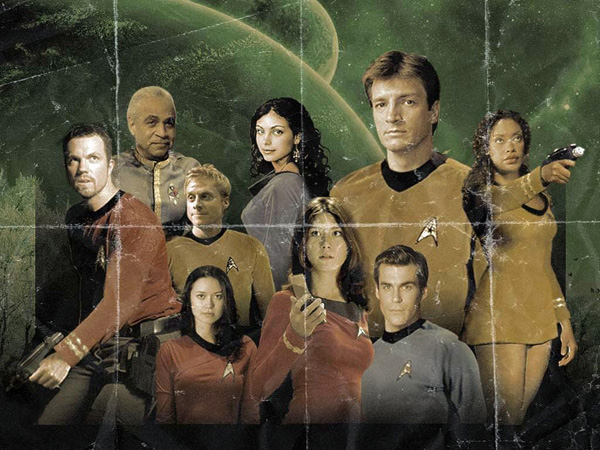
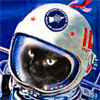


“Where shall we land, Gertie?” Ham asked. “That peninsula on the southeast coast of the northern continent looks like a good spot.”
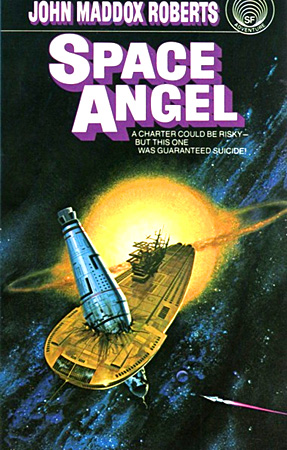
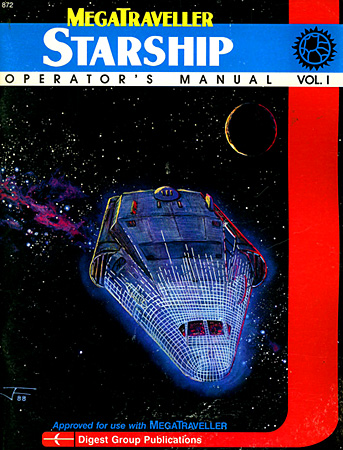

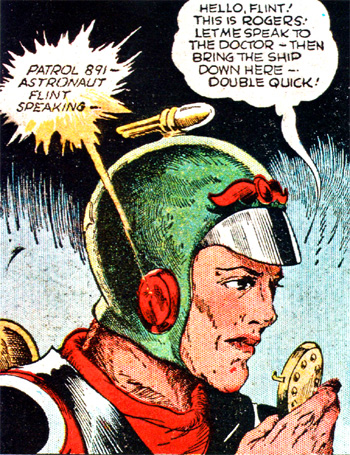

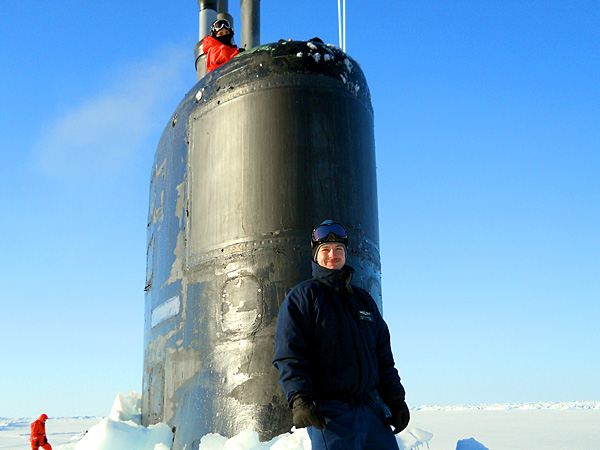
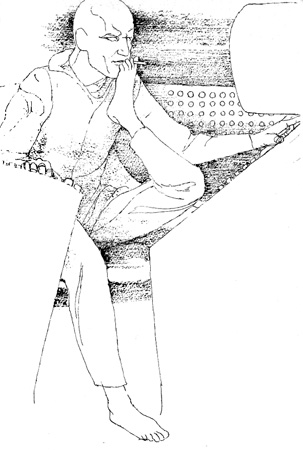
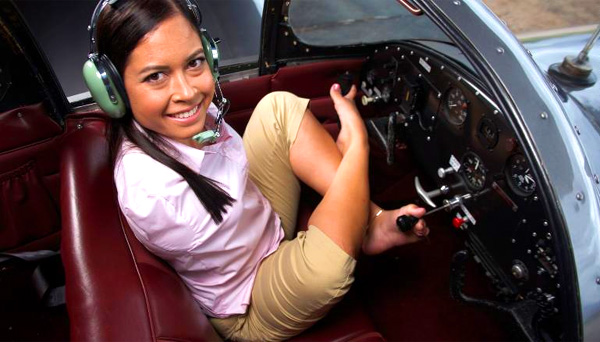


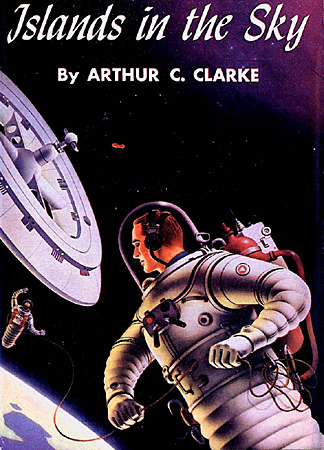
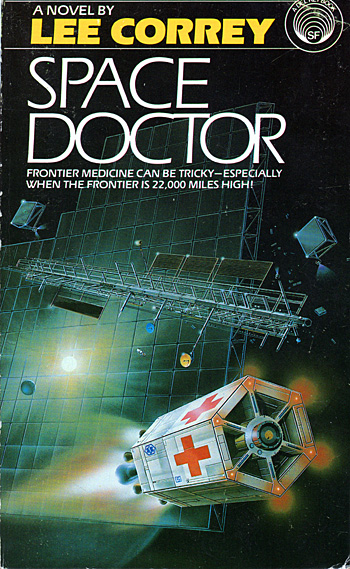
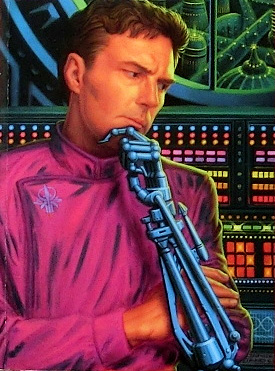



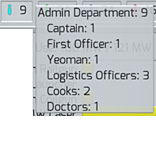
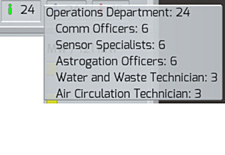
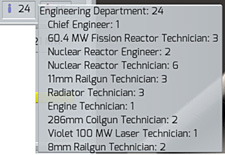
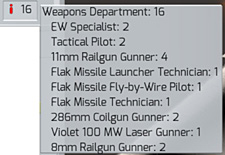
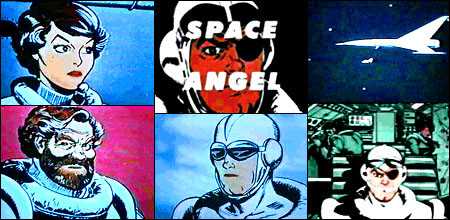
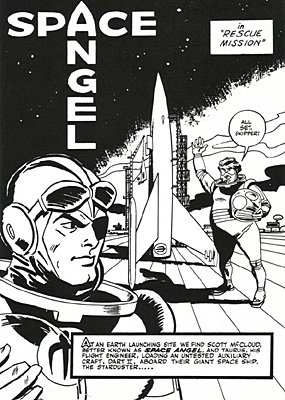
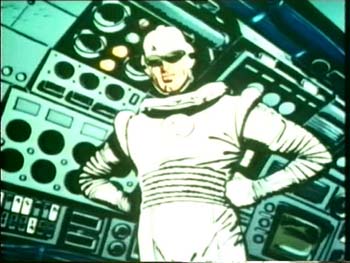
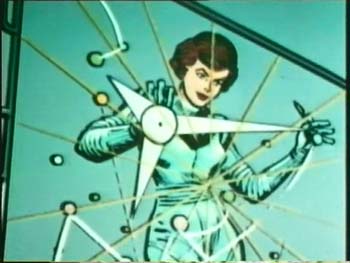
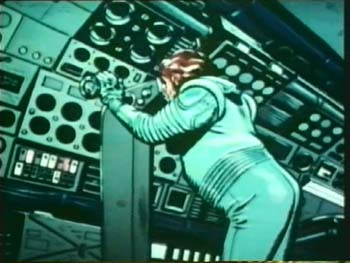
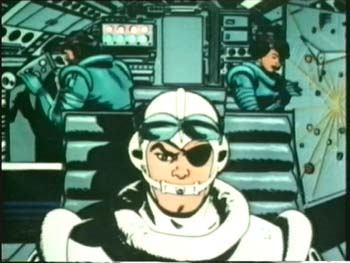
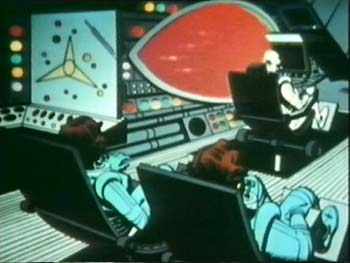
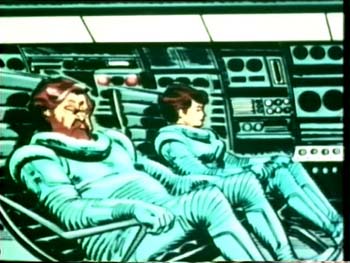
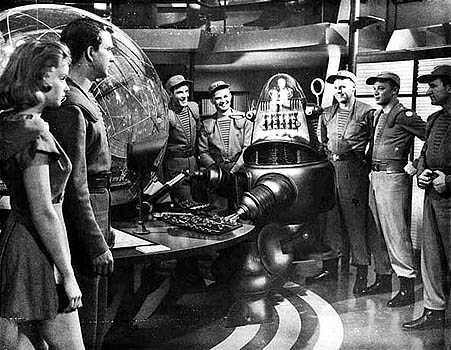

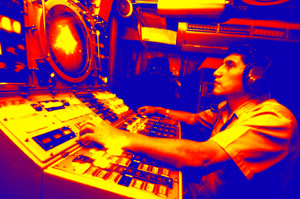
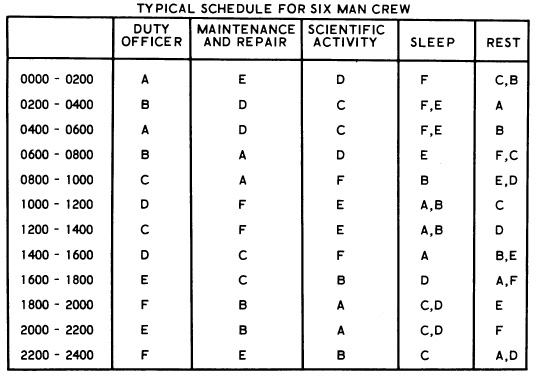
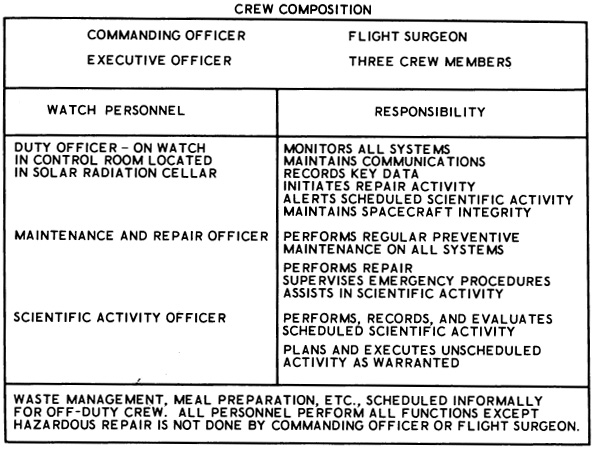
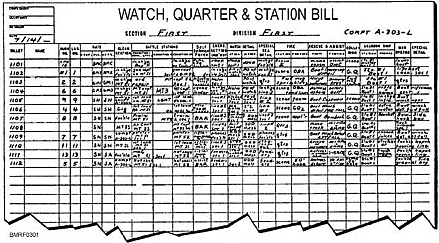
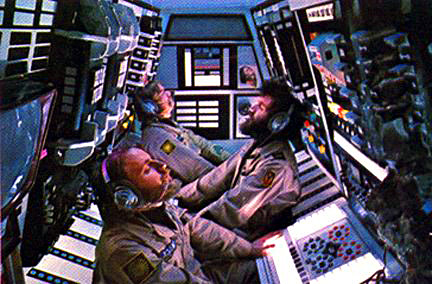
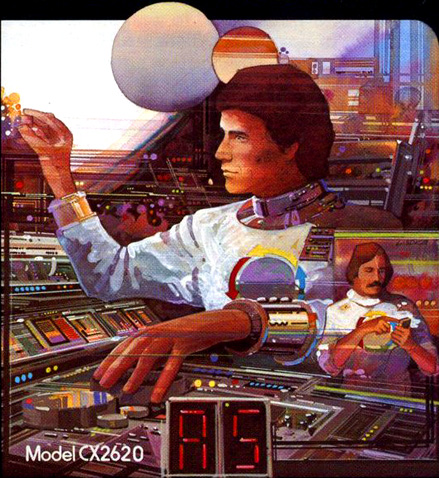
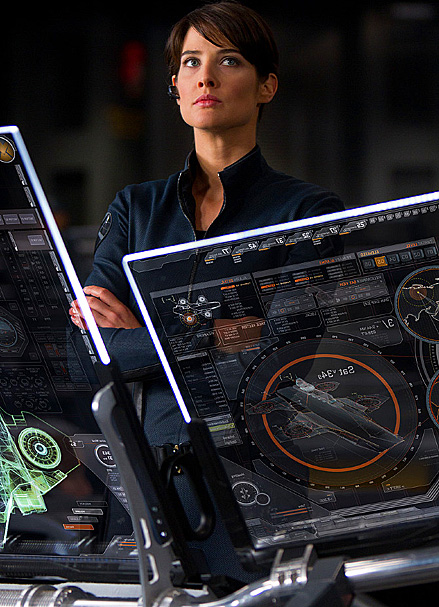
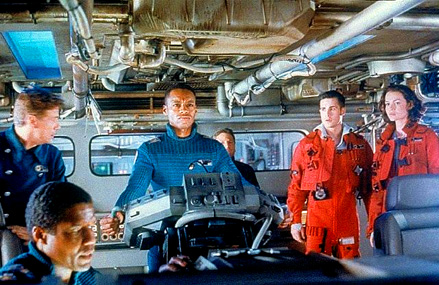
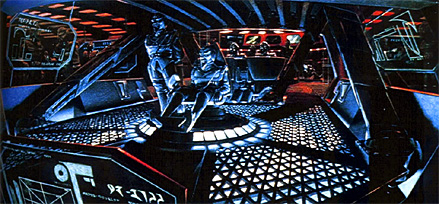

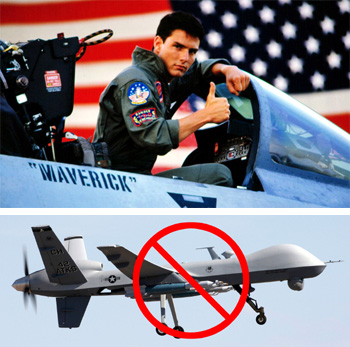
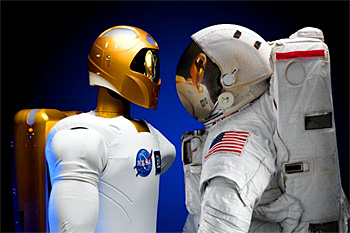
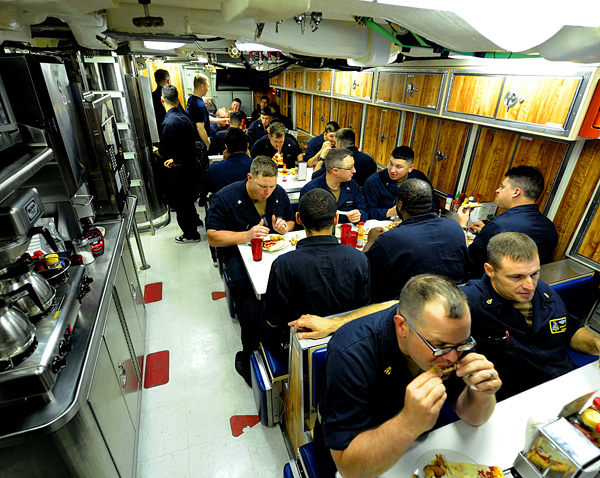
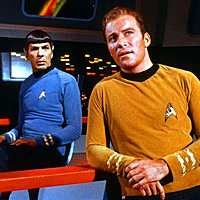
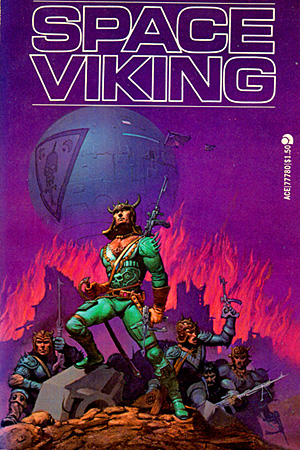
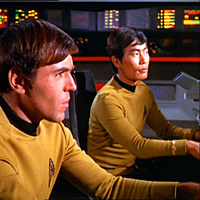
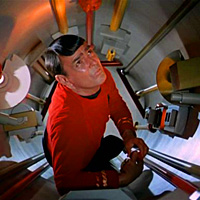
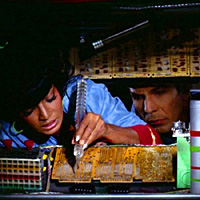
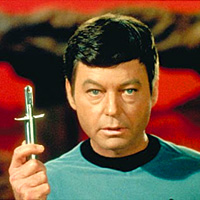
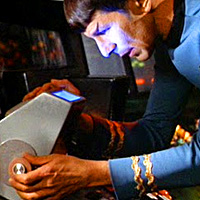

 Artwork by Ed Valigursky, Contraband Rocket by Lee Correy (aka G. Harry Stine), 1955Artwork by McConnell, The Ultimate Weapon by John W. Campbell, 1966

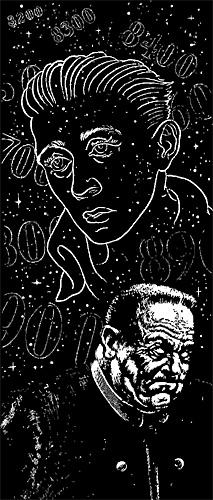
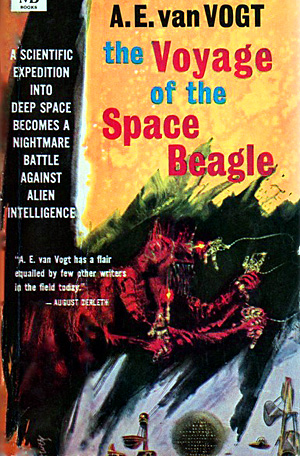


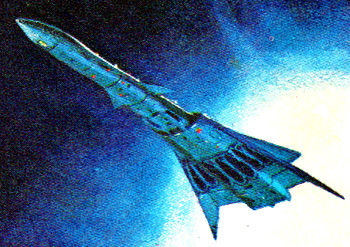
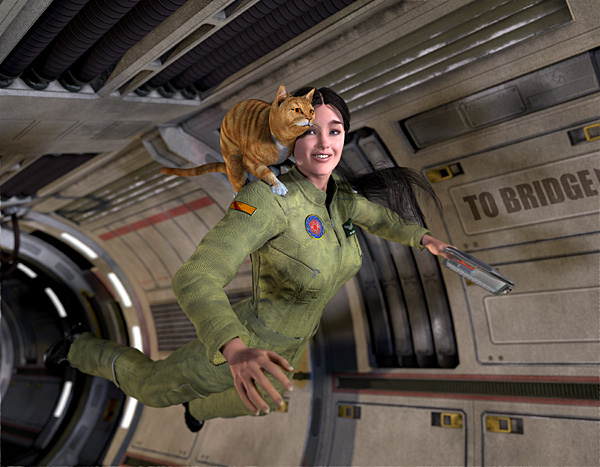
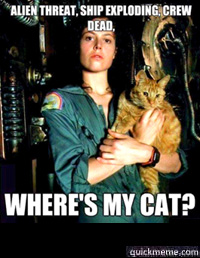
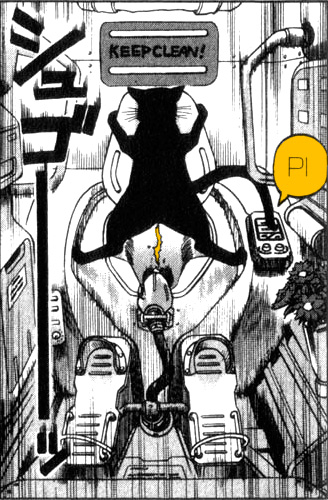
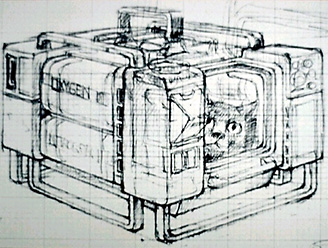

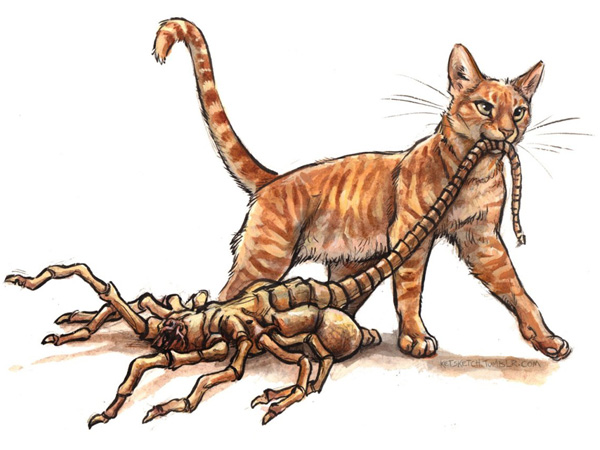
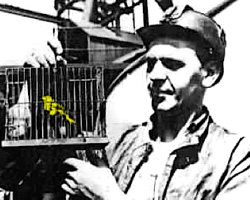
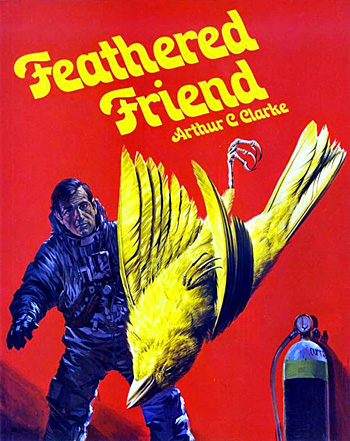
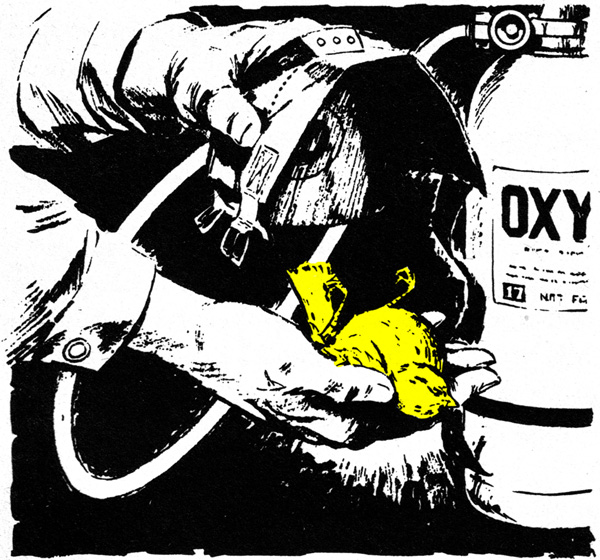
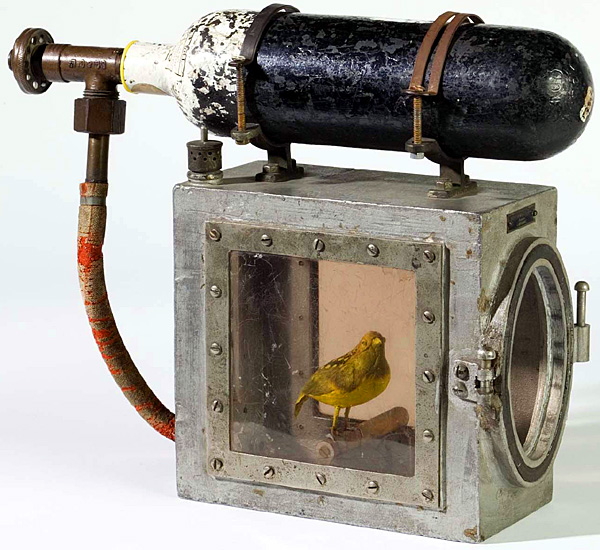



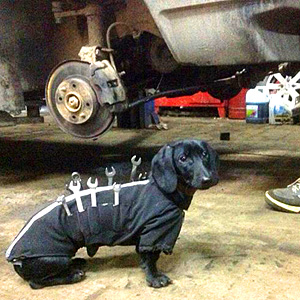
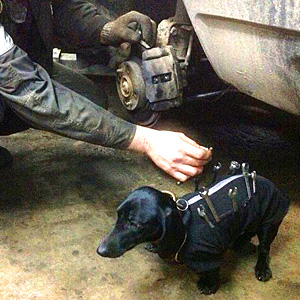
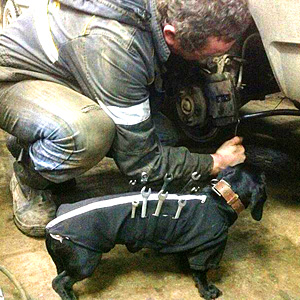
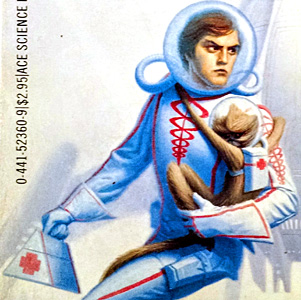
 Tourmal from Murray Leinster's Med Service Series. The animal has a special ability: if exposed to any disease (known or unknown), it will produce antibodies in quantity against it in about thirty seconds flat. The antibodies can be used to make a serum to protect against the diseease. Tourmals are used by the Med Service when they encounter planetary pandemics.