If ya gonna write about hard-science topics, use the freaking Metric system fer cryin' out loud. If the logic of using the measurement system of science when writing about science escapes you, well, perhaps you are in the wrong line of work. And you are probably not getting much use out of this website either.
The only countries on the freaking planet that don't are United States, Liberia, and Myanmar. The country of Myanmar doesn't use it because they are rabid xenophobe isolationists that don't give a rat's heinie about the rest of the world. Liberia doesn't use it so they can be in solidarity with the U.S. The States don't use it because Big Business sees it a waste of money while simultaneously considering purchasing politicians a sound investment. Business can use the latter to prevent the former.
The other 190-odd countries of Terra are all metric.
Until the US switches, we are going to continue suffering expensive cluster-farks like the Mars Climate Orbiter fiasco. NASA specified the metric system
in the Software Interface Specification, but those idiots at Lockheed Martin ignored this and used U.S. customary units anyway. $327 billion bucks of space probe went gurgling down the toilet because the US stubbornly refuses to use metric.
First off, you might want to study the various metric prefixes. These can be used with non-metric units, even with units you (the SF writer) has invented. For instance the milli-Helen.
SF novels like to alter things that are taken for granted, to remind the reader that they are reading science fiction (though it is a sign of a pathetic SF story if you can change the entire background to a conventional setting without affecting the story). A different system of measurements is a quick and easy addition. Remember how the original Battlestar Galactica had the crew taking about times and distances in terms of microns, centons, and yarens.
MICROTS
Kryten: Hmm yes, he's giving us 5 hanaka to decide. Rimmer: How long's a hanaka? Kryten: Well, curiously enough, it's exactly the same as one Earth minute.
— Red Dwarf, "Emohawk"
Fictional universes call for fictional measurements of time. After all, why would an alien culture use the same words for time as an Earth-based culture?
Strangely, 'alien' time units correlate pretty well with Earth time units in the majority of cases. 'Cycle' is the most common of these, usually referring to a year (though sometimes a day).
This can be justified easily enough; aliens probably live on a planet that orbits a star and has a day-night cycle, so they might well have natural units of time corresponding to "day" and "year," though probably not exactly the same length (unless, of course, the planet in question is almost identical to Earth and the star it circles is the same as the Sun, in which case it may be the same distance away and would therefore have about the same length for a year. No accounting for days, though.)
If an alien character doesn't use their own measurements, but instead uses Earth measurements in a jarring manner, they're talking in terms of Two of Your Earth Minutes. If these units are used across multiple worlds or civilizations, they are Standard Time Units. See also Fantastic Measurement System for other fictional units.
The Eldrae have a number of time measurement systems (well, when you’re an interstellar polity, you more or less have to, since local days and years vary all over the place and it’s handy if your time units bear some resemblance to what nature is doing). But there are two systems that are used more or less everywhere, so I’ll talk about those a little.
The first, “weavetime”, is the one that technical systems use internally, and as the basis for all the other systems, because it defines the base unit, the “pulse”. (It’s not actually the fundamental unit, I suppose, because it’s not the Planck time, nor is it a nice clean number in terms of things atomic clocks, etc., actually measure, but it’s the traditional “second”, if you will. It’s actually based on the length of a nominal resting heartbeat as a multiple of the Planck time – roughly 3/4 of an Earth second, in their terms.) And for scientific and technical purposes, weavetime just agglomerates pulses together, producing kilopulses (about a third of a local hour; 21.6 minutes), megapulses (24 local days; 26 of ours), gigapulses (124 of their years, 122.5 of ours), etc.
Weavetime is defined by consensus agreement of baseline clocks located aboard each and every stargate in the plexus, which together produces the “empire time reference frame”, a nice preferred standard by which everyone can agree what the time is despite all the wormhole FTLing. It also includes the standards for the frame-correction algorithms used to synchronize lighthugger starships and other objects moving at inconveniently relativity-invoking speeds up by defining the difference between the absolute pulse (“empire time”) and the local pulse (“wall-clock time”).
Said lighthugger starships, incidentally, generally make their own lives simpler by using “mission elapsed time” internally, thus avoiding having to use a pulse too different in length from everyone else’s, and go back on the local timebase when they arrive.
But weavetime is kind of inconvenient for day to day use – the nearest “day-length” unit, quite apart from not matching any planet anywhere, is the 144-kilopulse unit at 52 Earth hours, which is not that useful.
So for regular living, people use Imperial Standard Time, which in the finest traditions of hegemonists everywhere is essentially the same as planetary time for the eldrae homeworld, only using the precisely calculated weavetime pulse. It’s local time for there, and for everywhere whose day length is too short (e.g., space stations, where the local day can be around an hour), or too long (tide-locked worlds, where the local day can be around a year), or too weird (e.g., moons of gas giants, where argh conventional calendar does not work), to have a practical local calendar; it’s also used universally as the commercial calendar to work out public holidays, the financial year, etc., etc.
IST uses a local day that’s approximately 26 Earth hours long; that time unit is referred to as one “cycle”. It divides it in half precisely into day and night – which works well for their world, which lacks any axial-tilt-equivalent due to not being a conventional planet and so has no day-length variation – and then divides the day into twelve “hours” (~ 65 Earth minutes) and the night into six “watches”; each of these are individually named, although in writing them briefly it’s acceptable to number them instead.
The name actually doesn’t refer to the whole period, but rather to the moment the period centers around, so while an hour is divided into 72 minutes (each ~ 54 seconds), these are counted as 36 “rising” minutes before the named moment, and 36 “falling” minutes after it. Watches are, obviously, divided into 144 minutes, 72 before and 72 afterward. And each minute contains 72 pulses.
The calendar divides the homeworld’s year (333.3 local cycles in length), into 333 cycles with an additional intercalary cycle (“Calibration”) added every third year (and omitted every thirtieth) to fix the lag, in turn divided into 37 weeks of nine cycles each, which pleasingly allows the weeks to fit evenly into the year and make each calendar date the same day of the week. It’s also divided into months (whose length is taken from the period of the more prominent of the planet’s moons, but which no longer follow its phases, since they’re now synchronized with the years) each 27 days long. This, obviously, doesn’t exactly fit into the length of the year, so there are nine intercalary cycles added at various points to make up the slack.
"[...] the word 'human' only functions as that sort of adjective in bad science fiction."
— Rose Lalondein webcomic Homestuck
In Speculative Fiction, Aliens Speaking English or aliens speaking through Translator Microbes will sometimes be heard to use terrestrial measurements, but will for some reason feel the need to emphasise that they are your units of Earth measurements, and not theirs. This implies that the extraterrestrials have their own units of measurement, that by improbable coincidence share a name with the ones humans use, but are otherwise different. Of course, this is rather like someone from a country which uses imperial measurements visiting one that uses metric ones and using phrases like "20 of your kilometers" or "6 of your kilograms". It also spares the audience from clunky exposition where the alien explains that a floob is equal to 2.837 meters.
When two civilizations with different home-worlds (and thus different years, hours, and so on) interact, referring to "your" time units or "(planet name) time units" is entirely correct. It's the redundancy of using both "your" and the name of the planet which makes this an awkward phrasing.
Happens to some degree in real life, in situations such a Brit talking to an American about "two of your gallons" - but this is exactly because Britain and the US use the same word to mean different volumes. (1 Imperial gallon == 1.2 American gallons). Likewise, just as "minute" comes from the Latin for a small division, the aliens may have a time unit named after their word for a small division. But if not, there is little point specifying that it is an 'Earth Minute'... Unless it's mocking or derogatory, like most real-life uses of the trope in metric vs. imperial situations. "Your years" makes more sense as the duration of a planet's orbit around its sun would be different for each world.
Two Of Your Earth Minutes: Mostly averted, between the Translator Microbes and that most people using measurements internationally (or between species where that amounts to the same thing) are using either Accord System measurements or Imperial Standard, which just happen, since the latter uses a sensible Planck base and the Empire is a heavyweight on the Presidium of the Conclave, to share their base units and most of their derived ones. So it’s usually not much of an issue.
A fairly standard trick is altering the "year one" of the calendar. Popular choices are 1945 (the first detonation of a nuclear weapon), 1957 (the year Sputnik went up, the first man-made object boosted into orbit), 1961 (the year Yuri Gagarin became the first man in space), and 1969 (the year Neil Armstrong became the first man to set foot on an extraterrestrial object). Extrasolar colonies tend to set year one to the year the colony was established, the year of "first landing."
So if the novel adopts the Armstrong standard, a story set in the Gregorian year 2010 would be year 41 of the Space Age.
Authors who want to strike a more secular tone will use "CE" and "BCE" instead of "AD" and "BC", especially in the academic world. Or avoid the matter entirely, say by using a 1945-based year-one with a flashy title like "Atomic Era."
An actual real live problem is the fact that measuring units such as years, days, and seasons are very closely tied to Terra. They have reduced relevance for those living on other planets, and practically no relevance to Belters and others living in deep space. In Heinlein's Podkayne of Mars the main character emphasizes the fact the novel is science fiction by mentioning that she is about eight years old and almost old enough to marry. However, she lives on Mars, which has a longer year than Terra. So while she is 8 Martian years old, she is about 15 Terran years old.
This becomes a serious problem when interplanetary companies have to start coping with things like periodic fiscal years, tax periods, and rental durations when they have branch offices on several planets. Corporations with their headquarters based in the United States have to pay their taxes every April 15th, and the branches on other planets will have to deal with the fact that particular day does not correspond to the local month or date.
Commonly science fiction writers take one Terran year and dub it a "Galactic Standard Year", at least for planets colonized by humans. The writers usually pointedly have some character say such and such an event happened a few Tau Ceti IV years back, and another character irately asks "how many years is that in Galactic Standard Years, you moron?" This is to rub the reader's nose in the fact that this is a science fiction novel and they are not in Kansas any more.
And things can become real ugly with religious schisms over which day to celebrate specific holy days. It can seem a bit illogical to observe a holy day based on the start of spring, when on your planet that particular Terran day will drift through the planet year from season to season.
On a smaller scale you can guarantee that the length of an extraterrestrial planet's day is not going to be 24 hours. Which is going to really screw up the colonist's circadian rhythm. You can either desynchronize the 24 hour clock from the planet's day and night cycle, or divide the planet day into 24 divisions and deal with the fact that the first few generations will be suffering from permanent jet lag. In theory later generations of colonists will eventually adapt their circadian rhythm to the planet, unless the planet day is too extreme.
Some science fiction novels have people not using hours, but instead using ship watch periods to measure time. Usually one "watch" is four Terran hours, with six watches in a Terran day of 24 Terran hours. Sometimes you'll see the term "ship-day", meaning Terran Standard Day as understood by a starship crewman.
SECOND FOUNDATION
artwork by Michael Whelan
(ed note: in the year 12,000 of the Galactic Era, the people of the Galactic Empire know that humanity must have originiated on a single planet, but they have forgotten which one it is.)
For reason or reasons unknown to members of the Galaxy at the time of the era under discussion, Intergalactic Standard Time defines its fundamental unit, the second, as the time in which light travels 299,776 kilometers. 86,400 seconds are arbitrarily set equal to one Intergalactic Standard Day; and 365 of these days to one Intergalactic Standard Year.
Why 299,776?— Or 86,400?— Or 365?
Tradition, says the historian, begging the question. Because of certain and various mysterious numerical relationships, say the mystics, cultists, numerologists, metaphysicists. Because the original home-planet of humanity had certain natural periods of rotation and revolution from which those relationships could be derived, say a very few.
No one really knew.
Nevertheless, the date on which the Foundation cruiser, the Hober Mallow met the Kalganian squadron, headed by the Fearless, and, upon refusing to allow a search party to board, was blasted into smoldering wreckage was 185; 11692 G.E. That is, it was the 185th day of the 11,692nd year of the Galactic Era which dated from the accession of the first Emperor of the traditional Kamble dynasty. It was also 185; 419 A.S. — dating from the birth of Seldon — or 185; 348 Y.F. — dating from the establishment of the Foundation. On Kalgan it was 185; 56 F.C. — dating from the establishment of the First Citizenship by the Mule. In each case, of course, for convenience, the year was so arranged as to yield the same day number regardless of the actual day upon which the era began.
And, in addition, to all the millions of worlds of the Galaxy, there were millions of local times, based on the motions of their own particular heavenly neighbors.
But whichever you choose: 185; 11692—419—348—56 — or anything — it was this day which historians later pointed to when they spoke of the start of the Stettinian war.
Yet to Dr. Darell, it was none of these at all. It was simply and quite precisely the thirty-second day since (his daughter) Arcadia had left Terminus.
There was no trace of interference. The words were as clear as if they were coming from a local station. Yet Sadler had noticed the skyward tilting antenna system on the roof of the monocab, and knew that he was listening to a direct transmission. The words he was hearing had left Earth almost one and a half seconds ago. Already they would be heading past him to far more distant worlds. There would be men who would not hear them for minutes yet—perhaps for hours, if the ships that the Federation had beyond Saturn were listening in. And that voice from Earth would still go on, expanding and fading, far beyond the uttermost limits of man's explorations, until somewhere on the way to Alpha Centauri it was at last obliterated by the ceaseless radio whispering of the stars themselves.
The safety of Earth was quite a responsibility, but it was really too big for one man to worry about. Whatever reason said, the vast imponderables of planetary politics were less of a burden than the little cares of everyday life. To a cosmic observer, it might have seemed very quaint that Sadler's greatest worry concerned one solitary human being. Would Jeannette ever forgive him, he wondered, for being away on their wedding anniversary? At least she would expect him to call her, and that was the one thing he dared not do. As far as his wife and his friends were concerned, he was still on Earth. There was no way of calling from the Moon without revealing his location, for the two-and-a-half-second time-lag would betray him at once.
Central Intelligence could fix many things, but it could hardly speed up radio waves. It could deliver his anniversary present on time, as it had promised—but it couldn't tell Jeannette when he would be home again.
And it couldn't change the fact that, to conceal his whereabouts, he had had to lie to his wife in the sacred name of Security.
Jamieson tuned in the set, and rotated the antenna system toward Earth. There was a fair amount of noise from the solar background, for Earth was now almost in line with the sun, but the sheer power of the station made the message perfectly intelligible and there was no trace of fading.
Steffanson was surprised to see that the tractor chronograph was over a second fast. Then he realized that it was set for that oddly christened hybrid, Lunar Greenwich Time. The signal he was listening to had just bridged the four-hundred-thousand-kilometer gulf from Earth. It was a chilling reminder of his remoteness from home.
(ed note: Tyl is a mercenary arriving on the planet Bamberg. Desoix is explaining the local situation.)
"One thing," Desoix said, looking out the window even though the initial spray cloaked the view. "Money's no problem here. Any banking booth can access Hammer's account and probably your account back home if it's got a respondent on one of the big worlds. Perfectly up to date. But, ah, don't talk to anybody here about religion, all right?"
He met Tyl's calm eyes. "No matter how well you know them, you don't know them that well. Here. And don't go out except wearing your uniform. They don't bother soldiers, especially mercs; but somebody might make a mistake if you were in civilian clothes."
"What's the problem?" Tyl asked calmly. From what he'd read, the battle lines on Bamberia were pretty clearly drawn. The planetary government was centered on Continent One—wealthy and very centralized, because the Pink River drained most of the arable land on the continent. All the uniquely flavorful Bamberg tobacco could be barged at minimal cost to Bamberg City and loaded in bulk onto starships.
Desoix laughed without even attempting to make the sound humorous. "Well," he said, "do you know when Easter is?"
"Huh?" said Tyl. "My family wasn't, you know, real religious … and anyway, do you mean on Earth or here or where?" "That's the question, isn't it?" Desoix answered, glancing around the empty cabin just to be sure there couldn't be a local listening to him. "Some folks here," he continued, "figure Easter according to Earth-standard days. You can tell them because they've always got something red in their clothing, a cap or a ribbon around their sleeve if nothing else. And the folks that say, 'We're on Bamberia so God meant us to use Bamberg days to figure his calendar … well, they wear black."
"And the people who wear cloaks, black or red," Desoix concluded. "Make sure they know you're a soldier. Because they'd just as soon knock your head in as that of any policeman or citizen—but they won't, because they know that killing soldiers gets expensive fast."
Tyl shook his head. "I'd say I didn't believe it," he said with the comfortable superiority of somebody commenting on foolishness to which he doesn't subscribe."But sure, it's no screwier than a lot of places. People don't need a reason to have problems, they make their own."
"And they hire us," agreed Desoix.
As for the populace, its members knocked in each other's heads depending on what each was wearing that day.
Just normal politics, was all. Normal for places that hired the United Defense Batteries and other mercenary regiments, at any rate.
Two drivers, one with a load of produce and the other carrying hand bags, were snarling. Three black-cloaked toughs jumped the driver with the red headband, knocked him down, and linked arms in a circle about the victim so that they could all three put the boot in.
At least a dozen thugs in red coalesced from nowhere around the fight. It grew like a crystal in a supersaturated solution of hate.
The police had their stunners out and were radioing for help, but they kept their distance. The toughs wore body armor beneath their cloaks, and Desoix heard the slam of at least one slug-throwing pistol from the ruck.
"Say," asked a blond private Desoix couldn't call by name until his eye caught stenciling on the fellow's helmet: Karsov. "Is there any chance we're going to move, sir? Farther away from all this? It gets worse every day."
"What's …" Desoix began with a frown, but he turned to view the riot again before he finished the question—and then he didn't have to finish it.
The riot that Desoix had put out of his mind by steely control had expanded like mold on bread while he walked the three hundred meters to the shelter of his gun and its crew. There must have been nearly a thousand people involved—many of them lay-folk with the misfortune of being caught in the middle, but at least half were the cloaked shock troops of the two Easter factions.
Knives and metal bars flashed in the air. A shotgun thumped five times rapidly into a chorus of screams.
"Via," Desoix muttered.
A firebomb went off, spraying white trails of burning magnesium through the curtain of petroleum flames. Police aircars were hovering above the crowd on the thrust of their ducted fans while uniformed men hosed the brawlers indiscriminately with their needle stunners.
Time chart from Joan Vinges' The Outcasts of Heaven's Belt (1978)
One solution appears in Joan Vinge's The Outcasts of Heaven's Belt. In the Heaven's Belt system, there are no habitable planets, but zillions of mineral rich asteroids. That's where the people live. The only time unit is the Second (this is sometimes called Metric Time). Three kiloseconds is about an hour, thirty megaseconds is about a year, you can read it on the chart. It works regardless of the orbital period of the particular space habitat, you can calculate the duration between any two points in time with simple subtraction, it's great!
Vernor Vinge used the system in A Deepness In The Sky, also known as After Epoch Astronauticum. The zero point is set to Neil Armstrong's lunar walk, though when one does that the entire system starts looking suspiciously like Unix time, or POSIX time(Armstrong was in 1969, Unix time starts in 1970).
Astronomers use a similar system that is based on days instead of seconds, the Julian Day calendar. There are no years, months or weeks, just days. Day zero is noon on January 1, 4713 BC. The date was chosen because it was the last time that three particular calendrical cycles converged. The Julian Day system is based on days because calculating the interval between two dates using the years-months-days system (with leap years) is even more painful than trying to do long division using Roman numerals. Using Julian Day dates, all you need is simple subtraction.
Metric Time and Longitude
Ralph Buttigieg points out the fact that metric time does not work on the surface of a planet, due to our quaint way of measuring Longitude and celestial Right Ascension. Back in the age of sail, measuring lattitude was exceedingly easy to do with a sextant.
Longitude was hard, because measuring it requires an accurate clock, since the determination depends upon measuring how far the Earth had rotated upon its axis. Unfortunately in those days, the only accurate clocks were based upon pendulums, which won't work in a ship pitching with the ocean waves. After the British fleet was wreaked in 1707 due to an error in longitude, the British government offered the longitude prize to the first person to devise an accurate shipboard method of determining longitude. John Harrison won the prize by inventing a spring based chronometer, though the British board of longitude tried to cheat him out of the prize money.
Anyway, the point of all this is that longitude is measured in increments of the planetary day, which of course is of different lengths from planet to planet. Which puts a monkey wrench into plans of using some sort of universal metric time.
Decimal Time
There are other Decimal Time systems based on decimal Day units. 1 dekaday is about a week and a half, 1 centiday is about 14 minutes, and so on.
The Swiss watchmaking company Swatch invented Swatch Internet Time, where the 24 hour day is divided up into 1000 parts called ".beats", each .beat being 1 minute and 26.4 seconds. This is actually an advertising gimmick. It is a rehash of the French decimal time system invented right after the French Revolution in the far futuristic year 1793. You can tell that it is intended for advertising purposes since out of all the systems invented in the last two hundred years, it is the only one that moves the prime meridian from Greenwich England to Swatch Headquarters. Swatch Internet Time faded away due to lack of interest, unsurprisingly.
Of course, since all of these systems are based on the Terra-centered "Day" unit instead of the metric system "Second" unit, they are also much more parochial.
A "Decimal Time" system is one where the various units are decimal fraction or multiples of each other (e.g., A decimal hour divided into 100 decimal minutes, each minute composed of 100 decimal seconds). A "Metric Time" system is a decimal time system with only one unit, and the everything is expressed by adding a metric prefix to that unit (e.g., second, kilosecond, megasecond). In addition, a metric unit only defines units of time interval(as does a stopwatch), not time of day(as does a clock).
As an example, in Isaac Asimov's The Naked Sun, the Solarians use a decimal system. The Solarian hour as been divided into ten decads, each of which is divided into a hundred centads. This is not a metric system since the hour has not been divided into ten decihours, each of which is divided into a hundred millihours.
There was a flawed attempt to create a decimal time system in the TV show Star Trek, the infamous "Stardates." They were created on the spur of the moment by Gene Roddenberry to avoid the problem of tying each episode to specific dates. The writers were told to just pick four digits at random. Pedantic Star Trek fans have been trying ever since to retcon a system that would explain the dates.
Franz Joseph created his own system for Stardates: they are conventional Gregorian dates written in the form YYMM.DD (e.g., February 13, 1998 would be Stardate 9802.13). This is not considered canon. However, computer programmers have long noted the advantages of writing dates in odometer order. It simplifies sorting items by time. For example, if you have a series of files on your hard drive with names that start with a time stamp in YYYYMMDD form, when you examine that directory with the file names sorted alphabetically, the files will automatically be in chronological order.
The flaw with Franz Joseph's system is that is it not clear if Stardate 9802.13 refers to February 13, 1998, February 13, 2098, February 13, 2198, February 13, 2298 and so on. This same flaw became a huge problem at the turn of the century, the infamous Y2K problem.
In the Classic Battletech novels, particularly in the novel Tactics of Duty, a general solution to adapting to other planets was illustrated.
The length of a second remained the same, as did the number of seconds in a minute. but each planets day was divided up into twenty-four equal periods (sometimes with a twenty-fifth unequal period to make up the slack), which were the hour. So a fast rotating planet's hour would be less than Earth's, and a slow rotating planet's hour would be longer.
The number of days in a week was usually kept at seven, and the number of months left at twelve (sometimes with a few extra days tacked on at the end of the year to keep the months even). This meant a planet with a longer year would have more weeks in its months, a planet with a shorter year would have fewer (Which was the core of a supply problem used to illustrate the system. The military unit of the book used the Terran calendar, but the locals used one where the months were about two-thirds of Earth's. A supply clerk who was a local filled out forms using local months, meaning the supplies came faster, which drove up the expenses...)
Really odd worlds broke this system though, and Battletech has its share. For example, in the novel Decision at Thunder Rift, the planet of Trellwan had a year about three local days long, due to the planet orbiting a dwarf star and being almost tidally locked. That planet used Terran hours and twenty-four hour days, but divided up its year into 'light' and 'dark' months, each half a local day long.
Mark Temple
Measuring Distance
Station in Space by James Gunn (1958)
Astronomers measure the distance between stars using parsecs, but science fiction writers almost always use light years. Parsecs are more scientific, but there you go. Multiply parsecs by 3.26 to get light years, divide light years by 3.26 to get parsecs.
About the only place I've encountered parsecs in science fiction is in the novels of Isaac Asimov, the role playing game Traveller, and that stupid comment by Han Solo.
Traveller uses parsecs because they are very close to the average distance between stars. This means if you are created a Traveller-style sub-sector 2D star map you can cram as many stars as possible into the map with a minimum of wasted hexagons.
Strange sounding alternative metric units of length can be invented as well.
Erik Max Francis points out that the marvelously correct SI unit "megameters" makes an appearance in, of all places, the Americanized anime "Star Blazers". That anime was originally "Space Battleship Yamato", it is unclear if the term "megameters" appears in the original Japanese. One megameter is one thousand kilometers or about 620 miles.
Another metric system of measure appears in the SF show Battlestar Galactica. This is slightly odd since they use the same units for time as well as distance. They could be related by a rate, such as the speed of light. This is what scientists use when they talk about light-seconds, light-minutes, light-days, and light-years.
In Isaac Asimov's Foundation and Empire, Toran jumps his starship through hyperspace into the star system containing the planet Haven, then has to travel "several milli-microparsecs" to the planet. "Milli-micro-" is an obsolete term meaning "nano-" or 10-9. That would make one milli-microparsec about 31,000 kilometers, or about 1/13th the distance between Terra and Luna.
Factor
Distance
Description
Parsecs
Other
100
1 parsec (pc)
3.26 Light Years
74% of the distance between Sol and Proxima Centauri
10-1
1 deciparsec (dpc)
20,627 AU
Sol to outer boundary of Hills section of the Oort Cloud
10-2
1 centiparsec (cpc)
2063 AU
Sol to inner boundary of Hills section of the Oort Cloud
10-3
1 milliparsec (mpc)
206 AU
Approximately four times the Sol-Pluto aphelion
10-6
1 microparsec (μpc)
0.21 AU
A bit less than the Sol-Mercury semi-major axis
10-9
1 nanoparsec (npc)
30,857 Kilometers
2.5 times the diameter of Terra
10-12
1 picoparsec (ppc)
31 Kilometers
Diameter of Baltimore, Maryland USA
10-15
1 femtoparsec (fpc)
31 Meters
Length of a Blue Whale
10-18
1 attoparsec (apc)
3 Centimeters
2/3 the length of your finger
10-21
1 zeptoparsec (zpc)
0.031 Millimeters
0.06 the diameter of a grain of salt
10-24
1 yoctoparsec (ypc)
0.000031 Millimeters
Approximately the length of 160 bacteria laid end to end.
Measuring Position
Tactical display on the bridge of the Tempest. From the webcomic Outsider by Jim Francis. More here, here, here, and here.
For a spacecraft pilot sitting in the control couch, there lots of specific terms for directions relative to the pilot, which can be found here.
Zodiac Longitude
Longitude
Symbol
Sign
0°
♈
Aries
30°
♉
Taurus
60°
♊
Gemini
90°
♋
Cancer
120°
♌
Leo
150°
♍
Virgo
180°
♎
Libra
210°
♏
Scorpio
240°
♐
Sagittarius
270°
♑
Capricorn
300°
♒
Aquarius
330°
♓
Pisces
For absolute positions within a solar system, you'd probably use some kind of sphericalcelestial coordinate system, centered on the primary star, with the fundamental plane set to the primary's ecliptic(in other words: a heliocentric ecliptic coordinate system). The zero point of the ecliptic longitude is at the vernal equinox of the Northern Hemisphere, traditionally known as "The First Point of Aries". For a quick jargon, longitude can be divided into 12 segments of thirty degrees each, named after the signs of the Zodiac.
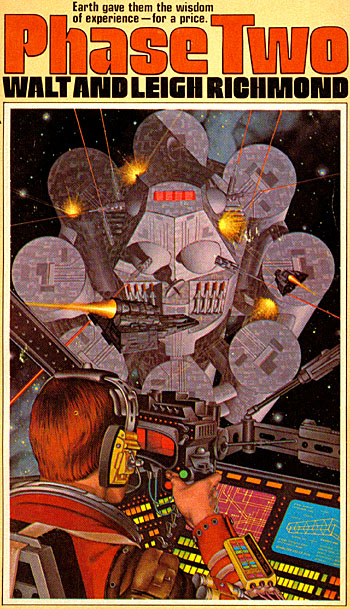
In the novel Phase Two, relative angular longitude measurement between two points is done in terms of "months", with one month equal to thirty degrees. This is related to the amount of time it takes Earth to travel thirty degrees around its orbit.
Space maps displaying the positions of local spacecraft are traditionally (in science fiction at least) shown in holographic spheres. Sky marshals will use a display based on absolute celestial coordinates as they control the strategy and tactics of a battle (center = primar star, zero longitude = vernal equinox or galactic center).
Combat starships in the thick of a fight, on the other hand, will probably use a display based on coordinates relative to the ship in question (center = ship, zero longitude = current position of ship's nose).
My re-do of a tactical map from the game Rocket Flight. The edges of the map are labeled with the signs of the zodiac denoting the ecliptic longitude.
For relative angular measure there are colorful archaic terms originating from astrology.
Angle Symbols
Angle
Name
Symbol
Notes
0°
Conjunction
In same sign
18°
Vigintile
360° / 20
30°
Semi-sextile
360° / 12 One sign apart
32.727°
Undecile
360° / 11
36°
Decile
360° / 10
40°
Novile
360° / 9
45°
Semi-square (Octile, Semiquartile)
360° / 8
51.429°
Septile
360° / 7
60°
Sextile
360° / 6 Two signs apart
72°
Quintile (Bidecile)
360° / 5
90°
Square (Quadrature, Quartile)
360° / 4 Three signs apart
102.857°
Biseptile
360° / 3.5 360° / (7/2) Septile × 2
108°
Tridecile
360° / 3.333 360° / (10/3) Decile × 3
120°
Trine
360° / 3 Four signs apart
135°
Sesquiquadrate (Sesquisquare, Trioctile)
360° / 2.647 90° + 45° Square + Semisquare
144°
Biquintile
360° / 2.5
150°
Quincunx (Inconjunct)
360° / 2.4 Five signs apart
154.286°
Triseptile
360° / 2.333 360° / (7/3) Septile × 3
165°
Quindecile
360° / 2.182 Opposition - 15° Undecile × 5
180°
Opposition
360° / 2 Six signs apart
But you're going in the wrong direction. A.T. headquarters is in King sector, about five months from Belt City."
"Five months?"
Paulsen laughed this time; a free laugh. "Oh, that's orbital distance, not the time it would take to get there. It's a Beltish system of direction. We use Earth's orbital velocity as the standard of distance for an asteroid—the way you use a clock face as the standard of position for an airplane; or a globe of Earth for the standard of reference in a spaceship.
"For instance, in an airplane—the way it's going would be twelve o'clock. If somebody comes up on it at a ninety-degree on the right, say, above it, that would be three o'clock high. Tells a guy where to look.
"But that wouldn't do you any good in a spaceship. Which way's up ? The way you 're facing or the way you're going? And are you in an acceleration couch lying down, or a couch-chair like ours? But— well, you've got the 3-D Plan Position Indicator. It's f a globe. You use it like a globe of Earth for your reference."
Paulsen pointed to the global PPI. The faint glow of orange grid reference lines made it look very much like a skeletonized globe of Earth. The navigation stars that the computer selected from the multitude of stars around them shown as bright yellow dots on the outside surface of the globe. In the center of the globe was one green spark that represented their own ship. Any outside object, Stan knew, would be represented by a red spot within the globe; or if it were a planet or other sizable object, it would intrude as a large red ball. The north-south axis of the globe was in line with the ship's axis; north the direction in which they were going, south the direction from which they were pushed.
"You're in a squadron, diving on the Earthies, and you want to tell the other ships which one you're taking. You use latitude—not many of them; about twenty, forty and sixty degrees of latitude. Then north and south is like in the scope here; north is the way you're going. East and west is a reference from where you're sitting—east is the right side of the scope from here. Then farside and nearside, meaning farside of the scope or near. So if the ship you're after is—well, I don't know how to describe it except to say 'north forty farside east.' That would mean ahead of my ship at an angle of about forty degrees on the far side of my PPI scope and on an east angle from me. Get it?"
"I think so."
"But an asteroid—well, A.T. is in a position that puts it in line with a spot on Earth's orbit that's five months Earth speed further along that orbit than Belt City. So they're five months apart."
"Then you just mean that's its relative position?"
"Yep. Wouldn't take more than two weeks to reach it in this crate. But now, if you want to say where an asteroid is in the Belt, not relative to you in distance, but just where it is, you use the zodiac sign. For instance, Belt City's just entered Taurus; and A.T. is in Libra. Distance is in months; position is in zodiacal sign. Right?"
"Sure. It's easy once you think about it. Makes sense."
"Then there's the other part, the sectors. They're named like a deck of cards—ace, king, queen, jack, ten. The Belt's not evenly spaced around its orbit, you know. It sort of divides up into five sectors, with a fair amount of fairly empty space between. So you've got the sectors to contend with too. Think you can manage?"
From PHASE TWO by Walt and Leigh Richmond (1979)
Measuring Systems
International System of Units
base units and derived units
used by every nation on Terra except US, Myanmar, and Liberia click for larger image
THE TROUBLESOME DIMENSIONS
artwork by Kelly Freas
Let’s call him Przewalski, just to
get away from the monotonously
Anglo-Saxon names of science-fiction
heroes. It does seem improbable that
as small a minority of humankind
as those of North European ancestry
will forever be the leaders of Terrestrial
civilization. Przewalski was
an eminent young physicist, head of
the scientific mission to Vega Five.
Explorers from the Solar System
had turned out to be the first in this
neck of the galaxy equipped with
a hyperspatial drive; but man was by
no means the only civilized race. In
many respects the Vegans were ahead
of us, and an exchange of knowledge
was indicated.
Landing at the planet’s largest city,
the humans donned their airsuits,
glare filters, spore repulsors, and a
dozen other items required to keep
them alive on this "terrestroid”
world. The Vegans crawled hospitably
forth to meet them, wagging tails
in the most ceremonious manner, and
led the way to specially prepared
quarters. Banquets, receptions, the
conferring of honorary degrees, and
speeches on the “hands-across-space”
theme took only a week—though to
be sure, Vega Five has a ninety-hour
day. At length Przewalski found
himself conferring through a glass
partition with his opposite number.
The being’s name was quite unpronounceable
by any human—special voder equipment was needed
for the discussion—so we will return
to science-fiction tradition and
call him Jennings.
"Getting down to business,” said
Przewalski, "the most obvious difference
between the accomplishments
of our two peoples is that we know
more about hyperspace and you know
more about radiation. You ought to,
with this sun of yours! Suppose I
ask you a few questions, just to
start the ball rolling.”
"What ball?” asked Jennings.
When it had been explained, he
nodded. "Oh, I see. The proper
idiom is 'to strike the gong with
vigor and enthusiasm.'”
Przewalski sighed, drew a deep
breath, and went on: "I've heard
that you have discovered a quantized
structure in the photon. Could you
outline the theory for me?”
"Easily. The structural unit is the
quwiggl (rough approximation to a
horrible noise) which is expressed
in terms of glutch times thirk—
Oh, dear.” Jennings wrung his
hands, all six of them. "Your linguists
of the preceding expedition
never did think to inquire about the
special language of physics.”
"Well, we can figure it out,” said
Przewalski. “Is the quwiggl a unit
of energy?” Perforce, he used the
Esperanto word for "energy.” "That
is, well, one form of energy is given
by the integral … damn! … now
let me see. Look, you have a certain
mass, a certain amount of matter.
Understand? You exert a certain
force on it—a push, a pull. This
accelerates it, makes it speed up. The
force is equal to the mass times the
acceleration, and the work done, the
energy expended, is the force times
the distance through which it acts.
Understand ?”
"No,” said Jennings unhelpfully.
"Glutch is—” He went into a long
rigmarole. Przewalski finally got the
idea that glutch was capacitance.
Jennings realized what mass and
energy are, but he thought of them
as functions of capacitance, action,
and radiation flux.
At the end of a rather unprofitable
session, Jennings gave Przewalski
some books on elementary Vegan
physics. Then he crawled home,
shaking his ears in mild dismay that
the Earthlings should have based
their physics on something so utterly
trivial as mass.
Przewalski settled doggedly down
to read his way through. He got past
the first sentence, and stopped cold.
What was a huk? Looking it up, he
found it to be a unit of distance. It
was the length of one side of a
cube of water with a capacitance of
one glutchguggl. Przewalski groaned
and reached for his slide rule and
Rubber Handbook.
He was going to be on Vega Five
a long, long time.
All of which is a roundabout introduction
to a most interesting and
complicated subject, the matter of
units and dimensions. It is one
which, on the practical side, has
bedeviled us for centuries with the
end not yet in view. On the theoretical
side, it touches the philosophical
foundations of science.
Every traveler abroad has run into
the problem of conversion. If a signpost
announces it is forty-five kilometers
to Paris … how many miles?
The American or Englishman is so
used to thinking in terms of his own
weird measurements that he normally
has to translate before kilometers
and kilograms have real
meaning for him. But this is a minor
nuisance compared to what the
technical student must go through.
An electric motor puts out twenty
horsepower … let’s see, how many
kilowatts does that amount to? One
horsepower is 0.7457 KW, or is it
the other way around? Probably as
many examination questions are missed
because of multiplying by the
wrong conversion factor as for any
other reason; humanely, most instructors
only take off a few points
for this mistake.
It seems grossly unfair that we
must wrestle with twelve inches to
the foot, five thousand two hundred
eighty feet to the mile, sixteen ounces
to the pound, two pints to the quart,
and one hundred sixty square rods
to the acre, when the non-Englishspeaking
world has nothing more to
do than multiply sensible units by
some power of ten. Who’s responsible?
As usual, no one person is to
blame. Human history looks like a
series of bumbling accidents. The
metric system originated in France
and was adopted during the Revolution.
The Anglo-Saxon countries, including
the United States, wanted
nothing to do with any project nurtured
by wild-haired regicides, and
stayed with weights and measures
going back to the Middle Ages. By
the time we were able to look at it
rationally, it was too late. There was
too large an investment in machinery
built in English units for us to scrap.
Of course, machinery does wear out
and can be replaced by freshly designed
equipment, but skilled mechanics
last somewhat longer, and
they are used to thinking in inches
rather than centimeters. To them a
centimeter is only an intellectual
concept, with no "feel.” It would
take many years to train our labor
force into new habits, and meanwhile
work would be slowed down.
("Micrometer reads 10.493 cm., now
how many inches is that?”) The
long-range saving in time and effort
would be worth the trouble, but
mankind isn’t noted for thinking
very far ahead.
The European continent was fortunate.
It had less industry in the
Eighteenth Century than England, so
the changeover was easier. Even so,
it was not made overnight; the process
was only finished two or three
generations ago. Some people, like
the Germans, helped matters along
by slapping a special tax on everything
not built or sold in the new
measurements.
Vestiges of the old system linger
on. I have seen them in action. It is
required by law in Denmark that
groceries be sold by metric units; but
it happens that half a kilo is approximately
one pound. So the Danes still
go to the store and ask for a pound
of butter, receiving 0.5 kilogram.
Ironically, the United States is
officially on the metric system. An
Act of Congress in the last century
created legal definitions of our English
units in metric terms. But that's
no help in everyday life.
Let's glance at the metric system
and see what it actually is. Everybody
knows that the meter was defined
as a fraction of the Earth’s
circumference and that the gram is
supposed to be the mass (not
weight) of one cubic centimeter of
water at four degrees Centigrade, the
point of maximum density. But these
are not the true definitions. After all,
the eighteenth-century measurements
were not too precise; any physical
unit is subject to change as measuring
techniques improve. Strictly
speaking, the meter is the distance
between two parallel scratches on a
metal bar kept at a controlled temperature
in Sevres, France. The International
Standard Kilogram is,
likewise, the mass of a particular
material object stored in the same
vaults.
Still—those scratches have a finite
width. There is a certain range of
error which is too great for the
modern physicist, dealing as he does
with quantities like one electron
mass. There has been a proposal to
re-define the meter in terms of the
wave length of cadmium red light,
a standard which cannot easily be
lost, stolen, or tampered with. But
then, on the other hand, maybe those
theorists are right who hold that the
wave lengths of all radiations are
slowly changing—
The same problem arises in creating
units of time—which, thank
God, are the same all over the world,
though divisions based on twelve are
rather clumsy in a number system
based on ten. We can define the
second as a certain fraction of the
Earth’s rotation period; but this period
fluctuates occasionally, a phenomenon
called trepidation, and in
any case is gradually increasing because
of tidal drag.
From the philosopher’s viewpoint,
science is a cat’s cradle of interrelated
phenomena, tied down to nothing
except the immediate sense data of
the observer. If the entire universe,
including ourselves and our measuring
instruments, is uniformly
shrinking or expanding, we have no
means of knowing it. The proposition
is, in fact, devoid of empirical
content.
But we have to start somewhere.
As we make fresh discoveries, we
must return to our basic concepts and
give them fresh definitions. It seems
unlikley that we will ever know just
what is meant by a "centimeter,” a
"gram,” or a "second.” There will
be definitions, both verbal and operational,
but the full meaning, the total
implication, will always escape us.
All our units are arbitrary. The
circumference of the Earth, its rotation
period, or the density of water
can scarcely have any cosmic significance,
It has been suggested that we
might adopt a set of "natural” units,
based on such quantities as the rest
mass of the electron, the associated
wave length, and the velocity of
light. Such systems have been worked
out. But they don’t represent any
great gain: they are subject to the
same errors of measurement, the
same prospect of future revision.
Nor do they simplify calculation,
since other natural quantities are not
neat multiples of the proposed base
units.
It appears that the metric system is
still our best bet. Physical scientists
throughout the world have been
sensible enough to adopt it, in the
CGS form—the fundamental units
being the centimeter, the gram, and
the second. There is, however, another
metric system favored by engineers,
the MKS: meter, kilogram,
and second. The difference is more
than a question of which power of
ten to multiply by; certain quantities
and equations, especially in electromagnetic
theory, assume different
forms and dimensions because such
other natural constants as the permittivity
of free space have been assigned
different values. Personally,
I was weaned on CGS and am prejudiced
in its favor, but I must admit
that MKS is easier to use in some
branches of physics.
I am pretty sure that the English-speaking
peoples won’t hold out forever.
Eventually Americans, too, will
be measuring their distances in kilometers,
though no doubt the British
will make exceptions for such ancient
streets as the "Royal Mile” of Edinburgh.
The "Royal One-point-six
Kilometer” just doesn’t sound right.
But when we start dealing with
extraterrestrial civilizations — oh,
brother! The inhabitants of Jupiter,
if any, may be able to tell us a lot
about high-pressure chemistry. But
look at a handbook, with its million
or so entries, and imagine having to
convert everything from snorks
(3.98742 inches) to centimeters!
The Jovians will sit back and grin,
because their system is based on the
number eight, the sidereal year of
their planet, and the physical properties
of ammonia at standard Jovian
temperature and pressure.
Of course, this is only a mechanical
problem, which we could turn
over to computers. But suppose the
aliens use an altogether different set
of basic concepts?
This brings us to the meat of the
present article: the question of dimensions.
For those who have not
worked in physics, dimensionality is
a complex topic, and even professional
scientists rarely realize the full
implications.
That word "dimension” has been
grossly misused in science-fiction, and
we had better take time to see what
it really means. In workaday language,
a dimension is a length, as
when we say the dimensions of a
box are 6'x6'x10'. It’s clear enough
that the "length” of an object is
arbitrary and can be measured in any
direction.
We also speak of three-dimensional
space. This means no more and no
less than that three co-ordinates are
necessary and sufficient to define a
point in that space. A line is a onedimensional
space: having once fixed
a zero point, we need only a single
number to specify any other point in
the line. A sheet of paper is two-dimensional:
we have to draw an x
and a y axis. All the above are
Euclidean. But a curve may be
thought of as a one-dimensional
space, the surface of a sphere as a
two-dimensional space, and so on;
these are the non-Euclidean spaces
encountered by the average man.
But suppose we are investigating
the physics of gases. In order to determine
precisely the state of a gas,
we must list a great many quantities,
such as molecular weight,
pressure, temperature, degree of ionization,
and so on. The biologist, and
still more the sociologist, must denumerate
hundreds or millions of
independent variables to specify a
state—in these two cases, we still
don’t know what most of the variables
are, we only know there are
a lot of them. The total state of the
system is a function of all these
variables, and if each of them is
given a numerical value, the function
gets a value, a single number,
which describes a single state of the
system.
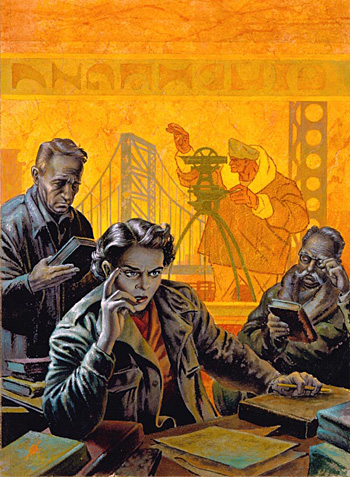
Cover painting [background] is credited to Walter Murch
Cover frieze [ship and grid] credited to Jerry Powell
Therefore—any such function can
be thought of as a space with a dimensionality equal to the number of
independent variables needed. Such
a space is known to mathematical
physicists as a "phase space,” and
can have any old number of dimensions.
Thus, the phase space of a
system of electrons has three dimensions
for each electron involved.
Every point in a phase space defines
a certain state of the system under
consideration.
Ordinary Euclidean 3-space, such
as man once imagined himself to inhabit,
is merely the phase space of
a single rigid body. The only thing
it describes is the position of such a
body. In principle, it doesn’t even
have to be Euclidean.
One of the non-Euclidean spaces
is of particular interest, being that
of the relativistic universe. We might
as well be clear on one point: it is
not legitimate to say that the cosmos
is a Riemannian space. What we
mean is that the theoretical geometric
construct of relativity is Riemannian,
and that there appears to be correspondence
between this "map” and
the structure of physical data.
As everyone knows by now, the
Einsteinian universe is four-dimensional:
besides the usual x, y, and z
co-ordinates, we need a fourth t coordinate
to specify the time of an
event. What is not so well known
is the fact that this t co-ordinate does
not have the same character as the
others. You can transform an x axis
into a y by a simple rotation, but the
transformation of t involves multiplication
by the velocity of light and
the square root of minus one.
From all the foregoing, it should
be plain that the old science-fiction
theme of Invaders from Another
Dimension is pure nonsense. You
might as well speak of Invaders from
Length. In fact, it's precisely as
meaningful to speak of Invaders
from Hunger.
Because actually a dimension is any
measurable quantity in which we
happen to be interested. You can
plot the alcoholic content of beer
against the temperature of fermentation
every bit as readily as you can
plot the position of a bullet against
the time it left the gun. A dimension
can be length, time, weight,
electric charge, cost, birth rate, pie-eating
ability—to borrow an example
from L. Sprague de Camp—or anything
else.
But naturally some dimensions are
a trifle more fundamental than others.
Pie-eating ability can be expressed
as mass consumed per second,
whereas it would get rather complicated
if we defined mass and time in
terms of pie-eating ability.
Newton made clear the distinction
between mass and weight. (Though
some science-fiction writers, whose
heroes have no trouble picking up a
thousand-ton spaceship on a small
asteroid, still haven’t gotten it
through their heads.) Mass appeared
to be a basic quantity, the mass of
an object would be the same anywhere
in the universe. Length seemed
another such fundamental unit, since
area and volume can be expressed as
powers of length. And time could
hardly be questioned in those days;
how would they have defined time
as a function of anything else?
It has been shown that three dimensions
are necessary and sufficient
to describe all the quantities of
physics. The three we have chosen
on Earth are mass, length, and time.
(I pass over the rather difficult question
of temperature.) For instance,
velocity is distance (length) per
unit of time; acceleration is velocity
per unit of time; force is mass times
acceleration; energy (work) is force
times distance … and so on. These
dimensions behave exactly like ordinary
algebraic symbols.
This point must be emphasized if
we are to develop our line of argument.
Let’s abbreviate mass, length,
and time as m, l, t respectively. Then
velocity has the dimensions lt-1(l/t), acceleration
lt-2(l/t2), force mlt-2(m⋅l/t2), energy
ml2t-2(m⋅l2/t2), and so on. (For the benefit of
those whose algebra is even rustier
than mine, a negative exponent indicates
division and a fractional exponent
the root to be extracted.) It is
worthwhile showing a case in which
the dimensions of some quantity are
to be found. How about electric
charge?
In the CGS (electrostatic) system,
the force between two charges in free
space is equal to the product of the
charges divided by the square of the
distance between them. If I may be
permitted an equation, this is
F = q2 / r2
assuming that the two charges are
equal. By simple algebra, then,
q = rF½( q = sqrt(rF))
or, in dimensions, l(mlt-2)½. Working
this out, we see that the coulomb
is m½l3⁄2t-1. In verbal language, a
coulomb is the square root of a gram
times the cube of the square root of
a centimeter, per second—a ghastly
mess, but perfectly unambiguous.
I solemnly swear that the above
are the only equations in this article.
Certain quantities are dimensionless,
e.g., specific heat. This docs not
make them any less real, it only indicates
that they are comparative.
The late Sir Arthur Eddington found
dimensionless quantities which were
algebraic combinations of such natural
constants as Planck's—one of
them, for example, was the ratio of
mass between the electron and proton.
These Eddington numbers are
independent of the units chosen; the
ratio of two masses is the same
whether they be expressed in grams,
pounds, or Martian ziks. He then set
himself the incredible task of deriving
these numbers from a few simple
axioms. His death cut short a work
which might have changed our whole
concept of the nature of the universe,
of logic, and of the human mind.
But that is unfortunately not relevant
here.
The dimensions of some quantities
depend on those chosen for others.
Thus, if we wished, we could make
the gravitational constant a dimensionless
absolute with a value of
unity, but this would require us to
define either mass, length, or force
differently.
This simple case illustrates a surprising
and important fact which has
hardly been noticed by anyone. We
have to choose three fundamental
units, yes, but which three we choose
is, in principle at least, arbitrary.
As a matter of fact, there is already
one set of units which does not take
mass as a starting point. This is the
FPS (foot-pound-second) system of
the English-speaking engineer, in
which the pound is not a mass but a
force. Here on Earth it makes small
practical difference, but out in space,
in free fall, the distinction between
mass, a scalar, and force, a vector,
would rapidly become obvious.
But all this is pretty small potatoes
when we think of the systems which
extraterrestrial scientists might pick.
Mass, length, and time looked
fundamental to our ancestors, and we
are now stuck with them. But a native
of Vega Five might attach more
importance to tire amount of radiation
he is getting per square centimeter
per second, the energy flux,
than to the total amount he receives
in a day. When his giant sun stands
at high noon, the flux might be too
great for him to venture outdoors.
His physicists could well have substituted
energy flux for time—though
from his viewpoint, it’s we who have
switched things around. And come
to think of it, when you travel from
one place to another, it isn’t the distance
you’re primarily interested in,
it’s the energy and time required to
make the trip. In this sense, a round-
about road, well-paved and with
little traffic, is shorter than a straight
but overcrowded highway; you can
go faster and more easily on the first
route. So the Vegans might well imagine
action (energy times time) to
be more important than a mere distance—
an attitude which would pay
off when they got around to developing
quantum theory. As for their
third basic unit … well, suppose
their early scientists happened to find
out more about electrostatics than
mechanics. (This could have happened
in the Hellenistic era of Earth,
but didn't.) They would be inclined
to think of the capacitance of a body
as more important than its mass.
When they eventually figured out
statics and dynamics, they would get
the idea of mass all right, but for
them it would be an auxiliary concept
rather than a basic one.
Or take Hal Clement’s fine novel
"Mission of Gravity.” You remember
that his planet Mesklin was
enormous, flattened out by its terrific
rotational speed, with the force of
gravity radically dependent on the
latitude you happened to be at. In
their prescientific age, the Mesklinites
would have no way of realizing
that mass is constant, but they would
be acutely aware of the changing
force on them as they traveled about.
Under the high gravity of the polar
regions, they could never get up
much speed, but the acceleration of a
falling body would be an important
characteristic of any locality. And
when they began to breed physicists,
the rapid rotation of the planet
would suggest an intensive study of
spinning bodies. It would soon become
clear that the weight and size
of a rotating object were less useful
in predicting its behavior than the
angular momentum.
So let us imagine that the Mesklinites
worked out a physics based on
force, acceleration, and angular momentum.
Let us call these dimensions
f, a, and w respectively. Then let’s
see what their other units would
become.
The accompanying table shows
three systems of dimensions. The
first column represents the CGS system
of Earth. The exponents of
mass, length, and time are shown in
that order. For instance, we read
from the table that torque has the
dimensions ml2t-2
, gram-square centimeter
per second per second, the
same as energy. To find the corresponding
Mesklinite units, set up
their f, a, and w as functions of m,
l, and t, and solve for the latter; then
you can go right down the CGS
column making substitutions to get
the faw column. We find, then, that
on Mesklin torque has the dimensions
f½a½w½, the square root of
force times acceleration times angular
momentum.
Some interesting details show up.
Velocity and acceleration have the
same dimension, a. A Mesklinite understands
the difference between
speed and the rate at which speed is
acquired, but it isn’t a really fundamental
distinction to him. His mass,
length, and time are rather messy
functions of f, a, and w. He would,
of course, have names for such quantities,
just as we speak of "coulombs”
rather than of m½l3⁄2t-1. Electrical
resistance turns out to be dimensionless, a comparative quantity. Planck’s
Constant, as with us, has the dimension
of angular momentum, but the
Mesklinite student would see this at
a glance, while we must have it
pointed out to us. On the other hand,
he would be slower to realize that
one-body capacitance has the dimension
of length.
Earth, Jupiter, Vega Five, Mesklin—in a welter of such conflicting
units, the scientists of an interstellar
civilization would have some trouble
exchanging information. Perhaps
they would get together and try to
work out a universal set of dimensions,
corresponding to qualities they
believe to be genuinely fundamental.
After all, we on Earth can see that
the Vegans and the Mesklinites were
being arbitrary to the point of frivolity;
as for us, Einstein has shown
that mass, length, and time are not
universal constants either but dependent
on the velocity of the observer.
Electric charge would be a good
base point for this new interstellar
system. Energy seems to be quite important
too. And for our third quantity,
how about interval? This is
given bv the square root of X2 plus
Y2 plus Z2 minus c2T2, where X, Y,
and Z are the spatial distances between
two events and T the time
between them. Though X, Y, Z, and
T may all be measured differently by
different observers, the interval is invariant—
the same for all.
The third column of the table
shows an energy-interval-charge
(eiq) system of dimensions. It is not
converted directly from CGS, but
embodies some advantageous features
of MKS. You will note that mass has
the dimension e, which was to be expected,
and velocity is dimensionless,
which reflects well the fact that
velocity is relative. Acceleration
comes out to be i-1 and force is ei-1,
energy per unit of interval. Not bad.
It becomes still more attractive
when we see that the eiq system is
entirely free of those fractional
exponents.
But there’s a catch. Some quantities
which are dimensionless in CGS
acquire dimensions in eiq. Capacitance
and resistance have more complicated
dimensions in eiq than in
CGS.
In short, we have gained little except,
possibly, a neutral system which
would not offend anyone’s planetary
pride. And this is not very surprising,
because we don’t know that e, i,
and q are the building blocks of
the universe.
"Let us carve nature at the joints,"
said Francis Bacon, meaning that we
should adopt definitions and make
distinctions corresponding to real
differences in the physical world. But
nature’s joints turn out to be rather
elusive; in fact, it seems likely that
nature is a seamless unity. We carve
up the universe of phenomena because
that’s the only way our minds
can deal with it. But it is sobering to
think how many supposed fundamentals
exist only in our own heads.
Scroll vertically to see rest of infographic Dragan Radovanovic/Business Insider
Erik Max Francis Planck Units
Artwork by Alex Schomburg
Gee, I wonder what system these units are from? Shuttlecraft control panel from the Star Trek episode "The Galileo Seven" (1967)
Erik Max Francis has created a powerfully compelling measurement system based on fundamental Planck units. Well, in reality he said it was not particularly revolutionary, he just did the multiplication, and actually using it would be extraordinarily silly. But for science-fictional purposes, it is far more scientifically accurate than using centons and yarens.
The system was modified by Sean Williams and Shane Dix for use in their "Orphans" novels.
Planck units are pretty much standard when doing relativity theory, and have been since at least about the 1970's (at least, Misner, Thorne, and Weaver discuss Planck units in their classic textbook "Gravitation").
A related idea is atomic units, where the electric charge, the quantum of action (Planck's constant h-bar) and the electron mass are set equal to unity, creating a system where the fundamental length scale is the Bohr radius of hydrogen and the fundamental energy scale is twice the binding energy of the hydrogen atom in its ground state (I work with these units a lot for my real job). In this system, the speed of light is equal to one over the fine structure constant (c ~ 137, alpha ~ 1/137). It is a very convenient system of units for performing calculations in solid state, condensed matter, and atomic physics.
Luke Campbell
There are five Planck units: Planck length, Planck mass, Planck time, Planck charge and Planck temperature. For his system Mr. Francis only needs the first three.
As an aside, Mr. Francis says:
Another issue that is quietly not mentioned anywhere that I'm aware of is that the Planck constant is not really known to sufficient precision to base a system of units on it.
Erik Max Francis
A measurement system needs a set of fundamental units, from which all the other units can be derived. For his system Mr. Francis used the SI fundamental units: length, mass, time, electric current, thermodynamic temperature, luminous intensity, and amount of substance.
For length, mass, and time units just use the Planck units directly.
For electric current (charge divided by time), use the (unit independent) magnitude of the charge on an electron for charge, and Planck time for time.
For thermodynamic temperature, it can be derived with the Boltzmann constant. The Boltzmann constant is equal to energy divided by temperature, so simple algebra will give you the equation: temperature equals energy divided by Boltzmann constant. For the energy unit see below.
And for amount of substance, this isn't a strictly derivable unit. Mr. Francis proposes to replace the unit with the actual number of atoms (e.g., instead of one mole, just use Avogadro's number 6.02 x 10²³.)
Again, for details about the units derived from the fundamental units, refer to the essay. Any unit not defined is left as an exercise for the reader.
Mr. Francis doesn't approve of such alternate metrification in principle. He is, however, quick to say that he is not talking about Sean Williams and Shane Dix. What he is annoyed at is some people who want to actually propose alternate second-minute-hour-type systems to replace the existing SI unit system in the real world (which of course, is not at all what Mr. Williams and Mr. Dix were doing).
It's a weird mishmash of the raw Planck units — which are essentially so awkward as to be totally unusable — and a reformulation of different (non-metric) multiples of "new" units like "new hours" in order to refit them into roles that are vaguely like what the old ones were, but with the values slightly different so that they're metric... but not really.
For instance, there are 100 new seconds in a new minute, 100 new minutes in a new hour, 20 new hours in a new day, 5 new days in a new week, 6 new weeks in a new month, and 10 new months in a new year. The whole point of a metric system is that the ratios are powers of ten, and especially when you're dealing with modern metric systems like SI, a primary goal is that the unit system is coherent, meaning that the conversion factors between different units are unity.
More generally, I very strongly believe that any alternative unit system should not reference old names for non-metric divisions like "hour." This will only lead to confusion, and without much use. If you're talking about time systems in other local environments where the days and years are of different lengths, then this adds a new layer of confusion because now you have to figure out whether they mean Earth hours or Epsilon Eridani IV hours.
Note that this isn't quite even academic. It has been proposed from time to time in the United States to assist with metrication that maybe we should reformulate the old units in relatively even ratios of metric units, to get people used to the switch. So for instance, 1 kg = 2.2 lb, so make 1 "new pound" = 0.5 kg. That way people can get used to the idea of using metric without the pain, right? That has to be just about the dumbest idea for metrication I've ever heard of: confusingly changing units for the supposed purpose of helping them learn a new unit system, but then making them learn the new unit system later. I guess it's a two-for-the-price-of-one type of deal. Instead, just learn the new unit system and be done with it. (Note that, as an American, I was part of the generation that was vigorously exposed to the metric system when I was young and totally bought into it. Then the rest of the country kind of got bored and forgot about it.)
Truth be told, I think the executive summary is that having a coherent, metric system of units with reasonable base units for a wide range of endeavors is the goal. And we already have that in SI. Any modifications to that system seem to be only to be done for flair and not for any good purpose. Not that (15 pieces of) flair is a bad thing, but often, it seems, when people come up with neat alternative unit systems for the sole purpose of coming up with neat alternative unit systems, they kind of miss the point and makes ones that are qualitatively worse than SI.
Erik Max Francis
Fundamental Units
Quantity
Symbol
Value
Planck mass
mP
2.177 x 10⁻⁸ kg
Planck length
lP
1.616 x 10⁻³⁵ m
Planck time
tP
5.391 x 10-44 s
length
L
1.616 x 10⁻³⁵ m
mass
M
2.177 x 10⁻⁸ kg
time
T
5.391 x 10-44 s
current
C == e/T
2.972 x 1024 A
temperature
E == M L2 T -2/k
1.415 x 1032 K
plane angle
rad
1 rad
solid angle
sr
1 sr
Mechanical Units
Quantity
Symbol
Value
force
M L T -2
1.210 x 1044 N
energy
M L2 T -2
1.956 x 10⁹ J
power
M L2 T -3
3.629 x 1052 W
frequency
T -1
1.855 x 1043 Hz
pressure
M L-1 T -2
4.635 x 10113 Pa (yikes!)
Radiation Units
Quantity
Symbol
Value
activity
T -1
1.855 x 1043 Bq
absorbed dose
M L2 T -2 E-1
1.382 x 10⁻²³ Gy
dose equivalent
M L2 T -2 E-1
1.382 x 10⁻²³ Sv
Electromagnetic Units
Quantity
Symbol
Value
capacitance
M-1 L-2 T4 C2
1.312 x 10-47 F
charge
T C
1.602 x 10⁻¹⁹ C
electric conductance
M-1 L-2 T3 C2
2.434 x 10⁻⁴ S
inductance
M L2 T -2 C-2
2.215 x 10-40 H
magnetic flux
M L2 T -2 C-1
6.582 x 10⁻¹⁶ Wb
magnetic flux density
M T -2 C-1
2.520 x 1054 T
resistance
M L2 T -3 C-2
4.108 x 10³ Ω
voltage
M L2 T -3 C-1
1.221 x 1028 V
Williams-Dix Planck Units
Artwork by Chris Moore
Adjusted Plank Units
Quantity
Value
Mass
2.177 kg
Length
1.616 m
Time
0.5391 s
As previously mentioned, this system was adapted by Sean Williams and Shane Dix for their "Orphans" novels. The authors state that they have adapted Mr. Francis' ideas to suit their needs, and any errors introduced in the process are theirs.
Sean Williams and Shane Dix postulate the new system was adopted in the wake of even more disasters like the Mars Climate Orbiter fiasco. That was caused due to the fact that Lockheed Martin used English units while NASA (like the rest of the civilized world) uses Metric units. Everybody just assumed they were all using the same units, and didn't discover differently until the probe ricocheted off the Martian atmosphere. This sent the probe off into oblivion and $125 million dollars down the drain.
In the novels, Mr. Francis's system is modified somewhat. The Planck units are fundamental, but have exceedingly inconvenient sizes. One inch is about 157 billion quadrillion quadrillion Planck meters, an average person masses almost three trillion Planck kilograms, one hour is equal to about a trillion quadrillion quadrillion quadrillion Planck minutes.
So they scaled the Planck units, multiplying them by 1043. This makes the units more human sized.
Time
Diagram from Echoes of Earth
The time units were fiddled with so they
were vaguely the same as the old units
used Adjusted Planck time units and
were more or less decimal
Hours and minutes were divided into 100 sub-units. The day was split into two ten-hour halves: practical but not too unlike the old. And ten months of six five-day weeks gives one great flexibility when scheduling rosters and planning. From Echoes of Earth:
Adjusted Plank Time Units
Unit
Size
Conventional Equivalence
1 new second
0.54 old second
1 new minute
100 new seconds
0.90 old minute 54 old seconds)
1 new hour
100 new minutes
1.5 old hours (90 old minutes)
1 new day
20 new hours
1.2 old days (30 old hours)
1 new week
5 new days
0.89 old week (6.2 old days)
1 new month
6 new weeks
1.2 old months (5.3 old weeks)
1 new year
10 new months
1.025 old years (12 old months)
Distance
Diagram from Echoes of Earth
The distance units were chosen to be sort of a compromise between the old Metric and the old English units, since in the novel the US was still stubbornly and idiotically sticking to English. The new centimeter was between the old centimeter and the inch. The old mile and the old gallon was very close to the new kilometer and new liter.
Adjusted Plank Distance Units
Unit
Size
Conventional Equivalence
1 new centimeter
1.6 old cm, or 0.64 inches
1 new decimeter
10 new cm
6.5 inches
1 new meter
10 new dm
1.6 old m, or 3.3 feet
3 new meters
10 feet
1 new kilometer
1000 new meters
0.97 mile
1 new hectare
2.6 old hectares
6.4 acres
1 new liter (dm3)
4.2 old liters
1.1 gallons
Mass
The jingle in the US was "five old pounds equal one new kilogram".
Adjusted Plank Mass Units
Unit
Size
Conventional Equivalence
1 new g
2.2 old g
1 new kg
1000 new g
4.8 old pounds
1 new tonne
1000 new kg
2.1 old tons
1 new ampere
2.972 old ampere
Temperature
Adjusted Plank Temperature Conversions
Unit
Centigrade
Fahrenheit
Kelvin
1°
1.415° (misprint?)
2.563°
1.415°
0°
-273.15°
-459.67°
0° (absolute zero)
193°
0°
32°
273.15° (freezing point H2O)
264°
100°
212°
373.15° (boiling point H2O)
Constants
Many commonly used constants have simple values when expressed in Adjusted Planck Units.
Adjusted Plank Temperature Conversions
Quantity
Value
c (the speed of light)
1.00 x 10⁸ ms-1
1 light-year
6.00 x 10¹⁵ m
1 light-hour
1.00 x 10¹¹ m
1 parsec
2.0 x 10¹⁶ m
1 g
1.0 light-year/year2
1 solar radius
430000 km
1 Earth radius
4000 km (equatorial)
geostationary orbit
22220 km (Earth)
Conversion Factors
The following conversion factors will convert from the old International System of Units to the new Adjusted Planck Standard International Units.
Conversion Factors
Value
Unit
Factor
Velocity
m/s1
0.334
Acceleration
m/s2
1.76
Density
g/cm3
1.92
Pressure
Pa
0.216
Force
N
0.0818
Energy
J
0.0506
Frequency
Hz
1.86
Resistance
Ω
0.241
Voltage
V
0.0811
Natural Units
Natural units are physical units of measurement based only on universal physical constants, with each set to a value of 1. The Planck system is such a system.
While such a system may seem pedantic, it has applications to communicating with extraterrestrials. They ain't gonna use the metric system, that's for sure. For instance, the metre is defined as the distance traveled by light during a time interval of 1/299,792,458 second. That weird number is based on 1,650,763.73 wavelengths of the orange-red emission line of krypton-86. Which was based on the length of a physical prototype metre bar. Which was based a distance equal to one ten-millionth of the distance between the North Pole and the Equator.
The point being that an alien species is not going to be living on a planet with precisely the same size as Terra, and even if they did 1/ten-millionth is probably not a special number in whatever radix they use.
Natural units on the other hand are much more universal.
NATURAL UNITS
In physics, natural units are physical units of measurement based only on universal physical constants. For example, the elementary chargee is a natural unit of electric charge, and the speed of lightc is a natural unit of speed. A purely natural system of units has all of its units defined in this way, and usually such that the numerical values of the selected physical constants in terms of these units are exactly dimensionless 1. These constants are then typically omitted from mathematical expressions of physical laws, and while this has the apparent advantage of simplicity, it may entail a loss of clarity due to the loss of information for dimensional analysis. It precludes the interpretation of an expression in terms of fundamental physical constants, such e and c, unless it is known which units (in dimensionful units) the expression is supposed to have. In this case, the reinsertion of the correct powers of e, c, etc., can be uniquely determined.
1 BED is equal to 0.1 µSievert (or 10-7 Sv). This is the amount of radiation a person is exposed to by eating one average-sized banana, due to the naturally occuring potassium-40. There is a helpful chart here relating various types of radiation exposure to banana eating.
1 Elephant is a rocket propellant mass flow rate of 5,000 kilograms per second, where 5,000 kg is the mass of an average elephant. So a Saturn V rocket at lift-off is expending about 3 elephants per second. Unit was proposed by Maxim Sachs and refined by Kyle Hill.
Amount of facial beauty required to launch one-thousand ships. Therefore 1 milli-Helen is the amount of beauty required to launch one ship. Negative Helens are the amount of facial ugliness required to beach ships. This has been denounced as incorrect usage, since it is forbiddent to use metric prefixes with Troy-units.
Hummingbird
Unit of thrust equal to 0.05 Newtons, approximate amount of thrust generated by an average hummingbird. Useful for measuring the disappointing thrust levels of ion drives and other low-thrust/high-specific-impulse propulsion systems. For instance the NSTAR ion drive used by the DAWN mission had a thrust of about 1.8 hummingbirds. Invented by RocketCat.
Unit measuring life expectancy. One microlife is half an hour change of life expectancy. Smoking 15–24 cigarettes gives males -10 microlife and females -9. Fives servings of fruit and vegetables give males +4 microlife and females +3. Microlife scale assumes an average life expectancy of 57 years (1,000,000 half hours).
Mort
Unit measuring risk of death. One micromort is a one-in-a-million chance of death. Invented by Ronald A. Howard
Sagan-
Prefix meaning "a large number" or "Billions and Billions". At least four billion (two billion plus two billion).
Snail
Unit of acceleration equal to 0.008 meters/sec2, approximate amount of acceleration generated by an average snail. For instance the DAWN mission had an initial acceleration of about 0.00837 snails. Invented by RocketCat.
Train Wreck (TW)
A measure of impulsive acceleration equal to an inertial acceleration of 40 g. A human being can survive a 1 TW impulse lasting no more than a couple of seconds, while a 2 TW impulse of longer than a second is typically fatal. Invented by Wil McCarthy in The Wellstone


If ya gonna write about hard-science topics, use the freaking Metric system fer cryin' out loud. If the logic of using the measurement system of science when writing about science escapes you, well, perhaps you are in the wrong line of work. And you are probably not getting much use out of this website either.