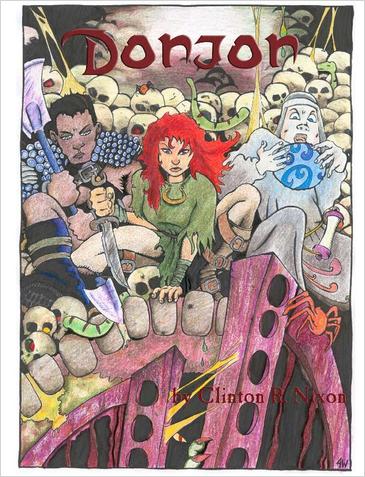

The blurb for Donjon says:
Do you remember the first time you played a fantasy RPG? I played an elf, and didn't know anything about the system, but just imagined it all in my head. I was so amazed that I could choose to do anything I wanted to. Donjon is all about that - recapturing that sense of wonder and running with it.
The way it accomplishes this is with an innovative game technique that turns things on their head.
Remember the old parlor game Twenty Questions? The player leaves the room and the rest of the people choose an item for the player to guess. When they return, the player has only twenty questions with which to determine the item.
Sometimes the player returns to find the rest of the people grinning. As the questions are asked, the people have to think about their answers. When the player guesses the item, they are let in on the joke.
The other people made a pact. No item was chosen. Instead, when the player asks a question, the answerer can randomly reply with "yes" or "no", as long as their answer does not contradict any of the previous answers. So at the end, when the item is determined, it is as much a surprise to the rest of the people as it is to the player.
This is sort of like a game version of Schrödinger's cat, the game item does not have an actual existence until it is defined by observation.
This is like Dunjon.
In most other RPGs, the game master carefully draws maps, creates non-player characters, and generates plot twists. They do none of that in Donjon. It's in the hands of the players.
Say the intrepid party of player-characters surprise and defeat a troll. If Thud the barbarian wants a +3 sword of chainsaw massacre, Thud's player is not at the mercy of the game master. Instead, Thud's player just announces that "I'm looking for a +3 sword of chainsaw massacre" and rolls the dice. If they make their roll, well, lo and behold there is the sword buried in the troll's treasure horde.
There are controlling rules (for instance, it is easier make the roll to find said sword in a dragon's horde compared to finding it in the horde of a were-hampster) but you see how some of the power of the game master is now in the hands of the players.
See the Schrödinger's cat effect? A player announces that they are looking for a secret door. If they make their roll, a secret door is found regardless of whether the game master put one there or not. It is sort of like those automatic dungeon generation rules, but the game master is not totally powerless. The players cannot create all the details of what was found, the game master can add more. Like a poison needle trap on the secret door, or Something Awful lurking on the other side.
Using the rules, the players can create entire encounters without any cooperation from the game master. But the master has the ability to tweak the encounter to make it more interesting.
You can find more details by reading this review.